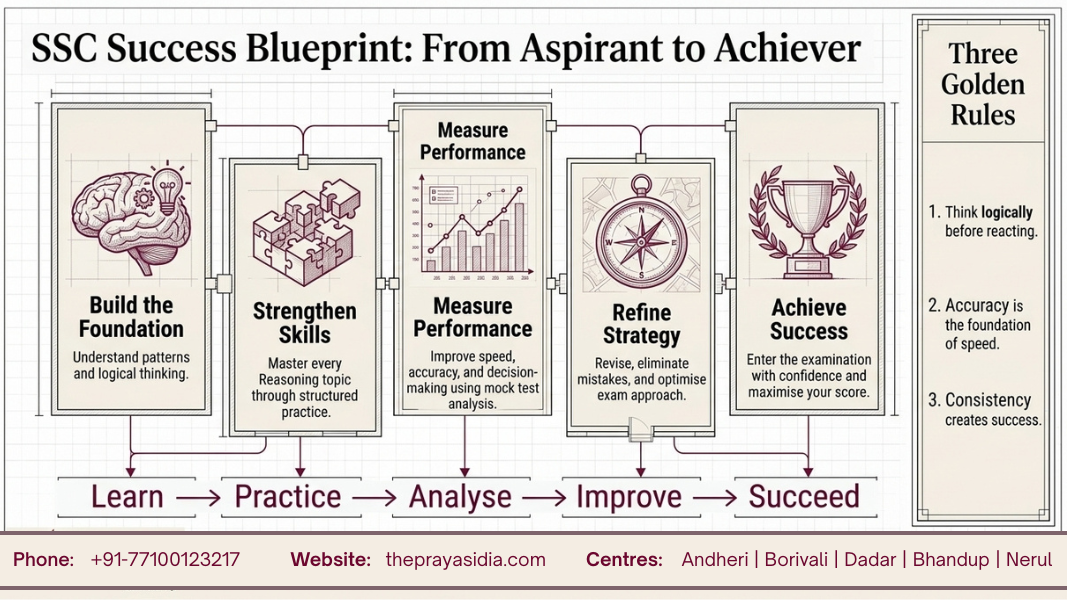
How to Master General Intelligence and Reasoning for SSC | Best SSC Coaching in Mumbai | The Prayas India
The Section That Doesn’t Test Intelligence—It Tests How You Think
Every year, thousands of SSC aspirants begin their preparation with a similar assumption. Mathematics needs formulas. English demands vocabulary. General Awareness requires endless reading. But General Intelligence & Reasoning? Most believe it depends on natural intelligence.
That belief quietly becomes the biggest obstacle in preparation.
Students often describe Reasoning as the most unpredictable section of the SSC examination. Some questions appear unbelievably easy, while others seem impossible to solve within the limited time available. A candidate who performs exceptionally well in practice may suddenly struggle during the actual examination, whereas another candidate finishes the section with remarkable speed and accuracy.
The difference rarely lies in intelligence.
It lies in understanding how the brain processes patterns under pressure.
General Intelligence & Reasoning is not a memory-based subject. It is not about how much information you can store. Instead, it measures your ability to observe relationships, recognize structures, eliminate distractions, and make logical decisions within seconds.
That is why students who prepare strategically often improve much faster than those who simply solve hundreds of random questions every day.
Before opening any Reasoning book or attempting your first mock test, it is worth asking a simple question:
What exactly is the SSC trying to evaluate?
The answer changes the entire approach to preparation.
Beyond IQ: Understanding the Real Purpose of Reasoning
Imagine walking into a room where every object has been rearranged. You instantly notice that something feels different. Nobody taught you this skill through textbooks. Your mind naturally compares patterns, detects changes, and reaches conclusions.
Reasoning works in a similar way.
The SSC examination does not expect candidates to invent complex solutions. Instead, it evaluates how efficiently they can identify hidden relationships among letters, numbers, symbols, shapes, or statements.
This explains why two students studying from the same book may achieve completely different scores.
One student memorizes shortcuts.
The other learns to identify patterns.
When the exam introduces a slightly unfamiliar question, memorized methods often fail. Pattern recognition, however, adapts naturally.
That is why experienced aspirants gradually stop asking,
“What is the formula?”
Instead, they begin asking,
“What is the examiner trying to make me notice?”
That small shift in thinking creates remarkable improvements over time.
Key Takeaways
- Reasoning is a skill, not an inherited talent.
- Pattern recognition matters more than memorization.
- Every question follows a logical structure.
- Faster thinking develops through repeated exposure to patterns.
- Understanding the examiner’s mindset is often more valuable than learning shortcuts.
A Familiar Story Seen Every SSC Season
Visit any coaching library a few weeks after SSC preparation begins, and you’ll notice two very different kinds of students.
The first group spends hours solving question after question without reviewing mistakes. Their notebooks fill quickly, but improvement remains slow.
The second group solves fewer questions.
Yet they pause after every mistake.
They ask themselves:
- Why did I choose the wrong option?
- Which clue did I overlook?
- Was I rushing?
- Did I misunderstand the pattern?
- Could this question have been solved differently?
At first glance, the second student appears slower.
A few months later, the same student often begins completing Reasoning sections several minutes earlier than everyone else.
The reason is simple.
Effective preparation is not measured by the number of questions solved.
It is measured by the number of thinking errors corrected.
The Biggest Myths That Hold Aspirants Back
Many SSC candidates unknowingly carry beliefs that make Reasoning seem much harder than it actually is.
Let’s separate assumption from reality.
Myth 1: “I’m not naturally good at reasoning.”
Students often compare themselves with friends who solve questions quickly.
Speed, however, is usually the result of repeated exposure rather than exceptional intelligence.
The more patterns you encounter, the faster your brain begins recognizing them.
Myth 2: “More practice automatically means higher marks.”
Practice certainly matters.
But solving 500 questions without analysing mistakes is far less effective than carefully reviewing 100 questions and understanding every error.
Quality consistently outweighs quantity.
Myth 3: “Every question needs a shortcut.”
Shortcuts are useful only after the underlying logic becomes clear.
Without conceptual understanding, shortcuts become confusing during unfamiliar questions.
Top performers first master the reasoning behind a pattern.
Only then do they optimise speed.
Myth 4: “Reasoning can be prepared at the end.”
Unlike factual subjects, reasoning develops gradually.
Your brain needs time to become comfortable with recurring patterns.
Delaying preparation often means rushing through a skill that requires consistency.
Reality Check
If Reasoning truly depended only on natural intelligence, the same students would top every competitive examination every year.
That doesn’t happen.
Every SSC cycle introduces new toppers.
Many begin with average scores.
What changes is not their intelligence.
It is their approach.
Thinking Like an Examiner
Every Reasoning question is designed with a purpose.
The examiner isn’t trying to confuse candidates randomly.
Instead, each question tests whether you can:
- Observe carefully before reacting.
- Ignore unnecessary information.
- Recognise hidden relationships.
- Stay calm while working under time pressure.
- Reach conclusions using logic rather than assumptions.
Students who understand this philosophy stop fearing unfamiliar questions.
Even when they haven’t seen an identical problem before, they know how to break it into smaller logical steps.
That confidence becomes one of the strongest advantages in the examination hall.
One Habit That Quietly Changes Everything
Successful SSC aspirants gradually develop a simple habit.
Instead of celebrating correct answers, they become curious about incorrect ones.
Every mistake becomes feedback.
Every confusing question becomes an opportunity to discover a new pattern.
Over weeks and months, this habit rewires the way they approach Reasoning itself.
The section no longer feels like a collection of unrelated puzzles.
It begins to feel like a language—one that becomes easier every time you practise it with understanding instead of urgency.
From Confusion to Clarity: Building the Mind of a Strong Reasoning Candidate
Most students believe that improvement in Reasoning happens suddenly.
One day they struggle to solve a puzzle. A few weeks later, they are solving similar questions effortlessly. From the outside, it looks like a dramatic transformation.
In reality, the improvement is gradual.
The brain does not become faster overnight. It becomes more efficient at recognising familiar structures.
Think about learning to ride a bicycle. In the beginning, every movement demands conscious effort—balance, direction, speed, and braking. After enough practice, these actions become automatic.
Reasoning follows the same principle.
Initially, every question appears different. Coding-Decoding looks unrelated to Blood Relations. Alphabet Series seems completely separate from Syllogism.
But after consistent practice, your brain begins identifying recurring frameworks.
Instead of seeing hundreds of individual questions, you start recognising a handful of logical patterns.
That is the moment when confidence begins to replace confusion.
The Pattern Recognition Advantage
High scorers in SSC Reasoning rarely read every question from beginning to end with the same level of attention.
Instead, they immediately search for clues.
A few keywords are often enough to identify the nature of the problem.
For example:
- Certain letter arrangements instantly signal a Coding-Decoding question.
- Relationship-based statements point towards Blood Relations.
- Position-based information hints at Ranking or Seating Arrangement.
- Sequential changes indicate a Series question.
This ability is not luck.
It is the result of repeatedly exposing the mind to different question formats until recognition becomes almost automatic.
Expert Insight
Imagine entering a supermarket for the first time.
Finding one product may take several minutes.
Visit the same store every week, and eventually you know exactly where everything is.
The store hasn’t changed.
Your mental map has.
Reasoning develops in exactly the same way.
When Practice Stops Helping
Many aspirants reach a stage where they solve dozens of questions daily, yet their scores remain almost unchanged.
This situation is surprisingly common.
The reason?
They have entered what psychologists call the comfort zone of repetition.
They continue solving only the questions they already know how to solve.
Difficult question types are skipped.
Mistakes are ignored.
Weak chapters remain untouched.
As a result, practice becomes routine instead of productive.
Real improvement begins only when students deliberately spend time on uncomfortable areas.
That doesn’t mean attempting the hardest puzzles on Day One.
It means identifying weaknesses early and working on them patiently.
Quick Reflection
Ask yourself these questions honestly:
- Which chapter do I avoid during practice?
- Which questions make me guess instead of think?
- Where do I lose the most time?
- Which mistakes appear repeatedly in my mock tests?
Your answers reveal the real starting point of improvement.
Preparation Isn’t Just About Solving Questions
There is a common misunderstanding among SSC aspirants.
They assume that preparation starts after opening a practice book.
In reality, effective preparation begins much earlier—with observation.
Whenever you solve a question, try noticing more than just the correct answer.
Observe:
- Why was one option tempting?
- Which information was actually useful?
- Which sentence could have been ignored?
- What pattern appeared before the solution became obvious?
This habit trains analytical thinking.
Over time, you stop reacting impulsively and begin approaching every question with structure.
That is precisely what the SSC examination rewards.
The Invisible Skills That Matter Most
Every Reasoning chapter appears different on paper, but underneath, they all depend on a few core thinking abilities.
Strengthening these abilities automatically improves performance across multiple topics.
Essential Thinking Skills
Observation
Notice every clue before drawing conclusions.
Comparison
Look for similarities, differences, and relationships.
Elimination
Remove impossible options before searching for the correct one.
Sequencing
Understand the order in which information appears.
Verification
Double-check assumptions before marking the answer.
Students who consciously practise these five skills often improve faster than those who focus only on completing question sets.
Small Habits, Big Difference
Preparation is shaped by daily habits far more than occasional marathon study sessions.
Consider the difference between these two students.
Student A
- Solves 150 questions every Sunday.
- Does very little during the rest of the week.
Student B
- Solves 30 carefully selected questions every day.
- Reviews every mistake.
- Revisits difficult concepts regularly.
After three months, Student B usually performs significantly better.
Consistency strengthens pattern recognition far more effectively than irregular bursts of practice.
Mini Checklist: Healthy Reasoning Habits
- Practice every day, even if only for a short session.
- Focus on understanding before increasing speed.
- Maintain a notebook of recurring mistakes.
- Revisit solved questions after a few days.
- Challenge yourself with new question patterns regularly.
A Different Way to Measure Progress
Most aspirants judge their preparation using only one number—the total marks scored.
But marks alone rarely tell the complete story.
A better approach is to monitor improvement through multiple indicators.
Track whether:
- You recognise question types faster.
- Your average solving time is reducing.
- You make fewer careless mistakes.
- You feel less anxious while attempting unfamiliar questions.
- Your confidence remains steady during mock tests.
These changes often appear before a noticeable increase in marks.
Recognising them keeps motivation realistic and sustainable.
Where Guidance Makes the Difference
Every serious aspirant eventually reaches a point where self-study alone is no longer enough.
Not because the syllabus becomes impossible, but because identifying one’s own blind spots becomes difficult.
This is where structured mentorship plays an important role.
A good coaching environment does not simply provide classes.
It helps students understand:
- Which topics deserve immediate attention.
- Which mistakes are affecting scores repeatedly.
- How to approach mock test analysis.
- How to develop an exam-ready mindset instead of only completing the syllabus.
At The Prayas India, this philosophy is reflected in the way SSC preparation is designed. Rather than encouraging endless practice without direction, the focus remains on building conceptual clarity, improving decision-making, and helping students develop the confidence to tackle unfamiliar questions with logic. Carefully planned classroom sessions, structured practice, realistic mock tests, and personalised guidance create an environment where improvement becomes measurable and consistent.
The objective is simple: prepare students not just to solve Reasoning questions, but to think like successful SSC candidates.
Closing Thought
General Intelligence & Reasoning is often misunderstood because it looks unpredictable.
In reality, it is one of the most learnable sections of the SSC examination.
Every puzzle, every series, every analogy, and every logical problem follows a pattern.
Once you learn to recognise those patterns, the section becomes less intimidating and far more rewarding.
The journey does not begin with shortcuts.
It begins with changing the way you think.
That shift transforms preparation from mechanical practice into meaningful learning.
And once that foundation is built, mastering individual topics becomes significantly easier.
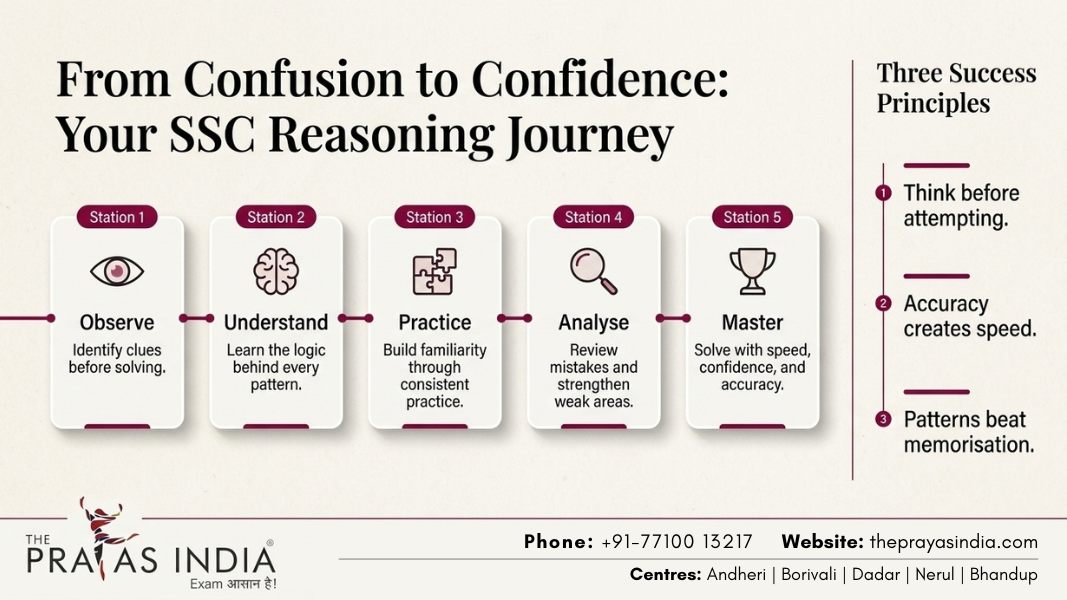
Mastering the Logic Behind Every SSC Reasoning Question
Winning the Section Starts with Thinking Like a Problem Solver, Not a Shortcut Collector
By the time most aspirants become comfortable with the basics of Reasoning, they face a new challenge. The questions no longer appear confusing, but completing them accurately within the time limit feels difficult. This is where preparation often takes the wrong turn.
Many students start collecting shortcut tricks from YouTube videos, Telegram channels, or handwritten notes. While these tricks may seem impressive, they often work only for specific question patterns. The SSC examination, however, is designed to reward adaptability rather than memorization.
Top performers rarely depend entirely on shortcuts. Instead, they understand the underlying logic so well that even unfamiliar questions appear manageable.
Each chapter in General Intelligence & Reasoning follows a pattern. Once that pattern becomes familiar, solving questions becomes significantly easier. The objective is not to memorize answers but to train your mind to recognize how the examiner has constructed the question.
In this section, we’ll explore the most frequently asked topics and understand how successful candidates approach them differently.
Coding-Decoding: Don’t Memorize Codes, Understand the Language
At first glance, Coding-Decoding questions seem random. Letters become numbers, words transform into symbols, and familiar sequences suddenly look unfamiliar.
The mistake many students make is trying to remember different coding methods separately.
Instead, imagine every Coding-Decoding question as a language puzzle. The examiner is giving you a rule. Your job is simply to discover that rule.
Some questions involve:
- Letter shifting
- Reverse alphabet positions
- Numerical values
- Symbol replacement
- Word transformation
- Mixed coding patterns
Rather than rushing toward the answer, spend the first few seconds identifying the rule.
Those few seconds often save much more time later.
How Toppers Approach Coding-Decoding
Instead of guessing, they follow a sequence:
- Read carefully.
- Identify the coding pattern.
- Verify the rule with another example.
- Apply it to the required question.
- Recheck before marking.
This systematic approach reduces careless mistakes significantly.
Quick Tips
- Never assume the first pattern you notice is correct.
- Verify every coding rule with at least one additional example.
- Keep reverse alphabet positions (A=26, B=25…) fresh in memory.
- Practice different coding styles instead of repeating identical questions.
Common Errors
- Ignoring one letter while decoding.
- Forgetting reverse alphabetical logic.
- Solving too quickly without verifying the pattern.
- Mixing multiple coding rules.
Analogy: Finding Relationships, Not Similarities
Many students believe Analogy questions test vocabulary or general knowledge.
In reality, they test relationships.
The examiner wants to know whether you can identify why two objects are connected before finding another pair with the same connection.
Consider this approach.
Instead of asking,
“How are these two words similar?”
Ask,
“What relationship exists between them?”
That single question changes your thinking completely.
Relationships may involve:
- Function
- Cause and effect
- Part and whole
- Classification
- Synonyms
- Opposites
- Degree
- Sequence
The better you identify relationships, the faster Analogies become.
Expert Strategy
Never look directly at the options.
First define the relationship in your own words.
Only then compare the answer choices.
This prevents confusion when multiple options appear similar.
Mini Checklist
Before marking your answer:
- Did I identify the exact relationship?
- Does the option follow the same relationship?
- Is there another option that seems similar but actually represents a different connection?
Series: Learning to Predict the Next Move
Series questions are among the highest-scoring topics in SSC examinations because they reward observation more than calculation.
Students often panic because they search for only one pattern.
Experienced candidates know that multiple patterns may exist simultaneously.
A Number Series, for example, might involve:
- Addition
- Subtraction
- Multiplication
- Division
- Alternate operations
- Square numbers
- Cube numbers
- Prime numbers
- Difference patterns
Similarly, Alphabet Series may include:
- Forward movement
- Backward movement
- Alternate letters
- Skip patterns
- Position shifts
- Reverse sequences
The objective isn’t to memorize hundreds of series.
It is to develop the habit of asking structured questions.
Questions Toppers Ask
- Is the sequence increasing?
- Is it decreasing?
- Are alternate terms connected?
- Is there a repeating cycle?
- Is alphabetical position involved?
- Is more than one pattern working together?
These questions help narrow the possibilities quickly.
Quick Tips
- Observe before calculating.
- Look for alternate patterns first.
- Compare differences between consecutive numbers.
- Check whether the sequence repeats after fixed intervals.
Common Mistakes
- Applying complicated formulas immediately.
- Ignoring alternate positions.
- Missing obvious arithmetic operations.
- Rushing after identifying only half the pattern.
Alphabet-Based Questions: Small Topic, Easy Marks
Alphabet questions appear simple, yet they account for a surprising number of mistakes in SSC examinations.
The reason is straightforward.
Students rely on memory instead of structured thinking.
Whether the question involves alphabetical order, letter positions, word arrangement, or missing characters, maintaining clarity is more important than speed.
One practical habit can make a noticeable difference.
Spend a few minutes each week revising alphabetical positions until they become instinctive.
Knowing instantly that:
- A = 1
- M = 13
- Z = 26
—and their reverse positions—eliminates unnecessary calculations during the examination.
Practical Strategy
Instead of memorizing isolated tricks, classify Alphabet questions into categories:
- Position-based
- Arrangement-based
- Missing letter patterns
- Dictionary order
- Reverse order
- Pair formation
Once categorized, each question feels familiar rather than intimidating.
The Difference Between Average Aspirants and High Scorers
One of the biggest differences isn’t intelligence.
It is decision-making.
Average candidates attempt every question with the same approach.
Top scorers adapt.
They immediately recognize:
- Which questions are direct.
- Which require deeper thinking.
- Which should be skipped temporarily.
- Which deserve a second look later.
This ability saves valuable time during the examination.
Instead of fighting difficult questions early, they collect easier marks first and return with a calmer mind.
That simple adjustment often improves both speed and accuracy.
Quick Revision Box
Remember These Principles
- Understand patterns before shortcuts.
- Verify coding rules before solving.
- Identify relationships in Analogies.
- Search systematically in Series questions.
- Categorize Alphabet problems.
Accuracy creates speed—not the other way around.
When Logic Meets Pressure: Solving Complex Reasoning Questions with Confidence
As you move deeper into SSC Reasoning, you’ll notice that the nature of questions begins to change. Instead of identifying a single pattern, you are now required to connect multiple pieces of information before arriving at the answer.
This is where many aspirants lose confidence.
The questions are not necessarily difficult—they simply demand patience, structured thinking, and the ability to avoid assumptions.
Successful candidates understand one important principle:
Complex questions are solved one step at a time, not all at once.
Rather than trying to visualize the complete solution immediately, they break every problem into smaller logical blocks. This approach reduces confusion, improves accuracy, and saves valuable time during the examination.
Let’s explore how to approach these high-scoring topics like a topper.
Blood Relations: Draw It, Don’t Imagine It
Blood Relation questions often look lengthy because they describe several family members in a single statement. Many students attempt to solve them mentally, only to get confused midway.
The smarter approach is surprisingly simple.
Create a quick family tree.
A rough diagram drawn in a few seconds is far more reliable than trying to remember every relationship in your mind.
For example, instead of repeatedly reading a statement like “A is the sister of B, whose father is C…”, convert it into a simple visual structure. Once the relationships are mapped, the answer usually becomes obvious.
How Toppers Solve Blood Relations
- Read the statement once without solving.
- Identify the central person.
- Draw a quick family tree using symbols.
- Add relationships one by one.
- Verify the final relationship before marking the answer.
Common Errors
- Assuming gender without confirmation.
- Ignoring words like only, either, or neither.
- Solving mentally instead of drawing a diagram.
- Missing one relationship while reading quickly.
Quick Tip
Use symbols such as:
- ♂ Male
- ♀ Female
- ─ Marriage
- │ Parent–Child
A five-second sketch can save a minute of confusion.
Syllogism: Trust the Statements, Not Your Experience
Syllogism is one of the most misunderstood chapters because students often mix real-world knowledge with logical statements.
Consider this example:
- All apples are books.
- Some books are chairs.
It sounds absurd.
But SSC is not testing reality.
It is testing whether you can draw conclusions only from the given statements.
This is where discipline matters.
Forget everything you already know and treat every statement as true within the context of the question.
Expert Strategy
Read the statements exactly as they are.
Do not add extra information.
Do not assume missing relationships.
Accept only what is explicitly given.
Mini Checklist
Before selecting an answer, ask yourself:
- Is this conclusion directly supported?
- Am I assuming something that isn’t stated?
- Have I confused “Some” with “All”?
- Did I rely on real-world knowledge?
Common Mistakes
- Making assumptions.
- Ignoring the meaning of “Only.”
- Confusing possibility with certainty.
- Reading conclusions before understanding statements.
Direction Sense: Turn Information into Movement
Direction Sense questions become easier when you imagine movement instead of reading words.
Many students repeatedly reread the question.
High scorers convert every instruction into a visual path.
For example:
- Face North.
- Move 10 metres.
- Turn right.
- Move 5 metres.
Instead of memorizing the sequence, quickly sketch arrows.
North ↑
East →
South ↓
West ←
The diagram instantly reduces mental load.
Quick Tips
- Always mark the starting point.
- Draw every turn immediately.
- Don’t calculate distances until movement is complete.
- Recheck the final direction before answering.
Ranking & Order: Organise Before You Solve
Ranking questions test your ability to arrange people or objects based on position.
Students often become confused because they try solving while reading.
Instead, create a simple list.
Example:
1
2
3
4
5
Fill the positions gradually as information becomes available.
If any position is uncertain, leave it blank and continue.
The missing pieces often become clear as additional clues appear.
Common Errors
- Mixing left and right positions.
- Forgetting ascending or descending order.
- Assuming consecutive positions.
- Rearranging the entire sequence repeatedly.
Pro Tip
Don’t erase your work constantly.
Use placeholders until every clue is available.
Seating Arrangement: The Power of Visual Thinking
Few topics intimidate SSC aspirants more than Seating Arrangement.
Ironically, these questions become quite manageable once you stop trying to remember every condition mentally.
Treat each clue as a piece of a puzzle.
Never force a conclusion before enough information is available.
Whether it’s a linear arrangement, circular arrangement, or mixed seating pattern, the process remains almost identical.
Topper’s Approach
- Draw the layout first.
- Place fixed positions.
- Add relative positions.
- Verify every clue.
- Solve the remaining blanks.
Notice that speed comes only after accuracy.
Trying to complete the arrangement too quickly usually creates more corrections later.
Mini Checklist
Before solving:
- Linear or circular?
- Fixed positions available?
- Relative clues identified?
- Opposite or adjacent relationships marked?
- Every clue verified?
Puzzle Questions: Don’t Chase the Answer
Puzzle-based questions combine multiple concepts.
Students often read the entire paragraph repeatedly, hoping the answer will appear automatically.
Instead, successful candidates organize information.
Create tables.
Draw columns.
Separate confirmed facts from assumptions.
The objective isn’t solving everything immediately.
It is reducing complexity step by step.
Smart Strategy
Whenever solving a puzzle:
- Identify fixed information first.
- Mark uncertain information separately.
- Eliminate impossible combinations.
- Revisit incomplete clues later.
This systematic approach keeps the puzzle manageable.
Decision-Making Under Exam Pressure
By the time you reach these chapters, solving ability alone is no longer enough.
Decision-making becomes equally important.
Not every question deserves equal attention.
Top scorers constantly evaluate:
- Can I solve this within one minute?
- Should I skip and return later?
- Is the information sufficient?
- Am I getting stuck unnecessarily?
Learning when not to attempt a question immediately is an underrated examination skill.
Remember, SSC rewards smart selection as much as correct answers.
Quick Strategy Box
Approach Every Complex Question Like This
Step 1: Understand the information.
Step 2: Draw a rough diagram or table.
Step 3: Identify confirmed facts.
Step 4: Eliminate impossible options.
Step 5: Verify before marking.
Following this sequence consistently reduces careless mistakes and improves confidence.
Key Takeaways
- Visual representation is more effective than mental calculation.
- Never make assumptions beyond the given information.
- Draw diagrams for Blood Relations, Direction Sense, and Seating Arrangement.
- Organise Ranking and Puzzle questions systematically.
- Read carefully before attempting shortcuts.
- Smart question selection improves overall scores.
Looking Ahead
By now, you’ve learned how to approach every major topic in the General Intelligence & Reasoning section—from identifying simple patterns to solving complex logical arrangements with clarity and confidence.
But knowing how to solve questions is only one part of success.
The next challenge is solving them faster, more accurately, and consistently under exam pressure.
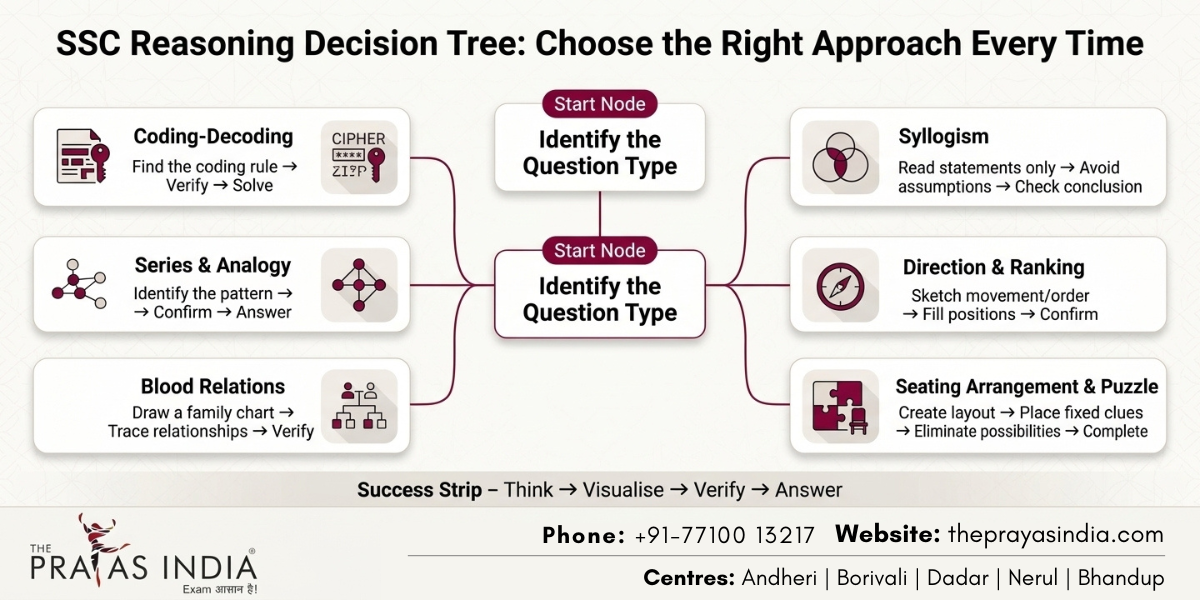
From Practice to Performance: Turning Preparation into SSC Exam Success
Knowing the Answer Is Good. Finding It Faster Is What Gets You Selected.
There comes a stage in every SSC aspirant’s preparation where learning new concepts is no longer the biggest challenge. Coding-Decoding makes sense. Syllogism feels familiar. Blood Relations are no longer confusing. Mock tests become a regular part of the routine.
Yet, the score refuses to improve.
If this sounds familiar, you’re not alone.
Many students reach this plateau because they continue preparing the same way they did when they were beginners. They keep solving more questions, buying more practice books, and watching more strategy videos. What they actually need, however, is a shift in focus—from learning to performing.
The SSC examination is not won by the candidate who knows the most. It is won by the candidate who can apply what they know quickly, accurately, and consistently under pressure.
Think of two aspirants.
The first has solved nearly 12,000 Reasoning questions over several months but has never analysed a mock test in detail.
The second has solved only 7,000 questions, but after every practice session, spends time understanding why mistakes happened, how much time each question consumed, and which topics need more attention.
When both appear for the examination, the second candidate often performs better.
The difference isn’t effort.
It’s direction.
Preparation helps you build knowledge.
Performance helps you convert that knowledge into marks.
That is the transition every serious SSC aspirant must make.
Speed Is Built, Not Borrowed
One of the biggest misconceptions among aspirants is that fast solvers are naturally gifted.
Spend a few minutes watching SSC toppers solve questions, and you’ll notice something interesting.
They rarely appear hurried.
Their movements are calm.
Their reading is controlled.
Their answers come quickly because they spend less time deciding how to solve the question.
This happens because repeated, structured practice creates familiarity.
The brain starts recognising patterns almost instantly.
Imagine seeing the same traffic signal every day on your way to work.
After a few weeks, you no longer consciously think about it.
Your response becomes automatic.
Reasoning works exactly the same way.
The more organised your practice is, the faster your recognition becomes.
Reality Check
Speed doesn’t come from attempting questions faster.
It comes from reducing the time spent thinking about the approach.
That is why experienced aspirants seem to solve difficult questions effortlessly.
They’re not solving faster.
They’re deciding faster.
The Three Layers of Speed Improvement
Improving speed is not about one magical shortcut.
It happens in stages.
Layer 1: Recognition Speed
Can you identify the question type within the first few seconds?
When you immediately recognise that a question belongs to Direction Sense or Coding-Decoding, your brain already knows the path to the solution.
Recognition saves valuable seconds throughout the paper.
Layer 2: Execution Speed
Once the pattern is recognised, the next challenge is solving efficiently.
Avoid unnecessary calculations.
Avoid reading the same sentence repeatedly.
Avoid second-guessing every step.
Confidence in execution develops only after conceptual clarity.
Layer 3: Decision Speed
This is where toppers gain a significant advantage.
They quickly decide whether to:
- Solve immediately.
- Skip temporarily.
- Return later.
Students who hesitate lose valuable time.
Remember:
Every difficult question left for later creates an opportunity to collect easier marks first.
Quick Performance Tips
- Read every question only once whenever possible.
- Train yourself to identify question categories instantly.
- Don’t chase perfection in every question.
- Build familiarity through repeated exposure to different patterns.
- Trust your preparation, but verify your final answer.
Accuracy: The Silent Rank Booster
Many students become obsessed with speed.
Ironically, this often reduces their overall score.
A candidate who attempts 24 questions with 95% accuracy usually performs better than someone attempting 30 questions with frequent mistakes.
Why?
Because negative marking quietly erases hard-earned marks.
Accuracy is not about solving slowly.
It is about making fewer avoidable mistakes.
Most incorrect answers in SSC Reasoning are not caused by difficult questions.
They are caused by:
- Misreading instructions.
- Ignoring keywords.
- Marking answers too quickly.
- Forgetting conditions.
- Careless assumptions.
These errors are completely preventable.
Understanding Your Mistake Pattern
Every aspirant has a unique pattern of mistakes.
Some struggle with speed.
Others lose marks because of overconfidence.
Some make calculation errors.
Others misinterpret logical statements.
Improvement begins only when these patterns become visible.
Instead of writing:
“Scored 38 marks today.”
Maintain a performance journal.
For every mock test, note:
| Question Type | Mistake Reason |
|---|---|
| Coding-Decoding | Misread the rule |
| Blood Relations | Skipped one relationship |
| Series | Missed alternate pattern |
| Puzzle | Started without organising clues |
| Syllogism | Assumed extra information |
Within a few weeks, recurring weaknesses become obvious.
This notebook becomes more valuable than another practice book.
Analyse Like an Examiner
Most students finish a mock test and immediately check the score.
That’s where learning stops.
Top performers begin learning after the mock ends.
Instead of asking,
“How many questions were correct?”
They ask:
- Which question consumed the most time?
- Which mistake was completely avoidable?
- Did I panic during lengthy questions?
- Which chapter requires revision?
- Which questions should I have skipped?
These questions transform every mock test into a lesson.
Mini Self-Assessment
After every mock, rate yourself from 1 to 5 on:
- Question recognition
- Time management
- Accuracy
- Confidence
- Decision-making
- Concentration
Marks show your result.
Analysis shows your future potential.
The 80–20 Rule of Reasoning Practice
Not every chapter contributes equally to your improvement.
Some topics strengthen multiple skills at once.
For example:
- Practising Seating Arrangement improves logical organisation.
- Solving Puzzles develops patience and analysis.
- Coding-Decoding sharpens observation.
- Series improves pattern recognition.
Instead of studying every topic in isolation, identify chapters that strengthen your overall thinking process.
This creates faster improvement across the entire Reasoning section.
Learning to Recover During the Exam
Even the best-prepared candidates encounter difficult questions.
The difference lies in their reaction.
Average aspirants become anxious after one confusing question.
Top scorers move ahead calmly.
They understand that the examination is a collection of independent questions.
One difficult puzzle should never affect the next Coding-Decoding question.
Recovery Strategy
Whenever you feel stuck:
- Stop for five seconds.
- Take a deep breath.
- Skip the question.
- Solve two easier questions.
- Return with a fresh perspective.
This simple technique prevents frustration from affecting the rest of your paper.
Key Takeaways
- Performance improvement begins after conceptual learning.
- Speed comes from recognition, execution, and decision-making.
- Accuracy protects your score from negative marking.
- Analyse every mock test like a performance review.
- Track mistake patterns instead of only tracking marks.
- Stay emotionally neutral during the examination.
- Smart decisions often matter more than solving every question.
Building a System That Delivers Results Every Week
Preparation for SSC is often compared to a marathon, but that analogy misses an important point. A marathon rewards endurance alone. The SSC examination rewards consistency, adaptability, and intelligent execution.
Many aspirants work extremely hard for a few weeks, only to lose momentum because they don’t have a structured system. Others study for long hours but cannot identify whether their preparation is actually improving.
The solution isn’t studying more.
The solution is studying with a measurable process.
Successful candidates rarely leave their preparation to chance. They know what they will practise, what they will revise, and how they will evaluate themselves every week. This routine keeps their preparation organised and prevents last-minute panic.
Let’s build that system.
A Weekly Practice Routine That Actually Works
Instead of solving random chapters every day, divide your Reasoning preparation into focused sessions. This helps your brain revisit concepts regularly while preventing monotony.
Suggested Weekly Planner
| Day | Primary Focus | Secondary Focus |
|---|---|---|
| Monday | Coding-Decoding & Analogy | Error Review |
| Tuesday | Series & Alphabet | Timed Practice |
| Wednesday | Blood Relations & Direction Sense | Previous Year Questions |
| Thursday | Ranking & Syllogism | Concept Revision |
| Friday | Seating Arrangement | Mixed Practice Set |
| Saturday | Puzzle Practice | Mock Test |
| Sunday | Mock Test Analysis | Weak Area Revision |
This structure ensures that no chapter is ignored for long and every week ends with a clear understanding of strengths and weaknesses.
Daily Revision: Small Sessions, Lasting Results
One of the biggest mistakes aspirants make is treating revision as an activity reserved for weekends or the final month before the exam.
Reasoning doesn’t require memorising large amounts of information, but it does require keeping patterns fresh in your mind.
A short, focused revision session every day is far more effective than revisiting everything after several weeks.
A 30-Minute Daily Revision Formula
First 10 Minutes
- Review formulas, letter positions, and commonly used concepts.
Next 10 Minutes
- Reattempt five questions you answered incorrectly earlier in the week.
Final 10 Minutes
- Solve five fresh questions without referring to notes.
This simple routine reinforces learning while exposing you to new patterns.
Question Selection: The Skill That Saves Marks
Not every question deserves immediate attention.
Many aspirants lose valuable time trying to solve a single complicated puzzle while several straightforward questions remain unanswered.
Top performers understand that the examination is about maximising total marks, not proving that every question can be solved.
Three-Step Selection Strategy
Round One
Attempt questions that look familiar and straightforward.
Round Two
Return to moderate-difficulty questions that require a little more thought.
Round Three
If time permits, attempt lengthy or uncertain questions.
This approach builds confidence early in the examination and reduces unnecessary pressure.
Managing Negative Marking
Negative marking doesn’t just reduce your score—it changes your rank.
Avoiding unnecessary mistakes can often improve your final result more than attempting additional questions.
Before marking an answer, ask yourself:
- Did I understand the question correctly?
- Have I verified the pattern?
- Am I guessing?
- Is there enough information to conclude?
If the answer to the last two questions is uncertain, it may be wiser to leave the question for later.
Do’s & Don’ts
Do
- Read carefully before solving.
- Mark answers only after verification.
- Skip questions that consume excessive time.
- Maintain a steady pace throughout the paper.
- Trust logic more than assumptions.
Don’t
- Panic after one difficult question.
- Change answers without a valid reason.
- Rush because other candidates appear faster.
- Attempt blind guesses.
- Ignore mock test analysis.
Your Weekly Self-Assessment Checklist
Every Sunday, evaluate your preparation honestly.
Performance Checklist
- Did I complete my weekly practice targets?
- Did I revise my weak chapters?
- Did I analyse every mock test?
- Did I reduce repeated mistakes?
- Did my average solving time improve?
- Did I maintain accuracy above my previous week’s level?
- Did I practise under timed conditions?
- Did I remain consistent throughout the week?
If several answers are “No,” your study plan needs adjustment—not necessarily more study hours.
The Value of Structured Guidance
There comes a point when improvement depends less on the number of hours studied and more on the quality of feedback received.
This is where a structured preparation environment becomes valuable.
At The Prayas India, students are encouraged to move beyond passive learning. Regular performance tracking, carefully designed practice sessions, realistic mock examinations, and systematic feedback help aspirants identify weaknesses before they become habits.
Rather than focusing only on completing the syllabus, the emphasis is placed on developing the skills that directly influence examination performance—speed, accuracy, logical thinking, and decision-making.
This balanced approach enables students to prepare with confidence instead of uncertainty, making their efforts more purposeful and measurable.
Preparation Is a Process, Not an Event
There is no single day when a candidate suddenly becomes “exam ready.”
Readiness develops gradually through disciplined practice, thoughtful revision, and honest self-evaluation.
Some days your mock score will improve.
Other days it may decline.
Both outcomes are valuable if you learn from them.
The students who eventually secure top ranks are not always those who started with the highest scores.
They are the ones who consistently refined their preparation, corrected their mistakes, and trusted the process.
As your Reasoning preparation progresses, remember that every analysed mock test, every corrected mistake, and every carefully revised concept is bringing you one step closer to your goal.
Key Takeaways
- Follow a structured weekly practice routine.
- Revise daily instead of waiting for weekends.
- Attempt questions strategically during the exam.
- Protect your score by avoiding unnecessary guesses.
- Analyse every mock test thoroughly.
- Measure progress through consistency, not just marks.
- Build habits that can be sustained until the examination.
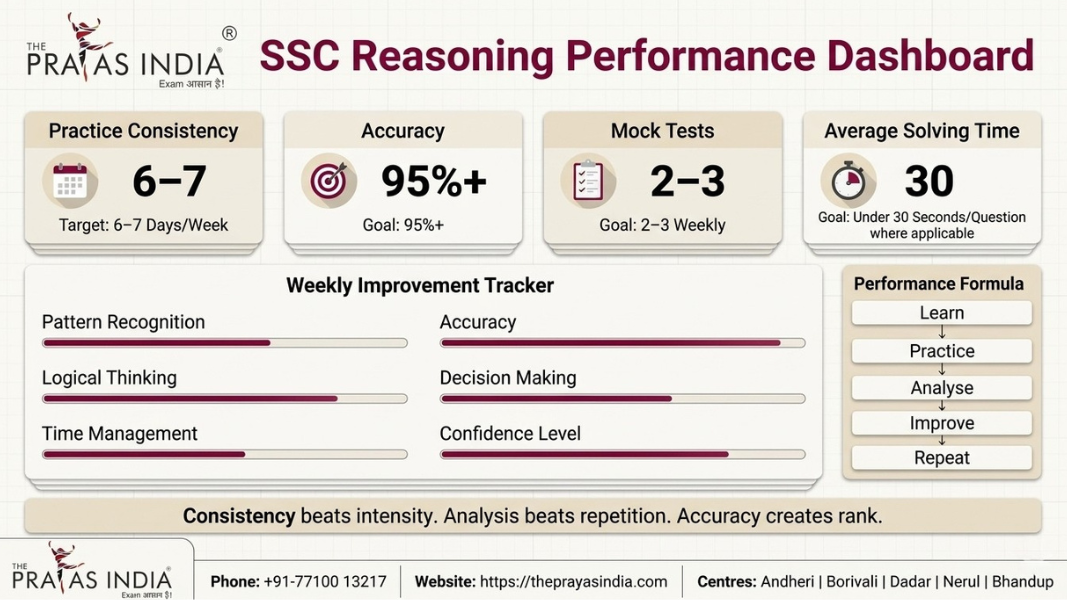
The Final Stretch: Converting Preparation into Selection
The Last Few Weeks Don’t Change Your Potential—They Reveal It.
Every SSC aspirant eventually reaches a point where preparation enters a different phase.
The syllabus is almost complete.
Previous Year Questions have been solved.
Mock tests have become a regular routine.
Yet, one question begins to dominate every study session:
“Am I really ready for the examination?”
Interestingly, this question isn’t answered by the number of books you’ve finished or the hours you’ve studied.
It is answered by your ability to perform consistently when it matters most.
The final month before the SSC examination is not the time to experiment with new resources or complicated strategies. It is the period when preparation should become simpler, more focused, and highly disciplined.
Many students unknowingly reduce their performance during this phase because they panic. They start comparing themselves with others, attempting every available mock test, or switching study plans every few days.
Successful aspirants do the exact opposite.
They simplify.
They trust the preparation they have already built.
They focus on improving execution instead of chasing perfection.
The Last Month Strategy
The final month is not about learning everything.
It is about ensuring that what you already know can be recalled quickly and applied accurately.
Your priorities should gradually shift from learning new concepts to strengthening familiar ones.
Week 1: Strengthen the Foundation
Begin by identifying chapters where your accuracy is consistently below expectations.
Rather than trying to master everything simultaneously, concentrate on correcting recurring mistakes.
During this week:
- Revisit important concepts.
- Solve Previous Year Questions chapter-wise.
- Review your mistake notebook.
- Focus on conceptual clarity instead of speed.
The objective is to eliminate weak areas before entering intensive mock practice.
Week 2: Build Examination Rhythm
Once concepts feel stable, increase the number of timed practice sessions.
Attempt Reasoning sections under actual examination conditions.
Maintain strict time limits.
Avoid unnecessary interruptions.
Most importantly, analyse every test carefully.
At this stage, improvement comes more from analysis than from additional practice.
Week 3: Improve Decision-Making
By now, your preparation should be less about solving questions and more about solving the right questions first.
Pay attention to:
- Which questions consume unnecessary time?
- Which chapters still reduce your confidence?
- Which mistakes continue appearing despite revision?
Fine-tuning these areas often improves overall performance significantly.
Final Week: Stay Sharp, Stay Calm
The final week is not meant for marathon study sessions.
Instead:
- Revise your notes.
- Solve selected practice sets.
- Review previous mistakes.
- Maintain a healthy sleep schedule.
- Stay consistent with your daily routine.
Confidence during the examination is often built outside the examination hall.
Preparation Checklist
Before entering the SSC examination, every aspirant should be able to answer “Yes” to the following questions.
Concept Mastery
- I understand every major Reasoning chapter.
- I can identify question types quickly.
- I know the logic behind common patterns.
- I have revised difficult concepts multiple times.
Practice
- I have solved a sufficient number of Previous Year Questions.
- I have attempted full-length mock tests regularly.
- I have practised under timed conditions.
- I have improved my weak chapters.
Performance
- My accuracy is improving consistently.
- I know how to manage difficult questions.
- I avoid unnecessary guessing.
- I analyse every mock test properly.
Mindset
- I remain calm during lengthy questions.
- I don’t compare my preparation with others.
- I trust my preparation process.
- I have a clear examination strategy.
If several boxes remain unchecked, there is still time to improve—but the focus should be on targeted revision rather than starting new material.
Frequently Asked Questions
How much time should I dedicate to Reasoning every day?
There is no universal answer because every student begins at a different level.
However, consistent daily practice is more effective than studying for long hours occasionally.
Even 45–60 minutes of focused Reasoning practice, followed by analysis, can produce significant improvement over time.
Should I solve only Previous Year Questions?
Previous Year Questions are one of the most reliable preparation resources because they reveal the examination pattern and recurring concepts.
However, they should not be your only source of practice.
Once you understand the pattern, supplement your preparation with high-quality practice questions that expose you to different variations.
Is it necessary to learn shortcut tricks?
Shortcuts become valuable only after conceptual understanding.
If you rely exclusively on tricks, unfamiliar questions may become difficult.
Learn the logic first.
Optimise speed later.
Can average students score full marks in Reasoning?
Absolutely.
Reasoning is one of the few SSC sections where improvement depends more on practice quality than academic background.
Many successful candidates started with modest scores but steadily improved through disciplined preparation, regular mock tests, and continuous error analysis.
How many mock tests should I attempt before the examination?
Quality is more important than quantity.
Instead of chasing a fixed number, ensure that every mock test is followed by detailed analysis.
A carefully reviewed mock contributes far more to your preparation than several tests attempted without learning from mistakes.
Common Myths That Still Mislead Aspirants
Even after months of preparation, certain misconceptions continue to influence students’ strategies.
Let’s separate myth from reality one final time.
| Myth | Reality |
|---|---|
| Reasoning is only for naturally intelligent students. | Logical thinking improves with consistent practice. |
| More questions always mean better preparation. | Meaningful analysis matters more than sheer quantity. |
| Speed should be the first priority. | Accuracy naturally leads to sustainable speed. |
| Difficult puzzles guarantee high scores. | Smart question selection improves overall performance. |
| Last-minute shortcuts can replace preparation. | Strong fundamentals remain the biggest advantage. |
One Final Perspective
When the examination begins, every candidate receives the same paper.
The difference is not in the questions.
It is in the preparation behind every answer.
Some students spend the examination fighting anxiety.
Others spend it applying months of disciplined practice.
That difference isn’t created overnight.
It is built through every revision session, every analysed mock test, and every corrected mistake.
Learning That Builds Confidence, Guidance That Creates Results
Preparing for the SSC examination is not simply about covering a syllabus. It is about developing a way of thinking that remains effective even when the examination becomes challenging.
Many aspirants begin their preparation with enthusiasm but gradually lose direction. They collect multiple books, follow different online strategies, and attempt countless practice questions. Despite working hard, they often struggle to identify what is actually preventing them from improving.
This is where the learning environment begins to matter.
The right guidance doesn’t replace self-study—it makes self-study more effective.
A structured preparation system helps students focus on what truly influences their performance: conceptual clarity, disciplined practice, regular assessment, and continuous improvement.
At The Prayas India, the emphasis is not on encouraging students to study endlessly. Instead, the objective is to help every aspirant study intelligently.
The preparation methodology is designed to help students:
- Build strong conceptual foundations.
- Develop logical thinking instead of memorising tricks.
- Improve speed without compromising accuracy.
- Analyse mock tests systematically.
- Strengthen weak areas through focused practice.
- Develop confidence to handle unfamiliar questions.
Students preparing for SSC also benefit from a structured academic environment where experienced faculty, quality study material, topic-wise practice sessions, regular mock tests, and personalised doubt-solving work together as part of a complete preparation ecosystem. Rather than functioning as isolated resources, these elements are integrated into a learning process that supports consistent progress throughout the preparation journey.
For many aspirants, this combination of structured guidance and disciplined self-study becomes the difference between merely preparing for the examination and preparing with confidence.
The Journey Doesn’t End with Preparation
Every chapter you complete, every mock test you analyse, and every mistake you correct adds another layer to your preparation.
General Intelligence & Reasoning is often regarded as one of the most scoring sections in the SSC examination—not because it is easy, but because improvement is measurable.
Students who approach it with patience and consistency almost always see progress.
The key is to avoid searching for shortcuts that promise instant success.
Instead, focus on building habits that continue producing results:
- Observe carefully.
- Think logically.
- Practise consistently.
- Analyse honestly.
- Improve continuously.
These habits not only improve your Reasoning score but also strengthen your overall examination temperament.
When the examination day arrives, confidence should come not from hope, but from preparation.
Final Thoughts
Mastering General Intelligence & Reasoning is not about proving how intelligent you are.
It is about training your mind to identify patterns, think logically, make accurate decisions, and remain calm under pressure.
Throughout this guide, we’ve explored every stage of that journey—from understanding the psychology behind Reasoning to mastering individual topics, improving speed and accuracy, building a weekly preparation system, and developing the mindset needed for examination success.
If there is one lesson to remember, it is this:
Consistency always outperforms intensity.
A few hours of focused preparation every day, combined with thoughtful revision and regular performance analysis, will always produce better long-term results than irregular bursts of study.
Approach every practice session with curiosity rather than fear.
Treat every mistake as feedback rather than failure.
Most importantly, trust the process.
The SSC examination rewards disciplined preparation, and with the right strategy, steady effort, and structured guidance, success becomes an achievable goal rather than a distant ambition.
Whether you are beginning your SSC journey or preparing for your next attempt, investing in the right learning environment can make your preparation more focused and effective. If you’re looking for expert mentorship, a structured study plan, and a proven approach to SSC preparation, The Prayas India offers comprehensive coaching designed to help aspirants prepare with clarity, confidence, and purpose.
Take the next step towards your SSC dream. Connect with The Prayas India and begin preparing with a strategy built for success.
Contact Us
📞 Call Now: +91-77100 13217