How to Prepare CAT Quant if Your Maths Basics Are Weak? | Best CAT Coaching in Mumbai | The Prayas India
Introduction: Weak Maths Basics Do Not Mean Weak CAT Quant Potential
For many CAT aspirants, Quantitative Ability is the section that creates the most anxiety. The problem becomes even more noticeable when a student has not studied mathematics seriously for several years or has always felt uncomfortable with calculations, formulas and numerical problems. Seeing other aspirants solve questions quickly can create the impression that CAT Quant is meant only for students with a strong mathematical background.
That is not necessarily true. CAT Quant does demand conceptual clarity, numerical comfort and the ability to solve problems under time pressure, but these skills can be developed systematically. A weak foundation simply means that the preparation process needs to begin at a different point. Instead of immediately solving difficult CAT-level questions, you need to rebuild the fundamentals and gradually move towards application, speed and selection.
The bigger mistake is not having weak basics. The bigger mistake is trying to hide those weaknesses by skipping fundamentals and jumping directly into advanced questions. That approach often leads to frustration because the student keeps encountering concepts that should have been mastered earlier.
If you are preparing for CAT 2026, the goal should not be to become exceptionally strong at every mathematical concept. The goal is to become comfortable enough with the important areas to identify solvable questions, apply concepts correctly and make efficient decisions inside the Quant section.
For students exploring CAT coaching in Mumbai, this distinction is important while evaluating a preparation programme. A useful learning environment should not assume that every student enters with the same mathematical background. Foundation-building, regular practice, doubt resolution, mock analysis and personalised feedback can make the preparation process considerably more manageable.
Start by Accepting Your Current Level
The first step towards improving CAT Quant is to honestly assess where you stand. Many students either overestimate or underestimate their mathematical ability. Someone who has not touched mathematics for years may assume that everything is weak, while another candidate may believe that school-level familiarity is enough to handle CAT questions comfortably.
Neither assumption gives you a useful preparation strategy.
Take a basic diagnostic test covering different Quant areas before beginning an intensive preparation schedule. The objective at this stage is not to obtain a high score. Instead, use the test to understand which concepts are familiar, which require revision and which areas are almost completely unfamiliar.
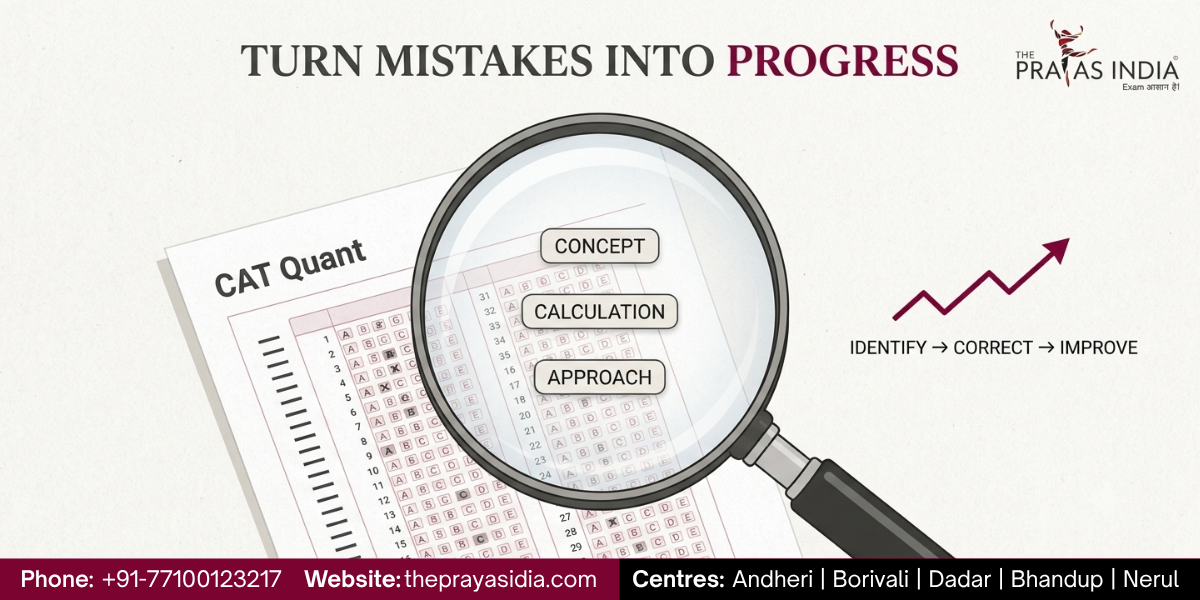
Pay attention to the type of mistakes you make. If you know the formula but cannot apply it, your conceptual understanding needs work. If you understand the method but make frequent calculation errors, your numerical accuracy needs improvement. If you can solve a question but take too long, the issue is likely application speed rather than conceptual weakness.
This diagnosis gives you something far more valuable than a score: a starting point.
Don’t Begin CAT Quant With the Toughest Questions
A common mistake among weak-maths students is starting their preparation with difficult CAT-level questions because they believe that exposure to difficult problems will make them stronger faster. In practice, repeatedly failing to solve advanced questions can reduce confidence without fixing the underlying problem.
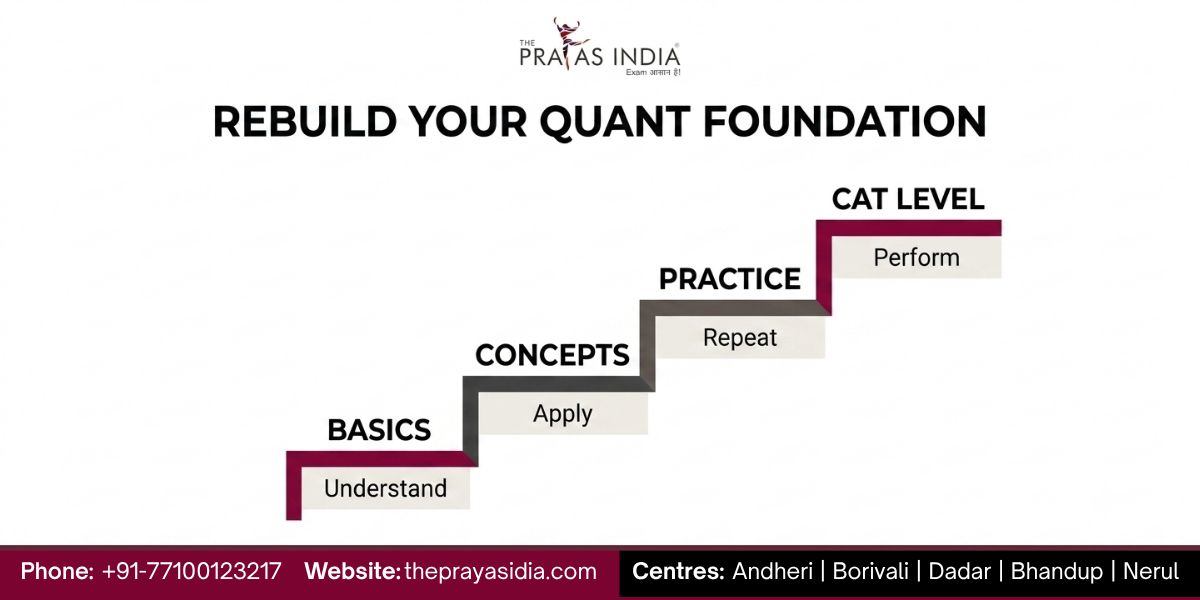
Your initial objective should be to make basic concepts familiar enough that they no longer require excessive mental effort.
Suppose percentages are weak. Before attempting a complicated CAT question involving successive percentage changes, begin by understanding what percentage actually represents and how percentage increase, decrease and comparison work. Once those ideas become comfortable, move towards application-based questions.
The same principle applies to ratios, averages, equations, geometry and other topics. Build the foundation first and increase the complexity gradually.
A strong CAT Quant preparation journey is usually less about making one huge jump in difficulty and more about making several manageable improvements in sequence.
Rebuild Your Mathematical Foundation Strategically
You do not need to revise every chapter of school mathematics before starting CAT preparation. Instead, focus on the concepts that form the foundation of the major CAT Quant areas.
Arithmetic deserves particular attention because it connects to a wide range of practical problem types. Percentages, ratios and proportions, averages, profit and loss, simple and compound interest, mixtures, time and work and time-speed-distance can all be approached more confidently when your basic arithmetic is strong.
Algebra is another important area where fundamentals matter. Understanding equations, identities, inequalities and basic algebraic manipulation can make many questions easier to interpret.
Geometry requires a slightly different type of preparation. Rather than memorising a large collection of formulas without understanding them, learn the basic properties and relationships that allow you to derive or apply those formulas correctly.
The objective is to create a foundation where concepts begin connecting with one another. When that happens, CAT Quant stops looking like hundreds of unrelated question types.
The Right Order Can Make Quant Less Overwhelming
Students with weak mathematical foundations often make their preparation harder by trying to study too many topics simultaneously. One day they may study geometry, the next day number systems, followed by modern maths and then return to arithmetic without properly consolidating anything.
A more structured progression can reduce this feeling of overload. Begin with areas where concepts are relatively intuitive and build confidence through repeated application. As your numerical comfort improves, introduce topics that require greater abstraction or multiple-step reasoning.
This does not mean that every student must follow exactly the same topic sequence. Your diagnostic performance should determine the order. However, the broader principle remains the same: build interconnected fundamentals before chasing complexity.
A topic should not be considered “completed” simply because you have watched a lecture or read the formula sheet. It becomes useful when you can recognise the concept inside a question and apply it without excessive hesitation.
Understand Concepts Instead of Memorising Formulas
Formula memorisation can provide a temporary feeling of preparation, but it does not guarantee that you will know when or how to use a formula in the examination.
Consider a student who memorises the formula for average but struggles when the question provides weighted information or asks for a missing value. The formula itself has not failed; the student has not yet developed the conceptual understanding needed to recognise the situation.
This is why every important formula should be connected to an idea. Understand what the formula represents, why it works and what kind of question requires it. Once you understand the relationship, remembering the formula becomes considerably easier.
Conceptual understanding also helps when CAT changes the wording of a familiar problem. Rather than depending on a memorised pattern, you can identify the underlying mathematical relationship and adapt your approach.
For an aspirant with weak basics, this shift from formula memory to conceptual thinking can make a significant difference.
Build Calculation Comfort Before Chasing Speed
Speed is important in CAT, but trying to become fast before becoming accurate can create bad habits. Weak-maths students often rush calculations because they believe that speed is their biggest problem. In reality, incorrect calculations can be an even bigger issue because they force you to revisit questions and lose valuable time.
Begin by solving basic calculations carefully. Work on fractions, percentages, multiplication, division, approximations and other commonly used numerical operations. As accuracy becomes stable, gradually introduce time limits.
The progression should look like this: first understand the method, then solve accurately, then solve repeatedly and finally introduce speed.
This approach may initially feel slower, but it creates a stronger foundation. Eventually, familiar calculations begin to require less conscious effort, allowing you to devote more attention to the actual logic of the question.
Arithmetic Should Become a Major Strength
For students rebuilding their Quant foundation, Arithmetic can provide an excellent opportunity to develop confidence because many of its concepts are connected to everyday numerical reasoning.
Percentages can support profit and loss, discounts and comparisons. Ratios can connect with mixtures, proportions and other applications. Averages can appear in questions involving groups, rates and weighted situations. Time and work and time-speed-distance require a clear understanding of relationships between quantities.
Rather than treating each chapter as completely independent, look for these connections.
For example, if your percentage concepts improve, several other areas can become easier because percentage calculations frequently appear as part of larger problems. Similarly, a strong understanding of ratios can make many word-based questions less intimidating.
This is one reason a structured Quant preparation programme can be valuable for students who lack confidence. The objective is not merely to complete chapters but to show how concepts interact and where they can be applied.
Move From Solved Examples to Independent Practice
Watching someone solve a question can make the solution look obvious. The real test begins when you have to solve a similar question without assistance.
After learning a concept, solve a few guided examples to understand how it is applied. Then close the solution and attempt similar problems independently. If you get stuck, identify exactly where your reasoning stopped rather than immediately copying the solution.
This process is important because CAT requires independent decision-making. In the actual examination, nobody will tell you which formula to use or which approach to follow.
Independent practice also exposes gaps that lectures can hide. You may understand a concept when someone explains it but discover that you cannot identify it when the same concept appears inside an unfamiliar question.
Keep a Record of Repeated Mistakes
A simple error log can become one of the most effective tools for a student with weak mathematical basics. Every time you make a meaningful mistake, record the reason rather than merely writing the correct answer.
Your mistakes may fall into different categories. Some may be conceptual, some may involve calculations, others may occur because you misunderstood the wording, and some may happen because you selected an inefficient approach.
After several practice sessions, review the pattern. If the same type of error keeps appearing, that topic requires additional attention.
For example, if you repeatedly make mistakes while converting fractions into percentages, you may need more foundational practice. If you understand the concept but make arithmetic mistakes, your practice should focus on calculation accuracy.
This transforms mistakes from something discouraging into a diagnostic resource.
Don’t Measure Your Progress Only by the Number of Questions Solved
A common misconception among CAT aspirants is that completing a large number of questions automatically means that preparation is progressing well. Quantity can certainly help, but only when it is accompanied by understanding and analysis.
If you solve 100 questions but repeat the same conceptual mistake across them, the number itself does not represent meaningful progress. Conversely, solving fewer questions carefully and understanding why different approaches work can significantly improve your ability.
Track multiple indicators of progress. Are you making fewer conceptual mistakes? Are familiar questions taking less time? Are you becoming better at identifying the relevant concept? Are you leaving fewer questions because of uncertainty?
These improvements may not immediately produce dramatic mock-test scores, but they indicate that your foundation is becoming stronger.
Learn to Recognise When a Question Is Worth Attempting
CAT Quant is not simply a test of mathematical knowledge. It also tests your ability to make decisions under time pressure.
A candidate with weak mathematics may feel compelled to attempt every question because they want to prove that they have improved. This can be counterproductive. Even strong mathematical candidates do not need to solve every question.
As your preparation develops, learn to identify questions that appear familiar and approachable. If the underlying concept is clear and the calculation seems manageable, the question may deserve your time. If the problem appears unusually lengthy or involves a concept you have not mastered, it may be better to move ahead.
Question selection should eventually become part of your preparation, not something you think about only during mocks.
Use Sectional Tests Before Full-Length CAT Mocks
Full-length mocks are essential later in CAT preparation, but students with weak basics can benefit from sectional testing before jumping into complete simulations.
A sectional test allows you to focus on one skill at a time. If you have recently completed Arithmetic, a focused test can show whether you are actually able to apply those concepts under time pressure.
Once your sectional performance becomes more stable, introduce mixed-topic tests. These are important because the real CAT Quant section does not announce which concept each question requires.
Finally, move towards full-length mocks and use them to evaluate your broader strategy.
This gradual progression reduces the psychological pressure that can come from repeatedly taking full mocks before your foundation is ready.
A Coaching Environment Should Strengthen the Foundation, Not Just Increase the Difficulty
When students search for the Best CAT Coaching in Mumbai, they often compare institutes based on faculty, results, study material, fees and batch schedules. These factors matter, but students with weak mathematical basics should also ask a more fundamental question: Will the learning process help me build my foundation?
A preparation programme should ideally provide a progression from fundamentals to CAT-level application rather than expecting every student to begin at an advanced level.
Regular doubt resolution, structured practice, topic-wise tests and mock analysis can be particularly valuable because they allow students to identify weaknesses before they become larger problems.
For an aspirant who lacks confidence in mathematics, the right environment can also make the preparation process more sustainable. Instead of constantly feeling behind stronger students, the candidate can measure progress against their own performance and gradually move towards the required CAT level.
The Prayas India provides CAT preparation support in Mumbai through centres at Andheri, Borivali, Dadar, Bhandup and Nerul. Students considering admission can evaluate the programme based on their individual preparation requirements, preferred learning style and the level of academic guidance they need. For admission-related information, The Prayas India can be contacted at +91-77100123217.
The purpose of joining coaching should not simply be to add another source of study material. For a student with weak Quant fundamentals, the greater value can come from having a structured path, regular feedback and a system that makes it easier to move from basic understanding to confident application.
The Right Mindset for a Weak-Maths CAT Aspirant
The most important change may not happen in your formula book. It may happen in the way you approach mathematics.
If you repeatedly tell yourself that you are “bad at maths”, every difficult question can become evidence supporting that belief. Instead, think in terms of specific skills. Perhaps your arithmetic is weak, your algebra needs revision or your calculation speed is low. These are identifiable problems, and identifiable problems can be worked on.
Progress in Quant is rarely perfectly linear. Some topics may become comfortable quickly, while others may require several rounds of practice. That is normal.
Your aim should be to become more capable than you were last week, rather than comparing your current performance with someone who has been practising Quant for years.
Move From Basic Mathematics to CAT-Level Thinking
Once your fundamentals start becoming comfortable, the next stage is to gradually introduce the type of thinking that CAT Quant demands. This is where many students make another mistake: they assume that understanding basic concepts automatically means they are ready for difficult CAT questions.
There is an important gap between knowing a mathematical concept and applying it when the question is presented in an unfamiliar way. CAT often tests whether you can recognise the underlying structure of a problem rather than simply recall a formula. A familiar concept may be hidden inside a lengthy situation, combined with another concept or presented through an approach that you have not seen before.
Your transition to CAT-level preparation should therefore be gradual. Start with standard applications, move towards moderate questions and then introduce more challenging problems. At every stage, ask yourself whether you understand the reasoning behind the solution. If you are consistently unable to identify the approach, go back one level rather than repeatedly attempting questions that are beyond your current foundation.
This approach allows difficulty to increase without making preparation feel overwhelming.
Prioritise Topics Instead of Trying to Master Everything at Once
CAT Quant covers several areas, but not every topic deserves exactly the same amount of preparation time for every student. Your preparation should be driven by the combination of importance, personal comfort and improvement potential.
Arithmetic is generally a useful foundation because its concepts are interconnected and can appear in many forms. Algebra and Geometry also require attention, while topics such as Number Systems and other areas should be incorporated according to your preparation level and performance in practice.
However, topic prioritisation should not become an excuse to completely ignore areas you find difficult. The objective is to allocate time intelligently. If one topic consumes several hours but produces very little improvement while another topic offers a better opportunity to strengthen your score, your preparation schedule should reflect that difference.
Maintain a topic-wise record of your performance. Over several weeks, you will begin to see which areas are becoming strengths and which ones continue to hold you back.
Use a Three-Level Practice System
A simple way to organise Quant preparation is to divide practice into three levels.
At the foundation level, focus on understanding concepts and solving straightforward applications. The purpose is to make the basic method familiar.
At the application level, introduce questions that require multiple steps or a combination of concepts. Here, the emphasis shifts towards interpretation and approach selection.
At the CAT level, practise questions that require you to identify the underlying concept independently, make decisions about the most efficient method and work within a time constraint.
Do not rush through these stages. If foundation-level questions are still producing frequent mistakes, moving directly to CAT-level problems may create more confusion than improvement.
The transition should happen when your accuracy becomes reasonably stable at the earlier level.

Improve Speed Without Sacrificing Accuracy
Once your concepts become stronger, speed becomes the next major area of improvement. However, speed should not be treated as simply “solving faster”. It is the result of recognising familiar patterns, choosing efficient methods and avoiding unnecessary calculations.
Begin timing yourself only after you have achieved reasonable accuracy. If you start chasing speed too early, you may develop the habit of rushing through questions and making avoidable errors.
Instead, observe where time is being lost. Perhaps you are taking too long to understand word problems. Perhaps your calculations are slow. Maybe you are using a longer method even when a simpler approach is available.
These are different problems, so they require different solutions.
A useful practice method is to revisit questions that took too long and solve them again after understanding the more efficient approach. With repeated exposure, certain patterns become familiar and the time required to process them gradually decreases.
Develop the Habit of Looking for Multiple Approaches
CAT Quant often rewards flexibility. A question may be solvable through a conventional formula, but there may also be a shorter method involving estimation, options, substitution, ratios or logical elimination.
Students with weak mathematical foundations sometimes become overly dependent on the first method they learn. If that method produces lengthy calculations, they continue using it even when a simpler approach exists.
During practice, once you solve a question, spend a little time asking whether there was another way to reach the answer. You do not need to memorise every shortcut you encounter. Instead, understand why an alternative method works and when it could be useful.
This gradually develops mathematical flexibility, which becomes particularly valuable when you are working against the clock.
Don’t Turn Every Weak Topic Into a Long-Term Obsession
Weak areas deserve attention, but there is a point where continued effort may stop producing proportional improvement. If you spend an excessive amount of time trying to master one highly uncomfortable topic, other areas of your preparation may suffer.
Your preparation should therefore involve regular reassessment. If a topic remains difficult after several rounds of conceptual revision and practice, determine whether the issue is the concept itself, the question selection or the level of difficulty you are attempting.
Sometimes the right strategy is to strengthen the basic and moderate questions from that topic rather than trying to master its most difficult variations.
CAT preparation is ultimately a decision-making exercise. You need to decide not only which questions to attempt in the examination, but also where your preparation time will generate the greatest improvement.
Make Mock Tests Part of Your Quant Preparation
As your preparation progresses, sectional tests and full-length CAT mocks become increasingly important. They help you evaluate whether the knowledge developed during practice can actually translate into performance under time pressure.
However, do not judge your Quant preparation only through mock scores. A low score can result from several different issues. You may have selected the wrong questions, spent too much time on difficult problems, misunderstood familiar concepts or made calculation errors.
After every test, review your Quant section carefully. Look at questions you solved correctly, questions you solved incorrectly and questions you did not attempt.
The third category is particularly valuable. Some skipped questions may genuinely have been unsuitable, while others may have been questions you could have solved if you had identified the correct approach quickly enough.
This analysis helps turn mock tests into a learning tool rather than merely a scorecard.
Analyse Your Quant Performance Beyond the Score
A useful Quant performance sheet can include several indicators: accuracy, average time per attempted question, questions left unattempted, conceptual errors and calculation errors.
Over time, these indicators provide a much clearer picture of your development.
For example, if your score has remained similar but your accuracy has increased and your average solving time has decreased, your preparation may actually be progressing well. The score may rise later as your question-selection ability improves.
Similarly, if your attempts have increased but accuracy has fallen sharply, you may be trying to solve too many questions rather than selecting them carefully.
This is why mock analysis should focus on patterns rather than individual scores.

Build a Revision System That Prevents Concepts From Fading
Students with weak mathematics often spend significant time learning a topic and then move on to the next chapter without revisiting it. A few weeks later, the same concept begins to feel unfamiliar again.
Revision needs to be integrated into your preparation rather than reserved for the final weeks.
After completing a topic, revisit its key concepts after a short interval and solve a small set of questions without looking at your notes. Later, include questions from that topic in mixed practice. This forces you to recognise the concept without being told which chapter it belongs to.
Mixed practice is particularly important because CAT does not label questions according to their topics. You will see a collection of questions and have to determine which ones are worth attempting and which approach might work.
The ultimate objective of revision is therefore not simply remembering formulas. It is developing instant recognition and application.
Build a Personal Quant Question Bank
Instead of collecting hundreds of random questions, create a smaller and more useful personal question bank.
Whenever you encounter a question that teaches you something important, save it. This could be a question involving an elegant approach, a concept you repeatedly misunderstand, a calculation method that saves time or a problem that initially looked difficult but became simple once you understood the underlying idea.
Periodically revisit these questions. They become especially valuable during the later stages of preparation when you need to revise efficiently.
Your personal question bank should represent learning value rather than volume. A carefully selected collection of questions can be far more useful than an enormous folder of problems that you never revisit.
A Practical Preparation Framework for Students With Weak Basics
If your mathematical foundation is weak, your preparation can be broadly divided into four stages.
Stage 1: Diagnose and Rebuild. Begin by identifying your weaknesses and revising essential mathematical concepts. Do not worry about speed at this stage.
Stage 2: Apply and Strengthen. Start solving standard CAT-style questions and focus on recognising concepts within different problem situations.
Stage 3: Time and Select. Introduce sectional tests, timed practice and mixed-topic questions. Begin working actively on question selection and efficient methods.
Stage 4: Simulate and Refine. Use full-length mocks, analyse your performance and refine your strategy based on repeated patterns.
The duration of each stage will differ from one student to another. Someone with very weak basics may need more time in the first stage, while another candidate may move into timed practice relatively quickly.
The important thing is to progress according to competence rather than according to the calendar alone.
Admission-Focused Guidance for CAT Aspirants in Mumbai
For students considering CAT coaching, the preparation environment can become an important factor, especially when Quant is a major weakness. A student who already has strong mathematical fundamentals may be able to work independently with practice material, whereas someone struggling with basic concepts may benefit from structured explanation and regular feedback.
When evaluating a CAT coaching programme, aspirants should look beyond advertisements and compare the academic support available to them. Faculty accessibility, foundation-level teaching, doubt resolution, sectional tests, mock analysis and the quality of study material can all influence the learning experience.
For students looking for CAT coaching in Mumbai, The Prayas India provides preparation support through centres at Andheri, Borivali, Dadar, Bhandup and Nerul. Aspirants can explore the programme and determine whether its teaching approach, academic structure and support system match their individual preparation needs.
Admission decisions should be based on your own learning requirements. If mathematics is your weak area, look for a preparation environment where asking basic questions is encouraged, concepts are explained clearly and progress is evaluated regularly rather than simply assuming that every student already has a strong foundation.
For admission-related information, students can contact +91-77100123217.
What a Weak-Maths CAT Aspirant Should Avoid
The first mistake is comparing your preparation speed with someone who already has a strong mathematical foundation. Their starting point may be completely different from yours, so comparison can create unnecessary pressure without improving your performance.
Another mistake is collecting too many resources. Switching between multiple teachers, books, video courses and question banks can fragment your preparation. Choose a structured source for learning and supplement it only when there is a genuine gap.
Avoid spending weeks memorising formulas without solving questions. Mathematics becomes useful when concepts are applied.
Do not take difficult mocks repeatedly simply to prove that you can handle them. If your foundation is still developing, use tests to diagnose weaknesses and improve systematically.
Most importantly, do not conclude that you cannot crack CAT because your current Quant score is low. Your current score describes your present level; it does not define your final performance.
How to Know When Your Quant Preparation Is Improving
Improvement is not always reflected immediately in your overall mock score. Look for smaller indicators.
You may notice that you recognise familiar concepts more quickly. Questions that previously seemed intimidating may begin to look manageable. Your calculation errors may decrease. You may start leaving difficult questions without wasting several minutes. Your accuracy may improve even before your attempts increase.
These are meaningful signs of progress.
Eventually, these smaller improvements begin to combine. Better fundamentals improve accuracy, better recognition improves speed, and better selection improves the efficiency of your attempts.
That is the progression a weak-maths aspirant should aim for.
Final Takeaway
Having weak mathematics basics can make CAT Quant intimidating, but it does not mean that the section is beyond your reach. What matters is how systematically you address the gap between your current level and the level required for CAT.
Start with a realistic diagnosis rather than assumptions. Rebuild essential arithmetic, algebra and other fundamentals before moving aggressively towards difficult questions. Practise concepts through multiple levels, gradually introduce time pressure and learn to recognise which questions deserve your attention.
As your foundation improves, focus on speed, accuracy and flexibility. Use sectional tests and full-length mocks to evaluate your performance, but analyse more than your score. Track your mistakes, time spent, question selection and recurring weaknesses.
Most importantly, keep your preparation sustainable. You do not need to become a mathematics expert overnight. You need to become progressively better at recognising, solving and selecting CAT Quant questions.
For aspirants exploring CAT coaching in Mumbai, a structured academic environment can provide a useful framework for this progression, particularly when foundation-building and regular feedback are important. The Prayas India has centres at Andheri, Borivali, Dadar, Bhandup and Nerul, allowing students to explore CAT preparation options based on their individual requirements.
With the right preparation strategy, weak mathematical basics can become a starting point rather than a permanent limitation.
Contact Us
- Call Now: +91-77100 13217
- Website: theprayasindia.com
- Centres: Andheri | Borivali | Dadar | Nerul | Bhandup
Frequently Asked Questions
1. Can I prepare for CAT Quant if my maths basics are weak?
Yes. A weak mathematical foundation does not automatically prevent you from performing well in CAT Quant. You should begin by rebuilding essential concepts, particularly arithmetic and basic algebra, before gradually moving towards CAT-level applications. Consistent practice and mock analysis can then help you improve speed, accuracy and question selection.
2. Which Quant topics should I study first if I am weak in mathematics?
Start with fundamental arithmetic concepts such as percentages, ratios, averages, profit and loss, time and work and time-speed-distance. Once these become comfortable, you can progressively strengthen algebra, geometry, number systems and other areas according to your diagnostic performance and preparation requirements.
3. How can I improve my CAT Quant speed?
Speed should be developed after your conceptual accuracy becomes reasonably stable. Identify where you are losing time, practise familiar question types repeatedly and learn to recognise efficient approaches. Timed sectional practice and mock-test analysis can then help you improve speed without encouraging careless solving.
4. Should I memorise formulas for CAT Quant?
Formula familiarity is useful, but memorisation alone is not sufficient. You should understand what a formula represents and when it can be applied. Conceptual understanding allows you to handle unfamiliar CAT questions where the underlying idea is presented differently.
5. How many hours should I study CAT Quant every day?
There is no fixed number of hours that works for every aspirant. Your preparation time should depend on your current level, CAT timeline and performance in practice tests. Students with weak basics may initially need more time for foundation-building and can later shift towards timed practice and mock analysis.
6. Are CAT Quant mocks useful for students with weak basics?
Yes, provided they are used at the right stage. Sectional tests can help you assess individual topics while your foundation develops. As your preparation becomes stronger, full-length mocks can help you evaluate question selection, speed, accuracy and overall exam strategy.
7. Should I join CAT coaching if my maths basics are weak?
Coaching is not mandatory, but structured guidance can be useful if you struggle to build fundamentals independently. When evaluating CAT coaching in Mumbai, consider whether the programme provides foundation-level teaching, doubt resolution, regular testing, mock analysis and a structured progression from basic concepts to CAT-level questions.
8. Where does The Prayas India offer CAT coaching in Mumbai?
The Prayas India has CAT preparation centres in Andheri, Borivali, Dadar, Bhandup and Nerul. Students interested in understanding the available preparation and admission options can contact +91-77100123217.