How to Prepare Current Affairs for RRB Group D? | Best RRB Coaching in Mumbai | The Prayas India
Preparing for RRB Group D is not simply about completing Mathematics, Reasoning and General Science. The General Awareness and Current Affairs section can also make a meaningful difference to your overall CBT performance, especially because it tests information that cannot be mastered through formulas or repeated calculations alone.
For many Railway aspirants, Current Affairs becomes one of the most difficult areas because the syllabus appears unlimited. New government schemes, appointments, awards, sports events, economic developments, science and technology updates, railway-related developments and national and international events continue to appear throughout the year. Trying to remember everything can quickly make preparation confusing and exhausting.
The better approach is to make Current Affairs exam-oriented rather than news-oriented. You do not need to know every event that happens in India or around the world. You need to identify the categories that matter for RRB Group D, study them through a reliable source, revise them repeatedly and practise questions based on them.
This article explains how RRB Group D aspirants can build a practical Current Affairs preparation strategy, what topics deserve greater attention, how much time should be dedicated to the section, how to use monthly current-affairs material and how mock tests and revision can turn information into marks.
Why Current Affairs Matters in RRB Group D
The RRB Group D CBT includes General Awareness and Current Affairs as one of its four sections. The current pattern has 100 objective questions overall, with 20 questions allocated to General Awareness and Current Affairs. The other sections are Mathematics, General Intelligence and Reasoning, and General Science. The CBT duration is 90 minutes, and incorrect answers carry a negative-marking penalty.
That makes Current Affairs important for two reasons.
First, it contributes directly to your score. Second, unlike Mathematics or Reasoning, improvement in Current Affairs depends heavily on reading, understanding, recall and revision. This means that an aspirant who builds a disciplined Current Affairs routine can gradually improve without needing to spend hours solving complicated problems.
The challenge is that General Awareness is broad. Current-affairs questions can cover areas such as sports, science and technology, culture, important personalities, economics, politics and other significant events.
Therefore, the objective should not be to consume maximum information. It should be to identify high-value information and retain it for the examination.
The First Mistake: Treating Current Affairs Like a Newspaper Reading Competition
One of the most common mistakes among RRB Group D aspirants is assuming that reading a newspaper from the first page to the last page every day is the best way to prepare Current Affairs.
It may help develop general awareness, but competitive-exam preparation requires a more selective approach.
If you spend two hours reading every political statement, business development, international event and local story, you may end the session feeling informed but still struggle to answer an examination question about an award, appointment, government scheme or sports event.
The problem is not a lack of effort. It is a lack of exam filtering.
For RRB Group D, your Current Affairs preparation should focus on information that can realistically be converted into objective questions. Instead of asking, “What happened in the news today?”, ask:
“Which facts from today’s important events are likely to become an examination question?”
This simple change can make your preparation much more efficient.
Understand the Current Affairs Areas You Need to Cover
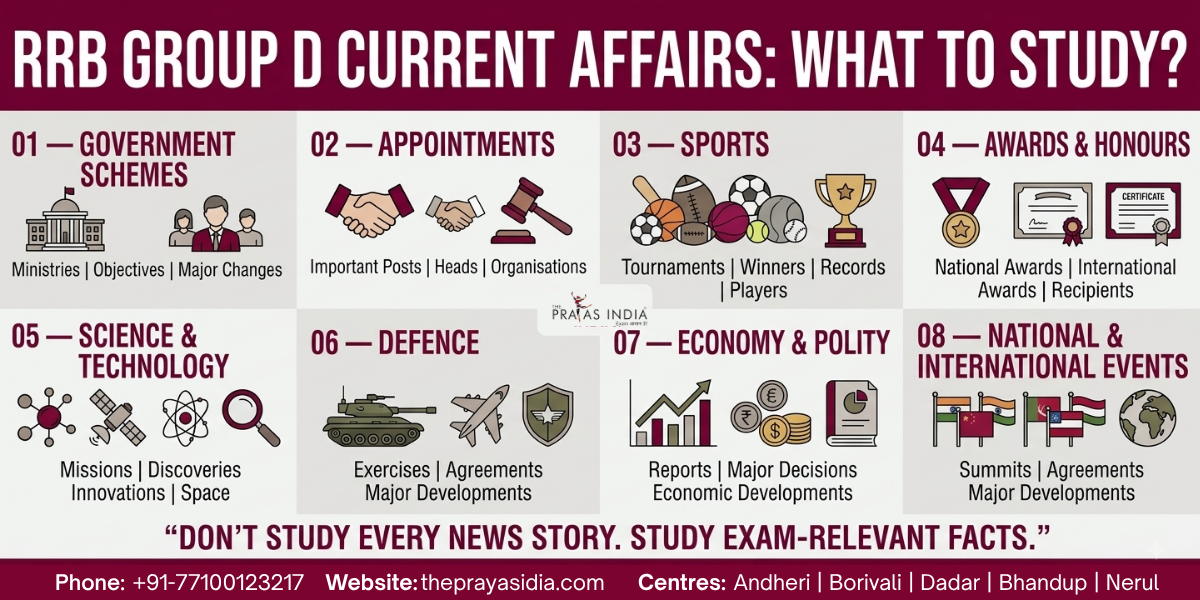
Before beginning daily preparation, divide Current Affairs into categories.
This prevents random reading and makes revision much easier.
Important areas include:
| Current Affairs Area | What to Focus On |
|---|---|
| National News | Major government decisions, important national developments |
| Government Schemes | New schemes, major changes, ministries and objectives |
| Appointments | Important appointments, heads of institutions and organisations |
| Awards & Honours | Major national and international awards |
| Sports | Major tournaments, winners, records and important personalities |
| Science & Technology | Major discoveries, missions, innovations and developments |
| Defence | Exercises, agreements, major acquisitions and developments |
| Economy | Major economic developments, institutions and important reports |
| International Affairs | Summits, agreements, organisations and major global events |
| Books & Authors | Important books, authors and notable publications |
| Important Days | Major national and international days and themes |
| Culture | Important cultural events, festivals and recognitions |
| Railway Updates | Important railway-related developments and initiatives |
The exact number of questions from each category can vary from paper to paper, so candidates should avoid treating any unofficial topic-wise distribution as guaranteed. Current-affairs preparation should instead cover the broad categories mentioned in the syllabus and prioritise important, exam-relevant events.
Which Current Affairs Topics Should RRB Group D Aspirants Prioritise?
Not every news event deserves equal preparation time.
Your first priority should be high-impact events that have clear factual information associated with them.
For example, if a major national award is announced, you should know the recipient and the relevant award category. If an important government scheme is launched or substantially modified, you should understand the scheme’s purpose, implementing ministry and target beneficiaries. If India participates in a major international summit or agreement, the participating countries, location and purpose may be relevant.
Similarly, important sports events should not be studied only as headlines. Identify the tournament, winner, venue, important achievement and other facts that can reasonably become MCQs.
A useful priority system is:
High Priority: Major appointments, government schemes, awards, sports events, major national developments, important science and technology developments, defence events and significant international events.
Medium Priority: Important reports, books and authors, important days and themes, economic developments and cultural events.
Selective Priority: Minor local developments, repetitive political statements and news with little factual examination value.
This approach allows you to spend more time revising information that has a greater chance of being useful.
How Many Months of Current Affairs Should You Study for RRB Group D?
There is no universally guaranteed number of months that will cover every question because the exact current-affairs range can vary across examination cycles and shifts.
A practical strategy is to build strong coverage of the recent months immediately preceding the examination, while giving extra attention to major events and frequently revised topics.
Recent preparation resources commonly recommend focusing heavily on the preceding several months, with some analyses suggesting roughly six to twelve months depending on the examination timeline.
However, simply downloading twelve monthly PDFs does not mean you have prepared twelve months of Current Affairs.
The real challenge is retention.
If you have six months of material but remember only a small percentage, increasing the number of months will not necessarily improve your score.
A better strategy is to combine:
- Recent monthly Current Affairs
- Important national and international events
- Major government schemes
- Important appointments
- Awards and honours
- Sports events
- Science and technology developments
- Railway-related developments
- Repeated revision
- PYQ and mock-test practice
Build a Daily Current Affairs Routine
The biggest advantage you can create in Current Affairs is consistency.
You do not need to spend several hours every day reading news. A focused daily session can be far more effective if it is followed by revision.
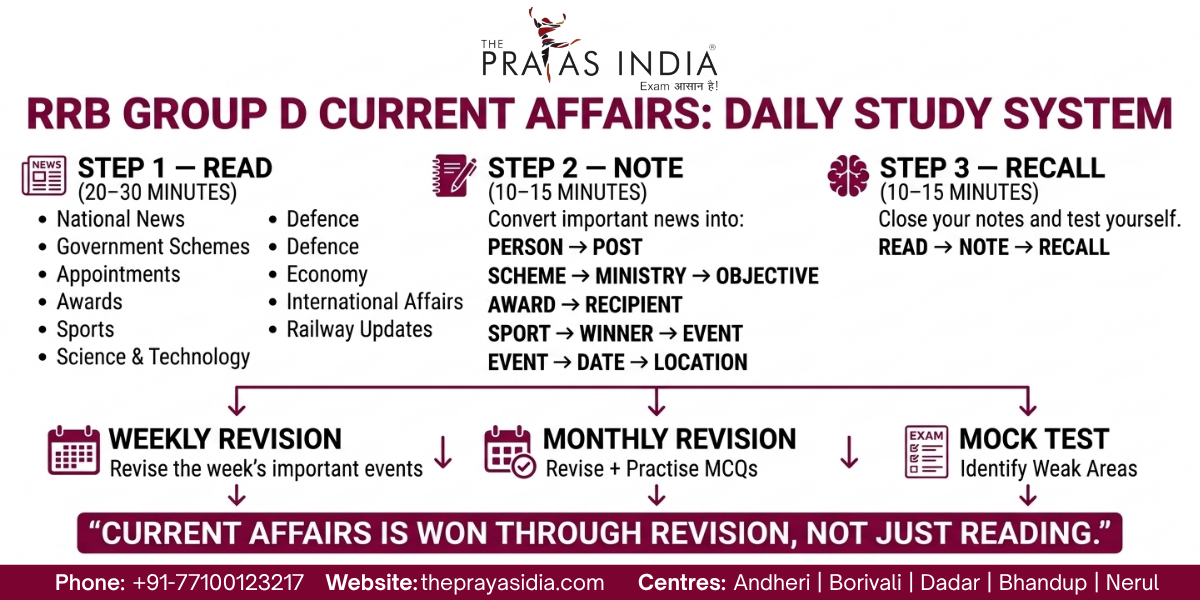
A practical routine can have three stages.
Stage 1: Read
Spend a fixed amount of time studying the day’s relevant current affairs from one reliable source.
Do not keep switching between multiple websites, Telegram channels, YouTube videos and PDFs. Excessive sources create duplication and make revision difficult.
Stage 2: Condense
Convert important information into short, exam-friendly notes.
For example, instead of writing a complete paragraph about a government scheme, record:
Scheme → Ministry → Objective → Target Group → Important Date
For an appointment:
Person → Position → Organisation → Predecessor, if relevant
For an award:
Award → Recipient → Field → Organisation/Year
This structure makes later revision much faster.
Stage 3: Revise
This is the stage many aspirants skip.
Reading today’s Current Affairs once does not guarantee that you will remember it several weeks later.
Revision should therefore be built into your schedule from the beginning.
The 1-7-30 Revision Approach
One useful way to organise Current Affairs revision is to revisit information at different intervals.
You can review a topic:
After 1 day: Quick recall of the previous day’s information.
After 7 days: Weekly revision of the week’s important events.
After 30 days: Monthly revision of the most important facts.
This does not mean that every fact needs to be memorised with equal intensity. Focus particularly on information that you repeatedly forget or that is especially important from an examination perspective.
The objective is to move information from short-term exposure towards long-term recall.
Don’t Make Notes That Are Longer Than the Original News
Your Current Affairs notes should save time, not create another textbook.
If you read a two-page article and then create a three-page note from it, your revision burden has increased rather than decreased.
Keep notes factual and compact.
For example:
Event: Major International Summit
Location: Country/City
Participants: Important countries/leaders
Purpose: Main objective
Key Outcome: Major decision/agreement
This structure is particularly useful for objective examinations because it converts information into the kind of factual format you are likely to encounter in MCQs.
Current Affairs and Static GK Should Not Be Studied Completely Separately
One of the smartest ways to improve retention is to connect current events with static knowledge.
Suppose you read about a new government scheme.
Do not stop at the scheme’s name. Understand the ministry associated with it.
If you read about an international organisation, know its headquarters and basic purpose.
If you study a sports tournament, know the sport, host location and important related facts.
If a national park appears in the news, revise its state and other basic geographical information.
This creates a connection between Current Affairs and Static GK.
Instead of memorising isolated facts, you begin building a network of related information.
That can make revision more meaningful and improve your ability to handle questions that combine current and static knowledge.
Use RRB Previous-Year Questions to Understand the Level of Current Affairs
Previous-year questions are valuable because they help you understand how information is converted into an examination question.
While analysing RRB Group D questions, pay attention to:
- The type of current event selected.
- Whether the question tests a person, place, award, organisation or event.
- How much factual detail is required.
- Whether the question connects Current Affairs with Static GK.
- Which categories appear repeatedly.
- Whether your current notes contain similar information.
This helps you avoid studying Current Affairs as a general knowledge hobby.
You are preparing for an objective examination, so your study material should gradually reflect the format of the questions you are expected to answer.
How to Remember Current Affairs for Longer
Memory becomes easier when information is organised.
Instead of attempting to memorise a long list of unrelated facts, group them.
For example, create separate weekly lists for:
- Appointments
- Awards
- Sports
- Government Schemes
- Science & Technology
- Defence
- Economy
- International Affairs
- Important Days
- Railway News
At the end of the week, test yourself without looking at the answers.
This process is more effective than repeatedly reading the same PDF.
The important distinction is between recognition and recall.
When you read a fact and think, “Yes, I have seen this before,” you are recognising it.
When you can answer a question without looking at your notes, you are recalling it.
For competitive examinations, recall is what matters.
Don’t Ignore Railway-Related Current Affairs
RRB examinations are conducted for the railway recruitment system, so railway-related developments deserve a place in your preparation.
This does not mean you should spend all your Current Affairs time studying railway news. Instead, create a dedicated revision category for important railway-related developments.
Pay attention to significant developments such as:
- Major railway projects
- Important infrastructure initiatives
- New technologies
- Major railway stations or developments
- Important trains or services when relevant
- Safety initiatives
- Electrification and modernisation
- Significant government railway initiatives
The objective is to understand major developments rather than memorise every routine railway announcement.
Continue Your Preparation With a Focused Strategy
Current Affairs should not become a subject that consumes the entire RRB Group D preparation schedule.
Remember that the CBT also includes 25 questions from General Science, 25 from Mathematics and 30 from General Intelligence and Reasoning, alongside 20 General Awareness and Current Affairs questions.
Therefore, your preparation needs balance.
A candidate who spends three hours every day reading Current Affairs but neglects Mathematics or Reasoning is not following an efficient strategy.
Current Affairs should become a consistent daily habit, while the larger preparation plan should distribute time according to your strengths, weaknesses and overall syllabus.
The goal is not to become a walking encyclopedia.
The goal is to know enough relevant information, remember it accurately and answer questions confidently under examination pressure.
Turn Current Affairs Into a Scoring Area
Current Affairs can become a scoring area for RRB Group D aspirants when preparation moves beyond passive reading. The biggest difference between an aspirant who reads current affairs every day and one who actually scores from it is usually revision and recall.
You may read hundreds of facts during a month, but the examination does not reward you for how much you have read. It rewards you for how much you can remember accurately when you see a question and its options.
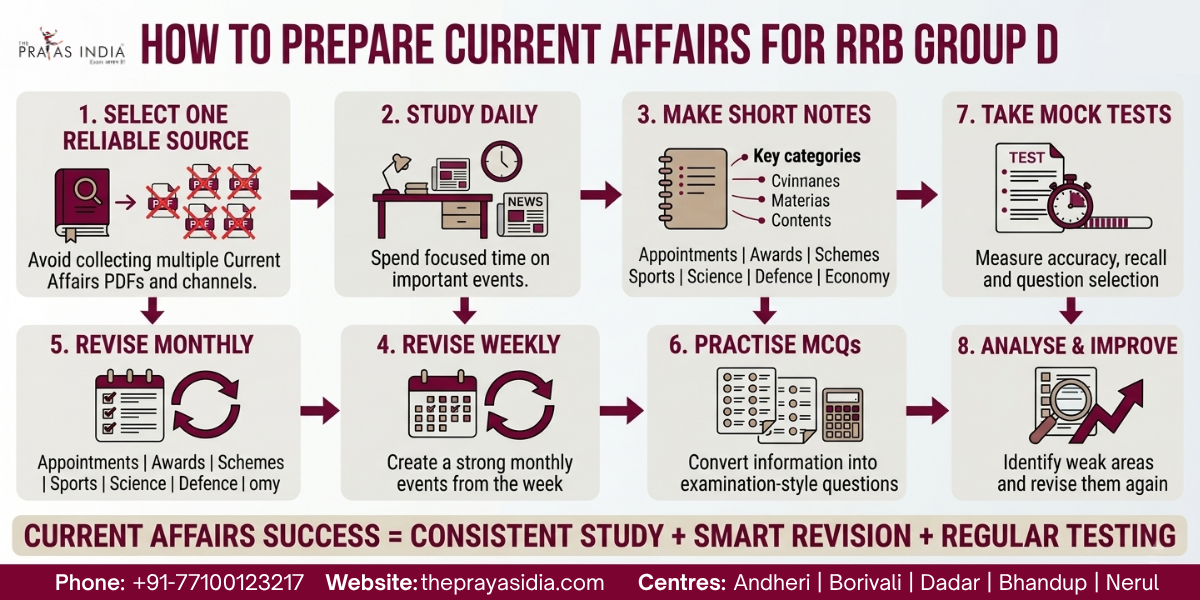
This is why your Current Affairs strategy should follow a simple progression:
Read → Understand → Shortlist → Revise → Recall → Practise → Analyse
Each stage serves a different purpose. Reading introduces information, shortlisting removes unnecessary details, revision strengthens memory, recall tests retention, and MCQ practice shows whether you can actually use the information under examination conditions.
For an RRB Group D aspirant, this approach is much more sustainable than trying to memorise every headline.
Don’t Study Current Affairs Without a Revision Calendar
One of the easiest ways to lose control of Current Affairs is to keep adding new information without revising old information.
Imagine that you study January Current Affairs in January, February Current Affairs in February and March Current Affairs in March, but never revise January or February. By the time you reach the examination, you may have studied thousands of facts but remember only a fraction of them.
A revision calendar prevents this problem.
You can divide your preparation into:
Daily Revision: Review the previous day’s important facts.
Weekly Revision: Revise all high-priority events from the week.
Monthly Revision: Revise the complete month’s selected Current Affairs.
Quarterly Revision: Revisit important appointments, awards, schemes, sports, science and major national and international events.
Final Revision: Focus on your consolidated notes, frequently forgotten facts and Current Affairs MCQs.
The exact frequency can be adjusted according to your examination schedule, but the principle should remain the same: new information must never completely replace revision.
How to Make Monthly Current Affairs PDFs Useful
Monthly Current Affairs PDFs can be useful because they consolidate a large amount of information in one place. However, downloading them is not preparation.
A common mistake is collecting PDFs from multiple sources and assuming that having more material means better preparation.
Instead, select one primary source and use it consistently.
When studying a monthly PDF, mark information under categories such as:
- Important appointments
- Awards and honours
- Government schemes
- Sports achievements
- Important days
- Defence developments
- Science and technology
- Economy
- International affairs
- Railway-related developments
- Important reports and indices
Do not highlight everything.
If every line is marked as important, nothing is actually prioritised.
Your final revision notes should contain only information that you genuinely need to remember.
Learn Facts Through Questions, Not Just Statements
Suppose your notes say:
“XYZ was appointed as the new chairperson of an organisation.”
Reading this statement several times may not guarantee recall.
Convert it into a question:
Who was appointed as the new chairperson of XYZ?
Then create another:
Which organisation appointed XYZ as its chairperson?
And, where relevant:
Who was the previous chairperson?
This process converts passive information into active recall.
It also prepares your mind for the format of an objective examination.
You can apply the same approach to schemes, awards, sports events, appointments and international organisations.
Use MCQs to Find Your Real Weaknesses
Current Affairs quizzes are useful, but they should not be treated simply as score-generating activities.
Suppose you attempt 50 questions and score 42.
The eight incorrect answers are more valuable than the 42 correct ones.
Ask why you got each question wrong.
Was the information never studied?
Did you study it but forget it?
Did you confuse two similar names?
Did you remember the event but forget the associated organisation?
Did you misread the question?
Did you make a guess because you were uncertain?
Each reason requires a different solution.
If you forgot the information, revise it.
If you confused two facts, create a comparison note.
If you misunderstood the question, improve your reading and question-solving discipline.
This is how MCQs become a preparation tool rather than merely a test.
Build a “Frequently Forgotten Facts” List
Every aspirant has certain facts that refuse to stay in memory.
Instead of repeatedly reading the entire Current Affairs material, maintain a separate list for these difficult facts.
For example:
| Category | Frequently Forgotten Information |
|---|---|
| Appointments | Person + Position |
| Awards | Award + Recipient |
| Schemes | Scheme + Ministry |
| Sports | Tournament + Winner |
| Organisations | Headquarters + Head |
| Reports | Organisation + Report |
| Important Days | Date + Theme |
| International Affairs | Country + Agreement/Event |
Review this list regularly.
Over time, it should become smaller because facts that have been repeatedly recalled will move into your long-term memory.
This is a much more efficient use of revision time than repeatedly studying information you already know.
How to Prepare Current Affairs Alongside Static General Awareness
RRB Group D preparation should not treat Current Affairs as an isolated subject.
When a current event introduces a topic, use it as an opportunity to revise related static information.
For example, if an international organisation appears in the news, revise its headquarters and basic purpose. If a state appears frequently in the news, revise its capital, geography and important features. If a sportsperson wins a major event, understand the sport and tournament involved.
This method creates connections between facts.
Instead of memorising:
Organisation → Headquarters
you begin remembering:
Organisation → Current Event → Headquarters → Function
Connected information is generally easier to recall than isolated information.
How Much Time Should You Give Current Affairs Every Day?
Current Affairs should receive consistent attention, but it should not dominate your complete RRB Group D schedule.
A practical daily session could be around 30–60 minutes, depending on your preparation stage and how much backlog you have.
A possible structure is:
20–25 minutes: Read selected Current Affairs.
10–15 minutes: Make or revise concise notes.
10–20 minutes: Solve MCQs or practise recall.
On a busy day, even a shorter session is better than completely abandoning the routine.
The important thing is to avoid the cycle of studying Current Affairs for three hours on one day and then ignoring it for the next four days.
Consistency is more valuable.
Current Affairs Should Be Integrated With Your Full RRB Group D Study Plan
A good RRB Group D preparation plan should give appropriate attention to every section rather than allowing one subject to consume your entire day.
The official RRB Level-1 recruitment framework has historically included General Science, Mathematics, General Intelligence & Reasoning, and General Awareness/Current Affairs in the CBT, with negative marking for incorrect answers. The exact distribution should always be checked against the notification applicable to your recruitment cycle.
That means Current Affairs should be treated as one component of a larger preparation strategy.
For example, your daily plan might include:
- Quantitative Aptitude practice
- Reasoning practice
- General Science revision
- Current Affairs
- Previous-year questions
- Sectional tests
- Mock-test analysis
This balance is especially important for candidates preparing for Railway exams through coaching because classroom learning should be supported by individual revision and practice.
How to Use Mock Tests for Current Affairs Preparation
Mock tests provide a realistic picture of whether your Current Affairs preparation is working.
When you take an RRB Group D mock, do not look only at your total score.
Record your Current Affairs performance separately.
For example:
| Test | Attempted | Correct | Incorrect | Accuracy |
|---|---|---|---|---|
| Mock 1 | 16 | 11 | 5 | 68.75% |
| Mock 2 | 17 | 13 | 4 | 76.47% |
| Mock 3 | 18 | 15 | 3 | 83.33% |
The exact numbers are only an illustration, but the principle is important.
If your accuracy is gradually improving, your revision strategy is working.
If your score remains stagnant despite studying more Current Affairs, you need to investigate whether the problem is poor retention, weak revision, excessive sources or ineffective MCQ practice.
What to Do If You Have a Large Current Affairs Backlog
This is a common problem.
An aspirant may suddenly realise that several months of Current Affairs have not been covered properly.
The wrong response is to attempt to read everything from the beginning in a few days.
Instead, create three categories:
Category 1: Must Revise
Major national events, important appointments, awards, government schemes, sports achievements, major science and technology developments and other high-priority events.
Category 2: Important
Reports, books and authors, important days, economic developments, defence events and other relevant information.
Category 3: Low Priority
Minor news and information with limited examination relevance.
Complete Category 1 first.
Then move to Category 2.
Do not allow Category 3 to consume the time required for your core preparation.
Common Current Affairs Mistakes RRB Group D Aspirants Make
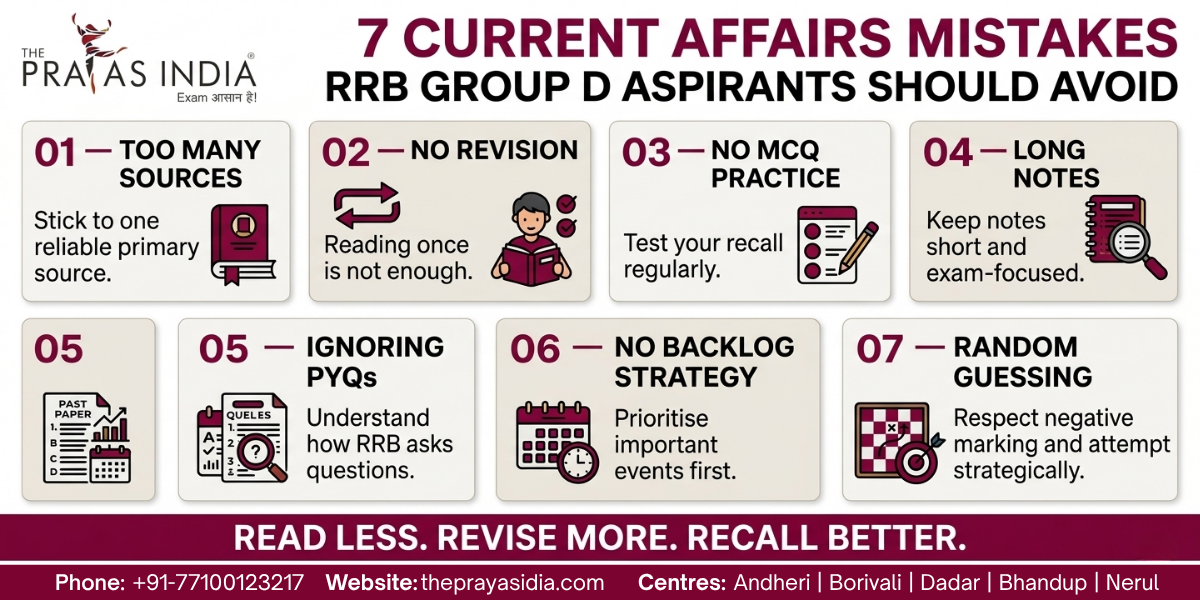
Studying From Too Many Sources
Multiple sources often contain the same information in different formats. Instead of increasing your knowledge, they increase your revision burden.
Reading Without Testing
You may feel familiar with information because you have seen it several times. Testing tells you whether you can actually recall it.
Ignoring Revision
Current Affairs is memory-intensive. Without revision, a large portion of what you study will gradually disappear.
Making Excessively Long Notes
Your notes should make revision faster, not create another syllabus.
Focusing Only on Recent Headlines
Important events from previous months can remain relevant during preparation. Build a systematic coverage and revision plan rather than studying only today’s news.
Neglecting Railway-Related Developments
Important railway developments can be relevant to Railway-exam preparation and should have a dedicated place in your notes.
Guessing Too Many Questions
Because RRB examinations use negative marking, random guessing can hurt your score. Your attempt strategy should account for the risk associated with incorrect answers.
When Should You Start Taking Full-Length RRB Group D Mocks?
You should not wait until every chapter and every Current Affairs topic is perfect before taking tests.
Early in preparation, topic-wise and sectional tests can help you understand your current level. As your syllabus coverage improves, full-length mocks become increasingly useful.
In the later stages, mock tests should become a regular part of your preparation.
But remember that the value of a mock lies in what you do after submitting it.
Spend time analysing:
- Current Affairs questions you got wrong
- Questions you guessed
- Questions you knew but answered incorrectly
- Facts you had studied but could not recall
- Questions that took too long
- Topics where your accuracy is consistently weak
This analysis should influence your next revision session.
A 30-Day Current Affairs Improvement Plan
If you want to strengthen Current Affairs systematically, you can use a four-week cycle.
Week 1: Build the System
Select your primary source and organise your notes into categories. Start daily reading and short revision.
Week 2: Increase Recall
Continue daily Current Affairs while adding daily MCQs. Start maintaining a list of frequently forgotten facts.
Week 3: Add Examination Practice
Solve Current Affairs questions through sectional tests and RRB-oriented mock papers. Analyse every mistake.
Week 4: Consolidate
Revise the complete month’s important Current Affairs. Focus on weak categories and repeatedly forgotten information.
At the end of the month, do not simply start another month.
First, complete the revision cycle for the previous month.
This ensures that your knowledge base grows without becoming increasingly difficult to manage.
How Coaching Can Help With RRB Group D Current Affairs Preparation
Current Affairs is one of the areas where students often struggle to decide what to study, what to ignore and what to revise.
This is where structured coaching can provide value.
A good RRB coaching programme can help students follow a defined preparation sequence, integrate Current Affairs with General Awareness, practise examination-oriented questions and use mock tests to identify weaknesses.
For students who are preparing independently, the same principles can still be applied. The important thing is to create a disciplined system instead of relying on random daily news consumption.
If you prefer classroom-based preparation, The Prayas India provides competitive-exam coaching support in Mumbai through centres at Andheri, Borivali, Dadar, Bhandup and Nerul.
The aim should not simply be to attend classes. Your coaching environment should help you develop a complete preparation cycle:
Learn → Practise → Test → Analyse → Revise → Improve
What to Look for Before Joining RRB Coaching in Mumbai
Choosing an RRB coaching institute is an important decision because preparation can extend over several months.
Do not select an institute only because of advertisements or general popularity.
Consider whether the institute provides:
- Structured RRB syllabus coverage
- Experienced faculty
- Relevant study material
- Regular doubt-solving support
- Topic-wise practice
- Previous-year question practice
- Sectional tests
- Full-length mock tests
- Performance analysis
- Revision support
- Current Affairs guidance
- A convenient centre location
A good preparation environment should reduce confusion rather than add to it.
For Mumbai-based Railway aspirants, The Prayas India has centres at:
Andheri | Borivali | Dadar | Bhandup | Nerul
Students can contact the institute at +91-77100123217 for further information about RRB exam preparation.
Can Current Affairs Be Prepared Without Feeling Overwhelmed?
Yes, provided you stop treating Current Affairs as an endless list of news stories.
The purpose of preparation is not to know everything.
It is to know the right information well enough to recall it during the examination.
A disciplined RRB Group D aspirant should therefore focus on four things:
Coverage: Study the important categories.
Retention: Revise information repeatedly.
Recall: Test yourself through MCQs.
Application: Practise under examination conditions.
If you follow this cycle consistently, Current Affairs becomes much more manageable.
The section that initially seems unlimited can gradually become a structured collection of categories, notes, questions and revision lists.
Final Strategy: Make Current Affairs a Habit, Not a Burden
Preparing Current Affairs for RRB Group D does not require you to spend your entire day following the news.
It requires a system.
Study important events every day. Avoid unnecessary sources. Keep your notes concise. Revise weekly and monthly. Practise MCQs. Use previous-year questions to understand examination patterns. Track the facts you repeatedly forget. Then use mock tests to determine whether your preparation is actually translating into marks.
Most importantly, do not postpone Current Affairs preparation until the final weeks.
Mathematics and Reasoning improve through repeated problem-solving, while Current Affairs requires repeated exposure and recall. If you leave it all until the end, the volume can become difficult to manage.
Start early and keep the daily workload small enough to maintain consistently.
For aspirants who prefer structured guidance, The Prayas India offers RRB exam preparation support in Mumbai through its centres at Andheri, Borivali, Dadar, Bhandup and Nerul.
📞 Call Now: +91-77100 13217
🌐 Website: theprayasindia.com
📍 Centres: Andheri | Borivali | Dadar | Nerul | Bhandup
The right strategy is not to read more news.
It is to study smarter, revise consistently and walk into the RRB Group D examination with information you can actually recall.