
How to Prepare for All 4 MBA CET Sections: A Complete Strategy for 99+ Percentile
The MAH MBA CET is an important entrance examination for students targeting leading management institutes in Maharashtra. However, achieving a competitive percentile requires more than completing the syllabus. Aspirants must develop speed, accuracy, logical thinking, and the ability to manage time across all four sections: Logical Reasoning, Abstract Reasoning, Quantitative Aptitude, and Verbal Ability and Reading Comprehension.
For students preparing in Mumbai’s Central Suburbs, choosing a structured study plan can make preparation more manageable. The Prayas India Bhandup offers a local option for aspirants seeking organised MBA CET preparation, classroom guidance, practice opportunities, and a focused approach to entrance exam readiness.
Whether you are beginning your preparation, balancing college with coaching, or trying to improve your mock-test performance, understanding the requirements of every section is the first step towards building a stronger CET strategy.
Understanding the Four Sections of MAH MBA CET
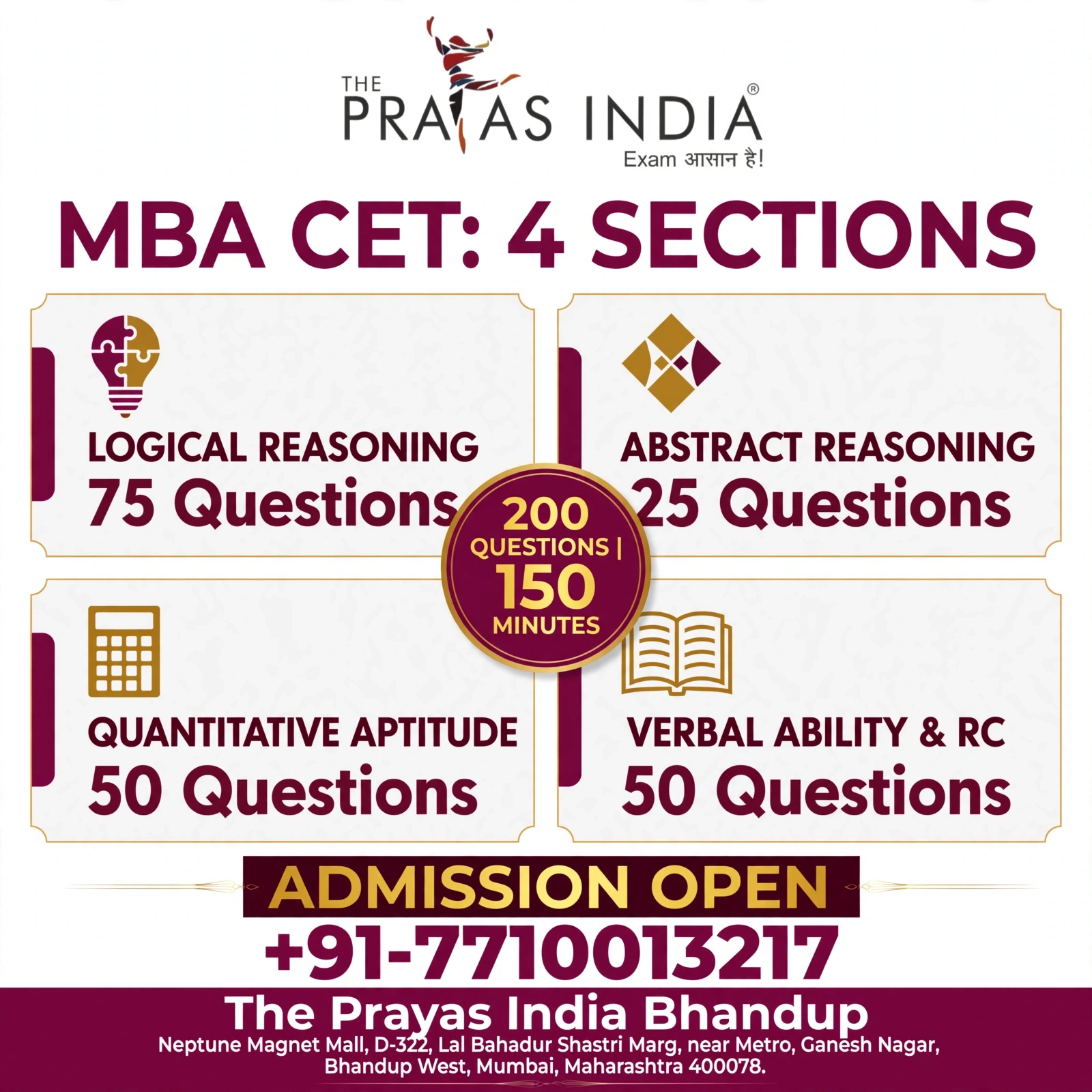
The MAH MBA CET tests multiple skills within a time-bound computer-based examination. Logical Reasoning evaluates analytical thinking, Abstract Reasoning tests visual pattern recognition, Quantitative Aptitude measures numerical problem-solving, and Verbal Ability and Reading Comprehension assesses language comprehension and verbal skills.
The commonly followed examination pattern comprises 200 questions to be attempted in 150 minutes, with no negative marking under the established pattern. Candidates should always verify the latest official notification because the examination authority may revise its rules or structure.
A practical preparation plan should cover all four sections rather than concentrating exclusively on a student’s strongest subject. Consistent practice across the paper helps candidates identify scoring opportunities, improve question selection, and avoid losing valuable time on difficult problems.
1. Logical Reasoning: Improve Speed Without Sacrificing Accuracy
Logical Reasoning is a major component of MAH MBA CET preparation. Questions may involve arrangements, seating arrangements, blood relations, coding-decoding, inequalities, syllogisms, directions, rankings, input-output patterns, and other analytical reasoning formats.
The challenge is not simply understanding a question. Candidates must recognise the question type quickly, select an efficient method, and reach a reliable answer without spending excessive time on a single problem.
Build concepts before attempting timed sets
Begin by studying one topic at a time. For seating arrangements, practise linear and circular arrangements before moving to more complicated puzzles. For blood relations and directions, use diagrams to represent the information instead of repeatedly rereading the question.
Once the basic concepts are clear, solve topic-wise exercises and gradually increase their difficulty. Maintain a notebook of recurring mistakes, such as overlooking a condition, making an incorrect assumption, or misinterpreting a relationship.
Practise question selection
Not every reasoning question requires the same amount of time. Some questions can be solved quickly, while a complex arrangement may demand several minutes. Learn to recognise questions that offer a better balance between solving time and confidence.
During mock tests, record which question types consume the most time. Review whether the delay occurred because of a conceptual gap, slow diagram formation, or an inefficient approach.
How coaching can support Logical Reasoning
Structured classroom practice can help aspirants understand different solving methods and receive feedback on their approach. At The Prayas India Bhandup, students can enquire about the available MBA CET course structure, reasoning practice, mock-test support, and doubt-solving arrangements before enrolling.
The objective is to develop a repeatable method for solving questions rather than memorising isolated tricks.
2. Abstract Reasoning: Master Patterns Through Visual Practice
Abstract Reasoning tests the ability to identify relationships between shapes, figures, symbols, and visual sequences. Although many questions appear straightforward, unfamiliar patterns and small visual differences can cause avoidable errors.
Learn the common pattern types
Practise figure series, odd-one-out questions, figure analogies, rotations, reflections, and pattern completion. When analysing a figure, check the number of elements, direction of movement, rotation, shading, symmetry, and changes in position.
For example, a shape may rotate by a fixed angle while the number of internal symbols increases. Another sequence may alternate between shaded and unshaded elements. Identifying these changes systematically is more reliable than guessing based on the overall appearance.
Use a fixed observation method
Whenever you encounter a new figure, examine it in a consistent order:
- Count the shapes, lines, dots, and other elements.
- Check whether any element rotates or changes direction.
- Observe changes in shading, position, and size.
- Look for alternating patterns or repeated cycles.
- Eliminate options that violate the identified rule.
This approach reduces random guessing and makes unfamiliar patterns easier to analyse.
Improve speed with short daily sessions
Abstract Reasoning benefits from frequent visual practice. Solve a short set of questions every day, review incorrect answers, and revisit patterns that previously caused confusion. Gradually introduce timed exercises after you can identify the underlying rules consistently.
Avoid practising only familiar questions. Mixed sets help you adapt to new patterns under examination conditions.
For CET aspirants in Bhandup, a balanced study plan should include Abstract Reasoning alongside Logical Reasoning and Quantitative Aptitude instead of leaving visual questions until the final weeks.
3. Quantitative Aptitude: Strengthen Fundamentals and Calculation Speed
Quantitative Aptitude can become challenging when candidates lack conceptual clarity or spend too much time on calculations. Common preparation areas include arithmetic, percentages, ratios, averages, profit and loss, interest, time and work, speed and distance, algebra, number systems, and data interpretation.
The exact topic distribution can vary, so candidates should use the latest syllabus and previous papers to guide their preparation.
Start with high-utility mathematical concepts
Build a strong foundation in percentages, ratios, fractions, averages, and basic arithmetic operations. These concepts support several other topics and are useful when solving data interpretation questions.
Practise calculations mentally where appropriate, but do not sacrifice accuracy for speed. Learn multiplication tables, fraction-to-percentage conversions, squares, cubes, and estimation techniques that are relevant to the problems you encounter.
Use a three-stage preparation method
First, understand the formula and the logic behind it. Second, solve untimed questions until the method becomes familiar. Third, attempt timed sets to improve calculation speed and question selection.
For example, a percentage question may be solved through direct calculation or a convenient fractional conversion. With practice, candidates learn to choose the shorter reliable method rather than applying lengthy calculations automatically.
Analyse data interpretation carefully
Data interpretation questions require candidates to read tables, charts, graphs, and numerical comparisons accurately. A common mistake is to begin calculating before understanding the units, scale, or relationship being asked about.
Read the question first, identify the required values, and estimate the likely answer before completing the calculation. This can help eliminate implausible options and reduce unnecessary work.
Turn mistakes into a revision plan
After every practice set, classify errors into conceptual mistakes, calculation errors, formula confusion, and time-management problems. Each category requires a different solution. Conceptual mistakes need revision, calculation errors need careful practice, and time-management problems require timed exercises and better question selection.
Students considering The Prayas India Bhandup can enquire about the availability of quantitative aptitude classes, calculation techniques, practice material, and performance reviews. The value of coaching depends on how consistently candidates apply what they learn between classes.
4. Verbal Ability and Reading Comprehension: Build Comprehension and Language Skills
The Verbal Ability and Reading Comprehension section evaluates how effectively candidates understand written information, interpret arguments, identify relationships between ideas, and use English language concepts.
Relevant preparation areas may include reading comprehension, grammar, vocabulary, sentence correction, para jumbles, sentence completion, and other verbal reasoning question types.
Make reading a daily habit
Read well-written editorials, analytical articles, and explanatory pieces on a variety of subjects. Focus on identifying the central argument, supporting evidence, the writer’s tone, and the purpose of each paragraph.
After reading an article, summarise its main idea in two or three sentences. This exercise improves comprehension and helps you distinguish the author’s central point from supporting details.
Practise vocabulary in context
Instead of memorising long word lists without context, learn unfamiliar words while reading. Record their meanings, synonyms, antonyms, and example sentences. Revise them regularly so that the vocabulary becomes easier to recognise during the examination.
For grammar, focus on sentence structure, subject-verb agreement, modifiers, articles, prepositions, and common usage errors. Apply each rule through practice questions rather than relying on theory alone.
Develop a strategy for reading comprehension
Read the passage with attention to its structure and argument. Identify the main idea, the role of each paragraph, and any contrast or conclusion. When answering a question, return to the relevant passage instead of choosing an option merely because it sounds reasonable.
For inference questions, distinguish what the passage supports from what might be true in general. Avoid options that introduce assumptions or extreme statements unsupported by the text.
Balance reading and question practice
Candidates who spend all their time learning vocabulary may neglect comprehension, while those who read extensively without solving questions may struggle with examination-style options.
Combine daily reading, verbal practice sets, and timed comprehension exercises. Review every incorrect answer to understand whether the problem was vocabulary, interpretation, grammar, or rushed reading.
A Practical Daily Study Plan for All Four Sections
A consistent timetable is generally more useful than occasional long study sessions. Your exact schedule should depend on your starting level, available preparation time, and performance in mock tests.
A sample three-hour daily plan is:
- Logical Reasoning: 50 minutes for concepts and timed practice.
- Quantitative Aptitude: 45 minutes for calculations and problem-solving.
- Verbal Ability and Reading Comprehension: 40 minutes for reading and verbal exercises.
- Abstract Reasoning: 25 minutes for visual pattern practice.
- Revision and error analysis: 20 minutes to review mistakes and update your weak-topic list.
This schedule totals 180 minutes. Adjust the time allocation as your mock-test results reveal which areas need more attention. A candidate with weak Quantitative Aptitude may temporarily devote additional time to mathematics, while a candidate with strong verbal skills may focus on maintaining that performance.
Once a week, attempt a full-length mock test under realistic examination conditions. Spend sufficient time reviewing the result rather than immediately moving to another test.
Why Mock-Test Analysis Matters for a Higher CET Percentile
Completing mock tests is only one part of effective preparation. The greater benefit comes from understanding what the results reveal about your performance.
Track accuracy, time spent per question, unattempted questions, repeated mistakes, and performance by topic. Compare results across multiple tests to determine whether your preparation is producing measurable improvement.
If you consistently answer a question type incorrectly, revisit its concepts. If you solve questions correctly but too slowly, practise shorter methods and timed sets. If you lose marks because of rushed reading, work on question interpretation and answer verification.
Avoid judging your preparation from one unusually good or poor mock test. Look for patterns across several tests and use them to make informed changes to your study plan.
At The Prayas India Bhandup, prospective students can ask about the current availability of mock tests, individual performance analysis, faculty feedback, and doubt-solving support. Confirm the facilities included in the course before admission.

Choosing MBA CET Coaching in Bhandup, Mumbai
For students living in Bhandup, Mulund, Kanjurmarg, Nahur, Vikhroli, and nearby Central Suburban areas, travel time and study consistency are important considerations when selecting coaching.
Compare institutes on faculty experience, coverage of all four sections, quality of practice material, mock-test frequency, feedback mechanisms, doubt resolution, batch timings, and total fees. Attend a counselling session or demo class where available, and ask how the institute helps students identify and improve weak areas.
The Prayas India Bhandup is a local option for students seeking MBA CET preparation near Bhandup’s residential and transport connections. Its centre is located at Neptune Magnet Mall on Lal Bahadur Shastri Marg, near the metro, in Bhandup West, Mumbai.
Students can contact the centre to confirm the current MBA CET batch schedule, fees, available learning resources, admission process, and demo-class options.
Final Preparation Strategy: Consistency Across All Four Sections
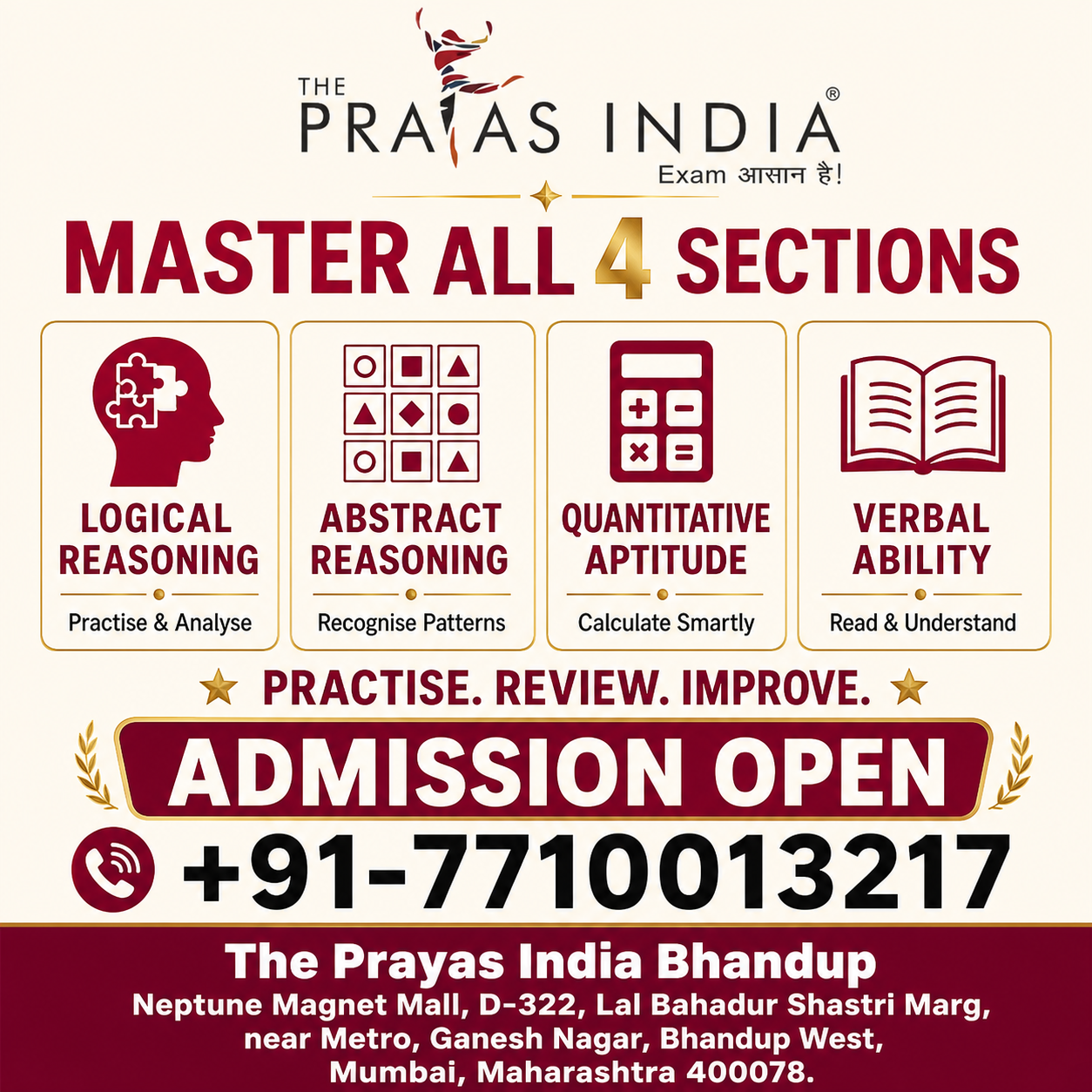
A strong MAH MBA CET preparation plan combines conceptual understanding, regular practice, timed solving, and honest performance analysis. Logical Reasoning requires structured thinking, Abstract Reasoning needs pattern recognition, Quantitative Aptitude demands mathematical fluency, and Verbal Ability and Reading Comprehension depend on language skills and careful interpretation.
Do not wait until the final month to begin mock tests or address weak topics. Start with a realistic timetable, track progress weekly, and revise recurring mistakes. As the examination approaches, increase the proportion of timed mixed practice and full-length tests while continuing to revise essential concepts.
If you are looking for MBA CET coaching in Bhandup, speak with The Prayas India Bhandup about its current preparation programme and decide whether its teaching approach, schedule, and support match your needs. With a structured plan and disciplined execution, you can work towards improving your performance across all four sections and pursuing your target MBA institutes.
The exam-pattern details used above are consistent with the MAH MBA/MMS CET 2026 information brochure and published section-wise pattern: 200 questions, 150 minutes, and four sections. Verify the next examination’s official notification before publishing any year-specific claims.
Frequently Asked Questions About MBA CET Preparation
1. What are the four sections of MAH MBA CET?
The four sections are Logical Reasoning, Abstract Reasoning, Quantitative Aptitude, and Verbal Ability and Reading Comprehension. Candidates should prepare for all four sections through concept revision and regular practice.
2. How many questions are there in MAH MBA CET?
The 2026 examination pattern comprised 200 questions to be completed in 150 minutes. Check the latest official notification for the pattern applicable to your examination year.
3. Which section has the highest weightage in MBA CET?
In the 2026 pattern, Logical Reasoning had 75 questions, Abstract Reasoning had 25, Quantitative Aptitude had 50, and Verbal Ability and Reading Comprehension had 50.
4. How should I prepare for all four MBA CET sections?
Build your concepts topic by topic, practise timed question sets, take regular mock tests, and analyse mistakes. Give extra attention to weaker sections while maintaining your strengths.
5. Are mock tests important for MBA CET preparation?
Yes. Mock tests help you assess speed, accuracy, question selection, and time management. Reviewing every test helps identify recurring mistakes and topics that need more practice.
6. Where can I enquire about MBA CET coaching in Bhandup?
You can contact The Prayas India Bhandup at 07710013217 or visit the centre at Neptune Magnet Mall, D-322, Lal Bahadur Shastri Marg, near Metro, Ganesh Nagar, Bhandup West, Mumbai, Maharashtra 400078. Contact the centre to confirm current batches, fees, and available facilities.
Prepare for MBA CET with The Prayas India Bhandup
Looking for MBA CET coaching in Bhandup? Enquire about available batches, section-wise preparation, mock tests, fees, and counselling options to plan your preparation.
Call or WhatsApp Us
Visit Our Bhandup Centre
The Prayas India Bhandup
Neptune Magnet Mall, D-322,
Lal Bahadur Shastri Marg, near Metro,
Ganesh Nagar, Bhandup West,
Mumbai, Maharashtra 400078.
Connect with our team to discuss your MBA CET preparation goals and the currently available course options.