How to Prepare for RRB NTPC 2026 from Scratch: Complete Beginner’s Strategy | The Prayas India
RRB NTPC is one of the most popular railway recruitment examinations for candidates looking for stable government-sector career opportunities. With the release of the RRB NTPC 2026 recruitment notification for 5,165 vacancies, interest among both graduate and undergraduate aspirants has increased significantly. The current recruitment includes 3,477 Graduate-level vacancies and 1,688 Undergraduate-level vacancies, giving candidates from different educational backgrounds an opportunity to apply for eligible posts.
However, receiving the notification is only the beginning. For a student who has already been preparing for competitive examinations, understanding the syllabus and building a study routine may be relatively straightforward. But for a complete beginner, the situation is different. Many aspirants have the same question: “Mujhe kuch nahi aata, RRB NTPC ki preparation kahan se start karun?”
The good news is that you do not need to know everything before starting. You need a structured approach that takes you from understanding the examination to building concepts, practising questions, improving speed and gradually becoming comfortable with mock tests.
This article provides a step-by-step strategy for beginners who are starting their RRB NTPC 2026 preparation from scratch. It explains what to study first, how much time to devote to each subject, how to build a daily routine, when to start mock tests, how to revise and how structured guidance can help you avoid common preparation mistakes.
RRB NTPC 2026: Why Beginners Should Start Early
The first mistake many beginners make is waiting for the examination date to come closer before beginning serious preparation. Competitive examinations do not become easier simply because the syllabus looks familiar. RRB NTPC preparation requires conceptual understanding, repeated practice, speed development, revision and examination-oriented question solving.
The 2026 recruitment has 5,165 vacancies, with applications scheduled separately for Graduate and Undergraduate-level candidates. Graduate-level applications are scheduled from 8 October to 6 November 2026, while Undergraduate-level applications are scheduled from 15 October to 13 November 2026. Candidates should always verify the latest official instructions, dates and eligibility requirements before submitting an application.
For beginners, the application window should not be treated as the starting point of preparation. Your preparation should ideally begin before or around the application period so that you have enough time to develop the required fundamentals.
The objective during the initial stage should not be to complete hundreds of questions every day. Instead, your first goal should be to understand the examination, identify your current level and create a realistic study system.
Important Note for Beginners
Important: If you are starting from zero, do not compare your first-week performance with candidates who have already spent months preparing. Your first target should be consistency and concept building, not an immediately high mock-test score.
What Is RRB NTPC and What Does a Beginner Need to Prepare?
RRB NTPC refers to the Railway Recruitment Board Non-Technical Popular Categories examination. The recruitment covers various non-technical posts at Graduate and Undergraduate levels.
For the current recruitment, Graduate-level posts include positions such as Goods Train Manager, Chief Commercial-cum-Ticket Supervisor, Junior Accounts Assistant cum Typist and Senior Clerk cum Typist. Undergraduate-level posts include Trains Clerk, Commercial cum Ticket Clerk, Accounts Clerk cum Typist and Junior Clerk cum Typist.
The exact selection stages can vary depending on the post. The recruitment process generally involves computer-based examinations, followed by applicable skill or aptitude tests, document verification and medical examination.
For the written examination, beginners need to build preparation around three major areas:
- Mathematics
- General Intelligence and Reasoning
- General Awareness
The important point is that you do not have to master all three subjects simultaneously from Day 1. A better strategy is to introduce the subjects gradually, understand your strengths and weaknesses and then increase the intensity of practice.
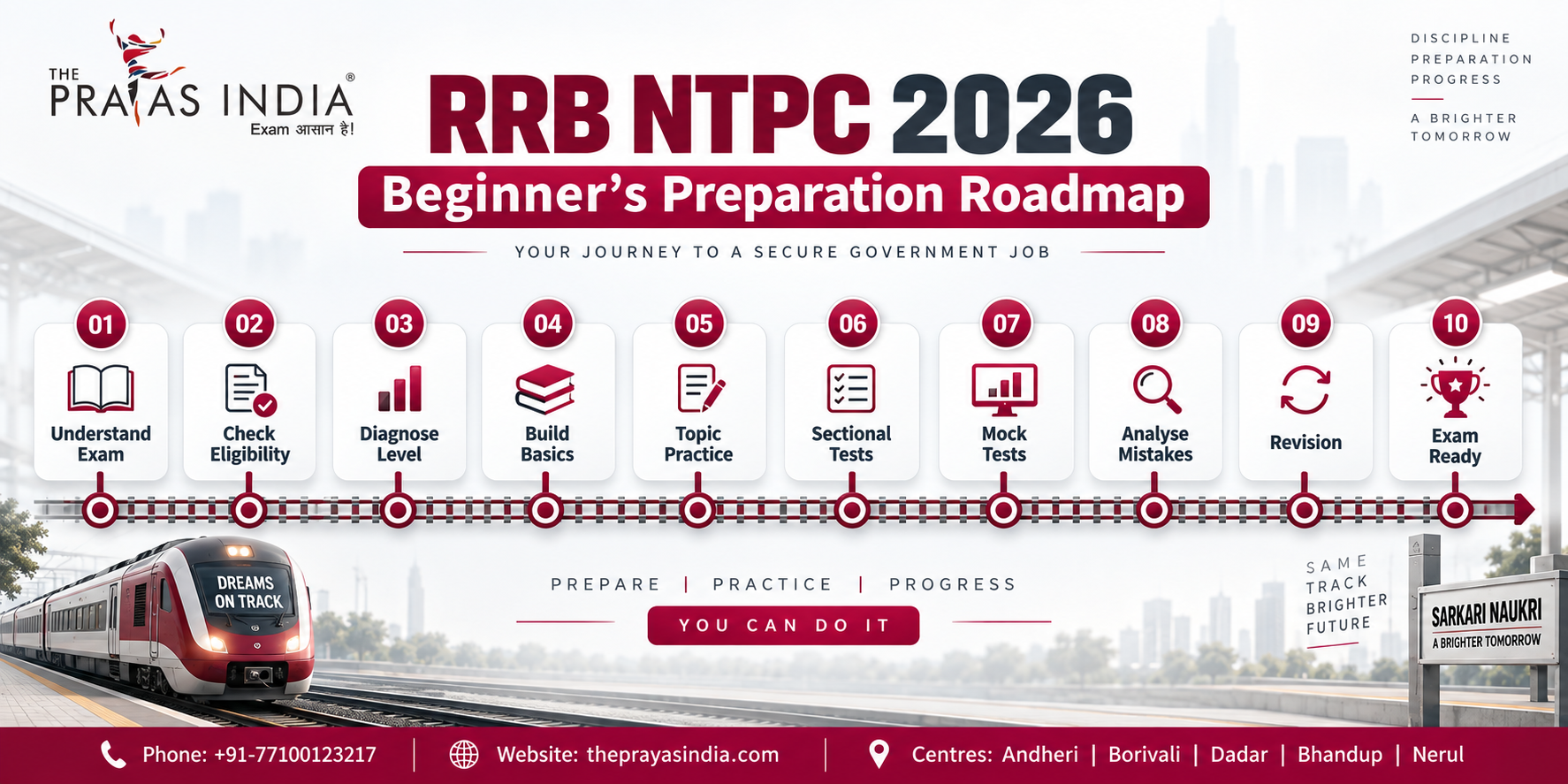
RRB NTPC Preparation Roadmap for Beginners
A beginner-friendly preparation journey can be divided into the following stages:
Stage 1: Understand the examination
Stage 2: Check your eligibility and target posts
Stage 3: Analyse your current level
Stage 4: Build basic concepts
Stage 5: Start topic-wise practice
Stage 6: Introduce sectional tests
Stage 7: Start full-length mock tests
Stage 8: Analyse mistakes and improve speed
Stage 9: Revise repeatedly
Stage 10: Move towards examination-level practice
The purpose of this progression is to prevent beginners from jumping directly into difficult questions and becoming discouraged.
Step 1: Understand the RRB NTPC Exam Before You Start Studying
Before opening a book, understand what you are preparing for. Beginners often start studying random chapters because someone recommended them, without knowing how the examination is structured. This creates confusion and makes preparation inefficient.
For CBT 1, the examination pattern includes questions from General Awareness, Mathematics and General Intelligence & Reasoning. The commonly notified pattern consists of 100 questions carrying 100 marks, with 90 minutes available for the examination. The broad distribution is 40 questions for General Awareness, 30 for Mathematics and 30 for Reasoning.
CBT 2 is a higher-level stage with 120 questions for 120 marks, generally distributed as 50 questions in General Awareness, 35 in Mathematics and 35 in General Intelligence and Reasoning, with 90 minutes available.
There is also a 1/3 mark negative marking for incorrect answers in the computer-based tests. This makes accuracy an important part of preparation. A beginner should therefore avoid developing the habit of blindly attempting questions just to increase the attempt count.
The exact selection requirements depend on the post. Some posts may involve a typing skill test, while applicable posts may involve the Computer Based Aptitude Test. Candidates should therefore prepare according to the specific post and the detailed notification applicable to them.
Step 2: Identify Your Target RRB NTPC Posts
Before creating a study plan, understand which posts you are eligible for.
Graduate candidates can target eligible Graduate-level posts, while candidates with 12th-level qualifications can target eligible Undergraduate posts. Some posts also have specific skill requirements, such as typing proficiency.
This step is important because your preparation should not be based only on the number of vacancies. You should understand the educational qualification, age requirement, typing or aptitude requirements, medical standards where applicable and selection stages associated with the posts you are interested in.
A beginner who understands the target post from the beginning is less likely to waste time preparing for requirements that may not apply to them.
Step 3: Take a Diagnostic Test Before Starting Serious Preparation
If you genuinely feel that you know nothing about RRB NTPC, do not immediately start studying for 8–10 hours every day.
Instead, take a basic diagnostic test.
Attempt a small number of questions from Mathematics, Reasoning and General Awareness without worrying about the score. The purpose is not to judge your ability. It is to understand your current position.
For example, you may discover that:
- Your basic calculations are slow.
- You understand reasoning questions but take too much time.
- Your General Awareness is weak.
- You are comfortable with percentages but struggle with time and work.
- You know static GK but have poor current-affairs coverage.
Once you identify these areas, your preparation becomes more personalised.
A Simple Beginner Diagnosis
| Area | What to Check |
|---|---|
| Mathematics | Basic calculation, formulas and arithmetic concepts |
| Reasoning | Understanding patterns and logical relationships |
| General Awareness | Static GK, science, history, geography and current affairs |
| Speed | Time taken to solve basic questions |
| Accuracy | Number of correct answers |
| Revision | How much information you can retain |
This diagnostic stage prevents one of the most common preparation mistakes: following the same study schedule regardless of your actual strengths and weaknesses.
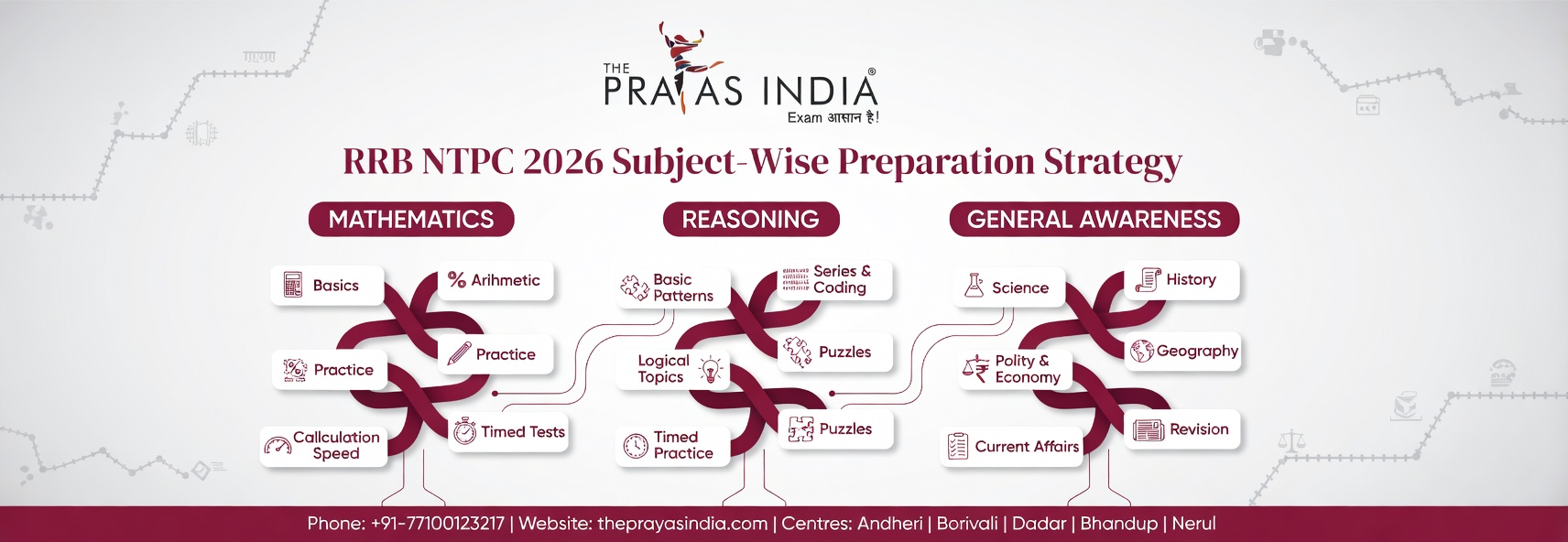
Step 4: Build Your Mathematics Foundation
Mathematics can feel intimidating to beginners, especially if they have been away from academic mathematics for several years. The solution is not to avoid Mathematics. Instead, rebuild your fundamentals systematically.
Start with topics that form the foundation for other arithmetic chapters. Number System, Fractions, Decimals, LCM, HCF, Ratio and Proportion and basic percentages can be introduced early.
Once your foundation improves, move towards topics such as Profit and Loss, Simple and Compound Interest, Time and Work, Time and Distance, Mensuration and other important arithmetic areas.
Do not focus only on memorising formulas. You should understand when and how a formula is used.
For example, learning the formula for percentage is not enough. You should practise converting percentages, comparing values, calculating percentage increases and decreases and applying percentages in profit-loss or other arithmetic questions.
The same principle applies to Time and Work or Time and Distance. Concept clarity should come before speed.
Beginner Mathematics Sequence
A practical progression can be:
Number System → Fractions & Decimals → LCM/HCF → Ratio & Proportion → Percentage → Profit & Loss → Average → Simple & Compound Interest → Time & Work → Time & Distance → Mensuration → Algebra/Geometry and other relevant topics
The sequence can be adjusted according to your strengths and the detailed syllabus.
Step 5: Build Reasoning from Basic Patterns
Reasoning can become one of the more manageable sections for a beginner if concepts are introduced in the right order.
Start with basic topics such as analogy, similarities and differences, classification, number series, alphabet series and coding-decoding. Once you become comfortable with these question types, gradually move towards syllogism, relationships, Venn diagrams, analytical reasoning, puzzles, statement-based questions and data sufficiency.
The objective is to learn how a question is structured rather than memorising answers.
Reasoning also provides an opportunity to develop speed. After understanding a topic, solve several questions of the same type together. This helps your brain recognise recurring patterns and reduces the time required to understand the question during the examination.
Do not immediately start with the most difficult puzzles. A beginner should first build confidence through basic and moderate-level questions.
Step 6: Start General Awareness with a Structured Approach
General Awareness can appear overwhelming because its syllabus covers a wide range of subjects. A beginner should avoid trying to memorise everything at once.
Divide General Awareness into broad categories such as:
- General Science and Life Science
- Indian History
- Geography
- Indian Polity and Governance
- Economy
- Science and Technology
- Environment
- Computers
- Sports
- Art and Culture
- Important Organisations
- Government schemes and programmes
- Current Affairs
- Important personalities and events
For General Science, school-level concepts can provide a useful foundation. History and Geography should be studied topic-wise rather than randomly. Current affairs should be covered consistently instead of being postponed until the final weeks.
A daily current-affairs habit is generally more manageable than trying to memorise several months of information in a short period.
Step 7: Do Not Ignore Revision from the First Week
One of the biggest problems beginners face is the illusion of completion.
You study a chapter today and feel that you have completed it. After two weeks, you realise that you remember very little.
This happens because learning and retention are different things.
Revision should therefore begin from the first week. Keep short notes of formulas, concepts, important facts and mistakes. Review them at regular intervals.
A simple revision cycle can be:
Learn → Practise → Revise → Test → Analyse → Revisit Weak Areas
This cycle should continue throughout your preparation.
Important Rule for Beginners
Do not measure preparation only by the number of chapters completed. Measure it by how accurately you can solve questions from those chapters after revision.
Step 8: Build a Realistic Daily Study Routine
A beginner does not necessarily need to start with 10 or 12 hours of study. A sustainable routine is more important.
If you are starting from zero, even 4–6 focused hours can be productive when used correctly. As your preparation develops, you can gradually increase the intensity according to your personal schedule.
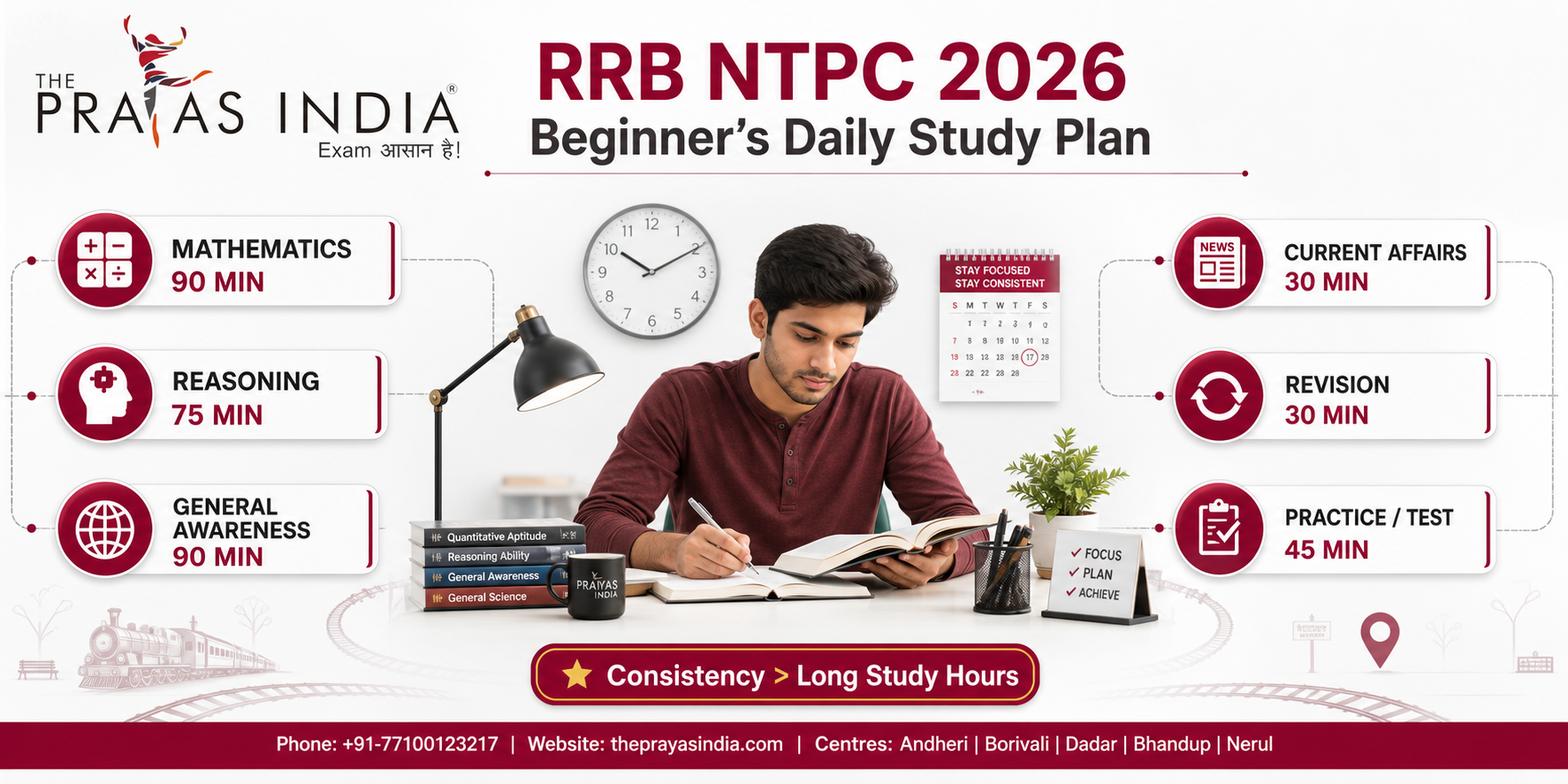
A basic daily structure could look like this:
| Study Area | Approximate Time |
|---|---|
| Mathematics Concepts + Practice | 90 minutes |
| Reasoning Concepts + Practice | 75 minutes |
| General Awareness | 90 minutes |
| Current Affairs | 30 minutes |
| Revision | 30 minutes |
| Previous Questions/Test Practice | 45 minutes |
This is only a framework. College students, working professionals and full-time aspirants may need different schedules.
The important principle is to maintain a balance between learning, practice and revision. Spending the entire day watching lectures without solving questions will not create examination readiness.
How Many Hours Should a Beginner Study for RRB NTPC 2026?
There is no universal number of hours that guarantees success in RRB NTPC. A student studying for six focused hours with proper practice and revision can be more productive than someone sitting with books for ten hours while frequently getting distracted.
If you are completely new, begin with a manageable target. The first objective is to develop the habit of studying consistently every day.
During the initial weeks, focus on:
- Understanding basic concepts.
- Solving easy and moderate questions.
- Creating short notes.
- Revising previously studied topics.
- Developing calculation speed.
- Reading current affairs regularly.
- Tracking mistakes.
As your confidence increases, increase the number of practice questions and gradually introduce timed tests.
The most important thing is not how many hours you promise yourself. It is whether you can follow your study plan repeatedly.
How Should Beginners Use Previous-Year Questions?
Previous-year questions are extremely useful because they help you understand how concepts are converted into examination questions.
However, do not use previous-year papers only as mock tests. During the foundation stage, use them as learning material.
Suppose you are studying Percentage. After completing the concept, solve relevant previous-year questions. Observe the types of questions being asked, the level of calculation and the methods that save time.
The same approach can be used for Reasoning and General Awareness.
Maintain a Previous-Year Question Notebook or digital record where you note:
- Questions you could not solve.
- Questions you solved incorrectly.
- Questions that took too long.
- New concepts learned.
- Short methods or important facts.
This record can become extremely useful during revision.
When Should You Start Taking Mock Tests?
A common mistake is taking full-length mock tests too early and becoming demotivated by low scores.
At the same time, waiting until the last few weeks to take your first mock test is also a mistake.
The better approach is gradual.
During the foundation stage, focus on topic-wise practice. Once you become comfortable with individual topics, introduce sectional tests. After completing a reasonable portion of the syllabus, start full-length CBT-style mocks.
The purpose of early mock tests is not simply to obtain a high score. It is to identify weaknesses.
If your first mock score is low, ask:
Which section caused the problem?
Then ask:
Was the problem conceptual knowledge, calculation speed, question selection, time management or careless mistakes?
This analysis is more valuable than simply checking the final score.
RRB NTPC 2026 Preparation Strategy: From Zero to Exam-Ready
Once the foundation is established, the preparation should gradually move towards examination-level practice. This is where many beginners make another mistake: they continue studying concepts indefinitely but do not transition into timed practice.
The purpose of preparation is ultimately to perform under examination conditions.
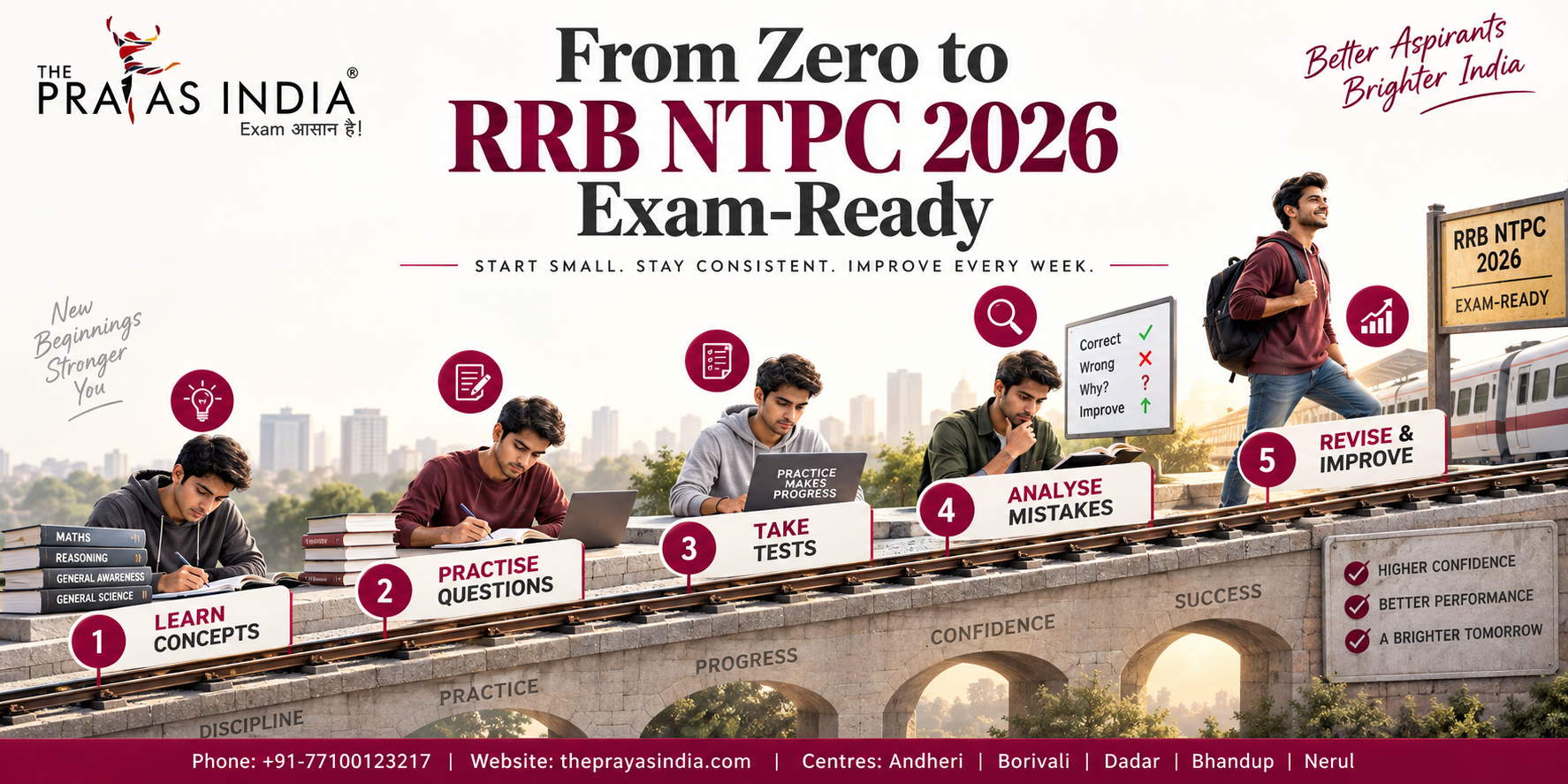
A useful progression is:
Foundation → Topic Practice → Sectional Tests → Mixed Practice → Full Mocks → Mock Analysis → Revision → Exam Readiness
Each stage has a different purpose.
Foundation Stage
Focus on understanding concepts and basic question types. Do not worry excessively about speed.
Practice Stage
Increase the number of questions and start identifying recurring patterns.
Sectional Test Stage
Solve Mathematics, Reasoning and General Awareness tests within time limits.
Mock Test Stage
Attempt complete CBT-style papers under realistic conditions.
Analysis Stage
Identify exactly where marks are being lost and modify your strategy.
Revision Stage
Revisit formulas, facts, weak chapters and previously incorrect questions.
How to Prepare for RRB NTPC Mathematics from Scratch
If your Mathematics is weak, do not start by attempting difficult questions. Start by repairing your basics.
Spend the first phase understanding arithmetic fundamentals. Learn percentages, ratios, averages, profit and loss and basic calculation methods carefully.
Once you are comfortable, introduce time-based topics such as Time and Work and Time and Distance. After that, move towards other syllabus areas according to your preparation level.
An important part of beginner preparation is calculation practice. You should gradually become comfortable with multiplication, division, fractions, percentage conversions and approximate calculations.
Speed does not develop overnight. It develops through repeated exposure to similar calculations.
However, speed should never come at the cost of accuracy. Since incorrect answers can attract negative marking, beginners should first aim for reliable solving and then reduce the time taken.
How to Prepare for RRB NTPC Reasoning from Scratch
Reasoning preparation should follow a similar concept-to-practice approach.
Start with straightforward topics such as analogy, classification, series, coding-decoding and relationships. Once you understand the basic patterns, progress towards syllogism, Venn diagrams, analytical reasoning, statement-based questions and puzzles.
After completing each topic, solve questions in a timed environment.
For example, if you complete coding-decoding today, do not simply watch another lecture tomorrow. Solve a set of questions and identify:
- How quickly you understand the code.
- Which question patterns confuse you.
- Whether you make calculation or interpretation errors.
- How much time you need per question.
This creates measurable improvement.
How to Prepare for RRB NTPC General Awareness from Scratch
General Awareness requires consistency because the syllabus is broad.
A beginner should divide the subject into static and current components.
Static areas include history, geography, polity, economy, science, computers, art and culture and other general knowledge topics. Current affairs require continuous updating.
Instead of trying to memorise long lists, use active revision. Read a topic, make short notes and test yourself after a few days.
For example, after studying Indian Polity, close the book and try to recall the important concepts. If you cannot remember them, revise the specific area rather than rereading the entire chapter.
The goal is to turn passive reading into active recall.
A 90-Day Beginner Strategy for RRB NTPC 2026
If you are starting from scratch, a three-phase approach can provide a useful framework.
Days 1–30: Build the Foundation
The first month should focus on understanding the examination and strengthening basic concepts.
During this period:
- Learn the fundamentals of Mathematics.
- Build basic Reasoning concepts.
- Begin General Awareness topic-wise.
- Start daily current-affairs preparation.
- Solve basic questions after every topic.
- Maintain an error notebook.
- Start regular revision.
Do not worry if your question-solving speed is low at this stage.
Days 31–60: Increase Practice
The second phase should shift towards question-solving.
Increase the number of questions you solve every day. Begin sectional tests and introduce time limits.
Your focus should now include:
- Topic-wise previous-year questions.
- Mixed practice.
- Sectional tests.
- Timed Mathematics practice.
- Reasoning speed development.
- General Awareness revision.
- Current-affairs revision.
- Regular error analysis.
You should begin noticing which chapters are consistently causing problems.
Days 61–90: Move Towards Exam Mode
The third phase should introduce more full-length examination practice.
Attempt CBT-style mock tests at regular intervals. Analyse every mock instead of simply checking your score.
After each test, classify your mistakes:
Conceptual Mistake – You did not know how to solve it.
Calculation Mistake – You knew the method but made an error.
Time-Management Mistake – You spent too long on one question.
Question-Selection Mistake – You attempted a question that should have been skipped.
Careless Mistake – You knew the answer but marked incorrectly.
This classification tells you what to improve.
RRB NTPC 2026 Mock Test Strategy for Beginners
A mock test should not be treated as just another question paper.
Its real value comes from the analysis that follows.
Suppose you score 62 in a mock test. Instead of simply deciding that your preparation is weak, examine the paper.
Perhaps you knew the answers to 15 questions but could not attempt them because you ran out of time. In that situation, the problem may be time management rather than knowledge.
Similarly, if you attempted 10 questions incorrectly because you rushed through them, increasing your attempt count may not solve the problem.
Your mock analysis should answer four questions:
- How many questions did I know?
- How many questions did I get wrong?
- Where did I spend excessive time?
- Which topics should I revise before the next test?
This approach gradually converts mock tests into improvement tools.
How to Improve Speed Without Losing Accuracy
Speed is important in a timed examination, but speed without accuracy can reduce your score because of negative marking.
Beginners should therefore follow a three-stage approach.
First: Accuracy
Learn to solve questions correctly without worrying excessively about time.
Second: Familiarity
Solve more questions from the same topic so that common patterns become familiar.
Third: Speed
Introduce time limits and attempt to reduce the average time per question.
For Mathematics, calculation practice can significantly influence speed. For Reasoning, familiarity with recurring question types can reduce thinking time. For General Awareness, quick recall is important because factual questions should not consume excessive time.
The Role of Revision in RRB NTPC Preparation
A large syllabus cannot be retained through one-time study.
Revision should be planned rather than left for the end.
You can divide revision into three categories:
Daily Revision
Review formulas, vocabulary, current affairs and mistakes from the day’s study.
Weekly Revision
Revisit the topics studied during the week and solve a short mixed test.
Monthly Revision
Review major topics, previous mistakes and important current-affairs notes.
A revision notebook can make this process easier. Keep it concise. It should contain information that you actually need to revisit rather than reproducing entire chapters.
Common Mistakes Beginners Should Avoid in RRB NTPC 2026
Starting preparation from scratch does not mean you have to repeat the mistakes made by previous aspirants.
1. Collecting Too Many Study Materials
Using multiple books, PDFs, videos and channels for the same topic can create confusion. Choose reliable study resources and complete them systematically.
2. Watching Lectures Without Practising
A lecture can explain a concept, but only question-solving can show whether you have actually understood it.
3. Ignoring General Awareness
Some beginners spend almost all their time on Mathematics and Reasoning and postpone General Awareness. Because GA has a substantial weightage, it should be studied consistently.
4. Avoiding Mock Tests
Mocks should not be postponed until the end. Introduce them gradually after building the foundation.
5. Focusing Only on Attempts
A high attempt count does not automatically mean a strong performance. Accuracy and question selection matter.
6. Not Analysing Mistakes
If you repeatedly make the same mistake but never record it, you may continue making it in every test.
7. Comparing Your Preparation With Others
Every aspirant begins from a different level. Your goal should be measurable personal improvement.
8. Changing Strategy Every Few Days
One week of Mathematics from one source, another week from a different source and a new timetable every Monday will not create consistency.
Choose a strategy and give it enough time to produce results.
Starting From Zero? Follow a Structured Preparation Plan
If you are completely new to RRB NTPC preparation, the biggest challenge is often knowing what to study, what to skip, when to practise and how to measure your progress. A structured preparation programme can help you follow a planned sequence of concepts, practice, revision and mock tests instead of preparing randomly. The Prayas India provides exam-focused guidance for aspirants who want to build their RRB NTPC preparation systematically.
RRB NTPC 2026: Should Beginners Join Coaching?
Not every aspirant follows the same preparation method. Some students are comfortable with self-study and can create, follow and evaluate their own preparation plan. Others struggle mainly with consistency, understanding concepts, selecting study material or analysing their performance.
The decision to join coaching should therefore be based on your preparation needs.
A structured coaching programme can be useful when you need:
- A defined syllabus sequence.
- Regular classes and study targets.
- Faculty guidance for difficult concepts.
- Practice questions and examination-level tests.
- Regular performance evaluation.
- Doubt-solving support.
- A structured revision system.
- Accountability during long-term preparation.
For beginners in particular, structure can reduce the amount of time spent deciding what to study next.
At The Prayas India, aspirants can explore a structured approach to RRB NTPC preparation with guided learning, practice and exam-oriented preparation. The objective should be to make the preparation process more organised and measurable.
How to Know Whether Your RRB NTPC Preparation Is Improving
Progress should not be measured only through mock-test scores.
Track multiple indicators.
Are you solving basic Mathematics questions more comfortably than before? Are you making fewer careless mistakes? Is your Reasoning solving time decreasing? Can you recall General Awareness facts more easily? Are you completing sectional tests within the required time? Are repeated mistakes reducing?
These indicators provide a better picture of preparation.
A simple weekly performance tracker can include:
| Parameter | Week 1 | Week 2 | Week 3 | Week 4 |
|---|---|---|---|---|
| Maths Accuracy | ||||
| Reasoning Accuracy | ||||
| GA Accuracy | ||||
| Average Test Time | ||||
| Questions Attempted | ||||
| Repeated Mistakes |
The numbers are less important than the trend. Your objective should be gradual improvement.
Final RRB NTPC 2026 Beginner’s Roadmap
If you currently feel that you know nothing about RRB NTPC, do not let that feeling stop you from beginning.
Start with the examination pattern. Understand your eligible posts. Take a diagnostic test. Build Mathematics and Reasoning fundamentals. Begin General Awareness systematically. Practise questions after every topic. Introduce sectional tests once your foundation improves. Move towards full-length mocks gradually. Analyse mistakes after every test and revise repeatedly.
Most importantly, do not expect your preparation to transform in a few days.
Competitive-exam preparation is built through repeated cycles of learning, practising, testing, analysing and revising.
The RRB NTPC 2026 recruitment provides a defined opportunity, but the notification itself does not prepare you for the examination. Your preparation begins when you turn the opportunity into a structured daily routine.
For a beginner, the most important question is not “How many chapters can I finish today?”
It is:
“What can I learn today, practise today and retain well enough to use in the examination?”
If you can consistently follow that approach, your preparation will gradually move from “Mujhe kuch nahi aata” to “Mujhe pata hai kya padhna hai, kaise padhna hai aur apni preparation ko kaise improve karna hai.”
Quick Revision Checklist for RRB NTPC Beginners
Before moving into intensive mock-test preparation, make sure you can answer “yes” to most of the following:
- I understand the RRB NTPC examination structure.
- I know which posts I am eligible for.
- I have a realistic daily timetable.
- I have started Mathematics from the basics.
- I practise Reasoning regularly.
- I study General Awareness consistently.
- I maintain current-affairs notes.
- I solve questions after completing topics.
- I have started using previous-year questions.
- I maintain an error notebook.
- I revise regularly.
- I have gradually introduced timed tests.
- I analyse my mock-test performance.
- I know my weak topics.
- I am improving accuracy before chasing speed.
If several answers are “no”, there is no need to panic. Simply identify the missing area and incorporate it into your next week’s plan.
RRB NTPC 2026 Preparation: The Right Mindset for Beginners
The biggest advantage a beginner can develop is consistency.
You do not need to know every formula on your first day. You do not need to solve difficult puzzles immediately. You do not need to score exceptionally high in your first mock.
What you need is a system that allows you to improve every week.
Start with the basics. Practise regularly. Revise what you learn. Test yourself. Analyse your mistakes. Repeat the process.
With the right preparation structure, even a student who begins with limited knowledge can progressively develop the concepts, accuracy, speed and confidence required for RRB NTPC preparation.
Starting RRB NTPC 2026 Preparation from Scratch?
Don’t get confused by where to start. Connect with the expert Railway mentors at The Prayas India to build your fundamentals from zero, clear core concepts in Maths & Reasoning, and master CBT-1 test-taking strategies.
Official Website: theprayasindia.com
Visit Our Mumbai Centres: