How to Prepare for SSC CGL from Zero? Complete Beginner’s Guide | Best SSC Coaching in Mumbai | The Prayas India
Starting SSC CGL preparation from zero can feel overwhelming. The syllabus is broad, competition is intense and there are several subjects that require different preparation approaches. A beginner may not know which books to follow, how many hours to study, when to start mock tests or how much time should be given to Quantitative Aptitude, Reasoning, English and General Awareness.
The good news is that starting from zero does not mean starting without a plan.
For a beginner, the biggest advantage is the opportunity to build the preparation correctly from the beginning. Instead of jumping between resources, attempting difficult questions too early or copying someone else’s timetable, you can develop a structured system that gradually takes you from basic concepts to exam-level practice.
SSC CGL preparation is best approached as a progression:
Understand the exam → Build fundamentals → Practise consistently → Improve speed and accuracy → Take mocks → Analyse performance → Revise strategically.
The objective is not to complete the syllabus as quickly as possible. It is to reach a stage where you can confidently handle the type of questions that appear in the examination under strict time constraints.
For aspirants looking for SSC coaching in Mumbai, this foundation-building stage is particularly important. The right preparation environment can help beginners understand the syllabus, follow a systematic sequence and avoid the confusion that often comes with preparing independently.
Start by Understanding SSC CGL Before Studying for It
A beginner should not begin preparation by immediately opening a book and solving random questions.
First understand the examination.
SSC CGL is a highly competitive graduate-level recruitment examination conducted by the Staff Selection Commission for various Group B and Group C posts in central government departments and organisations. Because different posts and stages have different requirements, aspirants should understand the current official examination structure and eligibility conditions before designing their preparation strategy.
The broad preparation areas that candidates commonly need to work on include:
- Quantitative Aptitude
- General Intelligence and Reasoning
- English Language and Comprehension
- General Awareness
- Computer-related knowledge or other requirements where applicable at the relevant stage
The exact pattern, stages and requirements can change through official notifications, so candidates should always verify the latest details before relying on a preparation plan.
This initial understanding prevents a common beginner mistake: studying hard without knowing exactly what the examination demands.
What Does “Starting From Zero” Actually Mean?
Starting from zero does not necessarily mean that you know absolutely nothing.
You may have studied mathematics until school, read English regularly or encountered general-awareness topics throughout your education. However, SSC CGL requires these abilities to be converted into exam-oriented skills.
For example, knowing basic percentages is different from being able to solve a percentage-based question quickly and accurately.
Similarly, understanding English grammar is different from identifying an error within seconds during a timed examination.
A beginner therefore needs to build three layers of preparation:
Conceptual knowledge: Understanding the underlying topic.
Question-solving ability: Applying the concept to different question types.
Exam efficiency: Solving the question accurately within limited time.
Many beginners focus only on the first layer. Serious preparation requires all three.
Don’t Start With Advanced Questions
One of the fastest ways to lose confidence is to begin with questions designed for experienced candidates.
If your Quant fundamentals are weak, jumping directly into difficult mixed sets can make you believe that you are incapable of solving SSC CGL questions.
That conclusion is usually incorrect.
The problem may simply be that your preparation has skipped the foundation stage.
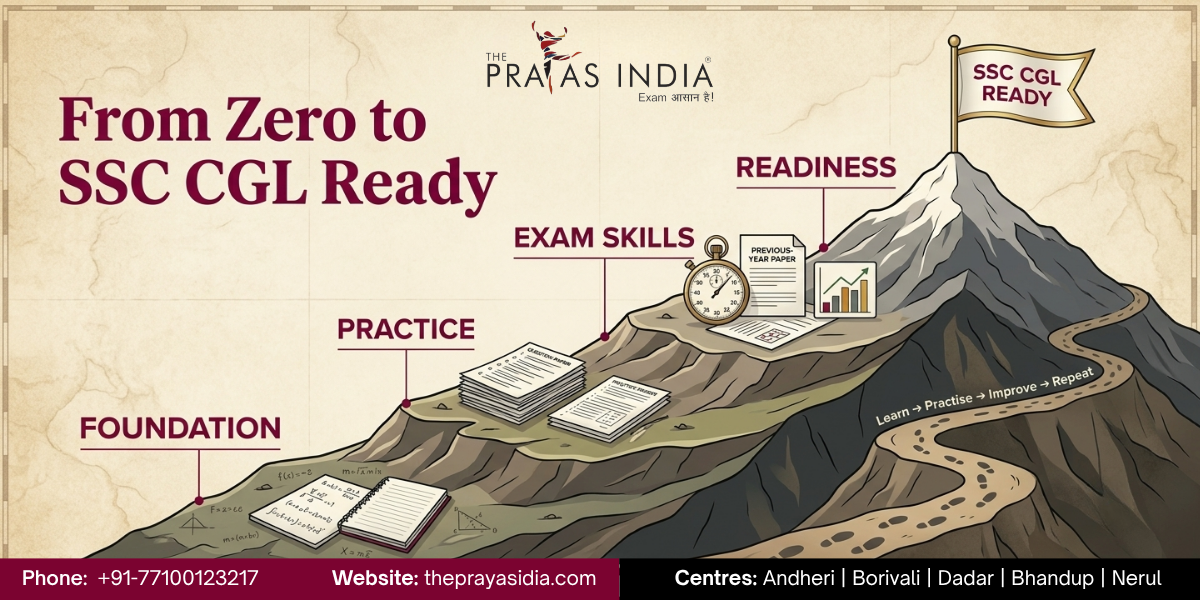
Start with basic concepts and progressively increase difficulty.
For Quant, for example, the progression can look like:
Basic arithmetic → Standard questions → Mixed practice → Previous-year questions → Timed practice.
The same principle can be applied to Reasoning and English.
Your preparation should become harder gradually.
Build Your Quantitative Aptitude Foundation
For many beginners, Quantitative Aptitude is the section that creates the most anxiety.
The solution is not to avoid it.
It is to rebuild the fundamentals systematically.
Start by becoming comfortable with basic calculations, percentages, ratios, averages and other foundational concepts. Once these become familiar, move towards more application-oriented arithmetic and then higher-level mixed practice.
A beginner should pay particular attention to calculation ability because slow calculations can affect performance even when the underlying concept is understood.
Your initial Quant routine can include:
- Concept learning
- Formula revision
- Basic question practice
- Calculation drills
- Topic-wise exercises
- Previous-year questions
- Timed sets
Do not worry about achieving exceptional speed in the first few weeks.
First aim for correctness.
Speed can be developed through repeated practice.
Develop Calculation Speed Gradually
SSC CGL is a time-bound examination.
Therefore, calculation speed becomes an important part of preparation.
But speed should not be developed by blindly trying to solve everything faster.
Begin by reducing avoidable calculation mistakes.
Practise:
- Percentage calculations
- Fraction-to-percentage conversions
- Multiplication patterns
- Squares and cubes
- Approximation
- Ratio calculations
- Basic arithmetic shortcuts
Over time, these exercises can reduce the amount of mental effort required for routine calculations.
The important point is to use shortcuts only after understanding the underlying concept.
A shortcut that you don’t understand can become a source of mistakes during the examination.
Build Reasoning Through Pattern Recognition
Reasoning can initially appear easier than Quant because many questions do not involve lengthy calculations.
However, SSC CGL Reasoning rewards familiarity with question patterns.
The more varied questions you solve, the faster you begin recognising the structure of a problem.
A beginner can gradually cover areas such as:
- Analogy
- Classification
- Series
- Coding-decoding
- Blood relations
- Direction sense
- Venn diagrams
- Syllogism
- Statement-based questions
- Non-verbal reasoning
The objective at the beginning is not maximum speed.
Instead, learn to identify what the question is actually asking and which logical approach should be used.
Treat English as a Daily Subject
English should not be treated as a subject that can be completed in a few weeks.
Regular exposure is much more effective.
A beginner should combine grammar, vocabulary, reading and question practice.
Your daily routine can include:
- Grammar concept revision
- Vocabulary development
- Reading comprehension
- Error detection
- Fillers
- Sentence improvement
- Cloze tests
- Previous-year questions
Reading also plays an important role because it gradually improves comprehension speed and familiarity with sentence structures.
Instead of trying to memorise hundreds of words at once, build vocabulary continuously and revise it repeatedly.
General Awareness Needs a Different Strategy
General Awareness can feel endless because it covers a wide range of areas.
This is why beginners often make one of two mistakes.
They either ignore General Awareness until the end or collect enormous amounts of information without a revision system.
Both approaches can create problems.
A better strategy is to divide preparation into manageable areas and build a revision cycle.
Depending on the examination requirements and latest syllabus, preparation may involve areas such as:
- History
- Geography
- Polity
- Economics
- General Science
- Current Affairs
- Static General Knowledge
The key is not simply reading more.
It is remembering the information when you need it.
This makes revision particularly important.
Previous-Year Questions Should Enter Your Preparation Early
Beginners sometimes postpone previous-year questions because they believe they should first complete the entire syllabus.
That is unnecessary.
Previous-year questions help you understand the examination’s actual language, recurring concepts and difficulty level.
They also answer an important question:
“What does SSC actually expect me to know?”
After completing a basic topic, introduce relevant previous-year questions.
For example:
Learn Percentage → Practise basic questions → Solve SSC-level questions → Review mistakes.
This creates a direct connection between learning and examination requirements.
Don’t Measure Progress Only by Syllabus Completion
Completing chapters can create a false sense of progress.
Suppose you have completed ten Quant topics but still take too long to solve basic questions.
Have you really completed those topics?
From an examination perspective, not completely.
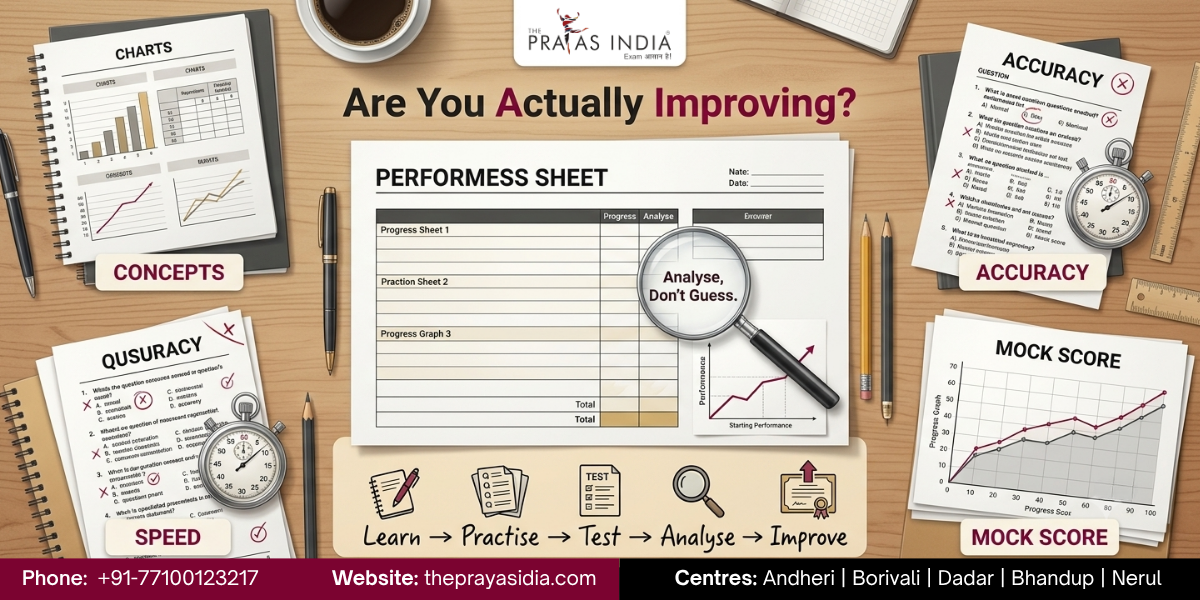
Your preparation should therefore track multiple indicators:
- Concepts completed
- Questions attempted
- Accuracy
- Average solving time
- Previous-year question performance
- Mock-test score
- Repeated mistakes
- Revision status
This gives you a more realistic picture of your preparation.
Create a Beginner-Friendly Daily Routine
A beginner’s timetable should not resemble the schedule of someone who has been preparing for six months.
Start with something sustainable.
For example, your daily structure could include:
Quant: Concept + practice
Reasoning: Topic-wise questions
English: Grammar/vocabulary + practice
General Awareness: Learning + revision
Revision: Mistake review or formula revision
The number of hours can be adjusted according to your circumstances.
If you are a college student or working professional, your available time may be different from that of a full-time aspirant.
The important principle is to create a routine that you can follow repeatedly.
Use Study Blocks Instead of One Long Session
Studying continuously for several hours can reduce concentration.
Divide your preparation into focused blocks.
For example:
Block 1: Quant
Block 2: Reasoning
Block 3: English
Block 4: General Awareness
Block 5: Revision or practice
The structure can change according to your schedule.
What matters is that every session has a specific objective.
“Study Quant for two hours” is vague.
“Complete Percentage concept and solve 30 questions” is measurable.
The second approach makes it easier to determine whether the session was productive.
Build a Revision System From Day One
Revision should not begin after the syllabus ends.
By that point, you may have forgotten a significant portion of what you studied at the beginning.
A beginner should revise continuously.
A simple approach can involve:
- Quick revision after learning a topic
- Weekly revision of completed concepts
- Periodic revision of weak areas
- Revision of previous-year mistakes
- Formula and vocabulary revision
The exact frequency can vary.
The important thing is to ensure that old material remains active while new material is being added.
Start a Mistake Log
Every wrong answer contains information.
Instead of simply checking the correct option and moving on, identify the reason behind the mistake.
Was it:
- A conceptual error?
- A calculation mistake?
- A question-reading error?
- A vocabulary problem?
- A logical mistake?
- Lack of familiarity?
- Time pressure?
Record recurring errors.
Over time, your mistake log can become one of the most valuable revision resources you have.
It shows you what you need to improve rather than what a generic preparation guide says you should improve.
Don’t Ignore Accuracy While Building Speed
Beginners often become obsessed with solving questions quickly.
This can create careless mistakes.
A better progression is:
Accuracy first → Familiarity next → Speed later.
When your accuracy becomes stable, gradually introduce time limits.
This teaches you to work under pressure without sacrificing correctness.
When Should a Beginner Start Mock Tests?
You don’t need to wait until the entire syllabus is complete.
However, the purpose of a mock changes as your preparation develops.
In the early stage, sectional tests and topic-wise timed practice may be more useful.
As your preparation expands, introduce full-length mocks.
At first, your score may be low.
That is normal.
Early mocks are diagnostic tools.
They help you discover where you stand.
Over time, you should see improvements in:
- Attempts
- Accuracy
- Speed
- Sectional balance
- Question selection
- Overall score
Don’t Be Discouraged by an Initial Low Score
A mock test is a snapshot of your current preparation, not a prediction of your final result.
If you are genuinely starting from zero, an early low score is expected.
The important question is whether the score becomes a learning tool.
For example, if your first mock shows that Quant is weak, don’t simply take another mock immediately.
Return to the relevant concepts, practise the weak topics and then test yourself again.
This creates a cycle of:
Test → Identify → Improve → Retest.
That cycle is much more valuable than repeatedly taking mocks without analysis.
The Role of a Structured SSC CGL Preparation Environment
Preparing from zero can be challenging because beginners often spend considerable time deciding what to study, what to skip, which resources to trust and how to measure progress.
This is where structured coaching can become useful.
A good SSC coaching programme can provide a predefined learning sequence, classroom guidance, practice material, doubt-solving support and regular testing. For a beginner, this structure can reduce the uncertainty surrounding preparation.
For aspirants searching for the best SSC coaching in Mumbai, the focus should therefore not be limited to faculty names or promotional claims.
Look at the entire academic system.
Consider whether the institute offers:
- Structured syllabus coverage
- Foundation-level teaching
- Topic-wise practice
- Previous-year question discussion
- Regular mock tests
- Performance analysis
- Doubt-solving support
- Revision planning
- Current-affairs and General Awareness guidance
- Mentorship and exam strategy
The right environment should help a beginner gradually transition from “I don’t know where to start” to “I know exactly what I need to improve.”
The Prayas India for SSC CGL Preparation
The Prayas India provides structured coaching support for aspirants preparing for SSC and other competitive examinations.
For a beginner, the value of joining a structured programme lies in having a defined academic pathway instead of trying to build every part of the preparation independently.
Regular classes, guided practice, doubt-solving, testing and performance-focused preparation can help students establish the foundation required for competitive examinations.
However, coaching alone does not clear an examination.
Students must complement classroom learning with self-study, revision, practice and mock-test analysis.
The strongest preparation approach combines:
Structured Coaching + Self-Study + Practice + Revision + Mock Tests + Analysis
For aspirants considering SSC coaching in Mumbai, admissions should ideally be treated as a preparation decision rather than simply a course purchase. The right programme should fit your current level, preparation timeline and learning requirements.
What a Beginner Should Avoid
Starting from zero already requires significant effort. Avoiding common mistakes can save valuable preparation time.
Some of the most common beginner mistakes include:
- Collecting too many books and resources
- Changing teachers or study sources repeatedly
- Ignoring weak subjects
- Postponing General Awareness
- Avoiding previous-year questions
- Taking mocks without analysing them
- Focusing only on study hours
- Trying to finish the syllabus without revision
- Comparing preparation with other aspirants
- Starting with advanced questions before building fundamentals
A beginner does not need more resources.
A beginner needs better direction and consistent execution.
Your First Stage Should Be About Building the Base
If you are genuinely beginning SSC CGL preparation from zero, don’t make your first goal “clear SSC CGL.”
Make your first goal more specific.
Understand the exam.
Build your fundamentals.
Develop regular study habits.
Start solving exam-level questions.
Track your mistakes.
Gradually introduce timed practice.
These smaller milestones eventually lead towards the larger objective.
Build Your SSC CGL Preparation Around a Timeline
Once your basic understanding of the examination is clear, the next step is to create a preparation timeline. A beginner should avoid making a timetable that assumes everything can be completed in a few weeks.
The right timeline depends on your starting level, available study hours, familiarity with the subjects and the time remaining before the examination. Someone who can study full-time may progress faster than a working professional, while a candidate with strong fundamentals may require less time for basic concepts.
Instead of asking, “How many hours should I study?”, ask:
“What should I be able to do by the end of the next four weeks?”
That shift makes preparation more measurable.
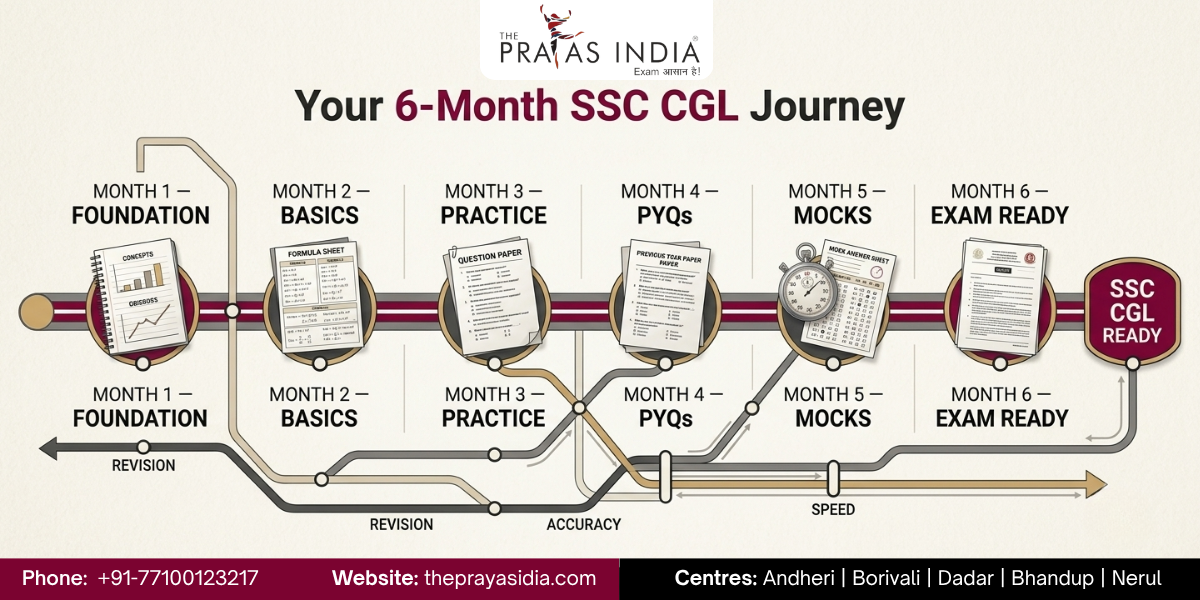
A useful long-term progression can be divided into three broad phases:
- Foundation Phase: Build concepts and basic question-solving ability.
- Practice Phase: Increase question volume and introduce previous-year questions.
- Exam Phase: Focus heavily on timed practice, mocks, revision and performance optimisation.
The duration of each phase can change according to your preparation timeline.
A 6-Month SSC CGL Roadmap for Beginners
If you have approximately six months, you have enough time to develop your preparation progressively rather than rushing through the syllabus.
Months 1–2: Build the Foundation
The first two months should focus on fundamentals.
Quant should receive structured attention because basic arithmetic and calculation ability influence performance across many topics. Reasoning should be developed through topic-wise practice, while English should become a daily habit. General Awareness should be introduced from the beginning rather than postponed.
At this stage, don’t obsess over mock-test scores.
Your priorities should be:
- Understand fundamental concepts
- Establish a daily study routine
- Solve basic and moderate questions
- Start previous-year question exposure
- Build vocabulary and reading habits
- Create revision notes
- Maintain a mistake log
The purpose of these two months is to create a reliable base.
Months 3–4: Move Towards Exam-Level Practice
Once the fundamentals become stronger, preparation should become more question-oriented.
Begin combining different question types instead of solving only isolated examples. Increase your exposure to previous-year questions and introduce sectional tests regularly.
This is also the stage where speed should begin improving.
You should gradually become comfortable with timed practice while maintaining reasonable accuracy.
Your focus can shift towards:
- Previous-year questions
- Mixed-topic practice
- Sectional tests
- Calculation-speed improvement
- Grammar application
- General Awareness revision
- Weak-topic reinforcement
At this stage, your mistake log becomes increasingly valuable because it shows which problems continue to repeat.
Months 5–6: Convert Preparation Into Performance
The final phase should focus on examination execution.
You may know the concepts by this stage, but knowing them and applying them under time pressure are different skills.
Increase the frequency of full-length mocks and analyse them carefully.
Your preparation should now answer practical questions such as:
Which section should I prioritise?
Which questions should I skip?
Where am I losing time?
Which mistakes are avoidable?
Which topics still need revision?
This is where preparation starts becoming performance-oriented rather than syllabus-oriented.
A 3-Month Strategy for Candidates With Less Time
Not every candidate has six months.
If you have around three months, the preparation needs to become more selective.
You cannot spend excessive time perfecting every topic before beginning exam-level practice.
A practical three-month structure can be:
Month 1: Fundamentals + high-priority topics + basic practice
Month 2: Previous-year questions + mixed practice + sectional tests
Month 3: Full mocks + intensive revision + weak-area improvement
The most important principle is to avoid postponing practice until the final month.
Testing and analysis should run alongside learning.
Subject-Wise Priority for SSC CGL Beginners
Every subject requires a slightly different preparation philosophy.
Quantitative Aptitude
Quant preparation should progress from concepts to application.
Start with foundational arithmetic and gradually move towards more complex question types. Calculation practice should run parallel to conceptual learning.
Focus on:
- Arithmetic fundamentals
- Algebra
- Geometry
- Mensuration
- Trigonometry
- Data Interpretation
- Number-based concepts
- Previous-year questions
The exact priority should be adjusted according to the latest syllabus and your performance.
General Intelligence and Reasoning
Reasoning preparation improves significantly with pattern familiarity.
Solve different question types and learn to identify recurring structures.
Focus on:
- Analogy
- Classification
- Series
- Coding-decoding
- Blood relations
- Direction-based questions
- Venn diagrams
- Syllogism
- Non-verbal reasoning
- Statement-based questions
Don’t simply memorise methods. Understand why a particular approach works.
English Language
English requires regular exposure.
A beginner should combine grammar, vocabulary, comprehension and question practice rather than studying only one component.
Build a routine around:
- Grammar rules
- Vocabulary
- Reading comprehension
- Error detection
- Sentence improvement
- Fill in the blanks
- Cloze tests
- Previous-year questions
The advantage of daily English practice is that improvement compounds gradually.
General Awareness
General Awareness should be approached through selective learning and repeated revision.
Instead of trying to memorise everything available online, build your preparation around the examination syllabus and reliable sources.
Create short revision material for important facts and revise it repeatedly.
The objective is retention, not the size of your notes.
Make Previous-Year Questions a Core Resource
Previous-year questions should become increasingly important as your preparation develops.
They reveal how concepts are actually tested and help you understand the language, recurring themes and level of questions.
After completing a topic, ask yourself:
Can I solve actual SSC questions from this topic?
If the answer is no, the topic may require more practice.
This is why previous-year questions should not be treated merely as material for the final revision stage.
They are a diagnostic tool throughout preparation.
Develop a Three-Level Practice System
A useful way to structure practice is to divide it into three levels.
Level 1 — Learning
Solve questions immediately after studying a concept.
The goal is understanding.
Level 2 — Reinforcement
Return to the same topic and solve a wider variety of questions.
The goal is consistency.
Level 3 — Timed Application
Solve mixed or previous-year questions under a time limit.
The goal is exam efficiency.
This progression prevents the common mistake of assuming that reading a concept means mastering it.
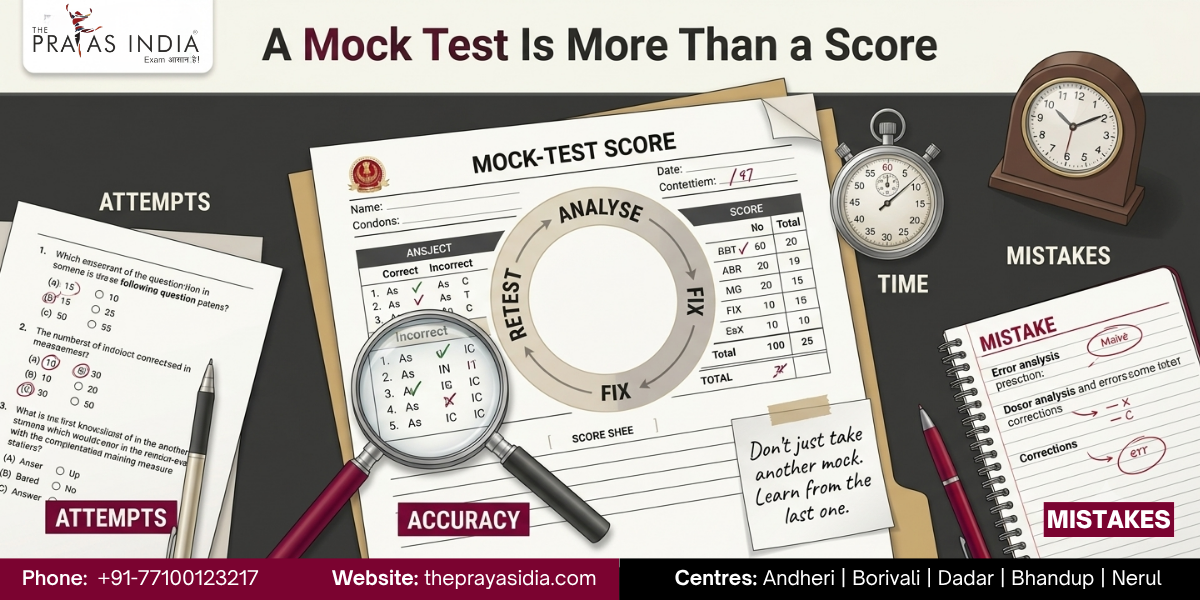
Mock Tests Should Become a Feedback Mechanism
Mock tests are not just score generators.
They are diagnostic tools.
A candidate who scores 120 but doesn’t analyse the test may learn less than a candidate who scores 100 and carefully examines every major mistake.
After each mock, review:
- Questions answered incorrectly
- Questions left unanswered
- Questions that consumed too much time
- Guesswork-based attempts
- Conceptual gaps
- Calculation errors
- Section-wise performance
Then convert the analysis into action.
If ten mistakes came from one weak topic, that topic should return to your study plan.
Maintain a Mock Analysis Sheet
A simple analysis sheet can make your progress much easier to understand.
| Performance Area | Track |
|---|---|
| Attempts | Questions attempted |
| Accuracy | Correct vs incorrect |
| Time | Time spent by section |
| Weak Topics | Topics causing repeated errors |
| Silly Mistakes | Avoidable errors |
| Skipped Questions | Questions that could have been attempted |
| Improvement Target | One or two priorities for the next test |
Don’t try to improve everything simultaneously.
After each mock, identify the most important two or three improvements and work on them.
Revision Should Become More Frequent Near the Examination
As the examination approaches, the proportion of time spent revising should increase.
During the foundation stage, learning new concepts may dominate.
Later, revision and testing should take a larger share of your schedule.
A simple progression is:
Early preparation: Learn more, revise regularly.
Middle preparation: Learn + practise + test.
Final preparation: Revise + test + analyse.
This prevents the common problem of reaching the final weeks with a large amount of material but insufficient recall.
Use Short Revision Resources
Your final revision should not require reopening every book and every class note.
Create compact resources throughout your preparation.
These can include:
- Quant formulas
- Common calculation methods
- English grammar rules
- Vocabulary lists
- Reasoning approaches
- General Awareness facts
- Frequently repeated mistakes
By the final stage, these resources can become your rapid revision toolkit.
Preparing Alongside College or a Job
Many SSC CGL aspirants are not full-time students.
They may have college classes, internships, jobs or family responsibilities.
That doesn’t make preparation impossible.
It simply requires a different strategy.
Instead of designing a timetable around an ideal day, design it around your actual available time.
For example, a working candidate could reserve:
Morning: Concept learning
Commute/Break: Vocabulary or General Awareness revision
Evening: Quant/Reasoning practice
Weekend: Sectional tests, mocks and detailed analysis
The exact structure should depend on the individual’s routine.
The important principle is to make the plan sustainable.
Don’t Compare Your Journey With Full-Time Aspirants
Comparison can make a beginner feel behind even when their preparation is progressing normally.
A candidate studying three focused hours every day may make more sustainable progress than someone who studies ten hours for three days and then stops for a week.
Your benchmark should be your previous performance.
Ask:
Am I more accurate than last month?
Am I solving familiar questions faster?
Are my repeated mistakes decreasing?
Is my mock performance improving?
These are better indicators of progress than someone else’s timetable.
How Coaching Can Help a Beginner
Self-study gives you flexibility, but it also places the responsibility for every decision on you.
You have to decide what to study, how to sequence topics, which resources to trust, when to test yourself and how to interpret your performance.
For some candidates, this independence works well.
For others, the absence of structure becomes a major obstacle.
This is where professional coaching can provide value.
A structured SSC coaching programme can create a learning sequence and provide regular academic touchpoints. Instead of spending weeks figuring out how to approach the syllabus, students can follow a planned curriculum supported by classes, practice, tests and guidance.
For a beginner, this can reduce preparation uncertainty and help establish consistency.
Choosing the Best SSC Coaching in Mumbai
The phrase “best SSC coaching in Mumbai” should not be evaluated only through advertisements or selection numbers.
The right institute depends on your individual requirements.
Before taking admission, examine the academic system carefully.
Look for:
- Faculty with a clear teaching approach
- Foundation-level support for beginners
- Structured syllabus coverage
- Quality study material
- Regular practice
- Previous-year question discussions
- Sectional and full-length tests
- Mock-test analysis
- Doubt-solving support
- Mentorship and performance guidance
- Revision support
- Convenient batch timings
Also consider whether the institute’s location and schedule are practical for you.
An excellent course that you cannot attend consistently may not be the right course for your situation.
The Prayas India: A Structured Path for SSC Aspirants
The Prayas India provides structured coaching support for aspirants preparing for SSC and other competitive examinations.
For candidates starting SSC CGL preparation from zero, a structured environment can make the initial phase more manageable by providing an organised academic pathway.
The objective should be to help students move progressively from fundamental concepts to exam-level practice, testing and performance analysis.
Students should still maintain independent study and revision because coaching cannot replace personal practice.
The most effective approach combines:
Classroom Learning + Self-Study + Practice + Previous-Year Questions + Mock Tests + Analysis + Revision
For aspirants considering SSC coaching in Mumbai, taking admission at the right stage can help establish structure early instead of trying to correct an unorganised preparation strategy later.
A Beginner’s Weekly Preparation Model
A beginner can structure a week around five broad activities.
Monday to Thursday: Concept learning and topic-wise practice.
Friday: Revision of the week’s difficult concepts.
Saturday: Sectional tests and previous-year questions.
Sunday: Mock/combined practice and performance analysis.
General Awareness, vocabulary and short revision sessions can be distributed throughout the week.
The exact timetable should be adapted according to your availability.
The important thing is that the week should contain all four components:
Learn. Practise. Test. Revise.
Your First 90 Days Should Have Clear Milestones
Instead of simply writing “SSC CGL preparation” in your calendar, establish measurable milestones.
By Day 30
You should have:
- Established a consistent routine
- Covered key foundational concepts
- Started regular English and General Awareness preparation
- Begun solving topic-wise questions
- Created revision notes
By Day 60
You should be:
- Solving more exam-level questions
- Attempting sectional tests
- Using previous-year questions regularly
- Tracking recurring mistakes
- Improving calculation and solving speed
By Day 90
You should be:
- Taking regular timed tests
- Analysing performance
- Revising completed topics
- Identifying your strongest and weakest areas
- Building an examination strategy
These milestones are more useful than simply counting the number of chapters completed.
The Beginner’s SSC CGL Checklist
Before considering your preparation “on track”, make sure you can answer yes to most of these questions:
- Do I understand the current examination structure?
- Do I have a realistic weekly study plan?
- Are my Quant fundamentals improving?
- Am I practising Reasoning regularly?
- Am I giving English daily attention?
- Have I started General Awareness preparation?
- Am I solving previous-year questions?
- Do I maintain a mistake log?
- Am I taking timed tests?
- Do I analyse my mocks?
- Am I revising older topics?
- Do I know my weakest areas?
- Am I following a consistent routine?
If several answers are no, don’t panic.
Use the checklist to identify where your preparation needs attention.
Final Takeaway: Starting From Zero Is Not Starting Too Late
Preparing for SSC CGL from zero requires patience because competitive-exam skills are built progressively.
You may initially struggle with basic questions. Your first mock score may be disappointing. Quant may feel slow, English may require regular work and General Awareness may seem too broad.
These are normal parts of the learning curve.
What matters is whether your preparation is moving forward.
Start with fundamentals. Follow a structured sequence. Solve questions after learning concepts. Introduce previous-year questions early. Build speed only after establishing accuracy. Take mock tests as your preparation develops and analyse them carefully. Revise continuously instead of waiting for the end.
Most importantly, don’t confuse activity with progress.
Reading for six hours does not automatically mean six hours of effective preparation. A focused session in which you learn a concept, solve questions, identify mistakes and revise them can be far more valuable.
If you are beginning your SSC CGL journey and need a structured academic environment, exploring a professional SSC coaching programme in Mumbai can help you create direction from the very beginning.
The goal is not simply to start preparing.
The goal is to build a preparation system that can take you from zero knowledge to exam-ready confidence, one stage at a time.
Contact Us
- Call Now: +91-77100 13217
- Website: theprayasindia.com
- Centres: Andheri | Borivali | Dadar | Nerul | Bhandup
FAQs
1. Can I prepare for SSC CGL from zero?
Yes. Beginners can prepare for SSC CGL by building their fundamentals first and gradually moving towards exam-level practice, previous-year questions and timed tests. The preparation timeline should be based on your starting level and the time available.
2. How long does it take to prepare for SSC CGL from zero?
There is no fixed duration for every candidate. A beginner may need several months to develop concepts, practice, speed and accuracy. A structured 3-month or 6-month plan can help organise preparation depending on the available time.
3. Which subjects should a beginner focus on first?
Quantitative Aptitude, Reasoning, English and General Awareness should all be introduced into the preparation plan. Quant and English may require additional foundational work for some beginners, while General Awareness should be prepared through consistent learning and revision.
4. Should I solve SSC CGL previous-year questions as a beginner?
Yes. You can begin with topic-wise previous-year questions after learning the relevant concepts. They help you understand how SSC tests different topics and gradually familiarise you with the examination standard.
5. When should I start taking SSC CGL mock tests?
Topic-wise and sectional tests can be introduced relatively early. Full-length mocks should become more important as your syllabus coverage and question-solving ability improve. Always analyse mocks rather than focusing only on the score.
6. How many hours should I study for SSC CGL?
The ideal number varies according to your preparation level and daily responsibilities. A realistic routine that you can follow consistently is generally more useful than an extremely long timetable that becomes difficult to sustain.
7. Is SSC CGL coaching necessary for beginners?
Coaching is not compulsory, and disciplined self-study can work for many candidates. However, structured coaching can provide a planned learning sequence, faculty guidance, practice, tests, doubt-solving and mentorship, which can be particularly useful for beginners.
8. How should I choose the best SSC coaching in Mumbai?
Compare the institute’s faculty, course structure, foundation support, study material, practice system, mock tests, performance analysis, doubt-solving and batch schedule. Also consider whether the location and timings are practical for maintaining regular attendance.
9. Can working professionals prepare for SSC CGL?
Yes. Working professionals can prepare by using fixed study windows, shorter revision sessions and weekends for longer practice and mock tests. The key is to create a sustainable schedule around actual working hours.
10. What is the biggest mistake beginners make in SSC CGL preparation?
A common mistake is trying to cover too much too quickly without building fundamentals. Other problems include changing resources repeatedly, ignoring revision, postponing previous-year questions and taking mock tests without analysing mistakes.
11. How important is revision for SSC CGL?
Revision is essential because completing a topic once does not guarantee long-term retention. Regular revision of formulas, vocabulary, General Awareness, concepts and mistakes helps keep previously studied material active.
12. Can The Prayas India help beginners prepare for SSC CGL?
The Prayas India provides structured coaching support for SSC and other competitive examinations. For beginners, a structured programme can help organise syllabus coverage, practice, testing and performance-focused preparation.