How to Prepare General Awareness for RRB NTPC? | Best RRB Coaching in Mumbai | The Prayas India
General Awareness is one of the sections that can significantly influence an aspirant’s performance in the RRB NTPC examination. Unlike subjects where preparation is largely based on solving questions repeatedly, General Awareness requires a combination of knowledge building, regular reading, revision and the ability to retain information over a long period.
For many railway aspirants, GA becomes difficult not because the subject is impossible to study, but because the preparation is often unstructured. Candidates collect multiple current affairs PDFs, watch random videos, save hundreds of important facts and keep switching between sources. After several months, they may have consumed a huge amount of information but still struggle to recall it during a mock test.
A better approach is to treat General Awareness as a long-term preparation cycle rather than a subject that can be completed in a few weeks.
For RRB NTPC aspirants, the objective should be to build a reliable knowledge base, revise it repeatedly and develop the ability to identify important information without allowing preparation to become unnecessarily overwhelming. This becomes even more important for candidates preparing alongside college, work or other competitive examinations.
If you are considering structured RRB coaching in Mumbai, the right academic environment can make this process considerably more organised. Regular guidance, curated study material, revision support and mock-test practice can help students spend more time learning and less time deciding what to study.
Understanding the Role of General Awareness in RRB NTPC
General Awareness covers a broad range of areas, which is one of the primary reasons students find the section intimidating. The preparation is not restricted to one textbook or one clearly defined concept area.
Depending on the examination stage and syllabus requirements, aspirants need to develop familiarity with areas such as:
- Current Affairs
- General Science
- Indian History
- Geography
- Indian Polity
- Indian Economy
- Art and Culture
- Sports
- Important Organisations
- Government Schemes
- Awards and Honours
- Books and Authors
- Important Days
- Railway-related awareness and developments
- Important national and international events
The breadth of the subject does not mean that every topic deserves exactly the same amount of preparation time.
The smarter approach is to understand the broad syllabus first and then create priorities based on the examination requirements, previous question trends, your existing knowledge and the amount of time available.
This prevents a common problem where aspirants spend disproportionate amounts of time memorising obscure facts while neglecting frequently tested areas.
Why GA Preparation Often Goes Wrong
The biggest problem with General Awareness preparation is usually not a lack of resources. It is an excess of them.
An aspirant may follow one YouTube channel for daily current affairs, another for monthly capsules, download PDFs from several websites, purchase multiple books and simultaneously use notes from a coaching institute. Each source may contain useful information, but the combined material becomes difficult to revise.
The result is a paradox: more information produces weaker revision.
General Awareness rewards retention. If you have read 5,000 facts but can recall only a small percentage during the examination, the quantity of material has not helped much.
A more effective preparation system uses a limited number of reliable sources and revisits them multiple times.
Your objective should not be to find the largest GA compilation available. It should be to create a manageable knowledge base that you can revise repeatedly.
Start With the Static and Conceptual Foundation
Current Affairs receives a lot of attention because it changes continuously, but RRB NTPC preparation should not become entirely dependent on current events.
A strong foundation in static General Awareness gives you a stable base that does not disappear when a new month begins.
Areas such as Indian History, Geography, Polity and General Science should be studied systematically. You do not necessarily need to read them at the depth required for UPSC preparation. The focus should remain examination-oriented.
For example, when studying Indian Polity, an RRB NTPC aspirant should understand important constitutional provisions, institutions and basic governance concepts rather than attempting to memorise every possible detail.
Similarly, General Science should focus on commonly tested concepts from Physics, Chemistry and Biology and their practical applications.
The key principle is depth appropriate to the examination.
Studying beyond the requirements of RRB NTPC can consume valuable time that could otherwise be spent on revision and mock-test practice.
Build Your GA Preparation Around Four Layers
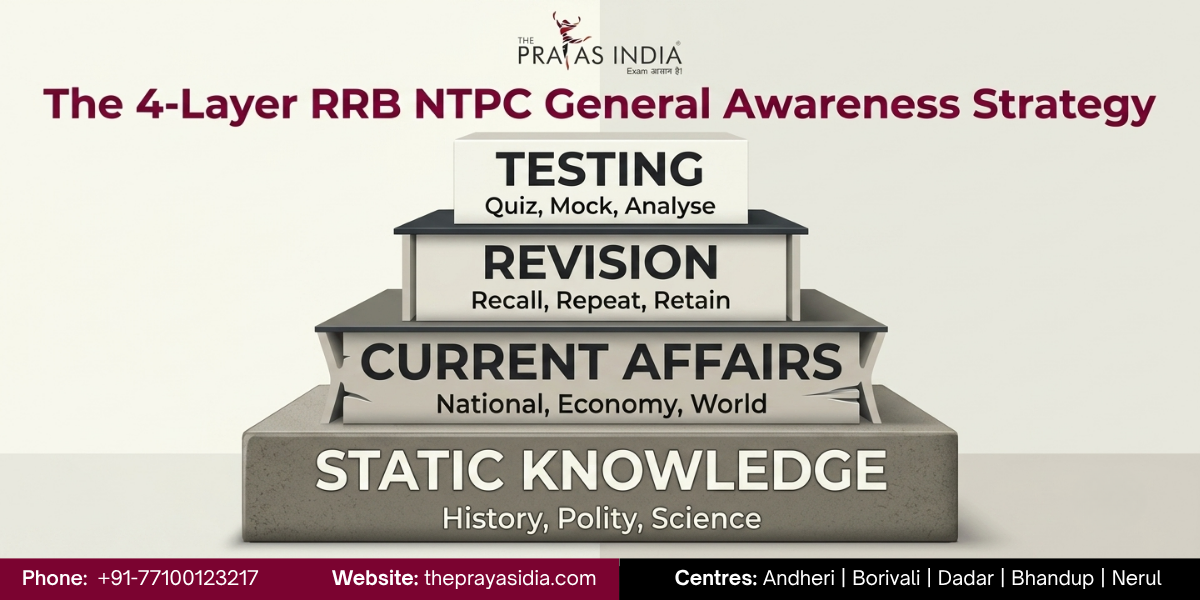
A useful way to organise General Awareness is to think of it as four interconnected layers:
Layer 1 — Static Knowledge:
Build the basic foundation through History, Geography, Polity, Economy, Science and Culture.
Layer 2 — Current Affairs:
Follow important national and international developments, government initiatives, appointments, awards, sports and major events.
Layer 3 — Revision:
Regularly revisit previously studied information so that it remains accessible.
Layer 4 — Testing:
Use sectional quizzes and full-length mocks to identify gaps and measure retention.
This structure prevents GA preparation from becoming a continuous process of consuming new information.
The real improvement begins when the information you studied earlier starts appearing correctly in your mock-test responses.
Don’t Treat Current Affairs as a Last-Minute Subject
One of the most common mistakes made by railway aspirants is postponing current affairs until the examination is close.
This creates an enormous information burden.
Current Affairs is much easier to manage when it is accumulated gradually. A short, consistent daily or weekly routine can be more effective than attempting to memorise several months of information in a few days.
Instead of asking yourself to remember every event, focus on identifying information that is likely to have examination value.
Important categories include:
- Major government schemes and initiatives
- Important appointments and resignations
- Awards and honours
- Sports tournaments and winners
- Important national and international events
- Books and authors
- Important reports and indexes
- Defence exercises and developments
- Science and technology developments
- Important economic and financial developments
- Significant railway-related developments
- Important days and themes
The exact priority should depend on the examination cycle and the current syllabus. The purpose of categorisation is simply to prevent daily news from becoming an unmanageable stream of disconnected facts.
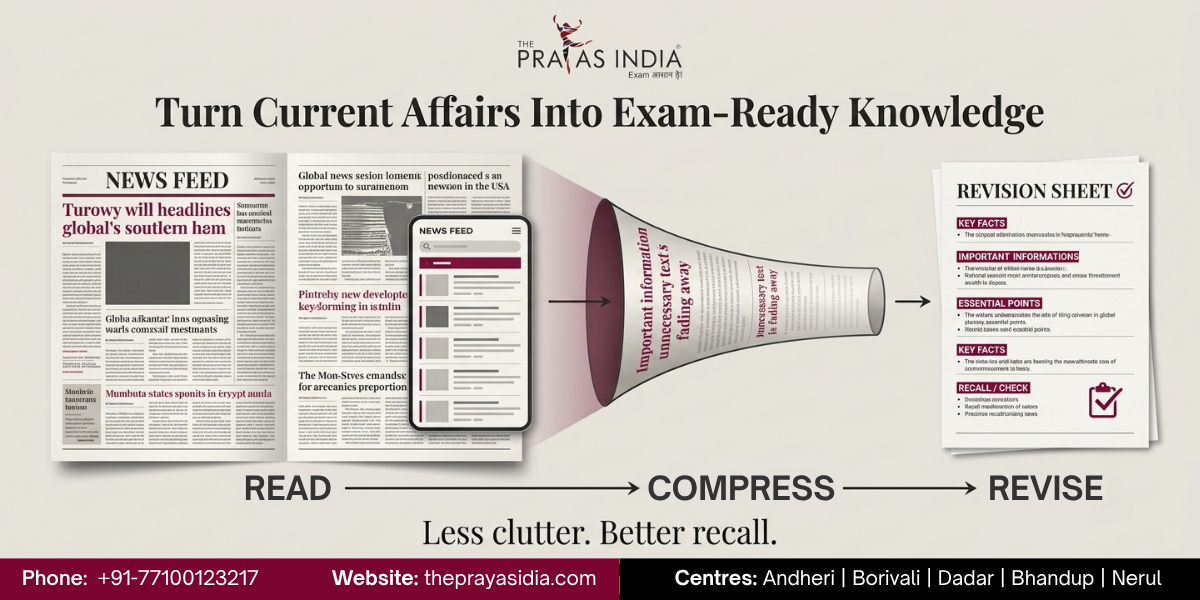
Follow a “Read, Compress, Revise” Method
Reading current affairs is only the first step.
After studying a monthly current-affairs source, compress the information into short revision-friendly notes or rely on a well-curated capsule that already performs this filtering.
The objective is to reduce a large amount of information into material that can be revised quickly.
For example, instead of writing a complete explanation of an award, your revision note might contain only the award name, recipient, category and the key fact associated with it.
This compression process makes later revision significantly easier.
A good GA note should answer one simple question: Can I revise this quickly before a mock test or examination?
If the answer is no, the notes may contain more information than necessary.
Use Categories Instead of Random Fact Lists
Random lists of facts are difficult to retain because the brain has very little structure to associate them with.
Categorisation creates connections.
For example, instead of maintaining one giant list of 100 current-affairs facts, organise them into sections such as:
- Government & Polity
- Economy
- Science & Technology
- Defence
- Sports
- Awards
- Appointments
- International Affairs
- Important Reports
- Railway & Transport
When you revise information within categories, related facts become easier to connect.
This also improves mock-test analysis. If you repeatedly make mistakes in international organisations, for example, you can create a targeted revision list rather than revisiting the entire current-affairs syllabus.
General Science Deserves Regular Attention
General Science is another important component of RRB NTPC preparation because railway examinations traditionally require candidates to be comfortable with basic scientific concepts.
The most efficient approach is to build conceptual clarity first and then reinforce it through objective questions.
Focus on understanding common principles rather than attempting to memorise disconnected statements.
For example, in Physics, concepts related to motion, force, work, energy, electricity, heat and basic measurements should be understood sufficiently to handle objective questions.
In Chemistry, topics such as elements, compounds, acids, bases, metals, non-metals and everyday chemical processes can form part of your preparation.
Biology can include human systems, nutrition, diseases, plants, cells and other foundational concepts.
A practical strategy is to:
- Learn the basic concept.
- Solve examination-level questions.
- Note recurring mistakes.
- Revise the concept after a fixed interval.
- Test yourself again.
This turns General Science from passive reading into active preparation.
Study Static GK Through Connections
Static GK can appear endless when approached as isolated facts. The better approach is to connect information wherever possible.
For example, while studying a state, you can connect its capital, geography, major rivers, national parks, important cultural features, historical associations and major industries.
Similarly, while studying an important historical event, connect the event with its period, major personalities, location and consequences.
These associations create multiple retrieval points.
The objective is not to make elaborate notes for every topic. It is to organise information in a way that makes recall easier.
This is particularly useful during mock tests because questions often require quick retrieval rather than lengthy reasoning.
Use Previous Questions as a Preparation Filter
Previous-year questions can help you understand the nature of questions asked in railway examinations.
They should not be treated as a guarantee of what will appear in the next paper. Their real value lies in showing the kind of information the examination has considered relevant.
Analyse previous questions to identify:
- Frequently tested subject areas
- Recurring factual categories
- Common General Science concepts
- Important historical and geographical themes
- Typical current-affairs categories
- Difficulty level
- Question framing patterns
Once these patterns become familiar, your preparation becomes more selective.
You begin to understand the difference between information that is interesting and information that is useful for your examination.
Don’t Ignore Revision While Chasing New Current Affairs
Current Affairs creates a unique problem because there is always something new to study.
Every day brings another headline. Every month produces another capsule. If you continuously chase new information without revisiting old material, your preparation becomes a moving target.
This is why revision should have a fixed place in your weekly routine.
A simple structure can be:
Daily: Review recently studied current affairs.
Weekly: Revise the week’s important information.
Monthly: Revise the complete monthly capsule.
Periodic: Revisit older months and static topics through quizzes or short revision sessions.
The exact frequency can be adjusted according to your preparation stage.
The important point is that new information should never completely replace revision.
Keep a Separate Mistake Register for GA
General Awareness mistakes are particularly valuable because they often reveal a simple knowledge gap.
Whenever you get a GA question wrong in a mock or quiz, identify the reason.
Was the fact never studied? Did you confuse two similar facts? Did you remember the concept but forget the exact detail? Did you change the correct answer because of uncertainty?
Maintain a concise mistake register for recurring problems.
This becomes a highly personalised revision resource as the examination approaches.
Instead of revising thousands of facts again, you can spend additional time on the information that has already demonstrated a weakness in your preparation.
How Much Time Should You Give to General Awareness?
There is no universal number of hours that every RRB NTPC aspirant should dedicate to GA.
The appropriate amount depends on your existing knowledge, preparation stage and performance in mock tests.
A candidate with a strong static-GK foundation may need more time for current affairs and revision. Another candidate may need to spend additional time building General Science fundamentals.
A practical daily session could include a combination of:
- New learning
- Current-affairs revision
- Static GK revision
- Objective-question practice
The important point is consistency.
A moderate GA session repeated regularly can produce better retention than occasional marathon study sessions.
Don’t Make GA Preparation Passive
Simply reading a PDF is not enough.
After completing a topic, close the material and attempt to recall the important information. Solve objective questions without looking at the answers. Explain a concept to yourself. Use short quizzes to test memory.
This is called active recall, and it makes your preparation more demanding—but also more useful.
For General Awareness, the difference between recognition and recall matters greatly. You may recognise a fact when you see it in a PDF but fail to retrieve it when the examination presents four answer choices.
Testing yourself closes that gap.
Mock Tests Should Influence Your GA Strategy
Mock tests are not only for measuring your overall score.
They can tell you which areas of General Awareness require additional attention.
Suppose you consistently perform well in History but lose marks in Science. Your revision strategy should reflect that difference.
Similarly, if your current-affairs accuracy is good but you frequently confuse static GK facts, you should change the allocation of your revision time rather than continuing to study every topic equally.
After each mock, classify your GA mistakes into broad categories.
For example:
- Not studied
- Forgotten
- Confused
- Careless error
- Question misunderstood
Each category suggests a different corrective action.
This makes mock analysis part of the learning process rather than just a score-checking exercise.
Structured Guidance Can Make GA Preparation Easier
The challenge with General Awareness is often deciding what not to study.
A student preparing alone may spend hours searching for the “best” current-affairs source, comparing different PDFs and trying to determine which facts are important. That time could instead be spent revising and testing.
For aspirants looking for RRB coaching in Mumbai, a structured institute can provide a curated preparation framework. Faculty guidance, relevant study material, regular quizzes, mock tests and performance analysis can reduce the uncertainty involved in planning GA preparation.
The Prayas India provides exam-oriented preparation for competitive examinations and aims to create a structured learning environment for aspirants. For RRB NTPC candidates, this can help bring greater discipline to a subject that otherwise tends to become scattered across multiple sources.
The purpose of coaching should not simply be to provide more information. It should help candidates filter, organise, revise and apply information effectively.
Choose an RRB Coaching Institute Based on the Complete Preparation System
When students search for the best RRB coaching in Mumbai, they often focus primarily on faculty or course fees. These factors matter, but they should not be the only considerations.
A serious aspirant should also evaluate how the institute approaches the complete examination cycle.
Look for a preparation system that includes:
- Structured classroom learning
- Exam-oriented study material
- Regular practice questions
- Current-affairs support
- Sectional and full-length mock tests
- Performance analysis
- Doubt-solving support
- Revision planning
- Guidance based on individual performance
A coaching institute can add the most value when it reduces uncertainty and helps students follow a disciplined preparation path.
For General Awareness especially, the right structure can prevent the common cycle of collecting material without revising it.
Your GA Strategy Should Become More Selective as the Exam Approaches
Long before the examination, your primary objective should be coverage and understanding.
As the examination gets closer, the focus should gradually shift toward retention and testing.
That means reducing the time spent searching for new resources and increasing the time spent revising what you have already studied.
Your final preparation should ideally contain:
- Repeated revision of important current affairs
- Strong recall of static topics
- Regular General Science practice
- Previous-question practice
- Mock-test analysis
- Revision of your personal mistake register
The closer you move toward the examination, the more valuable familiarity with your own notes and mistakes becomes.
General Awareness Is a Long-Term Score-Building Subject
GA should not be treated as a subject that you can “finish” once.
It is better understood as a continuously improving knowledge base.
Every revision strengthens retention. Every quiz reveals a gap. Every mock shows a weakness. Every mistake can become a future correct answer if it is analysed properly.
This mindset removes some of the pressure associated with trying to remember everything at once.
The goal is to gradually increase the percentage of relevant information that you can recall accurately under examination conditions.
For RRB NTPC aspirants, that requires patience and consistency.
Continue the Preparation With a Structured Approach
General Awareness can become one of the most manageable sections of RRB NTPC preparation when the process is organised around limited sources, systematic coverage, active recall, repeated revision and regular testing.
The biggest mistake is not knowing too little. It is often trying to know too much without a revision strategy.
Start with the syllabus. Build your static foundation. Follow current affairs consistently. Organise information into categories. Test yourself regularly. Maintain a mistake register and allow your mock-test performance to guide your revision priorities.
For candidates who want additional academic structure, joining a reputed RRB coaching institute in Mumbai can provide a disciplined environment where preparation is guided rather than left entirely to trial and error.
The Prayas India can support aspirants through structured exam preparation, practice and performance-oriented guidance, helping students approach RRB NTPC preparation with greater clarity and consistency.
Create a Practical Daily GA Routine
General Awareness preparation becomes much easier when it has a fixed place in your daily routine. The purpose of creating a GA routine is not to spend several hours every day memorising facts. It is to ensure that the subject receives regular attention so that information does not disappear between two revision cycles.
For most aspirants, a balanced session can combine current affairs, static knowledge and question practice. The exact duration should depend on the candidate’s overall study schedule and preparation stage. Someone starting preparation may need more time for conceptual learning, while a candidate approaching the examination may need to dedicate a larger share of the session to revision and testing.
A practical routine can include:
- Current Affairs: Read and revise important recent developments.
- Static GK: Cover a focused topic rather than jumping between subjects.
- General Science: Revise one concept and solve objective questions.
- Practice: Attempt a short GA quiz or previous-year questions.
- Recall: Spend a few minutes revisiting previously studied information.
The most important part is repetition. A routine that can be followed consistently for several months is more valuable than an intensive routine that lasts only a few days.
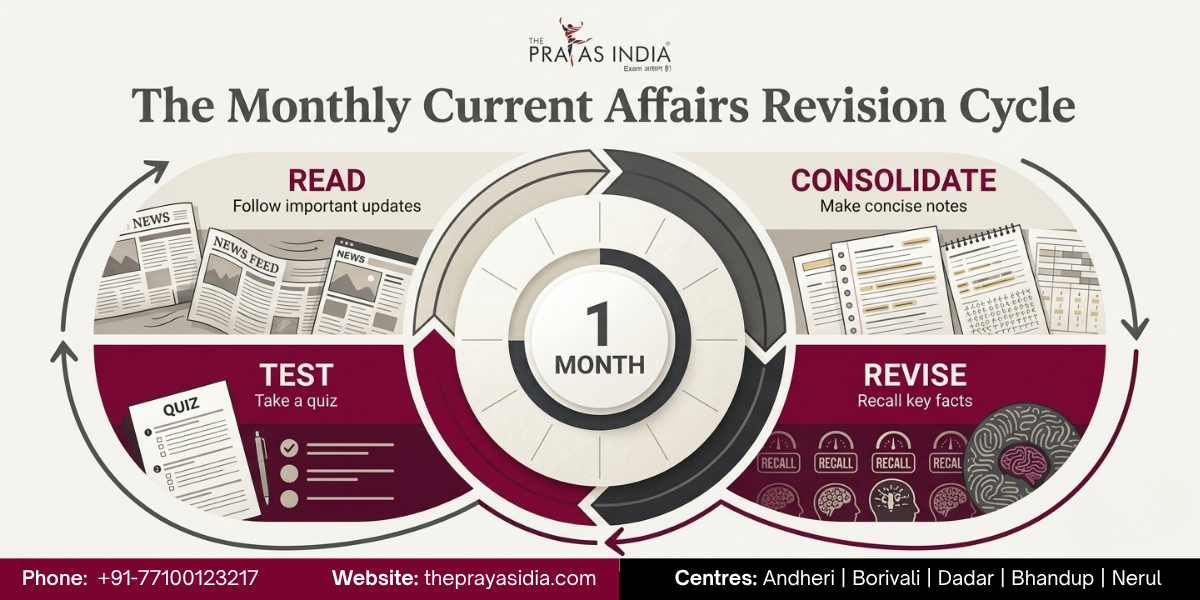
Follow a Monthly Current Affairs Cycle
Current Affairs preparation becomes considerably more manageable when every month follows a predictable cycle.
During the month, focus on understanding and recording important events. At the end of the month, consolidate the information into a concise revision source. During the following weeks, revise it through quizzes and short recall sessions.
This creates a continuous cycle rather than a situation where several months of current affairs are left for the end.
A monthly cycle can look like this:
Week 1–3: Read and understand important current affairs.
Week 4: Consolidate and revise the month’s key information.
Following Month: Test the previous month’s content through quizzes.
Periodic Revision: Revisit older months along with new current affairs.
This approach also reduces the temptation to download every available current-affairs compilation. Once you have a defined monthly system, you know exactly where your information is coming from and when it needs to be revised.
Prioritise Current Affairs That Can Be Tested
Not every headline deserves equal preparation time.
An RRB NTPC aspirant should learn to distinguish between general news consumption and examination-oriented current affairs. A major appointment, government initiative, international development, sports achievement or important report may have greater examination relevance than an ordinary daily event.
This does not mean predicting the exact questions that will appear. No preparation strategy can guarantee that.
Instead, focus on categories that traditionally have strong relevance in competitive examinations:
- Government schemes and initiatives
- Important appointments
- Awards and honours
- Sports events and achievements
- National and international developments
- Important reports and indexes
- Science and technology
- Defence-related developments
- Economy and banking-related developments
- Books and authors
- Important days and themes
- Transport and railway-related developments
The objective is to create a filtered current-affairs base that can actually be revised.
Use Previous-Year Questions as a Reality Check
Study material tells you what you could learn. Previous-year questions help you understand what the examination has actually tested.
This makes them an important part of GA preparation.
Do not simply solve previous questions and check the answer. Study the pattern behind them. Identify the subjects that repeatedly appear and the level of factual or conceptual detail expected.
If a particular area repeatedly appears in previous questions, it deserves proper preparation. If a topic consistently creates confusion, add it to your revision list.
Previous-year questions should not be treated as a substitute for syllabus coverage. Their role is to help you prioritise and contextualise your preparation.
Revise Through Questions, Not Only Through Notes
Reading the same notes repeatedly can create a false sense of familiarity. The material looks familiar, so you assume that you remember it.
Questions expose whether that memory is actually available.
This is why quizzes should be integrated into the revision cycle.
After revising a topic, solve objective questions without looking at the material. Mark the questions you could not answer confidently. Then revisit only the relevant portions.
This creates a simple feedback loop:
Study → Recall → Test → Identify Gap → Revise
Over time, this process can make General Awareness preparation significantly more efficient.
It also helps candidates become comfortable with the pressure of retrieving information quickly.
Build Short Revision Sheets
As the examination approaches, revision speed becomes increasingly important.
Large notes that took hours to create may become difficult to revise when several subjects compete for your attention. This is why important GA information should gradually be compressed into short revision sheets.
These sheets can contain:
- Important names and appointments
- Important awards
- Government schemes
- Important organisations
- Key reports and indexes
- Major sports events
- Important scientific developments
- Frequently confused facts
- Personal mistakes from mocks
The revision sheet should not attempt to reproduce an entire book. It should act as a memory trigger.
If a short phrase is enough to make you recall the complete information, there is no need to write a long explanation.
General Science Should Be Revised Repeatedly
General Science should not be treated as a one-time chapter completion exercise.
Once the basic concepts are covered, repeated objective practice becomes important. Questions can reveal whether you genuinely understand the concept or merely recognise it from your notes.
A useful revision pattern is to divide Science into broad areas and rotate them throughout the preparation period.
For example:
Physics: Motion, force, work, energy, heat, electricity and basic physical principles.
Chemistry: Elements, compounds, acids, bases, metals, non-metals and everyday chemistry.
Biology: Human body, nutrition, diseases, cells, plants and basic biological processes.
The exact topic distribution should be aligned with the relevant RRB NTPC syllabus and your mock-test performance.
The important point is to keep Science active through repeated practice rather than leaving it untouched after the first reading.
Give Static GK a Fixed Weekly Slot
Static GK can easily get pushed aside because current affairs always feel more urgent.
That is a mistake.
Current affairs keeps changing, while static knowledge provides a relatively stable foundation. A fixed weekly slot can therefore prevent static GK from disappearing from the preparation routine.
You can rotate themes throughout the week. For instance, one session may focus on Geography, another on History and another on Polity or Culture.
This prevents the subject from becoming monotonous and allows gradual coverage without demanding long daily sessions.
The key is to avoid trying to complete the entire static GK syllabus in one marathon.
Use Memory Techniques Selectively
Not every fact requires a complicated memory trick.
Memory techniques are most useful when information is confusing, similar or difficult to recall naturally. For example, if you repeatedly confuse two organisations, dates or geographical facts, creating a simple association may help.
For straightforward information, repeated exposure and testing may be enough.
Some useful techniques include:
- Connecting related facts into groups
- Creating short associations
- Using comparison tables for similar information
- Revising confusing facts together
- Testing yourself without looking at notes
The technique should make recall easier, not make your notes more complicated.
Don’t Keep Changing Your Study Sources
Changing resources frequently is one of the biggest productivity traps in General Awareness preparation.
Every new source creates the impression that something important may have been missed. The aspirant then starts collecting another PDF or watching another lecture instead of revising the material already available.
Once you have identified reliable and examination-relevant sources, stay with them unless there is a genuine reason to change.
The same principle applies to coaching material.
A structured RRB coaching institute in Mumbai can reduce resource confusion by providing curated study material and a defined preparation path. This allows students to focus on understanding and revision rather than constantly searching for additional content.
Track GA Accuracy Separately in Mock Tests
Overall mock-test scores are useful, but section-wise analysis can reveal much more.
Track your GA performance separately. Look at your accuracy, attempted questions and the categories responsible for mistakes.
For example, if your GA score remains low despite completing the current-affairs syllabus, the problem may not be the amount of information you have studied. It could be weak recall.
If you perform well in current affairs but poorly in static GK, the solution is not necessarily more current-affairs material. You may simply need to rebalance your preparation.
A simple tracking table can include:
| Area | Attempted | Correct | Incorrect | Action |
|---|---|---|---|---|
| Current Affairs | — | — | — | Revise weak topics |
| Static GK | — | — | — | Increase revision |
| General Science | — | — | — | Practise concepts |
| Mixed GA | — | — | — | Analyse errors |
The purpose of this tracking is not to create another complicated task. It is to make your preparation decisions evidence-based.
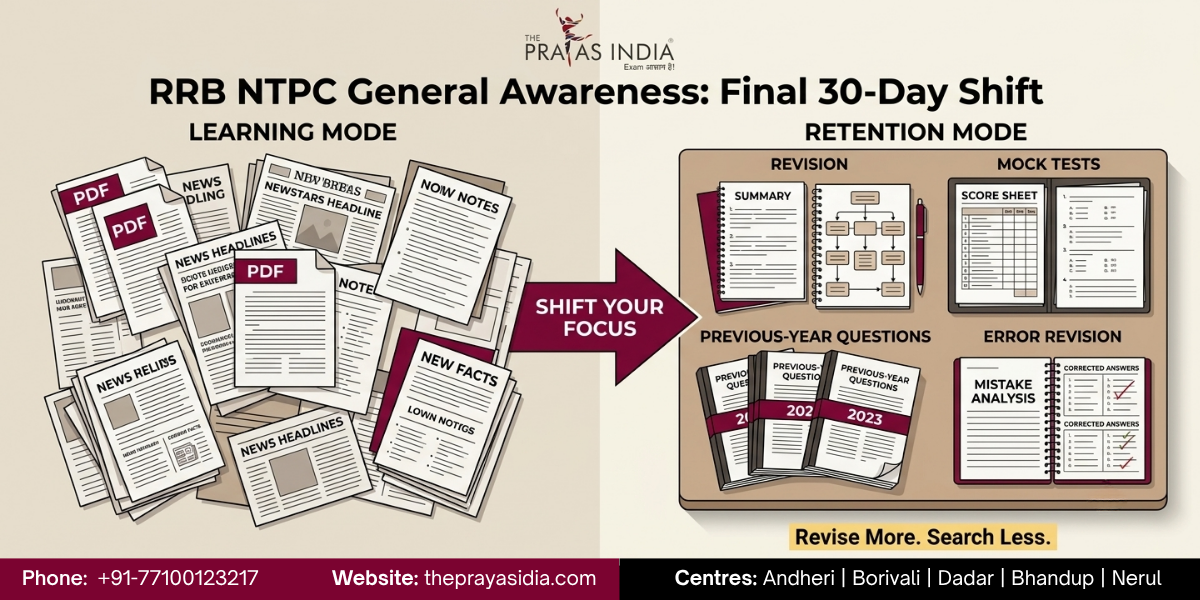
The Final 30 Days Should Be About Retention
As the examination approaches, your preparation philosophy should change.
You should gradually reduce the time spent collecting new resources and increase the time spent revising, testing and correcting.
During the final month, priorities can include:
- Revising monthly current-affairs capsules
- Revisiting important static GK
- Practising General Science questions
- Solving previous-year questions
- Attempting GA sectional tests
- Analysing mock-test mistakes
- Revising your personal error register
This is not the ideal stage to discover five new sources and attempt to complete all of them.
Your final preparation should feel increasingly familiar, not increasingly chaotic.
Avoid These Common GA Preparation Mistakes
General Awareness mistakes often look small individually, but together they can reduce the effectiveness of months of preparation.
Some of the most common mistakes include:
- Studying from too many sources
- Reading current affairs without revision
- Ignoring static GK
- Treating General Science as pure memorisation
- Not solving previous-year questions
- Taking mocks without analysing GA mistakes
- Creating excessively long notes
- Postponing current-affairs preparation
- Spending too much time on obscure facts
- Changing the strategy repeatedly
The solution is not to study more material. It is to make the existing preparation system more disciplined.
How Coaching Can Improve Your RRB NTPC Preparation
Self-study can work extremely well when an aspirant has a clear plan, reliable resources and the discipline to follow the schedule. However, many students struggle not because they are incapable of studying but because they lack a structured system.
This is where professional guidance can become useful.
For candidates searching for the best RRB coaching in Mumbai, the institute should ideally provide more than classroom lectures. A comprehensive preparation system can help students understand the syllabus, follow relevant study material, practise questions, evaluate mock-test performance and revise systematically.
The Prayas India offers structured preparation for competitive examinations with an emphasis on guided learning and exam-oriented practice. For RRB NTPC aspirants, having regular academic support can make it easier to maintain consistency across subjects while giving special attention to areas such as General Awareness.
The right coaching environment can also provide accountability. When students regularly attend classes, complete assignments and participate in tests, preparation becomes a structured process rather than an activity that depends entirely on daily motivation.
Choosing the Right RRB Coaching in Mumbai
Before joining an institute, aspirants should evaluate whether its teaching and testing system actually matches their preparation requirements.
Instead of focusing only on advertisements or claims, consider questions such as:
- Is the syllabus covered systematically?
- Is the study material examination-oriented?
- Are current affairs regularly updated?
- Are there enough sectional and full-length tests?
- Is mock performance analysed?
- Can students clarify doubts?
- Is revision incorporated into the course?
- Does the institute provide guidance throughout the preparation cycle?
For students who need structure, these factors can have a greater long-term impact than simply selecting the institute with the largest number of promotional claims.
The objective of joining RRB coaching in Mumbai should be to create a more organised path toward the examination.
A 90-Day General Awareness Approach
A longer preparation window allows aspirants to divide GA preparation into clear stages.
Days 1–30: Build the Foundation
Focus on static GK, General Science and basic current-affairs coverage. The objective is to establish a broad knowledge base without worrying excessively about speed.
Days 31–60: Strengthen and Practise
Increase question practice, revise previous topics and begin taking regular GA quizzes. Use mistakes to identify weak areas.
Days 61–90: Test and Retain
Shift the emphasis toward revision, mock tests, previous-year questions and error correction. Current affairs should be revised systematically rather than consumed endlessly.
This is only a framework. Candidates with more or less preparation time can adapt the same principle by changing the duration of each phase.
A One-Week Sample GA Routine
A weekly structure can help aspirants understand how different components can work together.
Monday: Current Affairs + General Science
Tuesday: Static GK + Current Affairs Revision
Wednesday: General Science + GA Quiz
Thursday: History/Geography/Polity + Current Affairs
Friday: Current Affairs Revision + Previous-Year Questions
Saturday: Mixed GA Test + Error Analysis
Sunday: Weekly Revision + Backlog Recovery
The exact schedule should be adjusted according to your overall RRB NTPC preparation plan.
The important idea is that learning, revision and testing should coexist.
General Awareness Preparation Should Support Your Overall Strategy
One of the biggest mistakes is allowing GA to consume so much time that Quantitative Aptitude, Reasoning or other examination sections are neglected.
General Awareness should be integrated into the overall preparation schedule.
A candidate may be able to spend a focused session on GA and then use the remaining study time for numerical practice or reasoning. Another candidate may prefer shorter GA sessions spread across the day.
There is no universally correct timetable.
The right balance depends on your strengths, weaknesses and preparation stage.
Consistency Beats Information Overload
The most successful GA preparation system is rarely the one with the largest number of PDFs.
It is the one where the candidate knows what to study, studies it regularly, revises it repeatedly and tests it frequently.
If you remember one framework from this article, remember:
Select → Study → Compress → Revise → Test → Correct → Repeat
This cycle can be applied to current affairs, static GK and General Science.
Over time, information that once felt unfamiliar becomes increasingly accessible. The subject becomes less intimidating because you are no longer trying to learn everything at once.
Final Takeaway
Preparing General Awareness for RRB NTPC requires a different mindset from simply reading facts. The syllabus is broad, current affairs keeps changing and retention can become a challenge when preparation stretches across several months.
The solution is a structured approach.
Build your static foundation. Cover General Science at the appropriate level. Follow current affairs consistently. Limit your sources. Compress information into revision-friendly notes. Use previous-year questions to understand the examination. Test yourself regularly and maintain a record of recurring mistakes.
As the examination approaches, reduce information overload and increase revision and testing.
For aspirants who want professional structure, choosing the right RRB coaching in Mumbai can provide additional support through organised classes, curated study resources, practice, testing and performance guidance. The Prayas India can help candidates approach their railway examination preparation with a structured, exam-focused framework.
General Awareness is not a subject that needs to be conquered in one sitting. It needs to be built, revised and strengthened repeatedly.
Prepare consistently, revise intelligently and let your mock-test performance guide your next step.
Contact Us
- Call Now: +91-77100 13217
- Website: theprayasindia.com
- Centres: Andheri | Borivali | Dadar | Nerul | Bhandup
FAQs
1. How should I start General Awareness preparation for RRB NTPC?
Start by understanding the relevant syllabus and dividing preparation into Static GK, General Science and Current Affairs. Use limited, reliable study sources and create a regular revision and testing routine instead of trying to memorise large amounts of information at once.
2. Is Current Affairs important for RRB NTPC?
Yes. Current Affairs is an important component of General Awareness preparation. Candidates should follow relevant national, international, economic, sports, government, science and other major developments and revise them regularly.
3. How many months of Current Affairs should I prepare for RRB NTPC?
The appropriate coverage depends on the examination cycle and the latest syllabus requirements. Rather than relying on a fixed number of months, aspirants should follow the relevant current-affairs window and ensure that the material is thoroughly revised.
4. How can I remember General Awareness facts for a longer time?
Use active recall, repeated revision, quizzes and previous-year questions. Creating short revision notes and maintaining a personal error register can also help reinforce information that you repeatedly forget.
5. Should I study General Awareness every day?
Regular exposure is beneficial, particularly for Current Affairs. However, the exact daily duration can vary according to your overall RRB NTPC preparation schedule. Consistency is generally more useful than occasional long study sessions.
6. How can mock tests improve my RRB NTPC GA preparation?
Mock tests reveal whether you can recall information under examination conditions. Analysing incorrect and uncertain answers helps identify weak areas and allows you to target future revision more effectively.
7. Should I join RRB coaching in Mumbai for General Awareness preparation?
Coaching is not compulsory for every aspirant, but structured guidance can be useful for candidates who need a defined study plan, curated material, regular tests, doubt support and performance analysis. The right RRB coaching in Mumbai can help make preparation more systematic.
8. Which is the best RRB coaching in Mumbai?
The best institute depends on your individual requirements. Before enrolling, compare faculty, study material, mock-test quality, revision support, doubt-solving facilities, course structure and overall academic guidance. A coaching institute should provide a complete preparation ecosystem rather than only classroom lectures.