How to Prepare General Science for RRB Group D? | Best RRB Coaching in Mumbai | The Prayas India
General Science is one of the areas where a well-planned preparation strategy can make a significant difference in RRB Group D. The section is not necessarily difficult because the concepts are highly advanced; the bigger challenge is the breadth of the syllabus and the number of facts and concepts that candidates are expected to remember and apply.
Many aspirants approach General Science by trying to memorise large amounts of information from multiple books and online sources. This often creates confusion rather than confidence. A better approach is to understand the level of questions generally asked, divide the subject into manageable areas, build conceptual clarity and then use repeated revision and practice to strengthen retention.
For RRB Group D aspirants, General Science primarily revolves around Physics, Chemistry and Biology at an approximately school-level foundation. This means candidates do not need to approach the subject as if they are preparing for an advanced science examination. The focus should instead be on understanding fundamental concepts, important applications, common scientific facts and the types of questions that can be asked in a competitive examination.
The most effective preparation therefore combines conceptual study, short revision notes, topic-wise practice, previous-year questions and mock-test analysis. With a structured plan, even candidates who are not naturally comfortable with science can gradually build confidence in this section.
Understanding the Role of General Science in RRB Group D
Before beginning preparation, it is important to understand what General Science demands from an RRB Group D candidate. The objective is not to study every scientific concept in extreme depth. Instead, you need to develop enough conceptual understanding to identify the correct answer quickly and accurately during the examination.
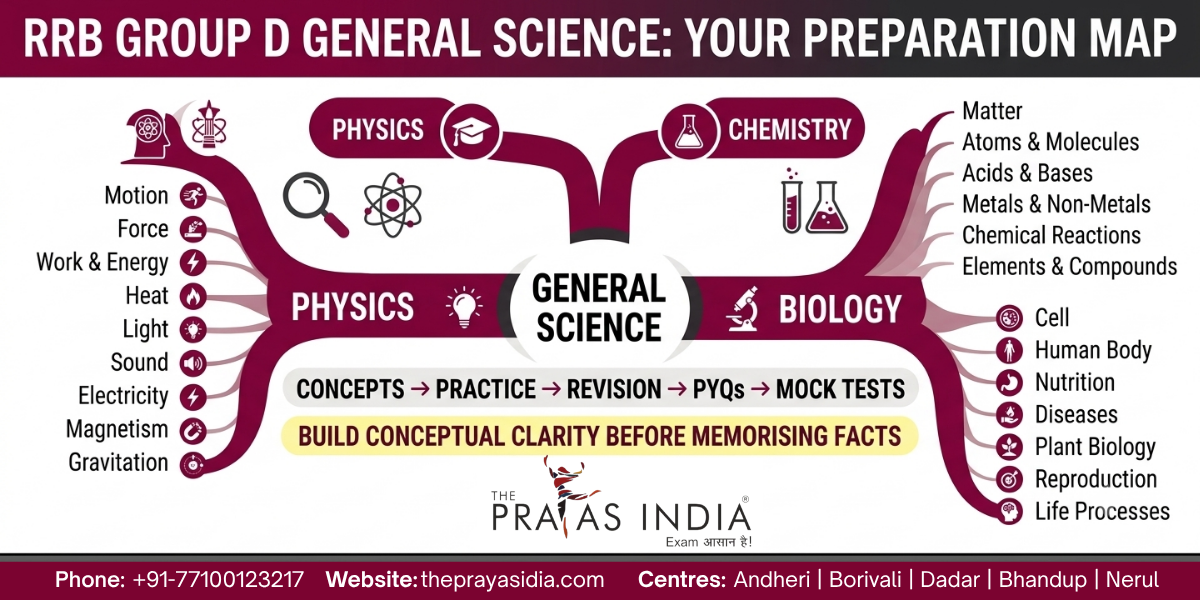
Physics questions may involve basic concepts related to motion, force, work, energy, electricity, heat, light, sound and everyday applications of scientific principles. Chemistry can include topics such as matter, atoms and molecules, acids and bases, metals and non-metals, chemical reactions and common compounds. Biology may cover human body systems, nutrition, diseases, plants, cells, reproduction and other fundamental life-science concepts.
The challenge is that questions can come from different parts of the syllabus. Therefore, preparing only one or two favourite topics is unlikely to be sufficient.
A good preparation strategy should help you develop breadth first and then accuracy. Once you have covered the major areas, repeated revision can help convert your knowledge into quick recall.
How to Divide the RRB Group D General Science Syllabus
One of the easiest ways to make General Science manageable is to divide it into three major subjects: Physics, Chemistry and Biology.
Instead of treating General Science as one huge subject, prepare each area separately and then bring them together through mixed practice.
Physics
Physics preparation should focus on understanding basic principles and their applications. Important areas include motion, force, work and energy, power, gravitation, pressure, heat, temperature, sound, light, electricity and magnetism.
Candidates should pay special attention to formulas, units, relationships between quantities and everyday applications. However, simply memorising formulas is not enough. You should understand what each formula represents and when it should be used.
For example, when studying work, energy and power, understand the relationship between these concepts rather than memorising isolated definitions. Similarly, while studying electricity, become comfortable with basic concepts such as current, voltage, resistance and their relationships.
This approach makes it easier to deal with questions that test understanding rather than direct memorisation.
Chemistry
Chemistry preparation should begin with basic concepts because many questions become easier once the fundamentals are clear.
Focus on areas such as matter, physical and chemical changes, atoms and molecules, elements and compounds, acids, bases and salts, metals and non-metals, chemical reactions, periodic-table basics and common chemicals used in everyday life.
You should also pay attention to practical applications. Questions involving substances commonly encountered in daily life can often become easier when you connect the concept with real-world examples.
Rather than trying to memorise hundreds of isolated facts, understand categories and relationships. Once the fundamentals are clear, revision becomes much more manageable.
Biology
Biology can cover a broad range of topics, but it becomes easier when studied systematically.
Important areas include the cell, tissues, human body systems, nutrition, digestion, respiration, circulation, excretion, reproduction, diseases, immunity, plants and basic genetics.
Human biology deserves consistent attention because many questions can be connected to organs, functions, nutrients, diseases and body systems.
Instead of memorising disconnected facts, try to understand how different systems work together. This makes revision more meaningful and can improve recall during the examination.
Start With NCERT-Level Fundamentals
One of the biggest mistakes candidates make while preparing General Science is jumping directly into advanced competitive-exam material. For RRB Group D, a strong foundation is usually more valuable than unnecessary depth.
If your fundamentals are weak, start with school-level science material and make sure you understand the basic concepts. NCERT books from the relevant school levels can be useful for developing this foundation, particularly when you are studying a topic for the first time.
The objective is not to read every page repeatedly. Instead, identify the chapters and concepts relevant to the examination and understand them properly.
For example, while studying the human body, do not simply memorise the names of organs. Understand their basic functions and relationships. Similarly, while studying electricity, understand the fundamental terms and relationships before moving towards question practice.
Once the foundation is strong, your competitive-exam preparation material becomes much easier to understand.
Do Not Turn General Science Into a Memorisation Exercise
General Science certainly contains factual information, but preparing entirely through memorisation can become exhausting and unreliable.
Suppose you memorise a scientific fact without understanding the concept behind it. You may remember it during revision but struggle when the examination presents the information differently.
Conceptual understanding creates multiple pathways for recall.
If you understand why a particular phenomenon occurs, you are more likely to remember the related fact. This is particularly useful in Physics and Chemistry, where many questions can test relationships between concepts rather than asking for direct definitions.
Biology also benefits from this approach. Understanding the function of a system is usually more useful than memorising isolated terminology without context.
The right balance is understand first, memorise what needs to be memorised, and then reinforce everything through questions and revision.
Build a Topic-Wise Study Plan
Instead of deciding each day what to study based on your mood, create a topic-wise General Science plan.
A practical schedule can divide your preparation into focused blocks. For example, you could spend several days building Physics fundamentals, followed by Chemistry and Biology, while continuing short revision sessions for previously completed topics.
Your study plan should include four activities:
- Concept learning for new topics
- Question practice immediately after learning
- Revision of previously studied material
- PYQ practice to understand examination trends
This prevents the common problem of completing the syllabus once and then discovering that you cannot recall much of it later.
A good study plan is not necessarily the one with the most hours. It is the one that allows you to cover the syllabus, practise questions and revisit important concepts repeatedly.
Give More Attention to Frequently Tested Fundamentals
Not every topic deserves exactly the same amount of preparation time.
Once you begin solving RRB Group D previous-year questions and practice sets, you will start noticing recurring concepts and question patterns. These observations can help you prioritise your revision.
For Physics, fundamental concepts such as motion, force, energy, heat, light and electricity deserve strong preparation. In Chemistry, focus on basic properties, reactions, acids and bases, metals and non-metals and common chemical concepts. In Biology, human body systems, nutrition, diseases, cells and basic life processes are important areas to understand thoroughly.
This does not mean you should completely ignore less familiar topics. Rather, your revision time should be distributed according to importance, difficulty and your individual performance.
How to Make Physics Easier for RRB Group D
Physics can initially appear difficult to candidates who are uncomfortable with numerical or conceptual questions. However, the subject becomes more manageable when you connect formulas with practical situations.
While studying a formula, ask yourself what each quantity represents, what unit it uses and how changing one quantity affects another.
For example, while studying speed, understand the relationship between distance and time instead of simply memorising the formula. While studying force, connect the concept with acceleration and mass. When studying electricity, understand the basic relationship between voltage, current and resistance.
Maintain a small formula and concept notebook for revision, but do not use it as a substitute for understanding.
After learning a concept, solve several questions without immediately looking at the solution. If you make an error, identify whether it occurred because you forgot the formula, misunderstood the question or made a calculation mistake.
This approach can gradually improve both accuracy and confidence in Physics.
How to Prepare Chemistry Efficiently
Chemistry can become highly manageable when you organise information into categories.
Instead of memorising isolated facts about elements, understand their basic properties and classification. Similarly, when studying acids, bases and salts, focus on their properties, common examples and important reactions.
Chemical equations and reactions should be revised repeatedly because they can become difficult to recall if studied only once.
Create concise notes for facts that genuinely require memorisation. These notes should be used for quick revision rather than becoming another large textbook.
Daily-life chemistry can also be easier to remember when you connect substances with their practical uses. This gives context to information that might otherwise feel like disconnected facts.
Biology Requires Repeated Revision
Biology has a large amount of terminology, which makes revision particularly important.
A candidate may understand the human digestive system today but forget several details after a few weeks without revision. This is why Biology preparation should not end after completing the chapter.
Use diagrams, flow-based notes and short revision tables where they genuinely improve recall. For example, while studying the human body, you can organise information around organ → function → related process → important fact.
Do not try to memorise every detail from a single reading. Study the concept, solve questions, revise it after a gap and then test yourself again.
Repeated active recall is generally more useful than repeatedly reading the same chapter.
Use Previous-Year Questions as a Learning Tool
Previous-year questions are extremely useful because they help you understand how your preparation translates into examination performance.
Do not use PYQs only at the end of your preparation. Start incorporating them after completing individual topics.
If you study electricity, solve relevant previous-year and practice questions soon afterwards. If you study human body systems, test yourself with questions from that area.
This gives you immediate feedback about whether your conceptual understanding is actually sufficient.
PYQs can also help you identify which areas deserve greater attention and prevent you from spending excessive time on unnecessarily advanced material.
The Importance of Active Recall
Reading a chapter multiple times can create a false sense of familiarity. You may feel that you know the information because it looks familiar on the page, but recalling it without seeing the material is a different skill.
After completing a topic, close your book and try to explain the main concepts in your own words. Write down important formulas, processes or facts from memory and then compare your notes with the original material.
For Biology, recall the functions of major organs without looking at the chapter. For Chemistry, try to remember important properties and reactions. For Physics, write down the relevant formulas and explain when they are used.
This process identifies gaps much faster than passive reading.
Key Takeaway
Preparing General Science for RRB Group D does not require endless memorisation or advanced scientific knowledge. What you need is a structured approach that combines school-level conceptual clarity, topic-wise preparation, regular practice and repeated revision.
Begin by dividing the syllabus into Physics, Chemistry and Biology. Build your fundamentals before moving towards intensive question practice, and use previous-year questions to understand the level and style of examination questions.
Most importantly, do not wait until the final stage to revise General Science. Because the subject covers a wide range of concepts, regular revision should run alongside new learning.
Create a Daily General Science Routine
A daily routine does not have to dedicate several hours exclusively to General Science. In fact, studying the subject for a focused period every day can be more effective than studying it intensively for one or two days and then leaving it untouched for a week.
A practical session can begin with learning a new concept, followed by a short question-practice session. The remaining time can be used to revise something studied earlier. This combination ensures that your preparation includes both new learning and retention.
For example, if you study electricity on one day, do not simply finish the chapter and move on permanently. Spend a few minutes on subsequent days recalling formulas, concepts and common applications. This repeated exposure helps prevent the forgetting that often occurs when candidates complete large portions of the syllabus without revision.
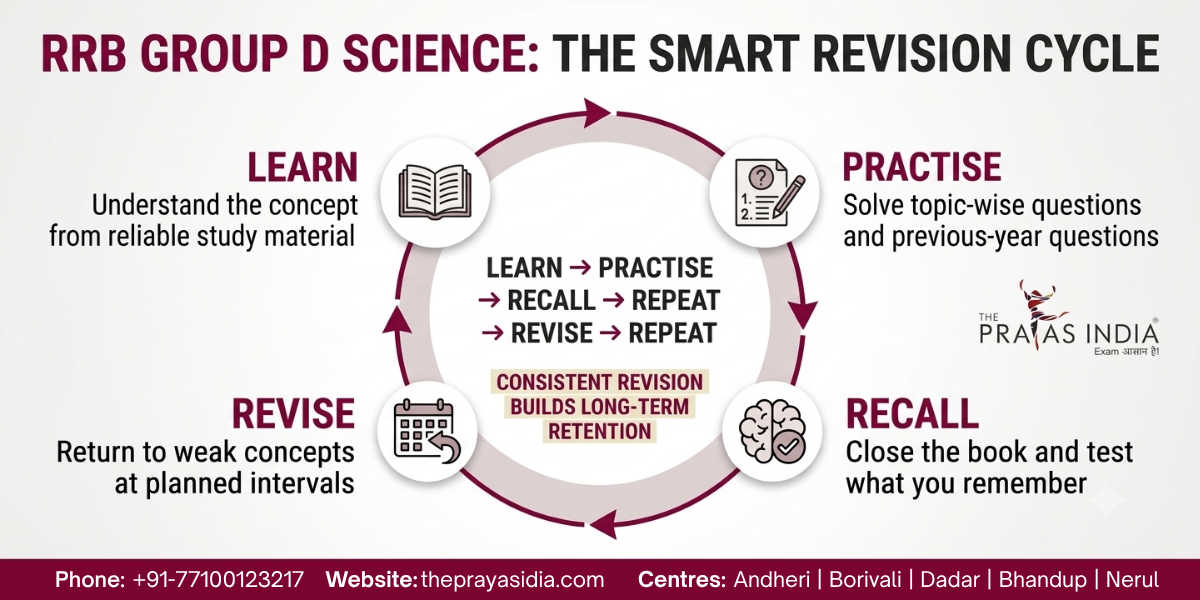
Your routine should therefore include three elements: learn, practise and revise.
Use a 3-Layer Approach for Every Topic
A simple three-layer method can make General Science preparation much more organised.
Layer 1: Understand
Study the basic concept and make sure you understand what the topic actually means. Avoid rushing through the chapter simply because it appears easy.
Layer 2: Apply
Solve questions based on the topic. This reveals whether you can actually use what you have studied.
Layer 3: Recall
Return to the topic after a gap and test yourself without looking at your notes.
This cycle is more effective than repeatedly reading the same material because it combines understanding with active practice and recall.
For example, while studying acids and bases, first understand their basic properties and reactions, then solve relevant questions, and finally test yourself later by recalling important properties without referring to your book.
How to Revise General Science Without Getting Overwhelmed
Revision becomes difficult when your notes become too large. If every chapter produces several pages of notes, revision itself can become another major task.
Your notes should therefore focus on information that requires repeated recall. In Physics, this may include formulas, units, laws and important relationships. In Chemistry, it may include reactions, properties, formulas and common applications. In Biology, it may include functions, classifications, processes, diseases, nutrients and important factual relationships.
Do not rewrite entire chapters in your notebook. Your notes should act as a revision tool, not a replacement textbook.
A good test is simple: if you can revise a topic quickly from your notes before a practice test, they are serving their purpose.
Use Spaced Revision Instead of One-Time Revision
One of the most common problems in General Science preparation is the gap between learning and revision. A candidate may study a chapter thoroughly but revisit it only several weeks later, by which time much of the information has already been forgotten.
A better approach is to revisit topics at planned intervals.
After studying a topic for the first time, revise it briefly after a short gap. Revisit it again later, and then test yourself through questions. The intervals can be adjusted according to how well you remember the material.
Topics that you consistently recall correctly require less revision time, while topics that repeatedly cause mistakes should return to your priority list.
This creates a personalised revision cycle rather than treating every topic as equally weak.
Make Previous-Year Questions a Regular Part of Preparation
Previous-year questions should not be treated as something you solve only after completing the entire syllabus. They are useful during preparation because they show how concepts are converted into actual examination questions.
After completing a topic, solve questions related to that area. Pay attention not only to the correct answer but also to the way the question has been framed.
If several questions test the same fundamental idea in different ways, that is a signal that you should understand the underlying concept rather than memorise individual answers.
Previous-year questions can also help you judge whether your study material is too advanced. If you are spending significant time on complicated concepts that have little relevance to the examination level, you may be using your preparation time inefficiently.
The purpose of PYQs is therefore both practice and direction.
Create a General Science Mistake Notebook
A separate mistake notebook can be extremely useful, especially during the later stages of preparation.
Whenever you make an error in a practice set, sectional test or mock test, record the question or the key concept behind it. But do not simply write the correct answer.
Write down why you got it wrong.
Perhaps you forgot a formula. Maybe two scientific terms were confused. Perhaps you misunderstood a biological function or incorrectly remembered a chemical property.
Over time, the notebook will show you your personal weak areas.
During revision, you can focus on these mistakes rather than spending equal time on concepts that you already know well.
How to Use Mock Tests for General Science
Mock tests are particularly useful after you have developed reasonable coverage of the syllabus. They introduce the pressure of time and force you to make decisions under examination-like conditions.
However, your General Science mock analysis should not end with your score.
For every incorrect question, identify whether the issue was:
- Lack of conceptual knowledge
- Poor factual recall
- Confusion between similar concepts
- Misreading the question
- Guesswork
- Careless selection of an option
Also examine questions that you answered correctly but were not confident about. These questions can reveal topics that need reinforcement before the actual examination.
The objective is to gradually increase accuracy without depending excessively on guesswork.
Do Not Ignore Negative Marking
RRB Group D preparation should account for the effect of negative marking. Current exam-pattern resources commonly list a deduction for incorrect responses, so candidates should not treat every uncertain question as an automatic attempt.
This makes question selection important. If you genuinely know the answer, attempting the question is straightforward. If you have partial knowledge, you need to assess the available options and your level of confidence before deciding.
Practice sets and mocks can help you develop this judgement.
Instead of setting an unrealistic goal such as attempting every question, focus on making high-quality attempts while reducing avoidable errors.
Build a Question Selection Habit
General Science questions may appear short, but not every question deserves the same amount of attention.
If you immediately recognise the concept and are confident about the answer, solve it and move forward. If the question requires you to recall a fact that you are unsure about, do not allow it to consume disproportionate time.
This is particularly important when General Science is being attempted alongside other sections of the examination. Your objective is to maximise your overall performance, not to spend excessive time proving that you can solve one difficult science question.
Regular mock practice can help you develop a natural sense of which questions can be answered quickly and which should be reconsidered later.
What to Do If Your Science Preparation Is Weak
Candidates who have avoided Science for a long time often feel that they have too much to cover. The solution is not to immediately start memorising hundreds of facts.
Begin with the fundamentals.
Pick one subject and build confidence gradually. For example, start Biology with cells and human-body basics, Physics with fundamental quantities and motion, or Chemistry with matter and basic chemical concepts.
Once you understand the foundation, move towards the more specific topics.
Do not compare your progress with candidates who have already completed multiple revision cycles. Your objective should be to establish a consistent process and improve your own performance from one test to the next.
Common Mistakes to Avoid While Preparing General Science
Many aspirants lose valuable preparation time because of inefficient study habits rather than lack of ability.
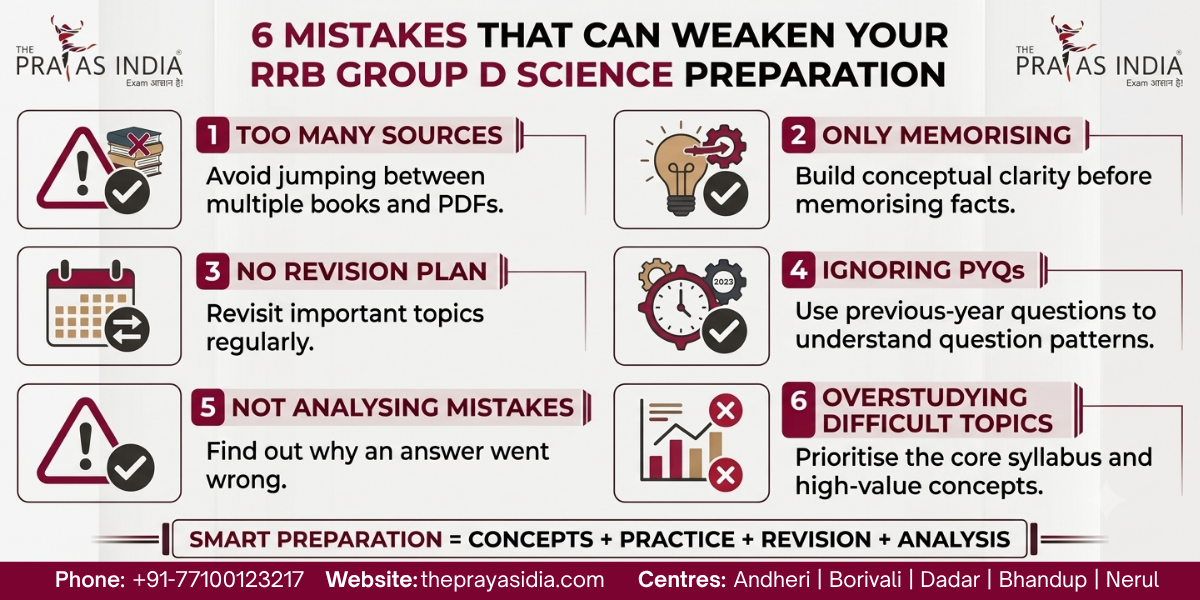
Studying From Too Many Sources
Using several books, PDFs, videos and online notes for the same topic can create duplication and confusion. Choose reliable core material and use additional resources only when necessary.
Memorising Without Understanding
This can work for isolated facts but becomes unreliable when questions test concepts or applications.
Ignoring Revision
Completing a chapter once does not mean you have mastered it. General Science requires repeated exposure and recall.
Avoiding PYQs
Without previous-year questions, it is difficult to judge whether your preparation is aligned with the examination level.
Solving Questions Without Analysing Mistakes
If you repeatedly make the same error but simply move on to the next question, the practice is not producing its full benefit.
Spending Too Much Time on Difficult Topics
Do not allow one complicated concept to consume the time you need for several important areas. Build your foundation first and prioritise according to examination relevance and your performance.
A 30-Day General Science Preparation Framework
If you have approximately one month to strengthen General Science, your preparation should be divided into phases rather than trying to complete everything simultaneously.
Days 1–10: Build the Foundation
Focus on the major concepts across Physics, Chemistry and Biology. Do not worry about achieving perfect recall at this stage. The objective is to understand the syllabus and identify areas where you need additional work.
Days 11–20: Practice and Strengthen
Start solving topic-wise questions and previous-year questions regularly. Use your mistakes to identify concepts that need revision.
Days 21–25: Mixed Practice
Move from individual-topic practice towards mixed General Science sets. This forces you to switch between Physics, Chemistry and Biology just as you may need to do during the examination.
Days 26–30: Revision and Testing
Focus primarily on weak areas, short notes, formulas, important facts and previously made mistakes. Add sectional and full-length mock practice to test your overall readiness.
This framework can be adjusted according to the time available. If you have more time, extend each phase rather than simply increasing the number of study hours.
How to Balance General Science With Other RRB Group D Subjects
General Science should not consume your entire preparation schedule. RRB Group D preparation requires attention across multiple subjects, so your daily timetable should maintain a balance.
You can use General Science as a focused daily block and distribute the remaining study time across Mathematics, Reasoning and General Awareness according to your strengths and weaknesses.
For example, a candidate who is strong in Mathematics but weak in Science may need to allocate more time to Science during the early preparation phase. Another candidate who already has strong Science fundamentals may require more time for practice and revision rather than lengthy concept sessions.
The important principle is to allocate time according to performance, not simply according to the size of the syllabus.
How to Know Whether Your General Science Preparation Is Improving
Do not judge your progress only by how many chapters you have completed.
A better indicator is your performance in mixed practice and mock tests.
Ask yourself whether you are making fewer repeated mistakes. Are you recalling concepts faster? Has your accuracy improved? Are you spending less time on questions you already understand? Are you becoming better at distinguishing between questions you know and questions where you are uncertain?
If the answer to these questions is gradually becoming positive, your preparation is moving in the right direction.
A candidate who has completed fewer chapters but can answer questions accurately may be better prepared than someone who has read the entire syllabus but cannot recall the information under time pressure.
Why Structured RRB Coaching Can Help
Self-study can be effective, but many aspirants struggle with deciding what to study, which resources to follow, how to prioritise topics and how to evaluate their progress.
Structured RRB coaching can provide a more organised preparation environment by bringing together classroom guidance, study material, regular practice, tests and performance evaluation.
For candidates preparing in Mumbai, The Prayas India offers structured preparation for railway and other government examinations. A guided approach can be particularly useful for aspirants who want a fixed study schedule, systematic revision and regular evaluation instead of preparing entirely through scattered resources.
The aim should not simply be to attend classes. The real benefit comes when classroom learning is combined with self-study, practice, revision and mock-test analysis.
Final Strategy for RRB Group D General Science
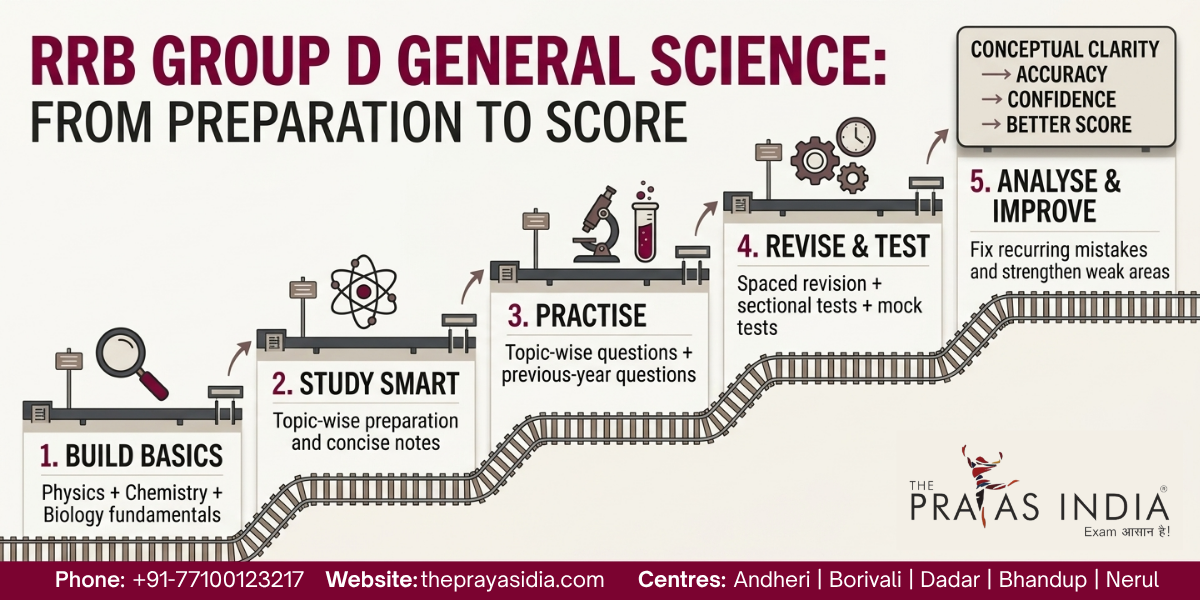
The most effective way to prepare General Science is to stop treating it as a subject that must be memorised in one sitting. It should become a continuous cycle of learning, practice, revision and testing.
Start with Physics, Chemistry and Biology fundamentals and keep your preparation close to the expected school-level foundation. Current preparation references consistently describe the section around these three areas, with emphasis on basic scientific principles and applications.
Once the concepts are clear, use topic-wise questions and previous-year questions to test your understanding. Maintain concise notes for important formulas, reactions, facts and biological processes, and return to them through spaced revision.
As your preparation progresses, introduce mixed practice and mock tests. Analyse every mistake rather than simply checking your score. Pay particular attention to questions you got wrong because of poor recall, conceptual confusion, careless reading or guesswork.
Most importantly, do not let the size of the syllabus discourage you. General Science becomes much more manageable when divided into smaller topics and revised consistently.
For aspirants looking for RRB Coaching in Mumbai, The Prayas India provides structured preparation for railway examinations through its centres in Andheri, Borivali, Dadar, Bhandup and Nerul. The right combination of guided preparation, self-study, regular practice and performance analysis can help you approach RRB Group D preparation with greater clarity and consistency.
Contact Us
📞 Call Now: +91-77100 13217
🌐 Website: theprayasindia.com