How to Recover From a Bad MAH MBA CET Mock Test: A Practical Strategy to Bounce Back | The Prayas India
A bad mock test can affect an MBA entrance aspirant more than expected. You may walk into a test feeling prepared, only to finish with a score that is much lower than your target. Perhaps you attempted fewer questions than usual, made several avoidable mistakes, struggled with time management or simply found the paper much harder than expected. The immediate reaction is often frustration: “Am I actually prepared for MAH MBA CET?”
That reaction is understandable, but it is not the most useful way to look at a mock test.
A bad MAH MBA CET mock score is not a final verdict on your preparation. A mock test is a controlled environment designed to expose weaknesses before the actual examination. If a test reveals that your question selection is poor, your calculations are slow, your accuracy drops under pressure or you are spending too much time on certain questions, discovering that problem during preparation is valuable.
The real problem is not taking a bad mock.
The real problem is taking a bad mock, feeling disappointed, and then taking another mock without understanding what went wrong.
For students preparing for MAH MBA CET, recovery should therefore be systematic. Instead of trying to immediately compensate with more study hours or another full-length test, aspirants should diagnose the score, identify the source of lost marks, fix the specific problem and then test the improvement again.
The preparation cycle should be:
Mock Test → Analyse → Diagnose → Correct → Practise → Re-test
This article explains exactly how to follow that cycle and recover effectively from a poor MAH MBA CET mock-test performance.
First, Separate a Bad Score From a Bad Preparation Phase
One disappointing mock does not necessarily mean your entire preparation is going badly.
Mock-test performance can fluctuate because of several factors. The paper may contain a larger number of questions from areas where you are less comfortable. You may have made unusual calculation mistakes. You may have spent too much time on one difficult set. Fatigue, poor concentration or an ineffective attempt strategy can also affect the result.
This is why aspirants should avoid making broad conclusions from a single score.
Instead of saying:
“My preparation is weak.”
ask:
“What exactly caused my score to fall?”
That change in thinking is important because preparation problems are usually specific.
For example, imagine that your usual mock score is around your target range but one test produces a significantly lower result. On analysis, you discover that you spent too much time on difficult Logical Reasoning questions and then rushed through the remaining sections. In that situation, the problem may not be a lack of conceptual knowledge. It may be time allocation and question selection.
Similarly, if your attempts are high but your accuracy has dropped sharply, taking even more questions may make the situation worse. Your immediate priority should be identifying why the errors increased.
A mock score is therefore best treated as performance data.
It tells you something about your current execution. Your job is to understand what that information is telling you.
Do Not Take Another Mock Immediately
One of the most common reactions to a disappointing mock is to take another test as quickly as possible.
The logic sounds reasonable:
“I performed badly today. I will take another mock tomorrow and prove that I can do better.”
But this can become an unproductive cycle.
If you have not analysed the previous paper, another mock may simply reproduce the same mistakes. You may again spend too much time on difficult questions, make the same calculation errors or attempt questions without a clear selection strategy.
A full-length mock requires time and concentration. That time is valuable. If you are repeatedly testing without correcting the underlying problems, you may be generating more scores without generating enough improvement.
After a bad mock, take a step back.
Analyse the paper first.
Your immediate objective should not be:
“Score higher in the next mock.”
It should be:
“Understand why I scored lower in this mock.”
Once the reason is clear, the next test becomes much more meaningful.
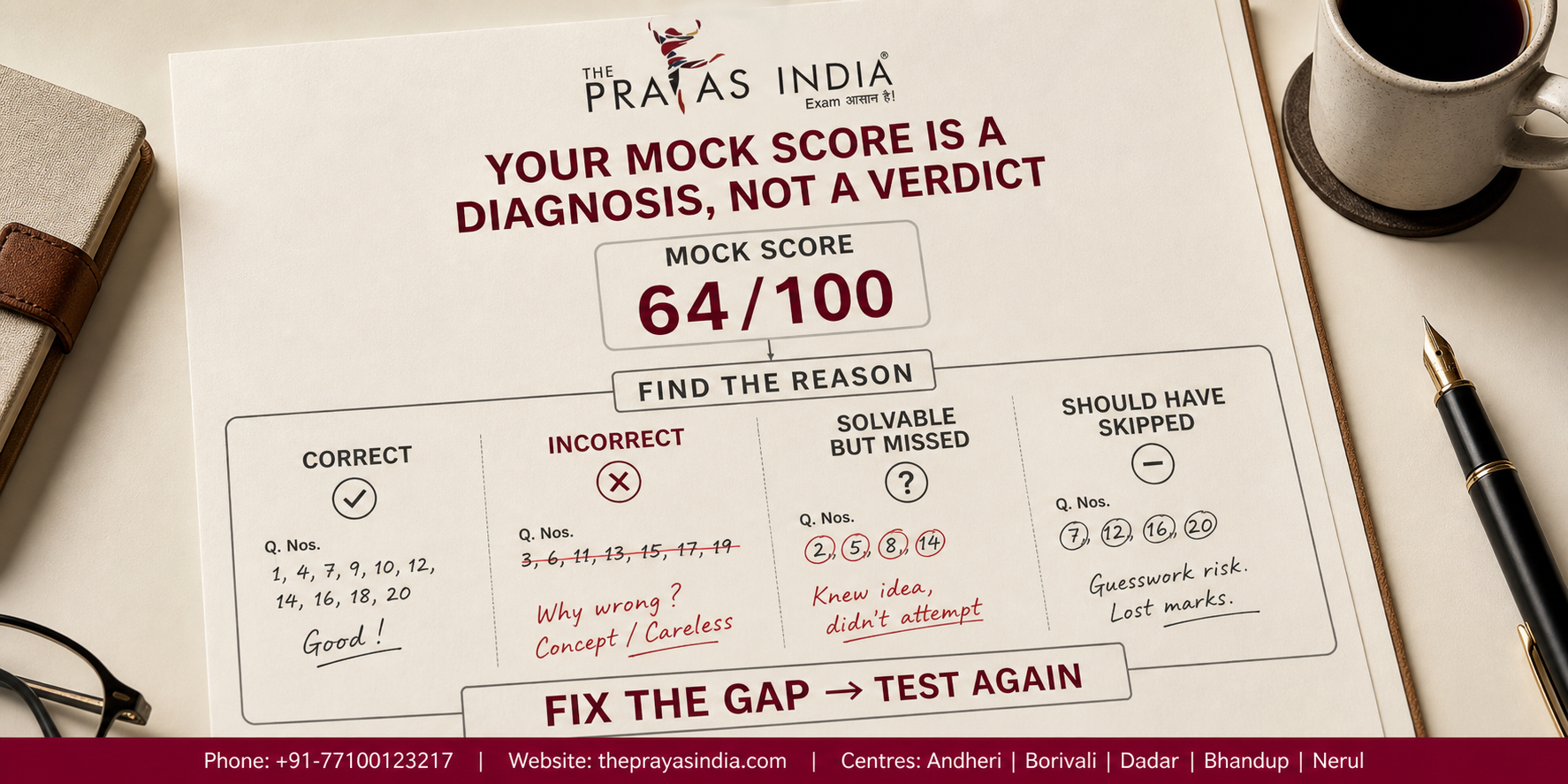
Start With a Four-Part Mock Score Diagnosis
A total score tells you how much you scored. It does not tell you why you scored that much.
For effective analysis, divide your performance into four broad categories:
- Questions You Got Correct
- Questions You Got Incorrect
- Questions You Could Have Solved But Did Not Attempt
- Questions You Should Have Skipped
This classification immediately gives you more information than the final score alone.
Correct Questions
Look at your correct answers and identify whether they were solved efficiently.
Getting an answer correct is good, but if a relatively straightforward question consumed excessive time, it may still reveal an efficiency issue.
Ask:
- Did I recognise the question type quickly?
- Did I use the most efficient method?
- Did I spend too much time checking the answer?
- Could I have solved it faster?
Incorrect Questions
Incorrect answers deserve deeper analysis.
Do not simply mark them as “wrong.”
Identify the reason:
- Conceptual gap
- Calculation mistake
- Misreading
- Logical error
- Guessing
- Rushing
- Poor question selection
This distinction matters because every error requires a different solution.
Unattempted but Solvable Questions
This category is particularly important in a speed-oriented examination.
You may discover that several questions you left unattempted were actually within your capability. Perhaps you did not notice them because you were rushing, or you had already spent too much time elsewhere.
These questions represent lost opportunities.
Questions You Should Have Skipped
Some questions consume disproportionate amounts of time. If you spent several minutes struggling with a question that eventually remained unanswered or incorrect, that decision should become part of your analysis.
The objective is not to solve every question.
The objective is to make better decisions about which questions deserve your time.
Calculate Your Potential Score, Not Just Your Actual Score
One of the most useful exercises after a bad mock is to calculate what your score could have been if avoidable mistakes had been corrected.
This is different from artificially increasing your score by assuming that every difficult question would have been solved.
Focus only on realistic recoverable marks.
For example, suppose you lost marks because of:
- Two calculation errors
- Three questions you knew but skipped because of poor time allocation
- Two questions where you changed a correct answer unnecessarily
- Several minutes lost on one difficult set
These mistakes can tell you that your underlying preparation may be stronger than the final score suggests.
Create three numbers:
Actual Score
Recoverable Score
Target Score
The difference between actual and recoverable score shows how much of your performance gap comes from execution rather than knowledge.
This distinction can be extremely useful psychologically as well as academically.
If your actual score is low but your analysis shows that a meaningful portion of the gap came from avoidable errors, the solution becomes clearer. You do not necessarily need to restart your preparation. You need to improve execution.
Identify Whether the Problem Is Knowledge, Speed, Accuracy or Strategy
Most bad mocks can be traced to one or more major performance areas.
1. Knowledge Gap
You genuinely did not know how to solve the question.
If the same concept repeatedly appears in your incorrect answers, revisit that topic.
2. Speed Gap
You know the concepts but take too long to apply them.
This requires timed practice rather than simply reading more theory.
3. Accuracy Gap
You understand the question but make avoidable mistakes.
The solution may involve slower reading, better calculation discipline or deliberate checking habits.
4. Strategy Gap
You spend your time on the wrong questions or fail to prioritise efficiently.
This requires question-selection practice and mock simulations.
These four categories are interconnected, but they should not be treated as identical.
A student with a knowledge gap needs concept revision.
A student with a speed gap needs timed drills.
A student with an accuracy gap needs error reduction.
A student with a strategy gap needs better decision-making.
This is why simply increasing the number of study hours is not always the correct response to a bad mock.
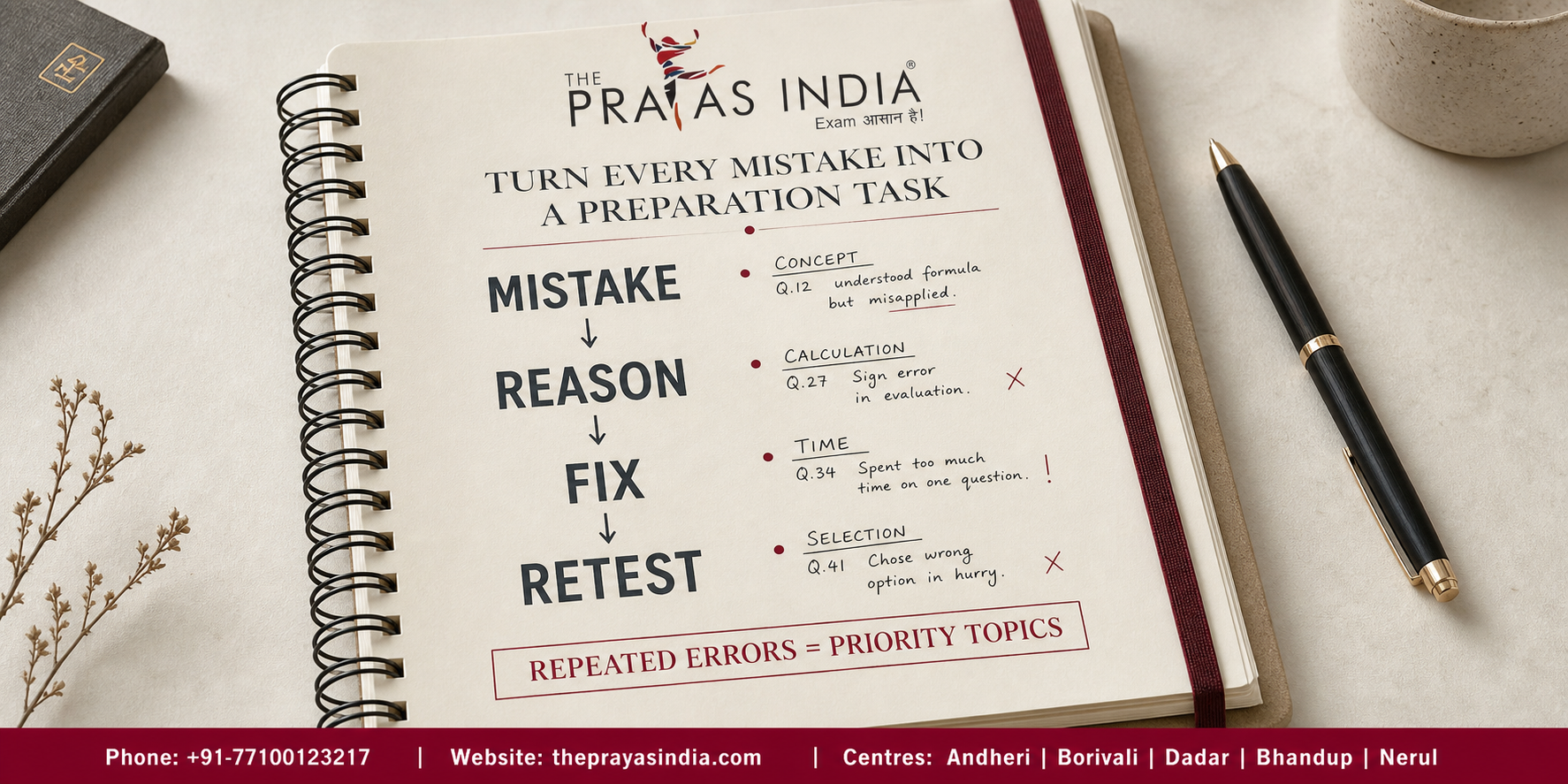
The Error Log Can Turn a Bad Mock Into a Useful Resource
One of the most effective habits for MAH MBA CET preparation is maintaining an error log.
An error log does not need to be complicated. It can be a notebook, spreadsheet or digital document where you record mistakes that are worth revisiting.
For each important error, record:
| Error Type | What Happened? | Corrective Action |
|---|---|---|
| Concept | Did not know the method | Revise concept + practise |
| Calculation | Arithmetic mistake | Timed calculation drill |
| Reading | Misread the question | Slow down key-word reading |
| Time | Spent too long | Set question-level time limits |
| Selection | Chose a low-value question | Practise question selection |
| Guess | Attempted without sufficient confidence | Improve elimination discipline |
The purpose of this log is not to collect mistakes forever.
Its purpose is to identify patterns.
If the same type of mistake appears repeatedly across several mocks, it deserves priority.
If an error appears once and never returns, it may not require major attention.
Over time, your error log can therefore become a personalised preparation map.
Do Not Try to Fix Everything at Once
A bad mock can reveal ten different problems. That does not mean you should try to fix all ten simultaneously.
Overcorrection can create another problem: scattered preparation.
Suppose your analysis reveals:
- Slow Quant calculations
- Weak vocabulary
- Inconsistent Logical Reasoning accuracy
- Poor question selection
- Excessive time spent on difficult questions
You cannot meaningfully fix all five in the next two days.
Instead, identify the highest-impact problem.
Ask:
Which weakness caused the largest avoidable loss of marks?
That should become your first corrective priority.
Then choose one or two focused actions.
For example:
Problem: Too much time spent on difficult questions
Action: Practise timed question-selection drills
Or:
Problem: Calculation errors
Action: Daily timed calculation practice + error tracking
Or:
Problem: Low attempts because of slow reading
Action: Timed reading and comprehension drills
The goal is not to make your preparation look busy.
The goal is to make it more effective.
Rebuild Your Confidence Through Smaller Wins
After a bad mock, some students immediately become obsessed with proving that they can score higher.
This can create unnecessary pressure.
A better approach is to rebuild confidence through specific, measurable improvements.
If your biggest problem was calculation speed, spend the next few practice sessions improving calculation accuracy and timing.
If question selection was the problem, practise identifying easy, moderate and time-consuming questions without necessarily solving the entire set.
If accuracy was the issue, take smaller timed tests and focus on reducing avoidable errors.
These smaller improvements create evidence that your preparation is moving forward.
Confidence should come from better performance, not from repeatedly telling yourself that the next mock will be better.
Use Sectional Tests Before Returning to Full-Length Mocks
If a bad mock exposes a specific weakness, sectional or topic-level testing can be more useful than immediately returning to another full-length examination.
For example, if your Logical Reasoning performance collapsed because of poor set selection, spend time on LR-specific timed practice.
If Quant suffered because of calculation speed, work through timed Quant sets.
If Verbal performance was affected by reading speed or comprehension errors, practise those areas separately.
The purpose is to isolate the problem.
Once the specific weakness improves, return to full-length mocks and check whether the improvement survives under complete exam conditions.
This creates a useful progression:
Topic Practice → Sectional Test → Full-Length Mock
The full-length mock should eventually confirm whether the correction has transferred into overall performance.
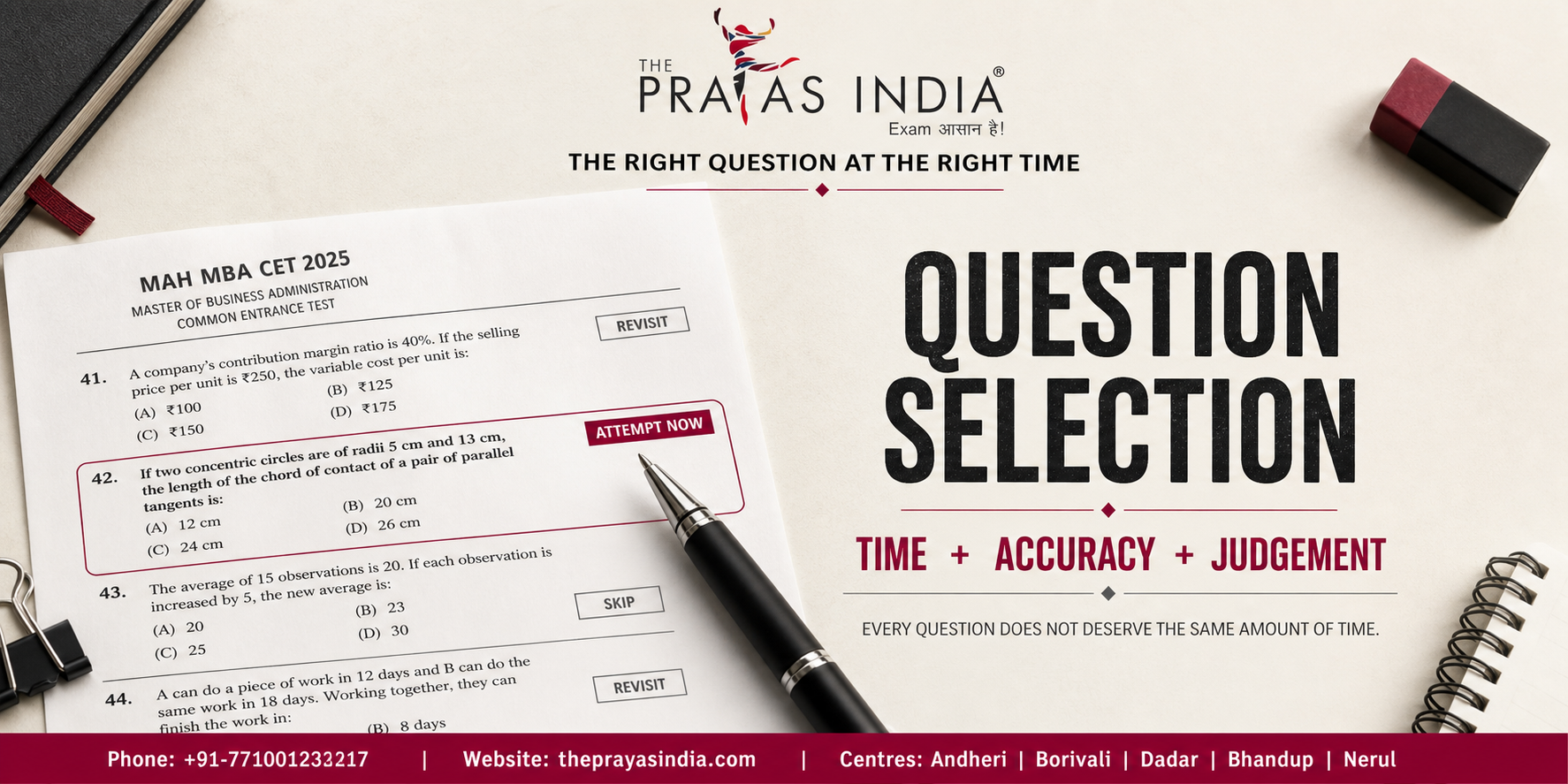
Question Selection Is a Skill You Must Practise
A common misunderstanding about competitive entrance examinations is that solving more questions automatically leads to a higher score.
In a time-bound examination, selection is part of solving.
You need to decide:
- Which question should I attempt first?
- Which one looks straightforward?
- Which question may consume too much time?
- Should I return to this later?
- Is the expected benefit worth the time investment?
This becomes particularly important after a bad mock because poor selection is often invisible when students look only at their total score.
During analysis, review the questions where you spent the most time.
Then ask:
Was that time investment justified by the outcome?
If you spent several minutes on a question and still got it wrong, that decision deserves attention.
The lesson is not “never attempt difficult questions.”
The lesson is:
Do not let one question control your entire paper.
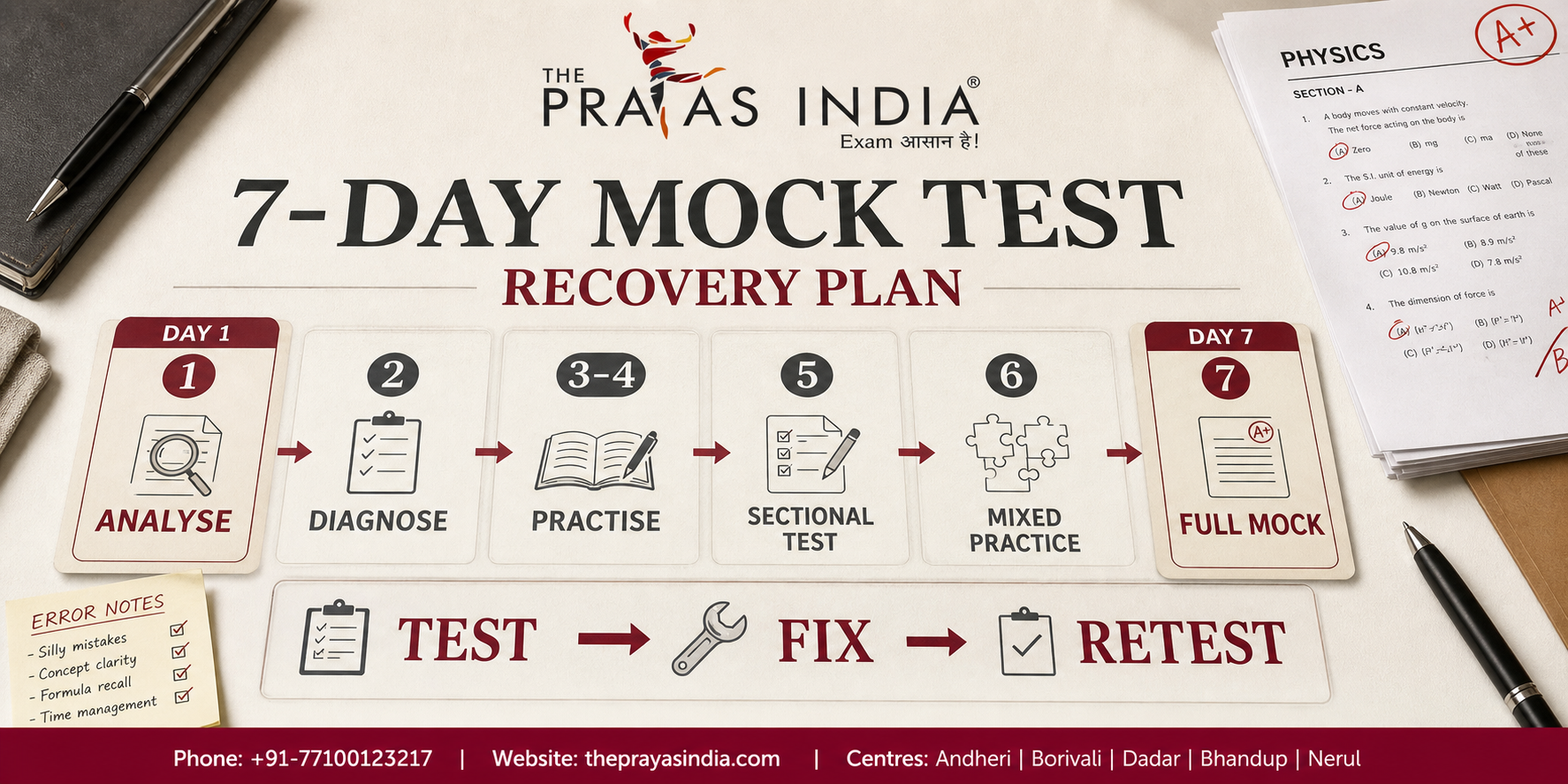
Create a Recovery Plan for Your Next Seven Days
After diagnosing the mock, create a short recovery plan rather than making a vague promise to “study harder.”
A practical seven-day cycle can look like this:
Day 1: Analyse
Review the complete mock.
Identify:
- Incorrect answers
- Solvable but unattempted questions
- Time-consuming questions
- Repeated mistakes
- Section-wise performance
Day 2: Diagnose
Classify the major problems into:
Knowledge → Speed → Accuracy → Selection
Choose the two highest-priority areas.
Day 3–4: Targeted Practice
Work specifically on those weaknesses.
Use topic-wise and timed practice instead of another full mock.
Day 5: Sectional Testing
Take sectional tests related to your weak areas.
Check whether the specific problem is improving.
Day 6: Mixed Timed Practice
Combine different question types to test whether the improvement survives when the questions are less predictable.
Day 7: Full-Length Mock
Take another full-length mock under realistic conditions.
Do not focus only on the total score.
Compare the new test with the previous one.
Look for:
Better selection?
Fewer avoidable mistakes?
Improved attempts?
Better time distribution?
Higher accuracy?
This makes the second mock a genuine test of your recovery strategy.
Compare Your Mocks as a Trend, Not as Isolated Scores
Once you begin taking multiple mocks, avoid judging your preparation based on individual scores alone.
Create a simple performance record containing:
- Mock number
- Total score
- Attempts
- Accuracy
- Time-management observations
- Major error type
- Section-wise performance
- Corrective action taken
The objective is to identify the trend.
Imagine your scores are:
Mock 1 → 102
Mock 2 → 96
Mock 3 → 108
Mock 4 → 111
The second mock may have been disappointing, but the broader trend may still show improvement.
Similarly, your total score may remain almost unchanged while your accuracy improves substantially. That can indicate that your preparation is moving in the right direction even before the score fully reflects it.
This is why mock analysis should consider multiple performance indicators.
A Bad Mock Can Reveal a Hidden Strength
Mock analysis should not focus only on weaknesses.
Sometimes a disappointing overall score can reveal areas where you are performing better than expected.
For example, you may discover that:
- Your accuracy in one section is consistently high.
- You solve certain question types significantly faster.
- Your conceptual understanding is strong even though your attempt rate is low.
- Your mistakes are concentrated in a small number of recurring areas.
These observations can help you build your exam strategy around your actual strengths.
Preparation is not only about eliminating weaknesses.
It is also about using strengths intelligently.
Avoid These Common Reactions After a Bad Mock
A poor mock can lead to several unproductive responses.
Taking Multiple Mocks Without Analysis
More tests do not automatically mean more improvement.
Changing Your Entire Study Plan
One disappointing paper is rarely enough evidence to abandon a preparation strategy completely.
Comparing Your Score With Everyone Else
Your preparation should be measured against your own performance trend and target requirements.
Studying Only Your Weakest Topic
Aspirants sometimes overcorrect and spend all their time fixing one area while neglecting sections where they are already performing well.
Ignoring Easy Mistakes
Conceptual errors are easy to notice. Silly mistakes are often dismissed. But repeated avoidable errors can significantly affect overall performance.
Chasing a Particular Score Immediately
Trying to force a specific number in the next mock can increase pressure and encourage poor question selection.
The better goal is better execution.
When Should You Take Your Next Full-Length Mock?
There is no universal rule that says you must wait exactly one, two or three days after a bad mock.
The better indicator is whether you have actually worked on the problem identified during analysis.
If your mock revealed a calculation issue and you have not practised calculations, another full-length test may simply reproduce the same weakness.
If your problem was question selection and you have done several timed selection drills, a new mock can help test whether the strategy has improved.
Therefore, the next mock should ideally come after a corrective practice cycle, not simply after a fixed number of hours.
How Coaching and Structured Guidance Can Help
Self-analysis is an important part of MAH MBA CET preparation, but some students find it difficult to identify the actual reason behind their score fluctuations.
A structured preparation environment can provide another layer of accountability through regular tests, performance analysis, topic-wise practice and feedback.
For students preparing for MAH MBA CET in Mumbai, the value of coaching should not simply be measured by the number of classes or study materials provided. A useful preparation system should help students understand:
- Where they currently stand
- Which areas need improvement
- How their mock performance is changing
- Which mistakes are recurring
- How to improve speed and accuracy
- How to develop better question-selection habits
The ultimate objective should be to make preparation measurable.
Students should also continue developing independent analysis skills. The goal of coaching is not to make you dependent on someone else to interpret every mock. It should gradually help you understand your own performance better.
Recovery Means Returning Stronger, Not Pretending the Bad Mock Did Not Happen
The easiest way to feel better after a bad mock is to forget about it.
The most useful response is the opposite.
Study the paper.
Find the mistakes.
Identify the patterns.
Fix the highest-impact problems.
Then test yourself again.
A disappointing mock can become one of the most useful tests in your preparation if it exposes a weakness that you still have time to correct.
The key is to avoid turning the score into an emotional judgment.
A score is information.
Your analysis gives that information meaning.
Your corrective practice turns it into improvement.
And your next mock tells you whether the correction worked.
Final Takeaway
A bad MAH MBA CET mock test does not need to derail your preparation. In fact, when analysed correctly, it can provide a clearer picture of your preparation than a surprisingly high mock score.
The important question is not:
“Why did I score so badly?”
The better question is:
“Where exactly did I lose marks, and what can I change before my next test?”
Start by separating correct, incorrect, missed-but-solvable and time-consuming questions. Calculate your realistic recoverable marks. Classify your mistakes into knowledge, speed, accuracy and selection issues. Record recurring errors. Work on the highest-impact weaknesses through targeted practice and sectional tests. Then return to a full-length mock and compare the performance trend.
Remember the complete recovery cycle:
TEST → ANALYSE → DIAGNOSE → FIX → PRACTISE → RETEST
For MAH MBA CET aspirants, the ability to recover from a bad mock is itself an important part of exam preparation. The candidates who learn to use every test as feedback can gradually turn mistakes into a more reliable strategy for the actual examination.
If you are preparing for MAH MBA CET and want a structured preparation environment with systematic learning, regular testing and performance-focused guidance, explore MAH MBA CET coaching in Mumbai with The Prayas India.
Frequently Asked Questions: How to Recover From a Bad MAH MBA CET Mock Test
1. What should I do after a bad MAH MBA CET mock test?
Do not immediately take another mock. First analyse the paper, identify where marks were lost, classify the mistakes and work on the highest-impact weaknesses through targeted practice.
2. Does one bad mock mean my MAH MBA CET preparation is weak?
Not necessarily. Mock scores can fluctuate because of paper difficulty, question selection, time management, accuracy and other factors. Look at your performance across multiple mocks before drawing conclusions about your overall preparation.
3. Should I take another mock the next day after a bad score?
Not automatically. Take another full-length mock after you have analysed the previous test and completed enough corrective practice to address the identified weakness.
4. How should I analyse my MAH MBA CET mock test?
Separate questions into correct, incorrect, unattempted-but-solvable and questions that consumed too much time. Then identify the reason behind your mistakes and compare attempts, accuracy and time management with previous mocks.
5. What is an error log for MAH MBA CET preparation?
An error log is a record of important mistakes made during mocks and practice. It can include the error type, reason for the mistake and corrective action. Reviewing it regularly helps identify recurring weaknesses.
6. How can I improve my MAH MBA CET mock-test score?
Focus on the specific causes of your lost marks. Depending on the problem, you may need concept revision, timed practice, accuracy drills, question-selection practice or better time allocation.
7. How can I improve question selection in MAH MBA CET?
During practice and mock analysis, identify questions that are easy, moderate or likely to consume excessive time. Train yourself to prioritise questions based on familiarity, expected solving time and potential return.
8. Should I focus on speed or accuracy after a bad mock?
The answer depends on what caused the score drop. If you attempted too few questions because of slow solving, speed may need attention. If you attempted many questions but made several errors, accuracy may be the bigger priority.
9. How many mocks should I take for MAH MBA CET?
The number of mocks matters less than how effectively you analyse them. Every full-length mock should be followed by detailed analysis and corrective practice so that subsequent tests provide evidence of improvement.
10. Can sectional tests help after a bad MAH MBA CET mock?
Yes. If the mock reveals a weakness in a particular section, sectional tests can isolate that problem and help you practise it before returning to full-length tests.
11. What should I do if my MAH MBA CET mock scores keep falling?
Review your recent mocks together rather than focusing on the latest score. Look for recurring patterns in attempts, accuracy, time allocation, question selection and mistakes. If the same issue appears repeatedly, make it the priority of your next practice cycle.
12. How can MAH MBA CET coaching help with mock-test improvement?
A structured coaching programme can provide regular tests, performance analysis, targeted practice and feedback. The important benefit is having a systematic process for identifying weaknesses and converting mock-test feedback into corrective action.
Turn Your MAH MBA CET Mock-Test Mistakes Into Score Improvement
A bad mock test can show you exactly where your preparation needs improvement. Build stronger concepts, improve speed and accuracy, develop better question-selection skills and prepare with a structured MAH MBA CET strategy at The Prayas India.
Official Website: theprayasindia.com
Explore Our Mumbai Centres:
Andheri | Borivali | Dadar | Nerul | Bhandup