How to Recover From a Low SSC Mock Test Score | Best SSC Coaching in Mumbai | The Prayas India
A low SSC CGL mock-test score can be frustrating, especially when you have already spent weeks or months preparing. You revise chapters, solve practice questions, attempt a full-length mock and then see a score that is far below your expectation. The immediate reaction is often to assume that the preparation is not working. Some students start studying for longer hours, while others abandon their existing strategy and begin collecting new books, PDFs and online resources.
Neither reaction necessarily solves the problem.
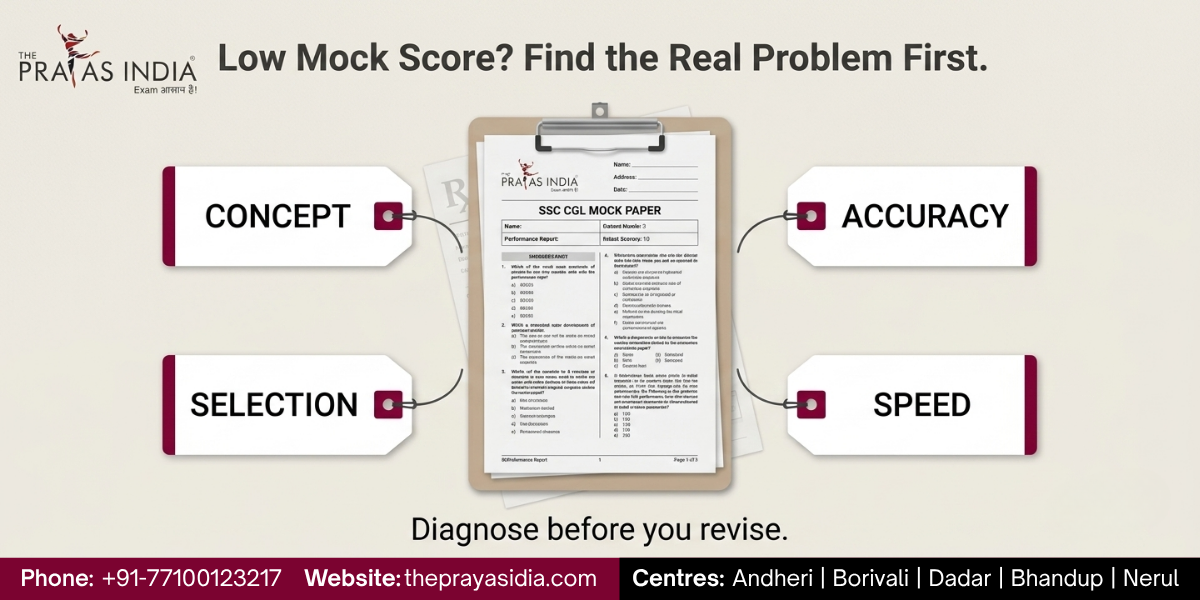
A mock test is not a final judgement on your SSC CGL preparation. It is a performance diagnostic. A low score can reveal a conceptual weakness, poor question selection, calculation errors, excessive time spent on difficult questions, weak revision or simply a lack of familiarity with the pressure of a timed examination. The important step is to identify the reason behind the score before deciding what to change.
For aspirants preparing for SSC CGL, learning how to recover from a disappointing mock result is itself an important examination skill. Your preparation will not move in a straight line. Scores can rise, fall and remain stagnant at different stages. What matters is whether you can convert each test into useful information and use that information to improve the next attempt.
This is also where structured guidance can become valuable. Students who can independently analyse their performance may continue with self-study, while those who repeatedly struggle to understand why their scores are not improving may benefit from faculty guidance, organised testing and a more systematic preparation environment. For candidates considering SSC Coaching in Mumbai, the objective should be to find support that improves the quality of preparation rather than simply increasing the quantity of study material.
A Low Mock Score Is Feedback, Not a Verdict
The first step after receiving a disappointing score is to avoid treating the number as your identity as an aspirant.
A mock test represents your performance on one particular paper, under one particular set of conditions. It does not measure everything you know. More importantly, the score alone cannot tell you why you performed below expectations.
Suppose two candidates score equally low. The first candidate may have excellent conceptual knowledge but spend too much time on lengthy questions. The second may work quickly but make several avoidable errors because of weak fundamentals. Their scores are similar, but their solutions are completely different.
This is why immediately opening a textbook and starting another round of revision may not be the best response.
Instead, step back and investigate the paper. Look at the questions you attempted, the questions you skipped, the questions you got wrong and the amount of time spent in each section. The purpose of this exercise is to transform an emotional reaction into a practical diagnosis.
Once you understand the reason behind the low score, recovery becomes much more manageable.
Step 1: Give Yourself Time to Analyse the Paper
After a low score, many students immediately take another mock in an attempt to prove that the previous result was an exception. This can create another poor result without addressing the original problem.
Instead, spend time analysing the completed paper.
Start with the questions you attempted incorrectly. Determine whether each mistake came from a lack of knowledge, a calculation error, a misunderstanding of the question, poor application of a concept or simple rushing.
Then examine the questions you left unanswered. Were they genuinely difficult, or did you spend too much time earlier in the section and fail to reach them?
Finally, look at the questions you solved correctly but slowly. These questions can be particularly useful because they may reveal where your approach needs to become more efficient.
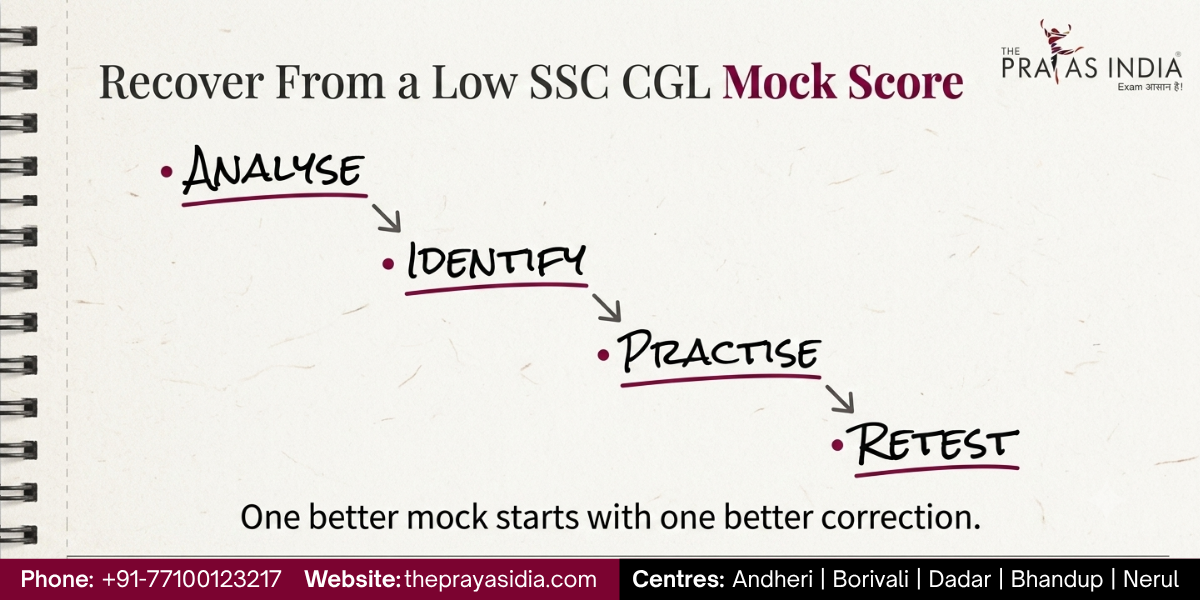
A proper mock analysis should therefore answer three basic questions:
What went wrong?
Why did it go wrong?
What will I do differently next time?
If your analysis cannot answer the third question, it is incomplete.
Step 2: Separate Knowledge Gaps From Execution Problems
One of the biggest mistakes students make after a low mock score is assuming that every wrong answer represents a conceptual weakness.
That is rarely true.
Consider a Quantitative Aptitude question that you answered incorrectly. If you review it later and solve it comfortably, your concept may not be the problem. Perhaps you calculated too quickly during the test. Perhaps you misunderstood one value. Perhaps you selected a longer method despite knowing a simpler approach.
The same distinction applies to English and Reasoning.
A candidate may understand a grammar rule but make an error because they rushed through the sentence. A Reasoning question may be conceptually easy but consume excessive time because the candidate did not recognise the efficient approach.
This distinction is extremely important because the remedy changes according to the cause.
A knowledge gap requires learning and targeted practice.
An execution problem requires timed practice, question selection and test analysis.
An accuracy problem requires controlled solving and error tracking.
A time-management problem requires a better attempt strategy.
Without this classification, students often revise topics they already know while ignoring the actual reason their score is low.
Step 3: Create a Mock-Test Error Log
Instead of allowing mistakes to disappear after the test, maintain a simple error log.
The purpose of an error log is not to record every wrong question permanently. It is to identify patterns.
You can classify mistakes into categories such as:
| Error Type | Typical Problem | Corrective Action |
|---|---|---|
| Conceptual | Formula or rule not understood | Relearn the concept |
| Application | Concept known but incorrectly applied | Solve targeted questions |
| Calculation | Arithmetic or approximation error | Calculation drills |
| Reading | Question misunderstood | Slow down and identify key information |
| Time | Too long on one question | Timed practice |
| Selection | Difficult question attempted too early | Improve question selection |
| Memory | Forgot a known fact/rule | Revision cycle |
After two or three mocks, patterns become easier to identify.
For example, if calculation mistakes appear repeatedly in Quant, you have a specific problem to address. If the same type of Reasoning puzzle repeatedly consumes excessive time, you know where targeted practice is required.
This approach is much more efficient than simply saying, “I need to study everything again.”
Step 4: Do Not Restart Your Entire Preparation
A low score often creates the temptation to start from zero.
Students may decide that their entire Quant preparation is wrong, their English strategy needs to be replaced or their study material is no longer useful. This creates unnecessary disruption.
Your mock test should tell you what needs attention, not convince you that everything is broken.
If you performed well in certain topics, retain that progress. If only a few chapters are causing problems, focus on those areas. If your concepts are strong but your speed is weak, more concept lectures may not be the best use of your time.
Effective recovery is usually selective.
You should be asking:
Which part of my preparation needs correction?
rather than:
How do I start my preparation all over again?
This approach protects the work you have already completed and allows you to use your preparation time more efficiently.
Step 5: Identify the Section Responsible for the Score Drop
Overall mock scores can sometimes hide the actual problem.
Imagine that your English performance is strong, Reasoning is stable and General Awareness is acceptable, but Quantitative Aptitude has suddenly fallen. Your overall score may look disappointing, but the solution is not to revise all four areas equally.
Section-wise analysis provides a more useful picture.
Look at your attempts, accuracy and time consumption separately for each section. A section with low attempts and high accuracy may indicate a speed problem. A section with high attempts but low accuracy may indicate over-attempting or insufficient control.
The objective is to understand the relationship between attempts, accuracy and time.
This is particularly important for SSC CGL because a candidate’s final performance depends not only on knowing the syllabus but also on making effective decisions under examination conditions.
Step 6: Fix One Major Weakness at a Time
Once your errors have been identified, resist the urge to correct everything simultaneously.
Suppose your analysis reveals problems with percentage calculations, reading comprehension and reasoning puzzles. Trying to solve all three aggressively in one day may create another overloaded schedule.
Instead, prioritise.
Start with the weakness that has the greatest impact on your score or the one that can be improved most quickly through targeted practice.
For example, if calculation errors are costing several marks, introduce short calculation drills into your daily routine. If a particular Reasoning topic repeatedly consumes time, practise that topic under a timer. If English errors come from a recurring grammar concept, revise the rule and solve a focused set of questions.
Small improvements compound.
The objective is to make the next mock better analysed and better executed, not necessarily perfect.
Step 7: Use Targeted Practice Instead of Random Practice
After a low score, solving hundreds of random questions can feel productive. But volume alone does not guarantee improvement.
Your practice should correspond to the mistakes identified during mock analysis.
If you make errors in percentage, ratio and profit-and-loss questions, practise those areas deliberately. If you lose time on a specific type of Reasoning arrangement, work on similar questions until the approach becomes familiar.
Targeted practice has another advantage: it allows you to measure improvement.
After working on a weak area, take a small timed set. If your accuracy improves, the intervention is working. If the same mistakes continue, you may need a different explanation or practice method.
This creates a more scientific preparation process.
You are no longer studying simply because you feel you should study. You are studying because your test data has identified a specific requirement.
When Should You Consider Professional SSC CGL Guidance?
A low score by itself is not a reason to join coaching.
The more relevant question is whether you can identify and fix the reasons behind your low performance independently.
If you can analyse your tests, identify recurring errors, select appropriate resources and build a corrective study plan, self-study may continue to work effectively.
However, if you repeatedly receive low mock scores without understanding why, keep changing your strategy, struggle to balance subjects or cannot identify which areas deserve attention, structured guidance can become useful.
A faculty member or mentor can provide an external perspective on your preparation. Instead of spending weeks experimenting with different approaches, you may be able to identify the underlying problem earlier.
For students exploring SSC Coaching in Mumbai, this is one of the most important factors to consider. Coaching should not be viewed simply as a place to attend classes. Its potential value lies in providing a structured preparation system that connects teaching, practice, testing, feedback and revision.
The Role of Mock Tests in a Structured SSC CGL Preparation
Mock tests become much more valuable when they are integrated into the larger preparation process.
A student should not take a test simply because it is scheduled. There should be a clear purpose behind each test.
Early tests may help identify baseline weaknesses. Subsequent tests can measure whether targeted practice is working. Later tests can focus increasingly on exam-like performance, time management and question selection.
This progression allows mocks to become part of a feedback system rather than a source of repeated anxiety.
A structured coaching environment can help students follow this process more consistently by providing scheduled tests and a framework for analysing performance.
At the same time, students should develop the ability to interpret their own results. The long-term goal is not merely to receive a score report; it is to understand what the report means for the next stage of preparation.
How The Prayas India Approach Can Support Your Recovery
For aspirants who decide that professional guidance is appropriate, The Prayas India can serve as a structured learning environment where preparation is connected with regular practice and testing.
The important aspect for a student is not simply attending a class. Effective preparation requires students to take what they learn, practise it, test themselves and identify areas requiring improvement.
A structured coaching environment can make this process easier to follow by bringing academic guidance, practice and assessment into a single preparation framework.
For an aspirant considering SSC Coaching in Mumbai, this can be useful when the main difficulty is not a lack of effort but a lack of clarity about what to do next.
However, coaching should remain a support system. The student’s own revision, practice and analysis remain essential.
Admission Decision: Do You Need More Guidance or Better Self-Analysis?
Before considering admission, ask yourself a few honest questions.
Can you explain why your last mock score was low?
Can you identify your three biggest recurring mistakes?
Do you know which topics are responsible for most of your lost marks?
Can you create a realistic corrective plan?
Are you able to follow that plan consistently?
If you can answer these questions confidently, you may already have a strong self-correction system.
If you cannot, the problem may not be your ability to clear SSC CGL. You may simply need a more structured way of preparing.
That distinction is important.
The purpose of professional coaching should be to shorten the gap between identifying a problem and knowing how to correct it.
Final Takeaway
A low SSC CGL mock-test score is disappointing, but it can also be one of the most useful moments in your preparation.
Do not respond by panicking, studying everything again or collecting new resources. Start with analysis. Separate knowledge gaps from execution problems. Record recurring mistakes. Identify the section causing the biggest score loss. Practise the specific weaknesses and then test yourself again.
Your goal should not be to make every mock score perfect. Your goal should be to ensure that each mock teaches you something that improves the next one.
For some aspirants, this process can be managed effectively through self-study. Others may benefit from professional SSC coaching that provides structured classes, testing, feedback and academic guidance.
If you are considering SSC Coaching in Mumbai, evaluate your own preparation first. Choose professional guidance when it solves a genuine problem in your preparation—not simply because a coaching programme is available.
A low score does not mean your preparation has failed. It means your current approach has given you information about what needs to change. Use that information well, and the next mock can become the beginning of your recovery rather than another source of disappointment.
Turn Mock-Test Analysis Into a Weekly Action Plan
Once your mock has been analysed, the findings should become part of your weekly preparation schedule.
Suppose your analysis shows that Quantitative Aptitude is responsible for most of your lost marks. Simply writing “improve Quant” in your notebook is not enough. You need to identify the exact topics, question types or execution problems involved.
Your weekly plan could then include targeted concept revision, a focused practice set, timed questions and a short test at the end of the week.
The same approach works for English and Reasoning. Instead of treating the entire subject as weak, identify the specific areas where performance is below expectation.
This makes preparation more manageable because your study plan is responding to actual evidence from your tests.
Over time, this creates a useful relationship between your mock tests and daily preparation. The test identifies the problem, the weekly plan addresses it, and the next test checks whether the correction worked.
Do Not Chase Speed Before Building Accuracy
When students see that they are attempting fewer questions than expected, their first reaction is often to solve everything faster.
That can be counterproductive.
If your accuracy is already weak, increasing speed may simply increase the number of incorrect answers. Before trying to solve questions faster, make sure that your basic approach is reliable.
For example, if you repeatedly make arithmetic mistakes in Quant, spend some time developing calculation accuracy. If you misread English questions because you rush, practise controlled reading. If you select difficult Reasoning questions too early, work on recognising easier opportunities first.
Speed should develop alongside accuracy.
A useful progression is:
Correct approach → Consistent accuracy → Controlled speed → Better attempts
This is more sustainable than trying to force speed from the beginning.
Learn to Recognise Questions You Should Skip
One of the most underrated skills in a competitive examination is knowing when not to solve a question.
A difficult question is not necessarily a bad question. A question becomes problematic when the time required to solve it is disproportionate to the marks it can provide.
During mock analysis, identify questions where you spent too much time. Ask yourself whether you should have attempted them at all.
This helps develop an important exam habit: question selection.
As you take more mocks, you should gradually become better at recognising familiar patterns, estimating difficulty and deciding which questions deserve immediate attention.
Professional guidance can accelerate this learning for some students because faculty can explain not just how to solve a question but also how to decide whether solving it is strategically worthwhile.
Build a “Repeat Mistakes” Revision List
Not every mistake deserves equal attention.
Some errors occur once and never return. Others appear repeatedly despite revision.
The second category deserves special treatment.
Maintain a short list of recurring mistakes and review it before future mocks. This list can include formulas you frequently forget, grammar rules you repeatedly confuse, reasoning patterns that take too long or calculation habits that lead to incorrect answers.
Keep the list concise. If it becomes a giant notebook containing every question you have ever answered incorrectly, it will become difficult to revise.
The purpose is to create a high-value revision sheet containing your personal weaknesses.
This makes revision more relevant than simply reading through the entire syllabus repeatedly.
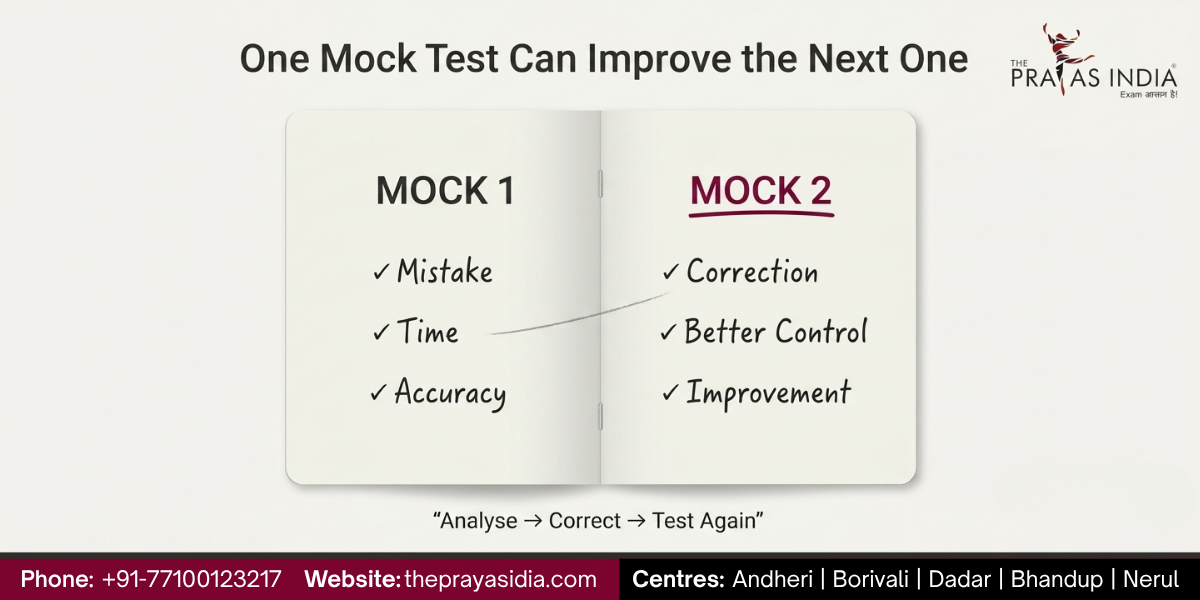
Use the Next Mock as an Experiment
Your next mock should not merely be another test.
Treat it as an experiment.
If your previous analysis showed that you were spending too much time on difficult Quant questions, consciously change your question-selection strategy in the next test.
If calculation errors were the problem, slow down slightly on calculations and check critical steps.
If you were losing marks in English because of rushed reading, change your reading approach.
Then compare the results.
Did accuracy improve?
Did time usage change?
Did the number of avoidable errors decrease?
This approach transforms mock tests into controlled experiments. You are testing a preparation hypothesis rather than simply chasing a higher score.
Do Not Let One Bad Mock Destroy Your Confidence
A poor mock can affect your confidence disproportionately when you interpret it emotionally.
You may start comparing yourself with friends, look at someone else’s score or conclude that you are not capable of clearing the examination.
None of these conclusions can be drawn from one test.
Competitive-exam preparation naturally includes fluctuations. Difficulty levels vary, some topics may favour you more than others, and your performance can change depending on fatigue, concentration and familiarity with the paper.
The useful question after a low score is not:
“Am I good enough?”
It is:
“What does this paper show me that I need to improve?”
That change in perspective can prevent one disappointing result from disrupting several weeks of preparation.
Avoid Changing Your Strategy After Every Mock
Another common problem is strategy hopping.
One mock goes badly, so the student changes the order of sections. The next mock is difficult, so they switch study material. Another score falls, and they begin following a completely different approach.
Constant changes make it difficult to determine what is actually working.
Give a new strategy enough time to produce meaningful evidence.
If you change your question-selection method, for example, use it across several tests and compare the results. If you introduce a new revision routine, track whether your retention and accuracy improve over time.
Preparation needs flexibility, but flexibility should not become instability.
Know When Self-Analysis Is Not Enough
Self-analysis is an important skill, but not every student finds it easy.
Sometimes an aspirant knows that the score is low but cannot identify the reason. They may understand the solution after the test but still make the same mistake under timed conditions.
This is where an external perspective can help.
A faculty member or mentor can sometimes identify patterns that the student overlooks, particularly when the same problem appears across multiple tests.
For example, a student may believe that Quant concepts are weak when the real issue is question selection. Another may think English requires more study when the actual problem is rushing through the paper.
Professional guidance can make these distinctions easier to recognise.
For students considering SSC CGL coaching in Mumbai, mock-test analysis and academic feedback should therefore be among the factors evaluated before admission.
What to Expect From a Good SSC CGL Coaching Environment
If you decide that professional coaching can strengthen your preparation, evaluate whether the programme supports the complete learning cycle.
A useful environment should provide more than classroom teaching. Students should have access to structured study material, regular practice, mock tests, doubt support and a mechanism for understanding performance.
The teaching approach should also leave enough room for self-study.
A candidate should be able to attend a class, understand a concept, practise it independently, test their understanding and revise based on mistakes.
This combination is more useful than simply attending lectures continuously.
How Structured Coaching Can Support Mock-Test Recovery
A structured coaching programme can be particularly useful when a candidate knows that mock performance is a problem but does not have a reliable process for fixing it.
The potential value lies in combining multiple elements of preparation rather than treating each activity separately.
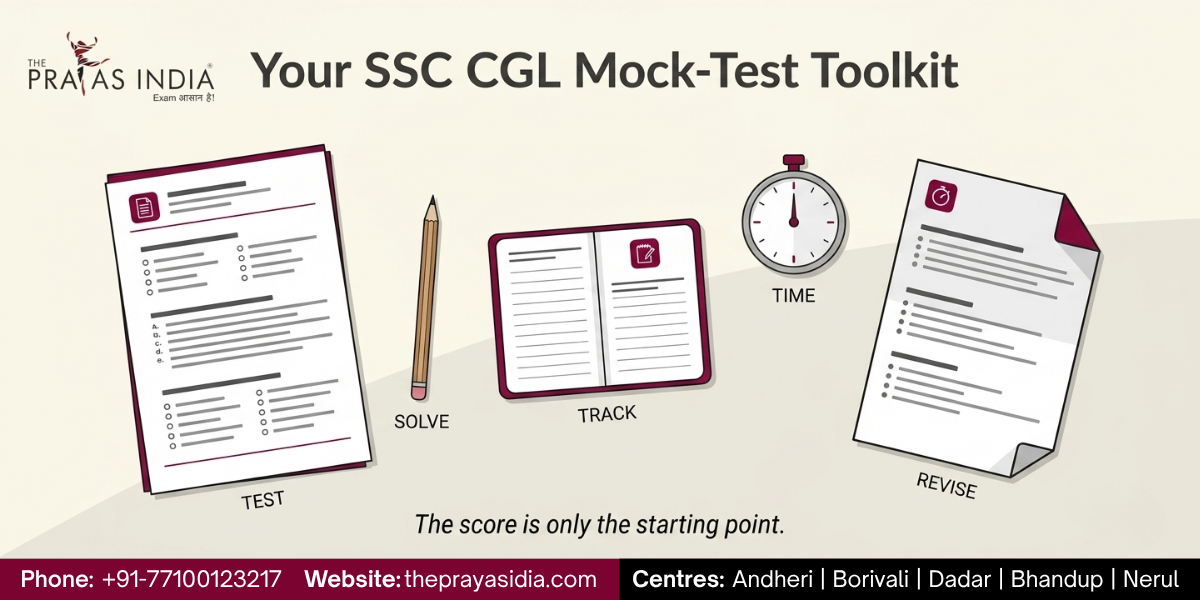
Concept classes build understanding. Practice develops familiarity. Mock tests measure performance. Analysis identifies weaknesses. Revision reinforces learning.
When these elements operate together, students can make decisions based on evidence rather than guesswork.
For aspirants considering The Prayas India for SSC CGL preparation, the important consideration should be whether the learning environment fits their individual requirements and supports their preparation stage.
The decision should remain practical. Students should consider faculty support, test structure, study material, doubt resolution, revision and the overall learning environment before taking admission.
Admission Decision: Choose Support That Matches Your Problem
There is no universal answer to whether every SSC CGL aspirant should join coaching.
A student who already has a disciplined routine, strong resources and a reliable mock-analysis system may be able to continue independently.
Another student may have the knowledge but struggle with execution. Someone else may need help building fundamentals from scratch.
These candidates have different requirements.
Therefore, when evaluating SSC Coaching in Mumbai, ask what problem the programme is actually helping you solve.
If your problem is direction, look for structure.
If your problem is conceptual clarity, look for faculty support.
If your problem is performance, examine the testing and analysis system.
If your problem is consistency, consider the schedule and accountability structure.
The right admission decision is the one that addresses the actual gap in your preparation.
A Low Score Can Become a Turning Point
Many aspirants remember a low mock score as a negative moment. But it can become a turning point if it changes how they prepare.
Perhaps you discover that you were attempting too many difficult questions. Maybe you realise that your Quant concepts are fine but calculation accuracy is weak. Perhaps your English preparation needs more regular practice, or your revision cycle is too irregular.
Once identified, each of these problems can be addressed.
The important thing is to stop treating mock tests as judgement and start treating them as feedback.
Your preparation becomes stronger when you can look at a disappointing score without panic and ask what it is trying to tell you.
A Practical Recovery Framework
After every low mock, follow a simple sequence.
First, pause and analyse. Do not immediately take another mock.
Second, classify your mistakes. Separate conceptual errors from execution errors.
Third, identify the highest-impact weakness. Do not try to fix everything simultaneously.
Fourth, practise specifically. Use targeted questions instead of random volume.
Fifth, change one strategy element. Experiment with question selection, timing, accuracy or revision.
Sixth, retest. Use the next mock to measure whether the correction worked.
Seventh, repeat. Preparation improves through repeated feedback cycles.
This framework can be followed independently or within a structured coaching environment.
Final Takeaway
A low SSC CGL mock-test score does not mean that your preparation has failed. It means that your current performance has revealed something that needs attention.
The strongest response is not panic. It is analysis.
Understand where the marks were lost, separate knowledge gaps from execution problems, record recurring mistakes and create a targeted correction plan. Then use the next mock to test whether your changes are working.
If you can manage this process independently, continue building your self-study system. If you repeatedly struggle to analyse your performance or maintain a consistent preparation cycle, professional guidance may provide useful structure.
For students considering SSC Coaching in Mumbai, the decision should ultimately be based on the kind of support your preparation genuinely requires.
A mock test gives you a score. Your analysis gives that score meaning. Your correction turns it into improvement.
Contact Us
- Call Now: +91-77100 13217
- Website: theprayasindia.com
- Centres: Andheri | Borivali | Dadar | Nerul | Bhandup
Frequently Asked Questions
1. What should I do immediately after getting a low SSC CGL mock score?
Do not immediately take another mock or completely change your study plan. First analyse the paper, identify incorrect and unanswered questions, examine time usage and classify the reasons behind your mistakes.
2. Should I be worried if my SSC CGL mock score suddenly drops?
One low score should not determine your assessment of your preparation. Look for patterns across multiple tests and use the latest result to identify specific areas that need improvement.
3. How can I identify why I am losing marks in SSC CGL mocks?
Review every incorrect and unanswered question and classify the problem as conceptual, calculation-related, reading-related, time-related, memory-related or due to poor question selection.
4. Should I take another mock immediately after a low score?
Usually, it is more useful to analyse the previous test first. Taking another mock without correcting the underlying issue may simply reproduce the same mistakes.
5. How can I improve my SSC CGL mock-test accuracy?
Identify recurring errors, practise the relevant question types, avoid rushing and focus on solving questions correctly before trying to increase speed.
6. How important is mock-test analysis for SSC CGL?
Mock analysis is important because the score itself does not explain why marks were lost. Detailed analysis can reveal weaknesses in concepts, accuracy, speed, selection and time management.
7. Can SSC CGL coaching help if my mock scores are consistently low?
Professional coaching may help when low scores are caused by unclear strategy, weak concepts, inconsistent practice or difficulty analysing performance. However, improvement still requires individual practice and revision.
8. Is it better to solve more questions or analyse mistakes?
Both have a role, but solving more questions without understanding recurring mistakes can be inefficient. Quality analysis should guide the kind of questions you practise next.
9. Should I change my preparation strategy after every mock?
No. Frequent strategy changes can create instability. Make targeted changes based on clear evidence and evaluate them across multiple tests.
10. How many mock tests should I take for SSC CGL?
The ideal number depends on your preparation stage and available time. More important than a fixed number is whether you are analysing each test and correcting the weaknesses it reveals.
11. Is self-study enough for SSC CGL?
Self-study can work well for students who have discipline, reliable resources and the ability to analyse their own performance. Candidates who struggle with direction, consistency or performance analysis may benefit from structured guidance.
12. What should I check before joining SSC CGL coaching in Mumbai?
Evaluate faculty, teaching methodology, study material, test series, mock-test analysis, doubt support, revision structure, schedule and how well the programme fits your individual preparation needs.