How to Recover If You Start Railway Exam Preparation Late | The Prayas India
Starting railway exam preparation late can feel stressful, especially when other aspirants seem to have already completed the syllabus, solved previous year papers and started taking mock tests. However, a late start does not automatically mean that you cannot prepare effectively. What matters most is how you use the remaining preparation time.
Railway examinations such as RRB NTPC, RRB Group D, RRB ALP and other railway recruitment examinations require a combination of conceptual understanding, regular practice, speed, accuracy and familiarity with the exam pattern. When preparation begins late, the biggest challenge is not simply completing the syllabus. It is deciding what deserves priority, avoiding unnecessary study material and creating a realistic daily routine.
A late starter should therefore avoid trying to copy the preparation schedule of someone who started months earlier. Instead, the strategy should focus on smart syllabus coverage, high-frequency topics, previous year questions, timed practice, mock tests and repeated revision.
With a structured plan and consistent effort, students can make meaningful progress even when they have limited preparation time.
Can You Still Crack a Railway Exam If You Started Late?
Yes, a late start can still be converted into a productive preparation phase if you approach the remaining time strategically. The important distinction is between studying everything and studying what is most useful for the examination.
Students who start late often make one of two mistakes. Some panic and try to study for extremely long hours, jumping between multiple subjects and resources. Others spend too much time planning and collecting material without getting enough practice. Neither approach creates efficient preparation.
Instead, divide your preparation into three broad objectives:
- Cover the most important concepts first.
- Practise questions based on the actual examination level.
- Revise and test yourself repeatedly.
Your preparation should gradually move from learning → practice → timed practice → mock tests → revision.
The goal is not to complete every available book or course. The goal is to become capable of solving the questions that are likely to appear within the available time.
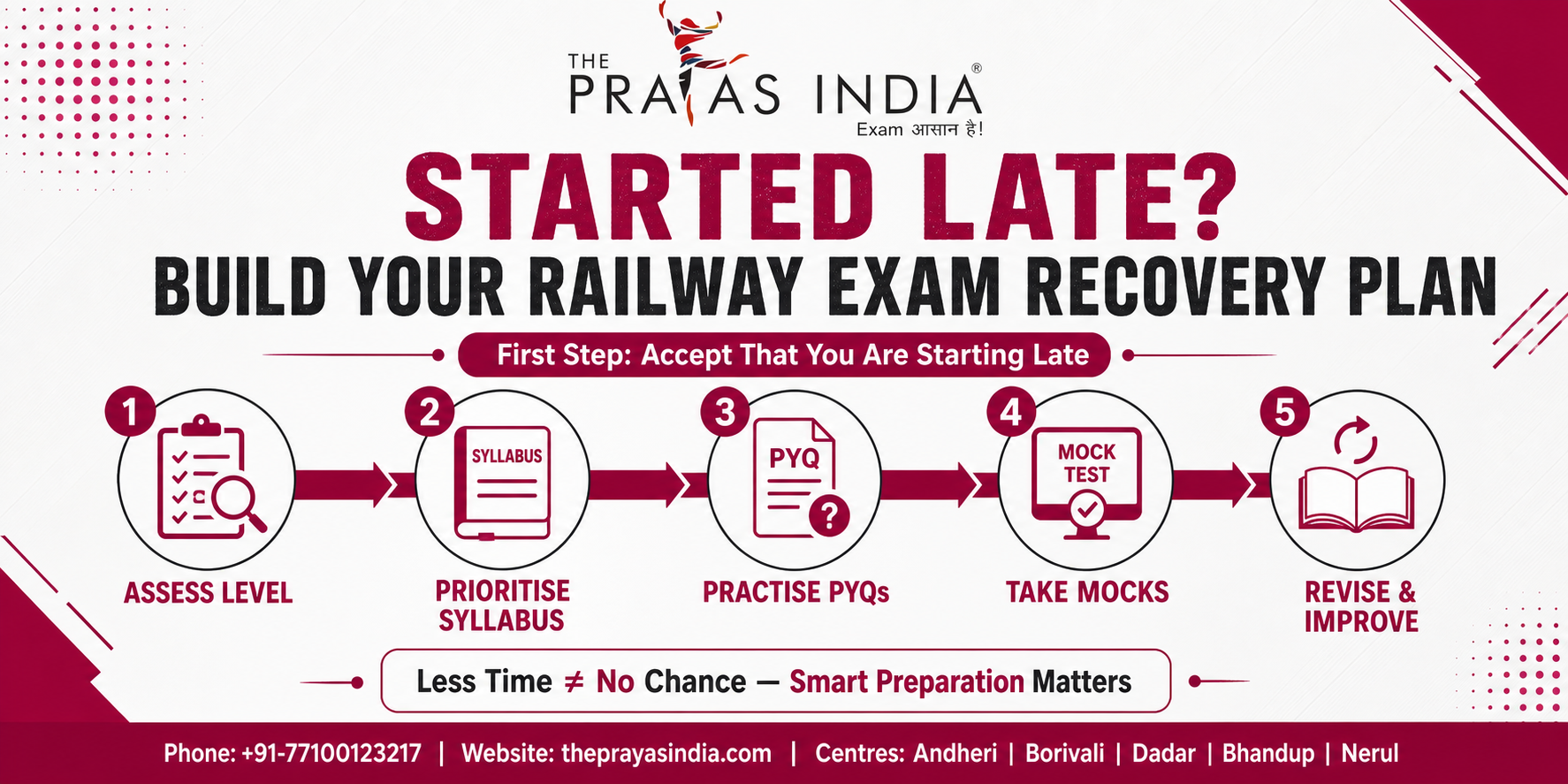
First Step: Accept That You Are Starting Late
The first step is psychological but extremely important. Once you realise that your preparation is behind schedule, avoid spending your remaining time worrying about how much other candidates may have studied.
You cannot recover the time that has already passed. You can, however, control how efficiently you use the time that remains.
A late-start preparation plan should therefore begin with a realistic assessment:
What is my current level?
Which subjects are strong?
Which topics are completely new?
How much time can I study every day?
How many days remain before my target examination?
How many questions can I currently solve accurately within a fixed time?
Once these questions are answered, you can create a preparation strategy based on your actual position rather than an ideal timetable.
Take a Diagnostic Test Before Making Your Timetable
Before beginning an intensive recovery plan, take a diagnostic test or attempt a previous year paper under timed conditions.
This will give you a much more useful picture of your preparation than simply looking at completed chapters.
For example, you may discover that your mathematics concepts are reasonable but your calculation speed is slow. You may find that reasoning is comfortable but general awareness is weak. Or you may know the concepts but lose marks because of incorrect question selection.
Record your performance subject-wise.
Create four categories:
- Strong topics
- Average topics
- Weak topics
- Completely unfamiliar topics
This classification will help you decide where your time should go.
A late starter cannot afford to spend equal time on every topic. Your timetable should give more attention to areas where improvement can produce meaningful gains.
Prioritise the Railway Exam Syllabus
When preparation time is limited, syllabus prioritisation becomes essential.
Instead of randomly selecting chapters, divide the syllabus into three levels.
Priority 1: High-Importance Topics
Start with topics that are fundamental, frequently practised and useful for solving a significant number of questions.
For Mathematics, this can include areas such as percentages, ratio and proportion, averages, profit and loss, time and work, time and distance, simple and compound interest, number system and basic arithmetic.
For Reasoning, focus on topics such as analogy, classification, series, coding-decoding, syllogism, direction-based questions, blood relations, mathematical operations and other commonly practised reasoning areas.
For General Intelligence and General Awareness sections, build coverage around the examination syllabus and focus on important factual and conceptual areas rather than trying to study every piece of information available online.
Priority 2: Moderate-Importance Topics
Once your fundamentals are reasonably strong, move to topics that require additional practice or appear as part of the broader syllabus.
Priority 3: Time-Consuming or Low-Confidence Topics
Do not completely ignore difficult topics, but avoid allowing one chapter to consume several days when your preparation is already behind schedule.
The correct strategy is to establish a strong base first and then use remaining time to expand coverage.
Do Not Try to Complete Every Book
One of the biggest disadvantages of starting late is information overload.
Students often respond to limited time by collecting more resources: multiple books, PDFs, YouTube playlists, Telegram materials, test series and current-affairs compilations.
This can create the illusion of preparation without sufficient actual practice.
A better system is to select:
- One primary source for concepts
- One reliable question-practice source
- Previous year papers
- One mock-test source
- Concise revision notes
The objective should be to repeat high-quality material, not continuously search for new material.
Use Previous Year Questions as Your Preparation Compass
Previous year questions are particularly valuable for late starters because they show how the syllabus is translated into actual examination questions.
When you solve previous year questions, do not only check whether your answer is correct.
Analyse:
- What concept was tested?
- Was the question easy, moderate or difficult?
- How much time did you take?
- Was there a shortcut?
- Did you make a calculation error?
- Did you misunderstand the question?
- Have you seen a similar question before?
This analysis helps you identify the practical requirements of the examination.
For a late starter, previous year questions can also help prevent unnecessary preparation because they show which types of questions deserve more attention.
Build Concepts Quickly, Then Move to Practice
When you start late, you need to balance concept building and question solving.
Spending weeks only watching lectures can create a false sense of progress. At the same time, solving questions without understanding the underlying concepts can lead to repeated mistakes.
A useful approach is:
Learn the basic concept → Solve basic questions → Move to exam-level questions → Analyse mistakes → Revise the concept.
For example, after learning percentages, do not immediately move to another chapter. Solve enough questions to understand how percentages are applied in profit and loss, discounts, ratio-based problems and other arithmetic situations.
This makes your preparation interconnected rather than chapter-by-chapter memorisation.
Create a High-Intensity Daily Study Routine
A late-start preparation schedule should be intensive but sustainable.
Instead of studying for an unrealistic number of hours for a few days and then losing consistency, establish a routine that you can maintain.
A sample structure could be:
Session 1: Mathematics
Concept learning followed by question practice.
Session 2: Reasoning
Topic-wise practice followed by timed questions.
Session 3: General Awareness / General Science
Conceptual and factual revision.
Session 4: Previous Year Questions
Mixed practice across subjects.
Session 5: Revision
Review mistakes, formulas and important facts.
The exact number of hours will depend on your personal schedule. The important factor is that every day should include learning, solving and revision.
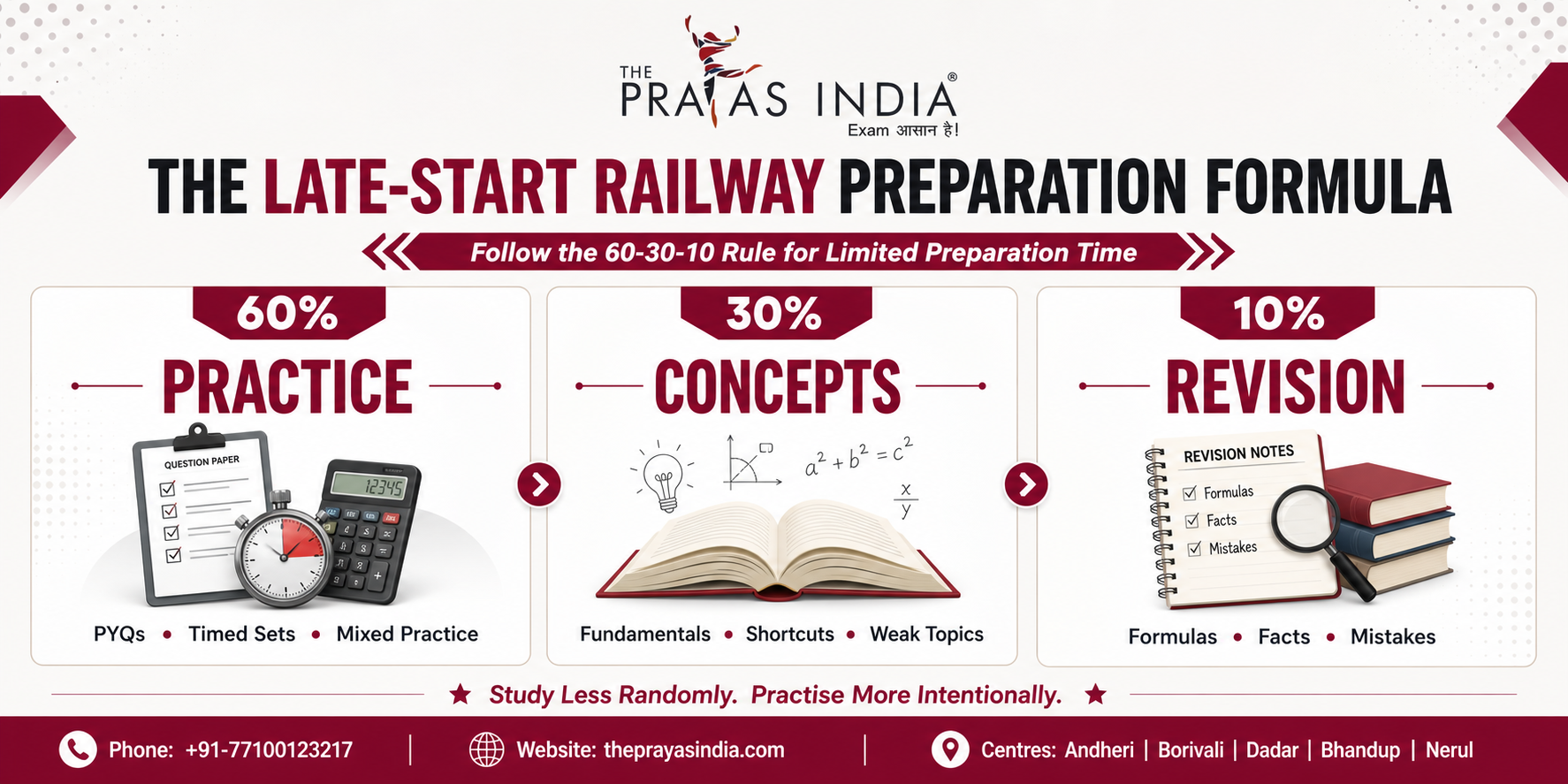
Follow the 60-30-10 Rule for Limited Preparation Time
When time is short, your study hours should not be spent entirely on new concepts.
A practical allocation can be:
60% — Question Practice
Solve topic-wise questions, previous year questions and mixed sets.
30% — Concept Building
Study concepts that are required to solve questions accurately.
10% — Revision
Revise formulas, facts, shortcuts and previous mistakes.
This ratio can change as the examination gets closer. In the final phase, revision and mock tests should gradually occupy a larger share of your preparation.
Give Extra Attention to Mathematics and Reasoning Practice
Mathematics and Reasoning are subjects where consistent question practice can make a substantial difference.
If you start late, do not spend the majority of your time passively reading solutions. You need to solve questions yourself.
For Mathematics, develop calculation speed alongside conceptual understanding. Practise fractions, percentages, multiplication, division, squares, cubes and common calculations so that routine operations become faster.
For Reasoning, focus on recognising patterns and understanding question structures. The objective is not simply to memorise tricks but to become comfortable identifying the correct approach quickly.
Maintain a mistake notebook for both subjects.
Whenever you make a mistake, record:
Question Type → Your Mistake → Correct Method → Shortcut/Observation
Revisit these mistakes every few days.
Improve General Awareness Without Getting Overwhelmed
General Awareness can become particularly challenging for candidates who start late because the volume of information is large.
The solution is not to read everything.
Create categories such as:
- Current national developments
- Important government initiatives
- Economy and banking
- Science and technology
- Sports
- Awards and honours
- Appointments
- Important organisations
- Important days
- Railway-related developments where relevant
- Static awareness connected with current events
Use concise monthly revision material and test yourself regularly.
If you are studying General Science as part of your railway examination syllabus, give adequate attention to core concepts rather than depending entirely on memorisation.
Use Active Recall Instead of Repeated Reading
One of the most effective ways to improve revision is to stop looking at the answer while studying.
After completing a topic, close your notes and ask yourself:
“What did I just learn?”
“Which formulas were important?”
“What types of questions can be asked?”
“Which facts do I still remember?”
“Which questions did I get wrong?”
This process forces your brain to retrieve information rather than simply recognise it.
Recognition can create a feeling that you know something. Active recall helps determine whether you can actually reproduce it.
Start Mock Tests Earlier Than You Think
Many late starters postpone mock tests because they believe they should first complete the entire syllabus.
That can be counterproductive.
You do not need to wait until 100% syllabus completion before taking your first mock.
Early mock tests can reveal:
- Your current speed
- Accuracy level
- Weak subjects
- Time-consuming topics
- Question-selection problems
- Silly mistakes
- Revision gaps
Your initial mock score is not the final measure of your ability. Treat it as a diagnostic tool.
The important thing is to analyse the paper afterwards.
A two-hour mock followed by no analysis is much less useful than a mock followed by detailed error analysis.
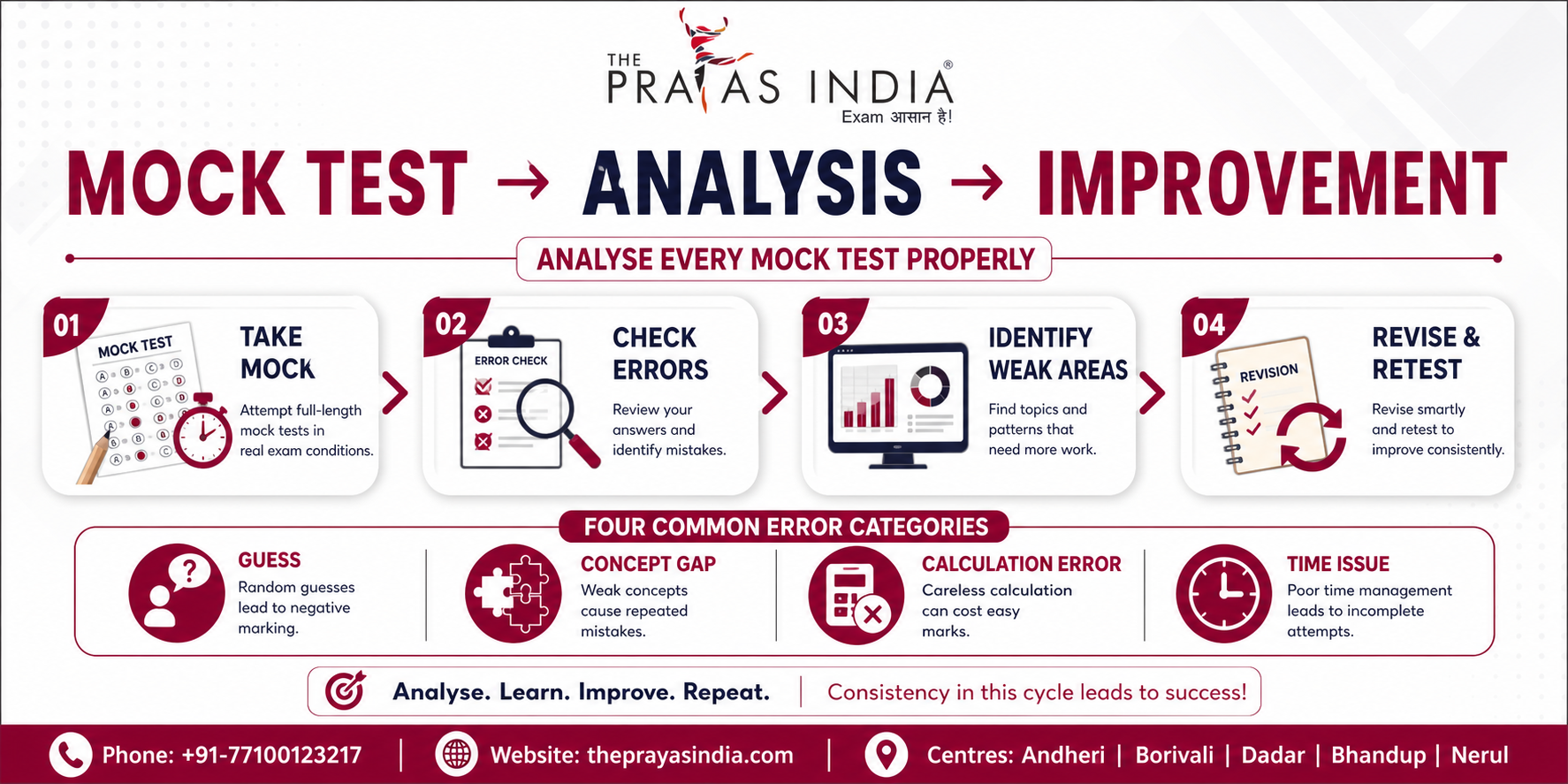
Analyse Every Mock Test Properly
After every mock test, divide your questions into four groups:
Correct and Confident
These indicate areas that are working well.
Correct but Guessed
These require revision because the answer may not have come from reliable knowledge.
Incorrect but Solvable
These are high-priority mistakes because better understanding or practice could convert them into marks.
Incorrect and Currently Difficult
These topics may require additional concept work or strategic prioritisation.
Also record the time spent on different sections.
Sometimes the problem is not lack of knowledge but poor time allocation.
Follow a 30-Day Recovery Strategy
If you have approximately one month or a similarly short preparation window, your preparation should be divided into phases rather than attempting everything simultaneously.
Days 1–7: Diagnose and Build the Foundation
Take a diagnostic test and identify your strongest and weakest areas.
Start high-priority Mathematics and Reasoning topics.
Begin regular General Awareness and General Science revision.
Solve previous year questions alongside concept learning.
Days 8–15: Increase Question Practice
Reduce passive learning and increase question-solving time.
Complete topic-wise previous year questions.
Start timed practice sets.
Continue daily revision of General Awareness and formulas.
Days 16–23: Shift Towards Mixed Practice
Start combining different topics.
Attempt sectional tests and mixed question sets.
Take regular mock tests.
Analyse mistakes after every test.
Focus heavily on weak but recoverable areas.
Days 24–30: Revision and Exam Simulation
Reduce the introduction of completely new material.
Focus on formulas, important facts, previous mistakes and frequently practised question types.
Take full-length mocks under examination conditions.
Work on question selection, speed and accuracy.
The final days should be about consolidation rather than panic-driven learning.
What If Your Railway Exam Is Only 15 Days Away?
If you have only two weeks left, the strategy needs to become even more selective.
Do not attempt to rebuild the entire syllabus from zero.
Focus on:
- Previous year questions
- High-priority topics
- Important formulas
- Frequently repeated question types
- General Awareness revision
- General Science fundamentals
- Sectional tests
- Full-length mock tests
- Mistake analysis
Your objective should be to maximise the number of questions you can solve accurately rather than trying to become an expert in every chapter.
What If You Have Only 7 Days Left?
With only one week remaining, preparation should primarily become a revision and testing exercise.
Avoid starting multiple new resources.
Revise your short notes and formulas.
Solve selected previous year questions.
Take mock tests.
Review your mistakes.
Practise time management.
Maintain your regular sleep schedule.
A calm and organised final week is more useful than trying to study continuously without a clear plan.
Avoid These Mistakes When Preparing Late
Trying to Study 12–15 Hours Immediately
Long study hours are not automatically productive. A sustainable schedule with focused sessions is more useful than extreme study hours followed by burnout.
Watching Lectures Without Solving Questions
Understanding a concept is only the first step. Examination performance requires application under time pressure.
Collecting Too Many Resources
Multiple books, PDFs and videos can create duplication and confusion.
Ignoring Previous Year Papers
PYQs provide valuable information about question style, difficulty and recurring concepts.
Waiting for Syllabus Completion Before Taking Mocks
Mocks can be used as diagnostic tools even before complete syllabus coverage.
Spending Too Much Time on One Difficult Topic
When preparation time is limited, opportunity cost matters. Move forward after reaching a reasonable level of understanding and return later if time permits.
Ignoring Revision
A topic studied once can easily be forgotten. Revision must be built into the timetable from the beginning.
How Coaching Can Help Students Who Start Late
When preparation begins late, deciding what to study can itself become a challenge. Students may spend considerable time creating timetables, searching for study material and deciding which topics to prioritise.
Structured coaching can help reduce this uncertainty by providing an organised preparation framework.
For a late starter, useful support can include:
- Structured classes
- Topic-wise concept coverage
- Previous year question practice
- Regular mock tests
- Doubt-solving support
- Performance analysis
- Revision planning
- Exam-oriented study material
- Faculty guidance
- Online learning support
The purpose of coaching should be to make preparation more structured and efficient, not simply to increase the number of hours spent studying.
How The Prayas India Can Support Your Railway Exam Preparation
If you have started your railway exam preparation late and need a structured way to organise the remaining preparation time, The Prayas India can provide an exam-oriented learning environment designed around concepts, practice, revision and testing.
Students can access online and offline preparation support, allowing them to choose a format that fits their schedule and learning preferences.
A structured preparation programme can help aspirants maintain consistency while working on the core requirements of railway examinations: conceptual clarity, question-solving ability, speed, accuracy and mock-test performance.
For students looking for classroom-based preparation in Mumbai, The Prayas India has centres at Andheri, Borivali, Dadar, Bhandup and Nerul.
The objective is not to make a late starter study everything. It is to help the student build a focused plan around the time and preparation level available.
Build a Recovery Timetable That You Can Actually Follow
A good timetable is not the one that looks impressive on paper. It is the one you can follow consistently.
Before creating your schedule, calculate your available preparation time.
For example, if you have six hours available, divide them into focused sessions rather than attempting to study continuously.
A practical structure could be:
2 hours — Mathematics
Concepts + timed question practice.
1.5 hours — Reasoning
Topic practice + mixed questions.
1.5 hours — General Awareness / General Science
Concepts + revision + current updates where relevant.
1 hour — PYQs / Mock / Error Analysis
The last session should change according to the preparation phase.
On some days, it can be a sectional test. On others, it can be a full mock or mistake revision.
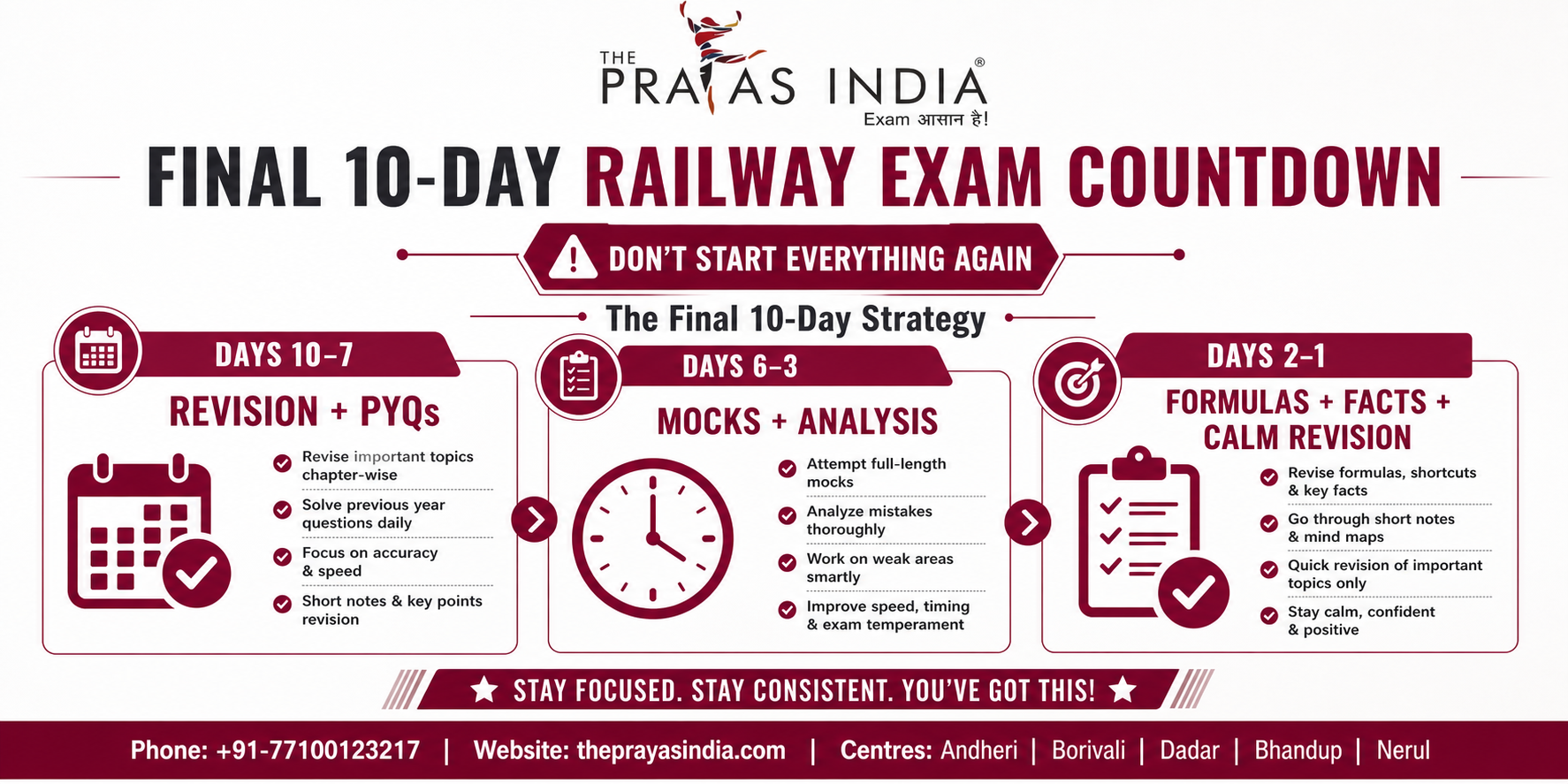
The Final 10-Day Strategy
During the final 10 days, your preparation should increasingly resemble the actual examination environment.
Take full-length tests under timed conditions.
Practise deciding which questions to attempt first.
Avoid spending excessive time on questions that are consuming your time.
Review formulas and short notes.
Revise important General Awareness and General Science material.
Analyse mistakes from previous mocks.
Most importantly, avoid constantly changing your preparation resources.
At this stage, consistency and recall are more valuable than discovering another new study source.
How to Stay Consistent When You Feel You Are Behind
Late preparation often creates comparison with other aspirants. You may see someone discussing their completed syllabus, mock-test scores or study hours and start feeling that you are too far behind.
Instead of comparing your preparation with someone else’s timeline, measure your progress against your own previous performance.
For example:
Can you solve more questions today than last week?
Has your accuracy improved?
Are you making fewer calculation mistakes?
Can you complete a sectional test faster?
Are you remembering more General Awareness facts?
Are you making fewer repeated errors?
These are more useful indicators of progress.
A late start requires discipline, but it does not require panic.
How to Balance Speed and Accuracy
Railway examinations generally reward candidates who can combine knowledge with efficient question solving. Therefore, preparation should not focus only on solving more questions.
Track both speed and accuracy.
If your accuracy is low, slow down during practice and strengthen your concepts.
If your accuracy is high but your speed is low, introduce more timed sets.
If both are weak, return to fundamentals before increasing test intensity.
Your objective should be to gradually move towards faster solving without sacrificing accuracy.
Make Every Study Session Have a Purpose
A late-start preparation plan becomes more effective when every session has a measurable objective.
Instead of writing:
“Study Mathematics for two hours.”
Write:
“Complete percentages concept revision and solve 40 questions.”
Instead of:
“Study Reasoning.”
Write:
“Complete coding-decoding practice and analyse 20 PYQs.”
Instead of:
“Revise General Awareness.”
Write:
“Revise this month’s notes and attempt a 30-question quiz.”
Specific goals make it easier to track progress.
A Simple Recovery Formula for Railway Exam Aspirants
If you are starting late, remember this preparation sequence:
Assess → Prioritise → Learn → Practise → Test → Analyse → Revise → Repeat
Assessment tells you where you stand.
Prioritisation tells you where to spend your time.
Learning builds the foundation.
Practice develops application.
Tests reveal your current performance.
Analysis identifies mistakes.
Revision strengthens memory.
Repetition turns preparation into consistency.
The process may look simple, but following it every day can make a major difference to the quality of your preparation.
Final Thoughts
Starting railway exam preparation late is a challenge, but the remaining time can still be used productively with a focused strategy. The key is to stop thinking about completing everything and start thinking about maximising useful preparation.
Begin with a diagnostic assessment. Prioritise important syllabus areas. Use previous year questions to understand the examination. Build concepts quickly and move into practice. Start mock tests before completing the entire syllabus and analyse every test carefully.
Do not allow resource collection, excessive planning or comparison with other aspirants to consume your preparation time.
Most importantly, make revision a daily activity. A late starter cannot afford to study a topic once and forget it. Repeated practice, active recall and mistake analysis should become part of the routine.
If you want structured guidance while preparing for railway examinations, The Prayas India offers online and offline preparation support with a focus on systematic learning, practice, revision and mock-test preparation.
For classroom-based preparation in Mumbai, students can explore learning support available at Andheri, Borivali, Dadar, Bhandup and Nerul.
Starting late means you need to prepare smarter, not that you should stop preparing.
Frequently Asked Questions (FAQs) – Late Start Strategy for Railway Exams
1. Can I prepare for a railway exam if I start late?
Yes. A late start requires a more selective and structured strategy. Focus on high-priority topics, previous year questions, regular practice, mock tests, and repeated revision instead of trying to cover every available resource blindly.
2. What should I do first if I have started railway exam preparation late?
Begin with a diagnostic test or previous year paper. Identify your strong, average, and weak areas before creating your timetable. This helps you allocate your remaining preparation time more effectively to high-yield sections.
3. Should I complete the entire syllabus before taking mock tests?
No. Mock tests can be used as diagnostic tools even before complete syllabus coverage. They can reveal critical weaknesses in speed, accuracy, question selection, and time management, helping you tune your micro-targets.
4. Are previous year questions important for railway exam preparation?
Yes. Previous year questions (PYQs) help you understand the exact type of questions asked, identify recurring high-yield concepts, and practise solving questions at the expected examination level under constraints.
5. How many hours should I study if I start late?
There is no universal number of hours that works for every student. Focus on creating a realistic schedule that you can follow consistently. Quality of practice, revision, and error analysis is far more important than simply counting raw study hours.
6. How can I improve my railway exam speed?
Practise questions under timed conditions. Build calculation speed using arithmetic short-tricks, use appropriate formulas, and regularly solve sectional and mixed timed sets. Meticulously analyse questions where you spent too much time.
7. Should I study multiple books when I have less preparation time?
Generally, avoid excessive resources. Select a single reliable primary study source, previous year papers, a suitable practice source, and mock tests. Repeated revision of selected material is usually more manageable and effective than continuously changing resources.
8. What should I do if my mock-test scores are low?
Treat low scores as diagnostic information. Analyse whether the problem is weak conceptual knowledge, calculation speed, accuracy slips, time management, wrong question selection, or a lack of revision. Then modify your weekly targets accordingly.
9. Can coaching help if I have started railway exam preparation late?
Structured coaching can provide a clearly defined study sequence, organized practice capsules, real-time mock tests, targeted revision support, and direct faculty guidance. It is particularly useful for students who find it difficult to prioritize the massive syllabus or maintain a strict routine independently.
10. Does The Prayas India provide railway exam preparation?
Yes. The Prayas India provides top-tier, structured competitive exam preparation. We offer optimized online live coaching batches and targeted offline classroom modules designed to cover high-scoring trends with maximum speed and accuracy.
11. Where are The Prayas India centres located?
For highly interactive classroom-based preparation support, candidates can visit any of our verified learning branches in Mumbai, located across Andheri, Borivali, Dadar, Bhandup, and Nerul.
🚂
Started Railway Preparation Late? Recover Fast with The Prayas India!
When time is running out, reading random study materials is a recipe for failure. A late start demands a hyper-focused strategy, high-speed calculation short-tricks, and target-oriented mock drills. Clear the thresholds under Mumbai’s best mentors!
How Our Intensive Railway Recovery Tracks Work:
- ⚡ High-Yield Pacing Shortcuts: Learn advanced mental math and reasoning shortcuts to crack questions in under 30 seconds.
- 📉 Focused Syllabus Completion: Skip the fluff. We prioritize topics that consistently carry maximum marks in railway exams.
- 📊 Simulated Mock Evaluation: Regular full-length computer-based tests combined with micro-level error tracing to boost your accuracy boundaries.
Connect with a Senior Course Counselor Today
📞 Admissions Desk: +91-77100 13217
🌐 Main Hub Portal: theprayasindia.com