How to Reduce Calculation Mistakes in SBI Clerk Quant? | Best Bank Coaching in Mumbai | The Prayas India
Quantitative Aptitude can become one of the most scoring sections in the SBI Clerk examination when a candidate combines conceptual clarity with speed and accuracy. However, many aspirants lose marks not because they do not understand the underlying concept, but because of small calculation errors. A misplaced decimal, incorrect addition, rushed multiplication, wrong percentage conversion or a simple sign mistake can turn an otherwise correct solution into a wrong answer.
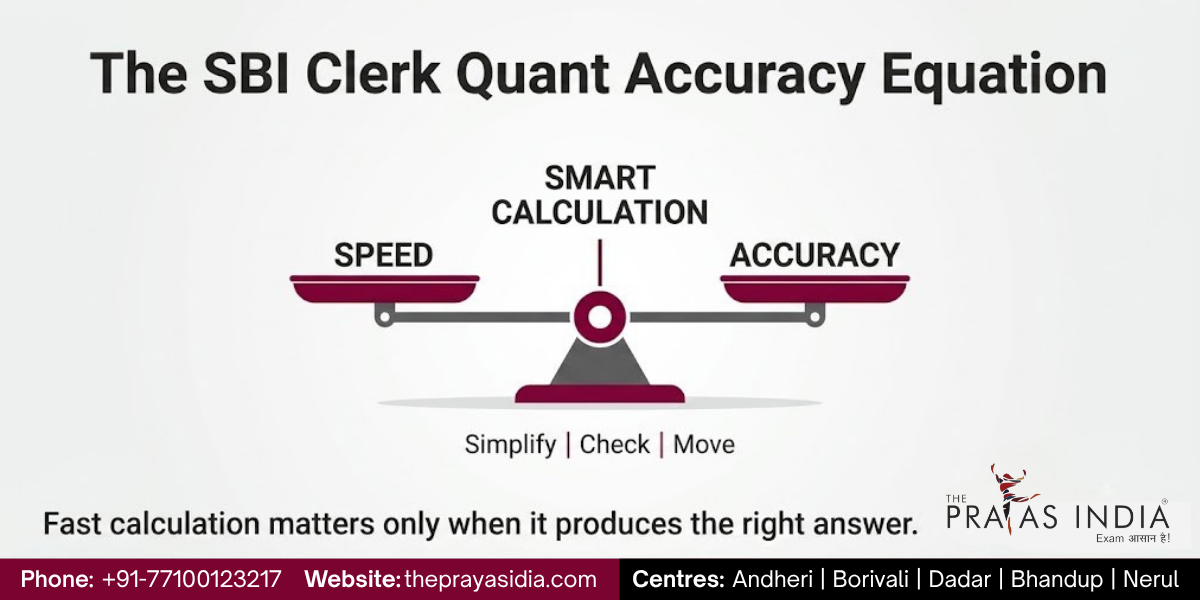
This becomes especially important in SBI Clerk preparation because the examination requires candidates to solve questions under considerable time pressure. The challenge is therefore not simply to calculate quickly. The real objective is to calculate accurately while maintaining a sustainable speed. Developing this ability requires deliberate practice rather than repeatedly solving random questions.
For students preparing for SBI Clerk, reducing calculation mistakes can have a direct impact on attempts, accuracy and overall Quantitative Aptitude performance. A candidate who saves even a few avoidable errors can improve the effective score without necessarily spending additional hours studying new concepts.
Calculation Accuracy Is a Skill, Not Just a Natural Ability
Many students believe that some people are naturally good at calculations while others are simply slow. In reality, calculation ability can be developed through repeated and structured practice.
When you solve arithmetic questions regularly, your brain begins to recognise familiar numerical patterns. Fractions become easier to convert into percentages, common multiplication combinations become quicker to process, and approximation becomes more instinctive.
The problem arises when students try to improve calculation speed by rushing through questions. Speed without control usually increases error rates. If your calculation speed improves by 20% but your mistakes increase significantly, the improvement has little practical value in an examination.
A better approach is to first establish clean and reliable calculation habits. Once accuracy becomes consistent, speed can gradually be increased.
Why SBI Clerk Quant Calculation Mistakes Happen
Calculation mistakes usually do not come from one single problem. They are often the result of several small habits developed during preparation.
One common reason is mental rushing. Students see an apparently easy question and immediately start calculating without carefully identifying what the question is asking. This can lead to using the wrong value or operation even when the actual calculation is simple.
Another problem is poor familiarity with basic numerical relationships. If a student has to repeatedly calculate common fractions, percentages or multiplication combinations from scratch, valuable examination time is consumed and the possibility of errors increases.
Writing style can also matter. Untidy rough work makes it difficult to distinguish numbers and operations, especially when several calculations are performed on the same page. A small mistake in one intermediate step can then affect the entire solution.
There is also the issue of over-calculation. Candidates sometimes perform lengthy calculations even when a question can be solved through approximation, fraction conversion or a simpler numerical relationship.
The first step towards improvement is therefore to understand why your mistakes are happening instead of simply solving more questions.
Build a Strong Calculation Foundation Before Chasing Speed
Before attempting to become exceptionally fast, make your basic calculations dependable.
An SBI Clerk aspirant should become comfortable with multiplication tables, squares, cubes, fraction-to-percentage conversions, percentage relationships and basic arithmetic operations. This does not mean memorising every possible number. It means developing familiarity with the numerical values that frequently appear in competitive-exam questions.
For example, knowing that:
- 1/2 = 50%
- 1/4 = 25%
- 1/5 = 20%
- 1/8 = 12.5%
- 1/10 = 10%
- 1/20 = 5%
can make percentage-based calculations considerably easier.
Similarly, familiarity with squares of commonly used numbers can reduce the time required for calculation-heavy questions.
The objective is to reduce the amount of conscious effort required for routine operations. When basic calculations become automatic, more mental attention can be directed towards understanding the question and selecting the correct approach.
Accuracy First, Speed Second
A useful principle for SBI Clerk Quant preparation is simple:
Do not try to become fast before becoming accurate.
If you are currently making frequent calculation errors, begin with untimed or moderately timed practice. Solve questions carefully and focus on writing each calculation clearly.
Once you can maintain a high accuracy level, introduce time limits gradually.
For example, instead of immediately attempting 20 questions in an aggressive time limit, begin with a smaller set and track both completion time and accuracy. Gradually reduce the time only when your accuracy remains stable.
This approach creates a better relationship between speed and reliability.
A candidate who consistently solves questions accurately at a slightly slower pace can usually improve speed through practice. A candidate who has developed careless habits while chasing speed may need considerably more effort to correct those habits later.
Learn to Identify the Calculation Before Starting It
One of the most overlooked aspects of Quant preparation is understanding the nature of the calculation before performing it.
Suppose a question involves percentages, ratios and a large number. You do not necessarily need to immediately begin multiplying everything. First identify whether the numbers can be simplified.
Similarly, if two quantities have a common factor, simplify them before multiplication. If a percentage can be converted into a familiar fraction, use the fraction. If the answer options are sufficiently different, approximation may be more efficient than exact calculation.
This habit is especially valuable in an exam like SBI Clerk, where every second saved can contribute to better question selection and additional attempts.
Good calculation is therefore not simply about doing arithmetic faster. It is about choosing the easiest reliable arithmetic method.
Develop a Daily Calculation Practice Routine
Calculation improvement requires consistency. Solving one calculation-heavy worksheet every few weeks will not produce the same benefit as practising for a short period every day.
A practical daily routine can include a focused calculation session before regular Quant practice.
Spend a few minutes on basic operations, followed by percentage conversions, fractions, multiplication and approximation. Then move into actual SBI Clerk-level questions.
The purpose is not to spend an entire study session doing calculations. Instead, create repeated exposure so that numerical operations become familiar.
A student who spends 15–20 focused minutes on calculation practice regularly may eventually notice that operations which initially required deliberate thought become much faster and more natural.
Use a Calculation Error Log
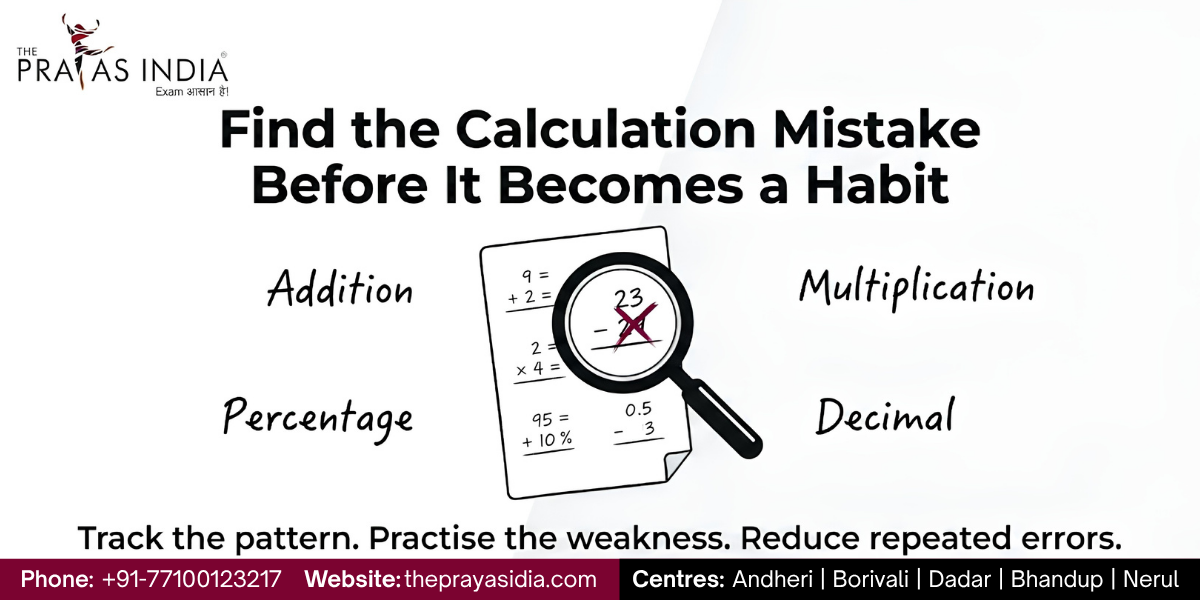
One of the most effective ways to reduce repeated mistakes is to maintain a dedicated calculation error log.
Whenever you make an incorrect calculation, do not simply mark the answer wrong and move on. Record the type of error.
For example, your mistakes may fall into categories such as:
| Error Type | Example |
|---|---|
| Addition Error | Incorrect total while adding multiple values |
| Multiplication Error | Mistake in a multi-digit product |
| Division Error | Incorrect quotient or remainder |
| Percentage Error | Wrong percentage conversion |
| Decimal Error | Misplaced decimal point |
| Sign Error | Incorrect positive/negative operation |
| Transcription Error | Copying a number incorrectly |
| Approximation Error | Rounding too aggressively |
| Formula Error | Using an incorrect relationship |
After several practice sessions, patterns will begin to emerge.
If most of your errors are caused by decimal placement, your solution should focus on decimal discipline. If percentage conversions are causing repeated problems, dedicate additional practice to percentage-fraction relationships.
This is much more effective than simply doing hundreds of additional questions without analysing the underlying issue.
Stop Repeating the Same Calculation Method
A common preparation mistake is using the same calculation technique for every type of question.
Competitive examinations reward efficient thinking. If one calculation can be simplified through fraction conversion while another is better handled through approximation, there is little benefit in forcing both questions through lengthy traditional calculations.
For example, percentage calculations often become easier when converted into fractions. Ratios can sometimes be simplified before values are substituted. Data Interpretation questions may allow approximation when answer choices are sufficiently separated.
The key is to build a toolkit of methods rather than relying on one calculation style.
However, shortcuts should be used only when you understand them properly. Memorising an unfamiliar trick without knowing why it works can create another source of mistakes.
Learn Common Fraction and Percentage Conversions
Percentage calculations appear frequently across SBI Clerk Quant topics. Developing familiarity with common conversions can reduce both calculation time and cognitive load.
Instead of repeatedly calculating the same relationships during practice, make commonly used conversions familiar.
For example:
12.5% = 1/8
16.67% ≈ 1/6
20% = 1/5
25% = 1/4
33.33% ≈ 1/3
50% = 1/2
75% = 3/4
These relationships can make calculations more intuitive.
At the same time, candidates should understand when approximation is appropriate. In questions where the options are extremely close, excessive approximation may produce the wrong answer. Therefore, the correct strategy depends on the question and available options.
Keep Rough Work Structured
You do not need to create elaborate mathematical layouts during the SBI Clerk examination. However, your rough work should be sufficiently organised to prevent avoidable confusion.
Write important intermediate values clearly instead of squeezing multiple calculations into the same space. If you are performing several operations, separate them visually.
This becomes particularly useful in Data Interpretation, Arithmetic and calculation-intensive questions where one incorrect intermediate value can affect the final answer.
A clean rough-work habit also makes it easier to quickly revisit a calculation when something appears inconsistent.
The objective is not beautiful handwriting. The objective is readable, controlled and efficient rough work.
Don’t Calculate What the Question Does Not Require
Another important calculation habit is knowing when to stop.
Students sometimes calculate an exact value even when the question only requires an approximate comparison. This consumes time and creates additional opportunities for mistakes.
Suppose answer options are widely separated. In such a situation, a controlled approximation may be enough to identify the correct option.
However, approximation should not become an excuse for careless calculation. The candidate must first understand the level of precision required.
A useful question to ask yourself during practice is:
“Do I actually need the exact value?”
If the answer is no, look for a reliable shorter route.
Calculation Accuracy and SBI Clerk Exam Strategy
Calculation accuracy should not be treated as an isolated Quant skill. It directly affects your broader exam strategy.
Every wrong calculation can result in lost marks. But the impact can be larger than the single question because correcting mistakes during an examination can consume additional time.
A candidate may solve a question, realise the answer does not match the options, return to the calculation and spend another 20–30 seconds checking the work. If the original mistake could have been prevented through cleaner calculation, that time could have been used on another question.
Therefore, accurate calculation improves more than your correctness. It can improve your time efficiency and confidence as well.
This is particularly valuable for candidates preparing for competitive bank examinations where the ability to make quick and accurate decisions matters significantly.
How The Prayas India Can Help With SBI Clerk Quant Preparation
Structured preparation can make calculation improvement more systematic.
At The Prayas India, SBI Clerk aspirants can work on Quantitative Aptitude through concept-based learning, regular practice, mock tests and performance analysis. Instead of treating every incorrect answer as an isolated mistake, students can identify recurring weaknesses and work on them through targeted practice.
For calculation-heavy Quant topics, consistent practice and analysis are particularly important. Students need opportunities to solve questions under time pressure while also receiving guidance on efficient approaches.
A focused preparation environment can help aspirants develop the combination of conceptual clarity, calculation accuracy, speed and question selection required for the examination.
For students searching for Bank Coaching in Mumbai, choosing a structured preparation programme can help turn calculation practice into a measurable improvement rather than an unplanned activity.
A Better Way to Measure Your Quant Improvement
Do not measure improvement only by the number of questions you solve.
Track at least three things:
Accuracy: How many questions are correct?
Time: How long do you take?
Error Pattern: Why are the wrong questions wrong?
Suppose you solve 30 questions in one session with 24 correct answers. After targeted practice, you solve 28 correctly while taking a similar amount of time. That is meaningful progress even if your total attempts have not increased dramatically.
Once accuracy stabilises, work on reducing the time gradually.
This creates a sustainable progression:
Accuracy → Consistency → Speed → Exam Readiness
Trying to reverse this order often results in unnecessary errors.
Key Takeaway
Reducing calculation mistakes in SBI Clerk Quant is not about becoming a human calculator. It is about developing a disciplined numerical approach that allows you to calculate quickly, clearly and reliably.
Start by identifying your recurring errors. Strengthen basic numerical relationships, practise regularly, maintain an error log and gradually introduce time pressure. Learn to simplify calculations rather than automatically choosing the longest method.
Most importantly, remember that speed and accuracy should develop together.
For an SBI Clerk aspirant, every avoidable calculation mistake represents a lost opportunity. With consistent practice and the right strategy, these mistakes can be reduced significantly, helping you approach Quantitative Aptitude with greater confidence and control.
Practise Calculations Under Controlled Time Pressure
Once your basic calculation accuracy becomes stable, the next step is to introduce time pressure gradually. This is where many aspirants make a mistake. They immediately start solving large sets with aggressive time limits and then assume that a higher number of errors is simply part of becoming faster.
A better method is to create controlled pressure. Start with a small set of calculation-based questions and assign yourself a reasonable time limit. Once you can complete that set accurately, reduce the time slightly. Continue this process only as long as your accuracy remains stable.
The purpose of timed calculation practice is not to make you panic while solving. It is to train your brain to perform familiar numerical operations efficiently even when the clock is running. Over time, this can help bridge the gap between comfortable practice and actual SBI Clerk exam conditions.
Use Mock Tests to Find Your Real Calculation Weaknesses
Mock tests are one of the best tools for identifying calculation mistakes because they reproduce the combination of speed, pressure and decision-making that candidates experience during an examination.
However, simply checking your final score is not enough. After every mock, examine the questions where you made calculation errors. Ask yourself whether the mistake occurred because you misunderstood the question, used an inefficient method, calculated too quickly, copied a number incorrectly or made an arithmetic error.
You should also identify questions where your answer was correct but the calculation took unusually long. These questions can reveal opportunities to improve your calculation method even when no marks were lost.
A good mock-test analysis therefore looks beyond “How many did I get wrong?” and asks “Why did I get them wrong, and can I prevent the same mistake next time?”
Create a Personal Calculation Checklist
A short mental checklist can prevent several common errors during practice and the actual examination.
Before finalising an answer, quickly verify whether you have copied the numbers correctly, used the correct operation, handled decimals properly and interpreted the percentage or ratio correctly. In approximation-based questions, check whether your approximation is appropriate for the answer choices.
This does not mean re-solving every question. That would defeat the purpose of time management. Instead, develop the habit of noticing potential error points while solving.
For example, if you are working with a multi-step percentage calculation, consciously slow down for the critical step rather than rushing through the entire question. The goal is selective caution, not excessive checking.
Strengthen Mental Calculation Without Abandoning Rough Work
Mental calculation can be extremely useful in SBI Clerk Quant, but it should not be confused with doing every calculation entirely in your head.
Some simple operations can become faster through mental practice. Percentage conversions, basic multiplication, addition of smaller values and common fraction relationships are good examples. But complicated calculations should still be written down clearly when necessary.
The best candidates are not necessarily those who calculate everything mentally. They are those who know which calculations can safely be done mentally and which should be written down.
During preparation, experiment with both approaches. If mental calculation consistently produces mistakes in a particular type of question, return to structured rough work until the process becomes reliable.
Improve Number Sense Instead of Memorising Endless Tricks
There are countless calculation shortcuts available for competitive examinations. While some are genuinely useful, memorising too many techniques can create confusion.
Instead of collecting shortcuts, develop number sense. Understand how numbers behave and how they can be rearranged.
For instance, multiplication can sometimes be simplified by breaking one number into convenient components. A percentage can be expressed as a fraction. A ratio can be reduced before values are substituted. An approximate calculation can sometimes eliminate unnecessary decimal operations.
This kind of flexibility is more valuable than memorising dozens of isolated tricks because it allows you to adapt your method according to the question.
Avoid Calculation Shortcuts You Cannot Explain
A shortcut should make your calculation simpler, not make the solution mysterious.
If you learn a technique but cannot explain why it works, avoid using it in a high-pressure mock or examination until you have practised it sufficiently. An unfamiliar shortcut can sometimes increase the risk of mistakes instead of reducing it.
This is particularly important when preparing for SBI Clerk because accuracy matters as much as speed. A method that saves five seconds but produces an incorrect answer is not an effective method.
Choose calculation techniques that you understand, practise and can reproduce confidently.
Build Topic-Wise Calculation Strength
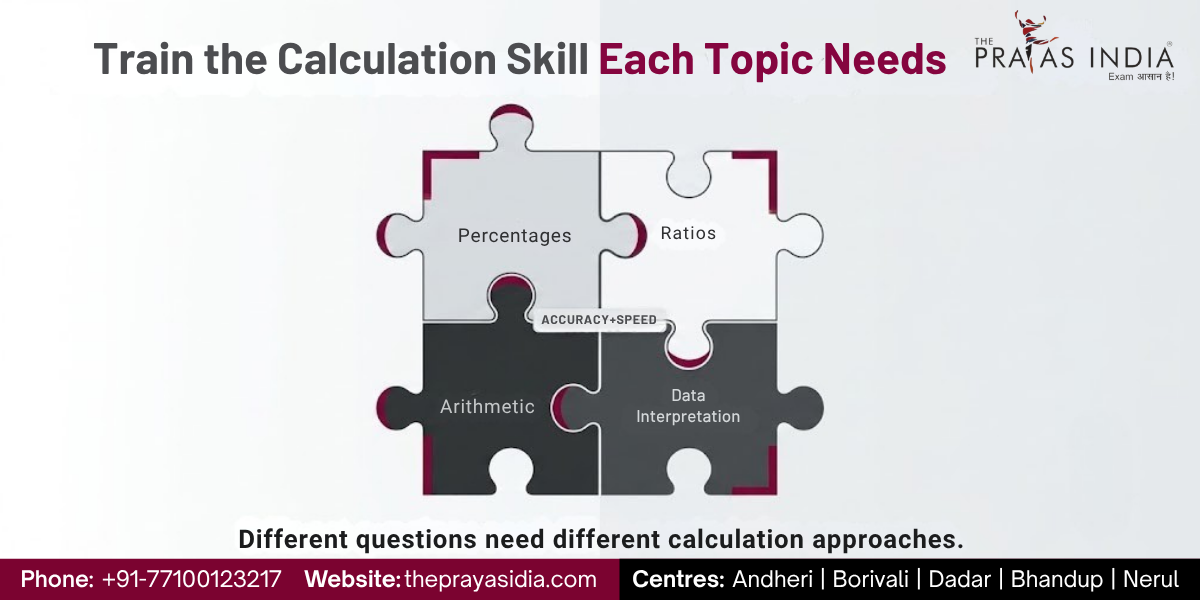
Different Quant topics create different types of calculation pressure. Your preparation should therefore not treat calculation practice as one uniform activity.
Percentage, Profit and Loss, Ratio and Proportion, Average, Simple and Compound Interest, Time and Work, Time-Speed-Distance and Data Interpretation may require different calculation approaches.
For example, percentage-heavy questions may benefit from fraction conversions, while Data Interpretation may require approximation and comparison. Ratio questions often become easier after simplification, while arithmetic questions may require a combination of calculation and conceptual understanding.
Track your accuracy topic-wise. If your overall Quant score appears acceptable but your errors consistently come from one topic, that topic deserves targeted practice.
Use Data From Mocks to Set Your Calculation Target
Your mock-test analysis should eventually produce measurable targets.
For example, instead of writing “I need to improve Quant,” identify a specific goal such as reducing calculation errors from six to three in the next few mocks. You can also track the average time you spend on calculation-heavy questions.
This creates a much more practical improvement cycle.
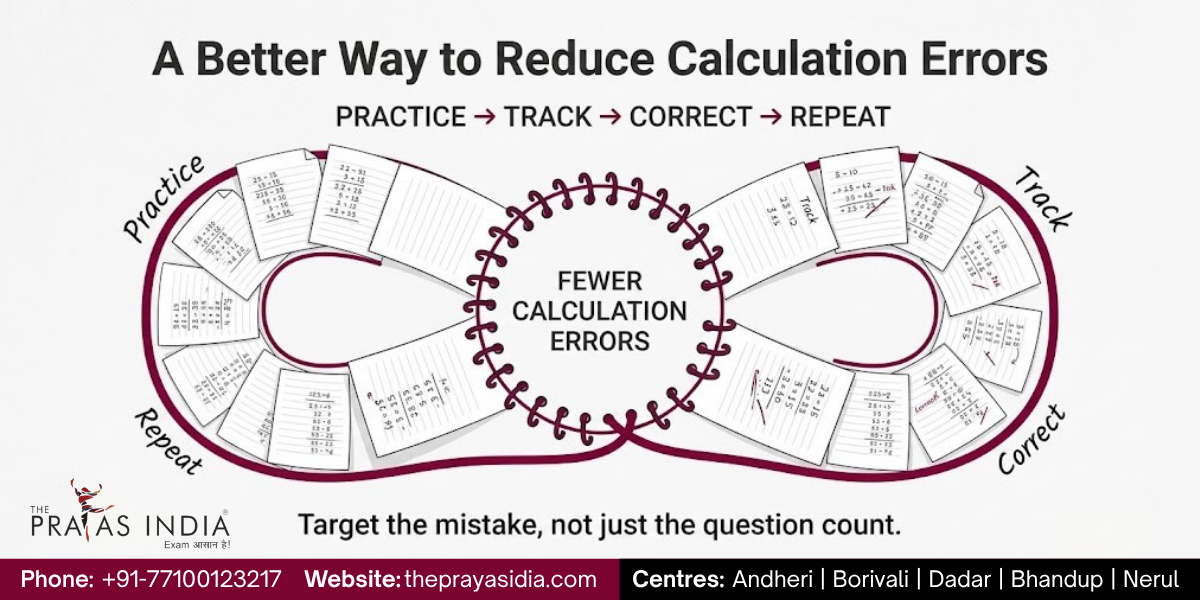
Attempt → Analyse → Identify Error → Practise → Re-test
The value of this process lies in repetition. If the same mistake appears in three consecutive mocks, it should become a priority rather than something you simply note and forget.
Know When to Skip a Calculation-Heavy Question
Calculation accuracy does not mean that you must solve every numerical question.
Question selection is an important part of SBI Clerk exam strategy. Some questions may involve lengthy calculations even though they are conceptually easy. If another question can be solved more efficiently, attempting the easier question first may be the smarter decision.
During mock tests, observe which questions consume disproportionate amounts of time. Build the ability to recognise them early.
A good Quant strategy is not:
“I must solve everything I see.”
It is:
“I must use my available time where it can produce the best score.”
Learn to Recognise Calculation Traps
Competitive-exam questions can sometimes contain numerical details that encourage careless calculation.
A candidate may see a familiar-looking percentage question and immediately apply a remembered formula without checking the exact wording. Another may calculate an increase when the question actually asks for a decrease. In Data Interpretation, a candidate may use the wrong row or column.
These are not purely arithmetic mistakes. They are attention mistakes that appear during calculation.
To reduce them, train yourself to pause briefly before starting a calculation and identify exactly what the question asks. A few seconds spent understanding the operation can save much more time later.
Improve Calculation Accuracy Through Repetition, Not Random Practice
Random practice has its place, but calculation improvement requires repetition of specific weak areas.
If your multiplication errors are frequent, practise multiplication deliberately. If percentages are creating problems, work through percentage conversions and percentage-based arithmetic. If decimal calculations are causing mistakes, practise them separately.
After several days, return to mixed questions and check whether the error rate has fallen.
This creates a targeted learning cycle rather than simply increasing the number of questions you solve.
Keep Your SBI Clerk Quant Practice Balanced
Calculation practice should support your overall Quant preparation, not replace conceptual learning.
A candidate who calculates quickly but does not understand Arithmetic concepts will still struggle. Similarly, someone with excellent conceptual knowledge but poor numerical execution may lose marks.
Your preparation should therefore combine:
- Conceptual understanding
- Calculation accuracy
- Calculation speed
- Question selection
- Timed practice
- Mock-test analysis
- Revision
This combination is more sustainable than focusing exclusively on speed.
Exam-Day Calculation Strategy for SBI Clerk
On the examination day, calculation accuracy should become part of your broader attempt strategy.
Do not begin the exam with the mindset that you have to solve every question. Start by identifying questions where the calculation and concept both look manageable. This allows you to build momentum without unnecessarily exposing yourself to lengthy calculations.
When a calculation becomes unexpectedly complicated, reassess the question. There may be a simpler approach, or the question may not be worth the time at that moment.
Keep your rough work controlled and readable. Avoid making unnecessary calculations. If the options allow a reliable approximation, use it. If exact calculation is necessary, take the extra moment required to perform the critical step correctly.
The goal is to finish the section with a strong combination of attempts and accuracy, rather than chasing the maximum possible number of attempts at the cost of avoidable errors.
A 30-Day Calculation Improvement Approach
A month of focused practice can be used to systematically improve calculation accuracy.
During the first week, concentrate on identifying your most frequent calculation mistakes. Build an error log and practise basic numerical relationships.
During the second week, introduce topic-wise calculation drills. Work specifically on percentages, ratios, arithmetic calculations and Data Interpretation depending on your weaknesses.
During the third week, increase timed practice. Use sectional tests and small calculation sets to improve speed while monitoring accuracy.
During the fourth week, integrate the skill into full-length mock tests. Analyse every calculation error and compare your performance with the first week.
The purpose of this approach is not to create a rigid schedule that every student must follow. It is to demonstrate how calculation practice can move from basic accuracy to exam-level execution.
How Bank Coaching Can Support SBI Clerk Quant Preparation
Self-study can certainly help an aspirant improve Quantitative Aptitude, but structured guidance can make the process more systematic.
At The Prayas India, SBI Clerk aspirants can work on Quant concepts, calculation techniques, practice questions, sectional tests and mock-test analysis within a structured preparation environment. Guidance can help students identify inefficient approaches and focus their practice on areas that are actually limiting their scores.
For aspirants looking for Bank Coaching in Mumbai, the objective should not simply be to attend classes. The preparation programme should help develop the complete exam skill set: concepts, calculations, speed, accuracy, question selection and test analysis.
A structured approach can be particularly useful for students who understand Quant concepts but continue to lose marks because of calculation errors.
Final Takeaway
Reducing calculation mistakes in SBI Clerk Quant is a gradual process. It does not happen because you suddenly discover one shortcut or solve hundreds of questions without analysis.
The improvement comes from understanding your errors, strengthening basic calculations, choosing efficient methods, practising under controlled pressure and repeatedly testing whether the same mistakes are returning.
Remember the core principle:
Accuracy creates reliability. Practice creates speed. Analysis creates improvement.
If you can combine all three, calculation-heavy Quant questions can become far more manageable during the SBI Clerk examination.
For aspirants targeting SBI Clerk and looking for structured Bank Coaching in Mumbai, the right preparation environment can help turn these skills into consistent exam performance.
Contact Us
- Call Now: +91-77100 13217
- Website: theprayasindia.com
- Centres: Andheri | Borivali | Dadar | Nerul | Bhandup
Frequently Asked Questions
1. Why do I make calculation mistakes even when I know the concept?
Calculation errors can happen because of rushing, weak numerical familiarity, poor rough work, incorrect transcription or using an inefficient method. Conceptual knowledge alone does not guarantee calculation accuracy.
2. How can I improve calculation speed for SBI Clerk Quant?
Begin with accuracy-focused practice and gradually introduce time limits. Practise common percentage-fraction conversions, multiplication, squares, approximation and other frequently used numerical operations.
3. Should I use calculation shortcuts in SBI Clerk?
Yes, but only when you understand and have practised the shortcut properly. A shortcut is useful when it improves efficiency without reducing accuracy.
4. How many calculation questions should I practise every day?
There is no universal number. Consistent, targeted practice is more useful than chasing a fixed question count. Focus on your error patterns and gradually increase difficulty and time pressure.
5. How can mock tests help reduce calculation mistakes?
Mock tests show how calculation accuracy behaves under actual time pressure. Analysing your mistakes can reveal whether the problem is arithmetic, question interpretation, time management or method selection.
6. Is mental calculation necessary for SBI Clerk?
Mental calculation can improve speed for simple operations, but not every calculation needs to be done mentally. Use mental methods where they are reliable and structured rough work for complicated calculations.
7. How important is approximation in SBI Clerk Quant?
Approximation can save time when the answer choices are sufficiently separated and the question permits it. However, excessive approximation can cause errors when options are very close.
8. Can calculation mistakes reduce my overall SBI Clerk score significantly?
Yes. Repeated calculation mistakes can directly reduce correct attempts and may also consume additional time when you revisit incorrect calculations.
9. How should I analyse Quant mistakes after a mock test?
Classify each error as conceptual, calculation-based, interpretation-related, time-related or careless. Then practise the specific weakness instead of simply solving another random set.
10. What is the best way to maintain a calculation error log?
Record the question type, exact mistake, reason for the mistake and the correct method. Review the log regularly and check whether the same error is appearing repeatedly.
11. Can an average student improve calculation speed?
Yes. Calculation speed is a trainable skill. Consistent practice, numerical familiarity and gradual timed practice can improve both speed and accuracy.
12. How can The Prayas India help with SBI Clerk Quant preparation?
The Prayas India provides structured bank-exam preparation with concept learning, practice, mock tests and performance analysis. This can help aspirants work systematically on Quantitative Aptitude, including calculation accuracy, speed and question selection.