How to Revise Effectively for Railway Exams | Best RRB Coaching in Mumbai | The Prayas India
Every year, thousands of Railway aspirants complete the syllabus for exams like RRB NTPC, Group D, ALP, Technician, and JE. They attend classes, solve practice questions, watch lectures, and prepare detailed notes.
Yet, when the actual examination arrives, many candidates realize they cannot recall formulas, reasoning tricks, current affairs, or important concepts as quickly as they expected.
Why does this happen?
The answer is simple.
Preparation teaches you concepts, but revision helps you remember them under exam pressure.
Railway examinations are highly competitive and time-bound. Questions must be solved accurately within limited time, leaving very little room for hesitation or forgotten concepts.
This is why successful candidates don’t just study hard—they revise strategically.
Imagine your Railway preparation as a train.
Studying lays the tracks.
Practice adds the engine.
But revision acts as the Railway Control Room, ensuring every section of your preparation stays on the right track and reaches the destination on time.
Without an efficient control system, even the fastest train can lose direction.
In this article, we’ll introduce the Railway Revision Control Room, a practical revision framework that helps Railway aspirants organize their preparation, monitor progress, improve memory retention, and maximize performance in exams like RRB NTPC, Group D, ALP, Technician, and JE.
Why Railway Exam Revision Is Different
Unlike many other competitive exams, Railway examinations require aspirants to answer a large number of questions accurately within a limited time.
Simply remembering concepts isn’t enough.
You must be able to:
- Recall formulas instantly.
- Solve calculations quickly.
- Recognize reasoning patterns immediately.
- Remember current affairs accurately.
- Avoid repeated mistakes under pressure.
This level of confidence develops only through continuous revision.
Think about a Railway Operations Control Room.
Train movements are monitored every minute.
Signals are checked regularly.
Routes are verified continuously.
Small issues are corrected before they become major problems.
Revision should work exactly the same way.
Instead of waiting until the last week before the exam, monitor your preparation every day.
The more frequently you check your preparation, the fewer surprises you’ll face on exam day.
Introducing the Railway Revision Control Room
Most aspirants treat revision as a separate activity.
Top performers treat it as a monitoring system.
Imagine entering a modern Railway Control Room.
Large digital panels display the status of every train.
Green signals indicate smooth movement.
Yellow signals require attention.
Red signals demand immediate action.
Now replace trains with your subjects.
Every topic in your preparation has its own status.
The Railway Revision Control Room consists of six operational panels:
Control Panel 1 – Route Mapping
Plan what needs revision and when.
Control Panel 2 – Topic Signals
Identify strong, moderate, and weak topics.
Control Panel 3 – Daily Tracking
Monitor revision consistency every day.
Control Panel 4 – Mock Test Monitoring
Use mock tests to evaluate preparation.
Control Panel 5 – Weak Zone Detection
Detect repeated mistakes before the exam.
Control Panel 6 – Final Departure
Complete focused revision before exam day.
Together, these six control panels keep your Railway preparation moving smoothly toward selection.
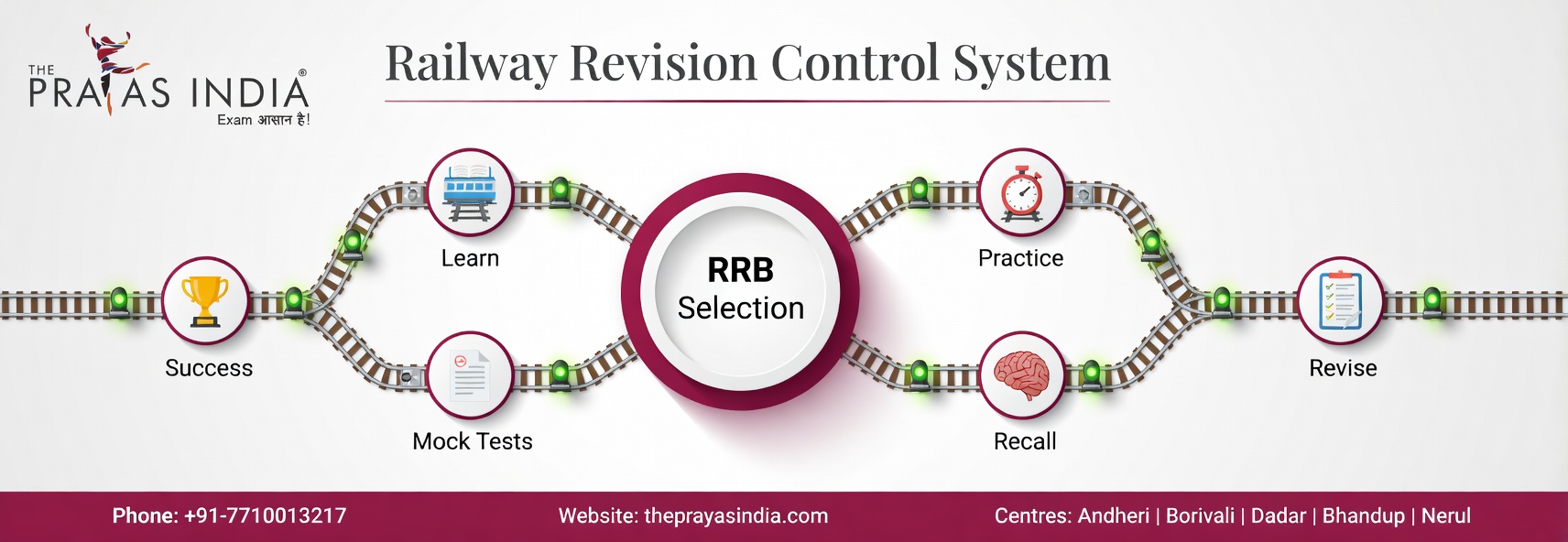
Control Panel 1: Map Your Revision Route
A train never begins its journey without a route.
Similarly, revision should never begin without a plan.
Many aspirants revise randomly.
One day they study Mathematics.
The next day they switch to Current Affairs.
Then they jump to Reasoning before revisiting English.
This lack of structure creates confusion and weakens memory.
Instead, create a revision route.
Divide your syllabus into manageable sections.
Assign specific revision days for each subject.
For example:
- Monday – Mathematics
- Tuesday – Reasoning
- Wednesday – General Awareness
- Thursday – Science
- Friday – Mixed Practice
- Saturday – Mock Test Review
- Sunday – Weak Topic Revision
A planned revision route keeps your preparation balanced and prevents important topics from being ignored.
Control Panel 2: Understand Your Topic Signals
Not every chapter requires the same level of attention.
Some topics are already strong.
Some require occasional revision.
Others need immediate improvement.
Classify every topic into three signal categories:
Green Signal
Topics you can solve confidently without referring to notes.
Examples:
- Percentage
- Profit & Loss
- Blood Relations
- Synonyms
Yellow Signal
Topics you understand but occasionally forget.
These require regular revision.
Red Signal
Topics where accuracy is low or concepts remain unclear.
These should become your highest priority.
The objective is simple:
Convert every red signal into yellow, and every yellow into green before exam day.
Control Panel 3: Track Your Revision Every Day
Railway operations never stop after one inspection.
Monitoring happens continuously.
Your revision should follow the same principle.
Maintain a simple daily revision tracker.
Record:
- Topics revised
- Practice questions solved
- Mock test score
- Weak areas identified
- Topics requiring another revision
You don’t need complicated software.
Even a notebook or spreadsheet can help you monitor your progress.
Consistency matters more than perfection.
When you can see your progress every day, motivation naturally increases.
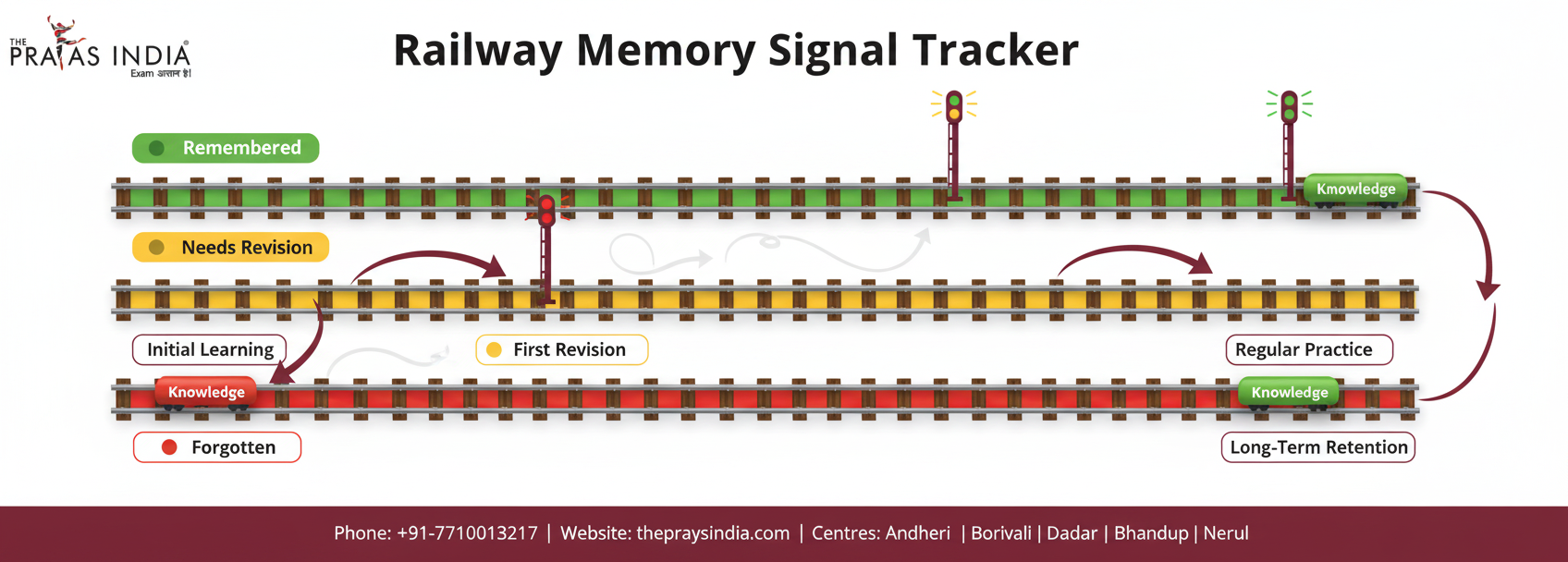
A Well-Monitored Preparation Leads to Better Results
Most Railway aspirants focus only on studying more.
Successful candidates focus on tracking what they remember.
The Railway Revision Control Room helps you move beyond random revision and build a structured system that keeps every subject under constant review.
Control Panel 4: Monitor Every Mock Test Like a Railway Operations Manager
Every train that enters a control room is monitored carefully.
Its speed, route, delays, and safety are analysed before it reaches its destination.
Mock tests should be treated the same way.
Many Railway aspirants attempt mock tests only to check their scores.
However, a mock test is much more than a scorecard—it is a performance report.
Instead of asking:
“How many marks did I score?”
Ask:
- Which section consumed the most time?
- Which questions were left unanswered?
- Which mistakes were repeated?
- Which topics require immediate revision?
- Which shortcuts worked well?
Each mock test reveals the exact areas that need attention.
The more carefully you analyse them, the smarter your revision becomes.
Build Your “Delay Report”
Railway control rooms immediately investigate delayed trains.
Similarly, identify topics that consistently slow you down.
Prepare a Delay Report Notebook.
Instead of writing complete notes again, record only:
Mathematics
- Frequently forgotten formulas
- Time-consuming calculations
- Repeated calculation mistakes
Reasoning
- Puzzle patterns causing confusion
- Incorrect logical assumptions
- Slow question types
General Awareness
- Current Affairs missed in mock tests
- Static GK facts you frequently forget
- Government schemes and important appointments
General Science
- Scientific facts requiring revision
- Biology diagrams or terminology
- Physics and Chemistry formulas
Review this notebook before every mock test.
You’ll gradually notice the number of repeated mistakes decreasing.
Control Panel 5: Detect Weak Zones Before They Affect Your Exam
In railway operations, engineers repair tracks before accidents happen.
Similarly, don’t wait until the last week to discover weak subjects.
Every week, identify your weakest areas.
Ask yourself:
- Which chapters have the lowest accuracy?
- Which questions take the longest?
- Which topics do I avoid revising?
- Which subject needs another practice session?
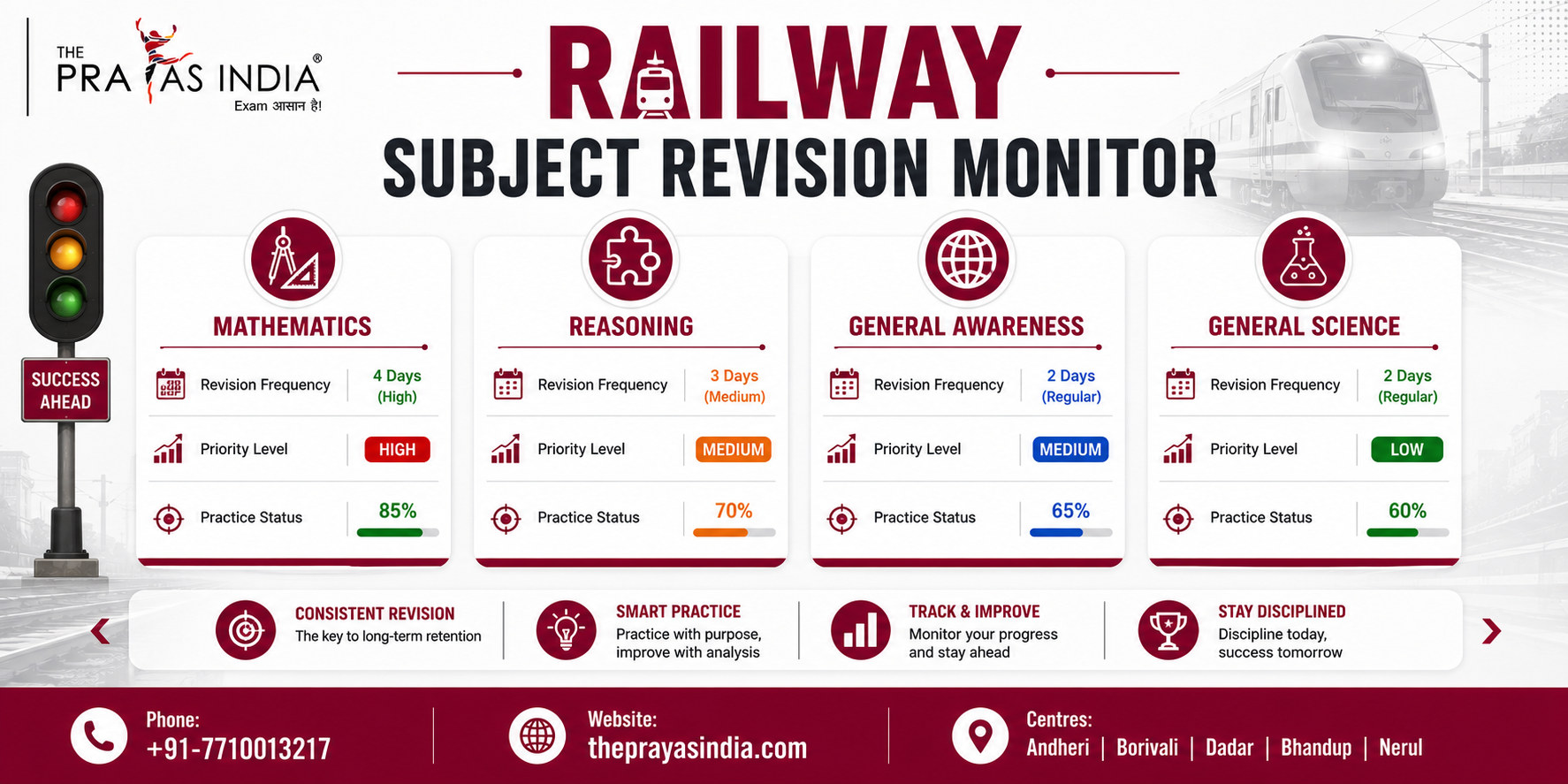
Create a simple priority system:
High Priority
Needs immediate revision.
Medium Priority
Requires additional practice.
Low Priority
Already strong. Maintain through short revision sessions.
This approach prevents weak areas from becoming major obstacles during the examination.
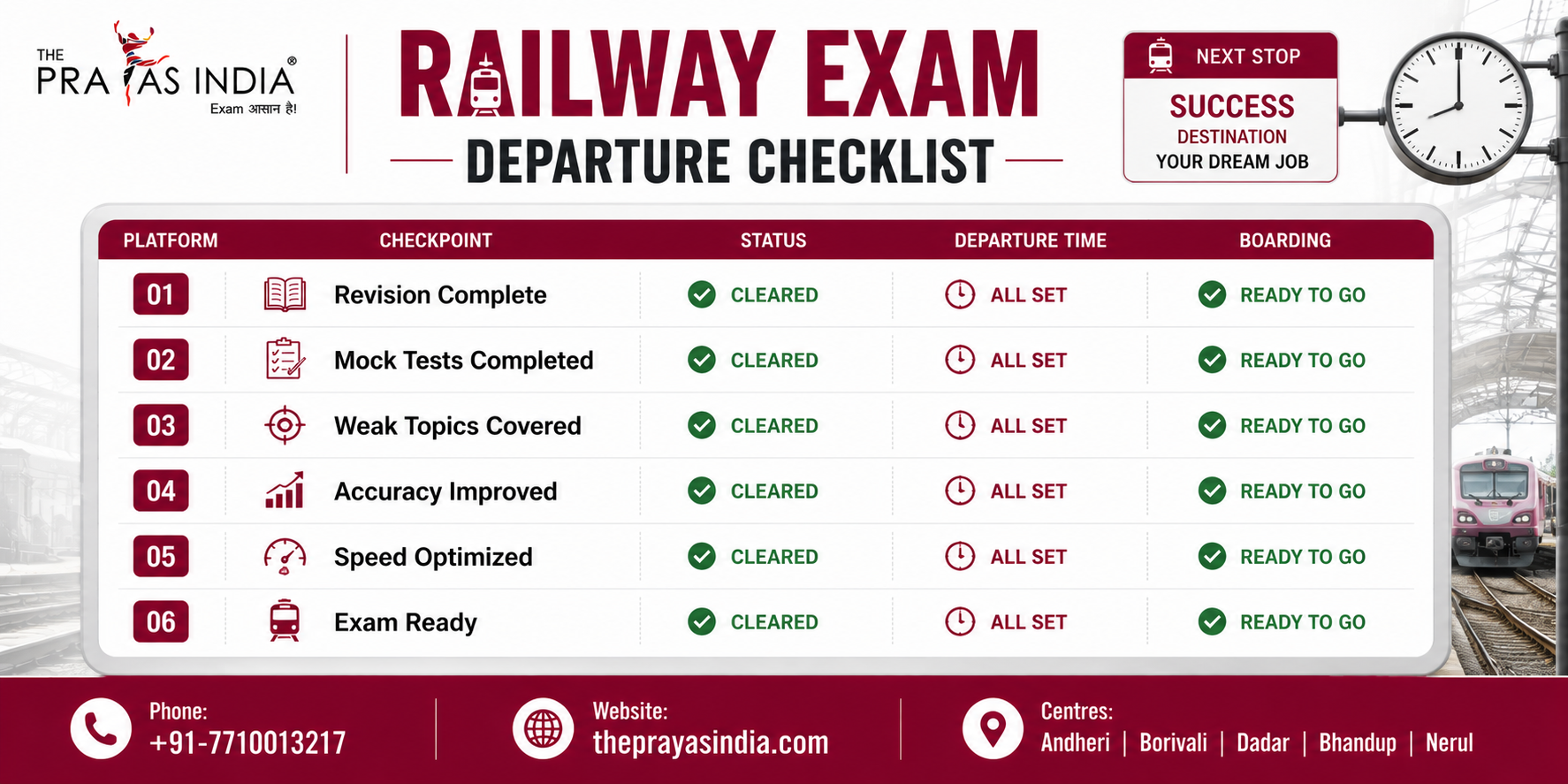
Control Panel 6: Prepare for the Final Departure
As exam day approaches, your revision strategy should become more focused.
This is not the time to begin entirely new chapters.
Instead, strengthen what you’ve already learned.
Your final revision should include:
- Formula notebook
- Shortcut tricks
- Current Affairs revision
- Static GK notes
- Previous mock test mistakes
- Frequently asked Railway questions
- Important reasoning patterns
Think of this stage as preparing a train for its final departure.
Every system is checked.
Every signal is verified.
Every route is confirmed.
When your preparation reaches this stage, you’ll enter the examination hall with confidence rather than uncertainty.
Subject-Wise Revision Strategy for Railway Exams
Different Railway subjects require different revision methods.
Using one revision style for every subject is rarely effective.
Mathematics
Revise:
- Formula sheets
- Speed calculation techniques
- Percentage, Ratio, Profit & Loss, SI-CI
- Algebra and Geometry basics
Daily timed practice is essential.
General Intelligence & Reasoning
Focus on:
- Pattern recognition
- Puzzle revision
- Coding-Decoding
- Syllogism
- Seating Arrangement
- Blood Relations
Instead of reading solutions repeatedly, solve fresh questions using learned techniques.
General Awareness
Prepare concise revision notes covering:
- Current Affairs
- Indian Polity
- History
- Geography
- Economy
- Sports
- Awards
- Important Days
Short daily revision sessions are more effective than lengthy reading.
General Science
General Science requires conceptual clarity.
Revise:
- Biology diagrams
- Physics formulas
- Chemistry reactions
- Everyday science concepts
Use one-page summary sheets for faster recall.
Why The Prayas India Helps Railway Aspirants Revise More Effectively
A good revision strategy becomes even more powerful when supported by experienced mentors and a structured preparation system.
At The Prayas India, revision is integrated into the learning journey from the very first class. Students preparing for RRB NTPC, Group D, ALP, Technician, JE, and other Railway recruitment exams receive continuous guidance to ensure concepts remain fresh throughout their preparation.
Our Railway programs are designed to help aspirants revise smarter through:
Structured Revision Plans
Topic-wise revision schedules ensure every subject is revisited at the right time, reducing the chances of forgetting important concepts.
Regular CBT-Based Mock Tests
Practice through Computer-Based Test (CBT) pattern mock exams helps students improve speed, accuracy, and exam confidence.
Performance Analysis
Every mock test is followed by detailed analysis to identify strengths, weak areas, and repeated mistakes, making revision more focused.
Experienced Faculty
Our mentors simplify difficult topics, teach practical shortcuts, and help students understand the most important concepts for Railway exams.
Personalized Mentorship
Every aspirant receives guidance based on their preparation level, ensuring consistent improvement throughout the revision journey.
If you’re searching for the Best RRB Coaching in Mumbai, choose an institute that combines quality teaching with a structured revision system, regular mock tests, and expert mentorship.
📞 Phone: +91-7710013217
🌐 Website: theprayasindia.com
📍 Andheri | Borivali | Dadar | Nerul | Bhandup
Smart Monitoring Creates Stronger Revision
Effective revision is not about reading more books—it’s about knowing exactly what to revise, when to revise it, and why it needs attention.
When you monitor your preparation like a Railway Control Room, every revision session becomes purposeful, every mock test becomes a learning opportunity, and every weak topic gradually turns into a strength.
Common Revision Mistakes Railway Aspirants Should Avoid
Even the best study plan can fail if revision is not done correctly. Many Railway aspirants put in months of hard work but lose marks because they follow ineffective revision habits during the final stages of preparation.
Avoid these common mistakes to make your revision more productive.
1. Revising Without a Clear Priority
Many candidates spend equal time on every topic.
However, not every chapter has the same importance or requires the same amount of revision.
Instead:
- Revise weak topics more frequently.
- Maintain strong topics with quick revisions.
- Focus on high-weightage chapters before the exam.
A priority-based approach saves time and improves overall performance.
2. Ignoring Mock Test Analysis
Attempting mock tests without reviewing them is like driving a train without checking the control panel.
After every CBT mock test:
- Review incorrect answers.
- Analyse time spent per section.
- Identify recurring mistakes.
- Revise related concepts immediately.
The real improvement comes from analysis—not simply attempting more tests.
3. Revising Too Many Resources
Many aspirants revise:
- Multiple books
- Numerous PDFs
- Several YouTube notes
- Different coaching materials
This creates confusion instead of confidence.
Stick to one trusted set of study material and revise it multiple times.
Consistency always beats variety.
4. Neglecting General Awareness
General Awareness is often postponed until the last week.
This increases pressure and reduces retention.
Instead:
- Revise Current Affairs daily.
- Review Static GK weekly.
- Maintain concise revision notes for important facts.
Small daily revisions produce better long-term memory.
5. Avoiding Difficult Topics
It’s natural to revise favourite subjects repeatedly.
However, difficult chapters deserve more attention.
Challenge yourself by revisiting:
- Weak Mathematics chapters
- Difficult Reasoning puzzles
- General Science concepts
- Frequently forgotten Current Affairs
Improvement happens outside your comfort zone.
6. Studying Without Breaks
Long revision sessions often reduce concentration.
Instead, use focused study blocks followed by short breaks.
This helps maintain energy, improves retention, and reduces mental fatigue.
Your 21-Day Railway Revision Plan
The final three weeks before the examination are crucial.
Instead of studying randomly, follow a structured revision cycle.
Week 1 – Strengthen the Foundation
Focus on:
- Mathematics formulas
- Reasoning concepts
- General Science basics
- Current Affairs revision
Attempt one or two full-length CBT mock tests and analyse every mistake.
Week 2 – Improve Speed and Accuracy
This week should focus on:
- Timed sectional tests
- Shortcut techniques
- Mixed practice sets
- Weak topic revision
- Error notebook review
Continue analysing every mock test carefully.
Week 3 – Final Exam Readiness
Avoid learning completely new topics.
Instead:
- Revise formula sheets.
- Review Current Affairs notes.
- Solve previous year Railway questions.
- Revise shortcut tricks.
- Read your error notebook.
- Stay calm and confident.
The objective is to strengthen what you already know.
Why Choose The Prayas India for Railway Exam Preparation?
Success in Railway recruitment exams depends on much more than completing the syllabus. It requires disciplined revision, regular CBT practice, expert guidance, and a preparation strategy that keeps improving until exam day.
At The Prayas India, Railway preparation is designed around continuous learning and systematic revision so that students retain concepts, improve accuracy, and build confidence throughout their journey.
Students preparing for RRB NTPC, Group D, ALP, Technician, JE, and other Railway recruitment examinations receive:
- Experienced faculty with competitive exam expertise
- Structured classroom and online learning programs
- Comprehensive study material
- Topic-wise revision schedules
- Regular CBT-based mock tests
- Detailed performance analysis
- Doubt-solving sessions
- Personalized mentorship and preparation guidance
Whether you are starting your preparation or looking to improve your score through smarter revision, our expert mentors help you stay focused on the right strategy.
Conclusion
Railway exams reward candidates who can recall concepts quickly, manage time efficiently, and maintain accuracy throughout the examination.
Revision is the bridge that connects preparation with performance.
Remember the Railway Revision Control Room:
Route Mapping → Topic Signals → Daily Tracking → Mock Test Monitoring → Weak Zone Detection → Final Departure
Each stage strengthens your preparation and reduces the chances of forgetting important concepts on exam day.
Whether you’re preparing for RRB NTPC, Group D, ALP, Technician, or JE, consistent revision, disciplined mock test analysis, and a structured approach can dramatically improve your chances of selection.
If you’re looking for the Best RRB Coaching in Mumbai, choose an institute that supports you beyond classroom teaching.
At The Prayas India, we combine expert mentorship, structured revision plans, CBT-based mock tests, and personalized guidance to help Railway aspirants prepare with confidence.
Start revising smartly today—because every focused revision session brings you one step closer to your Railway career.
Frequently Asked Questions (FAQs)
1. How often should I revise for Railway exams?
Daily short revisions combined with weekly revision cycles and regular mock test analysis provide the best results.
2. Which Railway subjects require the most revision?
Mathematics, Reasoning, General Awareness, and General Science all require regular revision, but your weaker subjects should receive additional attention.
3. Should I attempt mock tests before completing the syllabus?
Yes. Mock tests help identify weak areas early and make your revision more focused and effective.
4. How important is an error notebook?
An error notebook helps you track repeated mistakes and prevents you from making the same errors in future mock tests and the final exam.
5. Is it useful to revise multiple books?
No. Revising one reliable resource multiple times is usually more effective than reading many different books once.
6. How can I improve speed in Railway CBT exams?
Practice timed question sets, analyse mock tests, revise shortcut methods, and strengthen frequently tested concepts.
7. Why is revision important for Railway recruitment exams?
Revision improves memory retention, increases confidence, reduces mistakes, and helps candidates perform efficiently under time pressure.
8. Why choose The Prayas India for Railway exam preparation?
The Prayas India provides expert faculty, structured revision plans, CBT-based mock tests, detailed performance analysis, and personalized mentorship for Railway aspirants.
9. Which Railway exams can I prepare for at The Prayas India?
Students can prepare for RRB NTPC, Group D, ALP, Technician, JE, and other Railway recruitment examinations through our classroom and online programs.
Final Takeaway
Think of your preparation as a train and your revision as the control room that keeps it running on the right track. Every mock test you analyse, every mistake you correct, and every concept you revise brings you closer to your destination.
With consistent effort, a structured revision plan, and expert guidance from The Prayas India, you can approach your Railway examination with confidence, clarity, and the preparation needed to achieve success.