How to Revise Effectively for SSC Exams | Best SSC Coaching in Mumbai | The Prayas India
Most SSC aspirants believe that completing the syllabus is the hardest part of preparation.
In reality, remembering what you’ve studied is often a much bigger challenge.
Have you ever revised a chapter and felt completely confident, only to forget important formulas or concepts a week later?
If yes, you’re not alone.
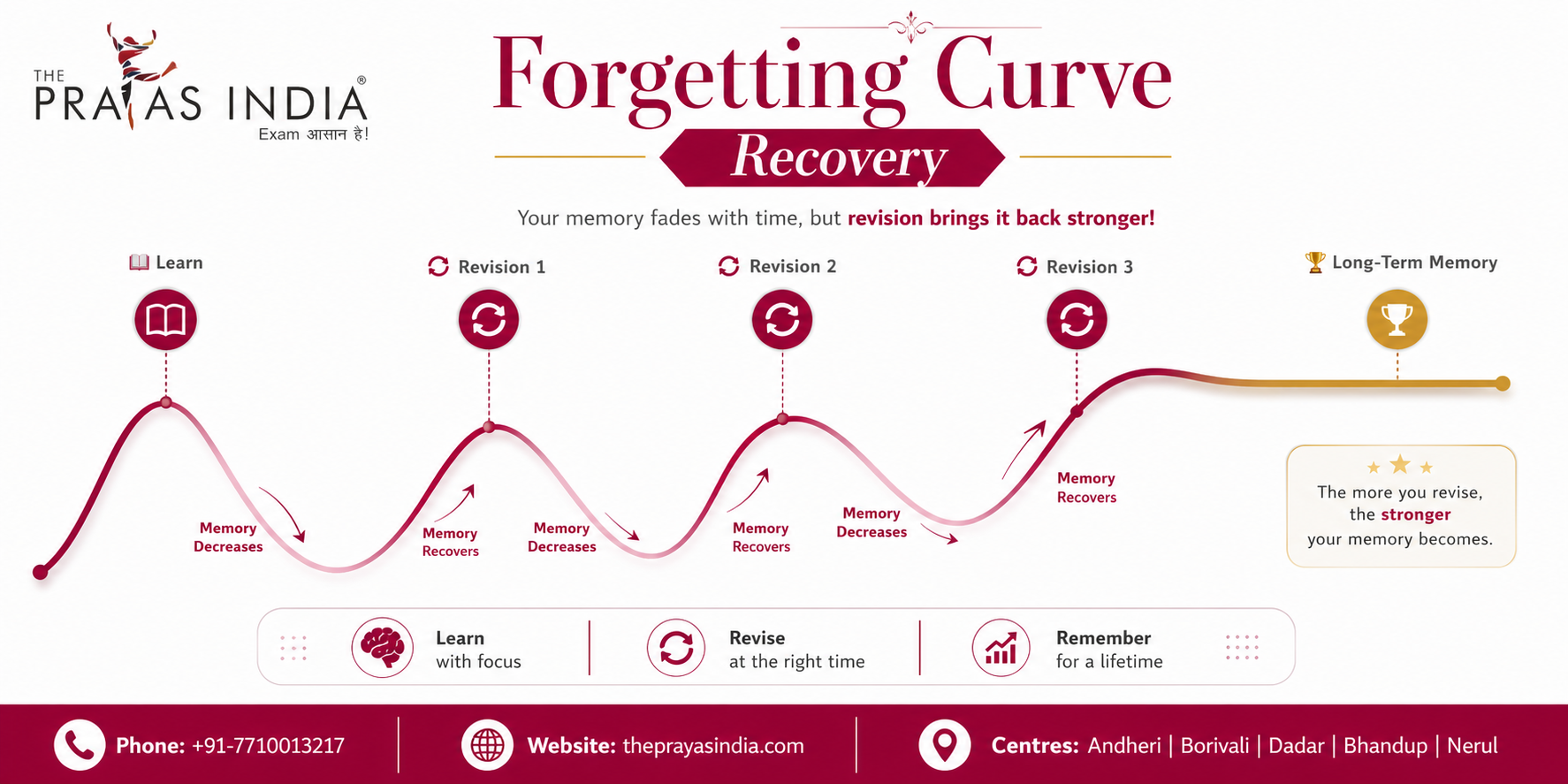
The human brain naturally forgets information unless it is revisited at the right time.
This is exactly why many hardworking candidates fail to convert months of preparation into high scores during the SSC examination.
The difference between an average aspirant and a top performer is rarely the number of books they study.
It is how effectively they revise those books.
Revision is not simply reading your notes again.
It is a structured process of strengthening memory, improving recall, correcting mistakes, and building confidence before the exam.
Whether you’re preparing for SSC CGL, CHSL, CPO, MTS, GD, JE, or any other SSC examination, developing a systematic revision strategy can dramatically improve your performance.
In this article, you’ll learn a practical revision system called the SSC Revision Engine, understand subject-wise revision techniques, discover common revision mistakes, and see how expert mentorship at The Prayas India, one of the Best SSC Coaching institutes in Mumbai, helps aspirants revise smarter and perform better.
Why Revision Decides SSC Success
Think of your preparation as filling a water tank.
Every chapter you study adds more water.
But if the tank has small leaks, the water slowly disappears.
Memory works in exactly the same way.
Without proper revision, even the best preparation gradually fades.
This is why students often say:
“I studied this chapter last month, but I can’t remember anything today.”
The problem isn’t intelligence.
The problem is the absence of a revision system.
Revision performs four important functions:
- It strengthens long-term memory.
- It improves speed during the exam.
- It reduces silly mistakes.
- It builds confidence under pressure.
Every successful SSC aspirant understands one simple truth:
Preparation introduces knowledge. Revision protects it.
Introducing the SSC Revision Engine
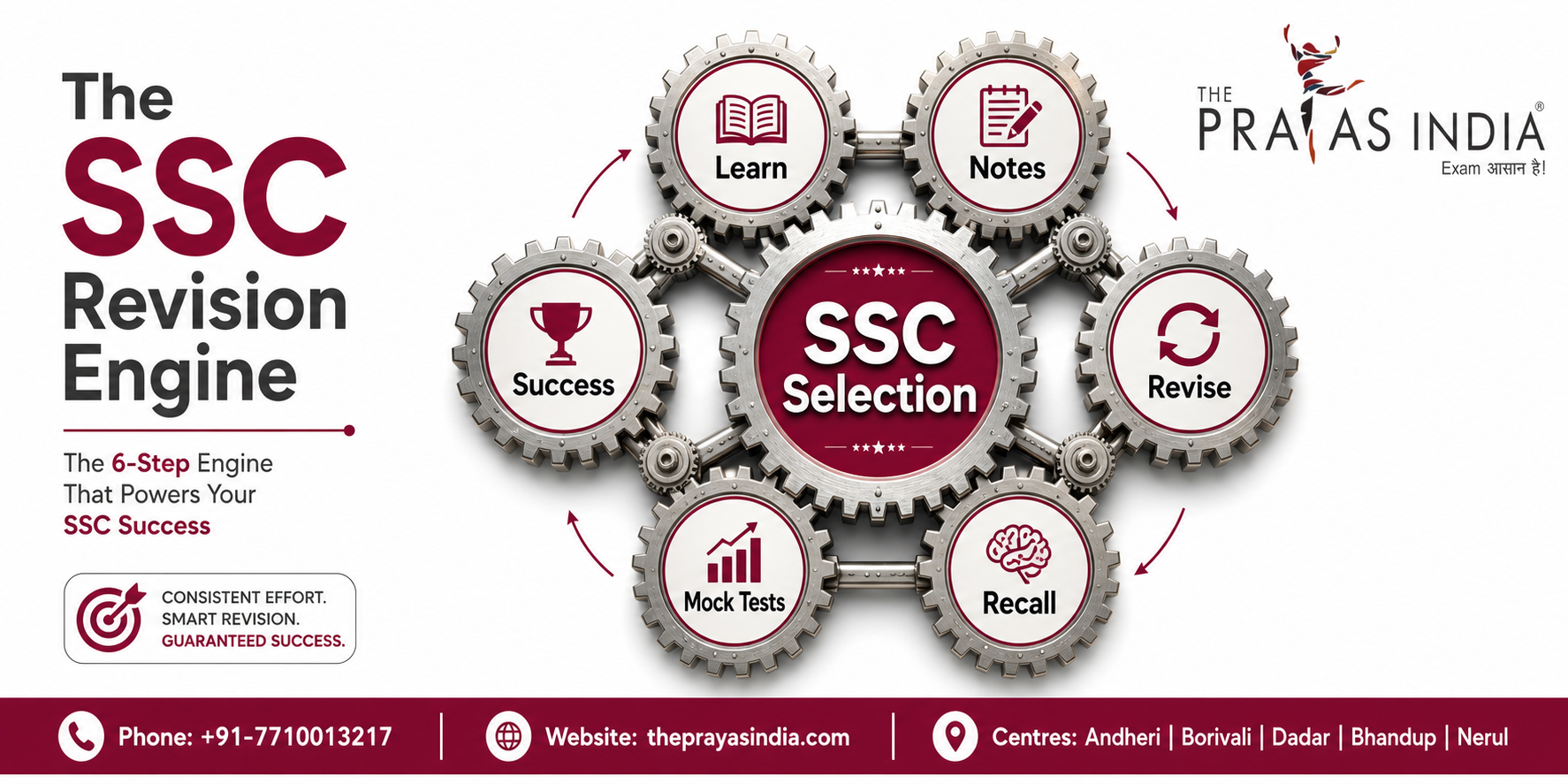
Instead of treating revision as an activity you perform only before the examination, imagine it as a continuously running engine.
Every stage powers the next one.
When one part of the engine stops, the entire preparation begins losing momentum.
The SSC Revision Engine consists of six connected stages:
Stage 1 – Collect
Study concepts and gather quality learning resources.
Stage 2 – Organize
Prepare concise notes, formula sheets, vocabulary lists, and shortcut tricks.
Stage 3 – First Revision
Strengthen recently learned topics before forgetting begins.
Stage 4 – Active Recall
Test yourself without looking at notes.
Stage 5 – Mock Test Revision
Identify mistakes through mock tests and revise weak areas.
Stage 6 – Rapid Revision
Prepare concise final revisions before the examination.
Instead of revising randomly, this engine keeps your preparation moving continuously until exam day.
Stage 1: Collect Smartly, Not Excessively
One of the biggest mistakes SSC aspirants make is collecting too many study resources.
One book recommends another.
One YouTube video suggests five more channels.
One PDF leads to ten additional downloads.
Soon, preparation becomes a collection exercise rather than a learning process.
Successful revision starts with selective learning.
Choose trusted resources and commit to completing them thoroughly.
Quality always beats quantity.
For example:
- One reliable Quant book revised three times is better than four books revised once.
- One vocabulary notebook remembered completely is more valuable than dozens of scattered word lists.
During this stage, your objective is simple:
Collect only what you truly intend to revise.
Stage 2: Organize Information Like an Examiner
The second stage focuses on making information easy to retrieve.
Imagine entering your examination hall with hundreds of disconnected facts in your mind.
Finding the right information quickly becomes difficult.
Instead, organize everything logically.
Create:
- Formula sheets for Quantitative Aptitude.
- Shortcut notes for Reasoning.
- Vocabulary lists for English.
- One-page Current Affairs summaries.
- Error notebooks for mock test mistakes.
When information is organized well, revision becomes significantly faster.
Think of your notes as a personal search engine.
The easier they are to navigate, the easier it becomes to remember concepts during the examination.
Stage 3: The First Revision Is the Most Powerful
Most students delay revision until they finish an entire subject.
Unfortunately, by then, much of the information has already faded.
The first revision should happen soon after learning.
Its purpose is not to memorize everything perfectly.
Its purpose is to strengthen neural connections before forgetting begins.
During the first revision:
- Focus on understanding rather than speed.
- Highlight recurring mistakes.
- Mark confusing concepts.
- Add practical examples to your notes.
- Rewrite only important points—not entire chapters.
This stage creates the foundation for long-term memory.
Students who revise early usually require much less effort during the final weeks before the SSC examination.
Revision Is a Habit, Not an Event
Many aspirants treat revision as the final step before the examination.
Top performers treat it as a daily habit.
The earlier you build an effective revision system, the less pressure you’ll feel during the final weeks before the SSC exam.
In the next part, we’ll explore how Active Recall, mock-test-based revision, and subject-wise revision strategies can help you retain information faster, improve accuracy, and maximize your SSC exam score.
Stage 4: Use Active Recall Instead of Passive Reading
Many SSC aspirants believe they are revising simply because they are reading their notes repeatedly.
Unfortunately, passive reading creates an illusion of learning. Everything looks familiar while you’re reading, but during the exam, recalling the same information becomes difficult.
A better approach is Active Recall.
Instead of asking, “Have I read this topic?”, ask yourself:
“Can I explain this topic without looking at my notes?”
This simple shift trains your brain to retrieve information rather than merely recognize it.
For example:
- Close your Quant formula notebook and write down formulas from memory.
- Read five English vocabulary words and try using them in sentences without checking the meanings.
- Solve a Reasoning puzzle without looking at previous solutions.
- Recall Current Affairs from the last seven days before opening your notes.
Every successful recall strengthens memory.
Every unsuccessful recall tells you exactly what needs revision.
That is why Active Recall is one of the most effective revision techniques for competitive exams.
Build a “Question Mindset”
Revision should not feel like reading a textbook.
It should feel like answering questions.
Whenever you complete a chapter, challenge yourself with questions such as:
- What are the important formulas?
- Which shortcuts save the most time?
- Which questions usually confuse me?
- Can I solve this without hints?
- Which concepts should I revise tomorrow?
The brain remembers information better when it is forced to search for answers.
Stage 5: Let Mock Tests Guide Your Revision
Many students complete a mock test, check their score, and immediately move on to the next one.
This is one of the biggest mistakes in SSC preparation.
The real learning begins after the mock test.
Think of every mock test as a diagnostic report.
Instead of focusing only on marks, analyse:
- Which section took the most time?
- Which mistakes were repeated?
- Which topics need another revision?
- Which shortcuts worked well?
- Which questions should have been skipped?
A mock test should not end when the timer stops.
It should end only after you understand why every mistake happened.
Create an Error Notebook
One habit that separates top performers from average aspirants is maintaining an Error Notebook.
Instead of writing everything again, record only the mistakes that you don’t want to repeat.
Your notebook can include:
Quantitative Aptitude
- Frequently forgotten formulas
- Calculation shortcuts
- Common mistakes
Reasoning
- Puzzle-solving approaches
- Frequently confused patterns
- Time-consuming question types
English
- Grammar errors
- Vocabulary mistakes
- Reading comprehension observations
General Awareness
- Important dates
- Static GK facts
- Current Affairs updates
As the exam approaches, this notebook becomes your most valuable revision resource.
Stage 6: Master Rapid Revision Before the Exam
The final stage of the SSC Revision Engine is Rapid Revision.
At this point, you should avoid learning completely new topics.
Instead, focus on reinforcing what you’ve already prepared.
Rapid revision should include:
- Formula sheets
- Vocabulary notebook
- Important grammar rules
- Current Affairs summaries
- Previous mock test mistakes
- Frequently asked SSC concepts
Your objective is not to increase your syllabus.
Your objective is to increase your confidence.
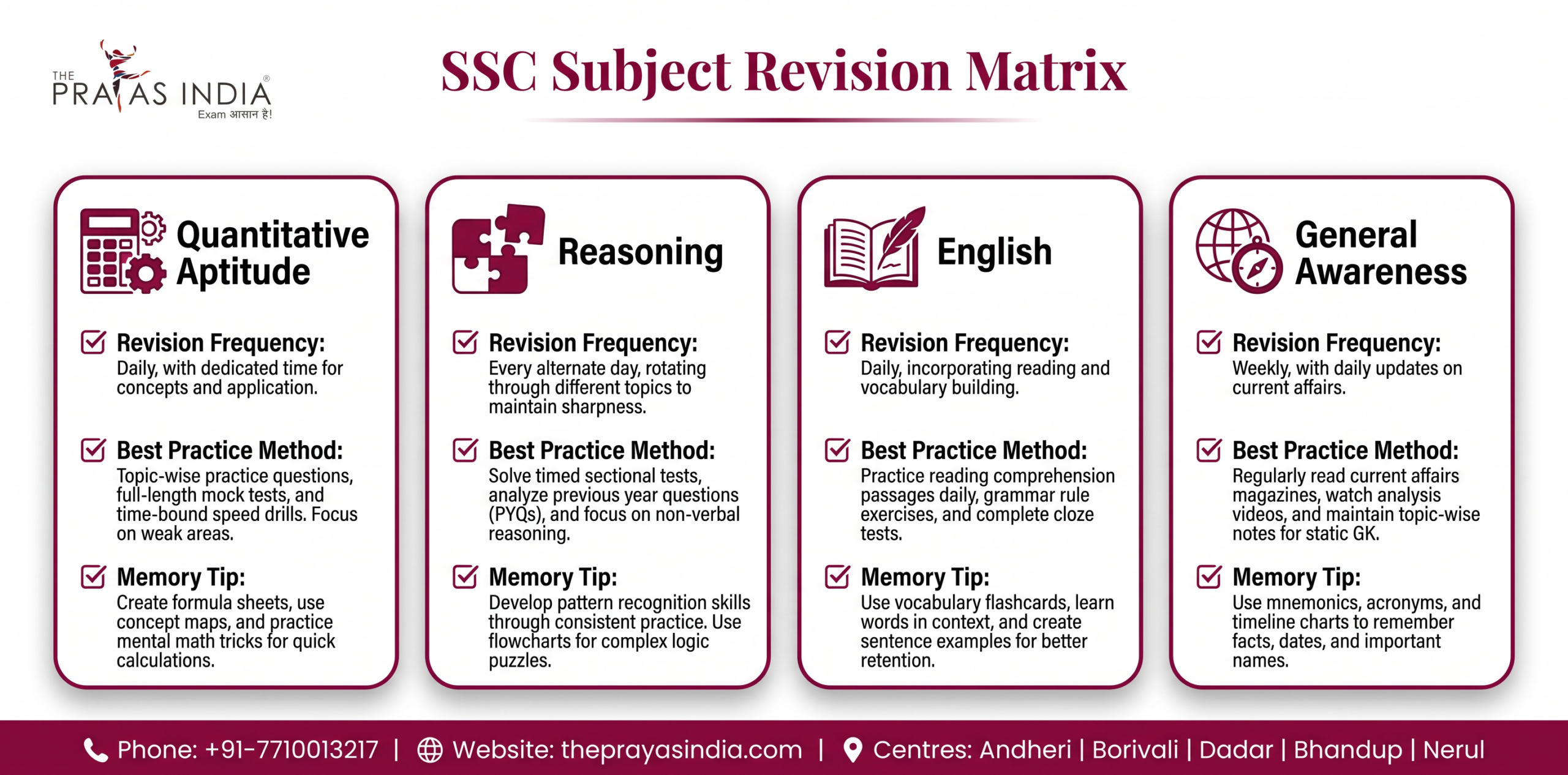
Subject-Wise Revision Strategy for SSC Exams
Every SSC subject requires a different revision approach.
Using the same revision method for every subject often leads to inefficient preparation.
Quantitative Aptitude
Revision should focus on:
- Formula recall
- Speed calculations
- Shortcut techniques
- Timed practice
Daily problem-solving is more effective than reading theory repeatedly.
General Intelligence & Reasoning
Reasoning improves through continuous exposure.
Revise by:
- Solving mixed question sets
- Practicing different puzzle types
- Reviewing shortcut methods
- Identifying recurring patterns
The more variety you solve, the faster your brain recognizes question patterns.
English Language
English revision should become a daily habit.
Focus on:
- Vocabulary revision
- Grammar rules
- Error detection practice
- Reading comprehension
Even 20–30 minutes of daily English revision creates long-term improvement.
General Awareness
General Awareness cannot be revised effectively from hundreds of pages.
Prepare:
- Monthly current affairs notes
- One-page revision sheets
- Static GK flash notes
- Important government schemes
- Awards, sports, economy, science, and international events
Frequent short revisions work much better than occasional long sessions.
Why The Prayas India Helps Students Revise Smarter
Revision becomes far more effective when it is guided by a structured preparation system.
At The Prayas India, revision is not treated as an activity reserved for the final weeks before the examination. It is integrated into the learning process from the very beginning.
Students preparing for SSC CGL, CHSL, CPO, MTS, GD, Stenographer, and other SSC examinations benefit from a systematic approach that emphasizes regular revision alongside concept building.
Our revision-focused preparation includes:
Structured Revision Plans
Students follow organized revision schedules that help them revisit important topics at the right intervals instead of revising randomly.
Regular Sectional & Full-Length Mock Tests
Frequent mock tests help students evaluate their preparation, identify weak areas, and improve exam temperament.
Detailed Performance Analysis
Every mock test is followed by detailed feedback, allowing students to understand mistakes and revise more effectively.
Expert Faculty Support
Experienced mentors simplify difficult concepts, provide practical shortcuts, and ensure students remain focused on high-scoring areas.
Personalized Mentorship
Individual guidance helps aspirants maintain consistency, overcome weak areas, and build confidence throughout their preparation journey.
Students looking for the Best SSC Coaching in Mumbai often seek more than classroom teaching—they look for a learning environment where revision becomes systematic, measurable, and result-oriented.
With centres in Andheri, Borivali, Dadar, Bhandup, and Nerul, The Prayas India supports thousands of SSC aspirants through classroom programs, expert mentorship, and structured preparation strategies.
📞 Phone: +91-7710013217
🌐 Website: theprayasindia.com
📍 Andheri | Borivali | Dadar | Nerul | Bhandup
Good Revision Doesn’t Just Improve Memory—It Improves Performance
By the time you reach the final month of your SSC preparation, revision should no longer feel like a burden. It should become an automatic habit supported by organized notes, active recall, mock test analysis, and continuous improvement.
In the final part, we’ll discuss the most common revision mistakes SSC aspirants make, a practical 30-Day Revision Checklist, frequently asked questions, and a conclusion that will help you convert your preparation into exam-day success.
Common Revision Mistakes That Cost SSC Aspirants Marks
Many SSC candidates study sincerely for months but fail to achieve the expected score because of ineffective revision habits.
Revision should increase confidence—not create confusion.
Let’s look at the mistakes you should avoid.
1. Revising Everything at the Last Moment
Trying to revise the entire syllabus during the final week creates unnecessary pressure.
Instead, divide revision into multiple cycles throughout your preparation.
Small and frequent revision sessions are always more effective than one long revision marathon.
2. Reading Without Testing Yourself
Simply reading notes repeatedly may create familiarity, but it doesn’t guarantee retention.
After every revision session, close your notebook and ask yourself:
- Can I recall the important formulas?
- Can I explain this concept?
- Can I solve similar questions without looking at the solution?
If the answer is “No,” another revision is needed.
3. Ignoring Weak Areas
Many students repeatedly revise topics they already know because it feels comfortable.
However, real improvement happens when you spend time on chapters that challenge you.
Maintain a separate list of weak topics and revisit them regularly until they become strengths.
4. Forgetting Previous Mock Test Mistakes
Every mock test contains valuable lessons.
If you continue making the same mistakes in multiple tests, your revision strategy needs improvement.
Always revise:
- Incorrect answers
- Time-consuming questions
- Guesswork attempts
- Frequently repeated errors
Learning from mistakes is one of the fastest ways to improve your SSC score.
5. Neglecting General Awareness Revision
General Awareness is one of the highest-scoring sections in many SSC examinations, yet many aspirants postpone its revision.
Instead of reading bulky notes repeatedly:
- Revise monthly current affairs.
- Prepare one-page static GK sheets.
- Use short revision notes for important facts.
Consistency matters more than volume.
6. Studying Without a Revision Calendar
Revision becomes inconsistent when there is no plan.
Prepare a weekly revision calendar that clearly defines:
- Which subjects to revise.
- Which mock tests to analyse.
- Which weak topics require additional practice.
- Which formulas or vocabulary need daily revision.
A planned revision schedule reduces stress and improves discipline.
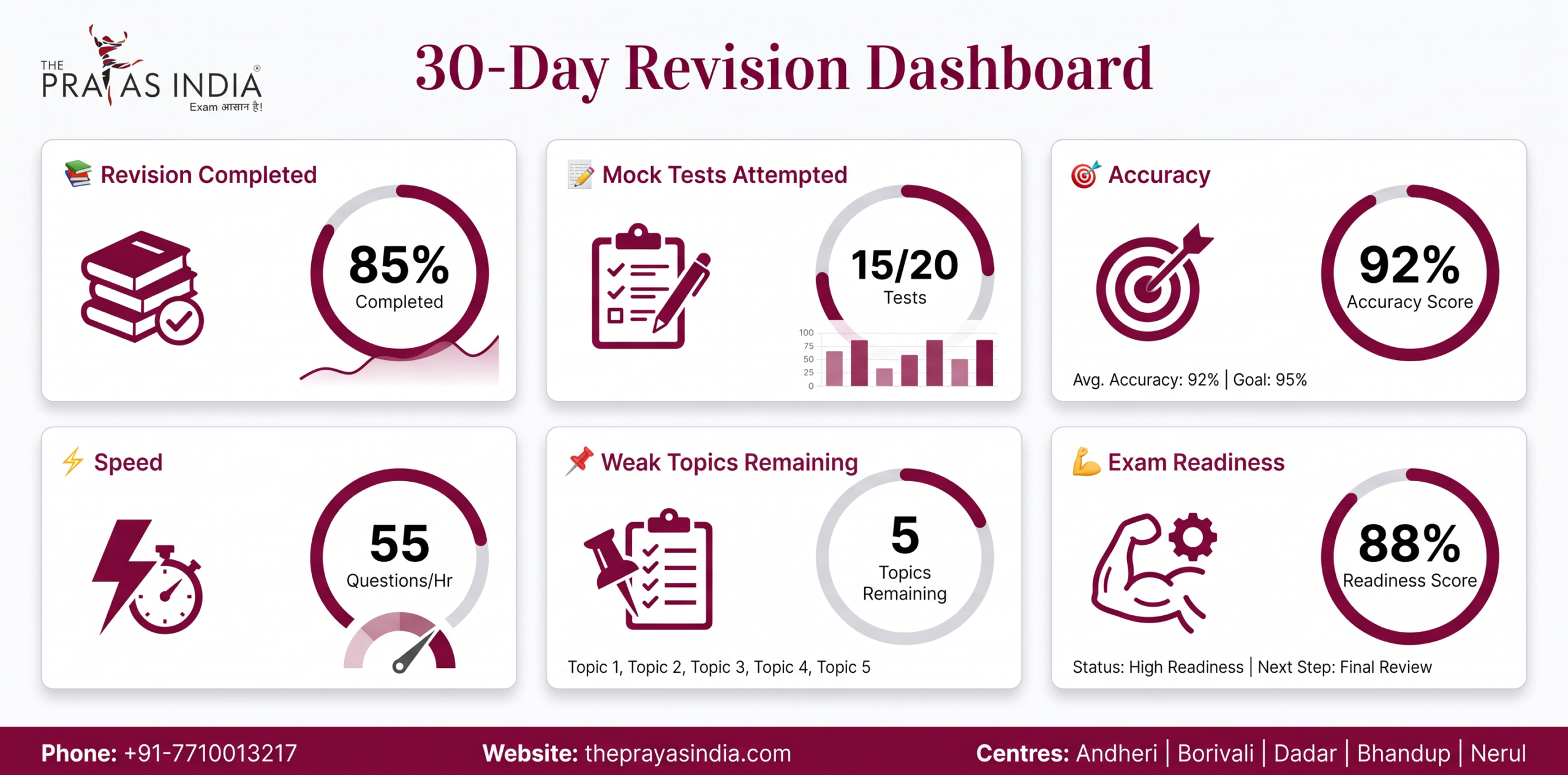
Your 30-Day SSC Revision Checklist
Use this checklist during the final month before your examination.
Ask yourself every week:
✅ Have I revised every major subject at least once?
✅ Did I practice Quant formulas daily?
✅ Did I revise English vocabulary and grammar rules?
✅ Did I revise Current Affairs and Static GK?
✅ Did I analyse every mock test thoroughly?
✅ Have I reduced repeated mistakes?
✅ Am I improving my speed without losing accuracy?
✅ Did I complete my revision according to schedule?
If most of these answers are “Yes,” you are moving toward exam readiness with confidence.
Why Choose The Prayas India for SSC Preparation?
Preparing for SSC exams is not just about covering the syllabus—it’s about retaining what you’ve learned and applying it confidently in the examination.
At The Prayas India, revision is built into the learning process so that students continuously strengthen their concepts instead of relying on last-minute preparation.
Our SSC preparation programs include:
- Expert faculty with years of competitive exam teaching experience
- Structured classroom and online learning programs
- Comprehensive study material
- Daily practice sessions
- Regular sectional and full-length mock tests
- Detailed performance analysis
- Doubt-solving sessions
- Personalized mentorship and revision guidance
Students preparing for SSC CGL, CHSL, CPO, MTS, GD, Stenographer, JE, and other SSC examinations benefit from a systematic approach that combines concept learning with continuous revision.
If you are searching for the Best SSC Coaching in Mumbai, choose an institute that helps you build knowledge, retain it effectively, and perform confidently in the examination.
Visit Our Centres
📍 Andheri | Borivali | Dadar | Nerul | Bhandup
📞 Phone: +91-7710013217
🌐 Website: theprayasindia.com
Conclusion
Revision is not the final chapter of SSC preparation—it is the thread that connects every chapter you’ve studied.
The students who perform well in SSC examinations are not necessarily those who study the most.
They are the ones who revise systematically, learn from their mistakes, analyse mock tests carefully, and strengthen their memory through consistent practice.
Whether you’re preparing for SSC CGL, CHSL, CPO, MTS, GD, or any other SSC exam, an organized revision strategy can make a significant difference in your final score.
Remember the SSC Revision Engine:
Learn → Organize → Revise → Recall → Mock Test → Success
Keep this engine running throughout your preparation journey, and you’ll enter the examination hall with greater confidence and clarity.
If you’re looking for the Best SSC Coaching in Mumbai, The Prayas India provides the expert guidance, structured revision plans, mock test practice, and personalized mentorship needed to help you achieve your SSC goals.
Start revising smartly today—because every successful revision session brings you one step closer to your dream government job.
Frequently Asked Questions (FAQs)
1. How often should I revise for SSC exams?
Revision should be a continuous process. Short daily revisions combined with weekly and monthly revision cycles help improve long-term retention.
2. What is the best revision strategy for SSC CGL?
An effective strategy includes concise notes, Active Recall, regular mock tests, error analysis, and subject-wise revision planning.
3. Should I revise from multiple books?
No. It's better to revise a few trusted resources multiple times than to read many books only once.
4. How important are mock tests in revision?
Mock tests help identify weak areas, improve time management, increase accuracy, and make revision more focused.
5. How can I remember Quant formulas for a long time?
Prepare a dedicated formula notebook, revise it regularly, and apply the formulas through daily practice questions.
6. How should I revise General Awareness?
Use monthly current affairs notes, one-page revision sheets, and regular short revision sessions instead of lengthy reading.
7. Why is Active Recall effective for SSC preparation?
Active Recall forces your brain to retrieve information from memory, improving retention much more effectively than passive reading.
8. What makes The Prayas India a good choice for SSC preparation?
The Prayas India offers expert faculty, structured revision plans, comprehensive study material, regular mock tests, performance analysis, and personalized mentorship for SSC aspirants.
9. Which SSC exams can I prepare for at The Prayas India?
Students can prepare for SSC CGL, CHSL, CPO, MTS, GD, Stenographer, JE, and other major SSC examinations.
Final Takeaway
Every chapter you study adds to your knowledge, but every revision session strengthens your ability to recall that knowledge when it matters most. A smart revision system is the bridge between preparation and selection.
Build the habit of revising consistently, analysing your mistakes, and improving a little every day. Combined with expert guidance, quality mock tests, and disciplined practice, your revision strategy can become your biggest advantage in the SSC examination.
Study well. Revise smarter. Succeed confidently.