How to Score High in IBPS PO Prelims | Best IBPS PO Coaching in Mumbai | The Prayas India
The First Round Doesn’t Select You—But It Can Eliminate You.
Every year, thousands of ambitious graduates register for the IBPS Probationary Officer (PO) examination with the dream of building a stable and prestigious banking career. The opportunity is attractive—a respected position, career progression, financial security, and the chance to work in one of India’s leading public sector banks.
Yet, before candidates can think about interviews or final merit lists, they must first clear a hurdle that appears simple on paper but proves highly competitive in reality.
The IBPS PO Preliminary Examination.
Many aspirants underestimate this stage.
“It’s only qualifying.”
“I’ll focus more on the Mains.”
“I just need to clear the cut-off.”
These assumptions sound harmless.
In reality, they become the reason why many talented candidates never reach the next stage.
The Preliminary examination is not designed merely to test what you know.
It evaluates how efficiently you can apply your knowledge under strict time constraints.
Every minute matters.
Every decision matters.
Every question attempted—or skipped—can influence the final outcome.
The students who consistently clear Prelims are not necessarily the ones who study the longest.
They are usually the ones who prepare with greater clarity.
That difference forms the foundation of this article.
Looking Beyond the Cut-Off
Ask any successful banking aspirant about the biggest lesson they learned during preparation, and you’ll hear something interesting.
Very few will say,
“I needed another book.”
Most will say,
“I wish I had understood the examination earlier.”
That statement deserves attention.
Many students begin preparation by collecting resources.
Books.
PDFs.
Telegram notes.
Mock tests.
Online playlists.
What they rarely collect is clarity.
Without understanding the nature of the examination, preparation quickly becomes a cycle of solving random questions without measurable improvement.
IBPS PO Prelims rewards a different approach.
It rewards students who understand the examination before attempting to conquer it.
A Test of Decisions More Than Knowledge
Imagine two candidates entering the examination hall.
Both have completed the syllabus.
Both have solved hundreds of practice questions.
Both feel reasonably confident.
Thirty minutes into the examination, however, their approaches begin to differ.
The first candidate tries to solve almost every question.
The second candidate spends the first few seconds evaluating which questions deserve attention.
One is answering questions.
The other is managing the examination.
That difference often determines the final score.
IBPS PO Prelims is not simply a test of aptitude.
It is equally a test of judgment.
Knowing what to attempt, when to skip, and how to manage limited time becomes just as important as understanding the concepts themselves.
Three Sections. One Common Challenge
The examination consists of three major areas.
- English Language
- Quantitative Aptitude
- Reasoning Ability
Students usually identify one section as their favourite and another as their weakness.
While this is perfectly natural, relying entirely on one strong subject rarely produces excellent results.
Balanced preparation almost always outperforms uneven preparation.
For example:
A candidate scoring exceptionally well in Reasoning but performing poorly in English may still struggle if sectional cut-offs become a deciding factor.
Success therefore comes from building consistent competence, not isolated excellence.
Preparation Insight
Think of IBPS PO Prelims as managing a financial portfolio.
Putting all your investment into one asset increases risk.
Balancing your investment creates stability.
The same principle applies to preparation.
Why Some Aspirants Improve Rapidly
Every coaching batch has students who seem to progress much faster than others.
They aren’t necessarily more intelligent.
Instead, they prepare differently.
They ask practical questions.
Instead of asking,
“How many chapters should I complete?”
they ask,
“Which mistakes reduced my score this week?”
Instead of measuring study hours,
they measure improvement.
Instead of chasing new resources,
they master existing ones.
This shift from activity to productivity creates remarkable progress.
The Invisible Problem Nobody Talks About
Most aspirants believe they know why they’re losing marks.
Surprisingly, they’re often wrong.
Many students think:
“My Mathematics is weak.”
After detailed analysis, they discover the actual problem was poor time management.
Others believe:
“My English vocabulary is insufficient.”
Yet mock analysis reveals they lose marks because they rush through Reading Comprehension passages.
Sometimes the obstacle isn’t knowledge.
It’s behaviour.
Preparation becomes much more effective once students identify the real reason behind their performance.
Small Mistakes Become Large Score Differences
Competitive examinations are unforgiving.
Missing one easy question may not seem significant.
Repeating the same mistake twenty times across several mock tests certainly is.
Common examples include:
- Reading questions too quickly.
- Spending excessive time on difficult problems.
- Guessing answers under pressure.
- Ignoring sectional timing.
- Avoiding regular revision.
- Practising without reviewing mistakes.
Individually these appear small.
Collectively they separate successful candidates from unsuccessful ones.
The Value of Structured Guidance
Every aspirant studies independently.
Self-study remains the foundation of competitive exam preparation.
However, there comes a point where independent effort benefits from structured direction.
Experienced mentors often identify preparation gaps that students cannot easily recognise themselves.
They help candidates understand:
- Which topics deserve priority.
- Where unnecessary effort is being invested.
- Which mistakes keep repeating.
- How to improve weekly performance.
- How to approach mock tests strategically.
This guidance saves time.
More importantly, it prevents students from developing ineffective study habits.
Where Preparation Begins to Feel Different
Students preparing in a structured environment often notice a gradual shift.
Preparation no longer feels uncertain.
Instead of asking,
“What should I study today?”
they begin asking,
“How can I score five more marks this week?”
This change is powerful.
Progress becomes measurable.
Confidence becomes evidence-based.
Every mock test becomes a learning opportunity rather than merely another score.
At The Prayas India, aspirants preparing for banking examinations are encouraged to follow this performance-oriented approach. Rather than simply completing topics, students prepare through structured planning, expert faculty, comprehensive study material, regular mock tests, doubt-solving support, and continuous evaluation. The emphasis remains on helping every aspirant improve steadily instead of relying on last-minute preparation.
Key Takeaways
- IBPS PO Prelims is a speed-and-decision examination.
- Preparation should focus on performance, not just syllabus completion.
- Balanced improvement across all three sections matters.
- Analysing mistakes is more valuable than solving endless questions.
- Structured guidance reduces confusion and accelerates progress.
- Consistency produces stronger results than irregular long study sessions.
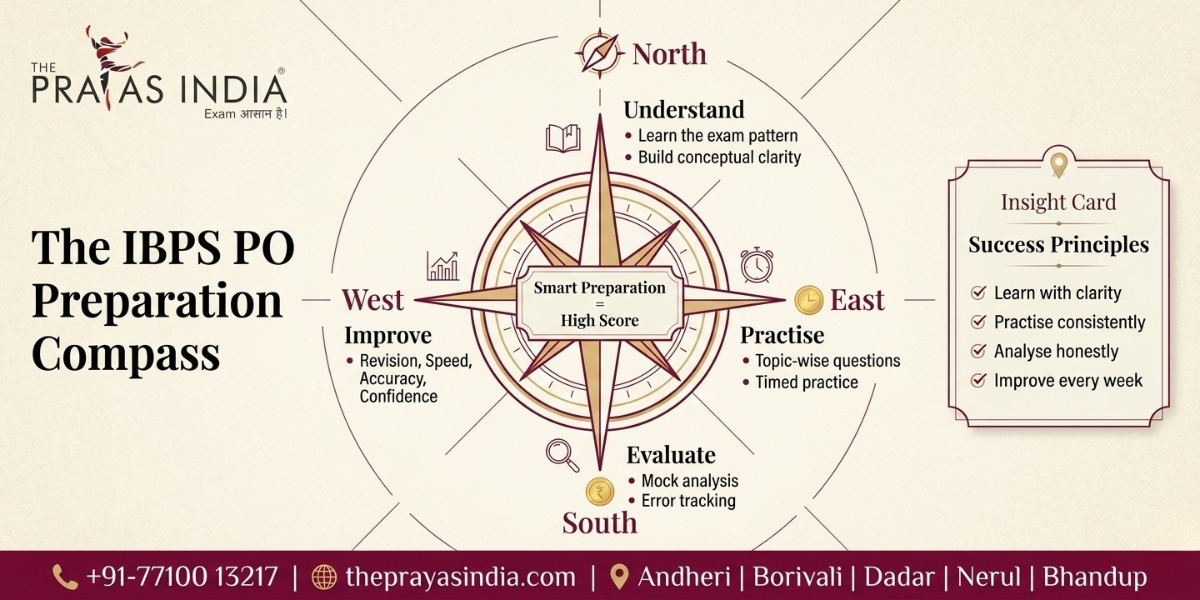
Winning One Section at a Time
High Scores Are Built Through Small, Repeatable Decisions.
Once you understand how the IBPS PO Preliminary examination works, the next challenge is turning that understanding into marks.
Many aspirants believe that increasing study hours automatically increases scores.
It doesn’t.
The students who consistently clear IBPS PO Prelims don’t necessarily study more—they study with greater precision. They know where to invest their time, what to revise, when to move on from a difficult question, and how to balance all three sections without allowing one to dominate the entire preparation.
Think of the Preliminary examination like managing a bank.
Every minute is an investment.
Every question is a transaction.
Your objective is to maximise returns before time runs out.
Let’s understand how successful aspirants approach each section.
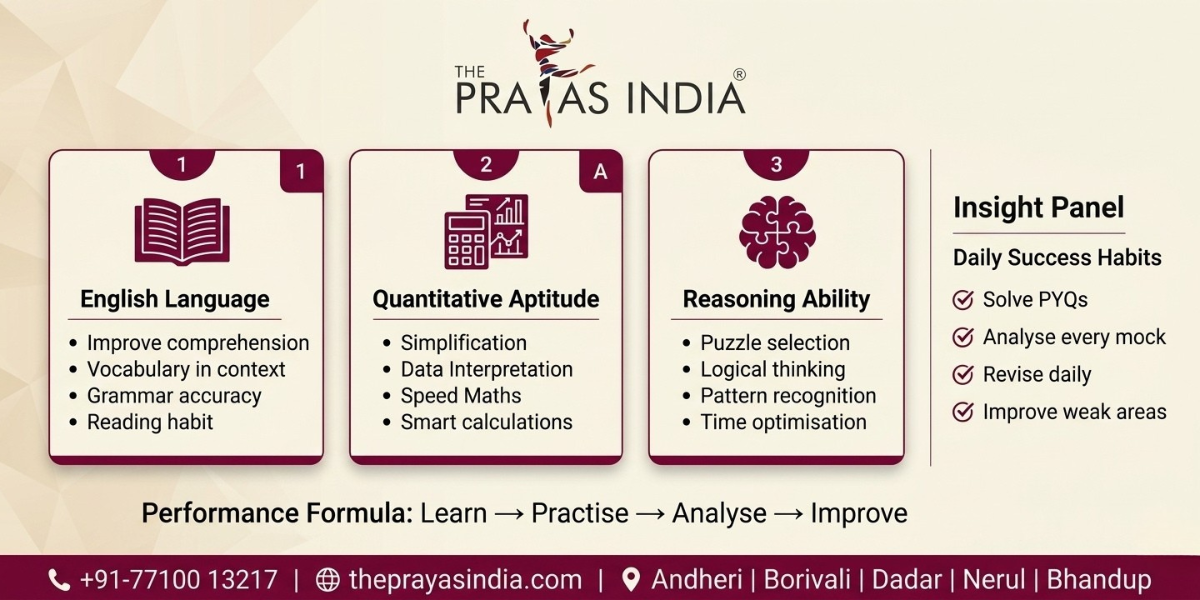
English Language: Read Less, Understand More
For many students, English appears unpredictable.
Some days Reading Comprehension feels easy.
On other days, even simple questions become confusing.
The reason is that English is rarely about memorising grammar rules alone.
It is about processing information quickly.
Strong English performers develop three habits.
First, they read every day.
Not because reading itself is part of the syllabus, but because regular reading improves comprehension speed.
Second, they improve vocabulary naturally by learning words in context rather than memorising endless word lists.
Third, they understand grammar concepts instead of depending entirely on shortcuts.
Focus Areas
- Reading Comprehension
- Cloze Test
- Error Detection
- Sentence Improvement
- Para Jumbles
- Fill in the Blanks
- Word Usage
Instead of treating these as separate topics, look for the common skill they require—careful reading.
Quick Strategy
Spend a few minutes every day reading:
- Editorials
- Business news
- Banking articles
- Government policy updates
This habit strengthens both comprehension and vocabulary simultaneously.
Quantitative Aptitude: Think Before You Calculate
Mathematics often becomes the deciding factor in IBPS PO Prelims.
Not because it is impossible.
Because many students spend unnecessary time solving questions they should have skipped.
Successful aspirants understand one important rule.
Every question deserves attention.
Not every question deserves equal time.
The examination rewards smart decision-making.
Before solving a lengthy calculation, ask yourself:
“Can I solve this efficiently?”
If not, move ahead.
Returning later is better than getting trapped early.
Priority Topics
- Simplification
- Approximation
- Number Series
- Quadratic Equations
- Data Interpretation
- Percentage
- Profit & Loss
- Ratio & Proportion
- Time & Work
- Simple & Compound Interest
These chapters frequently contribute a significant portion of the paper.
Mastering them creates a strong scoring foundation.
Common Calculation Mistakes
Many candidates lose marks because they:
- Ignore approximation techniques.
- Skip basic calculation practice.
- Depend completely on calculators during preparation.
- Forget frequently used percentage values.
Mental calculations should gradually become part of your daily routine.
Reasoning Ability: The Fastest Route to Marks
Among the three sections, Reasoning often offers the highest scoring opportunity.
However, it also creates the biggest trap.
Students become overconfident.
They attempt every puzzle immediately.
As a result, they lose valuable minutes.
Experienced aspirants approach Reasoning differently.
They first identify questions that can be solved quickly.
Only after completing those do they move towards lengthy puzzles.
This simple adjustment often improves both attempts and accuracy.
Important Chapters
- Puzzles
- Seating Arrangement
- Inequality
- Syllogism
- Coding-Decoding
- Blood Relations
- Direction Sense
- Order & Ranking
- Alphanumeric Series
- Logical Reasoning
Each chapter develops a different thinking skill.
Balanced practice remains essential.
The Puzzle Rule
If a puzzle feels unusually lengthy after the first reading,
leave it.
Solve easier questions first.
Return later with a calmer mind.
This prevents unnecessary time loss.
Previous Year Questions: Your Competitive Advantage
Every banking examination evolves.
Yet certain concepts continue appearing because they effectively measure aptitude.
Previous Year Questions help students identify these recurring patterns.
Instead of treating them as old papers, treat them as preparation guides.
Notice:
- Frequently repeated question formats.
- Difficulty level.
- Topic importance.
- Time-consuming question types.
Students who regularly analyse Previous Year Questions often recognise patterns much faster during the actual examination.
Mock Tests Should Build Strategy, Not Ego
Scoring well in one mock test feels encouraging.
Scoring poorly feels disappointing.
Neither emotion should control your preparation.
Mock tests exist for one purpose:
To improve performance.
The score itself tells only part of the story.
The analysis tells everything else.
Ask These Questions After Every Mock
Did I lose marks because I lacked concepts?
↓
Did I lose marks because I rushed?
↓
Which questions consumed unnecessary time?
↓
Which section deserves more attention this week?
↓
What should I improve before the next mock?
Every answer becomes an action point.
Managing Sectional Time
One common mistake among IBPS PO aspirants is spending too much time trying to perfect one section.
Remember,
the Preliminary examination is sectional.
Every section deserves respect.
A practical strategy is:
Beginning
Build confidence with familiar questions.
Middle
Handle moderate-level questions carefully.
End
Attempt only those difficult questions where success appears reasonably likely.
This prevents unnecessary negative marking while improving overall efficiency.
Quality Practice Always Wins
Imagine two aspirants.
The first solves 400 questions every day without reviewing mistakes.
The second solves 180 carefully selected questions and spends an additional hour analysing every incorrect answer.
After two months,
the second candidate usually demonstrates greater improvement.
Because learning happens during analysis.
Not repetition alone.
The Role of Expert Guidance
As preparation progresses, many aspirants discover that identifying their own weaknesses becomes increasingly difficult.
This is where structured guidance creates measurable value.
At The Prayas India, students preparing for IBPS PO examinations follow a systematic preparation model designed around continuous improvement. Experienced faculty simplify difficult concepts, comprehensive study material ensures complete coverage of important topics, regular mock tests recreate the examination environment, and dedicated doubt-solving sessions help students overcome conceptual barriers before they become long-term weaknesses.
Rather than encouraging students to simply complete chapters, the emphasis remains on improving weekly performance, strengthening decision-making, and building confidence through structured preparation.
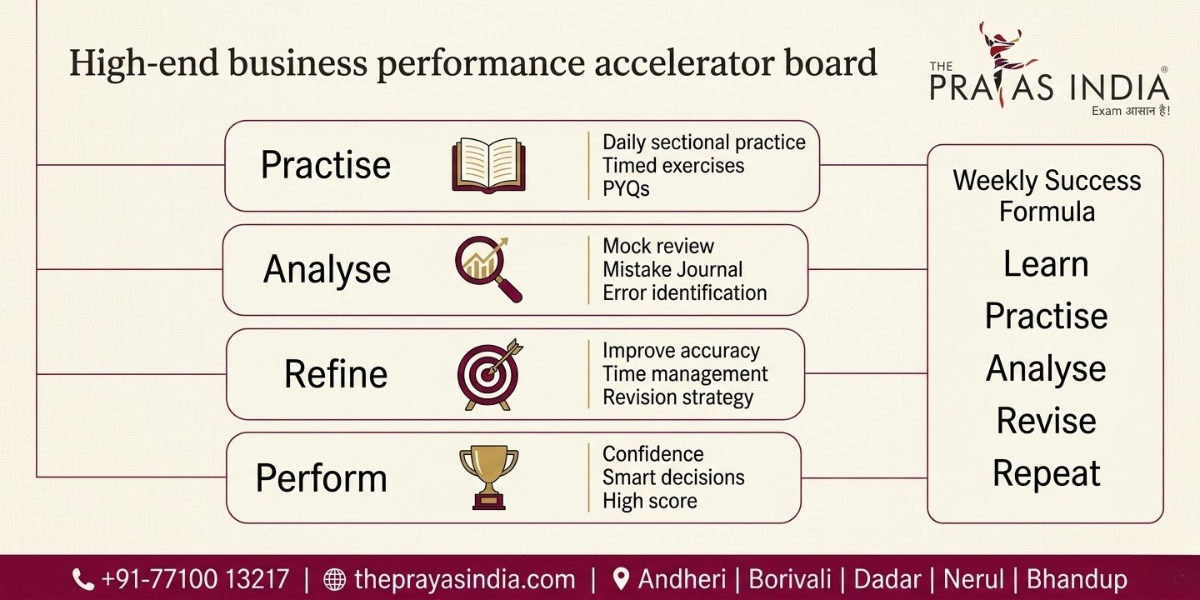
Where High Scores Are Really Built
Preparation Doesn’t Improve During Study Hours. It Improves After Honest Evaluation.
By the time most aspirants complete the IBPS PO syllabus, they assume the difficult part is over.
Ironically, this is where the real challenge begins.
Knowing concepts is one thing.
Applying them consistently under pressure is something entirely different.
Every year, thousands of candidates solve enough questions to clear the examination, yet only a smaller group consistently scores well in mock tests and performs confidently on the final day.
The difference rarely lies in intelligence.
It lies in performance management.
Students who improve continuously don’t simply study harder—they study smarter, review their work honestly, and make small improvements every week.
The goal now is no longer to learn.
The goal is to perform.
Progress Is Measured in Better Decisions
Many aspirants judge their preparation using only one question:
“How many hours did I study today?”
This question creates a false sense of productivity.
A far more meaningful question is:
“Did I perform better today than I did last week?”
Competitive examinations reward improvement, not effort alone.
If your accuracy increases by just three or four questions every week, those small gains become significant over the next two months.
Instead of measuring study time, measure:
- Accuracy percentage.
- Time taken per section.
- Number of repeated mistakes.
- Confidence level in difficult topics.
- Improvement compared with previous mock tests.
These indicators reveal genuine progress.
Speed Is Built Before the Examination
Many students try to increase their speed only during mock tests.
That approach rarely works.
Real speed develops long before examination day.
It comes from familiarity.
When the brain repeatedly sees similar question patterns, recognition becomes automatic.
Instead of solving from scratch every time, you begin identifying shortcuts naturally.
This is why revision plays such an important role.
The more familiar the concept feels, the less time you spend thinking.
Simple Ways to Increase Speed
Instead of solving more questions randomly, improve your preparation quality.
Focus on:
- Revising frequently asked concepts.
- Practising mental calculations daily.
- Reading questions carefully before solving.
- Learning pattern recognition instead of memorising methods.
- Solving section-wise timed practice sets.
Speed is not about rushing.
It is about reducing hesitation.
Accuracy Is Your Greatest Competitive Weapon
Aspirants often celebrate high attempts.
Experienced candidates celebrate correct attempts.
In IBPS PO Prelims, every incorrect answer carries a penalty.
One careless guess can reduce the value of several correct responses.
This is why accuracy deserves equal attention.
Before marking an answer, develop the habit of asking:
“Am I reasonably confident?”
If the answer is yes, proceed.
If uncertainty remains, move forward and return later if time permits.
Selective confidence performs better than unnecessary risk.
The Mock Test Mistake That Slows Improvement
Imagine spending one hour attempting a mock test and only five minutes reviewing it.
Unfortunately, many aspirants follow exactly this routine.
They note their score.
Compare it with others.
Then immediately begin another mock.
This cycle creates activity—but not improvement.
A mock test becomes valuable only after detailed analysis.
Every incorrect answer contains information.
It tells you whether the mistake happened because of:
- Lack of concept.
- Poor calculation.
- Misreading the question.
- Time pressure.
- Guesswork.
- Carelessness.
Once these reasons become visible, improvement becomes much easier.
A Better Mock Analysis Method
Instead of simply recording your score, maintain a Mistake Journal.
After every mock, divide errors into four categories.
Concept Error
I didn’t understand the topic.
Action:
Revise the concept.
Practise similar questions.
Calculation Error
I knew the method but calculated incorrectly.
Action:
Improve calculation accuracy.
Increase mental maths practice.
Time Management Error
I spent too long on one question.
Action:
Improve question selection.
Practise sectional timing.
Careless Error
I marked the wrong option or misread the question.
Action:
Slow down slightly.
Read every question twice before answering.
This simple exercise gradually eliminates recurring mistakes.
The Weekly Performance Cycle
Successful preparation follows rhythm.
Random study schedules create random results.
A structured weekly routine builds confidence and consistency.
Monday
Revise Quantitative Aptitude formulas.
Solve short calculation drills.
Tuesday
Reasoning practice with puzzles, syllogism, inequalities, and coding-decoding.
Wednesday
English Language revision.
Reading Comprehension.
Vocabulary in context.
Grammar revision.
Thursday
Mixed practice from all three sections.
Identify weak areas.
Friday
Full-Length Mock Test.
Strict examination conditions.
Saturday
Mock analysis.
Mistake Journal update.
Concept revision.
Sunday
Light revision.
Previous Year Questions.
Planning for the next week.
Consistency matters more than perfection.
Revision Should Never Feel Like Starting Again
Many students postpone revision because they believe they will remember everything.
Memory works differently.
Without revision, information gradually weakens.
An effective revision system reduces forgetting before it becomes a problem.
A practical revision cycle could look like this:
Daily
20–30 minutes.
Revise today’s learning.
Weekly
Review important concepts covered during the week.
Monthly
Revise complete notes.
Update formulas.
Review your Mistake Journal.
This layered revision process strengthens long-term retention without making preparation overwhelming.
Maintaining the Right Exam Temperament
Preparation is not only academic.
It is psychological.
Students often lose marks because anxiety changes their decision-making.
Strong performers develop routines that help them remain composed.
These routines include:
- Sleeping adequately before mock tests.
- Avoiding last-minute study material.
- Following a consistent timetable.
- Trusting preparation instead of comparing scores.
- Remaining flexible if one section appears difficult.
A difficult paper affects everyone.
Calm students simply respond better.
Do’s & Don’ts
Do
🗸 Analyse every mock thoroughly.
🗸 Revise regularly.
🗸 Improve weak topics gradually.
🗸 Focus on accuracy before attempts.
🗸 Maintain a Mistake Journal.
🗸 Practise under timed conditions.
Don’t
✘ Chase unnecessary study material.
✘ Ignore repeated mistakes.
✘ Compare your daily scores with others.
✘ Depend entirely on shortcuts.
✘ Guess excessively.
✘ Skip revision because of overconfidence.
Performance Audit
Before moving into the final phase of preparation, ask yourself these questions honestly.
| Performance Area | Yes | Needs Improvement |
|---|---|---|
| I analyse every mock in detail. | □ | □ |
| My accuracy is improving every week. | □ | □ |
| I revise consistently. | □ | □ |
| I know my weakest topic. | □ | □ |
| I manage sectional timing well. | □ | □ |
| I maintain a Mistake Journal. | □ | □ |
| I avoid unnecessary guessing. | □ | □ |
This self-audit highlights where your preparation truly stands.
Consistent Guidance Makes Consistent Performance
As aspirants move closer to the examination, preparation becomes less about learning new topics and more about refining performance.
At The Prayas India, this stage receives special attention. Students preparing for IBPS PO follow a structured improvement system that combines experienced faculty guidance, comprehensive study material, regular mock tests, personalised doubt-solving, and continuous performance evaluation. Every assessment becomes an opportunity to identify weak areas, strengthen accuracy, improve speed, and build examination confidence.
Rather than focusing only on syllabus completion, the objective is to help every aspirant develop the consistency required to perform well on the actual examination day.
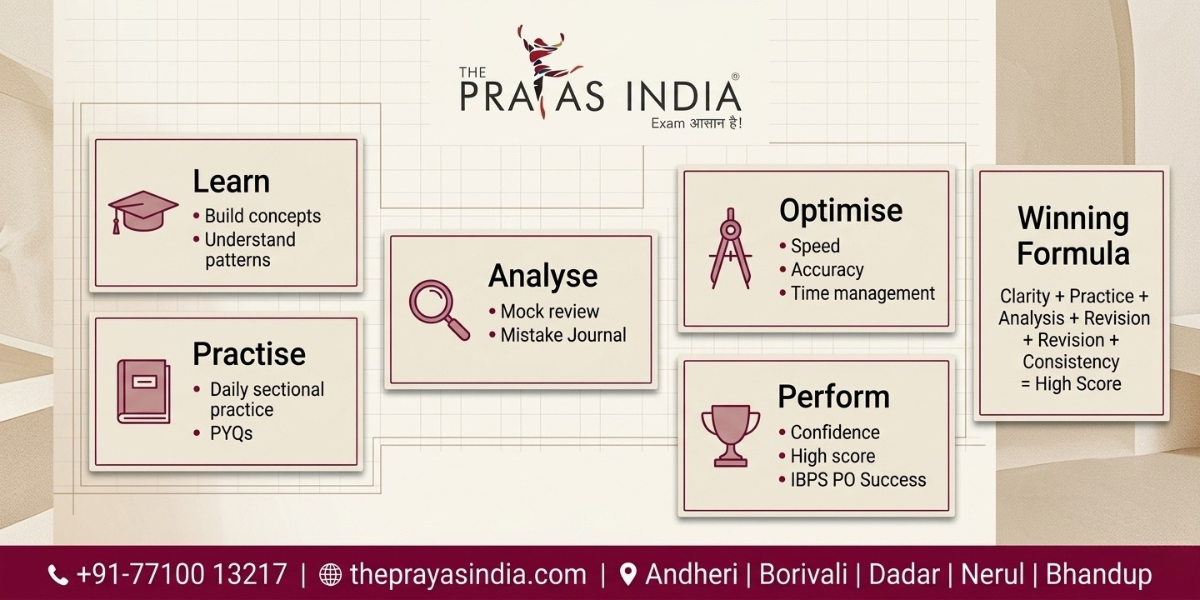
The Final Push
A High Score Is Earned Long Before You Enter the Examination Hall.
By the time the IBPS PO Preliminary examination is only a few weeks away, your preparation should no longer revolve around learning dozens of new concepts.
The focus now shifts from building knowledge to delivering performance.
Ironically, this is also the period where many aspirants unknowingly reduce their chances of success.
Some begin searching for “last-minute tricks.”
Others purchase new books.
Many keep changing study plans after every mock test.
These actions create the illusion of productivity, but they usually increase confusion instead of improving scores.
The final phase of preparation is about stability, confidence, and execution.
Students who perform well during the examination are usually those who trust their preparation and spend the final weeks refining it—not rebuilding it.
The Last Three Weeks That Matter
Instead of trying to study everything again, divide the final stage into three practical phases.
Phase 1 – Strengthen the Foundation
This week should focus on improving weak areas that repeatedly appear in mock analysis.
Don’t revise every chapter equally.
Prioritise the chapters that have the greatest impact on your score.
Ask yourself:
- Which topic still reduces my confidence?
- Which section consumes the most time?
- Which mistakes appear repeatedly?
Work on those first.
Improvement comes from fixing weaknesses—not revising strengths repeatedly.
Phase 2 – Simulate the Real Examination
Now preparation should resemble the actual examination.
Attempt:
- Full-length mock tests.
- Section-wise timed practice.
- Previous Year Papers.
Follow the same timing as the actual examination.
No interruptions.
No pauses.
No checking answers midway.
This conditions both your mind and body for examination day.
Phase 3 – Polish, Don’t Panic
The final week is meant for confidence-building.
Avoid learning entirely new topics.
Instead:
- Revise formulas.
- Read vocabulary notes.
- Review your Mistake Journal.
- Solve selected Previous Year Questions.
- Sleep properly.
A calm mind recalls information much better than an exhausted one.
What High Scorers Do Differently During the Final Week
Students who consistently score well often follow surprisingly simple habits.
They don’t attempt twenty mock tests in the last five days.
They don’t collect new PDFs.
They don’t compare scores every evening.
Instead, they simplify their preparation.
They focus on quality over quantity.
A Practical Daily Routine
Morning
- Revise Quantitative formulas.
- Solve short calculation drills.
Afternoon
- English reading practice.
- Vocabulary revision.
- Grammar review.
Evening
- Reasoning practice.
- Puzzle revision.
- Coding-Decoding.
- Syllogism.
Night
- Review mistakes.
- Plan tomorrow.
- Sleep on time.
Simple routines are easier to maintain.
Consistency matters more than intensity.
The Examination Hall Strategy
Preparation ends when the examination begins.
Performance begins when the first question appears on your screen.
Many students lose marks because they enter the examination without a clear execution plan.
A structured strategy helps you stay composed even if the paper feels difficult.
Before Attempting a Question
Ask yourself:
Can I solve this confidently?
↓
Yes → Attempt.
↓
Maybe → Mark for review if time permits.
↓
No → Move ahead.
Never allow one difficult question to consume valuable time.
Remember,
every unanswered easy question costs more than one skipped difficult question.
Frequently Asked Questions
Can I crack IBPS PO Prelims on my first attempt?
Absolutely.
Many successful Probationary Officers clear the examination in their very first attempt.
The key is structured preparation, disciplined practice, regular mock analysis, and consistent revision.
How many mock tests should I attempt?
Quality matters more than quantity.
Instead of chasing a specific number, ensure that every mock test is followed by detailed analysis and improvement.
Which section deserves the most attention?
There is no universal answer.
Your weakest section deserves the highest improvement effort, while your strongest section should remain consistently maintained.
Balanced preparation generally produces the best results.
Is coaching necessary for IBPS PO?
Many candidates prepare independently and succeed.
However, structured guidance often helps students avoid common mistakes, receive expert feedback, stay accountable, and improve more efficiently through planned preparation.
What should I avoid during the last week?
Avoid:
- New books.
- Random YouTube strategies.
- Excessive mock tests.
- Late-night study marathons.
- Comparing your preparation with others.
Stay consistent with what has already worked.
Common Myths About IBPS PO Preparation
Many aspirants unknowingly believe advice that sounds convincing but rarely produces good results.
Let’s separate myth from reality.
| Myth | Reality |
|---|---|
| Solving more questions automatically increases marks. | Improvement comes from analysing mistakes, not quantity alone. |
| English can be improved only by memorising vocabulary. | Reading comprehension and contextual learning matter much more. |
| Mock scores always predict the final result. | Mock tests are learning tools, not final judgments. |
| Long study hours guarantee success. | Consistency and smart preparation matter far more. |
| Every difficult question must be attempted. | Smart selection improves both speed and accuracy. |
Preparation Checklist
Before your examination, make sure you can confidently tick each point.
Academic Readiness
🗸 Complete syllabus revised.
🗸 Important formulas memorised.
🗸 Vocabulary notes updated.
🗸 Previous Year Questions completed.
Practice Readiness
🗸 Regular mock tests attempted.
🗸 Mock analysis completed.
🗸 Mistake Journal maintained.
🗸 Weak chapters revised.
Performance Readiness
🗸 Time management strategy ready.
🗸 Question selection strategy clear.
🗸 Accuracy improving.
🗸 Confidence maintained.
Mental Readiness
🗸 Healthy sleep routine.
🗸 Calm mindset.
🗸 No unnecessary comparison.
🗸 Trust your preparation.
Why Aspirants Choose The Prayas India
Every successful banking aspirant follows a preparation system—not just a study timetable.
At The Prayas India, students preparing for IBPS PO benefit from a structured learning environment that focuses on measurable improvement at every stage. From understanding the examination pattern to refining mock test performance, every aspect of preparation is designed to help aspirants progress with clarity and confidence.
Students receive:
- Experienced faculty with exam-focused teaching methodologies.
- Comprehensive and regularly updated study material.
- Structured classroom and practice sessions.
- Regular mock tests based on the latest examination pattern.
- Personalised doubt-solving support.
- Continuous performance evaluation and mentoring.
- A disciplined preparation framework that encourages consistency and confidence.
The objective is simple: help students prepare smarter, perform better, and maximise their chances of success in the IBPS PO examination.
Final Thoughts
Scoring high in the IBPS PO Preliminary Examination is not about finding a secret shortcut.
It is about understanding the examination, building strong fundamentals, practising consistently, analysing mistakes honestly, and performing confidently under pressure.
Throughout this guide, we’ve explored how successful aspirants think, prepare, revise, and improve. More importantly, we’ve seen that steady progress always outperforms rushed preparation.
If your goal is not just to appear for the examination but to clear it with confidence, begin preparing with a system that values strategy as much as hard work.
At The Prayas India, every step of preparation is built around helping aspirants move closer to their banking career with structured guidance and continuous improvement.
Your preparation starts today. Your banking career begins with the right direction.
📞 Call: +91-77100 13217
🌐 Website: https://theprayasindia.com