How to Start MBA CET 2027 Preparation from Scratch | Best CET Coaching in Mumbai | The Prayas India
Starting MBA CET 2027 preparation from scratch can feel confusing, especially when you are not sure which topics to study first, how much time to devote to each section, which resources to follow, or when you should begin taking mock tests. The biggest challenge for a beginner is usually not a lack of effort but a lack of direction. Without a structured plan, students often spend weeks collecting study material, switching between preparation strategies and solving questions without understanding whether their performance is actually improving.
For an aspirant targeting MBA CET 2027, the preparation journey should therefore begin with a clear understanding of the examination, followed by a realistic study plan, systematic concept building and regular performance analysis. Since MBA CET is highly dependent on speed, accuracy and question selection, preparation from the beginning should be designed around these three factors rather than simply focusing on completing the syllabus.
For students in Mumbai, joining the right CET coaching institute can make this process considerably more structured. The right coaching environment can provide a planned curriculum, faculty guidance, regular practice, mock tests, doubt-solving and performance analysis so that beginners do not have to figure out every part of the preparation journey on their own.
At The Prayas India, MBA CET preparation is designed to give aspirants this structured direction while helping them progressively move from basic concepts to exam-level performance. For students looking for Best CET Coaching in Mumbai, starting early with the right academic guidance can help create a stronger foundation for MBA CET 2027.
MBA CET 2027 Preparation Starts With the Right Approach
Before opening a preparation book or attempting hundreds of questions, a beginner should understand one important point: MBA CET preparation is not about studying everything equally. The objective is to identify the skills required by the examination and develop those skills through a combination of learning, practice, revision and testing.
A student starting from scratch may initially struggle with basic Quantitative Aptitude concepts, unfamiliar Logical Reasoning patterns, vocabulary or Abstract Reasoning questions. That is completely different from the challenge faced by an experienced aspirant who already understands the basics but needs to improve speed and accuracy. Your preparation plan should therefore evolve as your ability improves.
A useful beginner framework is:
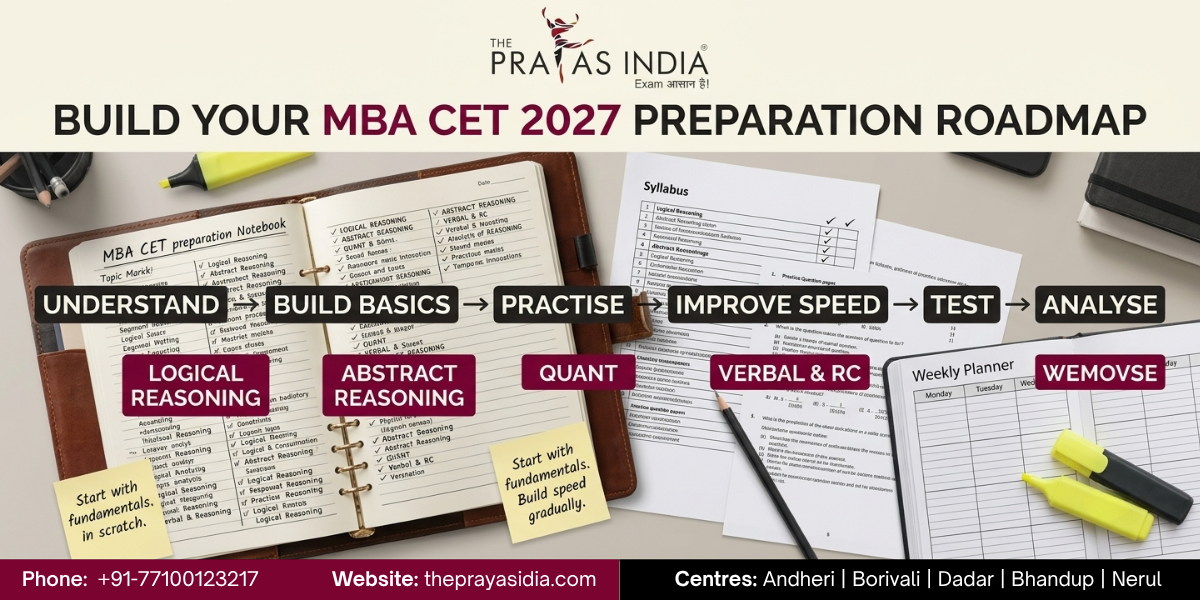
UNDERSTAND → LEARN → PRACTISE → ANALYSE → IMPROVE → RETEST
This cycle should become the foundation of your MBA CET 2027 preparation. At The Prayas India, structured preparation can help students follow this process systematically instead of relying entirely on unplanned self-study.
Step 1: Understand the MBA CET Examination Before You Start Studying
The first mistake beginners make is starting with random questions without understanding the examination structure. Before beginning serious preparation, spend some time understanding the major sections, question types, expected difficulty, time pressure and the skills that the test demands.
MBA CET preparation broadly revolves around Logical Reasoning, Abstract Reasoning, Quantitative Aptitude and Verbal Ability/Reading Comprehension. However, knowing the names of the sections is not enough. You need to understand the nature of questions within each area and identify where your current ability stands.
For example, a student may initially assume that Quantitative Aptitude is the biggest challenge because of mathematics. Another student may discover that Logical Reasoning consumes much more time. Someone else may find that reading speed affects their Verbal Ability performance. Your initial preparation should help you discover these differences.
A short diagnostic exercise at the beginning can be extremely useful. Attempt a small set of representative questions from each section without worrying about your score. Record which questions you could solve, which ones required too much time and which concepts were completely unfamiliar.
This gives you a starting benchmark. Your preparation then becomes measurable because you can compare your performance after four weeks, eight weeks and later stages of preparation.
Step 2: Know Your Starting Level
A beginner does not necessarily mean someone who knows nothing. Some students may have strong English skills but weak Quant, while others may be comfortable with mathematics but struggle with Logical Reasoning. Your preparation should account for this difference.
Create a simple starting-level assessment across the four major areas:
- Logical Reasoning: Can you identify patterns and solve basic arrangements or logical sets?
- Abstract Reasoning: Can you recognise visual patterns and relationships quickly?
- Quantitative Aptitude: Are your arithmetic fundamentals and calculations comfortable?
- Verbal Ability & RC: How comfortable are you with vocabulary, grammar, comprehension and reading speed?
Do not use this assessment to label yourself as “good” or “bad” at a section. Its purpose is to identify where your preparation should begin.
If your basics are weak, spend more time building concepts. If your concepts are already comfortable, move faster towards timed practice. This distinction becomes particularly important when preparing for a speed-oriented examination.
Step 3: Build Your MBA CET Preparation Around the Syllabus
Once you understand your starting point, divide the syllabus into manageable topic groups. Beginners often make the mistake of opening several books and trying to complete whatever chapter appears next. A better approach is to create a topic hierarchy.
For Logical Reasoning, your initial preparation can include areas such as arrangements, puzzles, blood relations, coding-decoding, syllogisms, directions, series, statements and conclusions, selection-based problems and other commonly tested reasoning formats.
For Quantitative Aptitude, begin with fundamentals such as percentages, ratios, averages, profit and loss, simple and compound interest, time and work, time-speed-distance, number-based concepts, algebraic fundamentals and other arithmetic areas before gradually moving towards more complex questions.
For Verbal Ability and Reading Comprehension, work on vocabulary in context, grammar, sentence correction, reading comprehension, para-based questions and reading speed. The objective should not simply be memorising word lists but improving your ability to understand and process language quickly.
Abstract Reasoning requires a different type of practice. Rather than treating it like a theory-heavy subject, beginners should develop familiarity with visual patterns, relationships, sequences and transformations through repeated exposure.
A Better Topic-Priority System
Instead of trying to finish every topic simultaneously, divide your preparation into three categories:
Priority A – Foundation Topics
Topics that build the basic skills required for solving other questions.
Priority B – High-Practice Topics
Areas where improvement comes primarily through repeated question solving.
Priority C – Performance Topics
Questions where speed, selection and accuracy become more important after the basics are established.
This prevents your preparation from becoming an endless syllabus-completion exercise.
Step 4: Build Your Foundation Before Chasing Speed
Speed is extremely important in MBA CET preparation, but beginners should not make the mistake of trying to solve every question quickly from the first week. Speed without conceptual clarity generally leads to repeated errors.
During the initial stage, your primary objective should be to understand the method behind a question. If a Quantitative Aptitude problem takes five minutes today but you understand the underlying concept properly, you have created a foundation that can later help you solve similar problems much faster.
The same principle applies to Logical Reasoning. When learning a new arrangement or reasoning pattern, focus first on understanding how the information is structured. Once the method becomes familiar, introduce time limits gradually.
A practical progression is:
Concept clarity → Untimed practice → Accuracy improvement → Timed practice → Speed optimisation
This approach is particularly useful for students beginning their preparation from scratch because it prevents them from confusing speed with progress.
Step 5: Create a Realistic Daily Study Routine
A beginner’s timetable should be sustainable. Studying for extremely long hours for a few days and then losing consistency is less useful than following a manageable routine every day.
If you are preparing alongside college or another commitment, divide your study time into focused blocks. One session can be used for concept learning, another for practice and a shorter session for revision or analysis.
A balanced daily routine could include:
- Quantitative Aptitude: Concept learning + practice questions
- Logical Reasoning: Concept development + timed sets
- Abstract Reasoning: Pattern-based practice
- Verbal Ability/RC: Reading + question practice
- Revision: Review formulas, concepts and previous mistakes
- Analysis: Record important errors and difficult question types
You do not necessarily need to study every section for exactly the same amount of time. Your schedule should reflect your weaknesses. If Quant requires more foundational work, allocate additional time to it. If your Verbal Ability is already strong, maintain it through regular practice while investing more time elsewhere.
Step 6: Make Quantitative Aptitude Calculation-Friendly
For many beginners, Quant preparation becomes difficult because they focus exclusively on formulas. MBA CET preparation requires more than knowing a formula. You also need to recognise which approach can solve a question efficiently.
Start by strengthening basic arithmetic operations and mental calculations. Percentages, fractions, ratios, averages and common numerical relationships should gradually become comfortable enough that they do not consume unnecessary time during the examination.
Your preparation should include three layers:
Concept: Understand the underlying method.
Application: Solve different types of questions based on that concept.
Timing: Gradually reduce the time required for familiar question types.
Maintain a small formula and shortcut notebook, but do not turn it into a collection of shortcuts that you have memorised without understanding. A useful notebook should contain formulas, frequently used relationships and mistakes that you repeatedly make.
Step 7: Develop Logical Reasoning Through Patterns
Logical Reasoning can appear intimidating when you encounter unfamiliar sets for the first time. The solution is not to solve hundreds of random questions but to become familiar with recurring structures.
Start with simpler reasoning formats and gradually move towards more complex arrangements, puzzles and multi-condition problems. Whenever you make a mistake, ask whether the problem was caused by misunderstanding the information, using the wrong approach, missing a condition or spending too much time on the set.
This distinction is important because the solution to each problem is different. A concept error requires learning. A selection error requires better judgement. A time-management problem requires timed practice.
Students preparing at The Prayas India can benefit from structured practice and faculty guidance at this stage because difficult reasoning sets can be discussed and analysed rather than simply marked wrong and forgotten.
Step 8: Treat Abstract Reasoning as a Skill That Improves With Exposure
Abstract Reasoning often feels unfamiliar to students because it is visually driven. The best way to approach it is through regular exposure to different patterns.
Instead of trying to memorise specific question types, observe how elements change between figures. Look for movement, rotation, position, number, direction, size, shading and other relationships.
The objective is to make pattern recognition increasingly automatic. Short, regular practice sessions can therefore be more effective than occasional long sessions.
For beginners, this is another area where guided practice can save time. A faculty-led approach can help students understand the logic behind patterns and identify recurring structures instead of treating every new figure as completely unrelated.
Step 9: Improve Verbal Ability Through Daily Reading
Verbal Ability preparation should begin from the first stage rather than being postponed until the later months. Regular reading can improve comprehension, vocabulary in context and familiarity with different writing styles.
Instead of only reading vocabulary lists, spend time reading quality articles, editorials and analytical content. After reading, try to identify the central idea, author’s viewpoint, tone and important supporting arguments.
For Reading Comprehension, focus initially on understanding the passage rather than racing through it. Speed should come naturally as your comprehension becomes more efficient.
A useful beginner routine is to read regularly and then solve a small number of RC or verbal questions with complete analysis. Ask yourself not only why the correct option is right, but why the other options are wrong.
The Role of Coaching When You Are Starting From Scratch
One of the biggest advantages of joining a structured MBA CET coaching programme early is that you do not have to design every aspect of your preparation independently.
Self-study can certainly play an important role, but beginners often struggle with questions such as:
- Which topics should I study first?
- Which resources should I follow?
- How much practice is enough?
- When should I start timed tests?
- How should I analyse mistakes?
- Am I progressing at the required level?
- Which sections require additional attention?
A good coaching institute should address these questions through a structured academic system rather than simply providing study material.
The Prayas India: Structured Support for MBA CET 2027 Aspirants
For students looking for CET Coaching in Mumbai, The Prayas India can become the academic support system around which preparation is organised. The objective is not merely to provide classes but to help aspirants develop the skills required for the actual examination.
A structured MBA CET programme can help students with:
- Systematic coverage of the MBA CET syllabus
- Concept-focused classroom preparation
- Section-wise practice
- Regular doubt-solving support
- Timed question-solving
- Mock-test practice
- Performance analysis
- Identification of weak areas
- Revision planning
- Guidance on speed and accuracy
- Consistent preparation under faculty mentorship
For a beginner, this structure can be particularly valuable because it reduces the uncertainty associated with starting preparation from scratch.

Step 10: Start Tracking Your Preparation From Day One
One of the simplest ways to make preparation more effective is to maintain a record of what you have studied and where you are struggling. This does not need to become a complicated productivity system.
A basic preparation tracker can include the topic studied, number of questions attempted, accuracy, time taken and important mistakes. Over several weeks, this record can reveal patterns that are difficult to notice during day-to-day study.
For example, you may discover that your Quant accuracy is good but your solving time is consistently high. You may find that you perform well in individual Logical Reasoning questions but struggle with lengthy sets. Or your RC accuracy may fall sharply when you attempt passages under time pressure.
These observations should directly influence your next week’s preparation.
The goal is to make your preparation data-informed without making it complicated.
Step 11: Start Practising Questions After Learning Each Concept
Do not wait until you have completed an entire section before beginning practice. Once you understand a topic, solve questions based on it.
This creates an immediate connection between theory and application. It also helps you discover whether you actually understand the concept or only feel familiar with it because you have read the explanation.
Use a gradual practice model:
Learn → Solve Easy Questions → Solve Mixed Questions → Add Time Pressure → Analyse Mistakes
When you repeatedly make the same type of error, stop and revisit the underlying concept. Continuing to solve more questions without fixing the reason behind the mistake usually produces more repetition, not more improvement.
Step 12: Build Your Preparation Around Consistency
Starting early does not mean studying aggressively for a few weeks and then losing momentum. MBA CET 2027 preparation should be treated as a long-term skill-building process.
Your initial months should focus on establishing strong fundamentals, developing familiarity with question types and creating a disciplined practice routine. As preparation progresses, the focus can gradually shift towards speed, mixed practice, mock tests and detailed performance analysis.
This is where a structured coaching environment can make a meaningful difference. Regular classes, planned assignments, practice schedules and testing can create external structure for students who find it difficult to maintain consistency through self-study alone.
The Prayas India Advantage for Beginners
For a student beginning MBA CET 2027 preparation from scratch, the first objective should not be chasing a percentile immediately. It should be building the right preparation system.
At The Prayas India, the focus should be on helping aspirants progress through clearly defined stages—from understanding concepts and practising questions to improving speed, analysing performance and becoming exam-ready.
Students looking for Best CET Coaching in Mumbai can consider the value of joining a programme where preparation is supported by faculty guidance, structured study, regular testing and performance-based improvement.
The advantage of starting with a structured coaching programme is that your preparation does not have to remain a trial-and-error process. You can begin with a defined academic roadmap and progressively adapt it according to your performance.
Key Takeaway
If you are starting MBA CET 2027 preparation from scratch, focus on getting the foundation right before trying to maximise speed.
Your first stage should be built around:
- Understanding the examination
- Identifying your starting level
- Breaking the syllabus into manageable topics
- Strengthening basic concepts
- Practising consistently
- Building calculation and reasoning skills
- Developing reading habits
- Tracking mistakes and performance
- Gradually introducing time pressure
- Following a structured preparation system
The next stage of preparation should move beyond fundamentals and focus on speed building, advanced practice, mock tests, question selection, revision and performance analysis—the areas that can make a significant difference as you move closer to MBA CET 2027.
For beginners who want guidance throughout this journey, The Prayas India provides a structured path for MBA CET preparation in Mumbai, helping aspirants move from the basics towards exam-oriented preparation with faculty support and regular performance evaluation.
Move From Learning to Exam-Oriented Preparation
Once the basic concepts are reasonably clear, MBA CET 2027 preparation needs to change gears. The initial stage is about understanding concepts and becoming comfortable with different question types. The next stage is about converting that knowledge into speed, accuracy and decision-making ability.
This transition is important because MBA CET is not simply a test of whether you know how to solve a question. The examination also tests how efficiently you can process information, identify the right approach and move through a large number of questions under time pressure. The latest available MAH-MBA/MMS-CET information brochure, for example, specifies 200 questions across Logical Reasoning, Abstract Reasoning, Quantitative Aptitude and Verbal Ability/Reading Comprehension, with a 150-minute duration and no negative marking for the 2026 examination. The exact 2027 notification and pattern should always be checked against the official CET Cell announcement when released.
For a beginner, this means the preparation journey should gradually move from “Can I solve this?” to “Can I solve this correctly and efficiently?”
That is the stage where structured coaching, timed practice and detailed performance analysis become increasingly valuable.
Step 13: Start Timed Practice Gradually
A common mistake is to begin full-length timed tests too early. If your concepts are still weak, a poor mock score may tell you very little because you have not yet developed the underlying skills.
Instead, introduce timing progressively.
Start by putting a time limit on a small set of questions. Once you become comfortable, increase the number of questions while maintaining the time constraint. Eventually, begin combining different topics so that you have to switch between question types just as you would during an actual examination.
For example:
Stage 1: Solve without pressure and understand the method.
Stage 2: Solve a small set within a fixed time.
Stage 3: Mix easy, moderate and difficult questions.
Stage 4: Attempt sectional tests.
Stage 5: Move towards full-length mocks.
This gradual progression allows your brain to adapt to exam pressure without sacrificing conceptual development.
Step 14: Develop Speed Without Destroying Accuracy
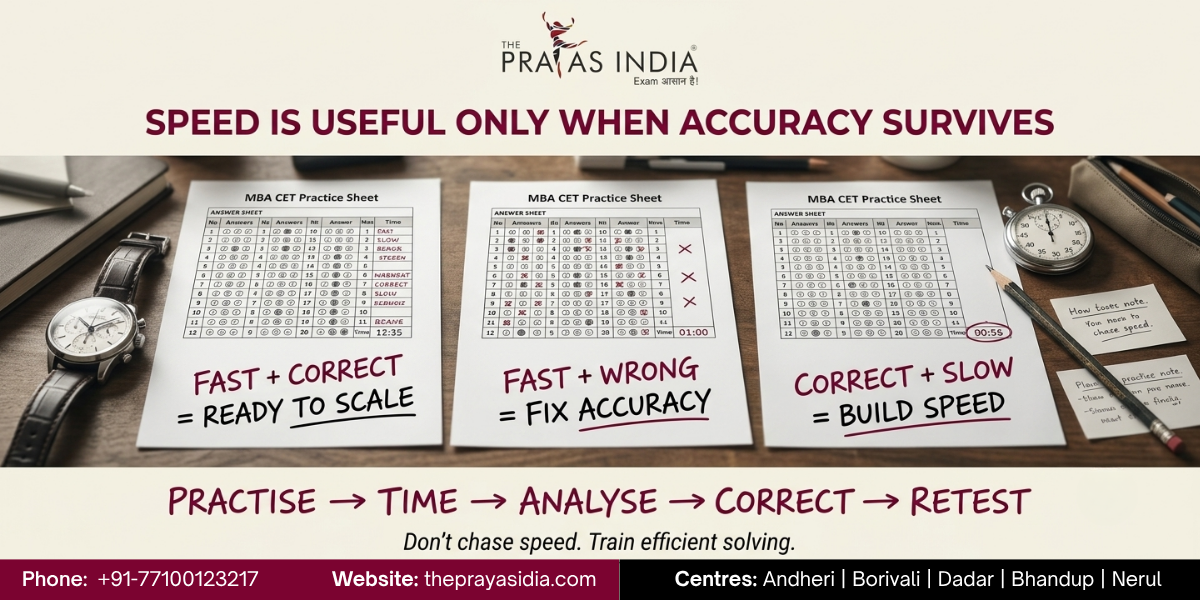
Speed is one of the most important skills in MBA CET preparation, but blindly attempting questions faster is not the answer.
Suppose you solve 20 questions in 15 minutes but make six mistakes. Increasing your speed further will not necessarily improve your result. Your first objective should be to understand where the mistakes are coming from.
Track three things during timed practice:
- Questions attempted
- Questions answered correctly
- Time spent
Then identify the reason behind lost marks.
If you know the concept but calculate slowly, you need calculation practice. If you understand the question but choose the wrong approach, you need method selection practice. If you spend too much time on one difficult question, you need better question-selection discipline.
This is why speed should be treated as a trainable skill, not a target that can be achieved simply by using a stopwatch.
Step 15: Learn the Art of Question Selection
One of the biggest differences between a beginner and an experienced MBA CET aspirant is often question selection.
A beginner may feel compelled to solve every question that appears difficult because leaving it unanswered feels like losing an opportunity. With practice, you learn that spending excessive time on one question can cost you several easier opportunities elsewhere.
Question selection therefore needs to become part of your preparation.
During practice, start identifying questions as:
Quick Win: Familiar concept and straightforward execution.
Workable: Requires some thinking but can be solved with the right approach.
Time-Heavy: Possible to solve but likely to consume significant time.
Risky: Unclear approach or high probability of error.
The objective is not to avoid difficult questions completely. It is to develop enough awareness to decide when a question deserves your time.
This skill becomes particularly important in a speed-intensive examination because every minute has an opportunity cost.
Step 16: Make Mock Tests a Learning Tool
Mock tests should not be treated as occasional score-checking exercises. They should become one of the most important diagnostic tools in your MBA CET 2027 preparation.
Your first few mocks may not produce the score you want. That is not necessarily a problem. A mock test is valuable when it reveals something that you can improve.
After every mock, analyse:
- Which sections consumed the most time?
- Which topics produced repeated mistakes?
- How many questions were left because of time?
- Which questions should have been skipped?
- Where was your accuracy weakest?
- Which mistakes were conceptual?
- Which mistakes were careless?
- Did you spend too long on any single question?
- Which question types are becoming faster?
- What should change before the next mock?
Your score is only the starting point of this analysis.

Step 17: Build a Personal Mock-Test Improvement Cycle
After every mock test, identify three specific actions for the next practice cycle.
For example:
Problem: Quant questions taking too long.
Action: Practise arithmetic calculations for 30 minutes daily.
Problem: Reasoning accuracy dropping in lengthy sets.
Action: Practise set selection and timed LR sets.
Problem: RC questions taking too much time.
Action: Increase timed reading and passage analysis.
This turns mock tests into an improvement mechanism rather than a repetitive activity.
A useful cycle is:
MOCK → ANALYSE → IDENTIFY → CORRECT → PRACTISE → RETEST
If your preparation follows this cycle consistently, every mock should have a purpose.
Step 18: Start Sectional Tests Before Full-Length Mocks
Sectional tests are particularly useful for beginners because they isolate specific weaknesses.
If you perform poorly in a full mock, it can be difficult to determine whether the problem was Quant, LR, Abstract Reasoning, Verbal Ability, time management or overall question selection.
Sectional tests provide a cleaner diagnosis.
Use them to measure:
- Accuracy in individual sections
- Average solving time
- Topic-level weaknesses
- Ability to maintain concentration
- Performance under time pressure
Once sectional performance becomes stable, move towards mixed tests and full-length mocks.
Step 19: Build a Revision System That Actually Works
Revision should not mean rereading every chapter from the beginning.
A better approach is to revise according to your performance history.
Your revision notebook can contain:
- Important formulas
- Frequently repeated concepts
- Difficult question types
- Short methods you genuinely understand
- Vocabulary and grammar observations
- Repeated mistakes
- Questions you got wrong in mocks
- Topics that require another round of practice
This makes revision personalised.
For example, if percentages are already strong but time and work questions repeatedly cause errors, your revision time should not be divided equally between the two. Spend more time fixing the area that is actually costing you performance.
Step 20: Prepare for 99+ Percentile With a Performance Mindset
Students often search for a single formula for achieving a 99+ percentile. In reality, there is no universal number of study hours or questions that guarantees a particular percentile.
A stronger approach is to build the capabilities associated with high performance:
Strong fundamentals + high accuracy + fast execution + smart selection + consistent mocks + detailed analysis
The earlier you start developing these capabilities, the more time you have to correct weaknesses.
For a beginner starting MBA CET 2027 preparation early, the advantage is not simply having more months available. The bigger advantage is having enough time to go through multiple improvement cycles before the actual examination.
A Practical MBA CET 2027 Preparation Roadmap
Your preparation can broadly be divided into five stages.
Stage 1: Foundation
Focus on understanding the exam, identifying your level and strengthening fundamental concepts.
Main objective: Build clarity.
Stage 2: Concept + Practice
Complete important topics while solving progressively more questions.
Main objective: Build application ability.
Stage 3: Speed + Accuracy
Introduce timed practice, sectional tests and mixed question sets.
Main objective: Improve execution.
Stage 4: Mock + Analysis
Take regular full-length mocks and analyse performance in detail.
Main objective: Build exam temperament.
Stage 5: Final Revision
Focus on high-value revision, weak areas, mock analysis and maintaining consistency.
Main objective: Enter the examination with a tested strategy.
Common Mistakes Beginners Should Avoid
Starting from scratch gives you a major opportunity—but only if you avoid habits that create unnecessary delays.
1. Collecting Too Many Resources
More books, PDFs and online videos do not automatically mean better preparation. Choose reliable resources and complete them properly.
2. Studying Without Testing
If you only study concepts, you may develop the illusion that you are progressing. Testing tells you whether that knowledge can actually be converted into marks.
3. Ignoring Abstract Reasoning
Some beginners focus heavily on Quant, LR and Verbal and postpone Abstract Reasoning. Regular exposure from the beginning can make this section much more comfortable.
4. Chasing Speed Too Early
Speed should come after understanding. Otherwise, faster solving simply produces faster mistakes.
5. Ignoring Mock Analysis
A mock that is taken but not analysed provides only a score. A mock that is analysed can provide your next preparation strategy.
6. Comparing Your Beginning With Someone Else’s Advanced Stage
Students entering coaching may have very different starting levels. Your objective should be to improve your own performance consistently.
Why Structured MBA CET Coaching Can Help Beginners
Self-study can work, but it requires the student to manage the entire preparation ecosystem independently—syllabus planning, resource selection, practice schedules, doubt resolution, mock tests, performance analysis and revision.
For a beginner, this can become overwhelming.
A structured coaching programme can reduce that uncertainty by providing an organised academic framework. Faculty guidance can help students understand difficult concepts, identify recurring mistakes and develop more efficient solving approaches.
Regular tests also create accountability. Instead of waiting until the final months to discover weaknesses, students can identify them much earlier and work on them systematically.
This is particularly relevant for aspirants looking for CET Coaching in Mumbai, where multiple preparation options are available. The right institute should be evaluated not simply on the number of classes it conducts, but on the quality of its academic structure, faculty support, practice system, mock-test ecosystem and performance feedback.
The Prayas India: A Structured Path for MBA CET 2027 Aspirants
For The Prayas India, the objective of MBA CET coaching should be to help students move through the complete preparation journey rather than simply complete a syllabus.
For a beginner, that journey starts with concept clarity. It then progresses towards guided practice, timed solving, mock tests, analysis and targeted improvement.
Students considering Best CET Coaching in Mumbai can look for an environment where they receive:
- Structured MBA CET preparation
- Faculty-led concept building
- Regular practice and assignments
- Section-wise preparation
- Doubt-solving support
- Timed practice
- Mock-test exposure
- Detailed performance analysis
- Revision guidance
- Strategy support for speed and question selection
The Prayas India can provide this structured ecosystem to students who want to approach MBA CET 2027 preparation with a clear academic roadmap.
The biggest benefit for a beginner is not simply having someone teach the syllabus. It is having a system that helps answer the question: What should I improve next?
That question should guide your preparation throughout the year.
Final MBA CET 2027 Preparation Framework
If you are starting MBA CET 2027 preparation from scratch, keep your overall strategy simple:
1. Understand the examination.
Know the sections, question types and performance demands.
2. Assess your starting level.
Identify your strengths and weaknesses before creating a timetable.
3. Build your fundamentals.
Do not rush through concepts simply to complete the syllabus.
4. Practise immediately.
Convert every concept into application through questions.
5. Introduce timing gradually.
Build speed after developing accuracy.
6. Learn question selection.
Recognise which questions deserve your time.
7. Take sectional tests.
Measure performance topic by topic.
8. Start full-length mocks.
Develop exam-level stamina and decision-making.
9. Analyse every mock.
Identify the reason behind every important mistake.
10. Revise strategically.
Spend more time on the areas that are actually affecting performance.
11. Repeat the improvement cycle.
Practise → Test → Analyse → Correct → Retest.
12. Use structured guidance when needed.
A good coaching programme can make the entire journey more organised and accountable.
MBA CET 2027 Preparation: The Beginner’s Final Checklist
Before moving into the advanced phase of preparation, make sure you can answer “yes” to these questions:
- Have I understood the MBA CET exam structure?
- Have I identified my strongest and weakest sections?
- Have I built my Quant fundamentals?
- Am I regularly practising Logical Reasoning?
- Have I started Abstract Reasoning preparation?
- Am I reading regularly for Verbal Ability and RC?
- Am I tracking mistakes?
- Have I started timed practice?
- Am I taking sectional tests?
- Do I analyse my mock tests?
- Do I know which question types consume too much time?
- Am I following one consistent preparation strategy?
If several answers are “no”, there is no reason to panic. The purpose of starting early is precisely to give yourself enough time to identify and correct these gaps.
FAQs: MBA CET 2027 Preparation From Scratch
1. When should I start MBA CET 2027 preparation?
Starting early gives you enough time to build concepts, practise questions, improve speed and complete multiple mock-test cycles. The exact schedule should depend on your current academic level and available preparation time.
2. Can I prepare for MBA CET 2027 without coaching?
Yes, self-study is possible. However, students must independently manage resources, planning, practice, doubts, mocks and performance analysis. Structured coaching can reduce this management burden and provide academic guidance.
3. Which sections should I study first for MBA CET 2027?
Begin with the areas where your fundamentals are weakest while maintaining regular practice across all sections. A diagnostic test can help determine your starting priority.
4. How can I improve my MBA CET speed?
Build conceptual clarity first, then use timed practice, calculation drills, sectional tests and question-selection exercises. Speed improves through repeated efficient execution.
5. When should I start taking MBA CET mock tests?
You do not have to wait until the end of preparation. Begin with topic-level and sectional tests after developing basic familiarity, then gradually move towards full-length mocks.
6. How important is mock-test analysis?
It is extremely important. A mock test can identify weaknesses in accuracy, timing, question selection and concepts, but only detailed analysis converts those observations into improvement.
7. Is Abstract Reasoning important for MBA CET?
Yes. It is one of the sections listed in the MAH-MBA/MMS-CET structure, so beginners should include it in their preparation rather than postponing it until the final stage.
8. Should I focus more on speed or accuracy?
Build accuracy first and then improve speed. Ultimately, strong performance requires a balance of accuracy, efficient solving and smart question selection.
9. How can The Prayas India help with MBA CET 2027 preparation?
A structured programme can support students through concept building, guided practice, doubt solving, mock tests, performance analysis, revision and exam-oriented strategy. This can be particularly useful for beginners who do not want to manage the entire preparation process alone.
10. Is joining CET coaching in Mumbai useful for a beginner?
It can be useful when the institute provides more than classroom teaching—particularly structured preparation, experienced faculty, regular testing, feedback, doubt support and a clear improvement system.
Conclusion
Starting MBA CET 2027 preparation from scratch does not require you to know everything on Day 1. What you need is a preparation system that allows you to build your skills progressively.
Begin with the fundamentals. Understand the examination. Practise consistently. Introduce timing gradually. Learn how to select questions. Start testing your preparation. Most importantly, analyse your performance and use that analysis to decide what you should improve next.
For students looking for Best CET Coaching in Mumbai, The Prayas India offers a structured preparation environment designed to support aspirants across these stages—from foundational learning to exam-oriented practice and performance improvement.
If your MBA CET 2027 goal is to compete seriously for leading management institutes, starting early with the right strategy can give you the time needed to build, test and refine your preparation before the examination.
Contact Us
- Call Now: +91-77100 13217
- Website: theprayasindia.com
- Centres: Andheri | Borivali | Dadar | Nerul | Bhandup