How to Stay Consistent During Long-Term SSC Exam Preparation | Best SSC Coaching in Mumbai | The Prayas India
Preparing for an SSC examination is rarely a short journey. Whether a candidate is targeting SSC CGL, SSC CHSL, SSC MTS or another major Staff Selection Commission examination, the preparation process can extend over several months and sometimes much longer. The syllabus is extensive, competition is high and the preparation routine has to survive through periods when motivation is strong as well as periods when studying feels difficult.
This is why consistency during SSC exam preparation is often more important than having a perfect timetable.
A student may study for ten hours on one day and barely open a book for the next three days. Another candidate may study for four to five focused hours every day for several months. On paper, the first student appears more hardworking because of the longer study session. In reality, the second student may be building the more sustainable preparation system.
Long-term competitive-exam preparation is not won through occasional bursts of extreme effort. It is built through repeated actions—learning concepts, solving questions, revising old topics, taking mock tests, analysing mistakes and returning to weak areas even when the initial excitement of preparation has disappeared.
For SSC aspirants, this becomes particularly important because preparation involves multiple subjects and different skill requirements. Quantitative Aptitude demands regular calculation and problem-solving practice, Reasoning improves through exposure to varied question patterns, English requires continuous development of language skills and General Awareness requires repeated revision. Ignoring a subject for weeks can create a gap that becomes difficult to repair later.
For students who find it difficult to maintain this routine independently, structured SSC coaching in Mumbai can provide an external framework that brings classes, practice, revision and testing into a more organised preparation cycle. The purpose of coaching, however, should not be to make students dependent on a timetable. It should help them develop the discipline to continue preparing consistently even when motivation fluctuates.
Consistency Is Different From Studying for Long Hours
One of the most common misconceptions among SSC aspirants is that consistency means studying for a fixed and very large number of hours every day. This approach can work temporarily, but it is difficult to sustain for months.
Consistency is better understood as the ability to maintain meaningful academic progress over a long period. Some days may involve intensive study, while other days may be affected by college, work, family responsibilities or simple mental fatigue. A sustainable system allows for these variations without allowing one difficult day to become an excuse for abandoning the routine altogether.
This distinction matters because unrealistic schedules often create a cycle of overcommitment and disappointment. A candidate may decide to study for ten hours every day, fail to maintain the target after a few days and then conclude that they are not disciplined enough. The problem may not be discipline at all. The problem may be that the system was never designed around realistic human behaviour.
A better approach is to establish a minimum level of daily preparation that remains achievable even on difficult days. On better days, you can exceed that baseline. On difficult days, you still maintain continuity.
This creates a psychological advantage. Missing one large target can feel like failure. Completing a smaller but meaningful target keeps the preparation cycle alive.
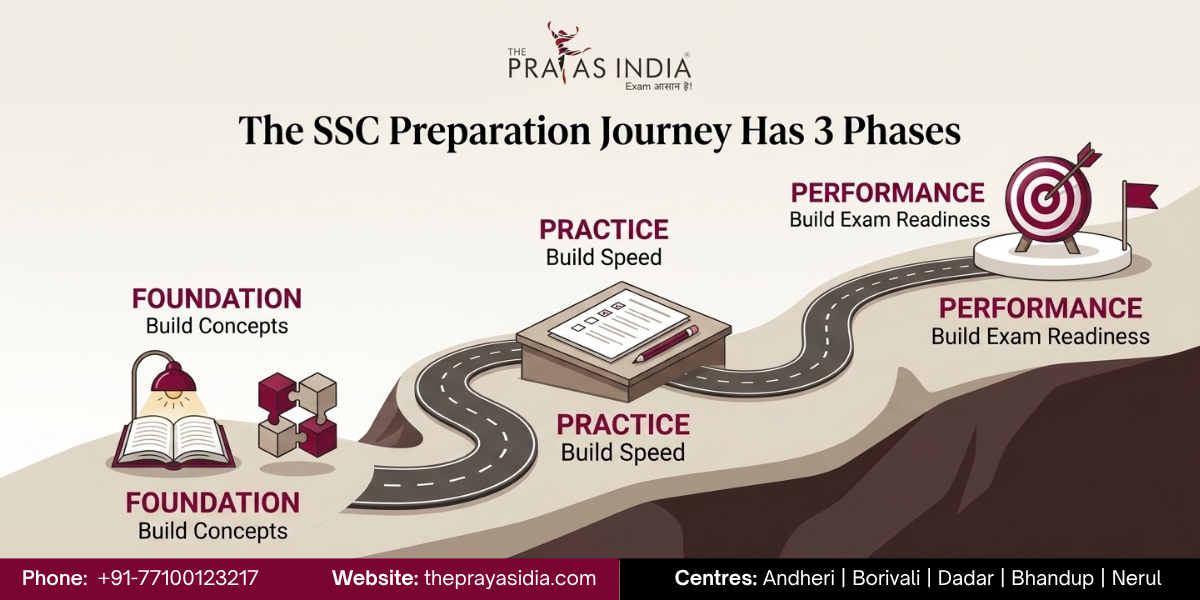
Long-Term SSC Preparation Has Different Phases
Another reason candidates struggle with consistency is that they expect their preparation to feel the same every month. It does not.
The beginning of preparation often feels exciting because the syllabus is new and every completed topic creates a sense of progress. After several weeks, the novelty decreases. The middle phase can feel repetitive because revision begins to replace new learning. As the examination approaches, pressure increases and the candidate may suddenly feel that there is too much left to cover.
Your strategy should therefore change with the phase of preparation.
During the foundation phase, the priority should be understanding concepts and developing basic solving ability. During the practice phase, the emphasis should move toward question volume, accuracy and speed. During the revision and testing phase, mock tests, error analysis and repeated revision should occupy a larger share of the routine.
Trying to use the same study pattern throughout all these stages can make preparation unnecessarily tiring.
A student who understands this progression is less likely to interpret a change in motivation as a sign that preparation is failing. The routine is simply entering a different phase.
Build a Routine That Can Survive a Bad Day
The real test of consistency is not what you do when you are motivated. It is what happens when you are tired, distracted or having a difficult day.
This is why your preparation system should include a minimum viable study routine. Decide beforehand what the smallest meaningful version of your daily preparation looks like. It could involve revising a previously studied topic, solving a limited set of questions, completing a short sectional test or revising vocabulary and current affairs.
The objective is not to pretend that every day will be equally productive. The objective is to prevent a difficult day from becoming a complete break in preparation.
Once you have completed the minimum task, you can stop if circumstances genuinely require it. But very often, beginning the task creates enough momentum to continue for longer.
This approach is particularly useful for working aspirants and college students preparing for SSC examinations alongside other responsibilities. A rigid schedule may collapse when an unexpected commitment appears. A flexible routine can absorb that disruption and continue the following day.
Consistency is therefore less about controlling every hour and more about protecting the continuity of preparation.
Stop Depending on Motivation
Motivation is useful, but it is unreliable as the foundation of a long-term preparation plan.
There will be days when an SSC aspirant feels highly motivated after watching a success story or receiving a good mock-test score. There will also be days when the same student feels discouraged after getting several questions wrong or seeing the size of the remaining syllabus.
If your routine depends entirely on feeling motivated, your preparation will naturally become inconsistent.
Discipline works differently. A disciplined routine creates a default action that does not require a major emotional decision every day. You do not need to ask yourself whether you “feel like studying” before starting. The study session becomes part of your normal routine.
This does not mean ignoring mental fatigue or forcing yourself through severe exhaustion. It means reducing the number of unnecessary decisions involved in beginning your preparation.
A fixed study location, a defined starting time, prepared study material and a clear first task can make it easier to begin. Once the first few minutes are completed, continuing often becomes considerably easier.
Use Small Targets Instead of Thinking About the Entire SSC Syllabus
The SSC syllabus can appear overwhelming when viewed as one large structure. Thinking about every subject, every chapter and every pending revision simultaneously can create unnecessary mental pressure.
Instead, divide the preparation into smaller, measurable targets.
Rather than telling yourself that you need to “finish Quant,” define a specific target such as revising a particular concept and solving a certain number of questions. Instead of thinking that you need to “improve English,” identify whether your immediate requirement is vocabulary, grammar, reading comprehension or question practice.
This makes progress visible.
Small targets also make it easier to recover from a bad week. If you lose several days because of personal or academic commitments, you can reassess the next few targets rather than feeling that the entire preparation has collapsed.
The important point is to avoid creating targets that are so small that they have no meaningful academic value. The target should be achievable but substantial enough to contribute to actual preparation.
Create a Weekly System, Not Just a Daily Timetable
Daily timetables can be useful, but long-term SSC preparation becomes more resilient when it is also organised at the weekly level.
A weekly system allows you to compensate for an unproductive day without feeling that the entire schedule has failed. If Monday does not go as planned, you still have several days to adjust the workload.
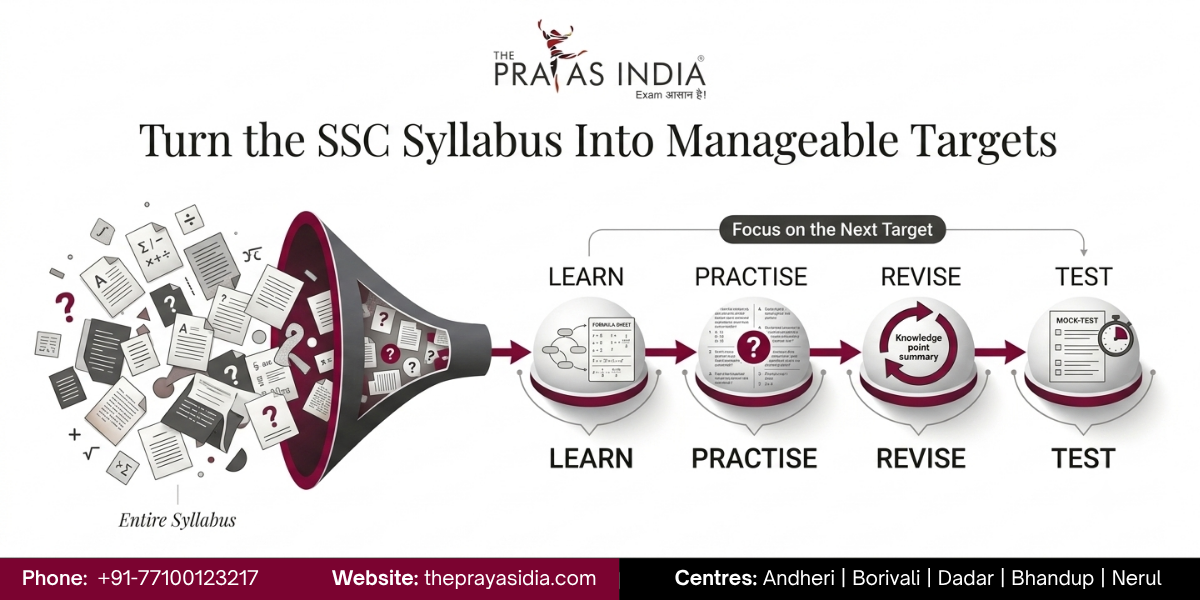
Your weekly plan should account for learning, practice, revision and testing. It should also include some flexibility because real life rarely follows a perfect timetable.
For example, you may dedicate certain sessions to Quant and Reasoning practice, maintain regular English work, revise General Awareness and reserve specific time for mock tests and analysis. The exact distribution will depend on your examination and individual strengths.
The advantage of thinking weekly is that you focus on consistent output rather than perfect daily execution.
Track What You Actually Complete
A preparation plan is useful only when you can see whether it is working.
Instead of maintaining a complicated productivity tracker with dozens of categories, keep a simple record of what you actually complete. Track major topics covered, revision completed, questions solved, mock tests attempted and important mistakes identified.
This creates accountability without turning preparation into an administrative task.
Over several weeks, the record can reveal patterns that are difficult to notice day to day. Perhaps your Quant practice is consistent but English revision keeps getting postponed. Perhaps you are taking many mocks but not analysing them properly. Maybe General Awareness is being pushed to the weekend and therefore not being revised frequently enough.
Once these patterns become visible, you can correct them.
The purpose of tracking is not to make you feel guilty about missed targets. It is to make your preparation more measurable and adjustable.
Revision Is the Anchor of Long-Term Consistency
One of the reasons SSC preparation becomes exhausting is that candidates constantly chase new topics. Every new chapter creates the feeling of progress, but competitive examinations reward what you can actually recall and apply.
Revision provides continuity between different stages of preparation.
A topic that you studied two months ago may feel familiar when you see the notes but may not be immediately accessible when a question appears in a mock test. Regular revision prevents this gap from becoming too large.
This is particularly important in subjects where information accumulates over time. Vocabulary, grammar rules, formulas, concepts and General Awareness facts all benefit from repeated exposure.
A good revision system does not mean reading everything from the beginning every week. It means revisiting important material at planned intervals and giving additional attention to topics that repeatedly cause mistakes.
This approach makes preparation more efficient because every revision cycle strengthens previous learning instead of forcing you to restart.
Don’t Let One Bad Mock Destroy Your Routine
Mock tests are necessary, but they can also affect consistency if candidates attach too much emotion to individual scores.
A low score can make an aspirant question months of preparation. A sudden drop in accuracy can lead to panic. Some students respond by changing their entire strategy overnight, while others temporarily stop taking mocks because they do not want to see another disappointing result.
Neither reaction is particularly useful.
A mock test is a diagnostic tool. Its purpose is to reveal what needs improvement before the actual examination. A low score can be useful if it identifies a weakness that you still have time to fix.
After every mock, separate the result into components. Identify conceptual errors, calculation mistakes, questions lost because of time pressure and questions you could have attempted but skipped. This transforms the test from a judgement of your ability into a source of actionable feedback.
Consistency improves when candidates stop seeing every mock as a verdict and start treating it as part of the preparation process.
The Right Coaching Environment Can Support Consistency
Long-term preparation becomes difficult when the student has to make every decision independently. What should I study today? Which topic should I revise? Which mock should I attempt? Why is my score not improving? How much time should I spend on General Awareness? Should I focus more on speed or accuracy?
A structured coaching environment can reduce some of this decision-making burden.
For aspirants considering SSC coaching in Mumbai, the important question should not simply be whether an institute has experienced teachers. Look at the entire preparation ecosystem. Regular classes, practice material, doubt support, mock tests, performance analysis and revision guidance can all contribute to a more consistent routine.
The Prayas India provides a structured preparation environment for competitive-exam aspirants who want guidance throughout the preparation journey. For SSC candidates, such structure can be particularly valuable when the initial motivation fades and the real challenge becomes maintaining discipline over several months.
Good coaching should not simply tell students to study harder. It should help them understand what to study, how to practise, how to evaluate their performance and how to improve without losing consistency.
Consistency Does Not Mean Never Taking a Break
An important part of sustainable preparation is understanding that rest is not the opposite of consistency.
A candidate who refuses to take any break may initially study intensely but eventually experience exhaustion, declining concentration and reduced productivity. Long-term preparation requires enough recovery to make continued effort possible.
The key is to distinguish between planned recovery and avoidance.
A planned break has a defined purpose and duration. Avoidance usually begins with “I’ll take a short break” and gradually turns into an entire evening or day away from preparation.
Students should therefore allow reasonable flexibility in their schedules without abandoning structure. A lighter study day can still include revision or practice. A genuine rest period can be planned without guilt.
The objective is to build a routine that can continue for months, not one that looks impressive for five days.
Your Preparation Should Become More Stable Over Time
The strongest sign of consistency is not that every day looks perfect. It is that your preparation becomes increasingly stable.
You start fewer sessions with uncertainty. You know what needs revision. You understand your weak areas. You have a regular mock-test routine. You track mistakes. You know how to recover after an unproductive day.
At that point, preparation becomes less dependent on mood.
This stability is particularly valuable in SSC examinations because competition requires sustained performance rather than short-term effort. The candidate who continues improving for six months can often outperform the candidate who studies intensely for a few weeks and then loses momentum.
Consistency is therefore not a separate skill sitting outside SSC preparation. It is the system that allows every other preparation activity to produce results.
Building the Right Preparation System Matters More Than Chasing the Perfect Routine
There is no single timetable that will work for every SSC aspirant. A college student, a working professional and a full-time aspirant may require completely different schedules. Even two students studying for the same examination can have very different strengths and weaknesses.
What they do need is a system that is realistic, measurable and sustainable.
That system should allow you to study regularly, revise what you have learned, practise enough questions, test yourself, analyse mistakes and make adjustments without repeatedly starting over.
If you can build that system independently, use it consistently. If you find yourself struggling to maintain direction or discipline, structured guidance from a reputed SSC coaching institute in Mumbai can help provide the framework you need.
For serious aspirants, The Prayas India offers an organised environment where preparation is designed around learning, practice and performance. The goal is not simply to complete the SSC syllabus but to help students develop the consistency required to stay on track until the examination.
When Motivation Drops, Your System Should Take Over
One of the biggest challenges in long-term SSC preparation is the inevitable decline in motivation. In the beginning, the goal of getting a government job can feel exciting and powerful. Aspirants make ambitious timetables, collect study material and imagine themselves clearing the examination. But after several weeks of the same routine, the excitement naturally reduces. The syllabus may begin to feel repetitive, mock scores may fluctuate and the final result may still seem far away.
This is completely different from failing to have ambition.
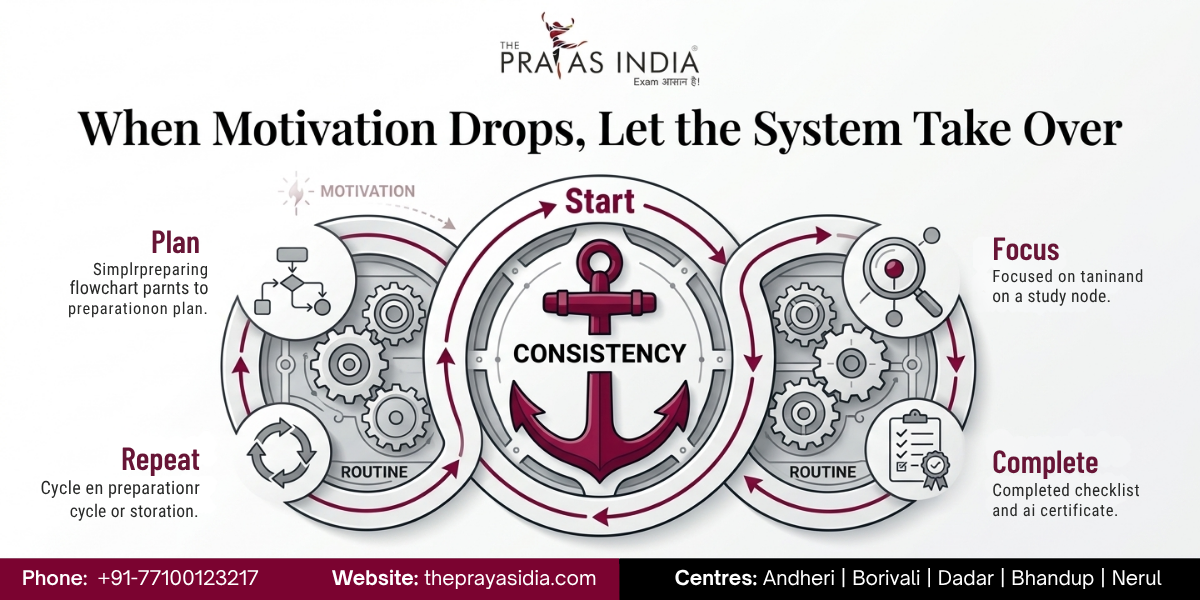
The important thing is to build a preparation system that does not require the same level of motivation every single day. When motivation is high, you can use that energy for additional practice or revision. When motivation is low, the routine should still tell you what needs to be done.
This is where fixed study triggers can help. Studying at a broadly consistent time, beginning with a familiar task and keeping the day’s priorities visible can reduce the mental effort required to start. Once studying becomes part of your normal routine rather than a daily decision, consistency becomes easier.
The objective is not to eliminate difficult days. It is to ensure that difficult days do not completely interrupt your preparation.
Learn How to Recover From Missed Study Days
Every serious SSC aspirant will eventually have an unproductive day. Sometimes it may be because of personal responsibilities, work, college, illness, travel or simply mental fatigue. The problem begins when one missed day becomes a reason to abandon the routine for an entire week.
Candidates often make the mistake of trying to compensate for lost time by creating an unrealistic schedule for the following day. If they missed five hours of study, they decide to study ten or twelve hours the next day. When that plan inevitably becomes difficult to complete, frustration increases.
A better approach is to resume the routine as quickly as possible.
Do not spend excessive time calculating how much preparation you have “lost.” Assess what genuinely needs to be recovered and what can be moved into the next weekly cycle. Some targets may need to be postponed. Others may no longer be equally important.
The ability to restart without guilt is an underrated part of consistency.
A long-term SSC aspirant should not measure discipline by the absence of interruptions. Discipline is also the ability to return to the plan after an interruption.
Handle Backlogs Without Creating More Pressure
Backlogs are common in long-term preparation. A topic takes longer than expected, a week becomes less productive or a new portion is added before the previous one has been fully revised.
The natural reaction is to create a huge backlog list and attempt to finish everything immediately. This often makes the situation worse.
Instead, divide the backlog into three categories: essential, useful and low-priority.
Essential topics are those that have a direct impact on your preparation and cannot reasonably be postponed. Useful topics can be scheduled into upcoming study cycles. Low-priority items can be addressed only if time permits.
This prevents the backlog from controlling your entire schedule.
You should also avoid stopping current preparation completely just because an old topic remains unfinished. If you spend two weeks trying to clear yesterday’s backlog, you may create another backlog in today’s syllabus.
The better solution is to run both processes together: continue the current preparation while gradually clearing the most important older gaps.
Don’t Compare Your Daily Routine With Someone Else’s
Social media has made preparation comparison much easier. Aspirants regularly see students claiming to study ten or twelve hours a day, complete enormous numbers of questions or take multiple mocks every week.
This can create unnecessary pressure.
Another candidate’s schedule may be based on completely different circumstances, preparation level, academic background and available time. Comparing your actual routine with someone else’s carefully presented study schedule does not tell you whether your preparation is progressing.
Your useful comparison is with your previous performance.
Are you solving questions more accurately than a month ago? Are you making fewer repeated mistakes? Is your mock score becoming more stable? Are you revising more effectively? Are you able to complete sections within your intended time?
These indicators provide much more meaningful information than the number of hours another aspirant claims to study.
Long-term preparation becomes healthier when competition is used to inspire improvement rather than create constant anxiety.
Create Accountability Without Creating Fear
Accountability can be extremely useful when preparing for an SSC examination. Knowing that someone will review your progress can make it easier to maintain a routine.
However, accountability should not become another source of stress.
A simple weekly review can be enough. Look at what you planned, what you completed, where you fell short and what needs to change during the next week. If you are preparing with a coaching institute, faculty feedback and test performance can provide another layer of accountability.
The purpose is not to punish yourself for incomplete targets. It is to understand why they were missed.
Perhaps the target was unrealistic. Perhaps too much time was spent on one subject. Perhaps distractions were responsible. Perhaps the study material was not appropriate. Each reason requires a different solution.
Effective accountability asks “What should change?”, not simply “Why didn’t you study enough?”
Use the 80/20 Principle Carefully
Long-term SSC preparation involves a large syllabus, but not every activity has equal value at every stage.
Some topics are fundamental and repeatedly useful. Some question types appear frequently enough to deserve extensive practice. Some weaknesses have a disproportionately large effect on your score. Identifying these high-impact areas can make your preparation more efficient.
However, this does not mean that aspirants should completely ignore less familiar portions of the syllabus based on assumptions about what will appear in the examination.
The practical approach is to prioritise high-value areas while gradually maintaining coverage of the wider syllabus.
For example, if a particular Quant concept repeatedly causes mistakes in your mocks, fixing that weakness may produce more immediate benefit than spending several hours polishing a topic you already solve accurately.
Consistency becomes easier when preparation feels purposeful. You are not simply completing tasks—you understand why each task deserves your time.
Protect Your Revision Cycle
A common long-term preparation mistake is completing a topic and then moving on permanently. Students often spend weeks covering new material while previously studied topics gradually become weaker.
Revision should therefore be built into the preparation cycle from the beginning.
A practical model is to revisit important concepts at increasing intervals. The exact schedule can vary, but the basic idea is simple: study a topic, practise it, revisit it after some time and test whether you can still apply it.
This is particularly important for Quant formulas, English rules, vocabulary, Reasoning approaches and General Awareness.
Revision also provides a psychological benefit. When you regularly revisit older topics, the syllabus feels less like an endless mountain of new information. You can see that previously completed portions are being retained and strengthened.
That sense of continuity can make it easier to remain consistent over several months.
Make Mock Tests a Habit, Not an Event
Many aspirants treat mock tests as something to attempt only after they believe they have “finished the syllabus.” This can delay one of the most valuable sources of performance feedback.
Mock tests should gradually become part of your preparation before the entire syllabus is complete.
Initially, your scores may be low. That is not necessarily a problem. Early tests can reveal weak concepts, poor question selection, inefficient time usage and areas requiring additional practice.
As preparation progresses, mock tests should become increasingly representative of the actual examination.
The most important habit is to analyse them consistently. A test without analysis is primarily a measurement. A test followed by detailed analysis becomes a learning opportunity.
Over time, your mock-test record can show whether the preparation is genuinely improving.
Learn to Recognise Burnout Before It Takes Over
There is a difference between ordinary tiredness and prolonged burnout.
If you occasionally feel tired after a long study session, that is normal. But if concentration remains poor for several days, studying becomes consistently unpleasant, sleep is disrupted and even simple tasks feel excessively difficult, continuing to increase study hours may not solve the problem.
Long-term SSC preparation requires sustainable effort.
Taking a planned break, reducing the intensity temporarily or changing the type of academic task can sometimes help restore concentration. A lighter day focused on revision may be more productive than forcing yourself through hours of difficult problem-solving when your attention is already depleted.
This is another reason why realistic schedules matter. A preparation plan that leaves no room for recovery may work temporarily but become difficult to maintain across many months.
Keep Distractions Outside the Study Process
Consistency does not require complete isolation from technology, social media or entertainment. It requires control over when they enter your study routine.
One of the most common problems is the small interruption that repeatedly breaks concentration. A quick message becomes ten minutes of scrolling. One video leads to another. A short break becomes an hour.
Creating physical and digital boundaries can help. Keep unnecessary notifications away during focused sessions, decide when you will check messages and avoid using entertainment as an automatic response to every difficult question.
The aim is not to eliminate every distraction from your life. It is to stop distractions from controlling your study schedule.
Your Study Environment Matters More Than You Think
A consistent study environment can reduce friction.
If you repeatedly study in the same reasonably organised place, keep frequently used material accessible and prepare your workspace before beginning, you eliminate several small decisions that can otherwise delay the start of a session.
For students attending coaching, the classroom environment itself can provide this structure. Regular classes create fixed learning periods, while peer interaction and faculty presence can make it easier to maintain momentum.
For independent aspirants, creating a similar structure at home or through a dedicated study environment can provide some of the same benefits.
The goal is to make starting preparation easy.
Build a Personal Error Library
One of the most effective ways to combine consistency with improvement is to maintain an error library.
Whenever you repeatedly make a particular mistake, record it in a concise format. This could be a calculation error, a forgotten English rule, a reasoning approach, a question-selection mistake or an important General Awareness fact.
Over time, this collection becomes a personalised revision resource.
Unlike generic study material, it contains exactly the mistakes your preparation is producing. Revising it regularly means you are repeatedly targeting the areas most likely to affect your performance.
This also prevents the frustrating experience of making the same mistake repeatedly without understanding why.
Keep Your Goal Visible, But Keep Your Daily Focus Small
Having a clear long-term goal is important. An SSC aspirant may be preparing for a specific examination because they want a stable government career, professional growth or a particular career path.
But thinking about the final result every day can create unnecessary pressure.
Your long-term goal should provide direction. Your daily task should provide action.
Instead of spending every morning thinking about whether you will clear the examination, focus on what needs to happen today. Complete the planned practice. Revise the scheduled topics. Analyse the mock. Correct the mistakes.
Large goals become achievable through small repeated actions.
This is perhaps the simplest way to understand consistency in competitive-exam preparation.
How The Prayas India Can Support Long-Term SSC Preparation
Long-term SSC preparation becomes easier to manage when students have access to a structured academic environment. Regular classes can provide continuity, while practice sessions, mock tests, faculty guidance and doubt resolution can help aspirants identify and address problems before they become major gaps.
For students looking for the best SSC coaching in Mumbai, the decision should therefore go beyond simply comparing course fees or the number of classes. Aspirants should consider the complete preparation system offered by an institute.
A useful coaching programme should help students build concepts, practise consistently, revise effectively and understand their performance through testing. It should also provide guidance when preparation becomes difficult or a candidate is unsure how to proceed.
The Prayas India focuses on structured competitive-exam preparation and provides an environment designed to help aspirants stay connected with their preparation journey. For SSC aspirants, this kind of structure can be especially valuable because the examination process demands sustained preparation rather than short-term effort.
Joining coaching does not remove the need for self-discipline. Instead, the right coaching environment can make disciplined preparation easier by giving students a clear academic framework, regular practice and measurable performance feedback.
A Simple Long-Term Consistency Framework
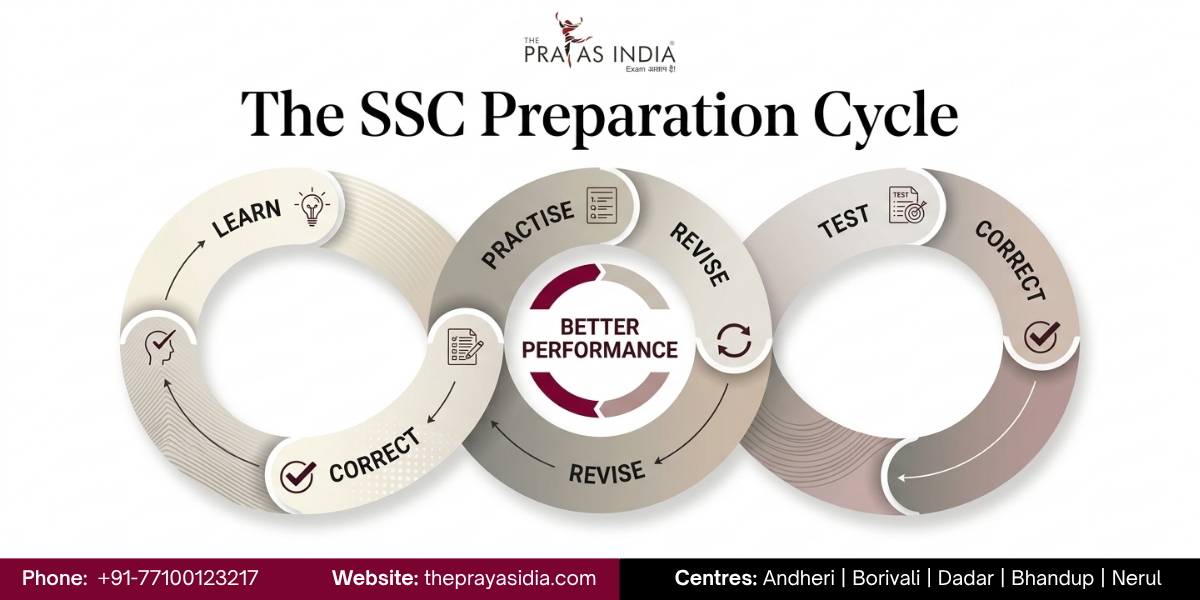
A sustainable SSC preparation cycle can be thought of as five connected actions: Learn, Practise, Revise, Test and Correct.
Learning gives you the concepts required to solve questions. Practice develops familiarity and speed. Revision protects what you have already learned. Testing shows how effectively you can perform under pressure. Correction ensures that the same mistakes do not continue appearing.
If one part of the cycle is missing, preparation can become unbalanced.
A student who only learns may know concepts but lack speed. A student who only practises may repeat conceptual mistakes. A student who takes mocks without analysis may repeatedly lose the same marks. A student who revises without testing may not know whether the knowledge can be applied under pressure.
Consistency means repeatedly completing this cycle over the months leading to the examination.
The Final Test of Consistency Is Staying With the Process
There will be days when your mock score improves dramatically and days when it falls. There will be weeks when the syllabus moves quickly and weeks when progress feels slow. Some topics will feel easy, while others may require repeated practice.
None of these experiences automatically determines the final result.
What matters is whether you continue responding intelligently to them.
A low score should lead to analysis. A missed week should lead to recovery. A weak topic should lead to targeted practice. A motivation drop should lead you back to your routine. A period of fatigue should lead to appropriate recovery rather than unnecessary guilt.
This is what makes long-term preparation different from a short burst of study.
For SSC aspirants, consistency is ultimately about creating a preparation process that can survive ordinary setbacks. You do not need every day to be perfect. You need enough good days, enough recovery after difficult days and enough discipline to keep moving forward.
Conclusion
Clearing an SSC examination requires knowledge, practice, accuracy and examination strategy, but all of these depend on one underlying factor: the ability to prepare consistently over time.
The strongest preparation routine is not necessarily the one with the longest daily study hours. It is the one that can continue through changing motivation, missed days, difficult topics, fluctuating mock scores and the repetitive nature of revision.
Set realistic targets. Build weekly structure. Revise regularly. Analyse your mocks. Track your mistakes. Protect your study time. Take sensible breaks. Most importantly, learn to restart quickly whenever your routine gets interrupted.
If you believe that external structure and expert guidance can make your preparation more organised, choosing the right SSC coaching in Mumbai can provide an additional advantage. The Prayas India offers a structured environment for aspirants who want to approach SSC preparation with planned learning, regular practice and performance-oriented guidance.
The journey may be long, but consistency makes it manageable. You do not have to complete the entire SSC preparation in one day. You only have to keep making meaningful progress—and keep showing up for the next study session.
Contact Us
- Call Now: +91-77100 13217
- Website: theprayasindia.com
- Centres: Andheri | Borivali | Dadar | Nerul | Bhandup