How to Stay Consistent During the Last 60 Days of IBPS Clerk Preparation
The Next 60 Days Can Decide Whether You Clear the IBPS Clerk Prelims or Prepare Again Next Year.
With the IBPS Clerk 2026 Prelims scheduled for 10th and 11th October, the final 60 days of preparation become the most crucial phase of your journey. By now, most aspirants have already covered a significant portion of the syllabus, solved practice questions, and attempted a few mock tests. However, this is also the stage where many candidates unknowingly lose momentum.
Some become overwhelmed by the amount of revision still pending. Others start changing their study plans every week after comparing themselves with toppers or watching different strategy videos online. A few candidates become so focused on completing new topics that they neglect revision, while others spend hours attempting mock tests without analysing their mistakes.
These habits often reduce confidence during the weeks leading up to the examination.
The final 60 days are not about studying everything again from the beginning.
They are about making the most of what you have already learned.
This phase requires discipline, structured revision, regular mock tests, and consistent execution. Aspirants who maintain a stable preparation routine during these two months usually enter the examination hall with greater confidence and better exam temperament than those who keep changing strategies.
The objective is no longer to prepare harder than everyone else.
The objective is to prepare smarter and more consistently every single day until the examination.
Why Consistency Becomes More Important Than Studying Longer Hours
During the early months of preparation, aspirants often experiment with different resources and study schedules. As the examination approaches, however, frequent changes become counterproductive.
The last 60 days should focus on strengthening your existing preparation instead of constantly searching for new methods.
Many candidates make the mistake of dramatically increasing their study hours because the exam is approaching. While the intention is good, this sudden change often leads to fatigue, inconsistent productivity, and eventually burnout.
A more effective strategy is to maintain a realistic daily schedule that you can follow without interruption.
For example:
- Allocate fixed hours for concept revision.
- Reserve daily time for sectional practice.
- Attempt mock tests at regular intervals.
- Analyse every mock carefully before taking the next one.
- Revise short notes instead of repeatedly reading entire books.
This balanced approach allows continuous improvement while preventing mental exhaustion.
Remember, an aspirant who studies productively for eight consistent hours every day usually performs better than someone who studies fourteen hours for only a few days before losing momentum.
Build Momentum Instead of Chasing Perfection
One of the biggest mistakes aspirants make during the final phase of preparation is trying to complete everything perfectly.
They revisit every chapter multiple times, spend excessive time mastering low-weightage topics, or postpone mock tests because they believe they are “not fully prepared.”
Unfortunately, this mindset delays progress.
The IBPS Clerk examination rewards candidates who can perform efficiently within limited time. Therefore, your preparation should also prioritise efficiency over perfection.
A better approach is to focus on continuous momentum.
Each day should include meaningful progress in four essential areas:
- Revision of previously studied concepts.
- Section-wise practice questions.
- Timed speed-building exercises.
- Mock test analysis.
When these four activities become part of your daily routine, preparation remains balanced and productive throughout the final two months.
Avoid the Common Traps That Break Preparation
The weeks before the examination often create unnecessary anxiety.
Many aspirants suddenly begin following multiple YouTube strategies, downloading new PDFs, purchasing additional test series, or switching books because someone else recommended them.
While these resources may be useful individually, introducing them during the final phase often creates confusion rather than improvement.
To remain consistent:
- Continue using the study material that has already helped you progress.
- Limit preparation resources.
- Avoid comparing your daily progress with other aspirants.
- Trust your preparation process.
- Focus on improving your own performance instead of chasing someone else’s schedule.
Consistency is built through repetition, not constant change.
The Final 60 Days Should Follow a Clear Purpose
Every study session during this phase should answer one simple question:
“Will this activity improve my performance in the actual examination?”
If the answer is yes, continue.
If the activity only creates unnecessary stress without measurable improvement, reconsider its importance.
By focusing only on high-impact preparation activities, aspirants maximise productivity while maintaining confidence throughout the remaining weeks.
Structured Guidance Helps You Stay Consistent Until Exam Day
Maintaining discipline during the final 60 days becomes easier when your preparation follows a structured roadmap. Many aspirants lose valuable time because they are unsure whether to revise, practise questions, attempt mock tests, or learn new topics. A well-planned preparation framework removes this uncertainty and allows students to focus on steady improvement.
At The Prayas India, IBPS Clerk preparation during the final phase is organised around structured revision schedules, sectional practice, full-length mock tests, detailed performance analysis, personalised mentoring, and continuous academic support. This systematic approach helps students remain consistent, improve speed and accuracy, and enter the examination with confidence.

Build a Daily Routine You Can Follow Until the IBPS Clerk Prelims
The Final 60 Days Are Not About Studying Randomly. They Are About Following the Same Productive Routine Every Day.
As the IBPS Clerk Prelims approach, many aspirants begin studying for longer hours without a clear structure. They spend one day solving Quantitative Aptitude, another day watching English grammar videos, and the next day attempting a mock test without reviewing it. Although they remain busy throughout the day, this scattered approach often leads to slow improvement because important areas of preparation receive inconsistent attention.
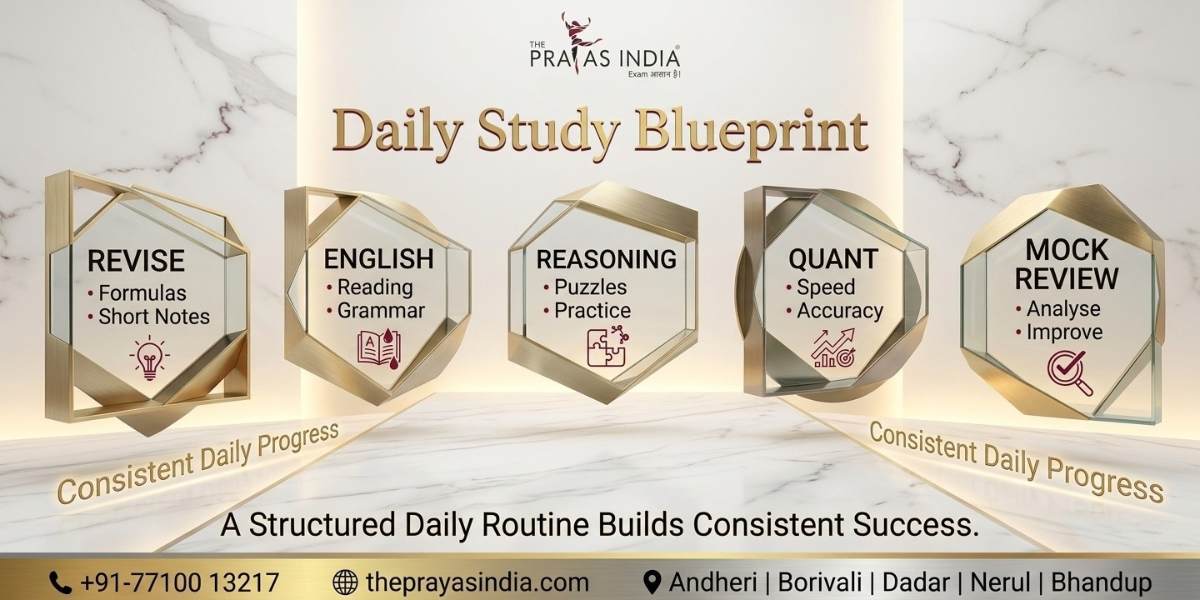
The final phase of preparation demands a disciplined routine where revision, sectional practice, speed building, and mock analysis become recurring habits rather than occasional activities.
A good study plan should not leave you wondering what to study next.
It should already answer that question before your day begins.
Begin Every Day with Revision Instead of New Learning
Many students feel productive when they start the day with a completely new topic.
However, during the last 60 days, retaining previously learned concepts is far more valuable than constantly expanding your syllabus.
Beginning your study session with revision offers several advantages.
It refreshes important formulas, grammar rules, reasoning techniques, and calculation shortcuts before practice begins. More importantly, it strengthens long-term memory and reduces the chances of forgetting concepts during the examination.
Your revision session may include:
- Important Quantitative Aptitude formulas.
- Vocabulary and grammar rules.
- Reasoning puzzles solved earlier.
- Short notes prepared during previous months.
- Frequently repeated examination concepts.
Even sixty to ninety minutes of focused revision every morning can significantly improve recall during the examination.
Allocate Dedicated Time to Every Section
IBPS Clerk Prelims evaluates three sections:
- English Language
- Numerical Ability
- Reasoning Ability
Ignoring one section because another appears stronger is a common mistake.
For example, an aspirant who spends most of the day solving Quantitative Aptitude while neglecting English may later struggle to achieve the overall cut-off despite good mathematical ability.
Instead of studying one subject extensively and postponing the others, distribute your daily preparation wisely.
A balanced routine allows you to strengthen every section gradually while maintaining confidence across the entire examination.
For example:
English Language
Focus on:
- Reading comprehension
- Cloze tests
- Error detection
- Vocabulary revision
- Sentence improvement
Reasoning Ability
Practise:
- Seating arrangements
- Puzzles
- Syllogisms
- Inequalities
- Blood relations
- Coding-decoding
Numerical Ability
Allocate time for:
- Arithmetic
- Simplification
- Number series
- Data interpretation
- Quadratic equations
Balanced preparation ensures that one weak section does not reduce your overall chances of qualifying.
Mock Tests Should Become Part of Your Weekly Routine
Many aspirants postpone full-length mock tests because they believe they should complete the syllabus first.
Unfortunately, this delay often leaves insufficient time to improve examination strategy.
During the final 60 days, mock tests should become a regular part of preparation.
Initially, you may attempt two or three mocks every week.
As the examination approaches, increase the frequency based on your performance and available study time.
However, remember one important principle:
Never allow the number of mock tests to become more important than their analysis.
After every mock, carefully review:
- Questions answered incorrectly.
- Questions skipped despite being easy.
- Sections where excessive time was spent.
- Repeated conceptual mistakes.
- Accuracy percentage.
- Speed of solving.
A mock test without analysis is only half complete.
Improve Speed Without Sacrificing Accuracy
IBPS Clerk Prelims is a speed-oriented examination.
Many candidates know how to solve questions but fail to complete enough attempts within the allotted time.
Improving speed does not simply mean solving questions faster.
It means solving familiar questions efficiently while avoiding unnecessary delays on difficult ones.
Some practical methods include:
- Daily timed sectional practice.
- Mental calculation exercises.
- Formula revision.
- Shortcut techniques where appropriate.
- Learning when to skip lengthy questions.
Speed and accuracy should always improve together.
Increasing attempts while making more mistakes rarely improves the final score.
Review Your Progress Every Weekend
Daily study sessions improve preparation.
Weekly reviews improve your preparation strategy.
At the end of every week, evaluate:
- Which section improved the most?
- Which topics still require revision?
- How many mock tests were attempted?
- Has accuracy improved?
- Is question-solving speed increasing?
- Which mistakes appeared repeatedly?
This weekly review allows timely corrections before small weaknesses become major problems.
Instead of waiting until October to identify gaps, you solve them while there is still enough time to improve.
Structured Preparation Helps You Maintain Daily Discipline
The biggest challenge during the last 60 days is not a lack of study material—it is maintaining a consistent routine without becoming distracted or overwhelmed. A structured preparation environment provides clear daily goals, regular assessments, and continuous feedback, helping aspirants remain focused throughout the final stretch.
At The Prayas India, IBPS Clerk preparation follows a systematic schedule combining concept revision, sectional practice, speed-building exercises, regular mock tests, detailed performance analysis, and personalised mentorship. This organised approach enables students to improve steadily while remaining confident and consistent until the examination.
Avoid the Habits That Break Your Momentum During the Final 60 Days
Most Aspirants Don’t Lose the IBPS Clerk Exam Because They Stop Studying. They Lose It Because Their Preparation Becomes Inconsistent at the Most Important Time.
As the IBPS Clerk Prelims draw closer, preparation naturally becomes more intense. Every day feels valuable, and many aspirants begin measuring their progress against friends, online discussions, Telegram groups, or YouTube strategy videos. While staying informed can be useful, excessive comparison often creates confusion rather than confidence.
Interestingly, the biggest challenge during the last 60 days is rarely the syllabus itself.
It is maintaining the discipline to follow one structured plan without being distracted by every new strategy that appears online.
The aspirants who eventually clear the examination are usually not those who study the highest number of hours. They are the ones who protect their preparation from unnecessary interruptions and continue improving steadily until exam day.
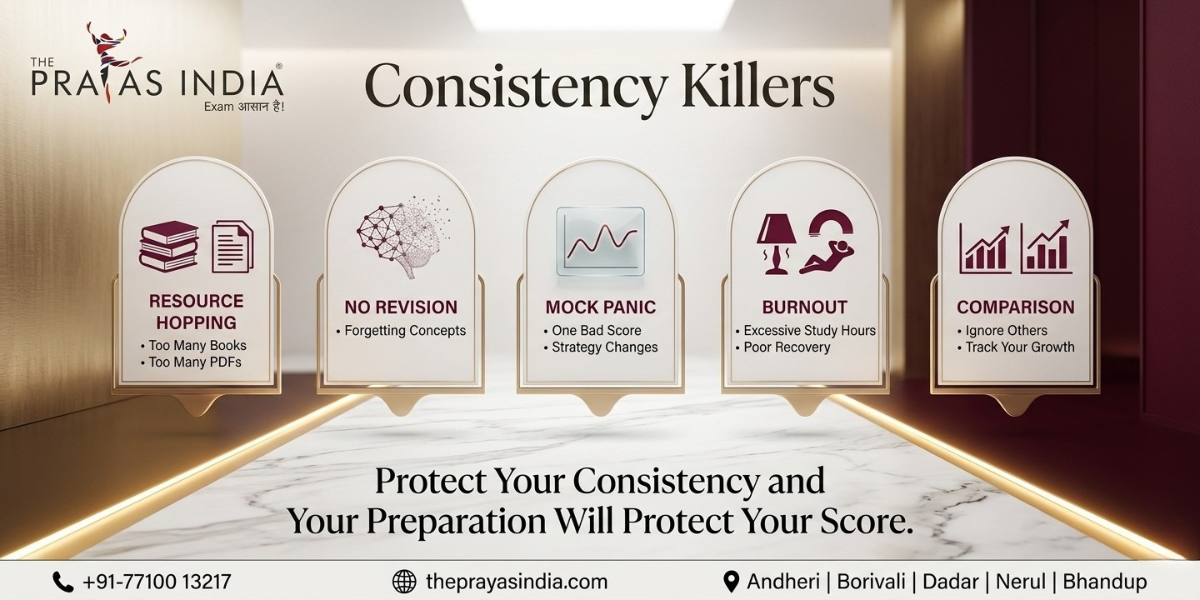
Consistency during these weeks is built by avoiding a few common habits that silently reduce productivity.
Stop Changing Study Material at the Last Moment
One of the most common mistakes before competitive examinations is the sudden urge to collect new resources.
Aspirants begin downloading fresh PDFs, purchasing additional test series, watching multiple faculty members for the same topic, and switching books because someone claims a different resource is “better.”
Although every new resource appears promising, changing study material this late often creates unnecessary confusion.
Instead of strengthening concepts, students spend valuable time adapting to new teaching styles and unfamiliar question patterns.
During the last 60 days, your focus should shift from collecting information to mastering the material you already have.
Continue revising the notes, books, and practice sets that have supported your preparation so far.
Consistency grows when resources remain stable.
Do Not Ignore Revision While Chasing New Topics
Many aspirants feel uncomfortable revising because revision does not create the same sense of progress as completing a new chapter.
As a result, they continue studying fresh topics while gradually forgetting concepts they learned weeks earlier.
For IBPS Clerk, this approach becomes risky because the examination rewards quick recall.
Whether it is a simplification shortcut, a grammar rule, or a reasoning pattern, you should be able to recognise and solve familiar questions almost instantly.
Build revision into your daily schedule.
Instead of revising only when you have “free time,” make it a compulsory part of your routine.
A simple practice that works well is maintaining concise revision notes containing:
- Important Quant formulas.
- Arithmetic shortcuts.
- English grammar rules.
- Vocabulary lists.
- Reasoning techniques.
- Frequently repeated mistakes.
These notes become extremely valuable during the final weeks before the examination.
Do Not Let One Poor Mock Test Destroy Your Confidence
Almost every serious aspirant experiences a disappointing mock test during preparation.
Some mocks are intentionally difficult.
Some expose genuine weaknesses.
Others simply reflect an off day.
The problem begins when students assume that one poor score represents their final examination performance.
Immediately after a low mock score, many aspirants:
- Change their entire study plan.
- Stop attempting mocks for several days.
- Begin doubting their preparation.
- Compare their scores with everyone else.
- Lose confidence unnecessarily.
A much healthier approach is to treat every mock as feedback.
Ask questions such as:
- Which section reduced my score?
- Were my mistakes conceptual or careless?
- Did poor time management affect my performance?
- Which questions should I have skipped?
- What will I improve before the next mock?
This mindset converts disappointment into measurable progress.
Avoid Burnout During the Final Phase
Long study hours do not automatically produce better results.
In fact, many aspirants experience burnout because they suddenly double their study hours after August, believing that more time always means better preparation.
Initially, this approach appears productive.
Within a few days, however, concentration begins falling, revision becomes ineffective, and motivation decreases.
Instead of pushing yourself beyond your capacity, create a routine that you can maintain every day.
A sustainable schedule should include:
- Focused study sessions.
- Short revision breaks.
- Mock practice.
- Physical movement or light exercise.
- Adequate sleep.
Your brain performs significantly better when it receives regular recovery rather than continuous overload.
Remember, consistency is impossible without maintaining both physical and mental energy.
Measure Improvement Instead of Comparing Yourself with Others
Competitive examinations naturally encourage comparison.
Students compare:
- Mock scores.
- Number of study hours.
- Completed syllabus.
- Test series rankings.
- Daily targets.
While occasional comparison may provide perspective, constant comparison often damages confidence.
The only comparison that truly matters is with your previous performance.
Every week, ask yourself:
- Has my accuracy improved?
- Am I solving questions faster?
- Are fewer mistakes being repeated?
- Is my confidence increasing during mock tests?
If the answer is yes, your preparation is moving in the right direction.
Steady personal improvement is far more valuable than temporary comparisons with others.
Stay Focused on Prelims While Building a Strong Base for Mains
Although the immediate objective is clearing the IBPS Clerk Prelims, aspirants should avoid preparing in a way that leaves them unprepared for the Mains examination.
For example:
- Improve reading habits while preparing English.
- Strengthen arithmetic concepts instead of memorising shortcuts alone.
- Build logical thinking through quality reasoning practice.
- Stay connected with current affairs so that Mains preparation becomes easier later.
A balanced approach ensures that clearing Prelims becomes the beginning of your preparation rather than a completely separate phase.
Expert Mentorship Helps You Maintain Momentum
Maintaining consistency becomes easier when experienced mentors regularly monitor your preparation. Many aspirants lose valuable time simply because they are unsure whether they should revise, attempt mocks, practise sectional tests, or focus on speed improvement. Structured academic guidance removes this uncertainty and keeps preparation aligned with the examination timeline.
At The Prayas India, the final phase of IBPS Clerk preparation is supported through personalised mentorship, structured revision plans, regular mock tests, detailed performance analysis, speed-building practice, and continuous faculty guidance. This organised learning environment helps students stay disciplined, improve steadily, and approach the examination with greater confidence.
Consistency Over the Next 60 Days Can Change Your Result on Exam Day
Success in IBPS Clerk Is Rarely Determined by What You Study in the Final Week. It Is Determined by What You Consistently Do Every Day During the Final Two Months.
As the IBPS Clerk Prelims approach, it is natural to feel pressure. Every aspirant wants to improve speed, accuracy, and confidence before the examination. Some worry about unfinished topics, while others become anxious after a few disappointing mock tests.
At this stage, remember one important fact.
You do not need a completely new strategy.
You need disciplined execution of the strategy that already works.
The final 60 days are about strengthening your preparation, not constantly rebuilding it. Every revision session refreshes concepts. Every sectional test improves speed. Every mock test teaches better decision-making. Every analysed mistake increases the probability of avoiding that mistake on the actual examination.
The aspirants who remain calm, organised, and consistent during these weeks usually enter the examination hall with greater confidence than those who spend the final days searching for shortcuts.
Instead of asking yourself whether you have studied enough, ask whether you have used each day effectively.
Consistent preparation transforms average study hours into excellent examination performance.
Frequently Asked Questions About the Last 60 Days of IBPS Clerk Preparation
Should I start new topics during the final 60 days?
If an important topic is completely untouched, learn its fundamentals. However, avoid spending excessive time mastering low-weightage or advanced concepts at this stage. Revision and practice should receive greater priority than expanding the syllabus.
How many mock tests should I attempt every week?
Most aspirants benefit from attempting two to four full-length mock tests every week, depending on their preparation level.
More importantly, every mock should be followed by detailed analysis. Reviewing mistakes, time management, and question selection contributes more to improvement than simply increasing the number of mocks.
What should I do after a poor mock test score?
Do not panic or change your entire preparation strategy.
Instead:
- Identify the sections that reduced your score.
- Classify conceptual and careless mistakes.
- Improve weak topics through targeted practice.
- Apply the changes in the next mock.
One poor mock is feedback—not a prediction of your final result.
How much revision should I do every day?
Revision should become a daily habit.
Whether you study for six hours or ten hours, dedicate a fixed portion of your schedule to revising formulas, grammar rules, reasoning techniques, vocabulary, and previously solved questions. Frequent revision improves recall and builds confidence during the examination.
Should I prepare for Mains before clearing Prelims?
Your primary focus should remain on the Prelims because qualifying it is the immediate objective.
However, while preparing English, Quantitative Aptitude, and Reasoning, strengthen your concepts instead of relying only on shortcuts. This balanced approach provides a smoother transition to the Mains examination after the Prelims.
Daily Consistency Checklist
Before ending each study day, review your preparation using this simple checklist.
Revision
✓ Revised important formulas and short notes.
✓ Reviewed grammar rules and vocabulary.
✓ Strengthened previously studied concepts.
Practice
✓ Solved sectional practice questions.
✓ Improved speed through timed exercises.
✓ Focused on accuracy instead of random attempts.
Mock Test Review
✓ Attempted a mock or sectional test as planned.
✓ Analysed mistakes carefully.
✓ Updated observations in the mock journal.
Planning
✓ Identified weak topics.
✓ Planned tomorrow’s study schedule.
✓ Avoided unnecessary changes to study material.
Following this checklist consistently ensures that every day contributes directly to your examination performance.
How Structured Mentorship Keeps You on Track
Maintaining consistency becomes easier when experienced mentors provide clear academic direction. Many aspirants lose valuable preparation time because they remain uncertain about whether to revise, practise questions, improve speed, or attempt more mock tests. A structured preparation plan removes this uncertainty and allows students to focus on meaningful progress every day.
At The Prayas India, the last phase of IBPS Clerk preparation is carefully designed around structured revision schedules, regular mock tests, detailed performance analysis, personalised mentoring, speed-building exercises, and continuous academic support. Students receive guidance not only on improving scores but also on maintaining consistency, confidence, and examination readiness throughout the final weeks before the Prelims.

Admission Scorecard
The final 60 days before the IBPS Clerk Prelims are often the difference between qualifying comfortably and missing the cut-off by a few marks. During this phase, students need more than study material—they need a structured plan, expert feedback, regular practice, and the discipline to follow a proven preparation strategy.
At The Prayas India, students receive a complete preparation ecosystem designed specifically for IBPS Clerk success:
Why Choose The Prayas India for IBPS Clerk Preparation?
- Experienced Banking Exam Faculty
- Structured 60-Day Revision Plan
- Regular Full-Length Mock Tests
- Detailed Mock Test Analysis
- Section-Wise Speed & Accuracy Improvement
- Personalised Mentorship and Doubt Solving
- Daily Practice Sessions
- Performance Tracking with Expert Feedback
- Preparation Support for Both Prelims and Mains
- Motivating Learning Environment Focused on Selection
If your goal is not just to appear for the IBPS Clerk examination but to secure a bank job, learning under expert guidance can help you maximise your preparation during these crucial final weeks.
Conclusion
The last 60 days before the IBPS Clerk Prelims are not about studying endlessly or experimenting with new strategies. They are about refining what you already know, strengthening weak areas, improving speed and accuracy, and building the confidence required to perform well on the actual examination.
A consistent daily routine that includes revision, sectional practice, mock tests, and detailed analysis will always produce better results than irregular bursts of intensive study. Small improvements made every day accumulate into significant progress by the time you enter the examination hall.
Stay committed to your plan, trust the preparation process, and avoid distractions that shift your focus away from your goals. The effort you invest consistently over these final weeks can become the foundation of your banking career.
Contact Us
📞 Call: +91-77100 13217
🌐 Website: https://theprayasindia.com