IBPS Clerk Mains Last 30 Days Strategy | Best Bank Coaching in Mumbai | The Prayas India
The final 30 days before the IBPS Clerk Mains examination can completely change the way an aspirant approaches preparation. At this stage, the objective should no longer be to keep adding new topics endlessly. The focus has to shift towards revision, question selection, mock-test performance, current affairs consolidation and fixing the weaknesses that can cost marks in the actual examination.
This phase is particularly important because the Mains examination demands a broader level of preparation than simply clearing the basics. Candidates need to manage multiple sections, deal with a larger variety of questions and maintain accuracy while working under considerable time pressure. A student may have completed the syllabus several weeks earlier and still struggle in Mains if revision is unstructured or mock-test performance is not analysed properly.
The last 30 days should therefore be treated as a conversion period—the stage where the knowledge accumulated during months of preparation is converted into examination performance. Instead of measuring progress only by the number of chapters completed, aspirants should start measuring progress through mock scores, accuracy, time management, revision efficiency and their ability to handle unfamiliar questions.
For candidates who are still looking for structured guidance at this stage, joining a focused bank exam coaching programme in Mumbai can also be useful. Professional guidance can help bring discipline to the final month, particularly when an aspirant knows the syllabus but is unsure how to prioritise revision, mocks and weak areas.
The Last 30 Days Are Not the Time for Random Preparation
One of the biggest mistakes candidates make during the final month is trying to study everything simultaneously. A typical day may begin with a new Quant topic, move to an unfamiliar Reasoning chapter, shift to current affairs, then include several hours of video lectures and finally leave very little time for actual practice.
This creates the feeling of being busy without necessarily improving examination performance.
By the time only 30 days remain, your preparation should become increasingly selective. Topics that you already understand should be revised efficiently rather than relearned from scratch. Areas where you repeatedly make mistakes should receive more attention. Topics that are extremely time-consuming and contribute very little to your overall preparation should not automatically consume hours simply because they appear difficult.
The final month is about prioritisation. You need to know where an additional hour of preparation is most likely to improve your score.
A candidate who spends two hours revising a strong topic may feel productive, but those same two hours could potentially be more valuable if used to analyse three mock tests, revise financial awareness or work on a recurring calculation weakness. This is why a personalised final-month strategy is far more effective than following a generic daily timetable without considering actual performance.
Start With a Performance Audit
Before designing your final 30-day plan, take a realistic assessment of where you currently stand. If you have been taking mock tests, review your recent performance rather than relying on memory or assumptions.
Look beyond the overall score. Examine your accuracy, section-wise performance, time spent on different question types, unanswered questions and recurring mistakes. A low score caused by weak concepts requires a different solution from a low score caused by poor time management.
For example, if your Reasoning score is relatively strong but you consistently lose time on lengthy sets, your preparation requirement is not necessarily more Reasoning theory. You may need to improve set selection and practise solving under a time limit. Similarly, if your General/Financial Awareness performance is weak because you have not revised consistently, adding more Quant practice may not address the actual problem.
This performance audit should become the starting point for the final month.
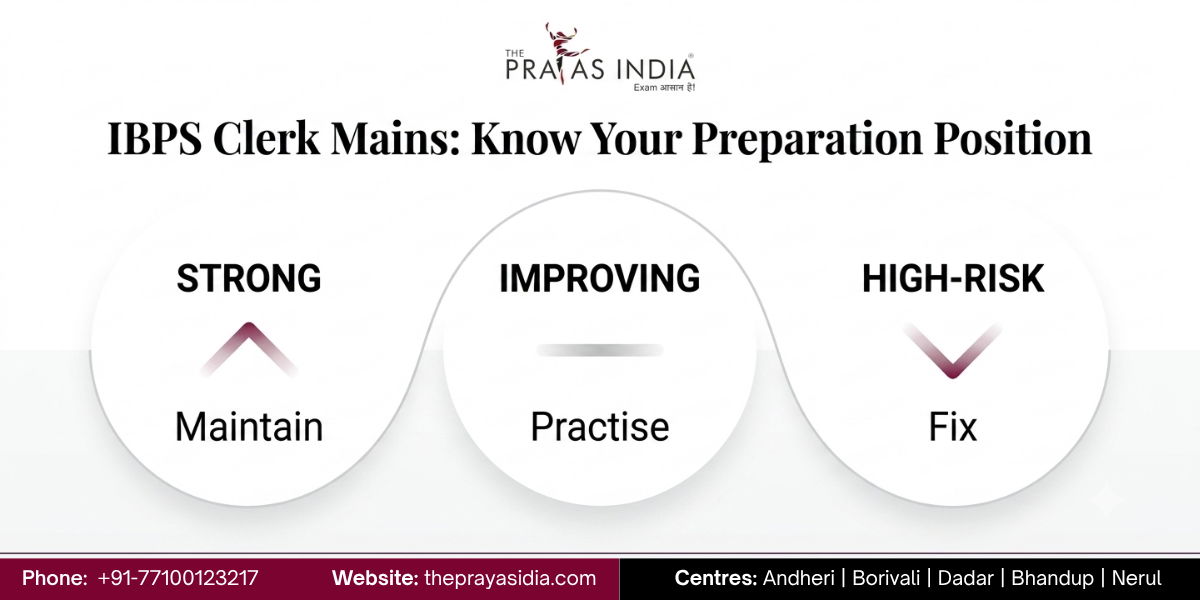
It is also useful to divide your preparation into three categories: strong areas, improving areas and high-risk areas. Strong areas need maintenance. Improving areas deserve regular practice. High-risk areas require targeted intervention, but they should not consume the entire month.
This simple classification prevents candidates from spending disproportionate time on one difficult topic while neglecting areas where marks can be gained more efficiently.
Revision Should Become the Centre of Your Preparation
During the last 30 days, revision needs to become much more systematic. Reading the same material repeatedly is not enough. The purpose of revision is to make important concepts, formulas, rules and facts accessible when you are under examination pressure.
For Quantitative Aptitude, revision should include important formulas, calculation techniques and frequently tested concepts, followed by timed question practice. For Reasoning, revise the approaches used for common question types and focus particularly on the sets where you tend to lose time. For English, revision should reinforce grammar concepts, vocabulary, reading ability and frequently encountered question patterns.
General and Financial Awareness require a different revision approach. Instead of continuously consuming new information, candidates should consolidate what they have already studied and repeatedly revise high-value current affairs and banking-related information. The final month is not about collecting an unlimited number of facts; it is about improving recall.
This is also where concise revision material can become valuable. Candidates should gradually build a compact revision system rather than repeatedly going through large volumes of material. The closer the examination gets, the faster you should be able to revise important information.
Don’t Let Current Affairs Become a Last-Week Task
General and Financial Awareness can become one of the most decisive areas in Mains, but many candidates postpone serious revision until the final few days. That creates unnecessary pressure and often results in superficial reading rather than meaningful recall.
The last 30 days should include regular current-affairs revision. Divide your material into manageable sections and revisit it repeatedly. Banking awareness, financial terminology, important appointments, government initiatives, reports, indices, economic developments and other relevant current events should be revised in an organised manner.
The important distinction is between reading and remembering. Simply scrolling through current-affairs capsules can create the impression that preparation is progressing. But the real test is whether you can recall the information without looking at the answer.
Short self-tests, quizzes and repeated revision can make this process more effective. If a particular category of information repeatedly disappears from memory, mark it for another revision rather than assuming that reading it once more will automatically solve the problem.
A structured coaching programme can be particularly useful here because faculty-curated revision and exam-oriented material can reduce the amount of time students spend deciding what information deserves attention.
Mock Tests Should Increase, but Analysis Matters More
As the examination approaches, mock tests should become an increasingly important part of preparation. However, simply increasing the number of mocks is not enough.
A candidate can take twenty mock tests and still make the same mistakes if none of those tests are analysed properly.
After every full-length mock, identify where marks were lost and why. Was the question conceptually unfamiliar? Did you misread it? Did you make a calculation error? Did you spend too much time on another question? Did you leave an easy question because you reached the section too late? Did you change a correct answer unnecessarily?
These questions turn a mock test into a learning tool.
A useful approach is to maintain a mistake log throughout the final month. The purpose is not to create another enormous notebook. Keep it concise. Record recurring errors, formulas you forget, question types that consume excessive time and important lessons from mock analysis.
By the final week, this mistake log can become more valuable than repeatedly attempting questions without reviewing them.
The Difference Between a Mock Score and Mock Readiness
A high mock score is encouraging, but it should not automatically create confidence that the examination preparation is complete. Similarly, one low score should not cause panic.
Mock tests vary in difficulty and question distribution. What matters more is the trend in your performance.
If your scores are gradually becoming more consistent, your accuracy is improving and you are making fewer strategic errors, your preparation is moving in the right direction. If your score fluctuates heavily because one section repeatedly collapses, that section needs immediate attention.
Candidates should also compare their attempts with their accuracy. Increasing attempts while making significantly more mistakes may indicate that speed is improving at the expense of control. On the other hand, extremely high accuracy with very low attempts may indicate that the candidate is being overly cautious.
The ideal final-month preparation should gradually move you towards a balance where you can make confident decisions under time pressure.
Build a “Must Revise” List Instead of a Huge Syllabus List
A common problem in the final month is the feeling that the syllabus is still enormous. Looking at a complete syllabus every morning can create anxiety because it reminds you of everything that could potentially be studied.
Instead, create a Must Revise List based on your actual preparation.
Include formulas and concepts that you frequently forget, question types where you make repeated mistakes, important current-affairs categories, banking awareness topics and mock-test lessons that need reinforcement.
The purpose of this list is not to replace your entire study material. It is to create a compact control panel for the final month.
Every time you complete a revision cycle, remove or update items instead of continuously adding more. This creates visible progress and prevents the final weeks from becoming an endless accumulation of study material.
Your Daily Preparation Should Have a Clear Purpose
The final 30 days should not necessarily mean studying for an extreme number of hours every day. More important than the raw number of hours is whether those hours have a defined purpose.
A productive day could include concept revision, timed practice, current-affairs revision, mock-test analysis and targeted work on one weak area. Another day may be dedicated more heavily to a full-length mock and detailed analysis.
The structure can change according to your performance. What should remain consistent is the connection between practice and feedback.
If you spend three hours solving questions but do not examine your mistakes, the learning value of those three hours is limited. If you spend an hour analysing why you repeatedly lose marks in a particular area and then practise specifically around that weakness, the impact can be considerably greater.
This is one of the reasons serious aspirants often benefit from a structured preparation environment. A coaching institute can provide a framework within which study, testing, revision and feedback are connected instead of being treated as separate activities.
The Final Month Is Also About Avoiding Preparation Overload
Another important aspect of the last 30 days is knowing what not to do.
Candidates often respond to examination pressure by increasing the number of resources they use. They download new PDFs, join multiple test series, watch different teachers for the same topic and collect several current-affairs compilations. Instead of making preparation stronger, this can create confusion.
At this stage, consistency is generally more valuable than resource accumulation.
Choose reliable study material and stick with it. If a concept is weak, identify one dependable source for learning it and then practise. If you are using a mock-test series, analyse it properly rather than constantly switching between platforms.
The final month should feel increasingly organised. Every week should make your preparation narrower, sharper and more exam-oriented.
Structured Guidance Can Make the Final 30 Days More Productive
For some aspirants, the biggest challenge in the final month is not a lack of effort but a lack of direction. They study for long hours but cannot decide how much time should go toward mocks, current affairs, revision or weak subjects.
This is where a focused banking coaching programme can add value. The benefit is not simply attending classes. A good preparation system can help candidates understand priorities, receive faculty guidance, practise through structured tests and identify performance gaps before the actual examination.
For students searching for the best bank coaching in Mumbai, the final month is a particularly important time to evaluate what an institute actually offers. Faculty support, test quality, revision planning, doubt resolution and performance analysis can matter considerably more than simply having a large quantity of study material.
The Prayas India provides a structured preparation environment for banking aspirants who want to approach competitive examinations with a planned and performance-oriented strategy. For candidates entering the final 30 days, the objective should be to use every remaining week intelligently rather than simply increasing study hours.
Think of the Final 30 Days as Four Different Weeks
Although the entire period is often referred to as one final month, treating all 30 days in exactly the same way is not ideal. Your priorities should gradually change as the examination approaches.
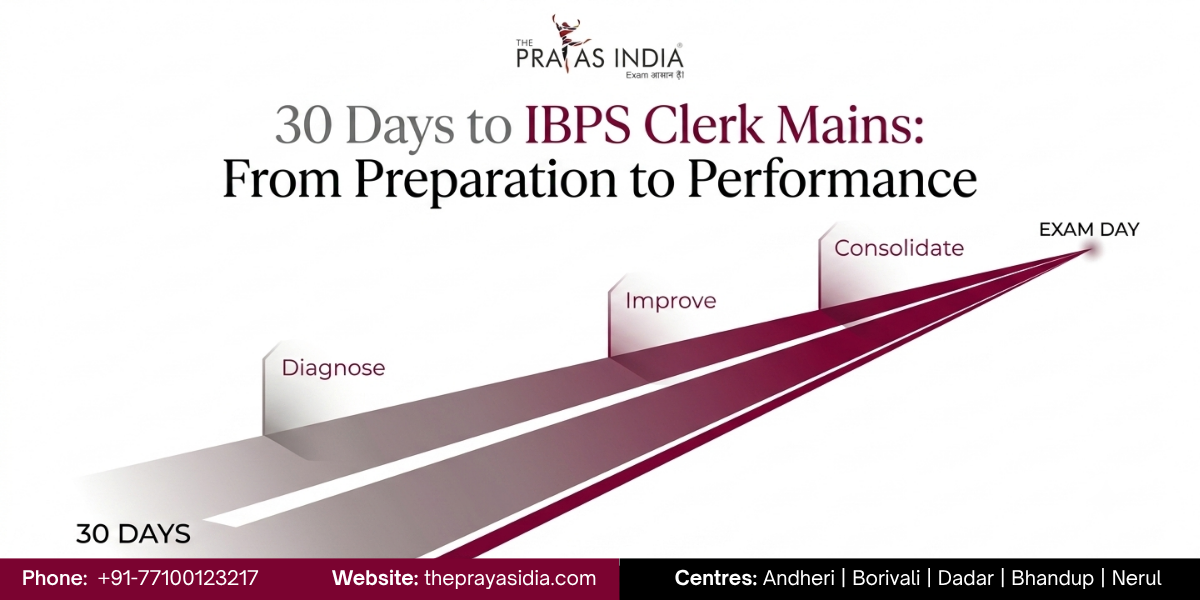
The first part of the final month should focus on identifying weaknesses, consolidating concepts and establishing a reliable mock-test and revision routine. You still have enough time to repair meaningful gaps, so this is the stage to address problems before they become last-week emergencies.
The middle portion should become more performance-oriented. Full-length mocks, sectional practice, current-affairs revision and targeted improvement should occupy a larger share of your preparation. By this point, you should have a much clearer idea of the question types and sections that affect your score most.
The final week should be about consolidation rather than experimentation. Avoid suddenly introducing unfamiliar resources or completely changing your strategy. Revise your compact notes, important current affairs, formulas, recurring mistakes and mock-test lessons. The aim is to enter the examination with clarity rather than information overload.
This gradual shift—from diagnosis to improvement to consolidation—is what makes the final 30 days different from the earlier stages of preparation.
The Right Strategy Can Turn 30 Days Into a Performance Advantage
Thirty days may appear short when you look at the entire IBPS Clerk Mains syllabus, but it can be a meaningful period when used with precision. You do not need to rebuild your entire preparation. You need to identify the gaps between your current performance and the performance required on examination day.
That means spending less time worrying about how much is left and more time understanding what can still be improved.
Aspirants who use the final month for focused revision, regular mock testing, current-affairs consolidation and targeted correction of weaknesses can enter the examination with considerably more control over their preparation. Those who continue studying without analysing performance may find themselves repeating the same mistakes until the final day.
For students who feel that they need expert direction during this crucial stage, professional bank exam coaching in Mumbai can provide a structured route from preparation to performance. The right guidance can help you prioritise what matters, avoid unnecessary resource overload and use the remaining days more effectively.
The goal of the last 30 days is not to study everything. It is to make sure that the things you have studied can actually translate into marks when the clock starts.
The Last 15 Days Should Be About Consolidation
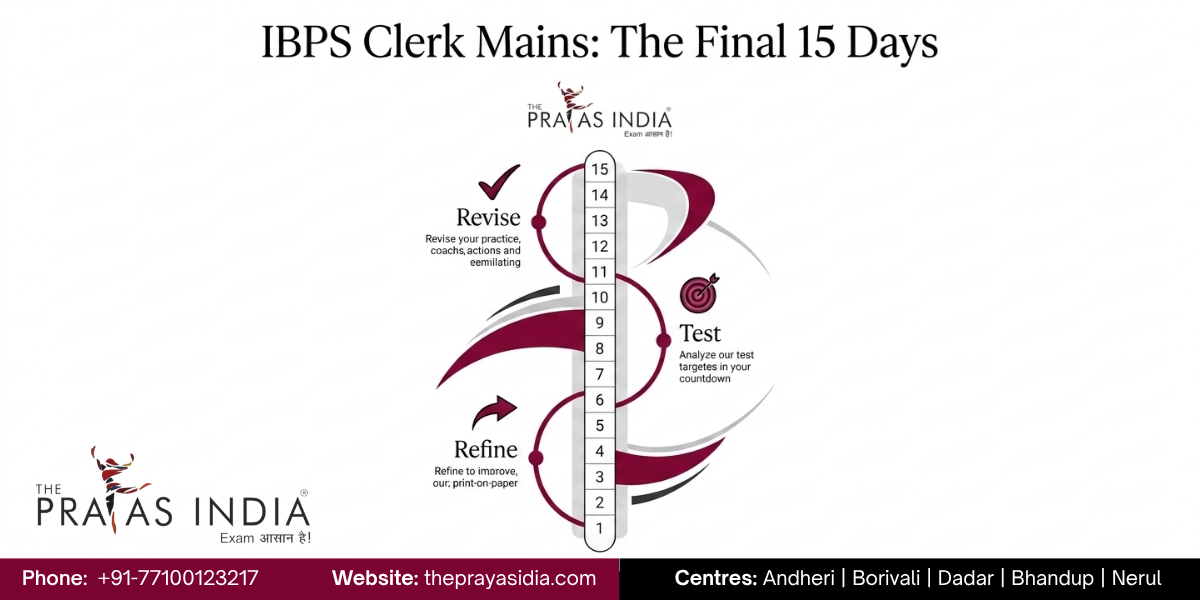
Once you enter the final 15 days, the nature of your preparation should change again. By this stage, most of the major concepts should already have been covered, and your attention should increasingly move towards revision, mock tests, current-affairs recall and eliminating recurring mistakes.
This is not the ideal time to begin studying every difficult topic you have avoided throughout your preparation. There may still be a few important gaps that need attention, but the focus should be on topics that can realistically improve your performance within the remaining time.
Your preparation should become more selective with every passing day. Instead of asking, “What else can I study?”, start asking, “What can I revise better, recall faster or solve more accurately?”
This change in mindset is important because the final two weeks can easily disappear in resource collection and unplanned revision. A candidate who spends the first 15 days of the final month building a foundation and the last 15 days consolidating it will generally be in a much stronger position than someone who continues changing their preparation strategy until the examination.
Full-Length Mocks Should Simulate the Real Examination
During the final two weeks, full-length mock tests should become a serious part of your preparation. However, a mock test is useful only when you attempt it under realistic conditions.
Avoid pausing the test, checking solutions midway or taking unnecessary breaks. Sit through the complete test as though it were the actual examination. This helps you understand not only your knowledge level but also your concentration, decision-making ability and ability to maintain accuracy when fatigue begins to appear.
After completing the mock, spend meaningful time analysing it. If the test took one hour or more to attempt, the analysis should not be completed in a few minutes. Review the questions you got wrong, the questions you left unanswered, the questions that consumed excessive time and the questions where you changed an initially correct answer.
The most valuable question after a mock is not simply, “What was my score?” It is, “What should I do differently in my next mock?”
That question turns every test into a preparation cycle.
Use Mock Tests to Finalise Your Question Selection Strategy
The final 15 days are also the right time to finalise how you approach different sections. You should already have enough mock-test data to understand where you perform best and where you tend to lose time.
Suppose you repeatedly discover that certain Reasoning sets consume too much time. Your final strategy should account for that. If your Quant attempts improve considerably when you begin with simpler questions, that pattern should become part of your examination approach. If English is your fastest section, you should know how to use that strength without becoming careless.
There is no requirement to copy a strategy used by another aspirant. Your strategy should be based on your own performance data.
This is one of the strongest arguments for taking multiple full-length tests before the examination. A strategy that sounds good in theory may not work for you in practice. Mock tests give you the opportunity to experiment when the consequences are limited.
By the final week, however, experimentation should reduce. You should have a dependable approach that you have already tested several times.
Current Affairs Revision Should Become More Frequent
The importance of General and Financial Awareness in the IBPS Clerk Mains examination means that current affairs revision should occupy a meaningful place in your final preparation.
At this stage, repeated revision is more useful than continuously searching for new information. You should aim to move through your current-affairs material multiple times, with particular attention to banking, financial and economy-related developments as well as other important national and international events relevant to the examination.
Active recall can make revision significantly more effective. Instead of simply reading a monthly capsule from beginning to end, pause and try to remember the answer before checking it. Questions, quizzes and short self-tests can help identify information that you recognise while reading but cannot actually recall independently.
That distinction becomes extremely important in an examination. Recognition while reading creates confidence; recall under pressure produces marks.
Candidates should also maintain a short list of repeatedly forgotten facts. These can be revised more frequently during the final week instead of repeatedly going through everything at the same intensity.
Financial Awareness Deserves Targeted Revision
Candidates preparing for IBPS Clerk Mains should not treat financial awareness as an extension of general current affairs. Banking terminology, financial institutions, important banking developments, monetary-policy-related concepts and other relevant areas require focused revision.
The objective is not to become an expert in every financial topic. It is to develop sufficient familiarity with the areas that are relevant to the examination and revise them often enough to improve recall.
This is another area where structured guidance can save preparation time. When students are preparing independently, deciding what to prioritise can become difficult because current affairs and banking awareness are extremely broad. A well-organised coaching programme can help aspirants approach revision in a more focused manner.
For candidates considering bank exam coaching in Mumbai, the quality of revision guidance should therefore be one of the factors considered before enrolling. The right institute should help students understand not just what to study but how to revise it efficiently.
Do Not Ignore Sectional Practice
Full-length mocks are essential, but they should not completely replace sectional tests during the final month.
A sectional test allows you to isolate a specific problem. If your Quant speed is weak, a targeted sectional test can help you work specifically on that issue. If Reasoning accuracy falls whenever you encounter certain sets, sectional practice can give you repeated exposure without the pressure of the complete paper.
The two forms of testing serve different purposes. Full-length mocks help you practise the complete examination experience, while sectional tests help you repair specific weaknesses.
A balanced final strategy should therefore use both. Your preparation should gradually move from fixing individual problems to ensuring that those improvements survive under full-exam conditions.
The Final Week Should Be Calm, Not Chaotic
The final week is where many candidates unintentionally damage their preparation. Anxiety encourages them to change teachers, start new books, download new PDFs and attempt extremely difficult questions simply because the examination is close.
This is rarely productive.
Your final week should be about consolidation. Revise your short notes, formulas, important concepts, current affairs, banking awareness and recurring mistakes. Continue with carefully selected mocks or sectional practice, but avoid exhausting yourself through excessive testing.
Sleep and concentration also become part of preparation at this stage. An aspirant who studies late into the night every day and reaches the examination exhausted may not be able to perform at the level reflected in their mock scores.
The objective of the final week is to arrive at the examination with a clear and stable preparation system. You should know what you have studied, how you approach questions and how you respond when a section becomes difficult.
Avoid Changing Your Strategy on Examination Day
One of the most damaging mistakes an aspirant can make is abandoning a tested strategy because the first few questions look unfamiliar.
Competitive examinations can contain unexpected questions or unusual difficulty levels. The correct response is not panic. If your preparation has taught you to move past questions that appear time-consuming, use that skill.
The same principle applies to section difficulty. If one section feels harder than expected, remember that other candidates are facing the same paper. Your job is to maximise your own performance rather than mentally compare yourself with an imagined ideal attempt.
A candidate who remains calm and follows a tested process can often recover from a difficult beginning. A candidate who panics and repeatedly changes strategy can lose valuable time.
The Final 30 Days Need Discipline More Than More Resources
The biggest advantage during the last month does not necessarily come from discovering another book or another online course. It comes from using the resources you already have more effectively.
Every new resource carries a hidden cost: time spent understanding its format, deciding what to study from it and comparing it with your existing material. That time could instead be used for revision, testing and analysis.
This does not mean that new resources are always harmful. If you identify a genuine gap and have enough time to address it, an additional resource may be useful. But the decision should be deliberate rather than driven by examination anxiety.
Your final month should increasingly become narrower and deeper, not wider and more complicated.
Where Structured Coaching Can Make a Difference
For many aspirants, the final 30 days expose a problem that was less visible earlier: they have studied extensively but do not know how to organise their final preparation.
This is where a structured coaching institute can be particularly valuable. A good programme can help students establish priorities, receive expert feedback, practise through regular tests and work systematically on weak areas instead of relying entirely on self-assessment.
For students searching for the best bank coaching in Mumbai, it is worth looking beyond advertisements and comparing the actual preparation ecosystem. Faculty accessibility, mock-test quality, doubt-solving, revision support, study planning and performance analysis can all influence how effectively an aspirant uses the final weeks.
The Prayas India aims to provide banking aspirants with a structured preparation environment where learning, practice and examination strategy work together. Students who feel that their preparation is scattered or that their mock performance is not reflecting their effort can benefit from having a more organised system and expert guidance.
Joining coaching during the final stage should not be viewed as a replacement for the preparation you have already completed. It should be about making the remaining time more focused and productive.
A Practical Final-Week Checklist
As the examination approaches, your preparation should become simple enough to manage without constant decision-making. Your final checklist should include revision of important concepts, formulas and shortcuts; repeated current-affairs and financial-awareness revision; review of your mistake log; selected sectional tests; full-length mock analysis; and a clear examination strategy.
You should also identify the topics that you do not need to revisit repeatedly. Not every weakness can be completely repaired in the final few days. Spending hours trying to master an extremely difficult topic may produce less benefit than strengthening several areas where improvement is realistic.
The final checklist should therefore reflect priority rather than completeness.
What a Strong Last-30-Day Strategy Ultimately Looks Like
A strong final-month strategy does not necessarily look impressive on paper. It may involve fewer resources, shorter notes, repeated revision and regular testing. The important thing is that every activity has a purpose.
You revise because you need better recall. You practise because you need speed and accuracy. You take mocks because you need examination experience. You analyse mocks because you need to identify mistakes. You work on weak areas because you want to improve your score. You repeat the process because consistency creates stability.
That is the difference between simply being busy during the final month and actually preparing for the examination.
For IBPS Clerk aspirants, the final 30 days can be used to bring months of preparation together. With disciplined revision, targeted practice, current-affairs consolidation and intelligent mock-test analysis, the final month can become a period of measurable improvement.
And if you believe you need expert guidance to structure this phase, The Prayas India offers bank exam coaching in Mumbai for aspirants who want a focused and systematic approach to competitive banking examinations.
The final month is not about proving how much you can study. It is about proving how effectively you can revise, recall, decide and perform.
Contact Us
- Call Now: +91-77100 13217
- Website: theprayasindia.com
- Centres: Andheri | Borivali | Dadar | Nerul | Bhandup
Frequently Asked Questions
1. Is 30 days enough to prepare for IBPS Clerk Mains?
Thirty days can be productive if the basic syllabus has already been covered and the remaining preparation is organised around revision, current affairs, mock tests and targeted improvement. The strategy should depend on your existing preparation level rather than simply the number of days remaining.
2. How should I prepare for IBPS Clerk Mains in the last 30 days?
Focus on revision, full-length mock tests, sectional practice, current-affairs consolidation, financial awareness and analysis of recurring mistakes. Avoid unnecessarily adding multiple new resources during the final month.
3. How many mock tests should I attempt in the last 30 days?
There is no fixed number suitable for every aspirant. The important factor is the quality of analysis after each mock. Increase full-length testing as the examination approaches, while using sectional tests to address specific weaknesses.
4. What should I study in the last 7 days before IBPS Clerk Mains?
Prioritise short notes, important formulas, frequently forgotten concepts, current affairs, banking and financial awareness, previous mock-test mistakes and your established examination strategy. Avoid major changes to your preparation during the final week.
5. Should I start new topics during the last 30 days?
Only when the topic is relevant and the expected improvement justifies the time required. The final month should primarily focus on strengthening existing preparation rather than attempting to cover everything from scratch.
6. How important is current affairs for IBPS Clerk Mains?
General and Financial Awareness is an important part of Mains preparation, so current affairs and banking-related information should receive regular revision. Repeated recall-based revision is more useful than simply reading large amounts of new information.
7. Is bank coaching useful during the last 30 days?
It can be useful for candidates who need help with revision planning, mock-test analysis, current-affairs preparation, doubt resolution or identifying performance gaps. The value depends on the quality and structure of the coaching programme.
8. How can The Prayas India help with IBPS Clerk Mains preparation?
The Prayas India provides structured bank exam preparation with a focus on conceptual learning, practice, testing and examination-oriented guidance. Aspirants looking for bank coaching in Mumbai can consider the institute based on their preparation requirements and learning needs.