IBPS Clerk Mains Study Plan: A 60-Day Strategy for Aspirants | Best IBPS Exam Coaching in Mumbai | The Prayas India
Clearing IBPS Clerk Prelims is an important milestone, but the real challenge begins when aspirants move toward the Mains examination. The Mains stage demands a more comprehensive preparation approach because candidates have to manage multiple sections, improve speed and accuracy, stay updated with banking and current affairs, and perform consistently under exam pressure.
This is where many aspirants make a strategic mistake. After clearing Prelims, they often start preparing for Mains without a proper timeline. They either spend too much time on one section, postpone General and Financial Awareness, take mocks without analysing them, or try to cover the entire syllabus in the final few weeks. Such an approach can make preparation stressful and difficult to measure.
A 60-day IBPS Clerk Mains study plan can provide a much more organised path. Two months are enough to make significant progress when preparation is divided into clear phases covering concepts, practice, sectional improvement, current affairs, mock tests and revision.
For aspirants preparing seriously for banking exams, structured guidance can make this process more efficient. The Prayas India, with its focus on competitive banking exam preparation, provides students with an organised learning environment where concepts, practice, test-taking and performance improvement can work together. For candidates looking for Best IBPS Exam Coaching in Mumbai, a structured preparation system can be particularly valuable during the limited Mains preparation window.
Start the 60-Day Plan With a Reality Check
The first step should not be immediately starting a new timetable. It should be understanding where you currently stand.
Your Prelims preparation has already given you some useful information. You know which sections are comfortable for you, which topics consume more time and where careless mistakes occur. Instead of treating Mains as an entirely new examination, use this information as the starting point for your next 60 days.
Ask yourself:
- Which section is currently my strongest?
- Which section needs the most improvement?
- How comfortable am I with Mains-level reasoning and quantitative questions?
- How much time am I spending on difficult questions?
- How strong is my banking and current-affairs preparation?
- Have I started practising Mains-level mock tests?
- Do I analyse my mistakes after every test?
This assessment is important because a 60-day plan should not be identical for every aspirant.
A candidate with strong Quantitative Aptitude but weak General Awareness will need a different allocation of time from someone who performs well in General Awareness but struggles with Reasoning. The Prayas India’s structured coaching approach can help aspirants identify these preparation gaps and work on them systematically instead of following a completely generic routine.
The 60-Day IBPS Clerk Mains Strategy
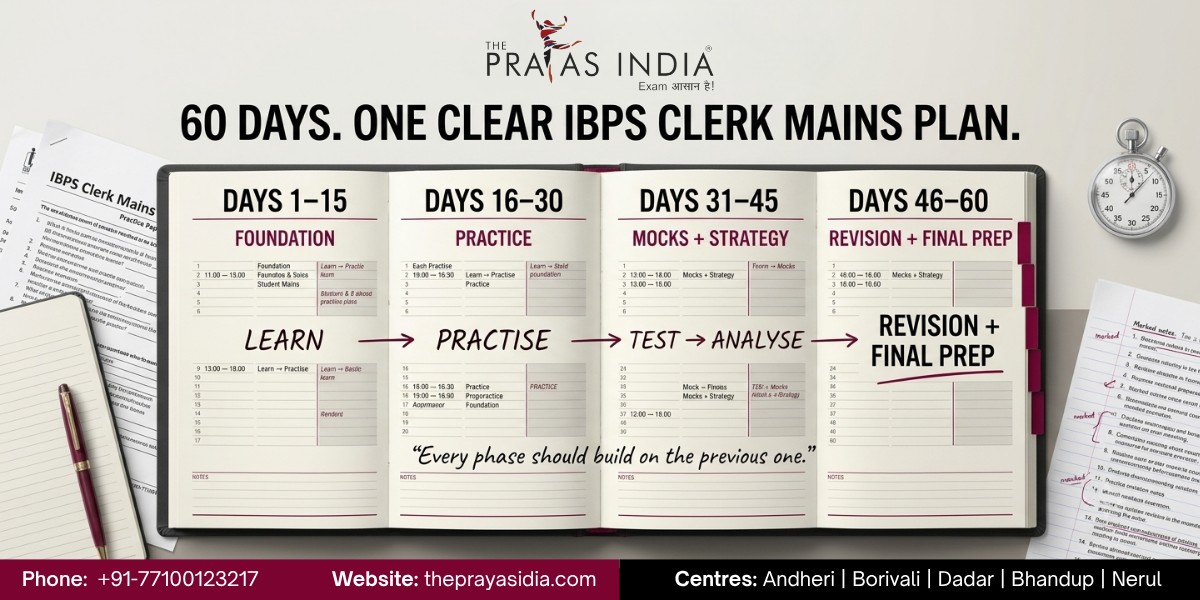
The most effective way to use 60 days is to divide preparation into four broad stages.
Phase 1: Days 1–15 — Build the Mains Foundation
Focus on concepts, important topics and understanding the difference between Prelims-level and Mains-level questions.
Phase 2: Days 16–30 — Increase Practice and Accuracy
Move from topic-wise practice toward mixed questions and introduce more timed sets.
Phase 3: Days 31–45 — Mocks, Speed and Exam Strategy
Increase sectional and full-length testing while identifying recurring mistakes.
Phase 4: Days 46–60 — Revision and Final Performance
Focus on mock analysis, current-affairs revision, weak areas, important concepts and final exam strategy.
This progression prevents the common mistake of taking full-length mocks too early or leaving all revision for the final week.
Days 1–15: Build Your Mains Foundation
The first 15 days should establish the foundation for the remaining preparation period.
At this stage, the objective is not to complete hundreds of questions every day. It is to understand the topics that require greater depth at the Mains level and identify the areas where additional practice is necessary.
Aspirants should divide their preparation time across the major areas of the examination while giving additional attention to their weaker sections.
Reasoning: Move Beyond Basic Practice
Reasoning preparation at the Mains level should move beyond simply solving familiar question types.
Focus on understanding the structure of questions and developing the ability to identify the most efficient approach.
Practice areas may include:
- Puzzles and seating arrangements
- Logical reasoning
- Coded inequalities
- Syllogism
- Input-output
- Data sufficiency
- Statement-based questions
- Blood relations
- Direction and ranking-based questions
- Miscellaneous reasoning questions
The important point is not to solve every difficult puzzle available. Instead, develop the ability to understand the conditions, organise information and decide whether a question deserves your time.
For students preparing through The Prayas India, regular practice under faculty guidance can help make this transition from basic question solving to exam-oriented reasoning more systematic.
Quantitative Aptitude: Build Calculation Efficiency
Quantitative Aptitude can become a major time-consuming area if calculation speed and question selection are not developed together.
During the first 15 days, revise the fundamentals while simultaneously working on calculation efficiency.
Important preparation areas can include:
- Simplification and approximation
- Number series
- Data interpretation
- Arithmetic
- Percentage
- Ratio and proportion
- Average
- Profit and loss
- Simple and compound interest
- Time and work
- Time, speed and distance
- Partnership
- Mixture and allegation
- Mensuration
- Data sufficiency
Do not make the mistake of spending the entire day on difficult arithmetic questions while neglecting easier scoring areas.
The objective should be to develop a preparation hierarchy:
Concept Clarity → Question Recognition → Efficient Method → Timed Practice
This approach becomes increasingly important as you move toward full-length Mains mocks.
English: Focus on Understanding, Not Just Rules
English preparation for IBPS Clerk Mains should not be restricted to memorising grammar rules or vocabulary lists.
Aspirants should develop the ability to understand passages, identify contextual meaning and interpret questions accurately.
Regular practice should include:
- Reading comprehension
- Cloze tests
- Error detection
- Sentence rearrangement
- Fillers
- Phrase replacement
- Vocabulary in context
- Para-based questions
- Grammar application
Reading should become a daily habit during the 60-day preparation period. Even 20–30 minutes of focused reading can help improve comprehension and familiarity with different writing styles.
For students who struggle with English, the goal should not be to memorise everything. It should be to understand patterns and repeatedly practise the types of questions that appear in competitive banking examinations.
General and Financial Awareness: Start Early
One of the biggest mistakes in IBPS Clerk Mains preparation is postponing General and Financial Awareness.
Students often focus heavily on Reasoning and Quantitative Aptitude because these sections require regular problem-solving. GA, however, can accumulate silently and become difficult to cover if preparation starts too late.
The better approach is to begin from Day 1.
Your preparation should include:
- Banking awareness
- Financial awareness
- Important government schemes
- RBI-related developments
- Banking and financial terminology
- Important national and international events
- Appointments
- Awards
- Reports and indexes
- Important economic developments
- Current affairs relevant to the examination
Instead of trying to memorise large amounts of information in the final week, build a daily current-affairs habit.
A short daily session followed by weekly revision is much more manageable than attempting to memorise months of current affairs at once.
Computer Aptitude: Don’t Leave It for the End
Computer-related questions can often be underestimated because students assume that the section will be easy.
However, easy questions still require preparation if you want to maximise your score and reduce time wastage.
Revise important areas such as:
- Computer fundamentals
- Hardware and software
- Operating systems
- Internet and networking
- MS Office
- Memory
- Input and output devices
- Computer terminology
- Cybersecurity basics
- Database fundamentals
- Shortcuts and common commands
The objective during the first phase is to create familiarity so that these questions do not consume unnecessary preparation time later.
Build a Daily Study Structure
A 60-day plan becomes useful only when it is converted into a realistic daily routine.
Instead of creating an unrealistic timetable with 10–12 hours of continuous study, divide the day into focused blocks.
A practical structure can look like:
| Study Block | Focus |
|---|---|
| Block 1 | Quantitative Aptitude |
| Block 2 | Reasoning |
| Block 3 | English |
| Block 4 | General/Financial Awareness |
| Block 5 | Computer Aptitude |
| Block 6 | Revision + Error Analysis |
The exact duration of each block should depend on your strengths and weaknesses.
If Reasoning is your weak section, allocate additional time there. If your Quantitative Aptitude accuracy is already strong, use that time for improving speed or strengthening another section.
The important principle is consistent daily coverage rather than occasional long study sessions.
The Prayas India Advantage: Turn the 60 Days Into a Structured Preparation Journey
A 60-day preparation window can feel short when an aspirant is preparing alone because every decision has to be made independently: which topics to study, which questions to practise, when to take mocks, how to revise current affairs and how to interpret performance.
This is where The Prayas India can add value to the preparation process.
For aspirants searching for IBPS Exam Coaching in Mumbai, the focus should not only be on attending classes. The coaching environment should help students move through the entire preparation cycle.
At The Prayas India, aspirants can approach their IBPS Clerk Mains preparation through a structured framework involving:
- Concept-focused learning
- Exam-oriented practice
- Faculty guidance
- Doubt resolution
- Regular test exposure
- Mock-test analysis
- Performance-based improvement
- Revision planning
- Strategic preparation for the Mains stage
This becomes particularly useful during a 60-day window because the candidate has limited time to experiment with different preparation methods.
The goal is to create a system where every week has a purpose and every mock provides actionable feedback.
For students targeting banking-sector opportunities and looking for Best IBPS Exam Coaching in Mumbai, choosing a structured preparation environment like The Prayas India can help bring greater consistency and direction to the Mains preparation journey.
Create a Personal Error Log From Day 1
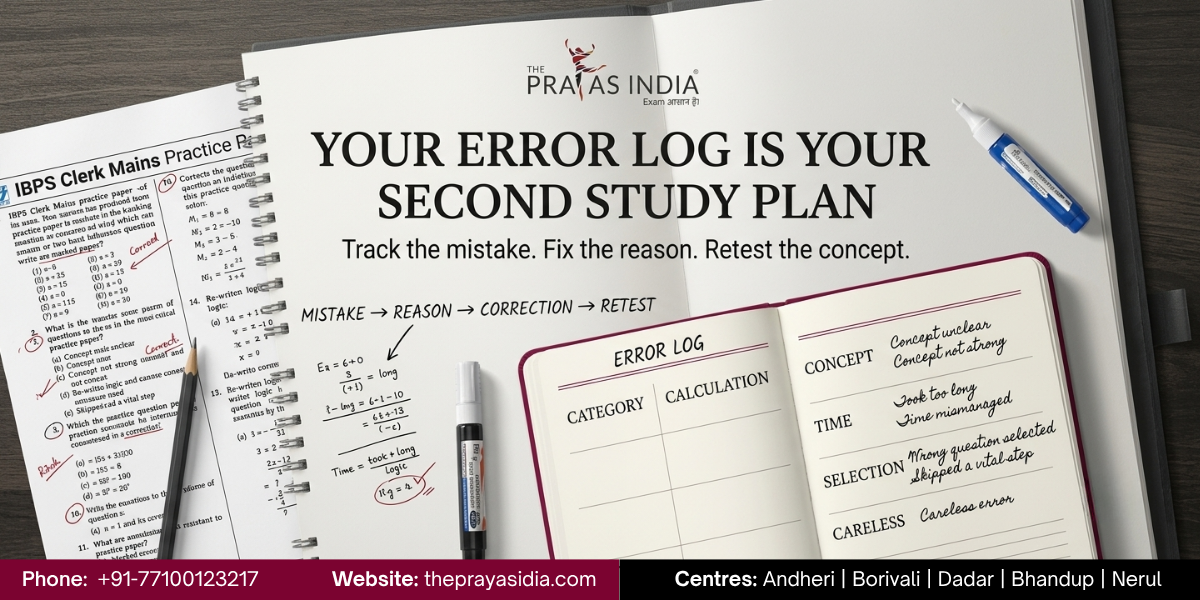
An error log is one of the most useful tools for a 60-day preparation plan because it prevents students from repeatedly making the same mistakes.
Do not record every question you get wrong. Instead, record meaningful mistakes that reveal a pattern.
Your error log can include:
| Mistake Type | Example |
|---|---|
| Concept Error | Formula or concept not understood |
| Calculation Error | Arithmetic mistake |
| Interpretation Error | Question misunderstood |
| Time Error | Too much time spent |
| Selection Error | Wrong question chosen |
| Careless Error | Avoidable mistake |
Review this log every few days.
If the same mistake appears repeatedly, it should automatically become a priority topic for the next practice session.
This creates a feedback loop:
Mistake → Identify Reason → Correct → Practise Again → Retest
That is far more productive than simply increasing the number of questions you solve.
Don’t Let the 60-Day Plan Become a Checklist
A timetable is only useful when it produces improvement.
Aspirants sometimes become so focused on completing daily targets that they forget to evaluate whether the preparation is actually working.
For example, completing 50 reasoning questions does not necessarily mean that reasoning preparation improved. If accuracy remained poor and the same puzzle type continues to consume excessive time, the target was completed but the problem remains.
Every week, evaluate:
- Accuracy
- Attempts
- Average solving time
- Strong topics
- Weak topics
- Repeated mistakes
- Mock performance
- Current-affairs coverage
- Revision progress
This weekly review should influence the following week’s timetable.
That is what makes a study plan dynamic rather than mechanical.
Key Takeaway
The first 15 days of a 60-day IBPS Clerk Mains preparation plan should establish the foundation for everything that follows. The focus should be on understanding Mains-level requirements, strengthening important concepts, beginning daily current-affairs preparation, developing calculation and reasoning efficiency and creating an error-analysis system.
Most importantly, aspirants should avoid treating the 60 days as one continuous period. Breaking preparation into clear phases makes the workload more manageable and provides measurable milestones.
For candidates looking for IBPS Exam Coaching in Mumbai, structured guidance can make this process more organised. The Prayas India can support aspirants through a preparation ecosystem focused on concepts, practice, tests, analysis and strategic improvement.
The next stage is where preparation intensity begins to increase.
The first 15 days of an IBPS Clerk Mains preparation plan should establish conceptual clarity, identify weak areas and create a consistent study rhythm. The next 45 days are where that foundation needs to be converted into exam performance. At this stage, preparation should gradually move away from simply learning topics and towards solving mixed questions, improving time management, taking mocks and repeatedly correcting the mistakes that affect your score.
For aspirants preparing for the IBPS Clerk Mains exam, this phase is also where structured guidance can make a significant difference. Instead of spending valuable preparation time deciding what to study next, candidates can follow a defined schedule, practise exam-level questions and receive guidance on areas that require improvement. This is one of the key advantages of preparing through a structured banking programme such as The Prayas India.
Days 16–30: Move From Learning to Exam-Oriented Practice
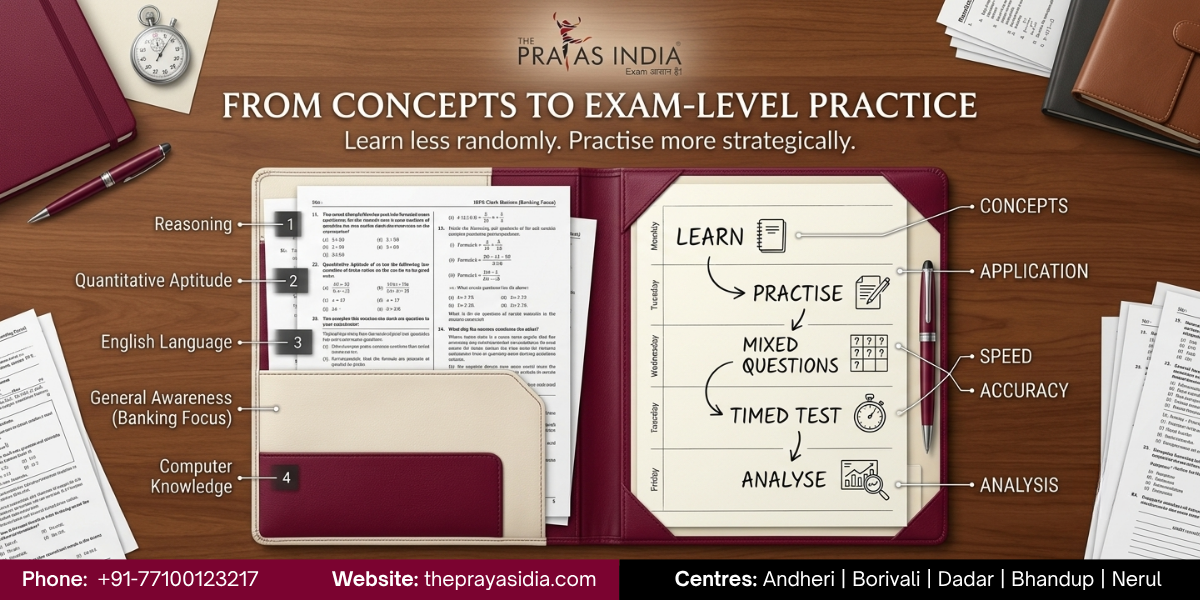
Once the basic concepts are reasonably clear, the focus should shift towards application. During Days 16–30, candidates should increase the volume of questions they solve while maintaining an accuracy-first approach. This is also the stage where previously studied topics should start appearing together in mixed practice sets.
The objective is not simply to solve more questions. It is to become comfortable switching between different question types without losing time. In the actual Mains examination, questions will not arrive according to the order in which you studied them. Your preparation therefore needs to develop flexibility along with knowledge.
Reasoning: Practise Complex Sets Under Controlled Time
Reasoning becomes increasingly important at the Mains level because several questions can be connected to the same puzzle or logical arrangement. During this phase, candidates should practise seating arrangements, floor-based puzzles, box-based arrangements, scheduling problems, comparison-based puzzles, input-output, data sufficiency and other logical reasoning questions.
Start with untimed or lightly timed practice for difficult sets. Once the method becomes familiar, introduce stricter time limits. After every set, ask yourself whether the problem was difficult because of the concept, the approach or the time required to reach the answer.
A useful reasoning practice cycle is:
- Understand the set.
- Solve it without unnecessary shortcuts.
- Check the complete solution.
- Identify where time was lost.
- Attempt a similar set again under time pressure.
This approach is particularly useful for aspirants who understand reasoning concepts but struggle to convert that understanding into Mains-level attempts.
Quantitative Aptitude: Combine Accuracy With Calculation Speed
By Days 16–30, Quantitative Aptitude preparation should increasingly involve mixed arithmetic and Data Interpretation. Candidates should practise percentage, ratio, averages, profit and loss, simple and compound interest, time and work, time-speed-distance, mixtures, partnership and other important arithmetic areas alongside DI sets.
Calculation speed should also become part of the routine. However, speed should not come at the expense of accuracy. A candidate who solves 20 questions quickly but makes several avoidable calculation errors may perform worse than someone who attempts fewer questions with much better accuracy.
Include short calculation sessions in your daily preparation. Practise approximation, simplification, fraction-percentage conversions and common calculation patterns so that basic arithmetic does not consume unnecessary examination time.
English: Make Reading and Accuracy Part of Daily Preparation
English preparation should not be restricted to grammar exercises. IBPS Clerk Mains requires candidates to understand passages, interpret information and identify the correct option among closely related choices.
During this phase, include Reading Comprehension, cloze tests, para jumbles, sentence-based questions, error detection, fillers and vocabulary-in-context questions in your routine. Pay particular attention to questions where two options initially appear correct. These are often the questions that expose weaknesses in comprehension and elimination.
Instead of memorising large vocabulary lists without context, read regularly and record unfamiliar words along with the sentence or idea in which they appeared. This makes vocabulary revision more practical and improves comprehension at the same time.
General Awareness: Build a Revision System, Not a Reading Habit
General Awareness can become difficult to manage when candidates continue collecting new information without revising what they have already studied. By the second phase of your 60-day plan, current affairs preparation should therefore include both new learning and systematic revision.
Focus on banking and financial awareness, RBI-related developments, government schemes, important appointments, reports and indexes, economic developments, national and international events and other exam-relevant current affairs.
A practical approach is to divide your revision into smaller cycles:
- Daily revision of recently studied current affairs.
- Weekly revision of the entire week’s material.
- Monthly consolidation of important events.
- Separate revision of banking and financial awareness.
- Final revision of frequently repeated facts and important developments.
This prevents General Awareness from becoming a last-minute subject.
Computer Aptitude: Revise Frequently Instead of Studying It Once
Computer-related topics can often be covered efficiently when candidates revise them repeatedly. During Days 16–30, revise computer fundamentals, operating systems, hardware and software, networking, internet concepts, MS Office, memory, databases, cybersecurity and common computer terminology.
Create short revision notes for concepts that are easy to confuse. Repeated exposure is more useful than spending an entire day studying the subject and then leaving it untouched for several weeks.
Days 31–45: Enter the Mock-Test and Performance-Improvement Phase
By the third phase, the preparation should begin resembling the actual examination environment. Candidates should now take sectional tests and full-length mocks regularly. The purpose of these tests is not simply to obtain a score. A mock test should reveal whether your preparation is translating into the ability to select questions, manage time and maintain accuracy under pressure.
At this stage, candidates should stop judging themselves only by the number of questions they attempted. Instead, analyse the relationship between attempts, accuracy, time and question selection.
For example, if your score is low because you spend too much time on difficult Reasoning sets, the solution is not necessarily to study another Reasoning chapter. The real correction may be learning when to leave a time-consuming set and move to a more manageable question.
Build a Section-Wise Time Management Strategy
Every candidate does not need to spend exactly the same amount of time on every section. Your strategy should depend on your strengths, weaknesses and the way you perform under pressure.
During Days 31–45, experiment with different approaches in sectional and full-length mocks. Observe which section consumes the most time and which section gives you the best return for your preparation.
Track:
- Questions attempted.
- Questions answered correctly.
- Questions answered incorrectly.
- Time spent.
- Questions skipped.
- Questions that consumed excessive time.
- Questions that could have been solved but were left due to poor selection.
Over multiple mocks, this information will reveal your actual exam behaviour.
Develop a Smart Question-Selection Habit
One of the biggest differences between preparation-level solving and examination-level solving is decision making.
During practice, you may try to solve every difficult question because there is no real penalty for spending additional time. The examination does not provide that luxury. A strong candidate must recognise when a question deserves attention and when it should be postponed or skipped.
Train yourself to identify:
- Questions that can be solved quickly.
- Questions requiring moderate calculation.
- Questions requiring lengthy analysis.
- Questions with uncertain interpretation.
- Questions that are consuming too much time.
This habit should be developed during mocks rather than for the first time inside the examination hall.
Mock-Test Analysis Should Become a Mandatory Routine
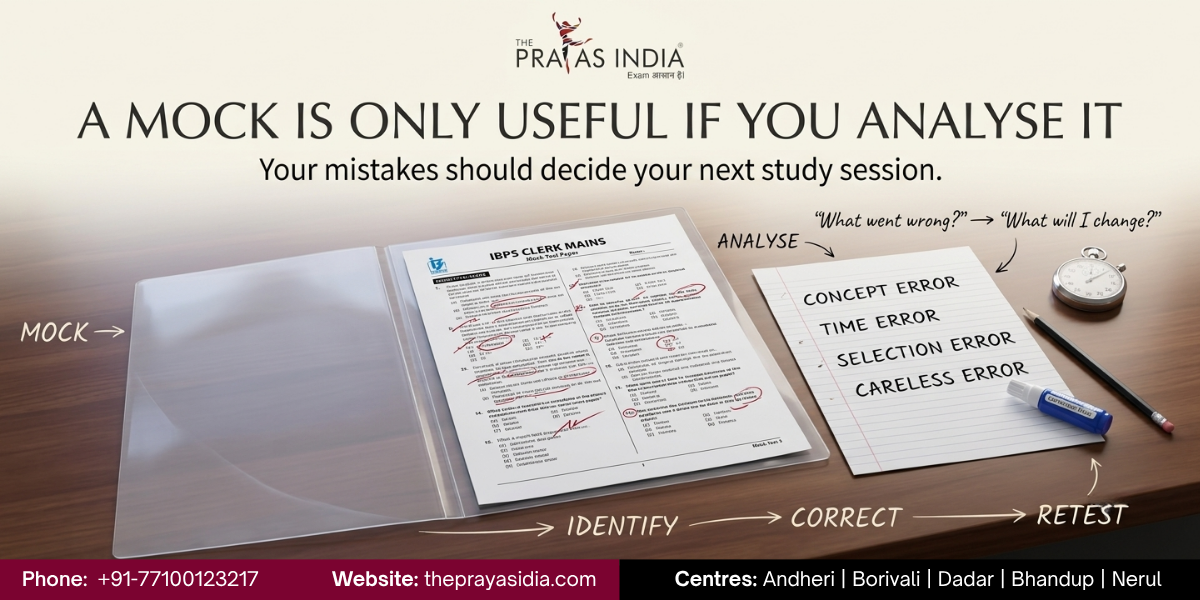
Taking a mock without analysing it leaves a major part of its value unused. After every mock, spend dedicated time reviewing the paper.
Divide mistakes into categories such as:
Concept Error: You did not understand the underlying concept.
Application Error: You knew the concept but could not apply it correctly.
Calculation Error: The method was correct but the arithmetic went wrong.
Time Error: You spent too long on a question.
Selection Error: You selected a question that should have been skipped or postponed.
Careless Error: You knew the answer but made an avoidable mistake.
This classification makes your preparation more precise. Instead of saying “I need to improve Quant,” you may discover that most of your lost marks are actually coming from calculation mistakes or poor question selection.
Days 46–60: Final Revision and Performance Refinement
The final 15 days should not become a period of panic-driven preparation. By this point, the objective should be to consolidate what you already know, improve weak areas and make your examination strategy more stable.
Do not suddenly introduce multiple new resources. Your preparation should increasingly revolve around your own notes, error log, important current affairs, previous mistakes, sectional performance and mock-test analysis.
Days 46–50: Consolidate Weak Areas
Review the error log created during the previous weeks. Identify the topics and mistake categories that continue to appear.
Prioritise weaknesses based on their impact on your score. A topic that causes repeated mistakes should receive more attention than a topic that you have already mastered.
Use a simple correction cycle:
Identify → Revise → Practise → Test → Recheck
Do not spend the entire day rereading theory. Revision should quickly lead back to question solving.
Days 51–55: Full-Length Mock Integration
Increase the importance of full-length mocks during this phase. However, avoid taking multiple tests every day if you do not have sufficient time to analyse them.
A better approach is to maintain a balance between:
- Full-length mock tests.
- Detailed mock analysis.
- Weak-area revision.
- Current-affairs revision.
- Short sectional practice.
- Error-log revision.
The quality of analysis is more valuable than simply increasing the number of mock tests.
Days 56–60: Final Exam Readiness
The final five days should focus on stability rather than experimentation. Revise important notes, banking awareness, current affairs, frequently repeated concepts and your most common mistakes.
Avoid making major changes to your examination strategy at the last moment. The strategy you use should already have been tested through multiple mocks.
Your final preparation should answer four questions:
- Which questions should I attempt first?
- Which questions should I leave or postpone?
- How will I manage time across sections?
- How will I recover if one section feels difficult?
Having clear answers to these questions can reduce uncertainty during the actual examination.
Current Affairs Revision in the Final Phase
General Awareness can influence the final score significantly, but the last few days should be used for revision rather than unlimited information collection.
Create a final revision set covering important banking and financial developments, RBI updates, government schemes, appointments, reports, indexes, economic developments and other relevant current affairs.
Instead of repeatedly reading long monthly compilations from beginning to end, revise the information you have already studied and focus on facts that you have previously marked as important or difficult to remember.
Common Mistakes to Avoid During the 60-Day IBPS Clerk Mains Plan
A well-designed plan can still fail if the execution is inconsistent. Aspirants should therefore watch for a few common problems during the final preparation period.
Taking Too Many Mocks
More mocks do not automatically mean better preparation. If every test is followed by little or no analysis, the candidate may repeatedly make the same mistakes.
Changing Resources Frequently
Switching between books, PDFs, YouTube channels, test platforms and study materials can consume valuable time. Select reliable resources and follow them consistently.
Ignoring the Error Log
An error log is useful only when it influences future preparation. Revise it regularly and use repeated mistakes to decide what you practise next.
Chasing Attempts Instead of Quality
A high attempt count with poor accuracy is not necessarily a strong performance. Your objective should be a sustainable combination of speed, accuracy and intelligent question selection.
Leaving General Awareness for the End
GA should be revised throughout the 60 days. Trying to learn everything in the final week creates unnecessary pressure.
Studying Without a Timetable
A 60-day plan becomes effective only when it translates into daily action. Decide in advance when you will study, practise, revise and take tests.
A Practical Daily Routine for the Final 30 Days
Your daily schedule can be adjusted according to your strengths and availability, but a balanced routine may look like this:
| Study Area | Suggested Focus |
|---|---|
| Reasoning | Puzzle practice + mixed questions |
| Quant | Arithmetic/DI + calculation practice |
| English | RC + grammar/application questions |
| GA | Current affairs + banking awareness |
| Computer | Short revision sessions |
| Mock/Sectional Test | Timed exam practice |
| Analysis | Error classification + correction |
The important point is not to copy someone else’s exact timetable. Build a routine that you can follow consistently while ensuring that every major component of Mains preparation receives regular attention.
How The Prayas India Can Strengthen Your IBPS Clerk Mains Preparation
For many aspirants, the biggest challenge is not a lack of study material. It is knowing what to study, how much to practise, how to evaluate performance and what to change when scores stop improving.
This is where structured coaching can become valuable.
At The Prayas India, IBPS and banking-exam preparation can be approached as a complete preparation journey rather than a collection of disconnected study sessions. Candidates can benefit from structured classes, exam-oriented practice, faculty guidance, doubt resolution, regular testing and performance analysis.
For an aspirant following a 60-day Mains strategy, this kind of structured environment can help in several ways:
- Concepts are taught with the examination in mind.
- Practice can be aligned with the level of the target exam.
- Doubts can be addressed instead of remaining unresolved.
- Regular tests help candidates understand their performance.
- Mock analysis can reveal recurring mistakes.
- Weak areas can be identified before the final stage.
- Revision becomes more systematic.
- Candidates can prepare with a defined study framework instead of relying entirely on self-planning.
For candidates specifically looking for IBPS Exam Coaching in Mumbai, The Prayas India provides an admission-focused preparation option for aspirants who want structured guidance while preparing for banking examinations.
The objective is not simply to complete the syllabus. The larger goal is to build the ability to learn, practise, analyse, correct and perform under examination conditions.
The Final 60-Day IBPS Clerk Mains Framework
A successful 60-day plan should ultimately become a repeatable preparation cycle:
LEARN → PRACTISE → TEST → ANALYSE → CORRECT → REVISE → RETEST
Each phase has a specific purpose.
During the first 15 days, establish the foundation.
During Days 16–30, increase application-based practice and accuracy.
During Days 31–45, develop mock-test strategy, question selection and time management.
During Days 46–60, consolidate knowledge, revise current affairs, correct weak areas and build final exam readiness.
This approach ensures that preparation does not remain stuck at the “study more” stage. Every stage has a measurable purpose.
Final IBPS Clerk Mains Preparation Checklist
Before entering the final week, make sure you have:
- Completed the major Mains-level topics.
- Practised mixed questions regularly.
- Taken sectional tests.
- Taken full-length mocks.
- Analysed your mocks properly.
- Maintained an error log.
- Identified your most frequent mistakes.
- Developed a question-selection strategy.
- Practised time management.
- Revised banking and financial awareness.
- Revised important current affairs.
- Covered computer aptitude basics.
- Prepared concise revision notes.
- Tested your final examination strategy through mocks.
- Avoided unnecessary changes to your preparation resources.
Final Takeaway
A 60-day IBPS Clerk Mains preparation plan should not be treated as a countdown where candidates simply complete a certain number of chapters every day. It should be treated as a structured performance-building process.
The first phase builds the foundation. The second phase strengthens application and accuracy. The third phase develops exam temperament through mocks and analysis. The final phase converts that preparation into a stable examination strategy.
For aspirants preparing in Mumbai, joining a structured programme such as The Prayas India can provide an organised environment for concepts, practice, testing, doubt resolution and performance improvement. The right coaching support can be particularly useful when the challenge is not simply studying harder but preparing in a more focused and measurable way.
The most effective 60-day strategy is therefore simple in principle: study with direction, practise with purpose, analyse every test, correct recurring mistakes and enter the Mains examination with a strategy that has already been tested.
Contact Us
- Call Now: +91-77100 13217
- Website: theprayasindia.com
- Centres: Andheri | Borivali | Dadar | Nerul | Bhandup
Frequently Asked Questions
1. Is 60 days enough to prepare for IBPS Clerk Mains?
Yes, 60 days can be used effectively if the preparation is structured and consistent. Candidates should focus on high-priority topics, regular practice, mock tests, current-affairs revision and continuous error correction.
2. How many hours should I study for IBPS Clerk Mains?
The ideal number of hours depends on your current preparation level and other commitments. Instead of focusing only on the number of hours, ensure that your daily routine includes concepts, practice, revision and analysis.
3. When should I start taking IBPS Clerk Mains mock tests?
Sectional tests can be introduced once you have basic conceptual familiarity. Full-length mocks should become more important during the middle and final phases of the 60-day plan.
4. How important is mock-test analysis?
Mock analysis is extremely important because it identifies the reasons behind incorrect answers, time loss and poor question selection. It should be treated as part of the preparation rather than an optional activity.
5. How should I prepare General Awareness for IBPS Clerk Mains?
Prepare current affairs regularly and revise them through weekly and monthly cycles. Give additional attention to banking and financial awareness, RBI-related developments, government schemes and important economic developments.
6. How can I improve my IBPS Clerk Mains speed?
Speed improves through timed practice, calculation drills, repeated exposure to common question types and better question selection. Accuracy should remain controlled while increasing speed.
7. Should I join coaching for IBPS Clerk Mains preparation?
Coaching can be useful for aspirants who need structured classes, faculty guidance, regular practice, doubt resolution and mock-test analysis. Candidates preparing in Mumbai can consider a structured banking-exam programme at The Prayas India.
8. What should I do in the last 10 days before IBPS Clerk Mains?
Focus on revision, mock tests, error-log analysis, current-affairs revision and exam strategy. Avoid introducing too many new resources or making major strategy changes at the last moment.
9. How can I avoid repeating the same mistakes in mocks?
Maintain an error log and classify mistakes into categories such as concept, calculation, time, selection and careless errors. Revisit recurring errors and solve similar questions again.
10. Where can I prepare for IBPS exams in Mumbai?
Aspirants looking for structured IBPS Exam Coaching in Mumbai can explore The Prayas India for guided preparation, exam-oriented practice, mock tests and performance-focused learning.