IBPS Clerk Quantitative Aptitude Preparation Strategy | Best Bank Coaching in Mumbai | The Prayas India
Quantitative Aptitude can become one of the most important scoring areas in IBPS Clerk preparation, but it is also a section where inconsistent practice can quickly become visible in mock-test scores. Many aspirants understand the basic concepts yet struggle to convert that understanding into accurate and timely attempts. The problem is often not a complete lack of mathematical ability. It is usually a combination of weak fundamentals, inefficient calculation methods, poor question selection and insufficient timed practice.
A successful IBPS Clerk Quantitative Aptitude preparation strategy therefore needs to go beyond completing chapters one after another. The objective should be to build a system in which concepts, calculation ability, speed, accuracy and exam strategy develop together. An aspirant who prepares with this approach is better positioned to handle both familiar and slightly unfamiliar questions under examination pressure.
For students preparing for IBPS Clerk, Quant should not be treated as a subject that can be mastered through last-minute formula revision. It requires regular exposure to numerical patterns and repeated practice. The earlier a student develops this habit, the easier it becomes to improve performance through mock tests and targeted revision.
Start With the Right Understanding of IBPS Clerk Quant
Before creating a study timetable, understand what Quantitative Aptitude actually demands in a bank examination. It is not simply a test of advanced mathematics. The section primarily checks how efficiently you can interpret numerical information, apply basic concepts, perform calculations and select the right questions within a limited amount of time.
This distinction is important because many aspirants prepare Quant as if they are preparing for a traditional mathematics examination. They spend too much time learning lengthy theoretical approaches and too little time practising how those concepts appear in competitive-exam questions.
IBPS Clerk Quant preparation should instead focus on exam-oriented application. You need to know the concept, recognise the question type, select an efficient method and reach the answer with minimum unnecessary calculation.
That is why two students with similar mathematical knowledge can achieve very different scores. The difference often comes from practice quality and exam execution rather than conceptual knowledge alone.
Build Your Quant Preparation Around Three Stages
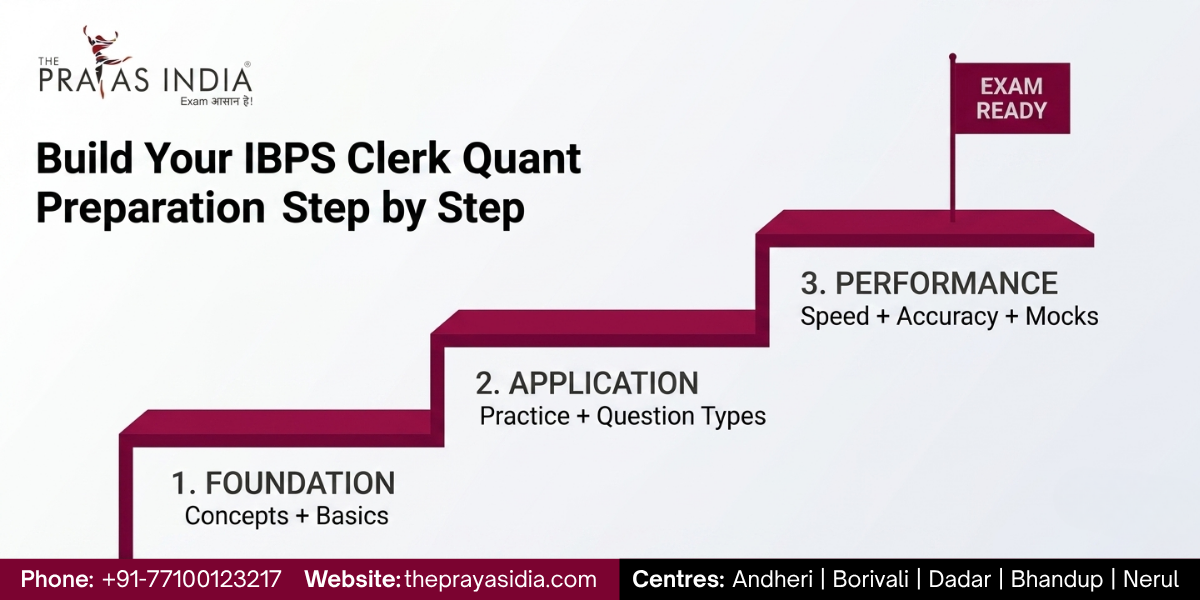
A practical preparation strategy can be divided into three broad stages: Foundation, Application and Performance.
During the Foundation stage, the priority should be understanding concepts and strengthening basic calculations. The Application stage involves solving different question types and learning how concepts are tested in IBPS Clerk-level questions. The Performance stage focuses on timed sectional tests, full-length mocks, question selection and error analysis.
These stages should not be treated as completely separate periods. They overlap throughout preparation. Even after completing the syllabus, you should continue revisiting concepts that appear frequently in your mistakes.
The important point is that simply finishing the syllabus does not mean your Quant preparation is complete. Your preparation is complete only when you can apply the concepts accurately within the required time.
Strengthen Arithmetic Before Chasing Difficult Questions
Arithmetic forms an important part of bank-exam Quant preparation, and students should develop a reliable understanding of its core topics.
Topics such as percentage, ratio and proportion, average, profit and loss, simple interest, compound interest, time and work, time-speed-distance and mixture-based problems require conceptual clarity as well as calculation practice.
The mistake many aspirants make is moving too quickly towards difficult questions before becoming comfortable with basic applications. If your percentage calculations are weak, for example, advanced arithmetic questions will continue to feel unnecessarily difficult.
Instead, build your preparation progressively. Understand the underlying relationship first, practise basic questions next, then move towards moderate and mixed questions. Once you are comfortable, introduce timed practice.
This approach creates a stronger foundation because you are not simply memorising formulas. You are learning how numerical relationships work.
Develop Calculation Speed Without Sacrificing Accuracy
Speed is essential in IBPS Clerk Quant, but speed without accuracy can become counterproductive.
A student may attempt many questions but lose marks because of incorrect multiplication, percentage conversion, decimal handling or rushed calculations. These mistakes also consume additional time because candidates often return to questions when their calculated answer does not match the options.
The better approach is to develop calculation speed gradually. Practise multiplication, squares, common fractions, percentage conversions and approximation regularly. At the same time, maintain an error log so you can identify the types of calculations that repeatedly cause problems.
Once your accuracy becomes stable, start introducing short timed sets. Gradually reduce the time available while ensuring that the error rate does not rise sharply.
The objective is not to become the fastest calculator in the room. It is to become a reliable calculator under examination pressure.
Learn Common Fraction and Percentage Relationships
A strong numerical foundation can significantly improve the efficiency of Quant preparation.
Common fraction-percentage relationships should become familiar enough that you do not need to calculate them from scratch every time. For instance, recognising that one-fourth represents 25%, one-fifth represents 20% and one-eighth represents 12.5% can make several arithmetic calculations faster.
Similarly, students should become comfortable with percentage increases and decreases, ratio conversions and basic proportional relationships.
This familiarity reduces mental load. Instead of spending valuable seconds figuring out a basic conversion, you can focus on understanding the actual question.
However, memorisation should always be accompanied by understanding. You should know why a relationship works rather than treating every conversion as an isolated fact.
Do Not Ignore Simplification and Approximation
Simplification and approximation can be valuable areas for IBPS Clerk aspirants because they help develop numerical speed and question-selection skills.
The key is to recognise when a calculation can be shortened without compromising accuracy. Instead of immediately performing long multiplication or division, check whether the numbers can be simplified.
Approximation can also be useful in questions where the answer choices are sufficiently separated. But approximation should never be applied mechanically. When options are close, exact calculation may be necessary.
This is where practice becomes important. The more questions you solve, the better you become at identifying whether a problem calls for exact calculation, simplification or approximation.
Understand Data Interpretation Instead of Memorising Sets
Data Interpretation can appear intimidating because of the amount of numerical information presented in a question set. However, the difficulty often comes from interpretation and calculation rather than from highly advanced mathematics.
Begin by learning how to read tables, bar graphs, line graphs, pie charts and caselet-based information. Before calculating anything, understand what the data represents and identify the information actually required.
A common mistake is to calculate every number in the set. That is rarely necessary.
Efficient DI solving requires selective calculation. Identify the question, locate the relevant data and use the shortest reliable calculation method. This can save significant time during a timed examination.
Make Simplification and Number Series Part of Regular Practice
Not every Quant question requires lengthy arithmetic. Simplification and number-series questions can sometimes provide relatively direct scoring opportunities when the candidate understands the underlying pattern.
However, these questions should not be approached with the assumption that every pattern will be obvious. Number series can involve differences, multiplication, division, squares, combinations of operations or changing patterns.
Regular exposure is therefore more useful than trying to memorise a fixed list of patterns.
Similarly, simplification practice can improve general calculation fluency. Even when a particular simplification question does not appear in exactly the same form, the calculation skills developed through practice can benefit other Quant topics.
Use Topic-Wise Preparation Instead of Random Practice
Randomly solving questions for several hours may create the feeling that you are working hard, but it does not always produce measurable improvement.
Topic-wise practice allows you to identify where your actual weaknesses lie. If you consistently struggle with Time and Work, for example, you can dedicate a focused practice session to the concept, followed by basic questions and then timed questions.
After working on the topic, test yourself again after a few days. If accuracy improves, move forward. If the same mistakes return, revisit the underlying concept.
This process creates a feedback loop between learning and testing. It is more effective than simply increasing the number of questions solved.
Keep a Separate Record of Quant Mistakes
Your mistakes can become one of the most valuable preparation resources if you record them correctly.
Do not maintain an error notebook that simply contains dozens of wrong questions. Instead, classify the reason for each mistake.
You may have made a conceptual mistake, a calculation error, a question-reading mistake, a time-management error or a question-selection mistake.
For example, if you repeatedly solve percentage questions incorrectly because you apply the wrong base value, that is a conceptual issue. If you understand the concept but repeatedly make multiplication errors, the problem is calculation accuracy.
Once these categories become visible, your revision becomes more targeted.
Instead of saying, “My Quant score is low,” you can say, “My arithmetic concepts are acceptable, but I lose marks through calculation errors and spend too long on DI.”
That is a much more useful diagnosis.
Practise Questions in the Same Way You Will Attempt Them
Preparation should gradually resemble examination conditions.
When learning a new topic, untimed practice is perfectly reasonable because your primary objective is understanding. But after you become comfortable with the concept, start solving questions with a time limit.
This transition is important because solving a question at home without pressure is very different from solving it during an IBPS Clerk examination.
Timed practice teaches you to make decisions. You learn when to continue, when to simplify, when to approximate and when to leave a question.
Over time, these decisions become more instinctive.
Learn Question Selection Through Mock Tests
One of the biggest differences between classroom preparation and exam performance is question selection.
A candidate may know how to solve 30 questions but may not have enough time to solve all 30. The examination therefore rewards candidates who can identify which questions deserve their time.
During mock tests, pay attention to the questions that consume too much time. Some may be conceptually easy but calculation-heavy. Others may be difficult because the approach is not immediately visible.
Do not judge every skipped question as a failure. A strategically skipped question can be a successful decision if it allows you to solve two or three more manageable questions.
This mindset is essential for improving the practical value of your Quant preparation.

Build a Realistic Daily Quant Routine
A successful IBPS Clerk Quant strategy does not require spending the entire day on Quantitative Aptitude. What matters is consistency and intelligent allocation of study time.
A typical preparation session can include a short calculation drill, concept learning, topic-wise practice and a timed question set. On certain days, this can be followed by sectional-test analysis.
The exact duration can vary depending on your overall preparation schedule. A beginner may need more time for concepts, while an experienced aspirant may benefit more from timed practice and mock analysis.
The important principle is to make Quant a regular part of your preparation rather than studying it intensely for a few days and then leaving it untouched.
How to Revise Quant Without Starting From Zero
Revision should not mean rereading every chapter from the beginning.
Create concise revision material for formulas, common calculation relationships, recurring mistakes and difficult question types. Revisit these notes periodically while solving mixed questions.
Your error log should become especially important during revision. Questions that you previously answered incorrectly can reveal exactly where your preparation needs reinforcement.
Mixed practice is also useful because it tests whether you can recognise the correct concept without being told which topic the question belongs to.
This is much closer to the experience of the actual examination.
Use Sectional Tests to Improve Quant Execution
Sectional tests are particularly useful once you have completed a reasonable portion of the syllabus.
They provide a controlled environment in which you can evaluate your attempt strategy without the complexity of a full-length paper.
After each test, analyse:
- Which questions were correct?
- Which questions were incorrect?
- Which questions consumed too much time?
- Which questions should have been skipped?
- Where did calculation errors occur?
- Which topic needs further practice?
The analysis is often more valuable than immediately taking another test.
Avoid the “Complete the Syllabus First” Trap
Many aspirants postpone mock tests and timed practice until they believe the entire syllabus is complete.
This can be risky.
You do not need to finish every topic before beginning performance-based practice. Once you have covered enough concepts to attempt meaningful questions, start using sectional tests and smaller timed sets.
Early testing can reveal weaknesses while there is still enough time to correct them.
Preparation should therefore happen in parallel:
Learn → Practise → Test → Analyse → Improve → Repeat
This cycle can continue throughout the preparation period.
How The Prayas India Can Support IBPS Clerk Quant Preparation
A structured preparation environment can help aspirants organise the different components of Quant preparation instead of treating them as separate activities.
At The Prayas India, bank-exam aspirants can work on concepts, question practice, calculation skills, sectional tests, mock tests and performance analysis. This kind of structured approach can be particularly useful for students who understand individual topics but struggle to convert their preparation into consistent test performance.
For students looking for Bank Coaching in Mumbai, the goal should be to choose an environment that supports both learning and execution. Quant preparation should eventually answer three practical questions:
Can I solve it? Can I solve it accurately? Can I solve it within the required time?
A strong preparation strategy works towards all three.
Key Takeaway
An effective IBPS Clerk Quantitative Aptitude preparation strategy is built around more than completing the syllabus. You need a strong numerical foundation, topic-wise practice, calculation accuracy, timed solving, question selection and regular performance analysis.
Start with concepts, strengthen arithmetic and calculation skills, and gradually move towards exam-level practice. Do not ignore simplification, number series and Data Interpretation, but avoid treating every topic with the same approach.
Most importantly, track your mistakes. Your incorrect answers can tell you more about your preparation than your correct answers if you analyse them honestly.
The goal is not merely to study more Quant. It is to build the ability to recognise, solve and select questions efficiently under examination pressure.
For aspirants preparing for IBPS Clerk and looking for Bank Coaching in Mumbai, a structured and admission-focused preparation environment can help turn consistent practice into measurable progress.
Turn Conceptual Knowledge Into Exam-Ready Skill
Knowing how to solve a Quant question and being able to solve it correctly within the examination time are two different skills. Many aspirants discover this difference only after taking their first serious mock test. They may understand percentages, ratios or arithmetic concepts but still struggle because they spend too long deciding which method to use.
This is why the second stage of preparation should focus on converting knowledge into execution. After learning a topic, solve questions without looking at the solution. Once your approach becomes familiar, introduce a time limit. Then move towards mixed sets where the topic is not mentioned in advance.
This progression helps develop the ability to recognise a question independently, choose an efficient approach and complete it under pressure.
Develop a Question-Selection Strategy
Quant preparation should not be measured by how many questions you know how to solve. In an actual examination, the more important question is whether you can identify which questions deserve your time.
Some questions may look simple but involve lengthy calculations. Others may appear complicated but have a short solution once the correct concept is recognised. Your preparation should train you to distinguish between the two.
During sectional tests, observe your behaviour. Do you spend too much time trying to solve one difficult question? Do you repeatedly return to questions that you initially skipped? Do you attempt calculation-heavy questions before easier ones?
These observations can help you create a personal question-selection strategy.
A strong IBPS Clerk Quant attempt is not necessarily the one with the maximum number of attempts. It is the one where your available time is used efficiently to maximise accurate attempts.
Practise With Mixed Quant Sets
Topic-wise practice is essential when you are learning a concept, but mixed practice becomes increasingly important as the examination approaches.
When you solve a chapter-specific set, you already know what concept is likely to be used. In a mixed set, you must first identify the topic and then decide how to approach it.
That additional decision-making is valuable because it resembles the actual examination.
Include questions from arithmetic, simplification, number series, Data Interpretation and other relevant areas in your mixed practice. Do not immediately check the topic after reading a question. Train yourself to identify it independently.
This can improve both recognition speed and question selection.
Improve Speed Without Creating Careless Errors
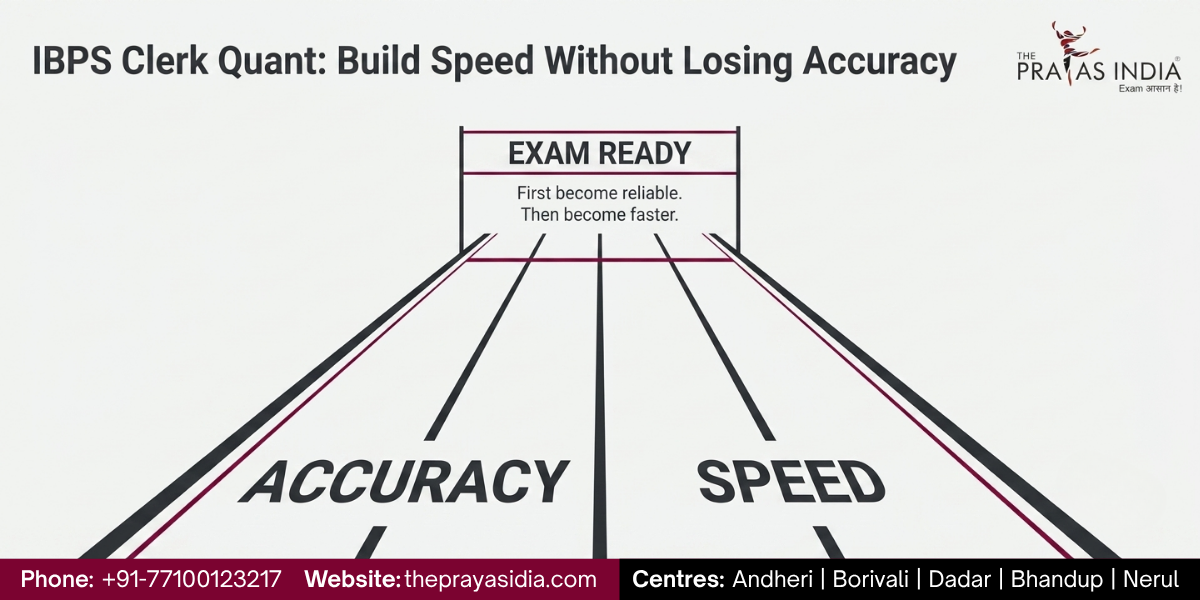
Speed improvement should be gradual. If your accuracy is already unstable, suddenly reducing your solving time can create more careless mistakes.
Instead, track your performance across several practice sessions. If you consistently solve a particular type of question accurately, try reducing the time slightly. If accuracy falls significantly, return to a more comfortable pace.
This creates a controlled progression:
Accurate → Consistent → Faster → Exam-ready
The objective is not to rush every question. It is to eliminate unnecessary pauses and inefficient calculations.
Build Calculation Fluency Through Short Daily Drills
Calculation practice does not always require a long study session. Short, consistent drills can be more useful because they create repeated numerical exposure.
Spend a few minutes practising multiplication, percentage conversions, fractions, squares, approximation and other calculations that frequently appear in bank-exam questions.
As your preparation progresses, combine these drills with actual Quant questions. This helps you transfer calculation speed into real problem-solving rather than keeping it as an isolated skill.
If you repeatedly make the same type of calculation mistake, temporarily increase practice for that particular area rather than trying to improve everything simultaneously.
Use Shortcuts Only When They Actually Save Time
Competitive-exam preparation often involves learning shortcuts. However, every shortcut is not automatically useful for every candidate.
A method is valuable only when it is faster and reliable for you.
If a shortcut requires you to remember several complicated steps, while the conventional method can be completed accurately in a similar amount of time, the conventional method may be the better choice.
Your strategy should therefore be based on practical efficiency rather than collecting the largest number of tricks.
The best shortcut is often the one you understand so well that you can use it without hesitation.
Analyse Every Mock Test Properly
Taking mock tests without analysing them is one of the biggest mistakes an IBPS Clerk aspirant can make.
Your mock score tells you what happened. Your analysis tells you why it happened.
After every Quant sectional or full-length mock, divide your questions into useful categories. Identify the questions you answered correctly and efficiently, the questions you answered correctly but took too long to solve, the questions you answered incorrectly, and the questions you skipped even though they were manageable.
This analysis can reveal your actual preparation gaps.
For example, if you consistently spend too much time on Data Interpretation, the issue may not be conceptual weakness. You may simply be calculating every value instead of focusing only on what each question requires.
Similarly, repeated errors in percentage questions may indicate a calculation issue rather than a conceptual one.
Create a Mock-Test Performance Sheet
Maintain a simple record of your mock-test performance instead of relying on memory.
You can record your score, attempts, accuracy, time spent and major error categories. Over several tests, patterns become much easier to identify.
Suppose your attempts increase from one mock to another but your accuracy falls. That suggests you may be chasing speed too aggressively. If accuracy is high but attempts remain low, question selection or calculation speed may require attention.
The purpose of tracking is not to become obsessed with numbers. It is to make your preparation more objective.
Give More Attention to High-Impact Weaknesses
Not every weakness deserves equal study time.
If one small topic produces occasional mistakes while another major topic is responsible for repeated errors, your preparation time should be allocated accordingly.
For example, if arithmetic questions consistently consume too much time, improving arithmetic methods may provide a greater benefit than spending hours on an advanced topic that rarely appears in your practice.
This is where mock analysis becomes particularly valuable. It helps you decide where additional study time can produce the greatest improvement.
Revise Through Questions, Not Only Notes
Formula revision is useful, but Quant revision should not stop at reading formulas.
After reviewing a concept, solve a small set of representative questions. This confirms whether you can actually apply the concept.
For frequently used topics, maintain a compact revision sheet containing important formulas, common relationships, calculation shortcuts you genuinely use and mistakes you repeatedly make.
Then use mixed questions to test whether those concepts remain accessible without prompting.
The objective of revision is not simply to remember information. It is to make the information usable under pressure.
Build a Practical Weekly Quant Routine
A balanced weekly routine should include different forms of practice rather than repeating the same activity every day.
You can divide your Quant preparation between concept learning, topic-wise questions, calculation drills, mixed sets, sectional tests and mock analysis.
For example, early preparation may contain more concept learning, while later preparation should gradually shift towards mixed practice, timed tests and analysis.
This flexibility is important because every aspirant starts from a different level. A beginner may need more foundation work, while an experienced candidate may benefit more from performance analysis.
The best study plan is therefore not the one that looks most intense. It is the one that you can follow consistently while addressing your actual weaknesses.
Revise High-Frequency Topics Regularly
Some Quant concepts repeatedly support questions across different problem types. These deserve regular revision.
Percentage, ratio, average, profit and loss, time and work, time-speed-distance, interest and Data Interpretation can all require repeated exposure.
Do not wait until the final days before revisiting these topics. Short periodic revision sessions can prevent concepts from becoming rusty.
A useful approach is to revisit a topic after a few days, then again after a longer interval. Combine the revision with questions so that you test both memory and application.
Do Not Let Difficult Questions Control Your Preparation
Aspirants sometimes spend disproportionate amounts of time on difficult questions because they believe that mastering the hardest problems will automatically improve their score.
That is not necessarily true.
IBPS Clerk preparation should first ensure that you can confidently handle questions within your expected level of difficulty. Once your accuracy and speed are stable, you can gradually introduce more challenging questions.
A candidate who can accurately solve a large number of moderate questions may be better positioned than one who can solve a few very difficult questions but struggles with routine ones.
Your preparation should therefore prioritise score-building ability before difficulty chasing.

A 60-Day Quant Preparation Framework
For aspirants who have around two months before the examination, preparation should gradually move from learning towards performance.
During the initial phase, focus on strengthening concepts and identifying weak areas. At the same time, maintain daily calculation practice so that numerical operations become more comfortable.
The middle phase should increase the amount of mixed practice and sectional testing. At this stage, start paying close attention to question selection and time spent on individual questions.
The final phase should be dominated by mock tests, revision and error correction. New topics should be introduced only when there is a clear reason to do so.
The purpose of this framework is not to prescribe exactly how many hours you must study. It is to create a progression where your preparation becomes increasingly similar to the actual examination.
How to Improve Data Interpretation Performance
Data Interpretation can become a time-consuming area if approached without a strategy.
Before calculating, read the data carefully. Identify the units, categories and relationships. Then read the question and determine exactly which information is needed.
Do not automatically calculate every percentage, total or difference in the table or graph. Calculate only what contributes to answering the question.
Approximation can sometimes help, especially when answer choices are sufficiently separated. However, exact calculations may be necessary when the options are close.
The more DI sets you practise, the better you become at identifying where the calculation effort should be spent.
How to Approach Arithmetic Questions
Arithmetic questions should be approached conceptually rather than as formula-memorisation exercises.
When reading an arithmetic question, first identify the relationship being described. Ask what the variables represent and what the question actually wants.
Once the structure becomes clear, choose the appropriate formula or equation.
After solving, use a quick sanity check. Does the answer make sense in relation to the numbers given? This simple habit can catch some calculation and interpretation mistakes.
With repeated practice, this process becomes faster and more natural.
How to Handle Quant During the Actual Examination
Exam-day Quant strategy should begin with composure rather than speed.
Start with questions that you can recognise quickly and solve confidently. This allows you to build momentum and avoid spending early time on questions that may consume too much effort.
As you proceed, keep evaluating whether a question is worth the remaining time. If a calculation becomes unexpectedly lengthy, do not hesitate to move forward.
The objective is to maximise accurate scoring opportunities.
Remember that the examination rewards the final result, not the number of difficult questions you attempted.
How The Prayas India Supports Bank Exam Preparation
For many aspirants, the challenge is not simply understanding individual Quant topics. It is maintaining a structured preparation cycle across concepts, practice, revision and testing.
The Prayas India provides a preparation environment where bank-exam aspirants can work on these different aspects systematically. Conceptual learning can be combined with regular question practice, sectional tests, mock examinations and performance analysis.
For students looking for Bank Coaching in Mumbai, structured guidance can help reduce the guesswork involved in deciding what to study, how to practise and how to analyse performance.
The objective should always be to build an exam-ready combination of knowledge, speed, accuracy and decision-making.
Common Quant Mistakes IBPS Clerk Aspirants Should Avoid
Several preparation mistakes appear repeatedly among bank-exam aspirants.
The first is studying Quant only when a mock-test score is low. Quant requires consistent practice rather than emergency preparation.
The second is focusing entirely on difficult questions. Score improvement often comes from becoming extremely reliable at moderate-level questions.
The third is ignoring calculation practice. Even strong concepts can lose value if numerical execution is weak.
Another common mistake is taking mock tests without analysis. A mock test should lead to a change in preparation whenever it exposes a recurring weakness.
Finally, avoid comparing your progress mechanically with someone else’s. Your strategy should be based on your own error patterns, accuracy and time-management needs.
Final Takeaway
A strong IBPS Clerk Quantitative Aptitude Preparation Strategy is built gradually.
Start with fundamentals and arithmetic concepts. Strengthen calculation ability. Practise topic-wise questions before moving into mixed sets. Introduce time limits progressively. Use sectional tests to improve execution and full-length mocks to develop question-selection skills.
Most importantly, analyse your performance.
Your mock-test score is only one part of the preparation story. The more important question is what that score tells you about your concepts, calculations, speed, accuracy and decisions.
For aspirants targeting IBPS Clerk, the goal should not simply be to complete the Quant syllabus. The goal should be to reach a point where you can recognise the right questions, solve them accurately and manage your time confidently.
Frequently Asked Questions
1. How should a beginner start IBPS Clerk Quant preparation?
A beginner should start with basic arithmetic concepts, numerical calculations and fundamental topics such as percentage, ratio, average, profit and loss and simplification. Once the foundation becomes comfortable, move towards topic-wise practice and timed questions.
2. Which Quant topics should I prioritise for IBPS Clerk?
Priorities can vary according to the examination pattern and your strengths, but arithmetic, simplification, number series, Data Interpretation and other commonly tested areas should form an important part of preparation.
3. How many hours should I study Quant every day?
There is no fixed number of hours suitable for every aspirant. Your study time should depend on your current level and overall preparation schedule. Consistent daily practice is more important than following an unrealistic number of hours.
4. How can I improve calculation speed for IBPS Clerk?
Practise common fractions, percentages, multiplication, squares, approximation and basic arithmetic regularly. Once accuracy is stable, use short timed drills to gradually increase speed.
5. Should I solve Quant questions topic-wise or randomly?
Both are useful at different stages. Topic-wise practice is better for learning and strengthening concepts, while mixed practice is important for developing question recognition and exam-level decision-making.
6. How important are mock tests for IBPS Clerk Quant?
Mock tests are extremely useful for understanding how your preparation performs under time pressure. Their value increases significantly when you analyse errors, time spent and question selection after every test.
7. What should I do if my Quant mock-test score is consistently low?
Identify whether the main problem is conceptual knowledge, calculation accuracy, speed, question selection or time management. Once the primary weakness is identified, create targeted practice rather than simply taking more mocks.
8. Is Data Interpretation difficult for IBPS Clerk?
DI can appear difficult when candidates calculate every piece of information unnecessarily. With regular practice, students can learn to identify relevant data, simplify calculations and use approximation where appropriate.
9. Should I memorise every Quant shortcut?
No. Learn shortcuts that you understand and can apply reliably. A smaller set of dependable methods is more useful than memorising numerous techniques without sufficient practice.
10. How can I avoid calculation mistakes in Quant?
Practise basic calculations regularly, maintain an error log, keep rough work organised and avoid unnecessary rushing. Analyse whether your mistakes come from calculation, interpretation or method selection.
11. When should I start taking IBPS Clerk Quant sectional tests?
You can start sectional testing once you have covered enough basic concepts to attempt a meaningful set of questions. You do not need to wait until the entire syllabus is complete.
12. Can I prepare for IBPS Clerk Quant without coaching?
Yes, self-study can work for many students if they have the discipline and resources to follow a structured plan. Coaching can nevertheless provide organised learning, guidance, practice, testing and performance analysis, which may be useful for aspirants who need additional structure.
13. How can I improve my Quant question-selection strategy?
Analyse your mock tests and identify questions that consume too much time. Practise recognising easier and more efficient questions first, and learn when to move on from lengthy problems.
14. How should I revise Quant before the IBPS Clerk exam?
Revise important formulas, calculation relationships, frequently tested concepts and your personal error log. Combine revision with mixed question sets and sectional tests so that you practise application rather than only reading notes.
15. Is IBPS Clerk Quant more about speed or accuracy?
Both matter. Speed allows you to attempt enough questions, while accuracy ensures those attempts contribute to your score. The ideal preparation strategy develops accuracy first and then progressively improves speed.