
IBPS Clerk Quantitative Aptitude Preparation: Topic-Wise Strategy for Beginners | The Prayas India
Quantitative Aptitude is one of the most important sections of the IBPS Clerk examination, but it is also one of the sections where beginners often feel uncertain about where to start. The problem is usually not that the mathematics is extremely difficult. The bigger challenge is understanding which topics deserve priority, how to build calculation speed, how to approach questions within a limited time and how to avoid losing marks through unnecessary mistakes.
A structured IBPS Clerk Quant Preparation strategy can make the section much more manageable. Instead of trying to study every mathematical concept at once, beginners should first understand the examination requirements and then build their preparation topic by topic. The objective should be to develop three things together: conceptual clarity, calculation speed and accuracy.
For students starting IBPS Clerk Maths Preparation from scratch, consistency is more important than attempting difficult questions immediately. Strong basics followed by regular practice can gradually make even calculation-heavy topics more comfortable.
Understanding Quantitative Aptitude in IBPS Clerk
The Quantitative Aptitude section of IBPS Clerk tests a candidate’s ability to work with numbers, calculations, arithmetic concepts and data-based questions within a strict time limit. In the Preliminary Examination, Numerical Ability carries 35 questions, making it an important scoring opportunity.
The challenge is that candidates do not have unlimited time to solve these questions. A student may know how to solve a particular problem but still lose valuable marks if the calculation takes too long. Therefore, IBPS Clerk Quant Preparation should never focus only on learning formulas.
A beginner should gradually learn how to recognise question types, identify the shortest practical method, estimate calculations where appropriate and decide whether a question is worth attempting.
This is why Quant preparation for banking examinations is different from studying mathematics only for academic examinations.
Start With Calculation Skills
Before moving deeply into individual chapters, beginners should work on their basic calculation ability. This is one of the most overlooked areas of IBPS Clerk Maths Preparation.
Calculations appear directly or indirectly in almost every Quant topic. Simplification requires quick arithmetic, Data Interpretation requires repeated calculations, percentage questions involve numerical manipulation and arithmetic problems often become lengthy when calculations are slow.
A beginner should therefore become comfortable with multiplication tables, squares, cubes, fraction-to-percentage conversions and basic mental calculations.
You do not need to memorise hundreds of formulas on the first day. Instead, develop familiarity with commonly used values and practise performing basic calculations without unnecessarily depending on a calculator.
The goal is not to calculate everything mentally. The goal is to reduce the amount of time spent on routine calculations.
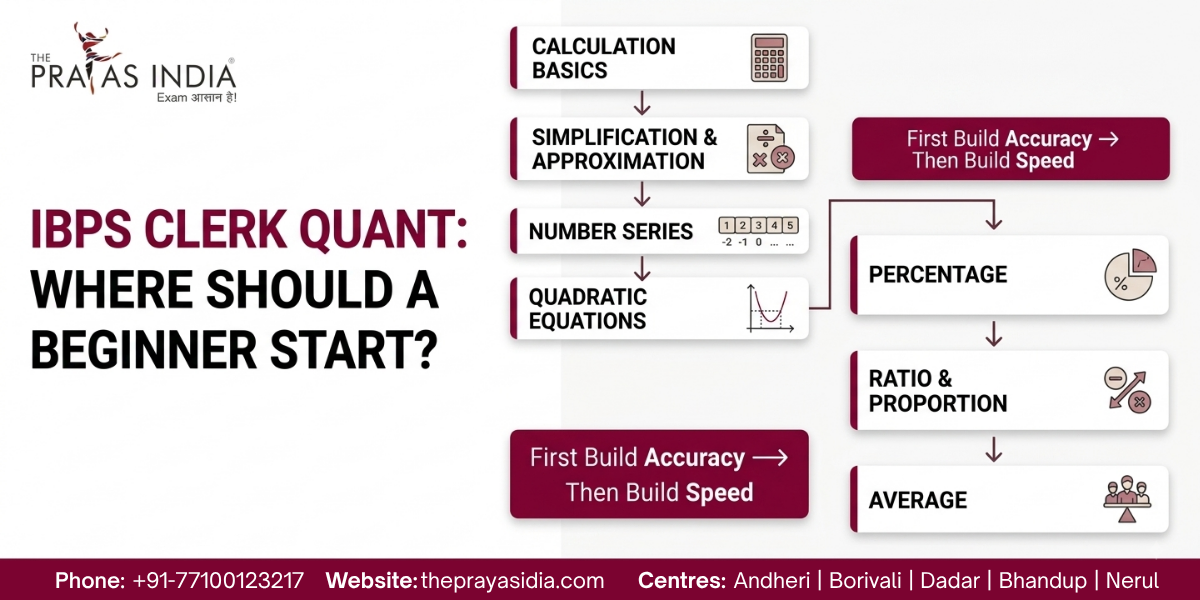
Topic 1: Simplification and Approximation
Simplification is usually one of the first topics beginners should study because it helps build calculation confidence.
Questions can involve operations such as addition, subtraction, multiplication, division, percentages, fractions, decimals, roots and other basic mathematical operations. The difficulty generally comes from the speed at which you need to perform these calculations.
For beginners, the first priority should be understanding the correct order of operations and becoming comfortable with fractions and percentages.
Once the basics are clear, start practising questions with a timer. Initially, focus on accuracy rather than speed. After your accuracy becomes consistent, gradually reduce the time allowed for each set.
Approximation can also become useful because some questions can be solved more efficiently by estimating values instead of performing lengthy exact calculations. However, beginners should first understand when approximation is safe and when exact calculation is necessary.
A common mistake during IBPS Clerk Quant Preparation is trying to learn shortcuts before understanding the underlying calculation. Shortcuts should make your method faster, not make the concept more confusing.
Topic 2: Number Series
Number Series is another topic that beginners can introduce relatively early in their preparation.
In these questions, candidates are generally required to identify a pattern involving numbers and determine a missing or incorrect value. The pattern may involve addition, subtraction, multiplication, division or a combination of operations.
The important skill here is pattern recognition.
Instead of checking random operations, develop a systematic approach. Look at the differences between consecutive numbers, examine multiplication or division relationships and check whether the differences themselves follow a pattern.
Regular practice is particularly useful because exposure to different patterns makes recognition faster.
However, don’t spend excessive time trying to force a pattern into a question. In an examination, if a series does not become clear after reasonable observation, moving to another question may be the smarter decision.
Topic 3: Quadratic Equations
Quadratic Equations can become a scoring topic once the basic method is understood.
The questions generally require candidates to compare the roots of two equations. Beginners should first understand how quadratic equations work and become comfortable identifying possible factorisation patterns.
The biggest advantage of this topic is that the solving process can become relatively mechanical with practice.
During IBPS Clerk Maths Preparation, students should focus on recognising the structure of the equations quickly rather than writing lengthy solutions every time.
After learning the basic process, practise different combinations and gradually introduce timed sets.
The objective should be to reach a stage where you can identify the likely relationship between the roots without spending unnecessary time on calculations.
Topic 4: Percentage
Percentage is one of the most important foundational topics in IBPS Clerk Quant.
Even when a question does not directly ask about percentages, the concept can appear inside other arithmetic topics. Profit and Loss, Simple and Compound Interest, Data Interpretation, Ratio-based problems and many word problems can require percentage calculations.
Beginners should therefore spend enough time developing a strong understanding of percentage rather than treating it as just another chapter.
Start with basic conversions between fractions, decimals and percentages. Then move towards percentage increase and decrease, successive changes and comparison-based questions.
For example, understanding common relationships such as:
1/2 = 50%
1/4 = 25%
1/5 = 20%
1/8 = 12.5%
can make calculations considerably faster.
The more comfortable you become with these relationships, the easier many arithmetic and DI questions become.
Topic 5: Ratio and Proportion
Ratio and Proportion form another important foundation for IBPS Clerk Quant Preparation.
A ratio compares quantities, while proportion helps establish relationships between two ratios. These concepts appear directly in questions and also support topics such as mixtures, partnership, averages and certain data-based problems.
Beginners should first learn how ratios are simplified and compared. Once the basics are clear, move towards problems involving multiple quantities.
Avoid memorising complicated methods without understanding the relationship between the quantities. If you understand what the ratio represents, many questions become easier to interpret.
Practice should gradually move from straightforward questions to mixed problems where ratio concepts are combined with percentages or averages.
Topic 6: Average
Average is another beginner-friendly topic that should be included early in your preparation.
The basic concept is simple:
Average = Total of observations ÷ Number of observations
However, examination questions may present the concept through changes in groups, replacement of values, addition or removal of members and comparison of averages.
The key is to understand how the total changes when the number of observations changes.
Once the fundamental formula is clear, practise different question structures instead of solving only direct average questions.
This approach helps you build the flexibility required for competitive examinations.
Topic 7: Profit and Loss
Profit and Loss is an important arithmetic topic for IBPS Clerk Maths Preparation. Beginners should understand the relationship between Cost Price, Selling Price, Profit and Loss before moving towards percentage-based questions.
The basic formulas are relatively simple, but questions can become challenging when discounts, marked prices or successive changes are introduced.
Start with direct problems and make sure you understand what each value represents. Once you are comfortable, practise questions involving profit percentage and loss percentage.
The most useful improvement comes from learning to translate a word problem into a mathematical relationship quickly.
Don’t rush into advanced questions before you can solve basic Profit and Loss problems accurately.
Topic 8: Simple and Compound Interest
Interest-based questions are another important component of arithmetic preparation.
Simple Interest is generally easier for beginners because the calculation follows a straightforward relationship between Principal, Rate and Time. Compound Interest requires additional understanding of how interest is added to the principal over different periods.
For IBPS Clerk Quant Preparation, beginners should first understand the basic concepts instead of memorising formulas mechanically.
Work through simple examples and understand how changing the rate, principal or time affects the final amount.
Once the basics are comfortable, practise questions involving differences between Simple Interest and Compound Interest and gradually introduce examination-level problems.
Topic 9: Time and Work
Time and Work questions test how efficiently you can understand the relationship between work, time and efficiency.
A beginner should first understand the idea of work rate. If one person completes a task in a particular number of days, you need to understand how much of the work that person completes in one day.
From there, questions involving two or more people become easier to approach.
The biggest mistake students make is trying to memorise a large number of formulas without understanding the concept of efficiency.
Build the concept first.
Once the foundation is clear, practise combined-work questions, efficiency comparisons and questions involving people joining or leaving a task.
Topic 10: Time, Speed and Distance
Time, Speed and Distance is another important arithmetic area.
The fundamental relationship is:
Distance = Speed × Time
But examination questions can involve trains, relative speed, different units and changes in speed.
Beginners should first become comfortable with unit conversion and the basic relationship between the three quantities.
After that, gradually move into questions involving relative speed and other common variations.
Do not immediately start with complicated train problems if your basic speed-distance relationship is still unclear.
A strong foundation makes advanced variations considerably easier.
Topic 11: Data Interpretation
Data Interpretation, commonly called DI, is an important part of banking-exam Quant preparation.
Instead of presenting a question directly, DI provides information through tables, bar graphs, line graphs, pie charts or caselets. Candidates then need to perform calculations based on the given data.
The difficulty of DI often comes from the combination of reading + calculation + time management.
For beginners, the best approach is to first become comfortable with percentages, ratios, averages and basic arithmetic. These concepts are frequently required while solving DI questions.
Start with simple tables and bar graphs. Once your calculation confidence improves, move towards more complex sets.
Most importantly, learn to read the entire set before calculating. You should first understand what information is available and which questions can be solved most efficiently.
Build a Topic-Wise Practice Routine
One of the biggest mistakes beginners make is completing a topic and immediately moving to the next one without sufficient practice.
For example, watching a lecture on Percentage does not mean that Percentage is prepared.
A better approach is:
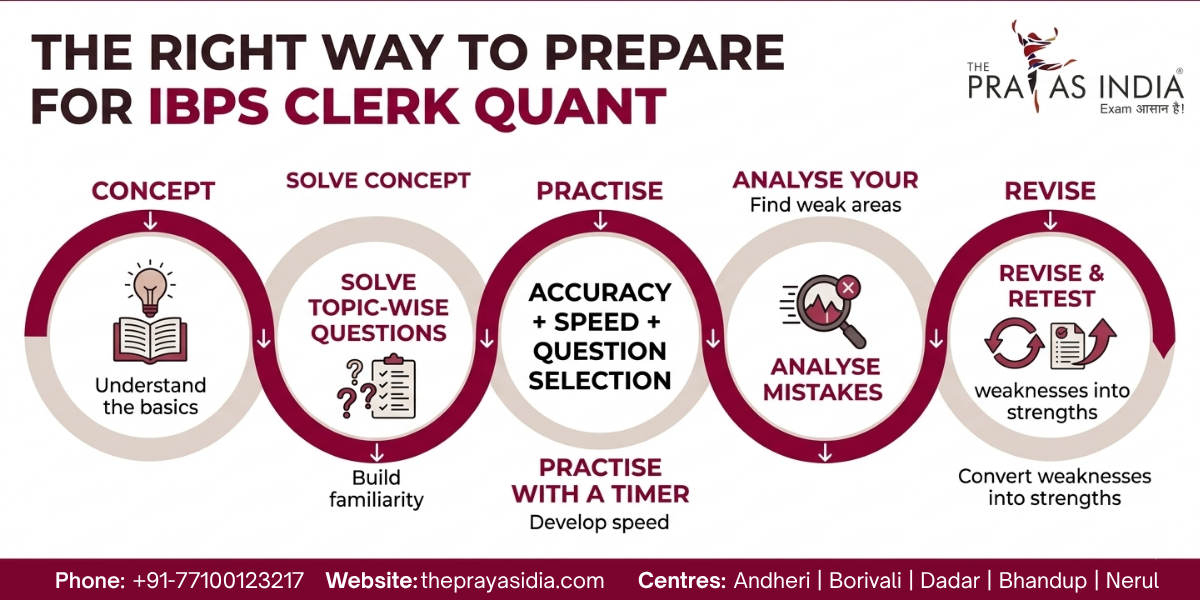
Learn → Solve → Analyse → Revise → Retest
After learning a topic, solve basic questions first. Then attempt exam-level questions under a time limit. Analyse the mistakes you make and revise the concepts responsible for those mistakes.
After a few days, return to the topic and attempt another short test.
This process helps convert theoretical knowledge into usable examination skills.
Don’t Try to Complete Everything at Once
Beginners sometimes create unrealistic schedules where they try to complete multiple Quant chapters every day.
This can create the illusion of progress while leaving the concepts weak.
A better strategy is to divide topics according to their difficulty and importance.
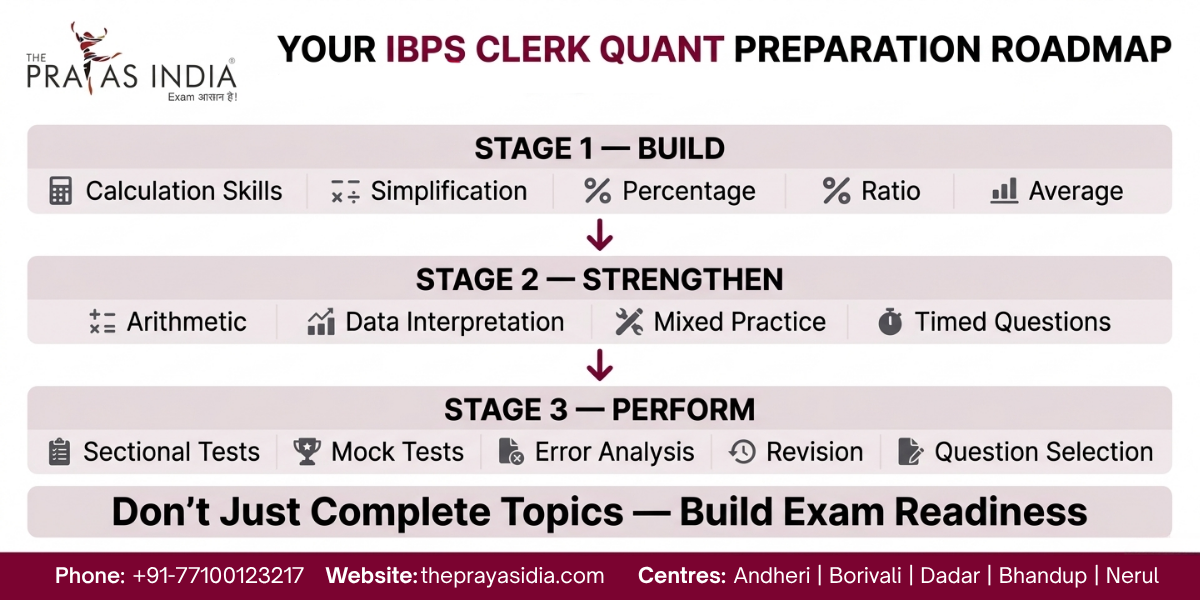
Start with calculation-based and foundational topics. Then move into arithmetic. Finally, combine different topics through mixed practice and sectional tests.
The exact timeline can vary depending on your current level, but the principle remains the same:
Depth of understanding is more valuable than the number of chapters marked as “completed.”
How to Improve Speed Without Losing Accuracy
Speed is important in IBPS Clerk, but speed without accuracy can hurt your score.
If you attempt questions quickly but make frequent calculation errors, increasing your attempt rate will not necessarily improve your result.
Instead, improve speed gradually.
First, record how much time you take to solve a particular question type. Then identify where the time is being spent.
If calculations are slow, work on calculation practice.
If you spend too much time understanding questions, practise different formats.
If you start solving difficult questions unnecessarily, improve your question-selection strategy.
This is the foundation of effective IBPS Clerk Quant Preparation.
Key Takeaway for Beginners
A strong Quant preparation journey does not begin with difficult questions. It begins with strong basics and a clear topic sequence.
Start with calculation skills, Simplification, Number Series and Quadratic Equations. Then build your foundation through Percentage, Ratio, Average and other arithmetic topics. As your confidence improves, introduce Data Interpretation and mixed practice.
Most importantly, don’t measure your progress only by the number of chapters you have completed.
Measure it through accuracy, solving time and mock-test performance.
Give Arithmetic a Major Role in Your Preparation
Arithmetic should receive consistent attention during IBPS Clerk Maths Preparation because several important concepts are connected to one another. Percentage supports Profit and Loss, Ratio and Proportion can help with Mixture and Partnership, while Average can appear in different forms across arithmetic questions.
Instead of studying every arithmetic chapter independently, try to understand how the concepts connect.
For example, once your percentage fundamentals are strong, Profit and Loss becomes easier. Once Ratio and Percentage are comfortable, Mixture and Partnership questions become more approachable. Similarly, understanding basic equations can help with Age and other word-based problems.
This connected approach makes your preparation more efficient and prevents you from treating every chapter as an entirely new subject.
Important Arithmetic Topics for IBPS Clerk
After completing the foundational topics, beginners should gradually cover areas such as Profit and Loss, Simple and Compound Interest, Time and Work, Time, Speed and Distance, Partnership, Mixture and Alligation, Problems on Ages and basic Mensuration.
You do not need to master all of them in a single week. Give yourself enough time to understand the concept, solve basic questions and then practise examination-level variations.
The important point is to maintain continuity. If you study Time and Work today and don’t touch it again for several weeks, much of the method may become unfamiliar. Regular revision prevents this.
A practical IBPS Clerk Quant Preparation approach is to keep previously studied topics active while introducing new ones.
Mixture and Alligation
Mixture and Alligation can initially appear complicated because questions are often presented through word problems. However, the underlying concept is based on comparing quantities and their respective values.
Beginners should first understand the basic relationship between the quantities being mixed. Once that becomes clear, they can learn the commonly used methods for solving questions efficiently.
Do not focus only on memorising the Alligation rule. Understand why the relationship works. This makes it easier to handle questions where the information is presented differently.
After learning the concept, practise simple mixture questions before moving towards more complex problems involving replacement or multiple quantities.
Partnership
Partnership questions are closely connected with the concept of ratio.
When different people invest different amounts for different periods, their share in the profit depends on both the amount invested and the time for which the money remains invested.
For beginners, the most important step is understanding this relationship rather than trying to memorise a shortcut.
Once the concept is clear, practise questions where investment amounts or durations change. Gradually increase the difficulty and include questions requiring comparison between partners.
Problems on Ages
Age-based questions are another useful area for arithmetic practice.
These questions generally involve present age, past age, future age or relationships between the ages of two or more people. The mathematics is usually not difficult, but interpreting the wording correctly is important.
A good approach is to represent unknown ages using variables and then translate the given information into equations.
As your confidence improves, you will start recognising common patterns quickly.
The benefit of practising such topics is that they improve your ability to convert lengthy statements into simple mathematical relationships, which is useful across several areas of Quant.
Data Interpretation: Move From Basic to Exam-Level Sets
Once your calculation skills and arithmetic foundation improve, Data Interpretation should become a regular part of your IBPS Clerk Maths Preparation.
Start with straightforward tables and bar graphs. Focus on reading the information correctly and performing calculations accurately.
After that, introduce line graphs, pie charts and caselet-based DI.
The objective is not to solve every DI set that you see. Instead, learn to identify which set is relatively manageable and which one may consume too much time.
This becomes especially important during mock tests. If one DI set requires lengthy calculations while another can be solved with relatively simple arithmetic, question selection becomes a major advantage.
Approximation Can Save Valuable Time
Approximation is particularly useful when exact calculations are unnecessary.
For example, if the options are sufficiently far apart, you may not need to calculate every decimal value precisely. Rounding numbers appropriately can help you reach the correct option much faster.
However, approximation should be used carefully.
If two options are very close, excessive rounding can lead to an incorrect answer. Therefore, beginners should first develop a sense of when approximation is safe.
The best way to learn this is through practice. During your mock analysis, identify questions where approximation could have saved time and compare your original method with a shorter approach.
Learn Question Selection Alongside Solving
A common beginner mistake is assuming that every question must be solved.
Competitive banking examinations do not reward you for spending excessive time on one difficult question. They reward the overall score you can produce within the available time.
Suppose you encounter a question that appears unfamiliar and requires several calculations. Spending two or three minutes on it may not be worthwhile if you could solve two easier questions in the same time.
Therefore, IBPS Clerk Quant Preparation should include question selection.
During practice, classify questions into three broad categories:
Quick: Questions that can be solved confidently with limited calculation.
Moderate: Questions that require some thought but remain manageable.
Time-Consuming: Questions involving lengthy calculations or unfamiliar concepts.
Your goal during the actual examination should be to maximise the number of accurate questions you can solve rather than proving that you can solve the hardest question.
Build a Daily Quant Practice Routine
A beginner does not necessarily need to spend several hours every day on Quant. What matters more is consistency and the quality of practice.
A practical daily routine can include concept revision, topic-based practice, calculation drills and a short timed exercise.
For example, you could begin with a short calculation session, spend the main study period on one concept, solve a set of questions and finish with an error review.
The routine should also include previously studied topics. This prevents the common problem of remembering a chapter only until the next chapter begins.
As your examination approaches, gradually shift more time towards sectional tests and mixed-question practice.
Keep an Error Notebook
One of the most effective tools for IBPS Clerk Maths Preparation is a simple error notebook.
Whenever you make a mistake, record the question type and the reason behind the error.
Your mistakes may fall into different categories:
- Conceptual mistake
- Calculation mistake
- Formula mistake
- Misreading the question
- Incorrect question selection
- Time-management issue
This classification is more useful than simply writing down the correct answer.
If most of your mistakes are calculation-based, you know that calculation practice needs attention. If you repeatedly misunderstand a particular concept, you need targeted revision.
Your error notebook should therefore become a record of what you personally need to improve.
Mock Tests Should Be Part of Preparation
Many students wait until they finish the complete syllabus before attempting mock tests. This is not an ideal approach.
You can start with small topic-wise tests after completing individual chapters. Once several topics are covered, move towards sectional Quant tests.
Mock tests help you understand more than just your score. They reveal how quickly you solve questions, which topics consume your time and what kind of mistakes you repeatedly make.
For effective IBPS Clerk Quant Preparation, treat mock tests as a diagnostic tool rather than simply a method of measuring marks.
A low score in an early sectional test is not necessarily a problem. What matters is whether you understand why the score was low and improve in the next attempt.
How to Analyse an IBPS Clerk Quant Mock
After completing a mock test, don’t immediately move to the next test.
Spend time analysing the paper.
First, identify questions that you answered incorrectly. Then look at questions you left unanswered. Finally, examine questions that you solved correctly but took too much time on.
This third category is often ignored.
Suppose you correctly solve a question but spend three minutes doing so. In the actual examination, that may still be a problem.
Your analysis should therefore answer four questions:
Did I know the concept?
Did I calculate correctly?
Did I choose the right method?
Was the time spent justified?
This approach gradually improves both accuracy and efficiency.
Don’t Ignore Easy Topics
Some students spend most of their preparation time on difficult arithmetic while neglecting comparatively manageable areas such as Simplification, Number Series or Quadratic Equations.
This can be a costly strategy.
Your preparation should aim to maximise scoring opportunities. Easier topics can provide valuable marks when approached with sufficient accuracy and speed.
This does not mean ignoring difficult topics. It means creating a balanced preparation plan where foundational and scoring areas receive proper attention before you spend excessive time chasing advanced questions.
Revision Strategy for IBPS Clerk Quant
Revision should not be postponed until the final week.
A better approach is to revise topics periodically throughout your preparation.
After completing a topic, revisit it after a few days. Then test yourself again after a couple of weeks.
This spaced revision approach helps you retain formulas, methods and question patterns for longer.
You should also revise your error notebook regularly because it contains the concepts that have already caused problems for you.
Before the examination, your revision should become increasingly focused on:
Important formulas → Common question types → Previous mistakes → Timed practice → Sectional tests
What Beginners Should Avoid
Several preparation mistakes can slow down your progress even when you are studying regularly.
The first is collecting too many resources. Switching between multiple books, teachers and online sources can create confusion instead of improving preparation.
The second is learning shortcuts without understanding concepts. Shortcuts are useful only when you already understand the underlying method.
The third is practising without a timer for too long. Accuracy should come first, but eventually you must learn to perform under examination pressure.
Another common problem is solving questions repeatedly without analysing mistakes. If you keep making the same error, simply solving more questions will not necessarily fix it.
A focused preparation system is more valuable than an overloaded study schedule.
When Should You Join Coaching for IBPS Clerk Preparation?
Self-study can work for some students, particularly those who already have strong fundamentals and can maintain a disciplined schedule. However, beginners often struggle with choosing the right topics, understanding shortcuts, analysing mocks and maintaining consistency.
Structured coaching can provide a defined preparation path, regular classes, doubt support, practice material, mock tests and performance guidance.
For students searching for Banking Coaching in Mumbai, the important consideration should not simply be whether an institute offers classes. You should evaluate whether the complete preparation system supports your specific requirements.
Faculty quality, study material, test series, doubt-solving, performance analysis and mentorship can all influence your preparation.
If you are comparing options for IBPS Clerk Coaching in Mumbai, look for an environment where you can systematically move from basic concepts to exam-level practice.
A Practical Weekly Strategy for Beginners
Your weekly preparation should balance new learning, revision and testing.
During the first part of the week, you can focus on learning new concepts and solving topic-wise questions. As the week progresses, include mixed practice so that you learn to identify questions without knowing the chapter beforehand.
Towards the end of the week, take a Quant sectional test and analyse it carefully.
The following week should begin with a short revision of the mistakes identified in the previous test.
This creates a continuous loop:
Learn → Practise → Test → Analyse → Improve
That cycle is much more effective than studying topics randomly.
How The Prayas India Can Support Your IBPS Clerk Preparation
Preparing for a competitive banking examination becomes easier when the preparation process is organised around clear milestones.
The Prayas India focuses on helping banking aspirants develop a structured approach to examination preparation. For a beginner, this can be particularly useful because the challenge is often not a lack of effort but uncertainty about what to study, how much to practise and how to measure improvement.
A structured learning environment can help students work through concepts systematically, practise relevant questions, attempt mock tests and identify areas that require additional attention.
For aspirants looking for IBPS Clerk Coaching in Mumbai, the objective should be to find coaching that supports the complete preparation journey rather than focusing only on classroom lectures.
The right guidance can help students create better study discipline, understand examination-level questions and gradually improve their speed and accuracy.
Final Strategy: Focus on Progress, Not Perfection
Beginners often compare their preparation with students who have already been studying for months. This can create unnecessary pressure.
Your Quant score will not improve overnight.
At the beginning, your priority should be understanding concepts. Then focus on accuracy. After that, work on speed and question selection.
If you can solve 15 questions accurately today and 20 after a few weeks of structured practice, that is meaningful progress.
The purpose of IBPS Clerk Quant Preparation is not to become a mathematics expert. It is to become efficient at solving the types of questions that can appear in the examination.
With a clear topic sequence, regular practice, mock-test analysis and consistent revision, beginners can gradually build the confidence required to handle the Quant section.
If you are starting your IBPS Clerk Maths Preparation and feel unsure about where to begin, a structured coaching programme can help reduce that confusion and provide a more organised path towards the examination.
For aspirants exploring Banking Coaching in Mumbai or looking for the Best Banking Coaching in Mumbai, the key is to choose an institute that combines conceptual teaching with practice, testing, analysis and continuous guidance.
The goal is simple:
Build the basics.
Practise intelligently.
Analyse every mistake.
Improve your speed.
Enter the exam with a strategy.
That is the foundation of effective IBPS Clerk Quant preparation.
Contact Us
📞 Call Now: +91-77100 13217
🌐 Website: theprayasindia.com