IBPS RRB 2026 Study Plan: How to Prepare for Prelims and Mains Together | The Prayas India
The IBPS RRB 2026 recruitment has created a strong opportunity for banking aspirants looking to secure a position as an Office Assistant or Officer Scale-I. With the notification now released, the biggest challenge for candidates is no longer simply understanding the eligibility criteria or exam dates. The real challenge is building a preparation strategy that works across both stages of the examination.
Many aspirants make the mistake of preparing only for the IBPS RRB Prelims and postponing Mains preparation until after the preliminary examination. While Prelims is certainly the immediate target, waiting until the result is announced can leave very little time to cover the broader Mains syllabus. A more effective approach is to prepare for both stages together, while giving greater weight to the subjects and skills required for the upcoming stage.
A well-structured IBPS RRB 2026 study plan should therefore work on two levels. The first is to build the speed, accuracy and question-selection skills required to clear Prelims. The second is to gradually develop the General Awareness, Computer Knowledge and other Mains-oriented areas that require consistent preparation over a longer period.
For aspirants preparing through coaching, this is also where structured guidance can make a difference. A planned approach helps students divide their time between concepts, practice, revision, sectional tests and full-length mocks instead of studying randomly based on whichever topic feels difficult on a particular day.
IBPS RRB 2026 Notification Out
Start With the Complete IBPS RRB 2026 Exam Roadmap
Before creating a daily timetable, candidates should understand how their preparation needs to evolve from the beginning of the recruitment process until the final stage. Prelims should be treated as the first checkpoint, not as the entire preparation journey.
For Office Assistant and Officer Scale-I aspirants, the preliminary stage places significant emphasis on Reasoning and Quantitative Aptitude. This means that candidates need to develop speed and accuracy early. At the same time, Mains preparation cannot be ignored because areas such as General Awareness, Computer Knowledge and broader banking-related awareness require repeated exposure and revision.
The ideal strategy is therefore not to divide preparation into two completely separate phases called “Prelims preparation” and “Mains preparation.” Instead, candidates should build a common foundation first and then gradually add Mains-specific preparation around it.
For example, when studying Quantitative Aptitude, the initial focus can be on concepts and frequently tested question types. Once the basics become stronger, candidates can start solving timed sets and sectional tests. Alongside this, a fixed daily slot can be reserved for current affairs and banking awareness. This way, Mains preparation keeps progressing even while the primary focus remains on Prelims.
The Right Preparation Model: Prelims First, Mains Alongside
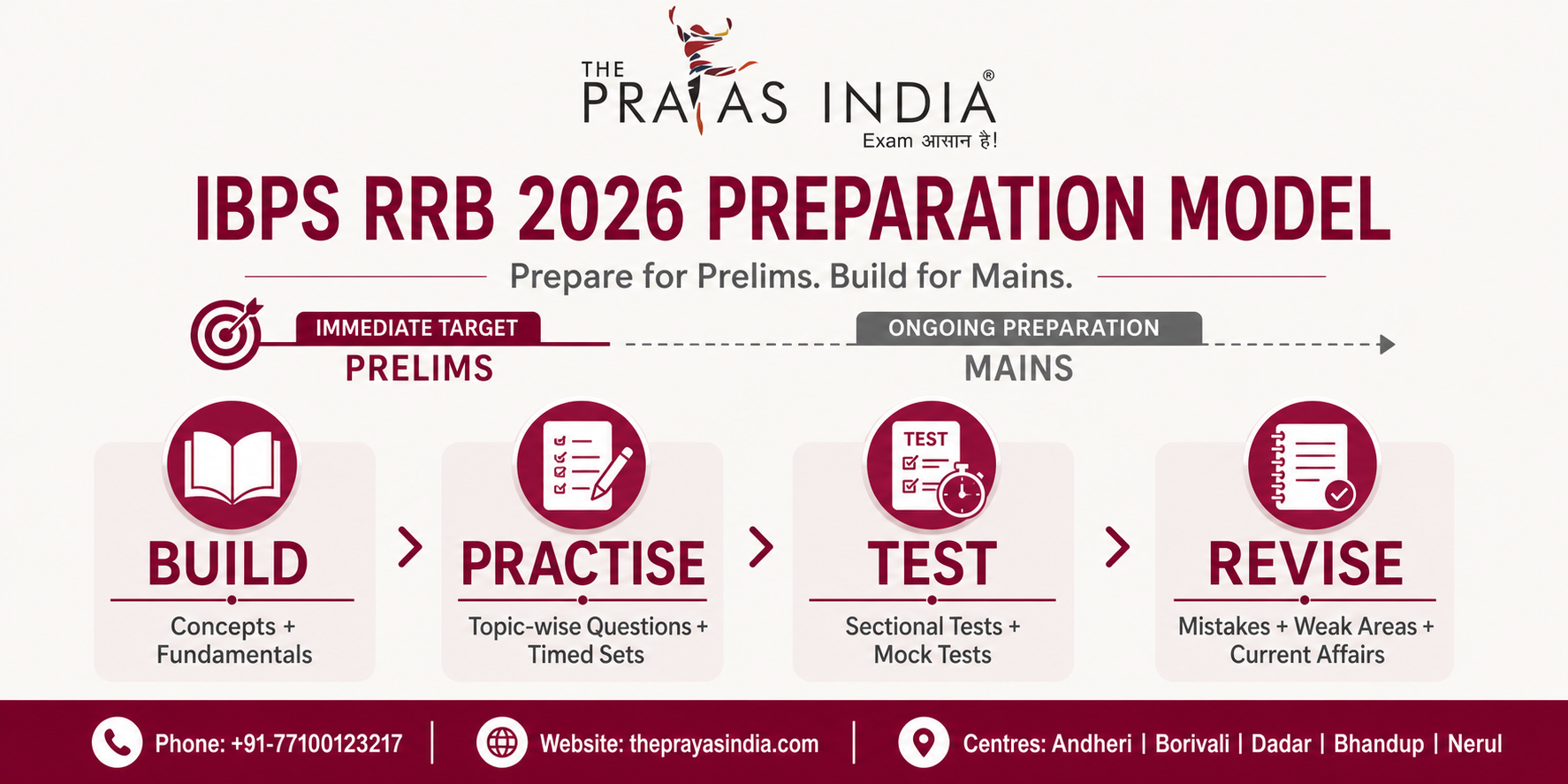
The most practical model for IBPS RRB 2026 preparation is to keep Prelims as the immediate performance goal while Mains remains a continuous preparation track.
This distinction is important. Preparing for both stages together does not mean giving equal time to every subject every day. Instead, the allocation of time should change as the examination approaches.
During the early stage, candidates should spend most of their study hours building concepts in Reasoning and Quantitative Aptitude while beginning regular General Awareness and Computer Knowledge preparation. As the Prelims examination gets closer, the focus should gradually shift toward timed practice, sectional tests, mock tests and revision. Mains-specific subjects should continue in smaller but consistent daily or weekly slots.
Once Prelims is over, the strategy can change sharply toward Mains because the speed-building phase for the preliminary examination will have served its purpose. Candidates who have already maintained their Mains preparation will then be in a much stronger position than those starting from zero after Prelims.
A Simple Preparation Framework
Think of your IBPS RRB 2026 preparation as four connected stages:
BUILD → PRACTISE → TEST → REVISE
The first stage is about developing conceptual clarity. The second converts concepts into solving ability. The third measures performance under time pressure. The fourth identifies gaps and strengthens weak areas.
The important point is that these stages should operate continuously. A candidate should not spend months only studying concepts and then suddenly begin taking mocks. Similarly, taking frequent mocks without revising mistakes does not automatically improve performance.
Build a Foundation Before Chasing Mock Scores
One of the biggest problems in competitive-exam preparation is starting mock tests too aggressively without developing the underlying concepts. Mock tests are important, but they should measure preparation rather than replace it.
For IBPS RRB 2026, candidates should first identify the core topics within Reasoning and Quantitative Aptitude and build enough conceptual understanding to solve standard questions confidently. The goal at this stage is not maximum speed. It is to understand the logic behind different question types and reduce dependence on guesswork.
Reasoning preparation should gradually cover areas such as puzzles, seating arrangements, inequalities, syllogism, coding-decoding, blood relations, direction-based questions and other commonly tested concepts. Quantitative Aptitude should similarly develop comfort with arithmetic, simplification, approximation, number-based questions, data interpretation and other relevant areas.
The foundation stage should also include reading and awareness habits. Current affairs should not be treated as a subject that can be completed in a few days. Reading regularly and revising important developments periodically creates a much stronger base for Mains.
Computer Knowledge can also be introduced early through short, consistent study sessions. Candidates do not necessarily need to spend several hours on it every day in the initial phase, but completely ignoring it until after Prelims can create unnecessary pressure later.
How to Divide Your Study Time Between Prelims and Mains
A good study plan does not necessarily mean studying for a fixed number of hours. What matters more is how those hours are distributed.
For a student who can study for around six hours a day, an initial structure could look like this:
| Preparation Area | Approximate Focus |
|---|---|
| Reasoning | Concept building + practice |
| Quantitative Aptitude | Concept building + practice |
| Current Affairs & Banking Awareness | Daily preparation |
| Computer Knowledge | Regular short sessions |
| Sectional/Timed Practice | Gradually increasing |
| Revision & Error Analysis | Daily |
The exact number of hours can vary depending on whether the candidate is a college student, working professional or full-time aspirant. The important principle is consistency.
A student preparing full-time may naturally devote more hours to practice and mocks, while a working aspirant may need a compact schedule built around mornings, evenings and weekends. The strategy should therefore be based on available study time rather than copying someone else’s timetable.
The most important rule is to protect a daily slot for Mains-oriented preparation even during the Prelims-focused phase. Twenty to forty minutes of consistent current-affairs preparation over several weeks can be more useful than attempting to cover months of information in a few days after Prelims.
A Month-Wise Approach to IBPS RRB 2026 Preparation
The study plan should evolve rather than remain identical throughout the preparation period.
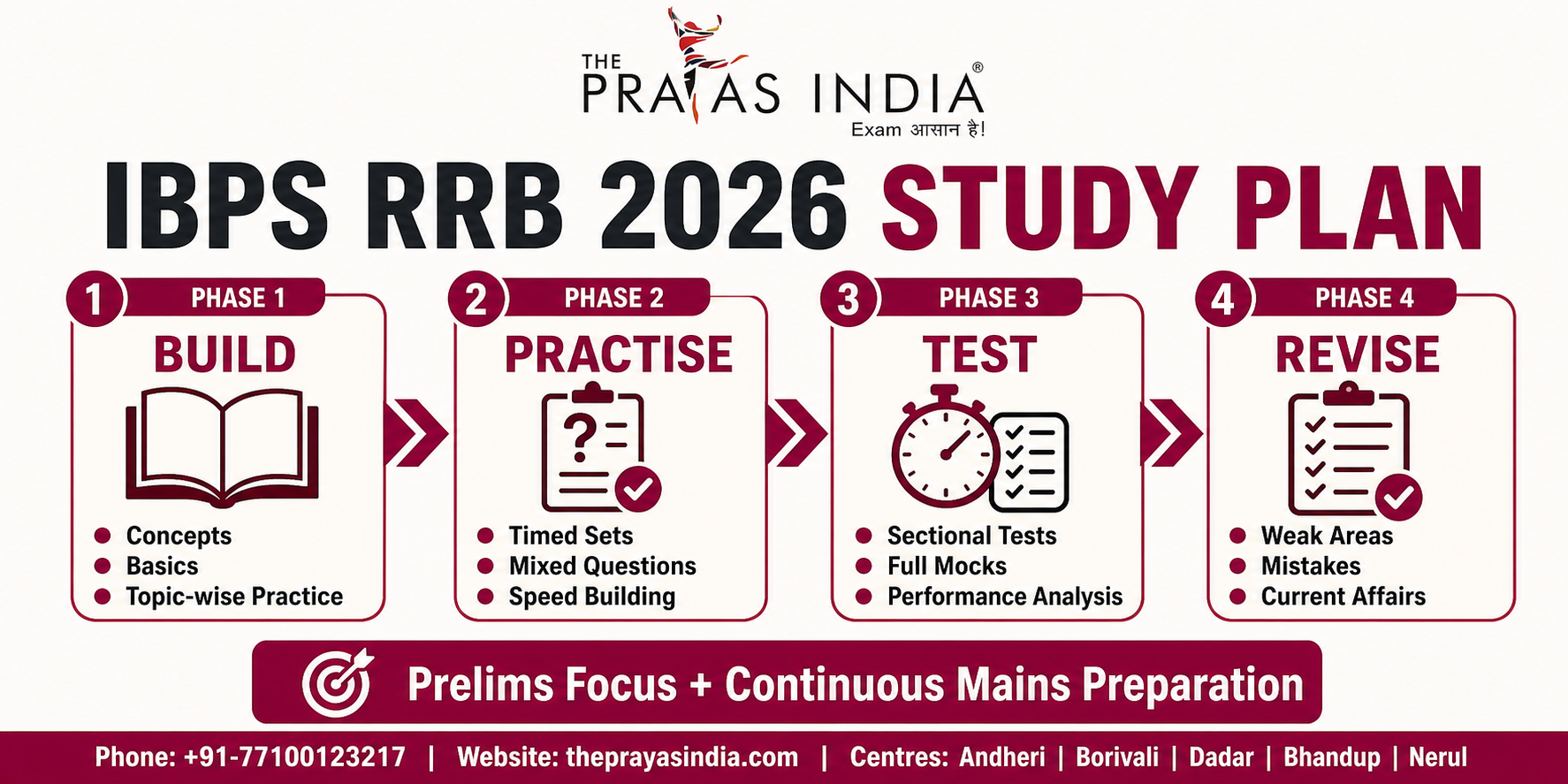
Phase 1: Concept Building
The first phase should focus on understanding the syllabus, identifying strengths and weaknesses and completing the fundamental concepts of Reasoning and Quantitative Aptitude. Candidates should solve topic-wise questions after learning each concept instead of waiting until the entire syllabus is completed.
At the same time, current affairs should become a daily habit. Candidates should begin maintaining concise notes or using a reliable revision system so that information can be revisited later.
Phase 2: Practice and Speed Development
Once the fundamentals are reasonably strong, preparation should move toward timed sets and mixed-question practice. The objective is to become comfortable solving familiar questions quickly while learning to recognise questions that should be skipped.
This is particularly important for Prelims because knowing how to solve a question is only one part of the challenge. The candidate must also determine whether the question is worth the time it requires.
Phase 3: Mock Tests and Performance Analysis
As the preliminary examination approaches, sectional tests and full-length mocks should become an important part of the routine. However, candidates should not judge preparation only by mock scores.
After every test, analyse incorrect questions, questions that consumed excessive time, questions that were left despite being solvable, and questions that were attempted despite uncertainty. This analysis can reveal whether the problem lies in concepts, calculation speed, question selection or time management.
Phase 4: Prelims Revision With Mains Preparation Running in Parallel
The final Prelims-focused phase should be dominated by revision, timed practice and mocks. At this point, candidates should avoid constantly adding new resources or repeatedly switching between preparation strategies.
Mains preparation should continue through short but consistent sessions, particularly for Current Affairs, Banking Awareness and Computer Knowledge. This keeps the second-stage preparation active without taking away the focus required for Prelims.
Create a Daily Study Routine That You Can Actually Follow
A study plan is useful only when it can be followed consistently. Many IBPS RRB aspirants create ambitious schedules with long study hours, multiple resources and several daily targets, but the routine becomes difficult to maintain after a few days. A better approach is to create a realistic schedule that gives every important area a defined place without making preparation unnecessarily complicated.
For a full-time aspirant, the first part of the day can be used for concept-heavy subjects such as Quantitative Aptitude and Reasoning, when concentration is generally higher. Current Affairs and Banking Awareness can be covered through a fixed daily session, while Computer Knowledge can be handled through shorter topic-wise sessions. The remaining study time should gradually move toward timed practice, sectional tests and mock-test analysis.
Students who are managing college or a job should not assume that they need to copy a full-time aspirant’s timetable. A shorter but disciplined routine can work extremely well when study sessions are planned around available time. Weekdays can focus on concepts and targeted practice, while weekends can provide longer slots for mocks, revision and detailed performance analysis.
The key is to ensure that the schedule contains four recurring activities: learning, practice, testing and revision. If any one of these is completely missing, the preparation can become unbalanced.
Subject-Wise Preparation Strategy for IBPS RRB 2026
Reasoning: Build Pattern Recognition and Decision-Making Speed
Reasoning can become a high-scoring area when candidates learn to recognise question patterns instead of approaching every question from scratch. Preparation should begin with fundamental topics and gradually move toward mixed sets and timed practice.
Puzzles and seating arrangements deserve consistent practice because they can consume considerable time if approached inefficiently. Candidates should learn to identify the structure of a puzzle quickly, determine whether sufficient information is available and decide whether it is worth attempting immediately. Alongside these sets, topics such as syllogism, inequality, coding-decoding, blood relations and direction-based questions should be practised regularly.
The ultimate objective is not simply to solve difficult reasoning questions. It is to identify the questions that can be converted into marks quickly and accurately during the examination.
Quantitative Aptitude: Combine Concepts With Calculation Speed
Quantitative Aptitude requires a combination of conceptual clarity, calculation ability and time management. Candidates should avoid spending weeks only reading formulas. Every concept should be followed by sufficient question practice.
Arithmetic topics should be studied systematically, with regular practice of percentages, profit and loss, ratio and proportion, averages, time and work, time-speed-distance and other relevant areas. Simplification, approximation, number-based questions and data interpretation should also receive regular attention.
Calculation speed should be developed separately rather than expecting it to improve automatically through syllabus completion. Short daily calculation drills can gradually reduce the time spent on routine arithmetic and create more time for questions that require deeper reasoning.
Current Affairs and Banking Awareness: Start Early
Current Affairs is one of the clearest reasons why candidates should not postpone Mains preparation. Unlike a single static chapter, current affairs builds over time and requires repeated revision.
A practical approach is to study current affairs regularly and maintain concise revision material. Candidates should pay attention to banking and financial developments, important appointments, government schemes, reports, awards, sports and other areas relevant to competitive examinations.
The objective should not be to collect enormous amounts of information. The focus should be on creating a manageable knowledge base that can be revised multiple times before the Mains examination.
Computer Knowledge: Small Sessions, Consistent Revision
Computer Knowledge is another area that can be integrated into the preparation routine without requiring large daily study blocks. Candidates can cover fundamental concepts through short sessions and then revise them periodically.
Topics can be divided into manageable units so that preparation continues alongside Prelims practice. Regular revision is more useful than completing the entire area once and leaving it untouched for several weeks.
How to Use Mock Tests Without Disturbing Your Study Plan
Mock tests should gradually become an integral part of IBPS RRB preparation rather than something candidates begin only a few days before the examination. However, the number of mocks should increase according to preparation level.
In the earlier stage, sectional tests can be more useful because they help candidates identify specific weaknesses. As the syllabus becomes stronger, full-length Prelims mocks can be introduced more regularly. Near the examination, the emphasis should shift toward realistic timed practice and exam-like conditions.
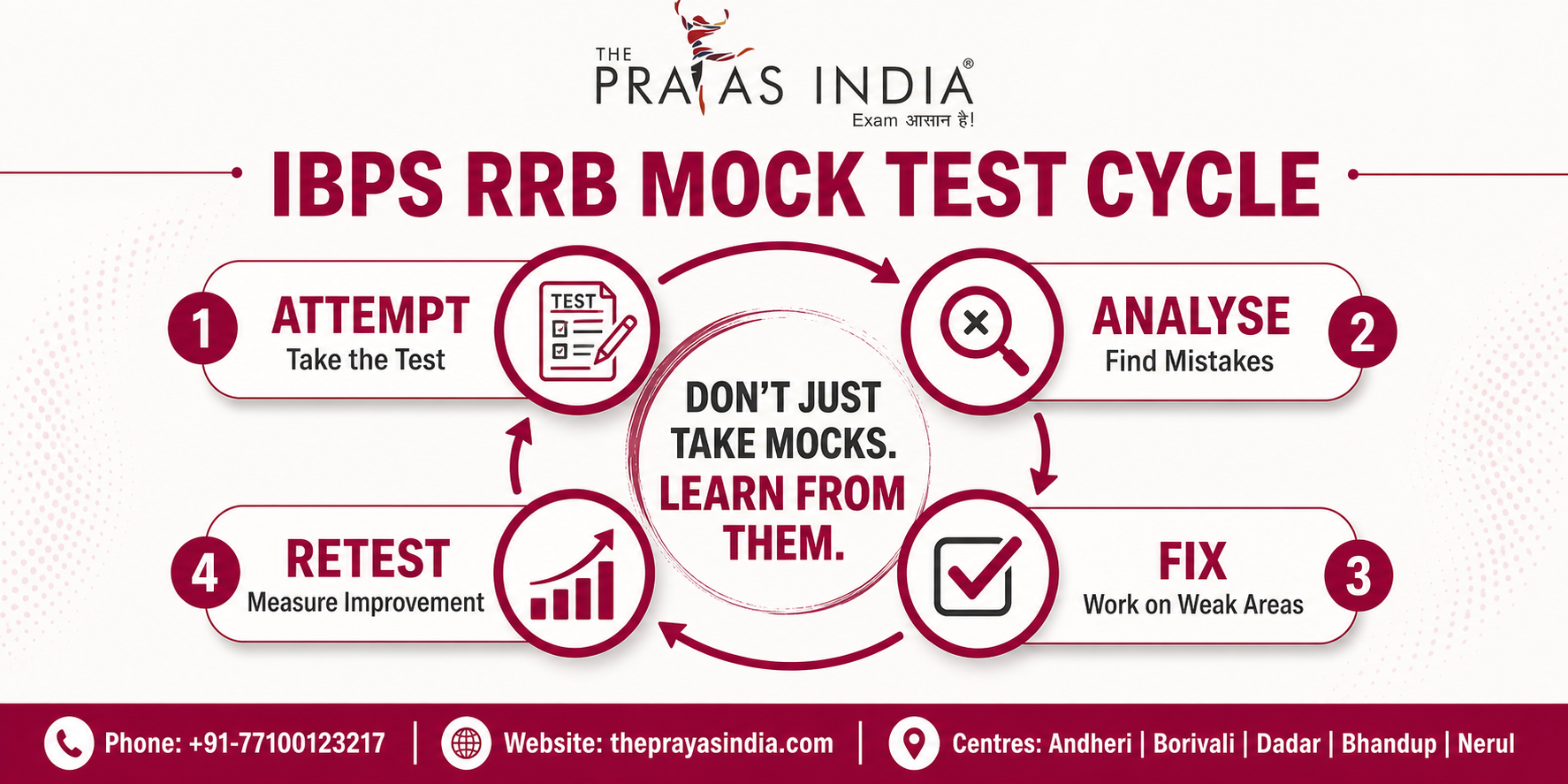
The most important part of a mock is what happens after submission. A candidate who takes ten mocks but does not analyse them may learn less than a candidate who takes fewer mocks and studies every important mistake carefully.
After each test, examine four things: incorrect attempts, unattempted but solvable questions, correct but time-consuming questions, and questions that should have been skipped. This analysis shows whether the next study session should focus on concepts, speed, accuracy or question selection.
Build a Weekly Revision System
Daily study builds knowledge, but weekly revision prevents that knowledge from disappearing. Candidates should reserve a fixed period every week to revisit concepts, formulas, vocabulary, current affairs and questions previously marked as difficult.
One effective approach is to maintain a small error log. Whenever a question is answered incorrectly because of a conceptual mistake, calculation error, misreading or poor question selection, record the reason rather than simply writing the correct answer. Over time, this creates a personalised list of recurring weaknesses.
Weekly revision should also include previously attempted sectional tests. If the same type of question continues to cause problems, simply taking another mock may not solve the issue. The underlying concept or solving approach needs to be addressed first.
This process becomes particularly valuable as the examination approaches because revision becomes increasingly important. Instead of trying to revise everything from the beginning, candidates can use their error logs and short notes to focus on the areas that actually affect their performance.
How to Balance Speed, Accuracy and Attempts
IBPS RRB preparation should never become a race to maximise attempts at the expense of accuracy. A large number of attempts is useful only when a substantial proportion of those attempts are converted into correct answers.
During practice, candidates should therefore track three broad indicators: speed, accuracy and question selection. If speed is high but accuracy is poor, more timed practice alone may not solve the problem. If accuracy is high but attempts are low, the candidate may need to improve question selection and solving speed.
Similarly, if a candidate spends too much time on individual questions, the issue may not be a lack of knowledge. It may be a failure to recognise when a question is becoming inefficient.
This is why mock analysis and sectional practice should work together. Sectional tests help isolate the problem, while full-length mocks show whether the candidate can apply the strategy under complete exam conditions.
The Last Stage Before Prelims: Shift From Learning to Execution
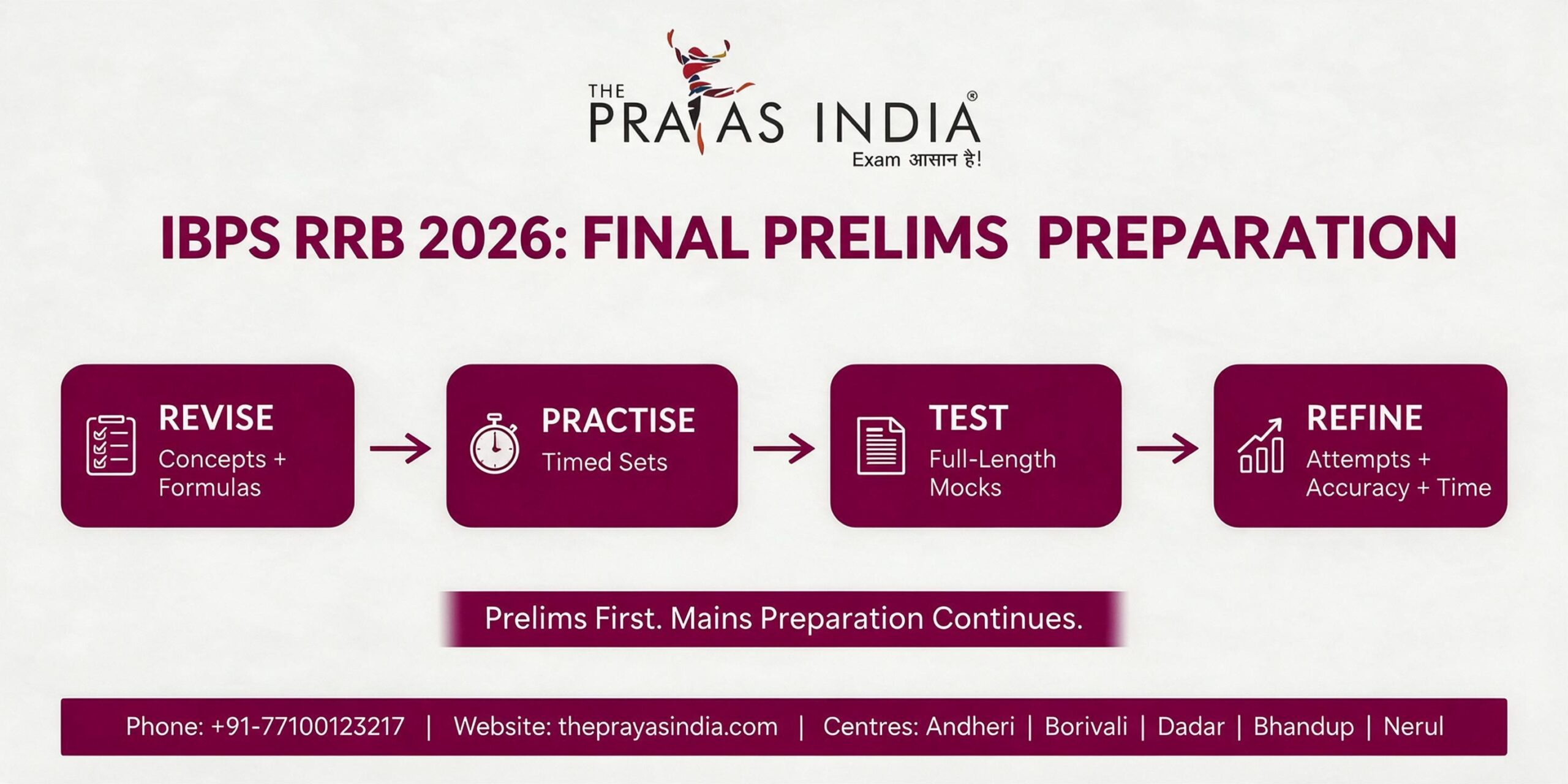
As the IBPS RRB Prelims examination gets closer, candidates should gradually reduce their dependence on new material and focus more on revision, timed practice and mock tests. This does not mean stopping learning completely. It means prioritising the topics that are most likely to influence actual exam performance.
At this stage, candidates should know their strongest topics, commonly repeated mistakes, preferred attempt order and approximate time requirements. The purpose of mocks should be to refine this strategy rather than experiment with a completely new approach every time.
Mains preparation should continue in parallel, but it can be kept compact during the final Prelims-focused period. Daily current affairs revision and regular Computer Knowledge practice can maintain continuity without distracting from the immediate examination.
Once Prelims is completed, candidates can immediately increase the time devoted to Mains-specific preparation. Those who have already developed a current-affairs base and maintained their awareness subjects will have a significant advantage over candidates beginning those areas from scratch.
When Structured Coaching Can Strengthen IBPS RRB Preparation
Self-study can work for many aspirants, but maintaining a balanced Prelims-and-Mains strategy can become difficult without a structured system. Candidates may spend too much time on one subject, postpone current affairs, take mocks without analysing them or repeatedly change resources.
A structured coaching programme can provide a defined learning sequence, regular practice, doubt-solving support, sectional and full-length tests, performance feedback and a disciplined revision cycle. The value of coaching is therefore not simply the availability of study material. It is the structure that connects learning with measurable improvement.
For aspirants looking for IBPS RRB coaching in Mumbai, the choice of institute should be based on factors such as faculty support, quality of study material, mock-test ecosystem, doubt resolution, batch structure, revision support and the institute’s approach toward both Prelims and Mains.
At The Prayas India, the objective is to bring these components into a structured preparation process so that students can work toward the immediate Prelims target while steadily building the foundation required for Mains.
How The Prayas India Can Fit Into Your IBPS RRB 2026 Preparation
The most useful coaching approach is one that complements the student’s individual preparation rather than simply adding more study material. A candidate should be able to understand concepts, practise them under guidance, identify weaknesses through tests and revise according to actual performance.
For IBPS RRB aspirants, this becomes particularly important because Prelims demands speed and accuracy while Mains requires a broader preparation base. A preparation programme that keeps these two requirements connected can help candidates avoid the common cycle of preparing intensely for Prelims and then struggling to transition into Mains.
The Prayas India can be considered by aspirants looking for a structured preparation environment in Mumbai, particularly those who want classroom guidance, regular practice and a systematic approach to mock tests and revision.
Admissions-focused preparation should ultimately be about finding a routine that an aspirant can sustain. Whether a candidate chooses full-time coaching, blended preparation or self-study with structured support, the goal should remain the same: build the fundamentals early, practise consistently, test regularly and use performance data to improve.
Common Mistakes to Avoid in IBPS RRB 2026 Preparation
One common mistake is treating Prelims and Mains as completely separate examinations. Candidates who ignore Mains-oriented subjects until after Prelims may find themselves under significant time pressure later.
Another mistake is collecting too many resources. Changing books, PDFs, teachers or online sources repeatedly can create the illusion of preparation without producing enough focused practice. A smaller set of reliable resources, used consistently and revised properly, is usually more practical.
Candidates should also avoid measuring progress only through the number of hours studied. Six focused hours with proper analysis and revision can be more valuable than a long study session where most of the time is spent passively reading.
Finally, preparation should not become mock-test dependent. Mocks are diagnostic tools. They should tell you what to improve next. If the same mistakes continue across several tests, the solution is not simply to take more tests; it is to identify and correct the underlying problem.
Final Strategy: Prepare for the Next Stage Before It Arrives
The most effective IBPS RRB 2026 study plan does not try to complete everything at once. It is a progressive system in which preparation changes according to the examination timeline.
Build your Reasoning and Quantitative Aptitude fundamentals early. Start Current Affairs and Banking Awareness preparation from the beginning. Add Computer Knowledge consistently. Introduce sectional tests as your concepts become stronger, and gradually increase full-length mocks as Prelims approaches.
Most importantly, analyse your performance. Know where you lose marks, where you lose time and which questions you should have attempted or skipped. This information should directly influence your next week’s study plan.
The candidates who approach IBPS RRB preparation this way are not merely studying for an examination. They are building an exam strategy that evolves with their performance.
For aspirants who want structured guidance and a systematic preparation environment, The Prayas India offers IBPS RRB coaching in Mumbai with a focus on concepts, practice, testing, revision and continuous performance improvement.
Contact Us
- Call Now: +91-77100 13217
- Website: theprayasindia.com
- Centres: Andheri | Borivali | Dadar | Nerul | Bhandup
Frequently Asked Questions
1. Should I prepare for IBPS RRB Prelims and Mains together?
Yes. Prelims should remain the immediate priority, but Mains-oriented areas such as Current Affairs, Banking Awareness and Computer Knowledge should be prepared consistently from the beginning. This reduces the pressure of starting Mains preparation from scratch after Prelims.
2. How many hours should I study for IBPS RRB 2026?
There is no universal number of hours that works for every candidate. A better approach is to create a sustainable routine that includes concept learning, practice, tests and revision. Full-time aspirants can naturally devote more hours, while working candidates can use shorter, focused sessions.
3. When should I start taking IBPS RRB mock tests?
Candidates can begin with sectional tests once they have covered enough basic concepts. Full-length mocks should be introduced progressively and become more frequent as Prelims approaches. Every mock should be followed by detailed analysis.
4. How can I prepare for IBPS RRB Mains while focusing on Prelims?
Reserve a fixed daily or weekly slot for Current Affairs, Banking Awareness and Computer Knowledge while keeping the majority of your study time focused on Prelims subjects. This allows Mains preparation to continue without reducing your immediate Prelims focus.
5. Is coaching necessary for IBPS RRB 2026 preparation?
Coaching is not compulsory, but structured guidance can be useful for candidates who struggle with consistency, concept clarity, doubt solving, mock analysis or maintaining a balanced Prelims-and-Mains preparation plan. The right choice depends on the candidate's preparation style and requirements.
6. How should I choose IBPS RRB coaching in Mumbai?
Look beyond advertisements and compare faculty guidance, course structure, study material, mock tests, doubt-solving support, revision strategy and performance tracking. The institute should help you build a complete preparation system rather than only provide classes.
7. What should I do if my IBPS RRB mock scores are not improving?
Start by analysing the reason behind the stagnant score. Check conceptual errors, calculation mistakes, accuracy, time spent, unattempted questions and question selection. Once the main problem is identified, modify your practice plan and retest the same skill.
8. Can I prepare for IBPS RRB while working or studying in college?
Yes. The key is to build a realistic schedule rather than copying a full-time aspirant's routine. Use weekdays for focused concept and practice sessions and utilise weekends for longer tests, analysis and revision.