IBPS RRB Quantitative Aptitude Preparation Strategy | Best Bank Coaching in Mumbai | The Prayas India
Introduction: IBPS RRB Quant Preparation Needs More Than Formula Learning
Quantitative Aptitude is one of the most decisive sections in the IBPS RRB examination. For many aspirants, the difficulty is not simply understanding mathematical concepts. The real challenge is solving questions within a limited time, identifying the right questions quickly, avoiding calculation errors and maintaining accuracy when the pressure of the examination increases. This becomes particularly important in IBPS RRB Prelims, where Quantitative Aptitude or Numerical Ability forms one half of the 80-question paper for Office Assistant and Officer Scale-I candidates. The section carries 40 questions, making the ability to convert preparation into fast and accurate attempts extremely important.
A strong IBPS RRB Quantitative Aptitude preparation strategy therefore has to move beyond collecting formulas or completing a syllabus checklist. Aspirants need a systematic process that takes them from concept building to guided practice, timed solving, mock-test performance and continuous correction. This is also where structured preparation at The Prayas India can make a meaningful difference. Instead of treating Quant as a subject that students have to manage on their own, The Prayas India approach can help aspirants build the subject progressively, identify their weak areas and develop the speed required for competitive banking examinations.
For candidates looking for IBPS RRB coaching in Mumbai, Quant preparation should be one of the first factors to evaluate before choosing a coaching institute. A good programme should not simply provide classes. It should give students a clear preparation direction, relevant practice, regular testing and a mechanism to understand why their performance is improving—or where it is getting stuck. That is the approach aspirants should look for while considering their preparation options at The Prayas India.
Understanding the Role of Quantitative Aptitude in IBPS RRB
The first step towards effective preparation is understanding exactly how Quant fits into the larger IBPS RRB examination strategy. In the Prelims examination for Office Assistant and Officer Scale-I, candidates face 40 Quantitative Aptitude/Numerical Ability questions along with 40 Reasoning questions, with a composite examination duration of 45 minutes. The section therefore cannot be approached as a conventional school-level mathematics paper where candidates can spend several minutes on a single difficult problem. The objective is to recognise familiar patterns, calculate efficiently and make intelligent question-selection decisions.
The importance of Quant does not disappear after Prelims. In the Mains examination, Quantitative Aptitude or Numerical Ability again has 40 questions for 50 marks. This means that candidates preparing for IBPS RRB should not build a strategy that is exclusively focused on clearing Prelims. The better approach is to strengthen the underlying Quant concepts from the beginning so that the same preparation continues to support Mains-level questions later.
This is one reason The Prayas India can be relevant for aspirants who want a structured banking-exam preparation journey. Instead of preparing each stage in isolation, students can work towards building a stronger Quant foundation that can support both Prelims speed and Mains-level application. For an aspirant considering Bank Coaching in Mumbai, this integrated approach is much more useful than simply joining a programme because it promises a certain number of lectures.
Start With the Right Quantitative Aptitude Foundation
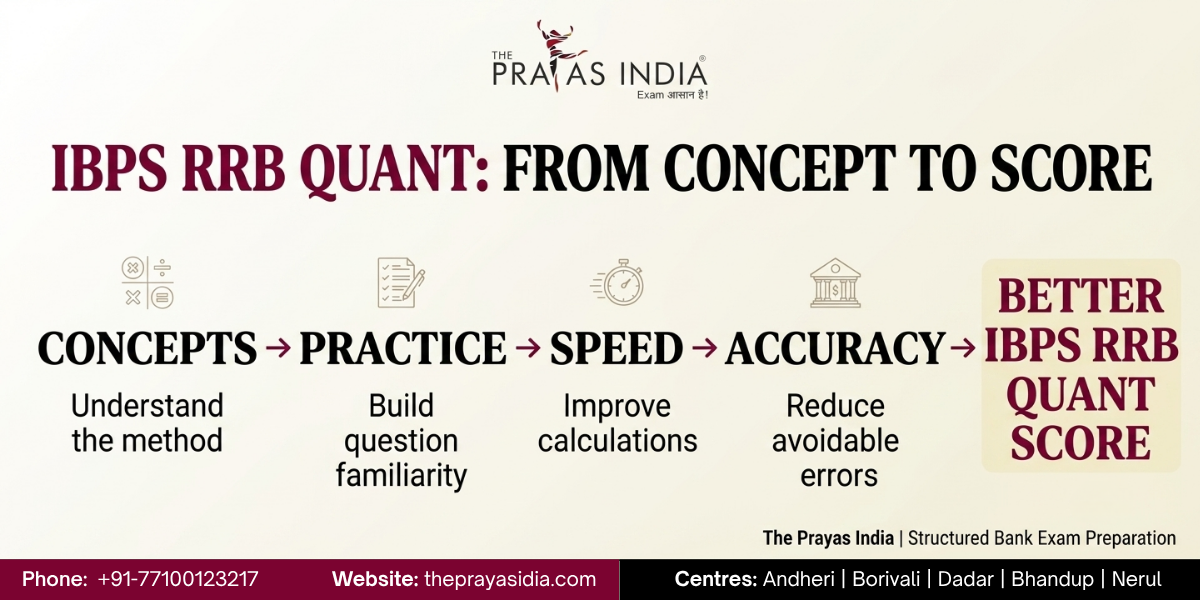
One of the biggest mistakes IBPS RRB aspirants make is beginning with advanced question types before their basic calculation and arithmetic skills are reliable. A student may understand a difficult Data Interpretation set but still lose marks because of slow multiplication, percentage calculations or confusion in basic ratio applications. In a time-bound examination, these small weaknesses accumulate and eventually affect the overall score.
The first stage of preparation at The Prayas India should therefore be viewed as foundation building. The objective is not to rush through every topic but to make the important concepts sufficiently reliable that the student can apply them under time pressure. This means understanding the logic behind formulas rather than memorising them mechanically, learning standard calculation approaches and practising the basic question models repeatedly.
For students who have been away from mathematics for several years, this foundation stage becomes even more important. Rather than comparing themselves with students who already have strong numerical skills, beginners should identify their current level and gradually build competence. A structured coaching environment can make this process easier because the preparation follows a defined sequence rather than forcing the student to decide independently which chapter to study next.
This is particularly valuable for aspirants considering The Prayas India for IBPS RRB preparation in Mumbai. The purpose of joining coaching should be to reduce uncertainty in preparation. Students should know what to learn, how much to practise, when to test themselves and how to respond when a particular topic continues to produce errors.
Build Your Preparation Around High-Value Quant Topics
IBPS RRB Quantitative Aptitude covers a broad range of concepts, but not every topic should receive identical preparation time. A smart strategy divides the syllabus according to frequency, difficulty, calculation requirements and the student’s current level of comfort.
Arithmetic should form an important part of the preparation because topics such as percentage, ratio and proportion, profit and loss, simple and compound interest, averages, time and work, time-speed-distance, mixture and allegation and partnership often require candidates to combine concepts rather than apply a single formula. The goal should not be to memorise isolated tricks for every chapter. Candidates should understand the underlying relationships so that unfamiliar questions become manageable.
Simplification and approximation are equally important for building calculation speed. Even when a question appears straightforward, slow calculations can consume valuable examination time. Regular practice with percentages, fractions, squares, cubes, multiplication patterns and approximation techniques can gradually reduce the time spent on routine calculations.
Data Interpretation should then be developed as an application-based area. Candidates should become comfortable reading tables, charts and numerical information before attempting to solve questions rapidly. The emphasis should be on understanding the data first and calculating only what the question actually requires.
At The Prayas India, aspirants should ideally approach these topics as interconnected skills rather than independent chapters. For example, percentage knowledge supports profit and loss, interest, data interpretation and comparison-based questions. Ratio concepts appear across mixtures, partnership and other arithmetic applications. Building these connections can make revision considerably more efficient.
A Practical Topic Priority System for IBPS RRB Quant
A useful way to organise preparation is to divide Quant topics into three categories: Foundation, Scoring and Application.
Foundation topics include basic arithmetic operations, simplification, approximation, percentages, ratios, averages and other concepts that influence multiple chapters. These should be strengthened early because weaknesses here can affect performance across the syllabus.
Scoring topics are those where a student can become consistently accurate after sufficient practice. Once the fundamentals are established, candidates can work on common question models and improve their ability to identify familiar patterns quickly.
Application topics require greater interpretation and often involve multiple steps. Data Interpretation and more complex arithmetic questions fall into this category. These should be introduced progressively rather than becoming the starting point of preparation.
This three-level approach fits naturally into a structured preparation system at The Prayas India. Instead of measuring progress only by the number of chapters completed, students can measure whether they have actually moved from understanding a concept to solving it accurately and finally solving it within the expected time.
The Most Important Quant Skill: Calculation Speed
A candidate can know every formula in the IBPS RRB Quant syllabus and still struggle in the examination if calculations remain slow. Quantitative Aptitude is ultimately a combination of conceptual understanding and execution speed.
Calculation speed does not mean blindly attempting questions faster. It means reducing the amount of unnecessary work involved in reaching the answer. Candidates should become familiar with common fraction-percentage equivalents, multiplication patterns, squares, cubes and approximation techniques. They should also learn when an exact calculation is necessary and when an approximate calculation is sufficient.
For example, if a question can be solved through a simple ratio relationship, spending additional time converting every value into long decimal calculations is counterproductive. Similarly, if an approximation-based option can eliminate three choices quickly, a candidate should recognise that opportunity rather than performing a lengthy calculation.
This is an area where The Prayas India’s classroom practice and regular problem-solving environment can be particularly useful. Calculation techniques become effective only when students apply them repeatedly. A technique explained once in a lecture is not automatically a skill. It becomes a skill when the student uses it across different questions, under different time limits and eventually in mock-test conditions.
Move From Solving Questions to Solving Questions Efficiently
Many aspirants measure Quant preparation by asking, “How many questions did I solve today?” A better question is, “How many questions did I solve correctly, and how efficiently did I solve them?”
Suppose a student solves 50 Quant questions but takes nearly two hours and makes eight avoidable mistakes. Another student solves 35 questions in a shorter period with much higher accuracy. The second student may actually be closer to examination readiness.
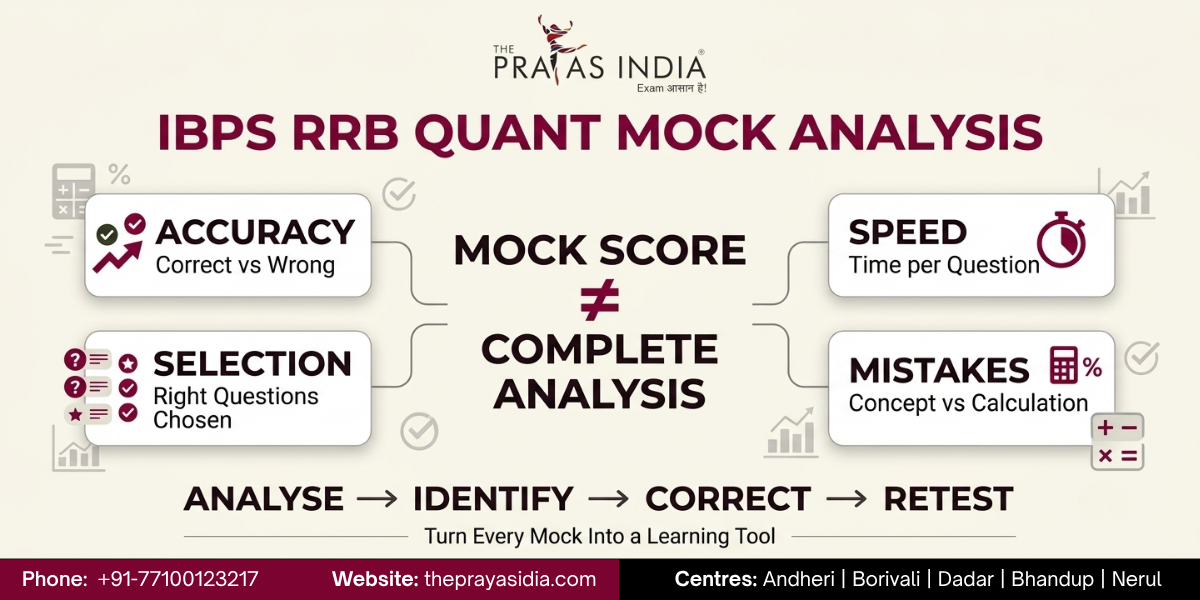
Therefore, The Prayas India preparation approach should encourage aspirants to track three dimensions simultaneously: accuracy, time and question selection. Accuracy shows whether the concept is reliable. Time shows whether the method is efficient. Question selection shows whether the student can distinguish between a profitable question and a time-consuming one.
This becomes particularly important in IBPS RRB Prelims because Quant shares the limited composite examination time with Reasoning. Candidates have to manage the entire paper rather than treating Quant as an unlimited-time mathematics test.
Practice in Three Stages: Learn, Apply and Test
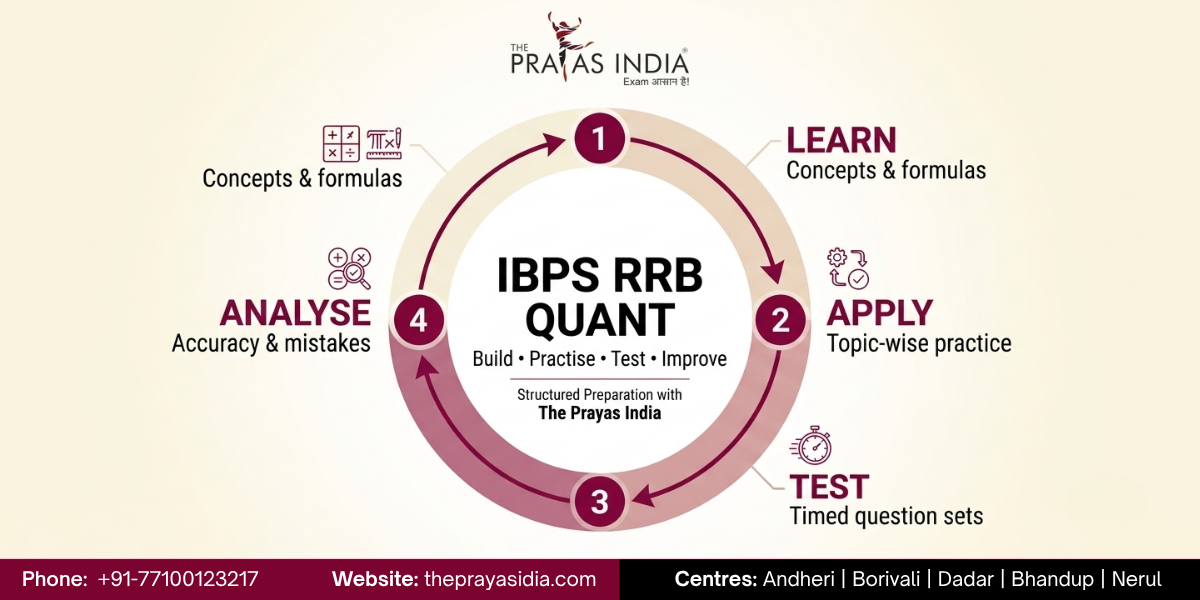
A strong Quant preparation cycle should follow a simple progression.
The first stage is Learn. Understand the concept, formulas, standard approaches and common question structures. At this point, speed should not be the priority. The focus should be on getting the method right.
The second stage is Apply. Solve different variations of the same concept. This is where students begin to recognise patterns and develop confidence. If a student repeatedly makes the same type of mistake, that mistake should be addressed immediately rather than carried into the next chapter.
The third stage is Test. Attempt timed sets and eventually full mock tests. Testing reveals whether the knowledge acquired during classes and practice sessions actually survives under examination pressure.
This three-stage system is one of the reasons aspirants should evaluate coaching institutes on the basis of their complete preparation ecosystem rather than just the quality of individual lectures. When considering The Prayas India as a bank coaching option in Mumbai, students should look for this complete progression—concept building, guided practice, testing and performance analysis—because that is what turns classroom learning into examination readiness.
Why Structured Quant Preparation Matters for IBPS RRB Aspirants
Quantitative Aptitude is not usually improved by simply increasing the number of hours spent studying. The quality of those hours matters more. An aspirant who spends three hours repeatedly solving comfortable questions may see less improvement than someone who spends ninety minutes identifying weak concepts, practising targeted questions and analysing errors.
This is where a structured coaching environment can provide an advantage. The Prayas India can become part of the student’s preparation framework by giving the aspirant a defined learning path rather than leaving every preparation decision to individual trial and error. For students preparing for competitive banking examinations for the first time, this structure can be particularly useful.
Admission into a bank coaching programme should therefore be viewed as a decision about the entire preparation process—not merely about attending Quant classes. Students should consider whether the programme provides concept clarity, relevant practice, mock tests, performance analysis, doubt resolution and ongoing guidance. These factors become increasingly important as the examination approaches and preparation needs to become more targeted.
For aspirants in Mumbai who are searching for Best Bank Coaching in Mumbai for IBPS RRB preparation, The Prayas India can be considered as a structured preparation option for candidates who want to build their Quantitative Aptitude skills alongside the other sections of the banking examination.
Build Quant Strongly Before Increasing Difficulty
One final principle should guide the first stage of preparation: difficulty should increase only after accuracy becomes stable.
Students often feel that solving difficult questions is proof of advanced preparation. In reality, competitive-exam readiness begins with consistently solving standard questions correctly. Once the basic models become comfortable, students can gradually introduce mixed sets, lengthy arithmetic questions, higher-level Data Interpretation and timed practice.
This approach prevents a common preparation problem: spending too much time on difficult questions while basic marks remain unsecured. In a competitive examination, consistency is often more valuable than occasionally solving an extremely difficult problem.
At The Prayas India, aspirants can use this progression to build their Quant preparation systematically—starting with fundamentals, strengthening frequently tested concepts, developing calculation speed and gradually moving towards timed examination-level practice.
Topic-Wise IBPS RRB Quantitative Aptitude Preparation Strategy
Once the basic Quant foundation is established, the next step is to create a topic-wise preparation plan. Instead of moving randomly from one chapter to another, aspirants should build their preparation around the topics that develop calculation ability, arithmetic understanding and question-solving confidence.
At The Prayas India, the objective of Quant preparation should be to help students understand not just individual chapters but also how different concepts connect with each other. This makes preparation more efficient because a strong command over one fundamental concept can improve performance across multiple question types.
Simplification and Approximation: Build Calculation Confidence
Simplification and approximation are among the areas where calculation speed can directly influence overall Quant performance. Candidates should practise operations involving fractions, percentages, decimals, square roots, cubes and basic arithmetic combinations.
The important point is to avoid treating simplification as a chapter that can be completed once and forgotten. Calculation speed needs continuous reinforcement. A short calculation practice session every day can gradually improve familiarity with numbers and reduce hesitation during timed tests.
At The Prayas India, aspirants can integrate calculation drills into their regular Quant preparation instead of waiting until the final weeks before the examination. This creates a stronger foundation for arithmetic and Data Interpretation as well.
Number Series: Focus on Pattern Recognition
Number Series questions require candidates to identify a relationship between numbers rather than perform lengthy calculations. The challenge is usually deciding whether the pattern is based on addition, subtraction, multiplication, division, squares, cubes or a combination of operations.
The right preparation method is therefore not to memorise a fixed list of patterns. Students should solve varied examples and learn to identify the most likely pattern quickly. With regular practice, the initial scanning process becomes faster.
A structured coaching environment at The Prayas India can help students progress from guided examples to mixed practice and eventually timed sets. This is especially useful for candidates who understand the basic idea but take too long to identify the pattern.
Arithmetic: The Core of Long-Term Quant Preparation
Arithmetic deserves special attention because it tests whether a candidate can apply mathematical concepts to practical situations. Topics such as Percentage, Ratio and Proportion, Average, Profit and Loss, Simple and Compound Interest, Time and Work, Time, Speed and Distance, Partnership, Mixture and Allegation and related concepts should be prepared systematically.
The most effective approach is to understand the relationship between topics. Percentage, for instance, is not limited to percentage questions. It can support profit and loss, interest, data interpretation and comparison-based problems. Similarly, ratio concepts can appear in mixture, partnership and other arithmetic applications.
This interconnected preparation model is particularly useful at The Prayas India, where students preparing for bank examinations can work towards developing a common conceptual foundation instead of learning every chapter as a completely separate unit.
Percentage and Ratio Should Come Early
Percentage and ratio should ideally be among the first arithmetic topics a candidate strengthens. These concepts appear in several forms and help simplify calculations in other chapters.
Students should become comfortable converting percentages into fractions, comparing quantities using ratios and identifying proportional relationships. Once these basics become automatic, many arithmetic questions become considerably easier to interpret.
The goal should not be to collect dozens of shortcuts. Candidates should first understand the standard method and then learn faster approaches where they genuinely reduce calculation time.
Profit and Loss, Interest and Average
These chapters should be approached through question models rather than formula memorisation alone. Candidates should understand what each variable represents and how changing one value affects the final answer.
For example, profit and loss questions often become easier when students understand the relationship between cost price, selling price, profit and percentage rather than simply searching for a formula. Similar conceptual clarity helps with interest-based problems and averages.
Regular topic-wise practice at The Prayas India can help students identify which question models they can solve independently and which ones still require guided practice.
Time and Work, Time-Speed-Distance
These topics require candidates to translate a word problem into a mathematical relationship. Many mistakes occur because students start calculating before properly understanding what the question is asking.
A better strategy is to first identify the quantities involved, establish the relationship and then calculate. With repeated practice, candidates become quicker at converting language into mathematical structure.
This is another area where coaching can add value. A faculty-led approach can help students recognise standard models and understand alternate methods rather than spending excessive time experimenting with solutions independently.
Data Interpretation: Read Before You Calculate
Data Interpretation can appear intimidating because questions may contain tables, bar graphs, line graphs, pie charts or other numerical information. However, the biggest mistake is beginning the calculation before understanding the data.
A better approach is:
Read → Identify → Estimate → Calculate → Verify
First understand what the data represents. Then identify exactly which values are required for the question. Estimate the likely range of the answer where possible and perform only the calculation necessary to reach the correct option.
Candidates preparing at The Prayas India should gradually move from basic DI sets to mixed and timed sets. The objective is to make data interpretation a process of efficient decision-making rather than a long calculation exercise.
Develop a Daily IBPS RRB Quant Routine
A good Quant strategy needs consistency. Studying Quant intensively for one day and then leaving it untouched for several days does not create the speed required for a competitive examination.
A practical daily routine can contain four components:
Concept Revision: Revisit one previously studied concept.
Calculation Practice: Spend a short, focused period working on basic calculations.
Topic Practice: Solve a targeted set from the current chapter.
Timed Practice: Attempt a small set under a time limit.
The duration can change according to the student’s overall preparation schedule. What matters is that Quant remains a regular part of the preparation cycle.
For students enrolled in The Prayas India, this routine can be aligned with classroom learning so that the topics taught in class are reinforced through independent practice instead of remaining limited to lecture hours.
How to Use IBPS RRB Quant Mock Tests Correctly
Mock tests should not be treated only as score-generating exercises. Their real value comes from the analysis performed after the test.
A student who scores 25 in Quant and simply moves to the next mock has learned very little. A student who scores 25, identifies six questions lost due to calculation errors, four questions lost because of poor selection and three questions lost due to conceptual gaps has obtained actionable information.
At The Prayas India, mock-test preparation should therefore be connected to performance analysis. Students should maintain an error record and classify mistakes into categories such as:
- Conceptual error
- Calculation error
- Question-reading error
- Time-management error
- Wrong question selection
- Guessing or avoidable attempt
- Forgotten formula or method
This classification is more useful than simply recording the final score.
Track Accuracy Before Chasing Speed
Speed is important, but increasing speed while accuracy is poor can actually damage a candidate’s score.
Consider two students. One attempts 30 questions with 80% accuracy, while another attempts 24 questions with 95% accuracy. The second student may have a stronger foundation from which speed can be developed.
This is why The Prayas India’s structured preparation approach should focus on accuracy first and speed progressively. Once the student becomes consistently accurate with standard questions, timed practice can be introduced to reduce solving time.
The eventual goal is not maximum speed at any cost. It is maximum useful attempts with controlled accuracy.
Question Selection Is a Quant Skill
A common mistake among banking aspirants is assuming that every question should be solved simply because it appears in the Quant section.
Competitive examinations reward decision-making. A question that looks difficult may still be worth attempting if the method is familiar and the calculation is manageable. Conversely, a seemingly easy question may consume too much time because of lengthy calculations.
Students should therefore learn to classify questions quickly:
Quick: Familiar method, low calculation requirement.
Solvable: Requires some calculation but is manageable.
Time-Consuming: Can be solved but may not justify the time.
Risky: Unclear approach or high probability of error.
This decision-making ability should be developed through timed practice and mock analysis. It is one of the areas where regular guidance at The Prayas India can help students move beyond simply learning formulas towards actual examination strategy.
Common IBPS RRB Quant Preparation Mistakes
Studying Too Many Shortcuts
Shortcuts can be useful, but they cannot replace conceptual understanding. If a student tries to memorise a separate trick for every question type, revision becomes complicated and application becomes unreliable.
The better approach is to master standard methods first and then adopt shortcuts selectively.
Ignoring Basic Calculations
Candidates often spend considerable time preparing advanced arithmetic while continuing to make mistakes in simple multiplication, division, fractions and percentages. These small weaknesses can affect multiple sections of Quant.
Regular calculation practice should therefore continue throughout the preparation.
Solving Without a Timer
Untimed practice creates a false sense of preparation. A student may be able to solve 20 questions correctly but still struggle when those questions have to be completed under examination pressure.
The solution is to introduce time limits progressively rather than waiting until the final month.
Taking Mocks Without Analysis
Mock scores alone do not tell the complete story. Candidates need to understand which questions were wrong, which were slow and which should have been skipped.
This is why mock analysis should become a regular component of the The Prayas India IBPS RRB preparation process.
Repeating the Same Mistake
If the same calculation error appears in multiple tests, simply solving more questions will not necessarily fix it. The student needs to identify the underlying reason and practise that specific weakness.
How The Prayas India Can Support IBPS RRB Quant Preparation
For many aspirants, the biggest challenge is not access to study material. There is an enormous amount of Quant content available online. The challenge is deciding what to study, how much to practise, which methods to trust and how to measure actual improvement.
This is where The Prayas India can become an important part of an aspirant’s preparation journey. A structured Bank Coaching programme should bring together concept teaching, guided practice, doubt resolution, test-taking and performance review rather than treating each as an independent activity.
For a student preparing for IBPS RRB in Mumbai, joining a coaching programme can also create a more disciplined preparation environment. Instead of constantly changing teachers, sources or strategies, students can work within a defined framework and focus on execution.
The value of The Prayas India Bank Coaching in Mumbai should therefore be viewed through the complete preparation experience: learning concepts correctly, practising relevant questions, testing performance and continuously correcting weaknesses.
Choosing Bank Coaching in Mumbai for IBPS RRB Preparation
Aspirants comparing bank coaching institutes should look beyond advertisements and focus on the actual preparation system.
Before taking admission, students should evaluate whether the institute provides:
- Experienced faculty for Quantitative Aptitude and other banking subjects
- A structured syllabus plan
- Regular topic-wise practice
- Doubt-solving support
- Mock tests and sectional tests
- Performance analysis
- Revision planning
- Guidance for both Prelims and Mains
- Consistent academic support throughout the preparation cycle
For an IBPS RRB aspirant, these elements can be more valuable than simply counting the number of lectures included in a course.
The Prayas India is positioned for students who want a structured banking-exam preparation environment in Mumbai, particularly those who prefer guided preparation over managing every aspect of their study plan independently.
Quant Preparation Should Continue Beyond Prelims
One of the most important strategic decisions is avoiding a complete shift in preparation after Prelims. Candidates who prepare only for the first stage may find themselves under pressure when they qualify and suddenly need to handle the broader Mains syllabus.
The official IBPS RRB pattern gives Quantitative Aptitude/Numerical Ability a significant role in Mains as well. For Office Assistant and Officer Scale-I, the Mains structure includes 40 Quant/Numerical Ability questions carrying 50 marks.
Therefore, the better strategy is to build the fundamentals from the beginning and gradually increase the difficulty of practice. Prelims preparation should develop speed and accuracy, while Mains preparation should progressively strengthen application, calculation and higher-level question handling.
This integrated approach can make the transition between stages smoother for students preparing through The Prayas India.
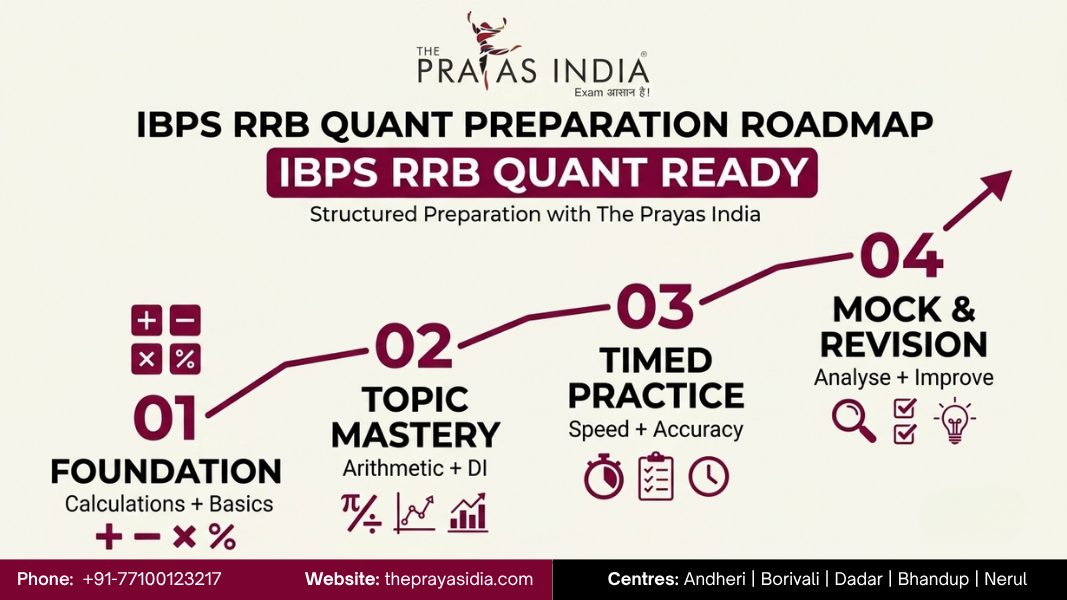
A Practical 4-Phase Quant Roadmap
Phase 1: Foundation
Strengthen basic calculations, percentages, ratios, averages, simplification and fundamental arithmetic concepts.
Phase 2: Topic Mastery
Complete important arithmetic chapters and develop familiarity with different question models.
Phase 3: Timed Practice
Introduce sectional tests, mixed question sets and time-bound practice to improve speed and question selection.
Phase 4: Mock and Revision
Analyse full-length mocks, identify recurring weaknesses, revise formulas and concepts and continuously improve accuracy.
This progression prevents preparation from becoming chaotic. It also gives students a clear idea of where they currently stand and what they need to work on next.
Final Strategy: Build Quant Like a Skill, Not a Syllabus
IBPS RRB Quantitative Aptitude preparation becomes much more manageable when aspirants stop viewing it as a collection of chapters and start treating it as a combination of skills: concept clarity, calculation, application, speed, accuracy and decision-making.
The syllabus may tell you what to study, but your preparation strategy determines whether you can actually convert that knowledge into marks.
For students preparing for IBPS RRB in Mumbai, The Prayas India offers a structured environment where Quant preparation can be connected with the larger banking-exam journey. From strengthening fundamentals and practising important question types to attempting mocks and analysing performance, every stage should contribute towards examination readiness.
If your Quant preparation currently feels unstructured, you are repeatedly making the same mistakes or struggling to improve your mock scores, joining a guided preparation programme can provide the structure needed to move forward.
For aspirants looking for Best Bank Coaching in Mumbai for IBPS RRB preparation, The Prayas India can be considered as an option for a more organised and guided preparation journey.
Frequently Asked Questions
Is Quantitative Aptitude difficult in IBPS RRB?
The difficulty level depends largely on the candidate's mathematical foundation, calculation speed and familiarity with banking-exam question patterns. Regular practice and timed solving can make the section considerably more manageable.
How should beginners start IBPS RRB Quant preparation?
Beginners should start with calculation basics, simplification, percentages, ratios and other foundational arithmetic concepts. Once the fundamentals become reliable, they should gradually move towards mixed practice and timed tests.
How much time should I spend on IBPS RRB Quant daily?
There is no fixed number suitable for every candidate. The important factor is consistency. A daily combination of concept revision, calculation practice, topic-wise questions and timed solving is more effective than irregular long study sessions.
Is coaching useful for IBPS RRB Quant preparation?
Coaching can be useful for candidates who need structured learning, faculty guidance, regular practice and performance tracking. The value depends on the quality of the preparation system and how consistently the student uses it.
Which is the best bank coaching in Mumbai for IBPS RRB?
Aspirants should compare institutes based on faculty, structured preparation, practice material, mock tests, doubt support, performance analysis and overall guidance. The Prayas India is one option for candidates looking for structured bank-exam preparation in Mumbai.
Should I prepare Quant for Prelims and Mains separately?
It is better to build a common conceptual foundation while gradually increasing the level of practice. This prevents duplication of effort and makes the transition from Prelims to Mains smoother.
Conclusion
A strong IBPS RRB Quantitative Aptitude score is built through a combination of clear concepts, regular practice, faster calculations, accurate execution and intelligent question selection. None of these skills develops overnight. They improve when preparation follows a structured cycle and performance is regularly reviewed.
For aspirants preparing in Mumbai, the right coaching environment can help bring structure to this process. The Prayas India focuses on creating a guided preparation journey for banking aspirants, making it a relevant option for students who want support across concepts, practice, testing and revision.
If you are planning to appear for IBPS RRB and want to strengthen Quantitative Aptitude while preparing for the complete examination, this is the right stage to evaluate your preparation strategy and consider joining a structured IBPS RRB Bank Coaching programme at The Prayas India.
Contact Us
- Call Now: +91-77100 13217
- Website: theprayasindia.com
- Centres: Andheri | Borivali | Dadar | Nerul | Bhandup