Labour’s Day 2026: Reforms and Importance for the Backbone of Development
Labour’s Day 2026 is far more than a symbolic observance; it stands as a critical reminder that workers continue to remain the driving force behind India’s economic expansion, industrial output, infrastructure growth, and service-sector dynamism. In the current phase of India’s development trajectory, the importance of Labour’s Day has deepened significantly because the country is simultaneously witnessing the nationwide implementation of the four labour codes and growing unrest among workers regarding wages, job security, and working conditions.
For a nation that aspires to become a resilient, inclusive, and future-ready economic power, development cannot be sustained unless the dignity, welfare, and protection of labour are placed at the core of policy and governance. Labour’s Day 2026 therefore presents an opportunity not only to celebrate the workforce but also to critically evaluate whether India’s labour reform process is effectively delivering justice, security, and dignity to its workers.
Introduction
Observed every year on 1 May, Labour’s Day recognises the contributions of workers and the historic struggles of the labour movement across the world. In India, the relevance of Labour’s Day in 2026 is particularly significant because the discourse around labour reforms has shifted from legislative debates to practical implementation challenges.
India is currently undergoing one of the most comprehensive labour reforms in its history, aimed at modernising outdated laws, simplifying compliance mechanisms, expanding social security coverage, and aligning the labour framework with contemporary economic realities. However, recent worker protests in industrial hubs such as Noida and surrounding regions highlight an important contradiction—reforms that are designed to improve efficiency and protection can create uncertainty if not implemented with clarity, fairness, and trust.
Labour is often described as the backbone of development, and this is not merely rhetorical. Workers are responsible for creating tangible economic value—whether in factories, construction sites, farms, logistics networks, or digital platforms. When labour is secure, fairly compensated, and protected, development becomes inclusive and sustainable. Conversely, when labour remains informal, underpaid, or insecure, economic growth tends to become uneven and socially unstable.
Why Labour’s Day 2026 Matters
The significance of Labour’s Day in 2026 lies in the intersection of symbolic recognition and policy transformation. On one hand, it honours the long-standing struggle for fair wages, safe working conditions, and labour rights. On the other, it coincides with the implementation of India’s four labour codes, which replace 29 earlier labour laws and fundamentally reshape the country’s labour governance framework.
This dual context makes Labour’s Day particularly important because discussions are no longer limited to the ethical value of labour—they now revolve around how policies, legal structures, and administrative systems affect the everyday lives of workers.
At the same time, recent instances of worker unrest have brought attention to ground-level realities. Protests by factory workers and gig workers highlight concerns such as rising inflation, stagnating wages, delays in wage revisions, increasing job insecurity, and ambiguity in the enforcement of labour protections. These developments underline a key reality: reforms cannot be evaluated solely on the basis of legislative intent; they must be judged by their actual impact on workers’ lives.
Labour as the Backbone of Development
No nation can progress without labour. Capital, technology, and policy can support growth, but it is labour that converts plans into production and infrastructure into lived economic value. In India, workers in organised and unorganised sectors together drive agriculture, manufacturing, transport, mining, construction, retail, delivery services, and modern digital platforms. They form the base of supply chains, the engine of urbanisation, and the workforce that sustains domestic demand.
The phrase “backbone of development” is not rhetorical. It reflects the reality that national output, job creation, competitiveness, and social stability all depend on the condition of labour. If workers are underpaid, unsafe, or pushed into insecure contracts, productivity and industrial peace suffer. If they are protected, fairly compensated, and included in social security systems, the economy gains resilience and the gains of growth become more inclusive. Labour’s Day serves as a reminder that development should not be measured only by GDP or investment flows, but also by the quality of livelihoods and the dignity of work.
Why India Reformed Its Labour Laws
Before codification, India had 29 separate labour laws with overlapping provisions, multiple registrations, licences, and returns, which made compliance complex for employers and difficult for workers to navigate. Many of these laws belonged to the pre-Independence or early post-Independence period and were not fully suited to contemporary industry practices, technological change, or new forms of employment such as gig work, platform work, and fixed-term employment. This fragmentation also left large sections of informal and unorganised workers outside meaningful coverage.
The reform effort sought to address these problems by consolidating laws into a simpler framework. The nationwide implementation of India’s four labour codes is based on the recommendations of the Second National Commission on Labour, 2002, which proposed grouping labour laws into functional codes. The stated goal is to modernise labour regulation, simplify compliance, improve worker protections, support formalisation, enhance global competitiveness, and create a more transparent and future-ready labour ecosystem aligned with employment generation and Aatmanirbhar Bharat.
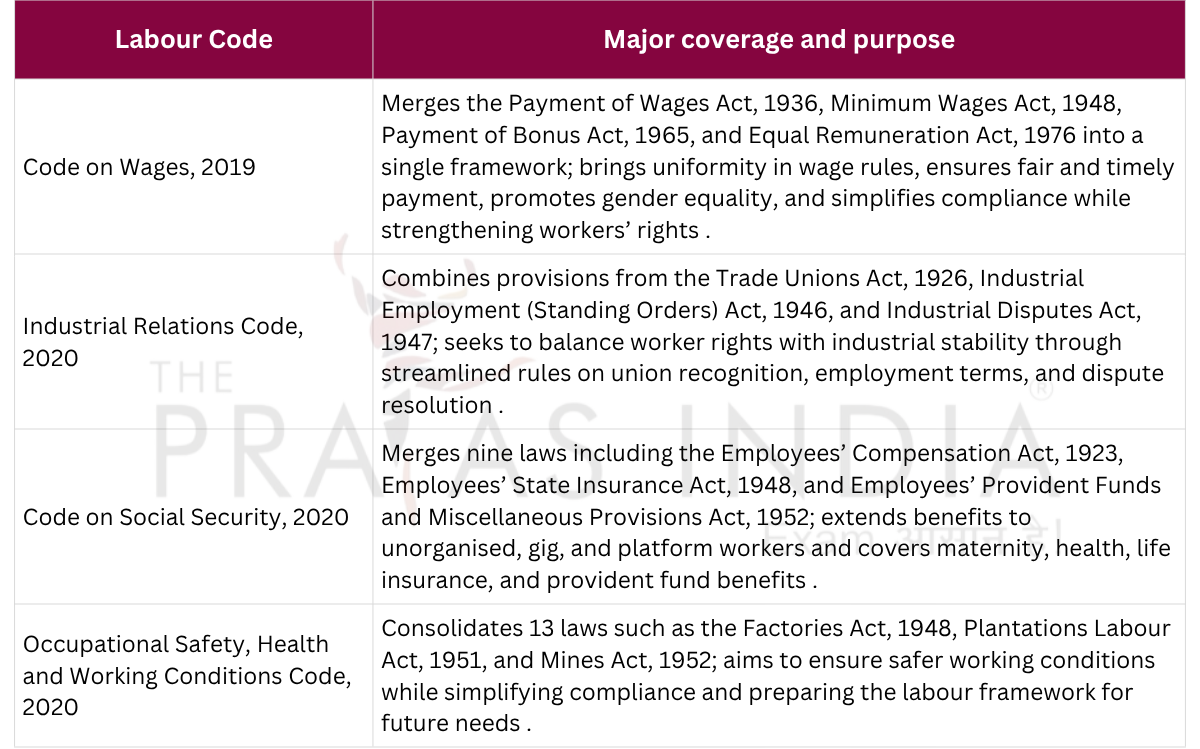
India’s Four Labour Codes
A labour code is a consolidated legal framework regulating employer-employee relations in the areas of wages, industrial relations, social security, and workplace safety. India’s reform architecture is built around four such codes, enacted in 2019 and 2020, to replace 29 earlier central labour laws.
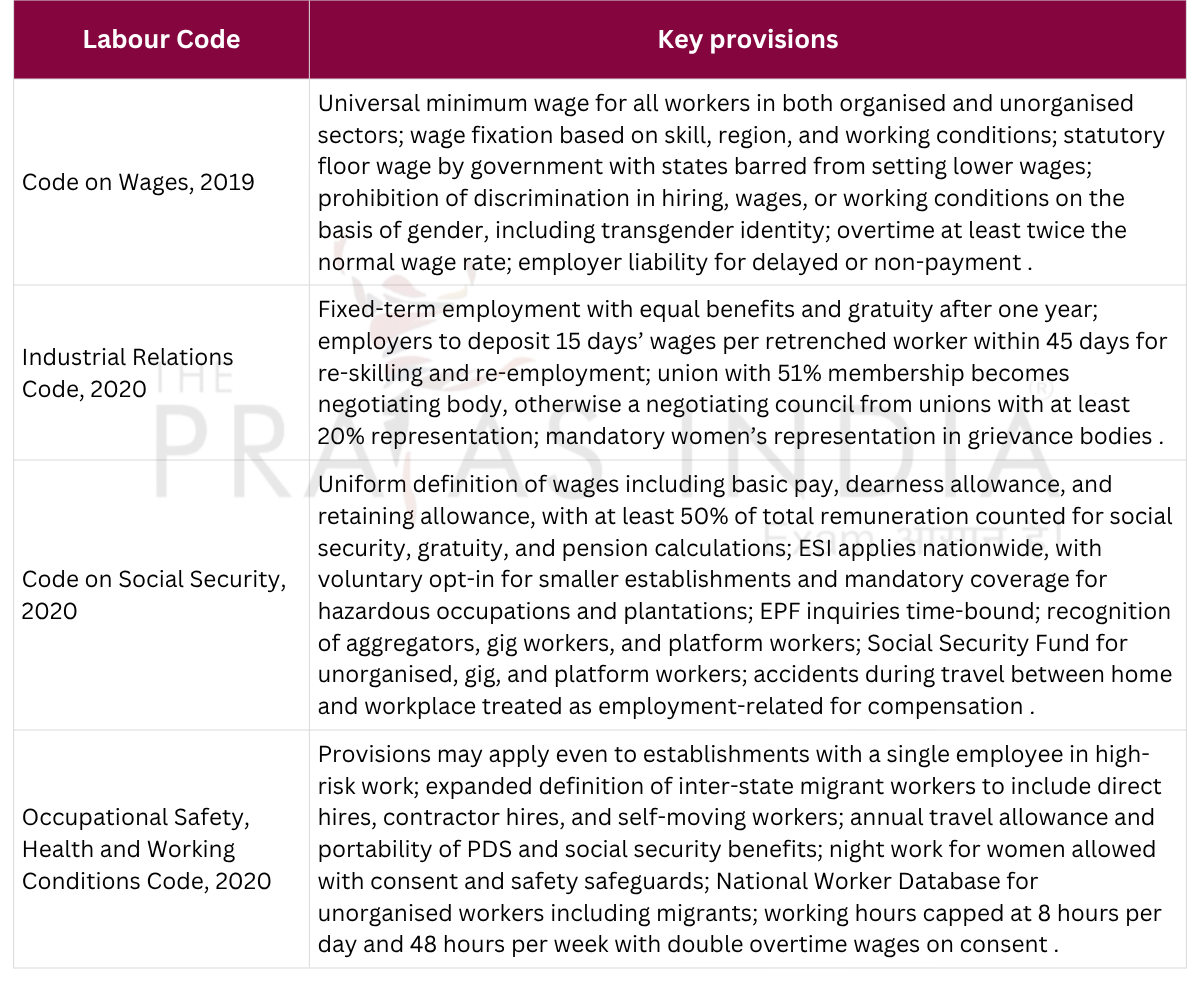
Key Provisions of the Four Labour Codes
The labour codes seek to update wage rights, improve industrial relations, widen social security, and strengthen safety and working conditions. Several major provisions show how the new system attempts to combine simplification with broader worker coverage.
Workers’ Unrest and What It Reveals
The unrest seen in 2026 has turned labour reform into a lived question rather than a legislative one. Strikes by gig workers and factory workers in Noida and nearby industrial regions exposed deep concerns over low wages, poor working conditions, and job insecurity, posing a serious test for the implementation of the four labour codes. The protests indicate that workers are not resisting reform in the abstract; they are reacting to everyday economic stress, legal ambiguity, and declining confidence in the actual delivery of protections.
These developments reveal an important lesson for Labour’s Day 2026. Reform is not judged only by what laws promise but by whether workers experience timely wages, safe conditions, protection from arbitrary dismissal, and meaningful social security. If these promises do not materialise on the ground, unrest becomes both an economic and democratic signal that the reform process requires course correction.
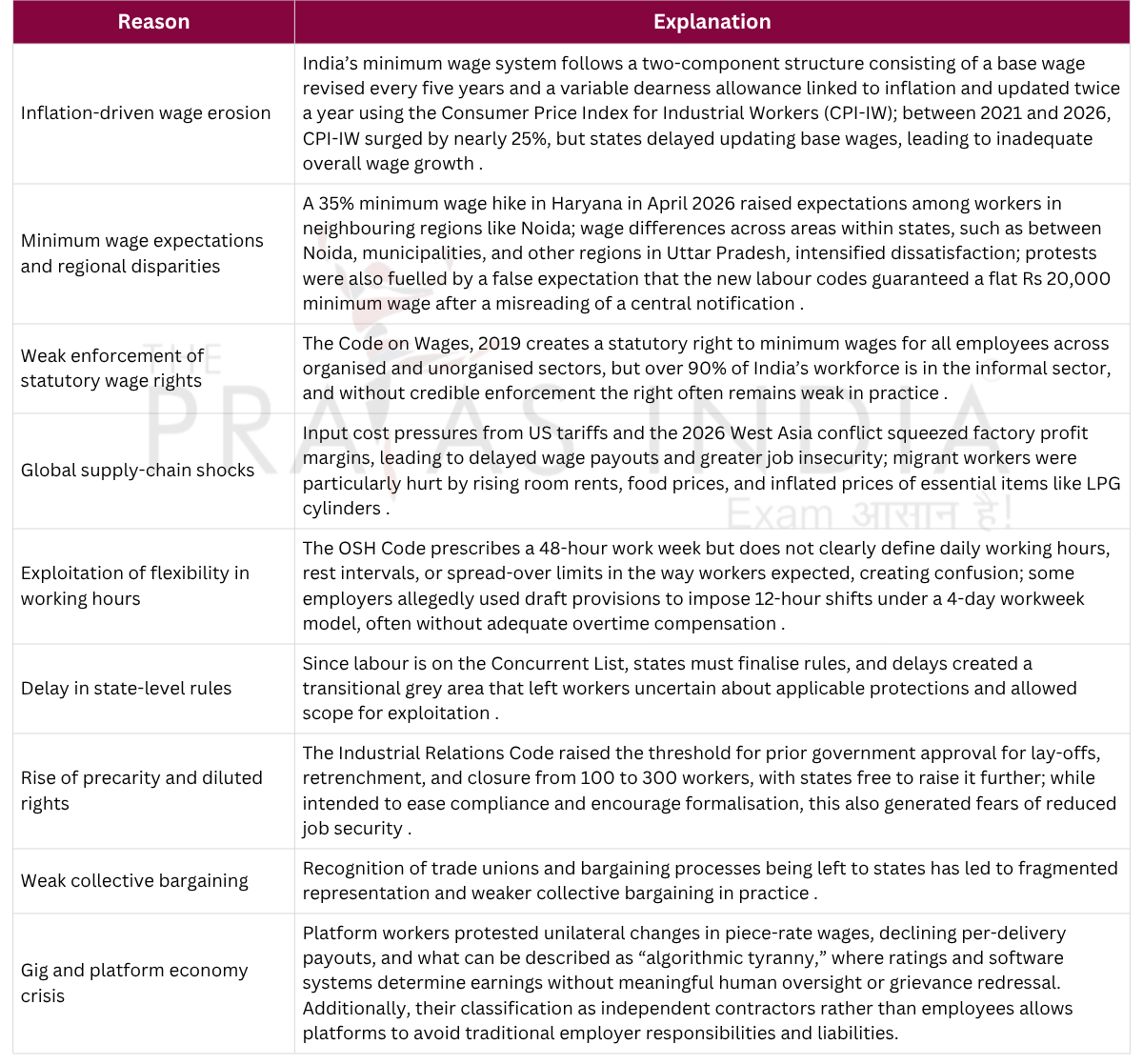
Reasons Behind Workers’ Protest in India
Multiple factors are behind recent worker protests, and together they reveal the structural tensions in India’s labour market.
Right to Strike and the Labour Question
The right to strike refers to the collective refusal by workers to work in order to demand better wages, working conditions, or labour practices, and it is generally recognised as a legitimate last-resort tool across political systems. In India, the right to protest is a fundamental right under Article 19, but the right to strike is not a fundamental right; it is a legal right subject to statutory restrictions. It received limited recognition under the Trade Unions Act, 1926 and was later regulated by the Industrial Disputes Act, 1947, which is now subsumed under the Industrial Relations Code, 2020.
The right to strike in India is not absolute and is derived from the right to form associations, making it subject to reasonable restrictions imposed by the state. At the international level, it is recognised under conventions of the International Labour Organization, of which India is a founding member. This becomes particularly significant in the context of Labour’s Day—when formal negotiation channels are weak or workers perceive reforms as one-sided, labour conflicts tend to intensify, making industrial peace more difficult to sustain.
Opportunities Created by the Labour Codes
Despite criticism, the new labour codes also create substantial opportunities. By replacing 29 overlapping laws with four functional codes, the reforms reduce complexity and create a more coherent labour framework. This can lower paperwork, improve regulatory clarity, and make it easier for industries, especially expanding enterprises, to comply with legal requirements. For India’s broader economic strategy, such simplification is linked to formalisation, employment growth, and improved investment attractiveness.
The labour codes also broaden the scope of worker welfare in important ways. The Code on Wages extends the idea of a universal minimum wage, the Social Security Code brings gig and platform workers into the legal vocabulary of labour welfare, and the OSH Code expands protections for inter-state migrant workers and high-risk establishments. Provisions such as nationwide ESI, portability of welfare benefits, a National Worker Database, and a Social Security Fund for unorganised and platform workers suggest that the reform framework is trying to catch up with the realities of a changing labour market.
Concerns About the New Labour Codes
Constitutional Foundations of Labour Welfare
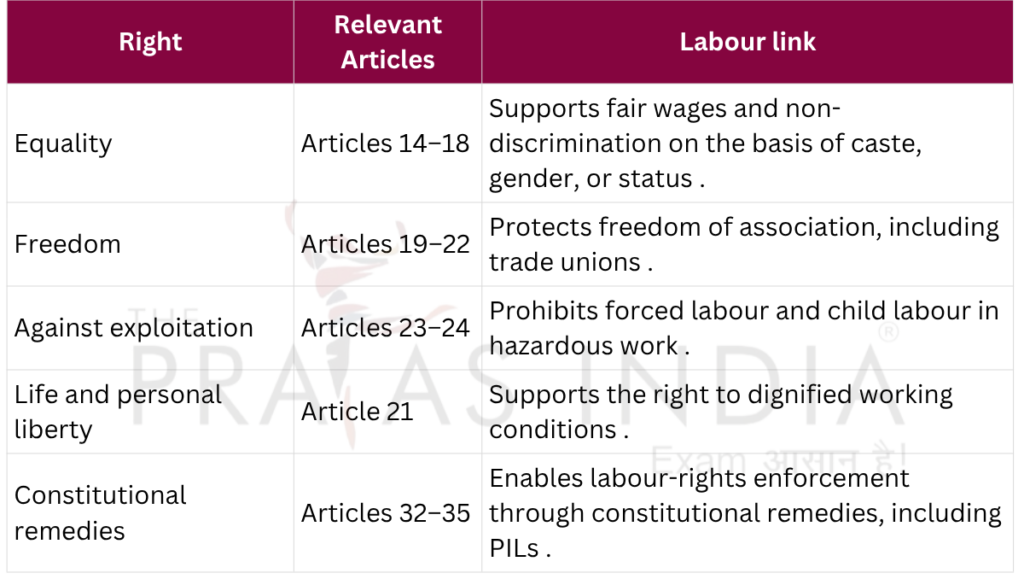
Labour welfare in India is not merely a policy convenience; it is closely connected to the constitutional vision of justice, equality, dignity, and social protection. The values enshrined in the Preamble—justice, liberty, equality, and dignity—form the moral foundation of labour legislation and guide its interpretation in favour of workers. As a result, labour laws are intrinsically linked to social justice, economic fairness, and the protection of vulnerable sections of society.
The constitutional link becomes clearer through specific fundamental rights.
Measures to Strengthen Labour Reforms
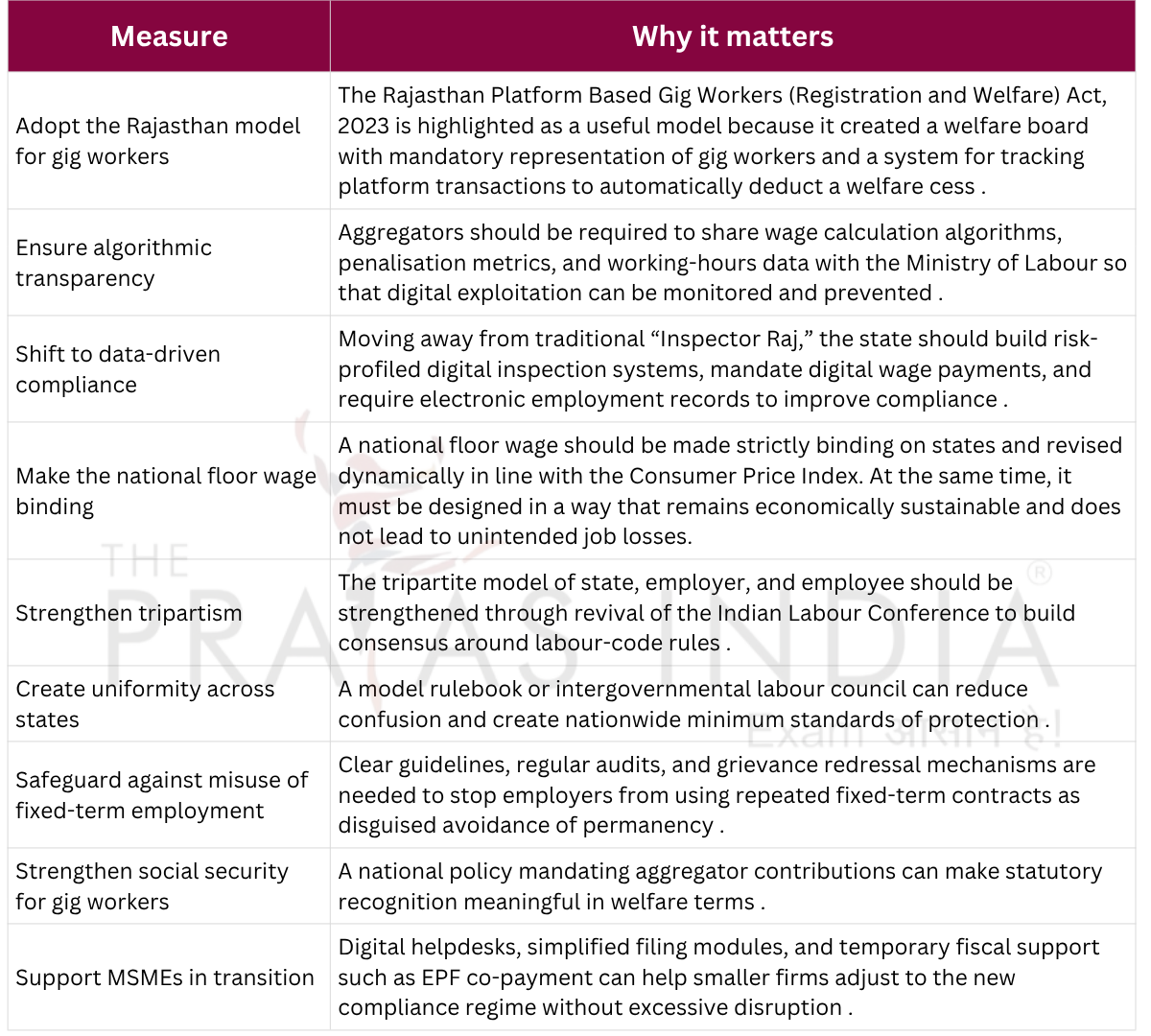
Labour’s Day 2026 and the Informal Sector
One of the strongest takeaways is that India cannot meaningfully address labour rights without confronting the reality of informality. More than 90% of the workforce operates in the informal sector, where legal protections often remain weak unless supported by effective enforcement, awareness, and accessible welfare systems. As a result, even well-designed laws may fail in practice if workers are unregistered, unaware of their entitlements, or unable to access grievance redressal mechanisms.
Labour’s Day 2026 is therefore particularly important for informal workers, migrant labourers, contract workers, and gig workers. The reform framework promises universal wage rights, broader social security, migrant-worker portability, and new databases for welfare delivery, but these promises must be translated into actual registrations, digital access, inspections, grievance redressal, and timely benefits. The future of inclusive development will depend on whether labour reform can move beyond formal legal design and reach the everyday reality of vulnerable workers.
Balancing Ease of Doing Business and Workers’ Rights
A central tension in India’s labour debate is the balance between ease of doing business and workers’ rights. Reform advocates argue that a simpler and more predictable regulatory regime helps firms expand, encourages formal employment, improves competitiveness, and reduces administrative burden. Critics counter that if simplification translates into easier retrenchment, weaker collective bargaining, excessive contractualisation, or vague protections, then efficiency may come at the cost of worker dignity and security.
Labour’s Day 2026 sharpens this debate. The challenge is not to choose between growth and labour, but to build a model where growth itself is labour-respecting. Sustainable development depends on stable industrial relations, fair wages, safe workplaces, social security coverage, and trust between employers, workers, and the state. In this sense, labour welfare is not an obstacle to development; it is one of its essential conditions.
Conclusion
Labour’s Day 2026 arrives at a critical moment in India’s economic and social journey. The nationwide implementation of the four labour codes represents one of the most significant labour reforms in recent decades, promising simplification, broader welfare coverage, and a more modern legal framework. Yet the worker unrest seen in 2026 makes it equally clear that reforms cannot succeed through codification alone; they require credible enforcement, fair wages, social dialogue, state-level coordination, and strong safeguards against precarity and exploitation.
Workers remain the backbone of development because every sector of the economy ultimately rests on their labour. If India wishes to build a truly inclusive, competitive, and future-ready economy, it must ensure that growth is accompanied by dignity, justice, and security for workers across organised, informal, migrant, and platform sectors. The true message of Labour’s Day 2026 is that development becomes meaningful only when the hands that build the nation are themselves protected, respected, and empowered.
FAQs
Labour’s Day 2026 is important because it coincides with the implementation phase of India’s four labour codes and a period of visible worker unrest over wages, job security, and working conditions.
India’s four labour codes are the Code on Wages, 2019; the Industrial Relations Code, 2020; the Code on Social Security, 2020; and the Occupational Safety, Health and Working Conditions Code, 2020.
Workers have protested over inflation-driven wage erosion, delayed base wage revisions, job insecurity, long working hours, weak enforcement, legal ambiguity, and insecurity in the gig economy.
The Social Security Code recognises aggregators, gig workers, and platform workers and provides for a Social Security Fund to support life, health, disability, and old-age benefits.
A major challenge is coordination between the Centre and states because labour is on the Concurrent List, which can lead to delays, uneven rules, legal uncertainty, and uneven worker protection1. Why is Labour’s Day 2026 important for India?
2. What are India’s four labour codes?
3. Why are workers protesting despite labour reforms?
4. How do the labour codes help gig and platform workers?
5. What is the biggest challenge in implementing labour reforms?