
Lal Bahadur Shastri: Ethical Leadership and Nation-Building in Post-Nehruvian India
- GS Paper 1: Modern Indian History (National Movement – limited), Post-Independence Consolidation
- GS Paper 2: Governance, Leadership, Political Institutions
- GS Paper 4: Ethics – Integrity, Simplicity, Leadership by Example
- Prelims: Prime Ministers of India, slogans, policies, wars
- Optional (History / PSIR): Post-Independence India, Political Leadership
Introduction
Lal Bahadur Shastri (1904–1966), India’s second Prime Minister, occupies a distinctive place in Indian political history as a leader who combined personal integrity, administrative competence, and quiet decisiveness. Taking office after the towering presence of Jawaharlal Nehru, Shastri led the country during a period of economic stress, food shortages, and external security threats.
Often remembered for his simplicity and moral authority, Shastri represented a form of leadership rooted in ethical conduct rather than charismatic dominance. His tenure marked a crucial phase in post-Nehruvian India, where continuity in democratic values had to be balanced with the need for pragmatic governance and national consolidation.
Early Life and Role in the Freedom Struggle
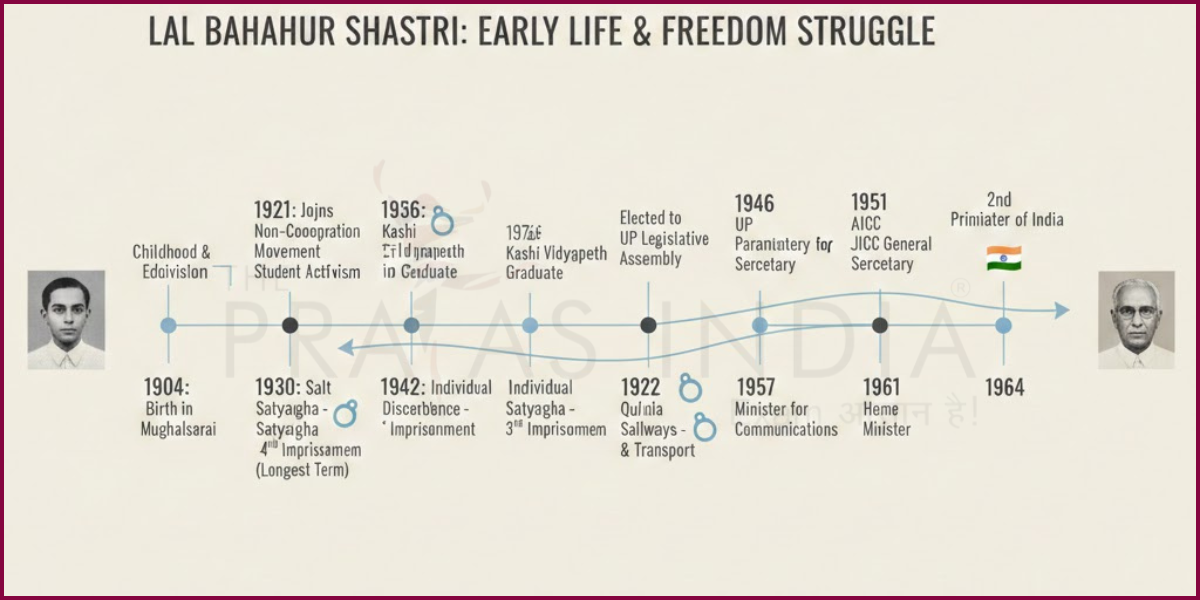
Lal Bahadur Shastri was born in 1904 at Mughalsarai (Uttar Pradesh) in a modest family. His early life was marked by economic hardship, which shaped his empathy for the poor and commitment to simplicity. Educated at Kashi Vidyapith, he consciously gave up the colonial title “Shastri” and adopted it as his surname, reflecting nationalist consciousness.
Participation in the National Movement
Shastri was deeply influenced by Mahatma Gandhi and actively participated in the Non-Cooperation and Civil Disobedience Movements. He was imprisoned multiple times, experiences that served as political training and strengthened his commitment to disciplined, non-violent struggle.
The freedom movement provided Shastri with early exposure to mass mobilisation, organisational discipline, and ethical politics, which later defined his administrative style.
Political Career Before Prime Ministership
After independence, Lal Bahadur Shastri emerged as a trusted organisational leader within the Indian National Congress and an able administrator.
Congress Organisation
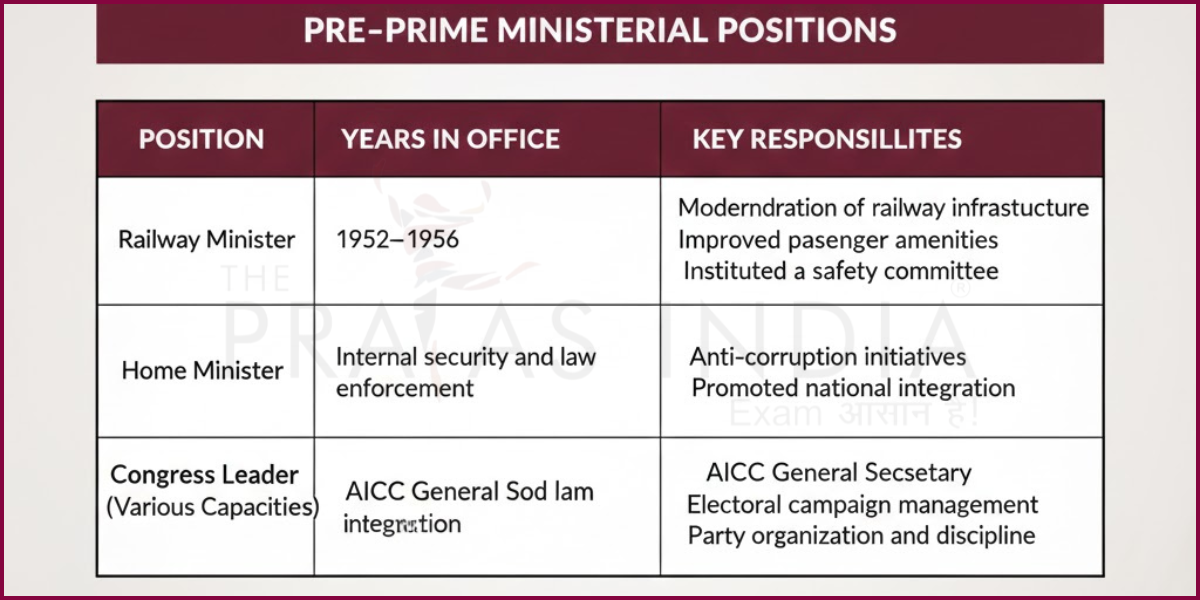
He worked closely with party organisation, strengthening grassroots structures and maintaining discipline during a period of political transition.
Ministerial Positions
- Minister for Railways: Demonstrated accountability by resigning after a major railway accident, setting a benchmark for ministerial responsibility.
- Minister for Home Affairs: Played a crucial role in internal security, linguistic reorganisation, and maintaining law and order.
These roles built his reputation as a low-profile but effective administrator, trusted across factions.
Lal Bahadur Shastri as Prime Minister (1964–1966)
Shastri assumed office in 1964 amid uncertainty following Nehru’s death. India faced:
- Economic stagnation
- Severe food shortages
- External threats from Pakistan
Unlike Nehru’s charismatic leadership, Shastri’s approach was collective, pragmatic, and consensus-oriented. He sought to reassure the nation through stability, continuity, and ethical governance.
Major Policies and Initiatives
Agricultural Policy and the Green Revolution
India faced a critical food crisis in the mid-1960s, with dependence on food imports undermining national confidence.
Shastri strongly supported measures that later came to be known as the Green Revolution, including:
- Adoption of high-yielding varieties of seeds
- Expansion of irrigation
- Institutional support to farmers
His leadership helped lay the foundation for food self-sufficiency, even though full results materialised after his tenure.
‘Jai Jawan, Jai Kisan’
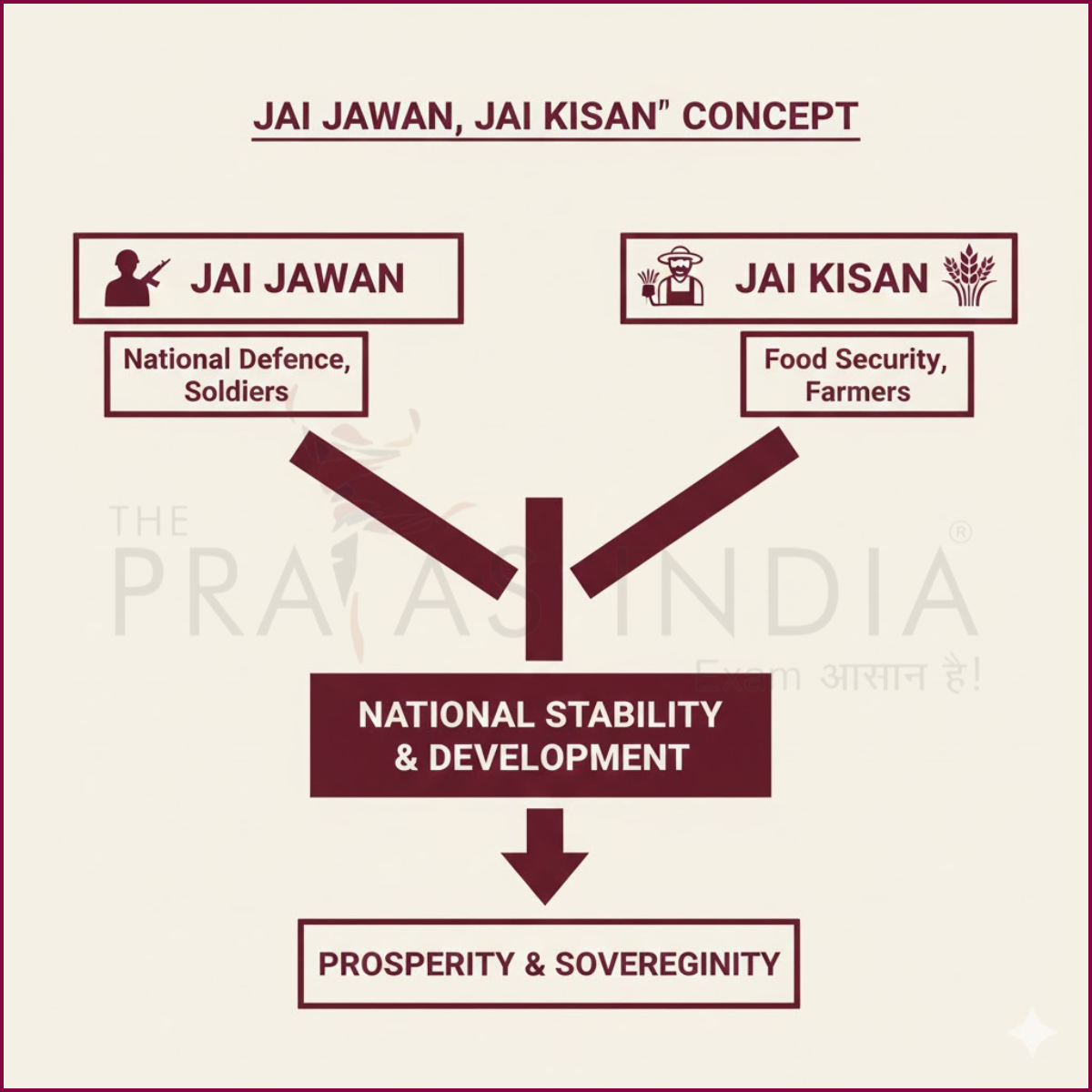
Shastri’s famous slogan “Jai Jawan, Jai Kisan” symbolised the twin pillars of national strength:
- The soldier safeguarding national security
- The farmer ensuring food security
The slogan captured the integrated vision of development and defence, linking economic resilience with strategic strength.
Leadership During the 1965 India–Pakistan War
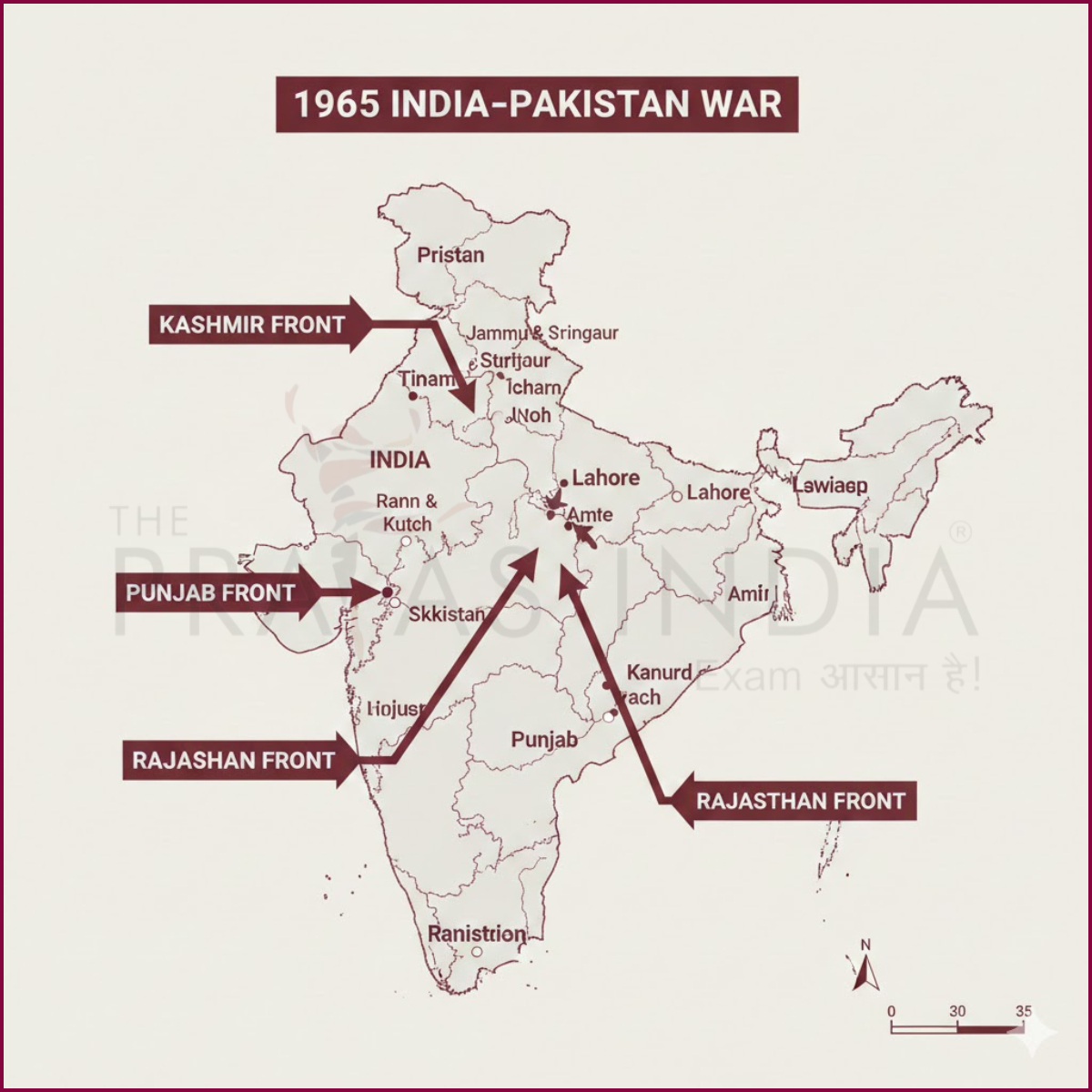
The 1965 war with Pakistan was a defining moment in Shastri’s leadership.
Causes and Course
Pakistan’s attempts to exploit perceived Indian weakness after the 1962 war led to military confrontation. Shastri responded with clarity and resolve, rejecting external pressure and mobilising national resources.
National Mobilisation
Shastri inspired confidence through firm leadership, reinforcing civilian morale and political unity. His slogan and public addresses reflected measured determination rather than militaristic rhetoric.
Tashkent Agreement
The war ended with the Tashkent Agreement (1966), facilitated by the Soviet Union. While the agreement aimed at restoring peace, it generated mixed reactions domestically.
Ethical Leadership and Personal Values
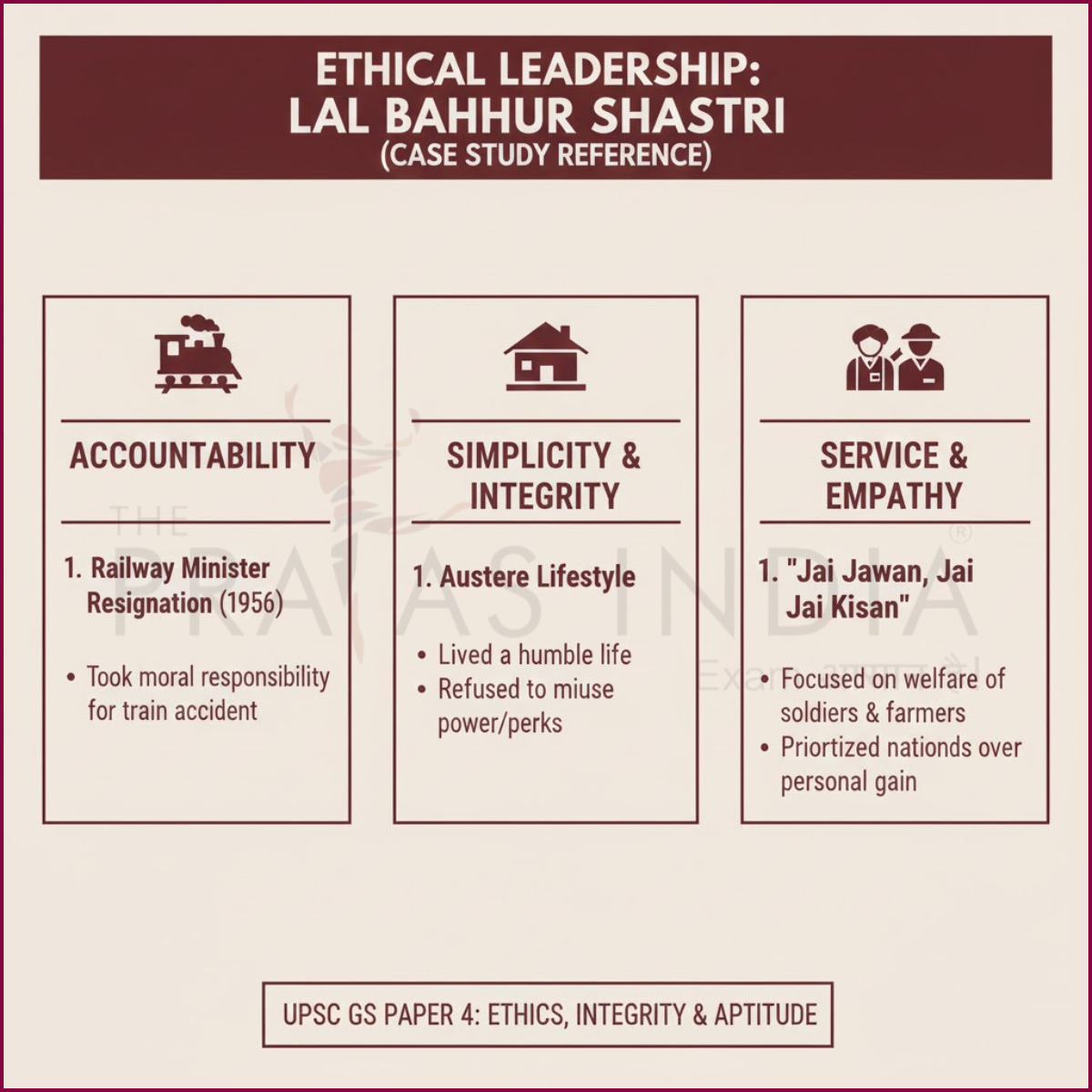
Lal Bahadur Shastri is widely regarded as a model of ethical leadership, particularly relevant for GS Paper IV.
Simplicity and Integrity
He lived a modest life, avoided personal privilege, and remained accessible as Prime Minister.
Accountability
His resignation as Railway Minister after an accident reflected a strong sense of moral responsibility, rare in political life.
Ethical Governance
Shastri believed that public office was a trust and that leaders must set personal examples of honesty and restraint.
Foreign Policy Approach
Shastri broadly continued Nehru’s policy of non-alignment, but with greater emphasis on pragmatism and national interest.
- Maintained balanced relations with major powers
- Focused on peace diplomacy while defending sovereignty
- Sought stability in South Asia despite adversarial neighbours
His foreign policy reflected quiet realism rather than idealistic internationalism.
9. Death and Legacy
Lal Bahadur Shastri died in January 1966 at Tashkent, shortly after signing the peace agreement. His sudden death shocked the nation and raised questions that continue to be discussed in public discourse.
National and International Response
Tributes poured in across political lines, recognising his integrity and service.
Institutional Memory
Institutions, awards, and public spaces named after Shastri continue to commemorate his legacy as a leader of conscience and commitment.
Critical Evaluation
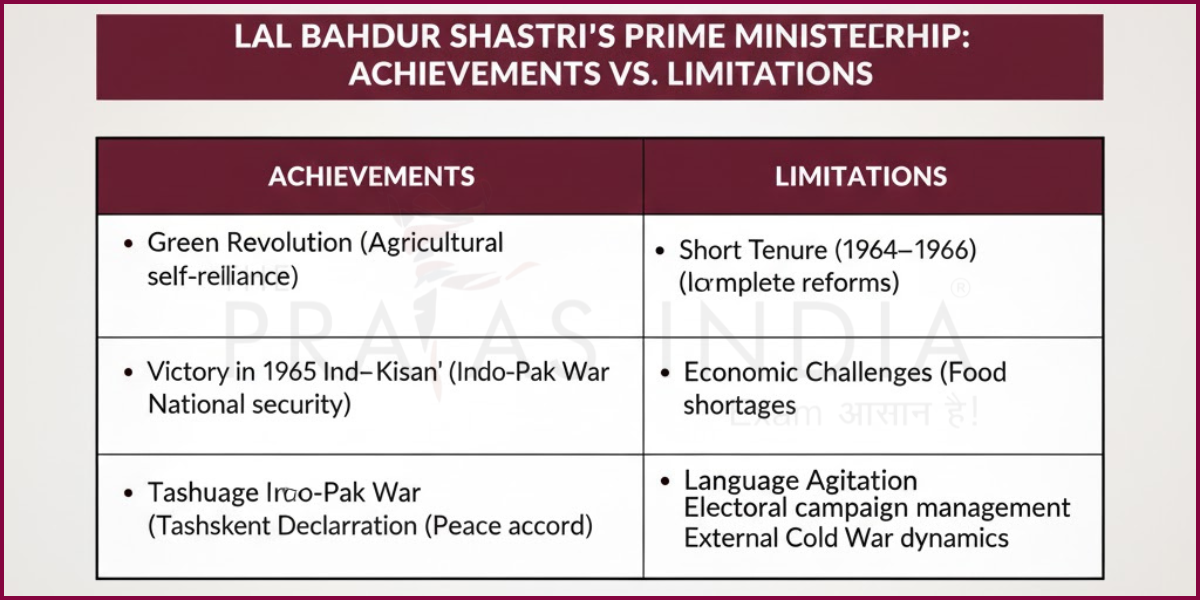
Strengths
- Ethical and accountable leadership
- Decisiveness during war
- Foundation for food security
- Ability to lead without charisma
Limitations
- Short tenure limited long-term policy implementation
- Economic reforms remained constrained by circumstances
- Tashkent Agreement faced domestic criticism
Overall, historians view Shastri as a transitional yet crucial leader who ensured continuity and stability in a sensitive phase.
Conclusion
Lal Bahadur Shastri remains a symbol of ethical, people-centric leadership in Indian political history. At a time of uncertainty and crisis, he demonstrated that authority need not rest on charisma, but on integrity, courage, and moral conviction. His life and leadership offer enduring lessons for contemporary governance—particularly the values of accountability, simplicity, and service. In an era of complex challenges, Shastri’s example continues to remind India that ethical leadership is itself a form of national strength.
Frequently Asked Questions (FAQs) on Lal Bahadur Shastri
Q1. Why is Lal Bahadur Shastri considered an important Prime Minister despite his short tenure?
Lal Bahadur Shastri provided stability after Nehru’s death, led India decisively during the 1965 war, addressed food shortages through agricultural reforms, and set high standards of ethical leadership, making his short tenure historically significant.
Q2. What was the significance of the slogan ‘Jai Jawan, Jai Kisan’?
The slogan symbolised the dual foundation of India’s security—strong armed forces and self-reliant agriculture—linking national defence with food security during a period of crisis.
Q3. How did Lal Bahadur Shastri contribute to the Green Revolution?
Shastri supported the adoption of high-yielding variety seeds, encouraged scientific agriculture, and motivated farmers, laying the political and moral groundwork for the Green Revolution.
Q4. What role did Lal Bahadur Shastri play in the 1965 India–Pakistan War?
He demonstrated firm leadership, mobilised national unity, upheld India’s territorial integrity, and later pursued peace diplomacy through the Tashkent Agreement.
Q5. Why is Lal Bahadur Shastri often cited in GS Paper 4 (Ethics)?
His personal integrity, simplicity, accountability (e.g., resignation after a railway accident), and moral leadership make him a model case study for ethical governance.
Q6. What was Shastri’s approach to foreign policy?
He maintained continuity with non-alignment, focused on peaceful coexistence, and balanced firmness with diplomacy, especially in relations with neighbouring countries.
Q7. How did Lal Bahadur Shastri’s freedom struggle experience shape his leadership?
Imprisonment, mass movements, and organisational work instilled discipline, humility, and people-centric governance values in his political life.