MBA CET 2027 Study Plan: A Month-Wise Strategy for 99+ Percentile | Best MBA CET Coaching in Mumbai
Scoring 99+ percentile in MBA CET 2027 is not about studying everything available on the internet or spending every waking hour solving questions. It is about building a preparation system that gradually improves three things: conceptual clarity, speed and decision-making.
MBA CET is particularly demanding because candidates have to solve a large number of questions within a limited time. This makes the preparation approach different from exams where students can spend several minutes on individual questions. For an aspirant targeting a very high percentile, knowing the concepts is only the starting point. The real challenge is learning how to recognise question types quickly, avoid unnecessary calculations, manage time and maintain accuracy while moving through the paper.
That is why a month-wise preparation plan can be more useful than an unstructured list of topics.
Instead of asking, “What should I study today?”, an aspirant should know what the objective of each month is.
The early months should establish the foundation. The middle phase should increase question-solving ability and speed. The later phase should become increasingly test-oriented. Finally, the last few weeks should focus on execution, revision and performance stabilisation.
For students preparing for MBA CET 2027, this approach can also help answer an important question: When should you consider professional MBA CET coaching in Mumbai?
Coaching is not a substitute for self-study. However, students who need a structured syllabus plan, faculty guidance, regular mock tests, performance analysis and mentorship may find a well-organised preparation system useful.
The key is to start with the right objective and then change the nature of preparation as the examination approaches.
What Does a 99+ Percentile Preparation Strategy Actually Require?
Before creating a month-wise plan, it is important to understand what a 99+ percentile target means from a preparation perspective.
A high percentile target does not mean that you need to become perfect in every topic.
It means you need to become consistently efficient across the paper.
That requires four abilities.
1. You Need Strong Fundamentals
You cannot solve questions quickly if you are still trying to remember basic concepts while solving them.
Quantitative Aptitude requires familiarity with concepts and calculations. Logical Reasoning requires recognising patterns and relationships. Abstract Reasoning requires visual interpretation and quick identification of patterns. Verbal Ability and Reading Comprehension require language familiarity, comprehension and efficient decision-making.
The first phase of preparation should therefore focus on building a dependable base.
2. You Need Extensive Question Exposure
Knowing a formula is different from recognising when to use it.
The same concept can appear through different question structures. Regular practice exposes students to these variations.
This is where topic-wise practice becomes important.
3. You Need Speed Without Losing Control
Speed is one of the defining challenges of MBA CET preparation.
A student may know how to solve a question but still lose valuable time by approaching it inefficiently.
Over time, preparation should make common question types feel familiar enough that the candidate can quickly decide:
Attempt → Solve → Move on
rather than:
Read → Think → Re-read → Experiment → Solve
4. You Need a Testing and Analysis System
Mocks should not be introduced only near the examination.
They should become progressively more important as preparation advances.
The purpose of a mock is not simply to tell you your score. It should show you:
- Which questions are consuming too much time
- Which topics are causing repeated mistakes
- Where your accuracy is falling
- Whether you are selecting questions efficiently
- Which sections are becoming strengths
- Which weaknesses require immediate attention
This information should then influence your next study cycle.
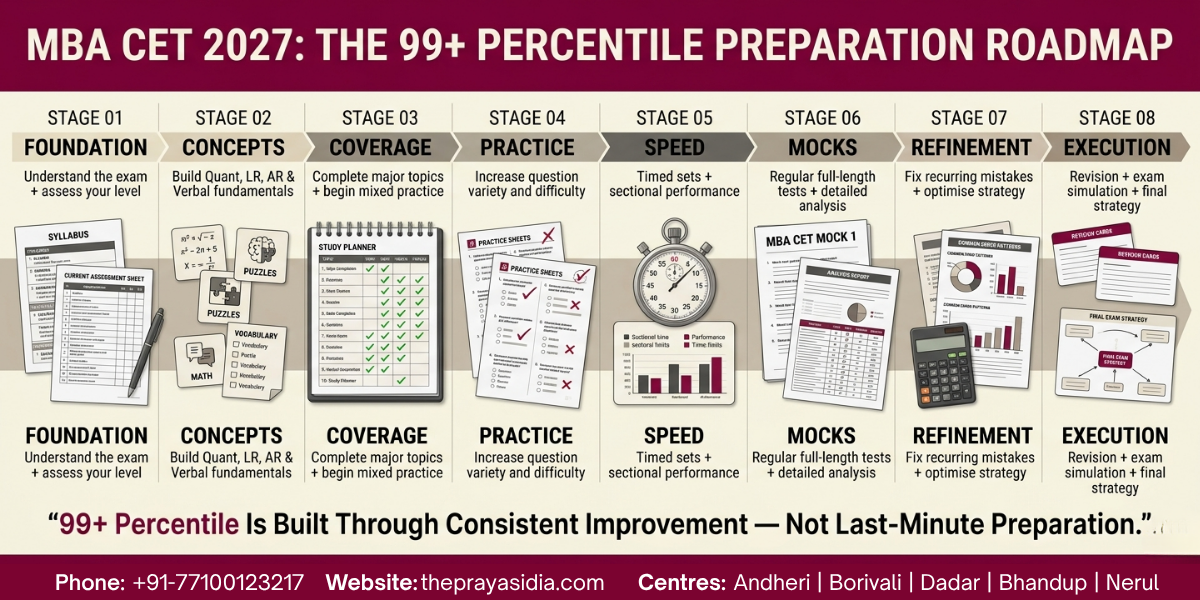
The Big Picture: A Month-Wise MBA CET 2027 Study Plan
A long preparation journey becomes easier to manage when divided into stages.
A practical framework can be divided into:
| Preparation Phase | Main Focus |
|---|---|
| Month 1 | Understand the exam and build fundamentals |
| Month 2 | Strengthen core concepts |
| Month 3 | Complete major topic coverage |
| Month 4 | Increase practice and question variety |
| Month 5 | Build speed and sectional performance |
| Month 6 | Start serious mock-test preparation |
| Month 7 | Full-length testing and targeted improvement |
| Month 8 | Advanced revision and strategy refinement |
| Final Month | Exam simulation and performance stabilisation |
The exact number of months available will depend on the eventual examination schedule and when you begin preparation. Therefore, this framework should be adapted rather than followed mechanically.
If you have fewer months, phases can be compressed.
If you have more time, the foundation and practice phases can be extended.
The important thing is to preserve the order of development.
Month 1: Build the Foundation Before Chasing Speed
The first month should not be about attempting hundreds of questions every day.
It should be about understanding where you stand and creating a dependable foundation.
Many aspirants make an early mistake by jumping directly into advanced-level questions because they want their preparation to look serious from Day 1.
That approach can create unnecessary frustration.
Instead, begin with an assessment.
Take an initial diagnostic test or a representative set of questions from each major area. The purpose is not to obtain a high score.
The purpose is to answer:
Where am I starting from?
You may discover that your Quantitative Aptitude fundamentals are strong but your speed is weak. Another student may find that Quant is comfortable but Logical Reasoning needs more work.
Your preparation plan should reflect those differences.
Month 1 Priorities
During the first month, focus on:
- Understanding the MBA CET exam structure
- Assessing your current level
- Revising basic mathematical concepts
- Building fundamental Logical Reasoning skills
- Developing familiarity with Abstract Reasoning patterns
- Strengthening basic verbal ability
- Starting regular reading
- Creating a realistic daily timetable
Do not worry about completing every topic immediately.
The objective is to create the base on which the next few months will depend.
How Much Should You Study in Month 1?
There is no universally correct number of study hours.
A college student, working professional and full-time aspirant will have different schedules.
Instead of blindly targeting ten or twelve hours, focus on productive study blocks.
A student starting preparation might use a structure such as:
| Activity | Suggested Daily Focus |
|---|---|
| Concept Learning | 2–3 hours |
| Quant Practice | 1 hour |
| Reasoning Practice | 1 hour |
| Verbal/Reading | 45–60 minutes |
| Revision | 30 minutes |
| Error Review | 15–30 minutes |
This is a framework rather than a fixed prescription.
The most important habit in Month 1 is consistency.
If you study for five focused hours every day, that can be more valuable than studying for twelve hours twice a week and then losing momentum.
Month 2: Strengthen the Core Concepts
Once the foundation is established, Month 2 should move towards stronger topic coverage.
This is where students should begin building depth.
For Quantitative Aptitude, move beyond basic concepts and start solving different question formats.
For Logical Reasoning, gradually increase the complexity of sets and arrangements.
For Abstract Reasoning, practise identifying patterns quickly instead of spending excessive time on individual questions.
For Verbal Ability, combine grammar, vocabulary and comprehension practice with regular reading.
The objective is to reach a stage where the student does not feel completely unfamiliar with most standard question types.
A Better Way to Study Each Topic
Use a four-step process:
Concept → Examples → Practice → Review
First understand the concept.
Then observe how it is applied.
Next solve questions independently.
Finally, review the questions you got wrong or took too long to solve.
This last step is often ignored.
Students tend to spend much more time solving questions than reviewing them. But review is where recurring mistakes become visible.
The Error Log: Start It Early
If you want to target 99+ percentile, maintain an error log from the beginning.
This does not need to be a complicated notebook.
For every meaningful mistake, record:
Question → Mistake → Reason → Correct Approach
For example:
Mistake: Incorrect percentage calculation
Reason: Used the wrong base value
Correction: Identify the reference quantity before calculating
Another example:
Mistake: Spent four minutes on a reasoning set
Reason: Did not identify that the arrangement had multiple conditions
Correction: Check complexity before committing to the set
Over several months, this becomes one of the most useful revision resources.
Your error log is not simply a record of wrong answers.
It is a record of how you personally lose marks.
That distinction is extremely important.
Month 3: Complete Major Concept Coverage
By Month 3, preparation should become more systematic.
You should now have a clearer understanding of your strengths and weaknesses.
This is the stage where students should aim to cover the major concepts while simultaneously increasing practice.
Do not make the mistake of waiting until the syllabus is 100% complete before solving mixed questions.
Begin introducing mixed practice alongside topic-wise practice.
For example, instead of spending the entire week solving only one Quantitative Aptitude topic, combine different concepts in some practice sessions.
Why?
Because the actual examination will not tell you:
“This is a percentage question.”
You have to identify the underlying concept yourself.
Mixed practice develops that recognition ability.
Building Section-Wise Strength
At this stage, it can be useful to classify your preparation into three categories.
Strong Areas
These are topics where:
- Accuracy is consistently high
- You recognise question types quickly
- Time spent is reasonable
Maintain them through regular practice.
Developing Areas
These are topics where:
- Concepts are understood
- Accuracy is inconsistent
- Speed still needs improvement
These should receive regular practice.
Weak Areas
These are topics where:
- Concepts are unclear
- Mistakes are frequent
- Questions take too long
- You tend to avoid the topic
These require targeted intervention.
A common mistake is spending most of the preparation time on favourite subjects because solving them feels productive.
For a high percentile target, preparation should be driven by performance data, not comfort.
Month 4: Shift from Learning to Serious Practice
By the fourth month, the nature of preparation should start changing.
The question is no longer simply:
“Do I understand this topic?”
It becomes:
“Can I solve questions from this topic quickly and accurately?”
This is a major transition.
Start introducing timed practice regularly.
For example, instead of solving twenty questions without a clock, give yourself a defined time limit.
The purpose is not to create pressure for the sake of pressure.
It is to train your brain to make decisions within constraints.
Start Tracking Three Numbers
From this stage onward, track:
Accuracy
How many attempted questions are correct?
Average Time
How long are you taking to solve questions from different categories?
Attempts
How many questions are you able to attempt within the available time?
These three numbers should be considered together.
High attempts with low accuracy is a warning sign.
High accuracy with very low attempts may indicate a speed problem.
Balanced attempts and accuracy with efficient time usage indicate progress.
This approach is much more useful than looking only at your total score.
Developing Question Selection Skills
One of the biggest differences between preparation-level solving and exam-level solving is question selection.
In practice, you may attempt almost every question because there is no serious consequence to spending extra time.
In the examination, that approach can be costly.
A high-level aspirant should gradually develop the ability to classify questions mentally:
Easy → Attempt immediately
Moderate → Attempt if time permits
Time-consuming → Consider skipping
This does not mean avoiding difficult questions altogether.
It means understanding the value of time.
If one question is consuming the same amount of time that could have been used to solve three easier questions, continuing with it may not be the best decision.
Question selection is therefore not about avoiding challenge.
It is about maximising output from limited time.
Month 5: Build Speed, Accuracy and Sectional Control
Month 5 should become more test-oriented.
By now, most major concepts should have been covered at least once, although some topics may still need revision.
Your practice should increasingly include:
- Timed Quant sets
- Logical Reasoning sets
- Abstract Reasoning drills
- Verbal Ability practice
- Reading comprehension
- Mixed-section question sets
- Sectional tests
This is also the stage where students should identify their personal time-management pattern.
Some students spend too much time at the beginning of a test.
Others become slower towards the end.
Some students repeatedly get stuck in one reasoning set.
Others over-attempt difficult Quant questions.
These patterns become visible through regular testing.
How to Improve Speed Without Becoming Careless
Speed should not be developed by simply trying to read faster or click answers faster.
It develops through familiarity and efficient processes.
For Quantitative Aptitude, this could mean:
- Improving calculation speed
- Learning efficient approaches
- Recognising familiar structures
- Reducing unnecessary written steps
For Logical Reasoning:
- Identifying the structure quickly
- Learning when to create diagrams
- Avoiding unnecessary assumptions
For Abstract Reasoning:
- Training visual pattern recognition
- Practising different pattern types
- Avoiding over-analysis
For Verbal Ability:
- Improving reading efficiency
- Recognising common grammar patterns
- Developing vocabulary through regular exposure
The goal is not to rush.
The goal is to reduce the amount of thinking required for familiar patterns.
When Should MBA CET Aspirants Start Mock Tests?
There is no reason to wait until the final month to take your first test.
However, the purpose of mocks changes over time.
Early mocks are diagnostic.
Middle-stage mocks are developmental.
Later mocks are performance-oriented.
This distinction matters.
If you take an early mock and score poorly, that does not mean your preparation has failed.
It tells you what needs attention.
Similarly, if your score improves dramatically in the middle phase, do not assume the preparation is complete.
The real objective is to make performance stable.
A 99+ percentile aspirant needs more than one excellent mock.
They need the ability to reproduce strong performance consistently.
The Role of Coaching in a 99+ Percentile Strategy
A month-wise plan gives students direction, but following that plan consistently can be difficult.
This is where professional MBA CET coaching can be valuable for some aspirants.
A structured coaching programme can provide a predefined learning sequence, faculty support, practice material, mock tests and performance guidance.
The advantage is not that students suddenly have less work to do.
In fact, serious aspirants still need substantial self-study.
The advantage is that they do not have to spend as much time deciding:
What should I study next?
Which topic should I prioritise?
Why is my score not improving?
Is my approach to this question efficient?
Should I revise this topic again or move forward?
A good coaching system should help answer these questions while leaving the student responsible for execution.
For aspirants considering MBA CET Coaching in Mumbai, this is an important distinction. The right institute should not merely provide lectures. It should support the complete journey from concept building to mock-test performance.
What to Look for in MBA CET Coaching
Before joining an institute, students should evaluate the actual preparation system.
Look at:
| Factor | What to Check |
|---|---|
| Faculty | Concept clarity and exam-oriented teaching |
| Course Structure | Logical progression from basics to advanced practice |
| Study Material | Quality and relevance |
| Practice | Regular topic-wise and mixed practice |
| Mock Tests | Frequency and difficulty |
| Mock Analysis | Whether performance is actually reviewed |
| Mentorship | Guidance for individual preparation problems |
| Doubt Solving | Accessibility of academic support |
| Batch Timing | Compatibility with college/work |
| Location | Daily travel convenience |
This checklist is more useful than choosing coaching simply because it is described as the “best.”
The best institute for one student may not necessarily be the best fit for another.
The Prayas India and a Structured MBA CET Preparation Approach
For students who prefer guided preparation, The Prayas India can fit into the month-wise strategy by providing a structured environment around learning, practice and testing.
The objective should remain the same throughout the preparation journey:
Understand → Practise → Test → Analyse → Improve
The role of coaching is to support that cycle.
Students still need to revise independently, solve questions regularly and learn from mistakes.
The more seriously a student engages with the complete system, the more useful structured coaching can become.
For an aspirant evaluating Best MBA CET Coaching in Mumbai, it is therefore worth looking beyond the classroom itself and examining the complete preparation ecosystem.
What You Should Have Achieved by the End of Month 5
By the end of the fifth month, your preparation should look significantly different from Month 1.
You should ideally have:
- Covered the major concepts
- Identified your strongest and weakest areas
- Developed a regular practice routine
- Started timed question-solving
- Built an error log
- Started sectional testing
- Improved calculation and reasoning efficiency
- Begun understanding your question-selection pattern
- Developed a basic mock-test strategy
- Created a revision system
You do not need to be perfect at this point.
But you should be measurably better than when you started.
That is the real indicator that the preparation plan is working.
Month 6: Enter the Serious Mock-Test Phase
Month 6 should mark a clear change in your preparation.
Until now, you have primarily been building knowledge and solving questions.
Now you need to start asking:
Can I convert what I know into marks under examination conditions?
This is where full-length mock tests become increasingly important.
A mock should reproduce the pressure of the actual examination as closely as possible. Sit at a fixed time, keep distractions away and attempt the complete paper without pausing.
But taking the mock is only half the exercise.
The more important half begins after submitting it.
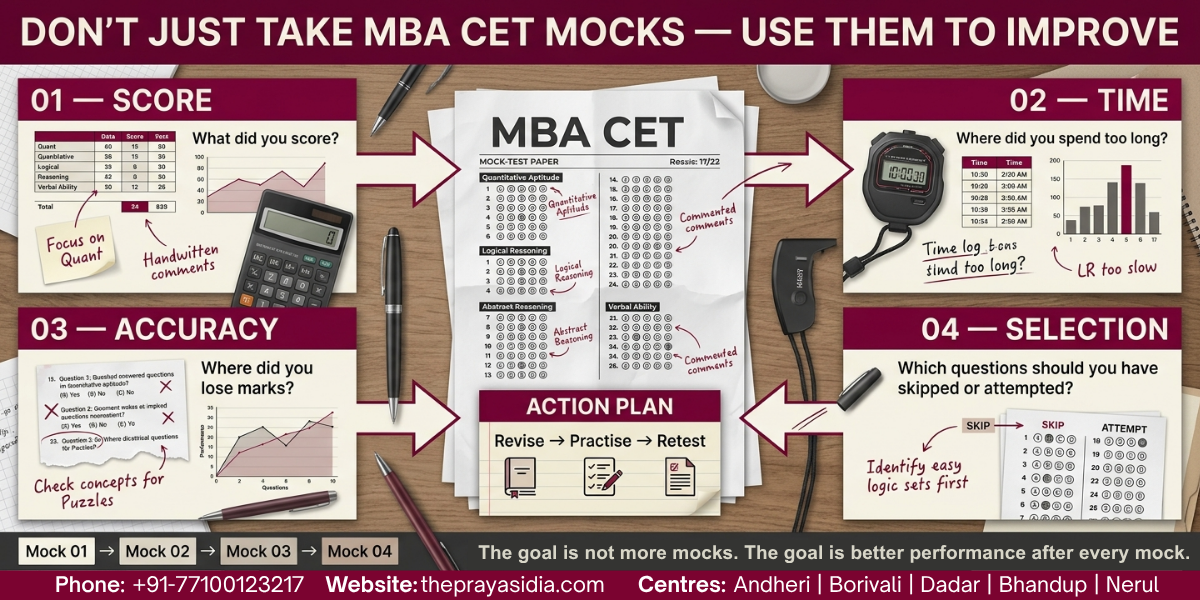
The Four-Step Mock Analysis Method
After every full-length mock, divide your questions into four categories:
Category 1: Correct and Efficient
You answered correctly and within reasonable time.
These are your strengths.
Category 2: Correct but Slow
You got the answer right, but the question consumed too much time.
These questions require speed improvement.
Category 3: Incorrect but Solvable
You knew the concept but made a calculation, interpretation or logical error.
These are often the easiest marks to recover.
Category 4: Incorrect Because of a Concept Gap
You did not know how to approach the question.
These require concept revision.
This classification is much more useful than simply writing down your mock score.
Your Mock-Test Notebook Should Answer Five Questions
After every serious mock, record:
- What went well?
- Where did I lose time?
- Where did I lose accuracy?
- Which questions should I have skipped?
- What will I change before my next mock?
The fifth question is the most important.
If you take ten mocks but make exactly the same mistakes in all ten, the number of mocks has not helped enough.
A mock should create an action point.
For example:
“I spent too much time on difficult LR sets.”
Your next action could be:
Practise set selection and timed LR drills.
Or:
“My Quant accuracy falls after prolonged calculation.”
Your action could be:
Practise calculation-heavy questions under shorter time limits.
This turns testing into improvement.
Month 7: Move from Preparation to Performance
By Month 7, the question should no longer be whether you have studied enough.
It should be whether your performance is becoming reliable.
A 99+ percentile target requires consistency.
One excellent mock score followed by several poor performances is not enough evidence that your strategy is ready.
Your objective should be to gradually narrow the gap between your best performance and your average performance.
Track Your Mock Performance
Maintain a simple table:
| Mock | Score | Accuracy | Attempts | Time Issues | Main Weakness |
|---|---|---|---|---|---|
| Test 1 | — | — | — | — | — |
| Test 2 | — | — | — | — | — |
| Test 3 | — | — | — | — | — |
| Test 4 | — | — | — | — | — |
| Test 5 | — | — | — | — | — |
Do not obsess over every fluctuation.
Mock scores can vary because of question selection, difficulty and your own performance on that particular day.
Look for patterns, not isolated numbers.
If your Quant accuracy has improved consistently over five tests, that is meaningful.
If your LR timing problem appears repeatedly, it needs attention.
The 99+ Percentile Mindset: Don’t Chase Every Question
One of the biggest strategic mistakes aspirants make is believing that a high percentile requires attempting every difficult question.
That is not necessarily the right approach.
The current official MAH MBA/MMS CET pattern has no negative marking, which affects how candidates can think about attempts; however, the precise strategy should still be based on the final 2027 rules and the candidate’s ability to manage time effectively.
The important point is this:
More attempts are useful only when they contribute to your overall score efficiently.
You should gradually develop a personal hierarchy:
First Priority
Questions you can solve quickly and confidently.
Second Priority
Questions requiring moderate effort.
Third Priority
Questions where the time-to-score trade-off is less attractive.
This is why mock analysis matters.
Your strategy should emerge from your performance rather than being copied blindly from another candidate.
Month 8: Advanced Revision and Strategy Refinement
Month 8 should not be treated as another syllabus-completion month.
By this stage, your preparation should become increasingly selective.
Instead of revising everything equally, divide your syllabus into:
High Priority → Medium Priority → Maintenance
High Priority
Topics where:
- You frequently make mistakes
- Questions take too long
- Concepts remain unclear
- Mock performance is consistently weak
Medium Priority
Topics where you understand the concepts but need more practice.
Maintenance
Topics where your accuracy and speed are already strong.
This approach prevents a common problem: spending hours revising topics you already know while ignoring the areas actually costing you marks.
Build a Personal Revision File
At this stage, create one compact revision resource.
It could contain:
- Important formulas
- Common calculation shortcuts
- Difficult LR patterns
- Abstract Reasoning patterns
- Frequently confused concepts
- Vocabulary or grammar reminders
- Mock-test mistakes
- Time-management observations
- Questions you repeatedly get wrong
This should not become another giant study material folder.
The purpose is quick revision.
By the final weeks, you should be able to revise important personal weaknesses without reopening dozens of books, PDFs or videos.
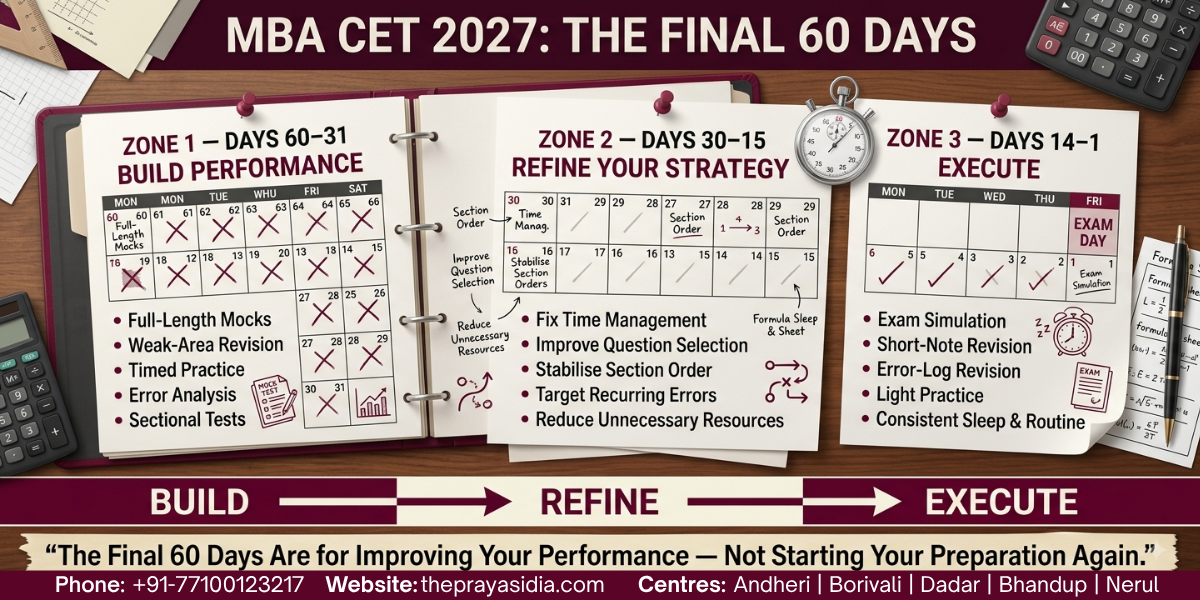
The Final 60 Days: Where Strategy Matters Most
The last 60 days should be divided into two distinct phases.
Days 60–31: Performance Building
During the first half:
- Continue full-length mocks
- Analyse every mock
- Revise weak concepts
- Practise timed sets
- Improve question selection
- Maintain sectional practice
- Continue reading and verbal practice
- Review your error log
This is still an improvement phase.
You are allowed to discover weaknesses.
In fact, this is the right time to discover them.
Days 30–15: Stabilise Your Strategy
Now you should start reducing experimentation.
If you have tested multiple approaches to time management, decide which one works best.
If you have experimented with different section orders, identify the most comfortable approach.
If certain question types consistently consume too much time, learn when to leave them.
The goal is to reduce uncertainty.
You do not want to enter the final week still asking:
“Which strategy should I use?”
That decision should already have been tested through mocks.
Days 14–7: Revision + Simulation
During this phase, focus heavily on exam simulation.
Take mocks under conditions that resemble your expected examination routine.
Do not keep changing resources.
Do not suddenly start studying from five new sources.
Do not attempt to complete every topic you ignored for months.
Instead:
Revise → Test → Analyse → Correct
This cycle should dominate your preparation.
The Final Week: Don’t Overload Your Preparation
The final week is not the time to prove how much you can study.
It is the time to protect your preparation.
Review:
- Your short notes
- Error log
- Important formulas
- Difficult question types
- Mock-test lessons
- Time-management strategy
- Section-wise approach
Avoid unnecessary experimentation.
Your preparation should feel increasingly simple.
You know what to revise.
You know how you perform.
You know your strengths.
You know where you need caution.
That is what exam readiness looks like.
How Coaching Can Help During the Final Months
Self-study remains an important part of MBA CET preparation regardless of whether you join an institute.
However, the final months can become difficult to manage independently because the number of decisions increases.
Students need to determine:
- Which topics require revision
- Which mocks to attempt
- How to analyse performance
- Which weaknesses to prioritise
- How to improve speed
- Whether their strategy is actually working
This is where structured MBA CET coaching in Mumbai can become valuable for students who prefer guided preparation.
A coaching institute should ideally provide more than lectures.
It should help create a system around:
Concept Building → Practice → Testing → Analysis → Mentorship → Improvement
The student still has to do the work.
But the preparation path becomes more structured.
Why Mock-Test Analysis Can Be More Valuable Than Taking More Mocks
There is a tendency among aspirants to measure preparation by the number of tests completed.
For example:
“I have taken 30 mocks.”
But the more important question is:
“What did those 30 mocks teach me?”
If every test reveals the same weakness and you do nothing about it, taking another test may simply reproduce the same problem.
Imagine that your analysis shows:
Quant: Good accuracy, low attempts
LR: High attempts, inconsistent accuracy
AR: Strong performance
VARC: Slow comprehension
Your next week’s preparation should not treat all four areas equally.
You may need:
- Speed drills in Quant
- Accuracy-focused LR practice
- Maintenance practice in AR
- Timed reading and verbal practice
That is what data-driven preparation looks like.
How to Balance MBA CET Preparation with College or Work
Not every aspirant can study full-time.
Many candidates prepare while attending college or working.
The solution is not necessarily to copy a full-time aspirant’s timetable.
Instead, divide your preparation into:
High-Focus Blocks
Use these for:
- Quant concepts
- LR sets
- Mock tests
- Difficult topics
Low-Friction Activities
Use shorter periods for:
- Vocabulary
- Reading
- Formula revision
- Error-log review
- Short practice sets
Weekend Blocks
Reserve longer sessions for:
- Full-length mocks
- Detailed analysis
- Weekly revision
- Backlog clearance
The goal is to make preparation fit your actual life.
A timetable that looks impressive but cannot be followed is not a useful timetable.
What If You Start MBA CET Preparation Late?
Starting late does not automatically mean giving up on a high percentile target.
But it does mean you need to become more selective.
If you have limited time, prioritise:
Concepts with high utility → Practice → Timed Sets → Mocks → Analysis → Revision
Do not try to consume every available resource.
A shorter, consistent preparation system is usually easier to execute than an enormous plan that constantly changes.
Students starting late may also benefit from professional guidance because a structured course can reduce the time spent deciding what to study next.
However, the final outcome will still depend heavily on individual effort and consistency.
How The Prayas India Can Fit Into Your MBA CET Preparation Plan
For students considering The Prayas India for MBA CET preparation, the important question should not simply be whether coaching is available.
The better question is:
How does the preparation system fit into my target?
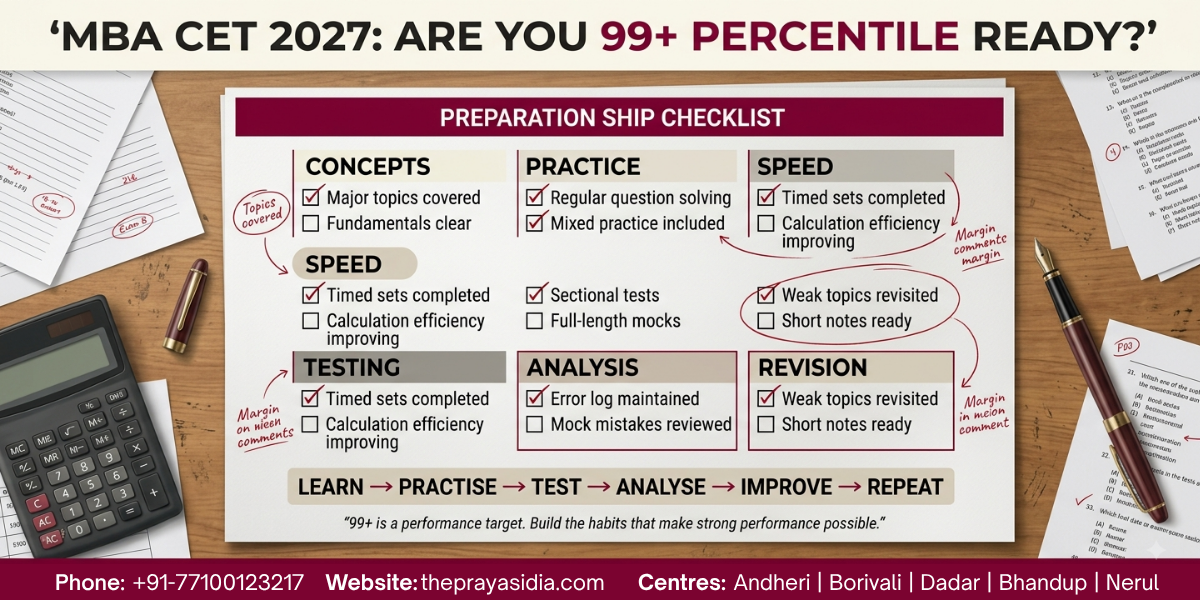
A student targeting 99+ percentile needs a system that supports multiple stages of preparation.
Foundation
Understand the concepts and build fundamentals.
Practice
Apply those concepts across different question types.
Testing
Measure performance through sectional and full-length tests.
Analysis
Identify exactly where marks and time are being lost.
Mentorship
Get guidance when the preparation strategy needs adjustment.
Revision
Return to weak areas without losing focus on strong sections.
This is the kind of complete preparation cycle students should look for while evaluating Best MBA CET Coaching in Mumbai.
The institute should support the student’s preparation, not replace it.
A Weekly Schedule for a 99+ Percentile Aspirant
A monthly plan becomes easier to follow when converted into a weekly structure.
A sample advanced-stage schedule could look like this:
| Day | Primary Focus | Secondary Focus |
|---|---|---|
| Monday | Quant Practice | Verbal |
| Tuesday | LR Practice | Abstract Reasoning |
| Wednesday | Quant + Timed Sets | Revision |
| Thursday | LR + AR | Verbal |
| Friday | Mixed Practice | Error Log |
| Saturday | Sectional Tests | Analysis |
| Sunday | Full Mock | Detailed Analysis |
This schedule should be adjusted according to your strengths.
If Quant is your weakest area, increase its practice.
If LR is already strong, maintain it instead of spending disproportionate time there.
The timetable should follow the data from your preparation.
A Simple Daily Rule: Learn, Solve, Review
Regardless of the month, try to maintain three elements in your study routine.
Learn
Study a concept or strategy.
Solve
Apply it to questions.
Review
Analyse what went wrong.
If one of these three is missing, preparation can become unbalanced.
Only learning leads to passive preparation.
Only solving can create repetitive mistakes.
Only reviewing without sufficient practice limits application.
The three need to work together.
99+ Percentile Is a Long-Term Process
A high percentile cannot be guaranteed by any coaching institute, study plan or number of hours.
Percentile depends on examination performance and the competitive performance of candidates in that examination.
Therefore, the right objective is not to obsess over a promised percentile.
Your controllable targets are:
Better accuracy.
Better speed.
Better question selection.
Better mock performance.
Better revision.
Better consistency.
If these improve steadily, your probability of achieving a strong result also improves.
That is a much healthier and more practical way to approach MBA CET preparation.
Common Mistakes to Avoid While Following a Month-Wise Plan
1. Treating the Plan as a Fixed Rulebook
A study plan should guide preparation, not control it blindly.
If you need more time on a weak topic, adjust the schedule.
2. Studying Every Subject for Equal Time
Equal time does not necessarily mean optimal preparation.
Your weak areas may need additional attention.
3. Taking Mocks Without Analysis
A mock without analysis is an incomplete exercise.
4. Changing Resources Constantly
More books, PDFs and videos do not automatically mean better preparation.
5. Ignoring Revision
New learning feels productive, but forgotten concepts eventually become lost marks.
6. Comparing Your Preparation with Others
Someone else’s study hours or mock scores do not determine your preparation requirements.
Track your own improvement.
7. Waiting for “Perfect Preparation” Before Testing
You need tests to discover weaknesses.
Do not wait until everything feels complete.
Choosing the Right MBA CET Coaching Institute in Mumbai
If you are considering classroom coaching, use your admission decision as carefully as you use your preparation plan.
Before joining, ask:
Does the course have a structured progression?
Are there regular mock tests?
Is mock analysis included?
Can students clarify doubts?
Is there mentorship or performance guidance?
Is the study material organised for revision?
Are batch timings practical for my routine?
Is the centre convenient enough for regular attendance?
Does the teaching approach suit my current level?
These questions are more meaningful than simply asking which institute has the highest number of advertisements.
For a student looking for MBA CET Coaching in Mumbai, convenience also matters. A coaching centre that fits your daily routine is more useful than one that creates an unsustainable commute.
Frequently Asked Questions About MBA CET 2027 Preparation
1. How many months are enough for MBA CET 2027 preparation?
There is no single ideal duration. Students with strong fundamentals may need less time, while beginners may need a longer foundation phase. The important factor is whether your preparation includes concepts, practice, timed solving, mocks, analysis and revision.
2. Can I score 99+ percentile in MBA CET through self-study?
Yes, self-study can be a viable approach for disciplined candidates. However, students who need structured planning, faculty guidance, regular testing and mentorship may find professional MBA CET coaching useful.
3. When should I start taking MBA CET mock tests?
You can use diagnostic tests early in preparation, but full-length mocks should become increasingly important as your syllabus coverage and question-solving ability improve. By the later stages, mock tests should be a regular part of preparation.
4. How many MBA CET mocks should I take?
There is no magic number. The quality of analysis matters more than simply counting tests. Take enough mocks to understand your performance pattern, test your strategy and make improvements before the actual examination.
5. Is speed more important than accuracy in MBA CET?
Both matter. MBA CET is a time-intensive exam, so speed is essential, but speed without control can result in poor performance. Your preparation should aim to improve efficient solving while maintaining strong accuracy.
6. Should I join MBA CET coaching in Mumbai?
That depends on your preparation style. If you can independently create a study plan, source reliable material, analyse mocks and maintain consistency, self-study may work. If you need structured guidance, faculty support, testing and mentorship, coaching may be worth considering.
7. What should I look for in the best MBA CET coaching institute?
Look beyond the marketing label. Evaluate faculty, course structure, study material, practice system, mock tests, performance analysis, doubt solving, mentorship, batch timings and location.
8. How can The Prayas India help MBA CET aspirants?
A structured coaching environment can help students organise concept learning, practice, testing, analysis and revision. Students should evaluate the current course structure, batch details and support system before taking admission.
9. What should I do if my MBA CET mock scores are not improving?
Do not immediately take more mocks. First analyse why the score is stagnant. Identify whether the problem is conceptual weakness, low accuracy, slow solving, poor question selection or insufficient revision. Then create targeted practice around that problem.
10. Can working professionals prepare for MBA CET 2027?
Yes. Working professionals can create a preparation plan around available study blocks, using weekdays for focused practice and weekends for longer sessions, mocks and analysis. Consistency is more important than copying someone else’s timetable.
Final Takeaway: Build Your 99+ Percentile Strategy Month by Month
A strong MBA CET 2027 preparation plan should evolve.
You should not be studying in the same way six months before the examination as you would during the final two weeks.
The journey should gradually move through:
Foundation → Concepts → Practice → Speed → Testing → Analysis → Revision → Execution
In the early stage, focus on understanding.
In the middle stage, focus on application and speed.
In the advanced stage, focus on mocks and performance analysis.
In the final weeks, focus on revision, strategy and execution.
The Maharashtra State CET Cell is the official authority for MAH MBA/MMS CET and publishes the examination and admission information. Candidates should rely on the official 2027 brochure for the final pattern, schedule and rules rather than assuming that the previous year’s details will remain unchanged.
For students considering MBA CET coaching in Mumbai, the decision should be based on how well an institute’s academic system fits this complete preparation cycle. A useful coaching environment should help students move from concepts to practice, from practice to testing and from testing to measurable improvement.
The Prayas India can be considered by aspirants who prefer a structured preparation environment, but students should evaluate the current programme, faculty, mock-test system, mentorship, batch timings and overall learning approach before taking admission.
Ultimately, no timetable can guarantee a 99+ percentile.
But a well-designed timetable can make your preparation more organised, measurable and consistent.
And that is the real objective.
Don’t prepare for 99+ percentile by simply studying more.
Prepare by getting better every month.
Contact Us
📞 Call Now: +91-77100 13217
🌐 Website: theprayasindia.com