MBA CET Question Selection Strategy: How to Maximise Your Attempts | Best MBA CET Coaching in Mumbai | The Prayas India
MBA CET is not simply a test of how much you know. It is also a test of how effectively you can use your knowledge under intense time pressure. With a large number of questions to be attempted within a limited examination window, spending too much time on a single difficult question can cost you several easier questions that you could have solved correctly. This makes MBA CET question selection strategy one of the most important skills to develop during preparation.
Many aspirants prepare extensively for Quantitative Aptitude, Logical Reasoning, Abstract Reasoning and Verbal Ability, but pay comparatively less attention to the decision-making process involved during the actual examination. They practise questions, take mock tests and revise concepts, yet they do not develop a clear system for deciding which questions to attempt first, which questions to postpone and which questions to leave.
A strong question selection strategy can help you use your preparation more efficiently. Instead of trying to solve every question, the objective should be to identify the questions that offer the best combination of accuracy, speed and confidence. This approach can improve your overall attempts without forcing you to take unnecessary risks.
For MBA CET aspirants, particularly those targeting competitive percentiles and top Maharashtra management institutes, learning to select questions intelligently should therefore become an integral part of preparation. This article explains how to build that skill and how structured practice, mock tests and expert guidance at The Prayas India can help you develop a more effective examination strategy.
The MBA CET Is Also a Test of Decision-Making
A common misconception among MBA CET aspirants is that a high score depends primarily on solving a greater number of questions. While the number of correct attempts is obviously important, the real challenge is deciding which questions deserve your time.
Imagine that you encounter a difficult Logical Reasoning question early in the test. You believe you can solve it, but it requires several steps and may take two or three minutes. During those same minutes, you might have been able to attempt multiple comparatively straightforward questions from another section. The problem is not that you lack the ability to solve the difficult question. The problem is that the question may not be the best use of your limited time.
This distinction is crucial in a speed-oriented examination. Every question has an opportunity cost. The time invested in one question cannot be used elsewhere. Consequently, effective MBA CET preparation should train you not only to solve questions but also to evaluate them quickly.
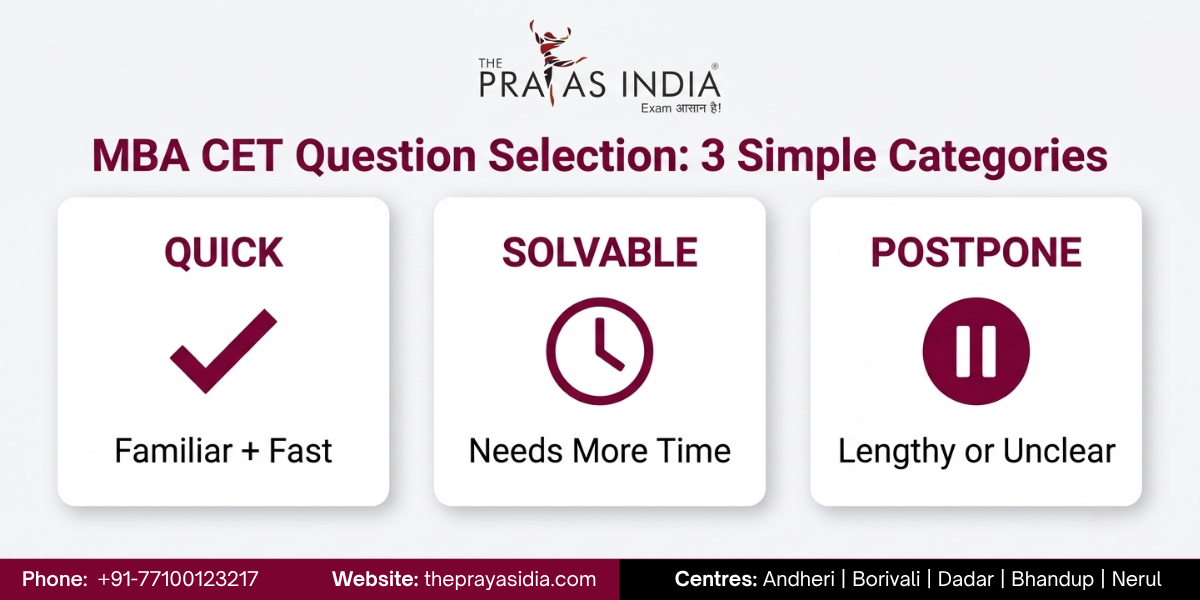
The strongest candidates gradually develop an instinct for identifying three broad categories of questions:
- Immediate attempts: Questions that appear familiar and can be solved quickly.
- Calculated attempts: Questions that require some work but are manageable within a reasonable time.
- Questions to postpone or skip: Questions that appear unusually lengthy, confusing or time-consuming.
This classification does not mean that a candidate should permanently abandon difficult questions. It simply means that the order of attempts should be based on the value of the question rather than on the order in which it appears.
Why Question Selection Matters in MBA CET
The importance of question selection becomes clearer when you consider the nature of MBA CET. The examination requires candidates to work through multiple sections involving different types of reasoning and problem-solving. Your performance is therefore influenced not only by conceptual knowledge but also by how efficiently you move through the paper.
A candidate with strong preparation can still underperform if they spend too much time on questions that do not justify the time investment. Conversely, a candidate with comparable preparation can produce a stronger performance by quickly identifying familiar questions, securing easier marks and returning to more demanding problems later.
Question selection also helps reduce mental fatigue. When you repeatedly struggle with difficult questions, your concentration can deteriorate. This may affect the accuracy of subsequent questions, including those that you would normally solve comfortably.
A good selection strategy therefore serves three purposes: it helps you protect your time, improve your accuracy and maintain control over the paper.
The objective should not be to avoid difficult questions altogether. Instead, it should be to avoid allowing one difficult question to disrupt the entire examination strategy.
The First Rule: Do Not Treat Every Question Equally
One of the biggest mistakes candidates make during competitive exams is assuming that every question deserves the same amount of attention. In practice, questions have different levels of difficulty, different solving times and different levels of familiarity for individual candidates.
Suppose you are highly comfortable with basic arithmetic-based Quantitative Aptitude questions but slower with advanced calculation-intensive problems. If you encounter both types during the exam, treating them equally would be inefficient. The easier question should probably receive priority because it gives you an opportunity to secure marks with less time investment.
The same principle applies to Logical Reasoning. Some questions may immediately reveal their structure to you, while others may require extensive interpretation. If you can identify the easier question first, you can build momentum before returning to the more demanding problem.
This is why MBA CET question selection strategy should be personalised. There is no universal sequence that every aspirant must follow. Your ideal attempt order should emerge from your own mock-test performance, strengths, weaknesses and average solving time.
Build Your Own Question Classification System
During preparation, start classifying questions according to the time and mental effort they require. This can be done during sectional practice as well as full-length mock tests.
A simple three-level system is enough.
Level 1: Quick and Familiar
These are questions where you recognise the concept almost immediately. The approach is familiar, the calculations are manageable and you have a high degree of confidence in reaching the correct answer.
These questions should generally receive early attention because they allow you to accumulate marks efficiently.
Level 2: Solvable but Time-Consuming
These questions are within your ability, but they require more calculation, multiple logical steps or careful interpretation. They are not necessarily bad questions to attempt, but they should be approached after you have secured the more straightforward opportunities.
The key is to know your personal time threshold. If a question regularly takes you too long during practice, you need to decide whether it deserves that investment in the actual examination.
Level 3: Uncertain or High-Cost
These are questions where you either do not immediately understand the approach or anticipate that solving them will consume disproportionate time. They may involve complicated calculations, lengthy arrangements or concepts you are not fully comfortable with.
Such questions should not automatically be attempted simply because you encounter them early. Mark them mentally as questions to revisit if time permits.
The 30-Second Decision Rule
One of the most useful habits you can develop during MBA CET preparation is learning to make an early decision about a question. You do not necessarily need to solve the question within 30 seconds, but you should often be able to determine whether the question deserves your immediate attention.
When you first read a question, quickly ask yourself:
Do I understand what is being asked?
If the question itself is unclear, investing additional time may not be productive.
Next ask:
Do I know the concept or method required?
If the approach is familiar, the question may be worth attempting immediately. If you are trying to remember an unfamiliar formula or constructing an approach from scratch, it may be better to move ahead.
Finally ask:
Can I reasonably solve this within my normal time limit?
This last question is especially important. Sometimes candidates know exactly how to solve a problem but fail to recognise that the calculation is too lengthy relative to the potential benefit.
The purpose of this rule is not to impose a rigid 30-second limit on every question. It is to develop the habit of making a quick strategic decision before becoming deeply invested in a problem.
Do Not Confuse Difficulty With Time Consumption
A difficult-looking question is not always a bad question, and an easy-looking question is not always a quick question.
This is an important distinction for MBA CET aspirants. Some questions may appear complicated but become straightforward once you identify the correct method. Others may look simple but involve lengthy calculations or multiple conditions.
Therefore, your question selection strategy should not rely only on perceived difficulty. Instead, learn to estimate the time-to-solution.
During mock analysis, record questions where your initial assessment was wrong. For example, you may have assumed that a particular question would take one minute but eventually spent three minutes on it. That is valuable information. Similarly, you may discover that certain questions look intimidating but are actually among your fastest attempts.
Over several mocks, these observations help you develop a more accurate sense of your own question-selection ability.
Start With Your Strengths, Not Someone Else’s Strategy
There is no mandatory rule that says every MBA CET aspirant should begin with the same section. Some candidates are faster in Logical Reasoning, while others are more comfortable with Verbal Ability or Quantitative Aptitude.
Your attempt sequence should therefore be based on evidence from your own preparation.
If Logical Reasoning is your strongest area and you consistently achieve high accuracy there, beginning with it may help you secure marks and establish confidence. If you are considerably faster in Verbal Ability, starting there may be more efficient.
The important point is to avoid blindly copying the strategy of a topper, friend or coaching peer. Their strengths, reading speed, calculation speed and decision-making patterns may be completely different from yours.
A strategy is useful only when it works for your own performance profile.
Use Mock Tests to Discover Your Ideal Attempt Order
Mock tests are among the most effective tools for developing MBA CET question selection strategy because they replicate the pressure of making decisions while the clock is running.
However, simply taking mocks is not enough. You need to study how you attempted them.
After every mock, look beyond the final score and analyse your attempt pattern.
Ask yourself:
- Which questions did I attempt first?
- Which section consumed the most time?
- Which questions took much longer than expected?
- Which questions did I skip but could have solved?
- Which questions did I attempt despite low confidence?
- Where did I lose time unnecessarily?
- Which section gave me the highest return for the time invested?
- Did my attempt order help or hurt my overall performance?
These questions transform a mock test from a simple score-generating exercise into a strategic training tool.
Track Attempts, Accuracy and Time Together
Many aspirants record only their mock-test score. While the score is important, it does not explain why the score happened.
A better system is to track three connected indicators:
Attempts + Accuracy + Time
Suppose you attempt 150 questions with 85% accuracy. That tells you something about your performance, but it does not tell you whether you spent too much time on particular questions.
Now suppose another mock shows 140 attempts with 92% accuracy and better time management. Even though the number of attempts is lower, the second performance may reveal a more sustainable strategy.
Similarly, if your attempts are very high but your accuracy is falling, increasing attempts further may not be the solution. You may need to improve question selection and reduce low-confidence attempts.
This is why the goal should not simply be “attempt more questions.”
The better objective is:
Attempt more of the right questions.
The Difference Between Maximum Attempts and Maximum Useful Attempts
The phrase “maximise your attempts” can sometimes be misunderstood. It does not mean attempting questions indiscriminately.
Maximum useful attempts means identifying the largest number of questions you can attempt while maintaining an acceptable level of accuracy and time efficiency.
For example, suppose you have two possible strategies. In the first, you rush through questions to increase the attempt count but make frequent mistakes. In the second, you identify high-confidence questions, maintain better accuracy and use the remaining time to revisit selected questions.
The second approach may produce a stronger overall result even if the raw attempt count initially appears lower.
Your preparation should therefore focus on quality-adjusted attempts rather than attempts alone.
This mindset is particularly important when you are preparing for competitive MBA admissions. A high percentile is not built simply by pressing through as many questions as possible. It comes from combining knowledge, speed, accuracy and intelligent decision-making.
Learn When to Leave a Question
Leaving a question temporarily is not a sign of weakness. In a time-bound entrance examination, it is often a sign of good strategy.
The difficulty is psychological. Once you have invested 40 or 50 seconds in a question, you may feel that leaving it means wasting the time already spent. This creates a common trap: candidates continue working on a question simply because they have already invested time in it.
This is essentially a sunk-cost problem.
Your previous time investment cannot be recovered. The only useful question is whether spending additional time is still worthwhile.
If the answer is no, move forward.
A strong candidate is not the person who never leaves a question. A strong candidate is someone who knows when continuing is no longer efficient.
Develop a Personal Skip Threshold
Your skip threshold should be developed during mock tests rather than invented on exam day.
For example, you may discover through practice that certain Quantitative Aptitude problems become inefficient for you if the correct approach is not visible within a particular period. You may also find that some Logical Reasoning sets require too much initial reading before you can determine whether they are worth attempting.
Record these patterns.
Over time, you can create personal rules such as:
- If the approach is unclear after the initial reading, move ahead.
- If calculations become disproportionately long, postpone the question.
- If two answer choices can be eliminated quickly, reconsider the question.
- If a question requires a method you have not practised adequately, do not let it consume valuable time.
These are not rigid laws. They are decision-making guidelines that become increasingly refined as your mock-test experience grows.
Question Selection Begins Before the Exam
Effective question selection does not suddenly begin when you enter the examination hall. It develops gradually during preparation.
Every practice session gives you an opportunity to learn something about your solving behaviour. You can identify the question types you solve quickly, the concepts that slow you down, the calculations that create errors and the situations in which you become unnecessarily attached to a problem.
This makes daily practice more valuable when it is combined with reflection.
Instead of simply asking, “How many questions did I solve today?”, occasionally ask:
“Which questions did I solve efficiently, and which questions consumed too much time?”
That change in thinking can significantly improve the quality of your preparation.
Build Question Selection Into Your Daily Practice
Aspirants often separate preparation into “concept learning” and “mock-test strategy.” In reality, question selection can be trained during everyday practice.
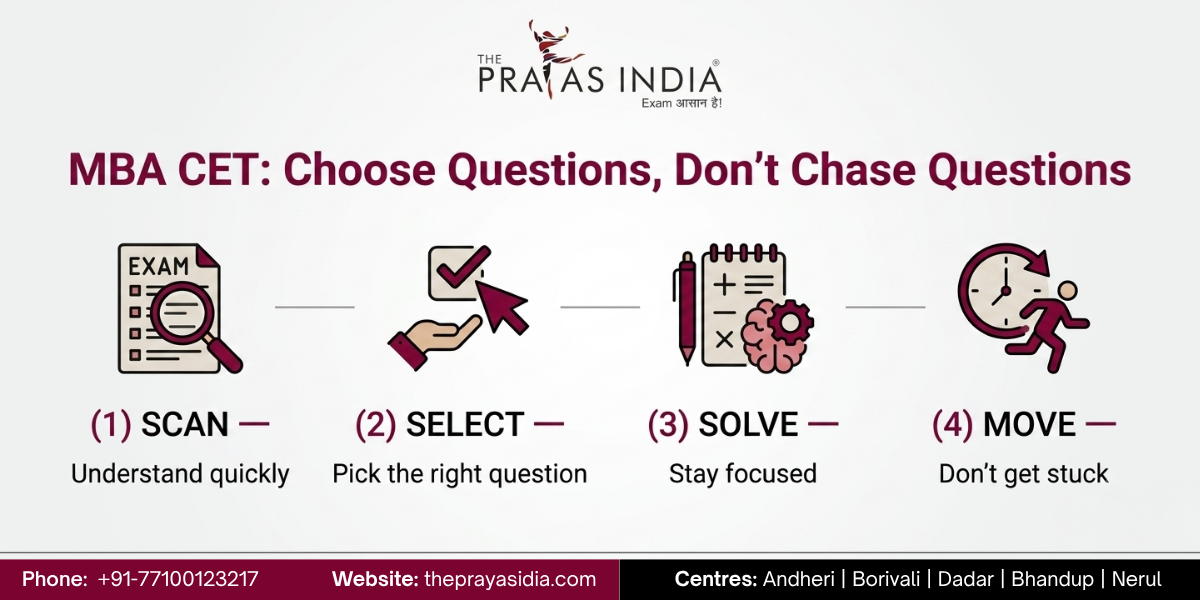
When solving a practice set, do not immediately start working on every question. First scan the set and classify the questions mentally.
Identify the questions that look familiar. Then identify the questions that require more thought. Finally, mark the questions where you are uncertain about the approach.
After completing the set, compare your initial classification with your actual experience.
Were the questions you marked as easy actually quick? Did any supposedly difficult question turn out to be straightforward? Did you spend too much time on a question that should have been postponed?
This process gradually builds what can be called exam judgment—the ability to make a quick and reasonably accurate decision about where your time should go.
Avoid the “I Must Solve Everything” Mindset
One of the biggest barriers to effective question selection is the belief that leaving questions means failing to use your preparation.
It is natural to want to solve questions you know how to solve. But the examination environment is different from a classroom or practice sheet. In practice, your objective may be to understand every problem. In the actual exam, your objective is to maximise your performance within the available time.
That means you need to become comfortable with moving away from questions temporarily.
A question can be important without being important right now.
This distinction allows you to stay flexible throughout the examination. You can return to postponed questions when you have secured the more efficient attempts.
How The Prayas India Can Help You Build Better Question Selection Skills
A well-designed MBA CET preparation programme should go beyond teaching formulas, shortcuts and question types. It should help students understand how to apply those concepts under actual examination conditions.
At The Prayas India, MBA CET preparation can be approached as a combination of conceptual learning, targeted practice, mock tests and performance analysis. This kind of structured preparation can help aspirants identify their strengths and weaknesses while developing a more disciplined approach to time management and question selection.
The value of coaching is particularly relevant for students who know the concepts but struggle to convert preparation into consistent mock-test performance. With regular practice and expert feedback, students can identify recurring patterns in their attempts and gradually refine their strategy.
For an aspirant targeting a competitive MBA admission, this can make preparation more systematic. Instead of repeatedly taking tests without understanding the reasons behind the score, you can use each mock as an opportunity to improve a specific part of your examination approach.
The aim is not to create a fixed strategy that you follow mechanically. It is to develop the judgement required to adapt your strategy to the paper in front of you.
Section-Wise Question Selection Strategy for MBA CET
Once you understand the basic principle of question selection, the next step is to apply it differently across sections. Logical Reasoning, Abstract Reasoning, Quantitative Aptitude and Verbal Ability/Reading Comprehension do not demand the same kind of time investment. A question that is worth attempting immediately in Abstract Reasoning may require a completely different decision in Quantitative Aptitude.
The current MAH MBA CET structure comprises 200 questions across four areas, with Logical Reasoning carrying 75 questions, Abstract Reasoning 25, Quantitative Aptitude 50 and Verbal Ability/Reading Comprehension 50. The examination duration is 150 minutes and there is no negative marking.
This structure makes intelligent movement across questions particularly important. Since candidates are not required to spend a fixed amount of time on each section, your question selection strategy should focus on identifying the highest-value opportunities throughout the paper.
Logical Reasoning: Be Careful With Time-Heavy Sets
Logical Reasoning carries the largest number of questions, which means it can have a significant influence on your overall performance. At the same time, this section can contain questions that vary considerably in the amount of time they require.
Individual reasoning questions may be relatively quick, while arrangements, puzzles or multi-condition problems can require considerably more reading and processing. The biggest mistake is to start solving a lengthy set without first determining whether it is worth the time investment.
When you encounter a reasoning set, first understand its structure. Look at the number of conditions, variables and relationships involved. If the information appears manageable and the questions can be answered using the same framework, the set may offer several useful attempts. If the setup is unusually complicated and you are struggling to establish the basic arrangement, consider postponing it.
This is particularly important because a single lengthy puzzle can consume several minutes. During that time, you could potentially have attempted multiple standalone reasoning questions.
Prioritise Standalone Questions When Appropriate
Standalone Logical Reasoning questions can often provide opportunities for quick attempts. Questions involving familiar concepts, straightforward deductions or easily identifiable relationships should generally be considered before highly complicated sets.
This does not mean avoiding puzzles. Instead, it means recognising when a puzzle offers a good return on time.
A useful approach is to scan the section and distinguish between:
Quick individual questions → manageable sets → lengthy or uncertain sets
Once the quick opportunities are secured, you can return to the more demanding questions with greater control.
Abstract Reasoning: Use Pattern Recognition to Your Advantage
Abstract Reasoning can reward candidates who develop strong visual pattern-recognition skills. The section includes figure-based questions and related reasoning tasks, making immediate recognition particularly valuable. The official syllabus describes Logical/Abstract Reasoning as testing how quickly and accurately candidates can think, including questions based on figures, diagrams and verbal reasoning.
The key selection skill here is recognising when a pattern is visible and when it is not.
If you immediately notice a relationship involving rotation, movement, addition or deletion of elements, the question may be an efficient attempt. But if you have examined the figures several times without identifying a meaningful pattern, continuing to stare at the same question can become counterproductive.
Abstract Reasoning therefore rewards decisiveness. Give yourself enough time to identify the underlying pattern, but do not become emotionally attached to a question simply because it looks like something you should be able to solve.
A quick decision to move ahead can protect your time for questions where the pattern is more apparent.
Quantitative Aptitude: Estimate Calculation Before You Commit
Quantitative Aptitude is where time management can become particularly important. A question may appear conceptually easy but involve calculations that take much longer than expected. Conversely, some questions that initially look difficult may have a short and efficient solution once the correct method is identified.
This is why your first task should not always be calculation. First identify the underlying concept.
If the method is immediately clear and the numbers are manageable, the question may be a good early attempt. If the calculation appears lengthy, involves multiple steps or requires repeated approximation, consider moving ahead unless you are particularly confident with that question type.
Candidates preparing for MBA CET should practise estimating calculation time. With regular timed practice, you begin to recognise whether a problem is likely to take 20 seconds, one minute or several minutes.
That instinct can become extremely valuable during the actual examination.
Verbal Ability and Reading Comprehension: Protect Your Reading Time
Verbal Ability and Reading Comprehension require a different form of question selection. Some questions can be answered almost immediately because the relevant grammar, vocabulary or sentence structure is familiar. Others may require more careful reading.
Reading Comprehension deserves special attention because the time investment is not limited to answering an individual question. You first have to read and understand the passage before answering its associated questions.
Therefore, when approaching an RC passage, consider both the length of the passage and the potential number of questions attached to it.
A passage that is reasonably short and has several approachable questions may offer good value. A long or complex passage with questions that appear highly inferential may require a more careful decision.
The objective is not to avoid RC. It is to avoid spending disproportionate time on a passage when better opportunities are available elsewhere.
Use a Flexible Section Order
There is no single “perfect” order for attempting MBA CET. Your ideal order should depend on your strengths, speed and mock-test evidence.
Some candidates may perform best when they begin with Verbal Ability because they can secure quick attempts and build momentum. Others may prefer Logical Reasoning because it is their strongest area. Some may find Abstract Reasoning to be an efficient section to attack early.
The important point is that your section order should be tested before the examination.
Try different combinations in your mock tests. For example:
- Logical Reasoning → Abstract Reasoning → Verbal Ability → Quantitative Aptitude
- Verbal Ability → Logical Reasoning → Abstract Reasoning → Quantitative Aptitude
- Abstract Reasoning → Logical Reasoning → Verbal Ability → Quantitative Aptitude
- Your own customised sequence based on performance
After each mock, compare not just your score but also your concentration, attempts, accuracy and time usage.
The sequence that consistently gives you better overall performance should become your preferred strategy.
Do Not Force a Fixed Time Allocation
A common preparation mistake is deciding in advance that exactly a certain number of minutes must be spent on each section and following that plan regardless of the paper.
A rough time framework can be useful, but rigid allocation can become a problem.
Suppose you have allocated 35 minutes to Quantitative Aptitude but encounter an unusually calculation-heavy set of questions. If you continue simply because the clock says you still have time allocated to that section, you may miss easier opportunities elsewhere.
The absence of a sectional time limit makes flexibility an important part of the strategy.
Think of your time as a common pool rather than four isolated compartments.
Your goal is to distribute that time where it generates the strongest overall return.
Speed Is Valuable Only When Accuracy Survives
The pressure to increase attempts can sometimes push aspirants into rushing. This is where question selection and accuracy become closely connected.
If you increase your speed but your accuracy falls sharply, the additional attempts may not translate into better performance. On the other hand, if you maintain very high accuracy but spend too much time on each question, you may leave too many opportunities unexplored.
The objective is to find your personal speed-accuracy balance.
This balance will not necessarily remain constant throughout preparation. As your concepts become stronger and your familiarity with question types improves, your solving speed should gradually increase.
The key is to improve speed through practice rather than through panic.
Use the “Return Later” Strategy
One of the simplest ways to improve question selection is to divide your attempts into rounds.
In the first round, focus on questions that are immediately approachable. Do not spend excessive time proving to yourself that you can solve a difficult problem.
In the second round, return to questions that require moderate effort but are still within your capabilities.
In the third round, use the remaining time for questions that you had deliberately postponed or for checking selected answers.
This approach prevents difficult questions from controlling the early stages of your paper.
It also gives you psychological control. Instead of thinking, “I have left this question,” you are thinking, “I have postponed this question.”
That small change in mindset can make a significant difference under pressure.
Learn From Questions You Skipped
Mock-test analysis should not focus only on incorrect attempts. Questions that you skipped are equally important.
After a mock, look at the questions you did not attempt and divide them into three categories.
Category 1: Correctly skipped
These were genuinely time-consuming, unfamiliar or low-confidence questions. Skipping them was a good decision.
Category 2: Missed opportunities
These were questions you could have solved quickly but failed to notice or reach. These indicate a scanning or time-management problem.
Category 3: Strategy mistakes
These were questions where you spent too much time elsewhere and therefore never got the opportunity to attempt them.
This analysis can reveal more about your question-selection ability than your overall score.
Create a Mock-Test Question Selection Sheet
To improve systematically, maintain a simple record after every full-length mock.
You do not need an elaborate spreadsheet. A basic table can include:
| Parameter | What to Record |
|---|---|
| Total Attempts | Number of questions attempted |
| Correct Attempts | Questions answered correctly |
| Accuracy | Correct answers ÷ attempts |
| Time-Heavy Questions | Questions that consumed excessive time |
| Missed Easy Questions | Easy questions left due to time |
| Wrong Selection | Questions you should have postponed |
| Best Section | Highest-efficiency section |
| Weakest Section | Section needing strategic improvement |
The purpose of this exercise is to identify patterns rather than judge yourself after every test.
If the same mistake appears across several mocks, it has become a strategic issue that deserves targeted practice.
Recognise the Difference Between Knowledge Gaps and Selection Errors
Suppose you attempted a Quantitative Aptitude question incorrectly because you did not know the relevant concept. That is a knowledge gap.
Suppose you knew the concept perfectly but spent too much time solving the question and eventually made a calculation mistake. That is a time-management or execution issue.
Now suppose you knew how to solve the question, but never reached it because you spent too long on three earlier problems. That is a question-selection issue.
These problems require different solutions.
You cannot fix a selection problem simply by studying more formulas. Similarly, taking more mocks will not automatically solve a conceptual weakness unless you identify it correctly.
Strong preparation begins with knowing what kind of problem you are actually trying to solve.
Common MBA CET Question Selection Mistakes
Trying to Solve Questions in Order
The question paper is not a to-do list that must be completed sequentially. If Question 1 is difficult and Question 2 is easy, there is no strategic advantage in allowing Question 1 to consume your time simply because it appears first.
Spending Too Long on Familiar Questions
Knowing the concept does not automatically mean the question deserves unlimited time. If a familiar question becomes unexpectedly lengthy, reassess whether it is still worth pursuing.
Chasing Difficult Questions
Some candidates become determined to solve a question precisely because it looks difficult. This can turn one problem into a time-management disaster.
Changing Strategy Midway Without Evidence
Trying a new strategy during the actual examination is risky. Experiment with section order, attempt sequence and time-management methods during mocks instead.
Looking Only at the Final Score
Your score tells you the outcome. Your analysis tells you the reason.
Without understanding the reason, improvement becomes difficult.
How to Maximise Attempts Without Sacrificing Accuracy
The most effective way to increase attempts is not to force yourself to work faster from the beginning. Instead, reduce the amount of time you waste.
There are several ways to do this.
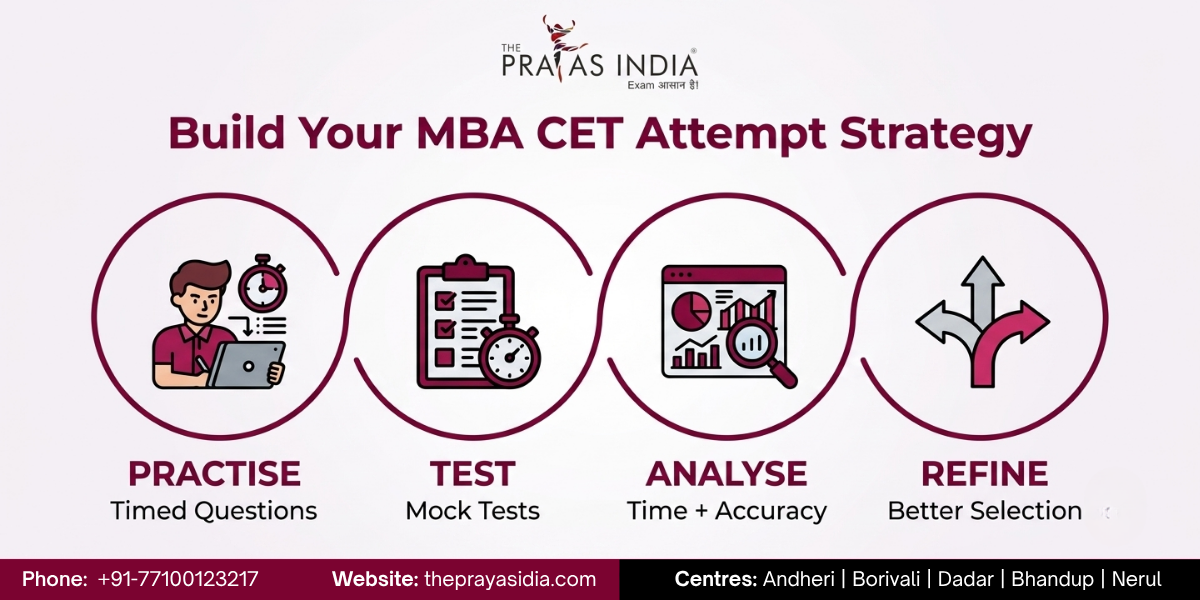
First, strengthen your fundamentals so that familiar question types become automatic. Second, practise timed sets so that you become comfortable making decisions under pressure. Third, analyse your mocks to identify recurring time traps. Finally, develop clear rules for when to continue and when to move ahead.
As these habits improve, you should naturally begin attempting more questions within the same amount of time.
The improvement should feel less like “I am rushing faster” and more like “I am wasting less time.”
That is the foundation of a strong MBA CET attempt strategy.
Your Final Attempt Strategy Should Come From Data
By the time you enter the final phase of preparation, you should have enough mock-test data to answer several important questions.
Which section gives you the highest accuracy?
Which section do you solve fastest?
Which question types consume the most time?
How often do you incorrectly judge a question as easy?
How many easy questions do you miss because of poor time management?
Which section should you start with?
How many questions can you comfortably attempt in the first phase of the paper?
The answers should come from repeated practice rather than assumptions.
A candidate who has taken multiple mocks and carefully analysed them enters the examination with a tested strategy. A candidate who has only focused on syllabus completion may know more concepts but still struggle to decide where to spend time.
This is one of the reasons structured MBA CET preparation can be valuable. A disciplined programme can create regular opportunities for practice, testing and performance review instead of leaving strategy development until the final weeks.
The Last Stage of Preparation: Refine, Don’t Reinvent
As the examination approaches, your focus should gradually shift from discovering new strategies to refining the one that already works.
Avoid changing your section order every few days simply because another candidate recommends a different approach. Do not suddenly start using unfamiliar shortcuts. Do not radically increase your attempts without understanding what is happening to your accuracy.
The final phase should be about stability.
Take full-length mocks under realistic conditions. Analyse your selection decisions. Identify your recurring time traps. Practise the question types that you repeatedly misjudge. Continue revising important concepts while strengthening your ability to make fast decisions.
The closer you get to the examination, the more valuable consistency becomes.
How The Prayas India Can Support Your MBA CET Preparation
Question selection is a skill that develops through repeated exposure to questions, timed practice and detailed analysis. This is where a structured preparation environment can make a difference.
At The Prayas India, MBA CET aspirants can approach preparation through a combination of conceptual classes, practice sessions, mock tests and performance analysis. The objective is not merely to complete the syllabus but to help students understand how to apply their preparation efficiently in a time-bound examination.
For students preparing for competitive MBA admissions, this strategic component can be particularly important. Knowing the concepts is one part of the preparation journey. Knowing when to use them, how quickly to use them and when to move on is another.
A focused coaching programme can help students identify their individual strengths and weaknesses and build an attempt strategy around their actual performance rather than generic advice.
The final goal is to enter the examination with a clear understanding of your own approach: where to begin, what to prioritise, when to move ahead and how to use the remaining time.
Final Takeaway
MBA CET question selection strategy is ultimately about making better decisions with limited time. You do not need to prove that you can solve every difficult question. You need to recognise the questions that can contribute most effectively to your overall performance.
The strongest approach is built around a few simple principles: scan before committing, prioritise familiar questions, estimate time before investing it, postpone questions that become inefficient, protect accuracy while increasing speed and use mock-test analysis to refine your decisions.
Most importantly, remember that maximising attempts does not mean attempting everything. It means maximising the number of useful attempts you can make while maintaining control over time and accuracy.
With consistent practice, you can turn question selection from an unconscious reaction into a deliberate examination skill. By the time you reach the MBA CET, the objective should be simple: recognise the opportunity, make the decision quickly, solve efficiently and move forward.
That is how preparation gets converted into performance.
Contact Us
- Call Now: +91-77100 13217
- Website: theprayasindia.com
- Centres: Andheri | Borivali | Dadar | Nerul | Bhandup
Frequently Asked Questions About MBA CET Question Selection Strategy
How can I improve my question selection strategy for MBA CET?
Start by analysing your mock tests rather than focusing only on your scores. Identify questions that were quick, questions that consumed excessive time and questions you skipped unnecessarily. Over several mocks, use this information to create personal rules for prioritising, postponing and attempting questions.
Should I attempt easy questions first in MBA CET?
Generally, yes. Quick and familiar questions can help you secure marks efficiently and prevent difficult problems from consuming your early examination time. However, your exact attempt order should be based on your own mock-test performance.
Should I skip difficult questions in MBA CET?
You do not need to permanently skip every difficult question. If a question appears time-consuming or unclear, postpone it and return later if time permits. The important skill is knowing when continuing with a question is no longer efficient.
How can mock tests improve MBA CET question selection?
Mock tests allow you to practise decision-making under time pressure. Their greatest value comes from analysing your attempts afterward. Track where you spent too much time, which easy questions you missed and which questions you should have postponed.
Is attempting more questions always better in MBA CET?
Not necessarily. Since the objective is to maximise useful attempts, simply increasing the attempt count without maintaining accuracy can be counterproductive. Focus on improving the number of questions you can answer correctly within the available time.
When should I finalise my MBA CET attempt strategy?
Your strategy should be tested and refined throughout preparation, but it should be reasonably stable before the final examination phase. Use your mock-test data to decide your preferred section order, question-selection approach and time-management system.