Netaji Subhash Chandra Bose: Militant Nationalism, INA, and the Revolutionary Path to Indian Independence
- GS Paper 1: Modern Indian History (Freedom Struggle, Revolutionary Nationalism)
- GS Paper 2: International Relations (World War II context, Foreign Alliances – limited)
- GS Paper 4: Ethics – Leadership, Courage, Patriotism, Moral Conviction
- Prelims: INC sessions, INA, slogans, organizations, events
- Optional (History / PSIR): National Movement, Revolutionary Ideologies, WWII & India
Introduction
Subhash Chandra Bose occupies a unique and formidable position in the history of India’s freedom struggle. A charismatic leader, revolutionary nationalist, and uncompromising advocate of complete independence, Bose represented a radical departure from constitutional and non-violent methods that dominated the Indian National Movement under Mahatma Gandhi. His call for Purna Swaraj was not merely rhetorical but rooted in a belief that freedom could be achieved only through organised struggle, discipline, and, if necessary, armed resistance.
Netaji’s political thought and action placed him at the forefront of militant nationalism. While deeply respectful of Gandhian leadership, Bose increasingly differed on strategy, timing, and methods. He believed that the international crisis created by the Second World War provided India with a historic opportunity to strike at British imperialism. Through the Indian National Army (INA) and the Provisional Government of Free India, Bose sought to internationalise the Indian freedom struggle and transform it from a moral resistance into a military challenge.
Within the broader freedom struggle, Subhash Chandra Bose stands as a revolutionary figure whose methods complemented the Gandhian mass movement by shaking the foundations of British loyalty within the armed forces and accelerating the process of decolonisation.
Early Life and Political Awakening
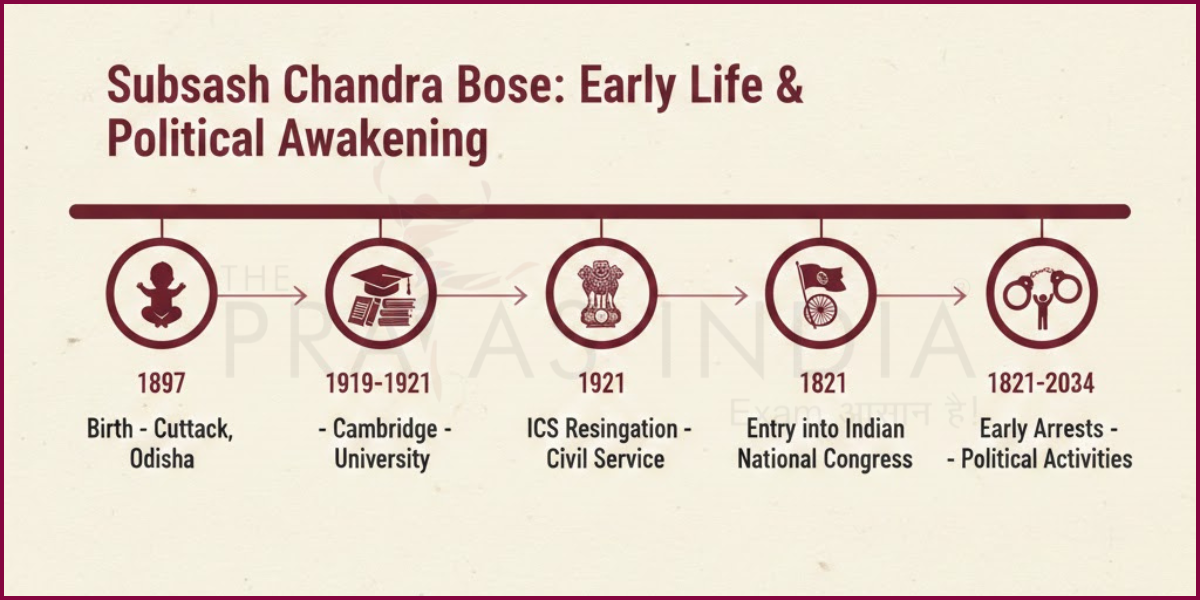
Subhash Chandra Bose was born on 23 January 1897 in Cuttack, Odisha, into a well-educated and nationalist-oriented family. His father, Janakinath Bose, was a prominent lawyer, while his mother, Prabhavati Devi, instilled in him deep moral values and spiritual discipline. Bose was academically brilliant and exposed early to both Indian cultural traditions and Western political thought.
He studied at Presidency College, Calcutta, where his nationalist inclinations became evident. His expulsion following an incident involving a British professor reflected his resistance to colonial arrogance. Bose later pursued higher studies at Cambridge University and successfully cleared the Indian Civil Services examination in 1920, securing a high rank.
However, Bose resigned from the ICS in 1921, declaring that he could not serve a colonial government while his country remained enslaved. This decision marked a decisive break from personal ambition and symbolised his commitment to national service. Upon returning to India, he joined the Indian National Congress and came under the influence of Chittaranjan Das, who shaped his early political training and belief in assertive nationalism.
Ideological Orientation and Political Thought
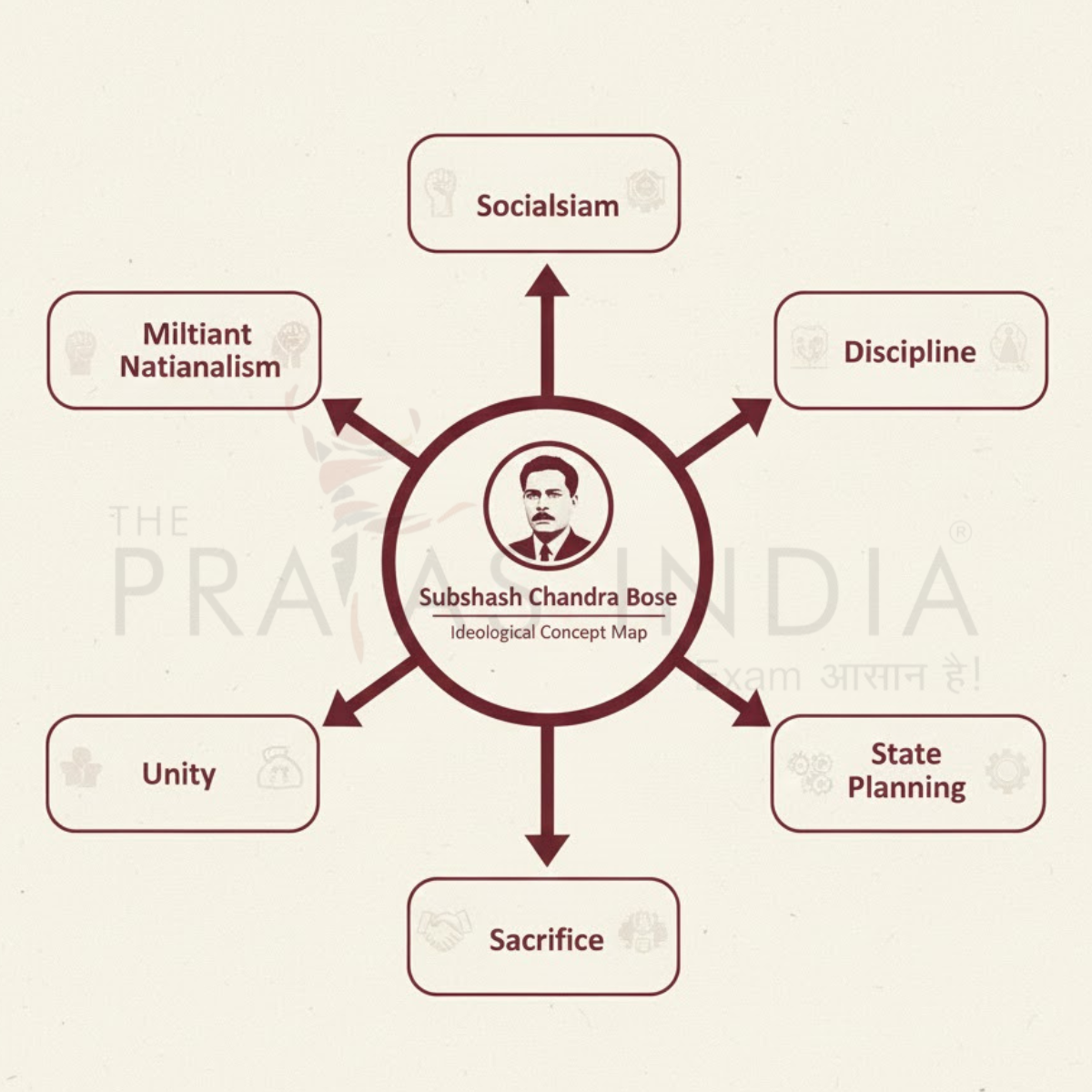
A synthesis of militant nationalism, socialism, and authoritarian discipline shaped Subhash Chandra Bose’s political ideology. Unlike the liberal constitutionalism of early moderates or the moral-spiritual framework of Gandhian politics, Bose emphasised organisation, sacrifice, and revolutionary action.
At the core of his thought was the belief that colonialism could not be dismantled solely through non-violence and negotiations. He argued that freedom struggles across the world—whether in Ireland, Italy, or Germany—had succeeded through decisive and organised resistance. Bose advocated socialism as a framework for post-independence India, supporting state planning, industrialisation, and social justice to eliminate poverty and inequality.
He also emphasised unity across religious, regional, and linguistic lines, asserting that nationalism must transcend communal divisions. Discipline and sacrifice were central to his vision, which was reflected in the military ethos of the INA. For Bose, freedom was not only a political goal but a collective moral duty requiring courage and endurance.
Role in the Indian National Congress
Subhash Chandra Bose rose rapidly within the Indian National Congress due to his organisational abilities and popularity among younger nationalists. He was elected President of the Congress in 1938 at the Haripura session, where he emphasised planning, industrial growth, and a strong centralised state.
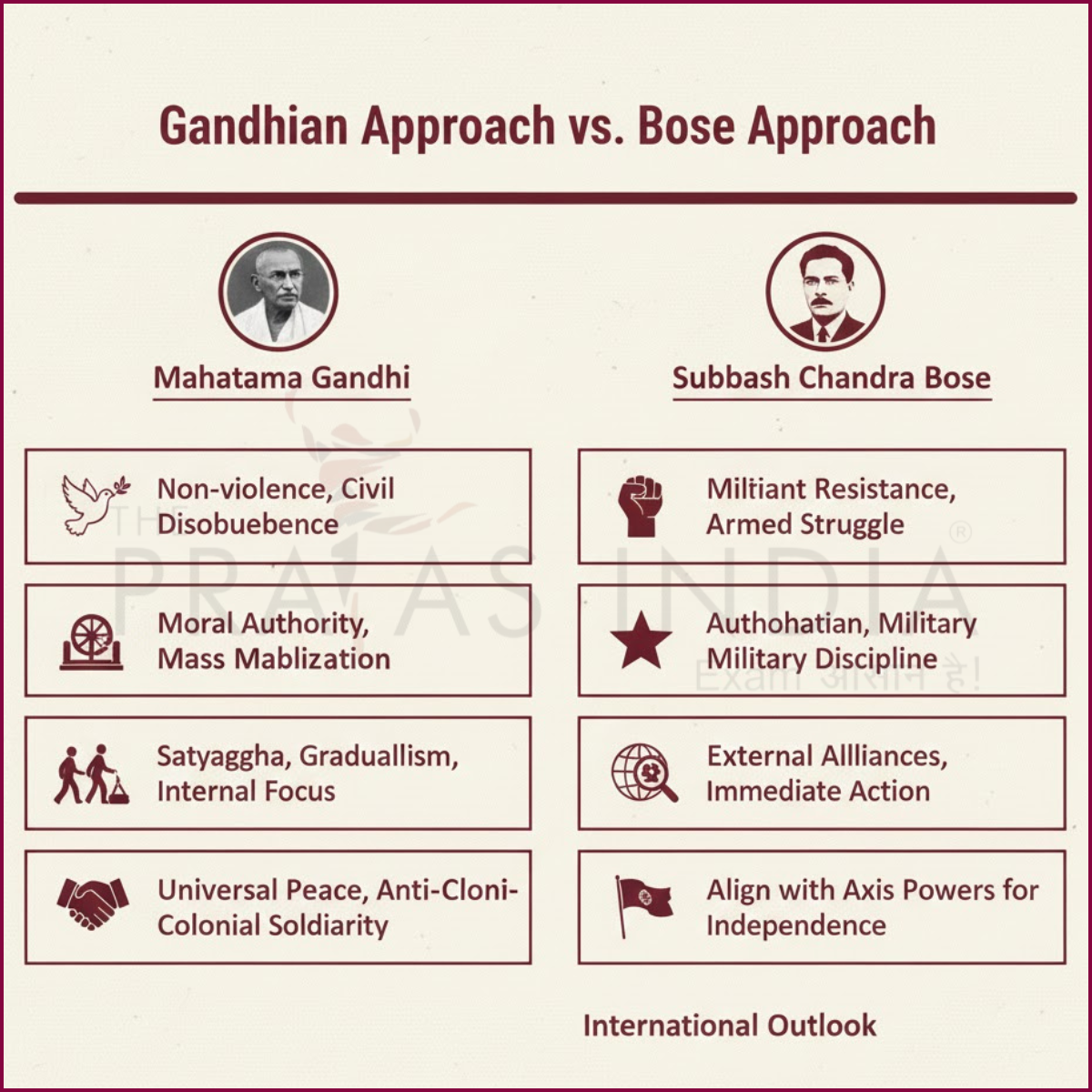
He was re-elected in 1939 at the Tripuri session, defeating a Gandhian-supported candidate. This victory, however, intensified ideological tensions within the Congress. Bose demanded immediate mass struggle against British rule, particularly in the context of an impending global war, while Gandhi and his followers preferred cautious, phased mobilisation.
The conflict culminated in Bose’s resignation from the Congress presidency. Subsequently, he formed the Forward Bloc to consolidate left-wing and radical nationalist forces. The episode highlighted the fundamental strategic divide between Gandhian non-violence and Bose’s militant nationalism, though both shared the ultimate objective of independence.
Escape from India and International Efforts
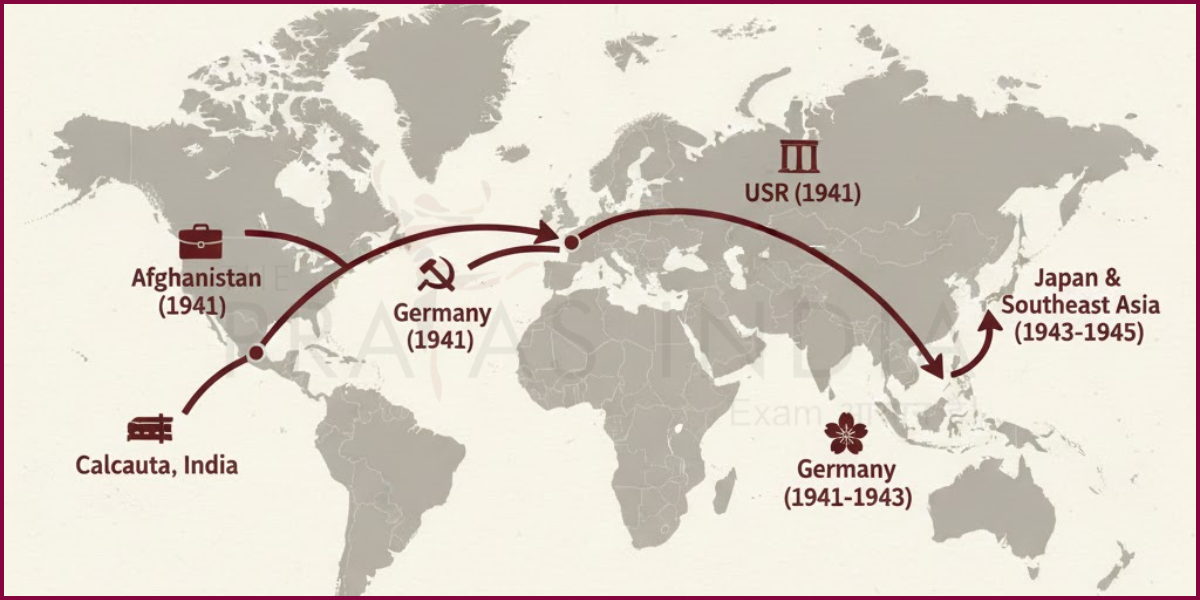
Following his marginalisation within the Congress, Bose was placed under house arrest by the British. In a daring and dramatic episode in January 1941, he escaped disguised as a Pathan and travelled via Afghanistan to the Soviet Union, and later to Germany.
In Germany, Bose established the Free India Centre and organised the Indian Legion composed of Indian prisoners of war. He broadcast anti-British messages through radio, appealing to Indians to rise against colonial rule. However, limited German interest in India and geopolitical constraints led Bose to seek support from Japan.
In 1943, Bose undertook a perilous submarine journey from Germany to Japan-controlled Southeast Asia. His escape and international diplomacy marked a decisive attempt to globalise India’s freedom struggle and exploit the weakening of British power during the war.
Indian National Army (INA) and Azad Hind Government
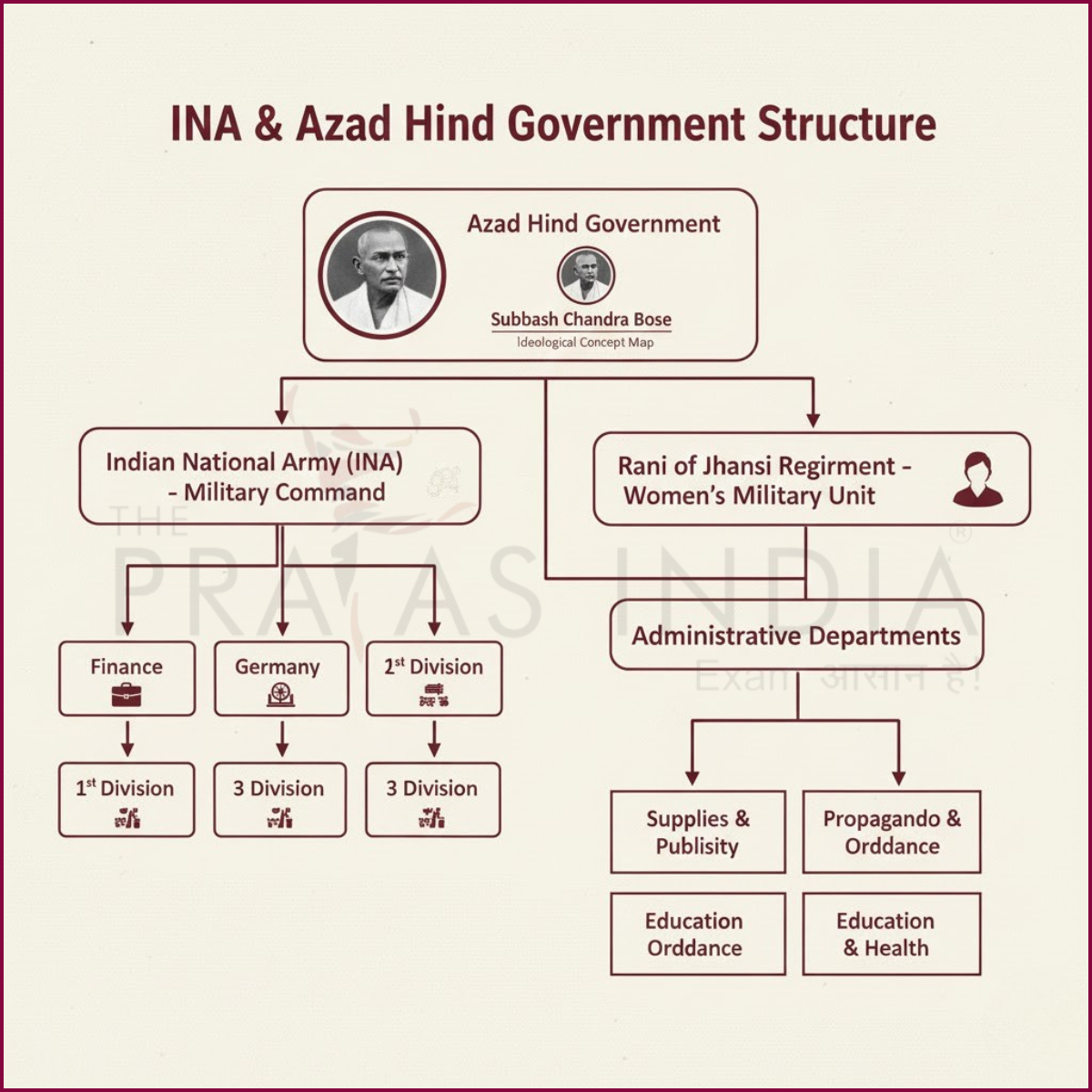
The Indian National Army, initially formed by Mohan Singh, was reorganised and revitalised by Bose upon his arrival in Southeast Asia. Bose transformed the INA into a disciplined fighting force with the explicit aim of liberating India through armed struggle.
In October 1943, Bose proclaimed the Provisional Government of Free India (Azad Hind Government), which was recognised by several Axis powers. This government symbolised India’s claim to sovereignty and issued its own currency, stamps, and civil codes.
A notable feature of the INA was the Rani of Jhansi Regiment, an all-women combat unit, reflecting Bose’s progressive views on gender equality and women’s participation in national liberation. The INA’s ideological appeal lay in its emphasis on unity, sacrifice, and national honour.
Military Campaigns and Impact
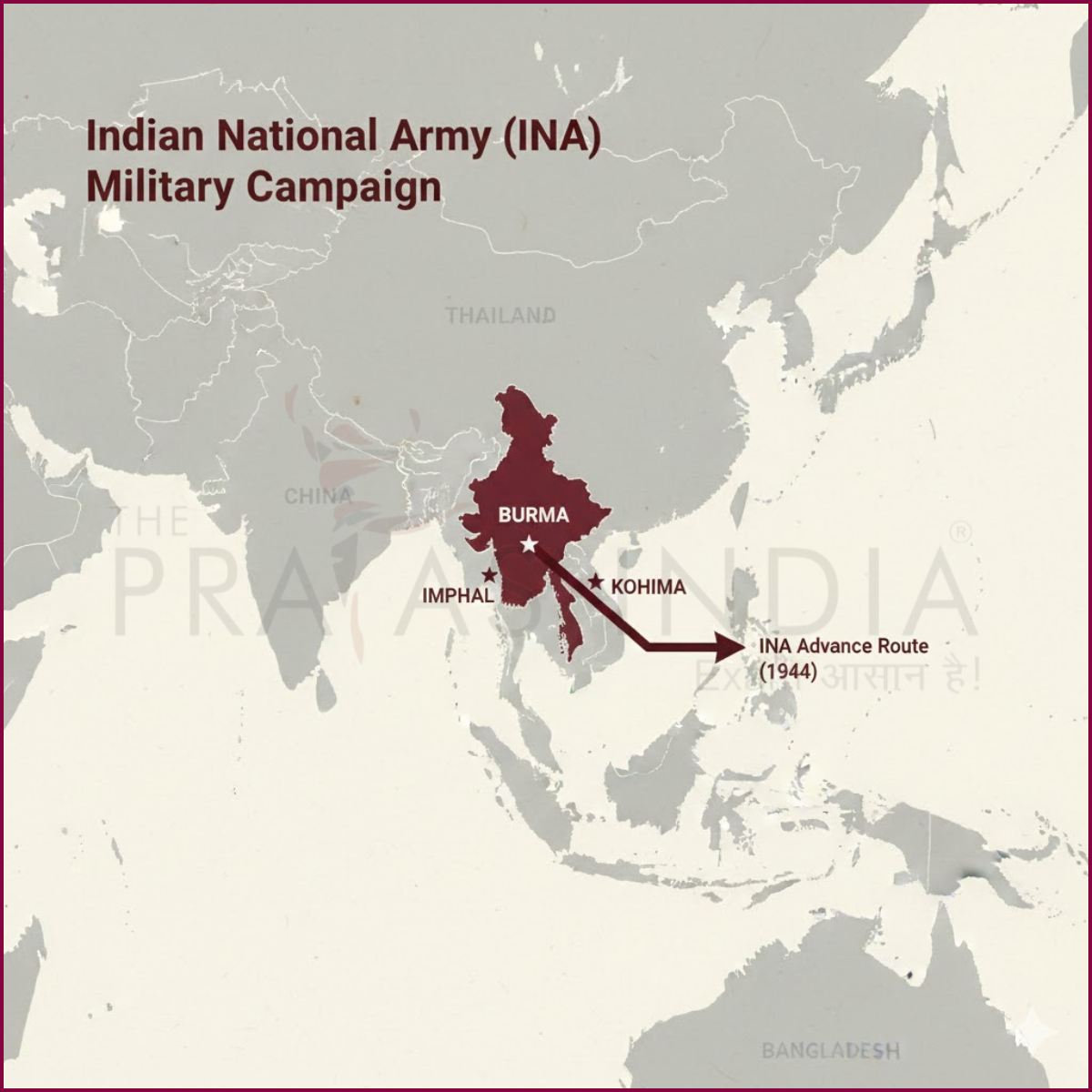
The INA participated in military campaigns alongside Japanese forces in Burma and advanced towards India through the Imphal–Kohima front. Despite initial successes, logistical constraints, difficult terrain, and Allied counter-offensives led to military setbacks.
While the INA did not achieve military victory, its psychological and political impact was profound. The INA trials held by the British after the war sparked nationwide protests, cutting across communal and political lines. These events significantly weakened British authority and loyalty within the Indian armed forces, contributing to the decision to hasten British withdrawal.
Controversies and Debates
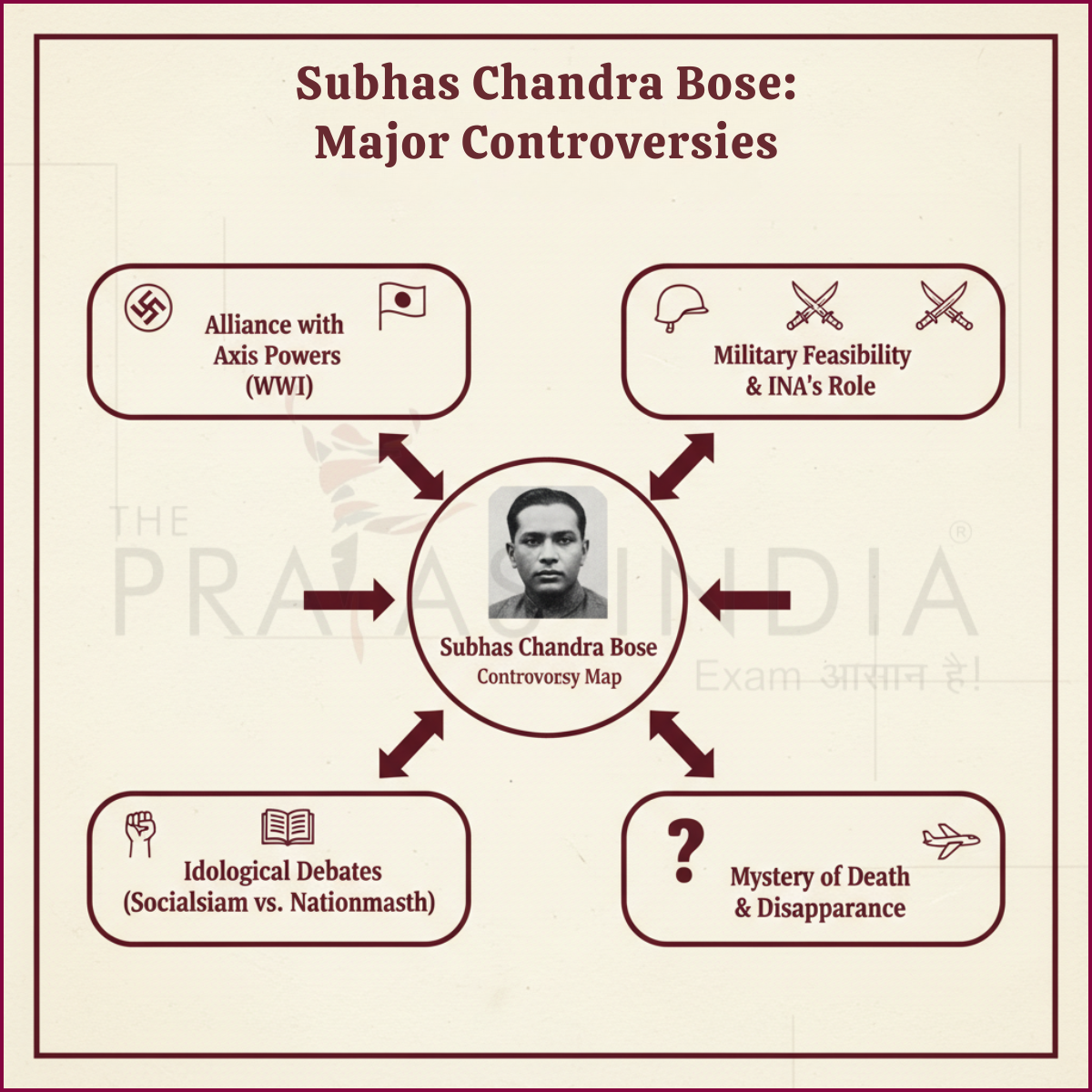
Subhash Chandra Bose’s alliance with Axis powers remains one of the most debated aspects of his legacy. Critics argue that collaboration with fascist regimes compromised moral legitimacy, while supporters contend that Bose acted out of strategic necessity, exploiting global power rivalries to serve India’s interests.
Questions have also been raised about the military feasibility of the INA’s campaign and Bose’s reliance on external support. The mystery surrounding his death—officially reported as a plane crash in Taiwan in 1945—continues to fuel speculation and debate, adding to his enigmatic legacy.
Legacy and Historical Significance
Subhash Chandra Bose left an indelible mark on India’s national consciousness. His emphasis on courage, sacrifice, and unity inspired generations of Indians and reshaped perceptions of colonial power. The INA experience significantly influenced post-independence attitudes within the Indian armed forces and reinforced the idea that British rule was neither invincible nor permanent.
Bose’s contribution lay not merely in armed resistance but in expanding the strategic horizons of the freedom struggle. By internationalising the movement and challenging British loyalty within the military, he complemented mass civil resistance and hastened the end of colonial rule.
Critical Evaluation
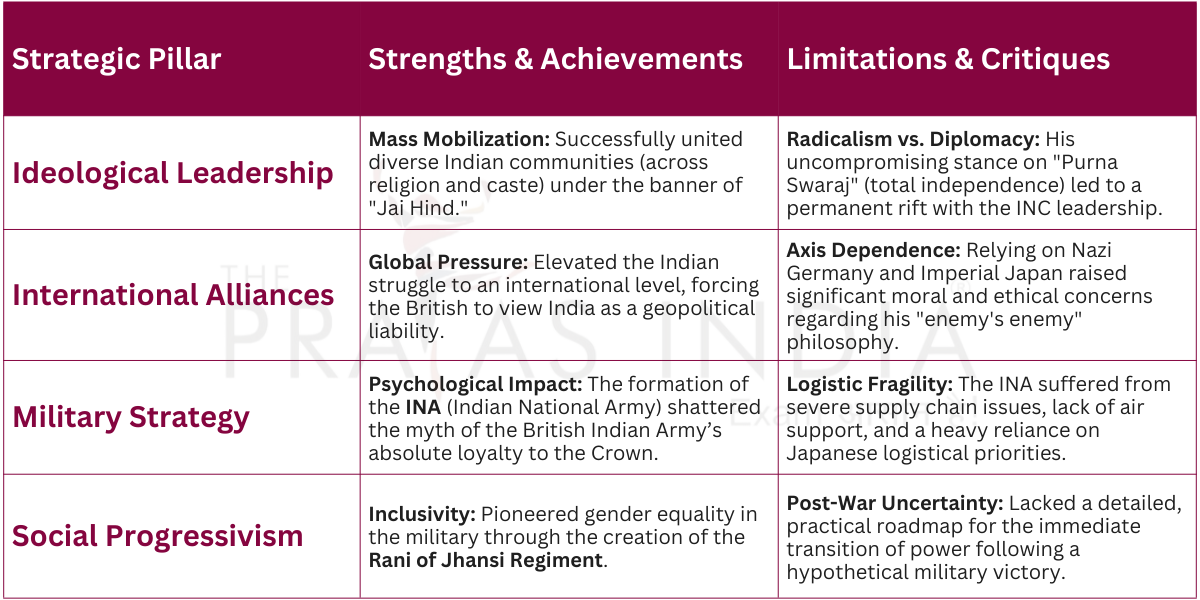
Bose’s leadership was marked by exceptional courage, organisational skill, and ideological clarity. His ability to inspire loyalty and sacrifice remains unparalleled. However, limitations included overdependence on foreign powers, military constraints, and ideological differences with the dominant nationalist leadership.
Historians increasingly view Bose’s role as complementary rather than contradictory to Gandhian methods. Together, these diverse strategies created cumulative pressure on British imperialism, making independence inevitable.
Conclusion
Subhash Chandra Bose stands as a revolutionary nationalist icon whose militant vision broadened the scope of India’s freedom struggle. While Mahatma Gandhi mobilised the masses through moral resistance, Bose challenged colonial rule through discipline, sacrifice, and armed assertion. His legacy lies in demonstrating that freedom could be pursued through multiple, complementary paths.
In the final analysis, Bose’s life and struggle underscore the complexity of India’s road to independence. His enduring relevance lies in his unwavering commitment to national dignity, unity, and sacrifice—values that continue to resonate in modern Indian history.
Frequently Asked Questions (FAQs) on Netaji Subhash Chandra Bose
Q1. Why is Subhash Chandra Bose considered a militant nationalist?
Subhash Chandra Bose is considered a militant nationalist because he believed that British colonial rule could not be dismantled solely through constitutional methods or non-violence. He advocated organised struggle, discipline, and armed resistance when necessary, especially during World War II.
Q2. How did Subhash Chandra Bose differ from Gandhian leadership?
While Gandhi emphasised non-violence and mass civil disobedience, Bose supported immediate and forceful resistance, international alliances, and military mobilisation. Their difference was strategic, not ideological, as both aimed for complete independence.
Q3. What was the significance of the Indian National Army (INA)?
The INA challenged British authority militarily and psychologically. Although it failed militarily, it weakened British morale, inspired nationalist sentiment, and played a crucial role through the INA trials in accelerating British withdrawal.
Q4. Why did Bose seek support from Axis powers during World War II?
Bose viewed the global conflict as an opportunity to exploit Britain’s vulnerability. His alliance with Axis powers was strategic rather than ideological, aimed solely at securing India’s independence.
Q5. What was the Azad Hind Government?
The Provisional Government of Free India, formed in 1943, symbolised India’s claim to sovereignty. It had its own administrative structure, currency, and military wing (INA), gaining recognition from several countries.
Q6. What is the historical debate surrounding Subhash Chandra Bose’s death?
Official records state that Bose died in a plane crash in 1945 in Taiwan, but lack of conclusive evidence has led to persistent debates and alternative theories regarding his fate.
Q7. How is Subhash Chandra Bose relevant for UPSC GS papers?
Bose is relevant for GS Paper I (Modern Indian History), GS Paper IV (ethics, leadership, sacrifice), and essays on nationalism, freedom struggle, and alternative paths to independence.