RRB Group D Mathematics Preparation: Topic-Wise Strategy | Best RRB Coaching in Mumbai | The Prayas India
For RRB Group D aspirants, Mathematics is often treated as a section that can be improved simply by solving more questions. That approach is incomplete. The real challenge is learning how to identify the right method, perform calculations accurately, manage time, and recognise which topics deserve more attention during revision. Since the Mathematics section contributes directly to the overall CBT score, a structured topic-wise strategy can turn a preparation plan from scattered practice into measurable progress.
The advantage of Mathematics is that improvement can be tracked much more clearly than in many other sections. If a candidate is making repeated mistakes in percentages, struggling with time and work, or taking too long on arithmetic calculations, the problem can be identified and addressed through targeted practice. The objective should therefore not be to solve hundreds of random questions every day. It should be to build command over the important concepts first, improve question-solving patterns next, and then develop the speed required for the actual RRB Group D examination.
For candidates preparing alongside other sections, this approach becomes even more important. A well-planned Mathematics routine prevents excessive time from being spent on one difficult topic while easier scoring areas remain underprepared. This is also where guided preparation can be useful. With the right classroom strategy, study material, practice sets, and mock-test analysis, aspirants can understand where their preparation is actually improving and where further work is required.
Start With the RRB Group D Mathematics Syllabus, Not With Random Questions
One of the most common mistakes in competitive-exam preparation is opening a question bank and immediately beginning to solve questions without first understanding the syllabus. RRB Group D Mathematics covers a broad range of topics, but not every topic should receive exactly the same amount of preparation time. The first step should be to divide the syllabus into manageable groups and then create a preparation sequence based on conceptual difficulty, question frequency, and personal accuracy.
A topic-wise approach also gives you a clearer picture of your preparation. Instead of saying that you have “studied Mathematics”, you should be able to say that your percentage concepts are strong, your ratio questions need more practice, your algebra is moderate, and your calculation speed requires improvement. This makes revision much more precise.
A practical classification can include:
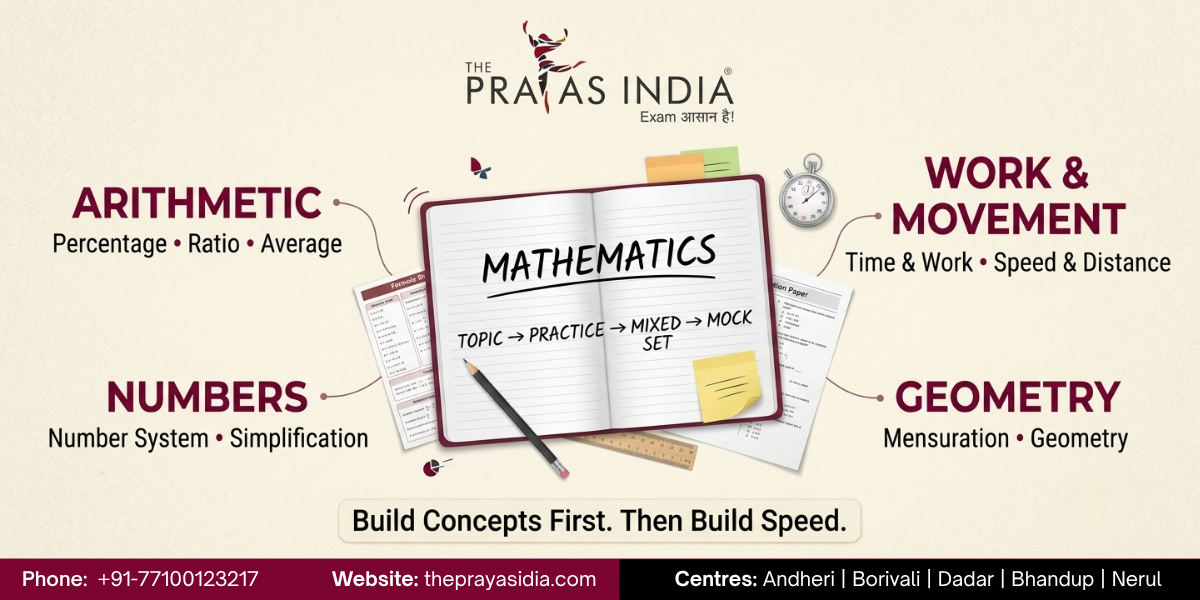
- Core Arithmetic: Percentage, Ratio and Proportion, Profit and Loss, Simple and Compound Interest.
- Work and Movement: Time and Work, Pipes and Cisterns, Time, Speed and Distance.
- Number-Based Topics: Number System, LCM and HCF, Simplification, Decimals and Fractions.
- Algebra and Geometry: Algebra, Elementary Algebraic Identities, Geometry, Mensuration.
- Data and Calculation: Average, Age, Data Interpretation and basic numerical analysis.
- Other Important Areas: Elementary Statistics, Square Root, Calendar and Clock, and related numerical concepts.
This classification should not be treated as a rigid timetable. Its purpose is to make preparation easier to manage. Once the syllabus is divided, candidates can study connected concepts together and identify weak areas without repeatedly jumping between unrelated chapters.
Build the Foundation With Number System and Simplification
Number System is one of the most useful foundations for RRB Group D Mathematics because several other topics depend on basic numerical understanding. Questions involving divisibility, factors, multiples, remainders, fractions, decimals, and numerical relationships become significantly easier when the underlying concepts are clear.
Simplification is equally important because it develops the calculation habits needed across the paper. A candidate may understand every formula perfectly and still lose marks because of slow multiplication, incorrect division, calculation slips, or poor handling of fractions. These errors are particularly costly in a time-bound examination.
Instead of simply memorising shortcuts, focus on building a reliable calculation process. Learn common fraction-to-percentage conversions, practise squares and cubes of frequently used numbers, become comfortable with approximation where appropriate, and gradually reduce the time required for routine calculations.
A useful daily calculation routine can include:
- Fractions and decimal conversions.
- Percentage equivalents.
- Squares and commonly used multiplication values.
- Division and approximation practice.
- Simplification questions under a time limit.
- Short calculation drills without using a calculator.
The objective is not to turn every calculation into a shortcut exercise. The objective is to make basic calculations sufficiently familiar that they do not consume unnecessary mental effort during the examination.
Percentage: A High-Value Concept for Arithmetic Preparation
Percentage deserves special attention because it is not an isolated chapter. It appears directly in percentage questions and also forms the foundation of several other arithmetic concepts. Profit and Loss, Discount, Interest, Data Interpretation and certain ratio-based problems often become easier when percentage relationships are understood properly.
Candidates should therefore avoid learning percentage as a collection of formulas. Instead, focus on understanding what a percentage represents and how percentage changes work. For example, an increase followed by a decrease cannot always be treated as if the two percentages simply cancel each other. Such conceptual clarity helps prevent the kind of mistakes that occur when candidates depend entirely on memorised patterns.
Your preparation should gradually move through three stages:
- Concept clarity — understand percentage relationships and basic conversions.
- Pattern recognition — identify common question types and efficient methods.
- Timed practice — solve mixed percentage questions while maintaining accuracy.
Once this foundation is strong, several related chapters become easier to approach. This is why percentage should be placed relatively early in a topic-wise RRB Group D Mathematics preparation plan.
Ratio and Proportion: Focus on Relationships, Not Formula Memory
Ratio and Proportion questions test how comfortably a candidate can understand relationships between quantities. The mathematics itself may not always be complicated, but the wording can make these questions confusing when the candidate has not developed a clear approach.
The most effective preparation method is to convert the information into a relationship before attempting lengthy calculations. Candidates should practise questions involving direct ratios, proportional relationships, distribution, comparisons and changes in quantities. Over time, the aim should be to recognise the structure of the question before deciding which calculation is required.
This topic also connects naturally with Percentage, Average, Profit and Loss and certain mixture-based problems. That makes it useful to revise these chapters together rather than treating every chapter as a completely separate subject.
A strong practice cycle is:
- Learn the basic ratio concepts.
- Solve straightforward questions first.
- Move to word-based applications.
- Practise mixed questions with Percentage and Average.
- Record recurring mistakes.
- Reattempt incorrect questions after a gap.
This process creates conceptual familiarity instead of temporary memorisation.
Average: Learn the Logic Behind the Formula
Average is often considered an easy topic, but candidates sometimes lose marks because they apply the formula mechanically without understanding how the total changes when a value is added, removed, or replaced.
The central relationship is simple:
Average = Total of observations ÷ Number of observations
However, RRB-style questions can test what happens to the total when one or more observations change. Understanding this relationship is much more valuable than memorising isolated question types.
During practice, begin with direct average questions and then move towards replacement, addition, removal and combined-average situations. The important skill is to determine what information has changed and how that change affects the total.
Candidates preparing at a coaching institute should also use classroom discussions and doubt-solving sessions for such chapters. A small conceptual misunderstanding in an apparently easy topic can repeatedly cause mistakes in mocks. Clearing it early saves considerable revision time later.
Profit, Loss and Discount: Make the Base Value Clear
Profit and Loss questions become confusing when candidates lose track of whether a percentage is being calculated on Cost Price, Selling Price, or another reference value. This is why preparation should begin with the relationship between Cost Price, Selling Price, Profit, Loss and Discount.
Rather than memorising every possible formula, understand the base on which the percentage is being calculated. Once that becomes automatic, many questions can be reduced to a few logical steps.
Candidates should practise:
- Basic profit and loss calculations.
- Profit and loss percentages.
- Marked price and discount.
- Successive discounts.
- Questions involving changes in selling price.
- Mixed arithmetic problems requiring comparison of values.
The biggest improvement usually comes when candidates stop rushing through familiar-looking questions. A question may appear easy because the numbers are simple, but a small misunderstanding about the percentage base can still turn the answer into a negative-marking error.
Simple and Compound Interest: Understand the Difference
Interest-based questions require both conceptual clarity and careful calculation. Candidates should first establish the distinction between Simple Interest and Compound Interest before moving into more complicated numerical applications.
For Simple Interest, the relationship between Principal, Rate, Time and Interest should become familiar enough to apply without hesitation. Compound Interest requires additional attention because interest is added to the principal at each compounding stage.
The preparation sequence should be gradual:
- Understand Principal, Rate and Time.
- Learn the Simple Interest relationship.
- Practise direct numerical questions.
- Understand annual compounding.
- Move to differences between SI and CI.
- Practise questions under timed conditions.
This is another area where an error notebook can be valuable. If your mistakes repeatedly come from calculation rather than concept, more theory will not solve the problem. You need targeted numerical practice.
Time and Work: Translate the Question Into Work Rates
Time and Work can initially appear complicated because questions often involve multiple people or machines working at different rates. The key is to stop thinking only in terms of days and start thinking in terms of work completed per unit of time.
Once the concept of work rate is understood, combined-work questions become much more manageable. Instead of trying to memorise numerous patterns, candidates can represent the contribution of each worker and then determine the combined rate.
During practice, move from simple individual-work questions to:
- Two-person work problems.
- Combined efficiency questions.
- Workers joining or leaving.
- Work completed in different time periods.
- Questions involving efficiency comparisons.
The same principle should guide preparation across the entire Mathematics syllabus: understand the structure first, then increase speed through repetition.
Time, Speed and Distance: Strengthen Unit Conversion and Relationships
Time, Speed and Distance is another important arithmetic area where candidates can lose marks through basic calculation mistakes. Before attempting advanced questions, make sure the relationship between distance, speed and time is completely clear and that unit conversions do not create confusion.
Questions involving trains, relative speed and movement can then be approached systematically. The candidate should first identify what is being asked, determine the relevant relationship, convert units where necessary, and only then perform the calculation.
A good practice strategy is to solve questions in layers. Start with direct formula-based problems, then move to relative-speed situations, followed by train and mixed application questions. Once accuracy is stable, introduce a timer.
The timer should not be introduced too early. If a candidate is still making conceptual errors, reducing the time limit usually increases those errors rather than improving performance.
Mensuration and Geometry: Visualise Before You Calculate
Geometry and Mensuration require a slightly different preparation style because the candidate has to interpret shapes and relationships before beginning the numerical calculation. Memorising formulas is necessary, but formula memory alone is not sufficient.
For Mensuration, build familiarity with common shapes, their dimensions, areas, perimeters and volumes. For Geometry, understand basic properties and relationships rather than treating every question as a formula-recall exercise.
A useful approach is to create a compact formula revision sheet containing only the formulas you genuinely need. Revisit it regularly rather than attempting to memorise a large collection of formulas in one sitting.
When solving these questions, develop the habit of:
- Drawing the figure when necessary.
- Marking the given dimensions.
- Identifying the required quantity.
- Selecting the correct formula.
- Checking whether the units are consistent.
- Reviewing the final answer for calculation errors.
This method can significantly reduce avoidable mistakes.
Do Not Treat Every Topic as Equally Difficult
One of the most important strategic decisions in RRB Group D Mathematics preparation is deciding how much time each topic deserves. A candidate who spends several days struggling with a difficult concept while neglecting high-confidence scoring areas may end up with an inefficient preparation plan.
Your topic allocation should therefore consider three factors: importance, personal weakness and improvement potential. A topic in which you are weak but can improve quickly deserves attention. A topic that is already strong may require maintenance rather than repeated full-length study.
A simple self-assessment can divide chapters into:
| Category | Preparation Approach |
|---|---|
| Strong | Short revision + timed practice |
| Moderate | Concept revision + sectional practice |
| Weak but manageable | Dedicated learning + repeated practice |
| Very weak | Rebuild fundamentals before advanced questions |
This approach prevents the common mistake of spending preparation time based only on what feels difficult.
Topic-Wise Practice Should Lead to Mixed Practice
Chapter-wise practice is essential during the learning stage, but candidates should not remain in chapter-wise mode until the end of preparation. The actual examination does not announce whether the next question belongs to Percentage, Average or Time and Work. The candidate has to identify the topic independently.
Therefore, after completing a group of chapters, introduce mixed practice sets. These sets force you to recognise the question type before selecting the method. This is an important transition between learning Mathematics and actually performing in an examination.
For example, after completing Percentage, Ratio, Average, Profit and Loss and Interest, begin solving mixed arithmetic sets. Avoid checking the chapter name before solving. Your task is to identify the concept yourself.
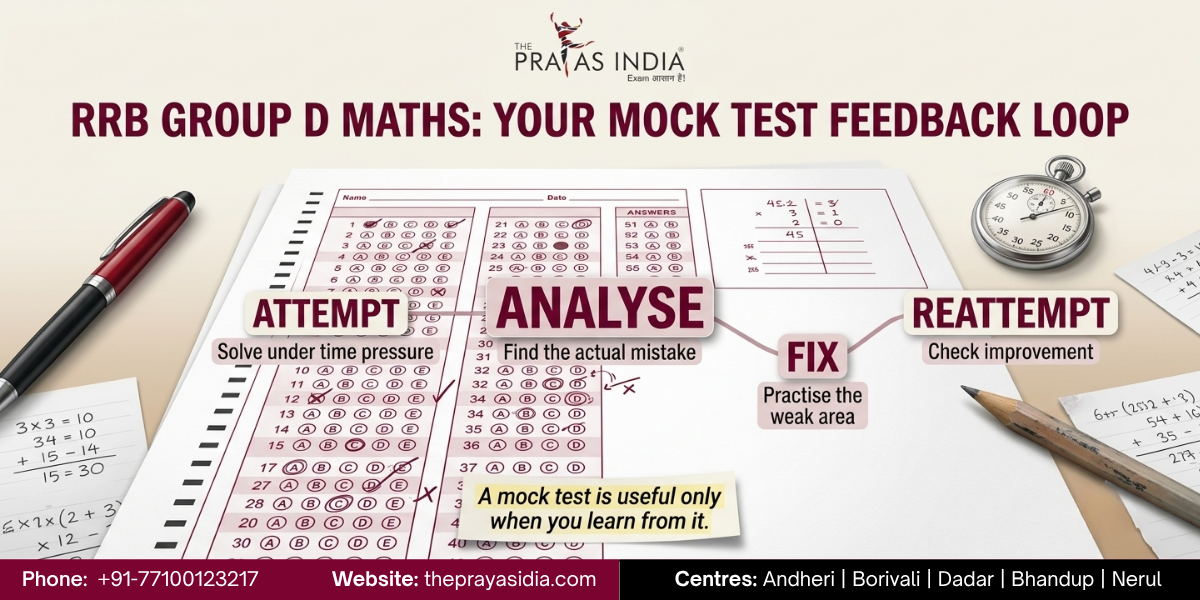
This is also where coaching and structured test practice can provide an advantage. Regular sectional and mixed tests create a feedback loop: attempt → analyse → identify weakness → practise → reattempt. That cycle should become a central part of RRB Group D preparation.
Accuracy Must Come Before Speed
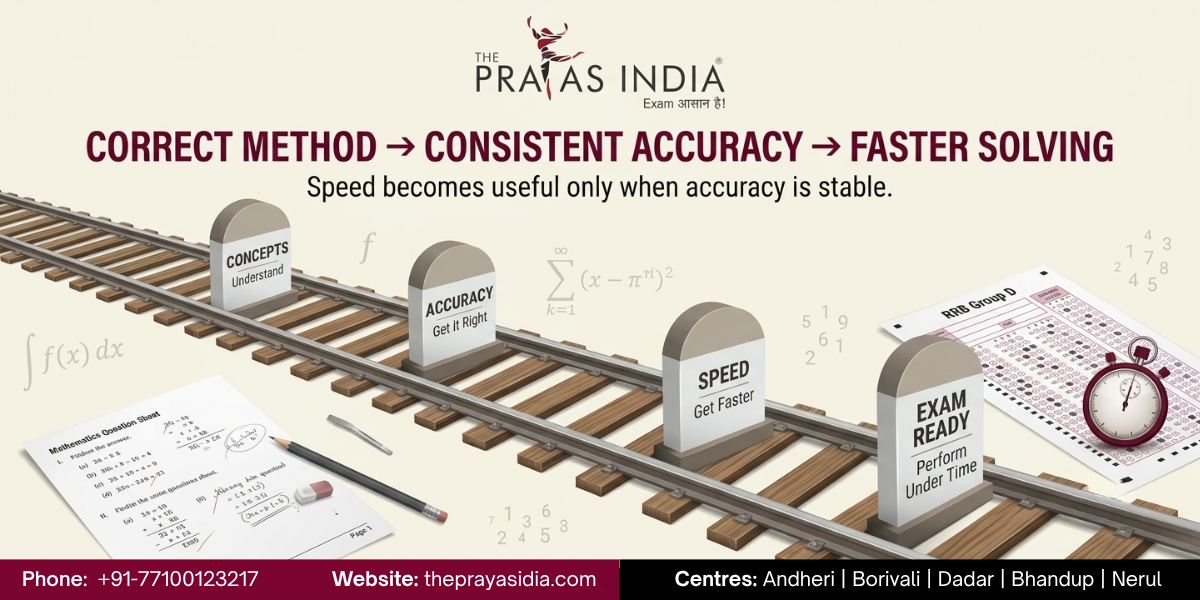
Speed is important in RRB Group D, but chasing speed before accuracy is one of the easiest ways to create a fragile preparation strategy. If a candidate solves a question in 30 seconds but gets it wrong, the speed has no practical value.
During the early stage, focus on solving correctly. Once your accuracy becomes stable, begin reducing the time required for familiar question types. This creates sustainable speed rather than rushed solving.
A useful progression is:
Correct Method → Consistent Accuracy → Faster Calculation → Timed Practice → Exam-Level Performance
This sequence is particularly important for Mathematics because calculation errors can continue even after the concept has been mastered.
Make Mock Tests a Part of Your Mathematics Preparation
Topic-wise preparation builds your foundation, but mock tests reveal whether that preparation actually works under examination conditions. Many RRB Group D aspirants perform well while solving chapter-wise questions because they already know which concept is being tested. A mock test removes that advantage. You have to identify the topic, decide whether the question is worth attempting, select the method, calculate the answer and move ahead—all within limited time.
This makes mock tests particularly valuable for Mathematics. They reveal not only how many questions you can solve, but also how you behave when the paper contains a mixture of easy, moderate and difficult questions. A candidate may discover that Percentage is strong in isolation but becomes difficult when mixed with Profit and Loss. Another candidate may know Mensuration formulas but spend too much time interpreting diagrams. These observations are more useful than simply looking at the final mock-test score.
After every test, analyse your Mathematics performance through four questions:
- Which questions were incorrect?
- Which questions took too much time?
- Which questions were left despite being solvable?
- Which mistakes were conceptual, calculative or due to poor question selection?
This analysis should directly influence your next practice session. If five mistakes came from calculation, solve another fifty random questions only after identifying the specific calculation issue. If the problem is question selection, more formula revision will not solve it. The preparation method has to respond to the actual weakness.
Use an Error Notebook Instead of Repeating the Same Mistakes
A simple error notebook can become one of the most valuable resources during the final phase of RRB Group D preparation. Candidates often solve a question incorrectly, check the solution, understand it temporarily and then move on. The same mistake may appear again in the next mock because the underlying error was never recorded.
Your error notebook should not become another textbook. Keep it compact and practical. Record the question type, your mistake, the correct approach and the lesson you need to remember. Over time, certain patterns will become visible.
For example, you may notice that:
- You repeatedly make percentage-base errors.
- You confuse units in Time, Speed and Distance.
- You make arithmetic mistakes when working quickly.
- You forget specific Mensuration formulas.
- You spend too much time on questions involving lengthy calculations.
Once these patterns are visible, revision becomes much more efficient. Instead of revising the entire Mathematics syllabus equally, you can concentrate on the areas that are actually reducing your score.
The Right Way to Revise RRB Group D Mathematics
Revision should begin before the syllabus is completely forgotten, not during the final few days before the examination. A topic-wise revision cycle allows concepts to remain active while gradually reducing the amount of time required to recall formulas and methods.
The first revision should focus on concepts and solved examples. The second should emphasise question patterns and calculation efficiency. Later revisions should become increasingly test-oriented, with mixed sets, sectional tests and full mocks replacing long theoretical study sessions.
A practical revision cycle can look like this:
First Stage: Concept revision + basic questions
Second Stage: Topic-wise practice + timed sets
Third Stage: Mixed Mathematics sets
Fourth Stage: Sectional tests + mock analysis
Final Stage: Formula revision + error notebook + high-frequency practice
This gradual transition is important because the final objective is not to remember how a chapter works in isolation. It is to recognise and solve the right questions quickly when the chapter name is not given.
Build a Daily Mathematics Routine
Consistency matters more than occasional long study sessions. A candidate who studies Mathematics for two focused hours every day can build stronger retention and calculation familiarity than someone who studies for eight hours once a week. The daily routine should contain a balance of learning, practice and analysis rather than spending the entire session on solving new questions.
For example, a focused session can begin with a short calculation drill, followed by one topic-specific practice set and then a smaller mixed set. The final portion should be used to review mistakes. As preparation progresses, the ratio should gradually shift from learning towards timed practice and mock analysis.
A useful daily structure can include:
- 15–20 minutes: Calculation and formula revision.
- 40–50 minutes: One focused topic.
- 25–30 minutes: Mixed Mathematics practice.
- 15–20 minutes: Error analysis and reattempt.
- Regularly: Sectional or full-length mock tests.
The exact timings can be adjusted according to the candidate’s overall preparation schedule. The important principle is that Mathematics should remain an active part of the routine instead of being studied only when a mock test exposes a weakness.
Do Not Ignore the Easy Questions
In a competitive examination, candidates sometimes become overly focused on difficult questions because they believe difficult questions will create a higher score. In reality, losing easy marks because of rushed calculations or poor question selection can be much more damaging.
RRB Group D Mathematics preparation should therefore include deliberate practice of straightforward questions. The purpose is not merely to solve them correctly but to solve them efficiently. Easy questions should become opportunities to build confidence, save time and create a time buffer for questions that require more thought.
During mocks, develop the habit of quickly classifying questions into three categories:
- Direct: Familiar method, low calculation burden.
- Manageable: Requires some calculation or thinking.
- Time-consuming: May be solvable but requires disproportionate time.
This classification can help prevent one difficult question from consuming the time needed to solve several easier questions.

A 30-Day Mathematics Revision Strategy for RRB Group D
A 30-day plan should not attempt to teach the entire Mathematics syllabus from zero in the final month. Its purpose should be to consolidate concepts, improve weak areas, increase question-solving efficiency and create examination readiness. Candidates who have already completed the syllabus should spend progressively less time on theory and more time on mixed practice and tests.
Days 1–7: Strengthen Arithmetic
Begin with Percentage, Ratio and Proportion, Average, Profit and Loss, Discount and Interest. These topics are closely connected and provide a strong arithmetic base. Revise formulas, solve topic-wise questions and maintain an error log.
Days 8–14: Work, Speed and Numbers
Focus on Time and Work, Pipes and Cisterns, Time, Speed and Distance, Number System, LCM, HCF, Fractions, Decimals and Simplification. Give special attention to calculation speed and unit conversion.
Days 15–21: Geometry and Remaining Topics
Revise Algebra, Geometry, Mensuration, Age, Calendar, Clock, Statistics and other relevant areas. Combine formula revision with timed practice rather than spending long hours reading theory.
Days 22–30: Mixed Practice and Mock Tests
At this stage, shift towards mixed Mathematics sets, sectional tests and full-length mocks. Analyse every test carefully and revise your error notebook repeatedly. The final days should focus on accuracy, question selection and maintaining confidence under time pressure.
How The Prayas India Can Support Your RRB Group D Preparation
A strong preparation strategy becomes easier to follow when candidates have a structured learning environment. For RRB Group D aspirants, the challenge is not simply finding study material; it is knowing what to study first, how much practice is enough, where mistakes are occurring and when to transition from concept learning to test practice.
This is where a focused coaching programme can add value. The Prayas India can help aspirants approach RRB Group D preparation through structured classes, topic-wise learning, guided practice and regular performance evaluation. Instead of leaving candidates to create the entire preparation system themselves, a coaching environment provides a framework within which progress can be monitored.
For students looking for RRB coaching in Mumbai, the objective should be to choose a preparation environment that supports both the academic and strategic sides of the examination. Mathematics requires repeated practice, but that practice becomes much more productive when it is guided by the right concepts, question patterns and performance analysis.
The goal is not simply to complete the Mathematics syllabus. It is to develop an examination-ready approach in which you can recognise familiar patterns, avoid unnecessary calculations, select questions intelligently and maintain accuracy when the clock is running.
Turn Topic-Wise Preparation Into Exam-Day Performance
Topic-wise preparation gives RRB Group D aspirants a clear starting point, but the final objective is broader than chapter completion. A candidate must eventually be able to move from a familiar chapter environment into an unpredictable mixed paper and still make good decisions.
That transition happens through repeated cycles of learning and testing. Concepts should lead to topic-wise practice, topic-wise practice should lead to mixed sets, and mixed sets should lead to mock tests. Every test should produce feedback, and that feedback should determine what you practise next.
The strongest preparation is therefore not simply:
Study → Solve → Move On
It is:
Study → Practise → Analyse → Correct → Reattempt → Test Again
Candidates preparing for RRB Group D should keep this cycle active throughout the preparation period. With disciplined topic-wise coverage, regular revision, careful error analysis and a balanced approach to speed and accuracy, Mathematics can become one of the more dependable sections of the paper.
For aspirants who want structured guidance rather than completely self-directed preparation, The Prayas India’s RRB coaching in Mumbai can provide an organised preparation environment focused on consistent practice and examination performance. The right time to strengthen your Mathematics strategy is before the pressure of the final revision phase begins.
Frequently Asked Questions
1. Which Mathematics topics should I study first for RRB Group D?
Begin with foundational and high-utility arithmetic topics such as Number System, Simplification, Percentage, Ratio and Proportion, Average, Profit and Loss and Interest. Once these concepts become comfortable, move towards Time and Work, Time, Speed and Distance, Geometry, Mensuration and other syllabus areas.
2. Is RRB Group D Mathematics difficult?
The difficulty level can vary from paper to paper, but many questions are based on fundamental concepts and standard numerical patterns. The major challenge for many candidates is completing the section accurately within the available time. Strong fundamentals, regular practice and mock-test analysis can make the section more manageable.
3. How much time should I study Mathematics every day?
The ideal duration depends on your overall preparation and current level. For many candidates, a focused daily Mathematics session combined with regular mixed practice is more effective than occasional long study sessions. The important factor is consistency and the quality of practice.
4. Should I focus on speed or accuracy first?
Accuracy should come first. Once you can solve familiar question types consistently without making calculation errors, gradually introduce time limits and work on increasing speed. Fast incorrect solving does not improve your examination score.
5. How can I improve my RRB Group D Mathematics calculation speed?
Practise basic calculations regularly, including fractions, percentages, multiplication, division, squares and approximation. Also analyse whether your speed problem comes from calculation itself or from choosing inefficient solving methods. Improving the method can sometimes save more time than simply calculating faster.
6. Are mock tests necessary for RRB Group D Mathematics preparation?
Yes. Mock tests help you understand how effectively you can apply your preparation under time pressure. More importantly, analysing mocks helps identify recurring conceptual mistakes, calculation errors, time-management issues and poor question-selection habits.
7. How should I revise Mathematics before the RRB Group D exam?
Use a combination of formula revision, error-notebook revision, mixed practice sets, sectional tests and full-length mocks. As the examination approaches, reduce lengthy theoretical study and focus more heavily on recall, accuracy and timed performance.
8. Can coaching help with RRB Group D Mathematics preparation?
Structured coaching can be useful for candidates who need a planned syllabus, guided practice, doubt resolution and regular performance evaluation. The benefit is particularly relevant for aspirants who struggle to maintain consistency through completely self-directed preparation.
9. How can I choose the right RRB coaching in Mumbai?
Look beyond advertisements and compare the teaching approach, course structure, practice material, test series, doubt-solving support and overall preparation methodology. A suitable coaching programme should help you build concepts as well as develop examination strategy.
10. When should I start preparing for RRB Group D Mathematics?
Start as early as possible rather than waiting for the final weeks. Early preparation gives you enough time to build fundamentals, identify weak topics, practise extensively and gradually improve speed and accuracy. Candidates who want structured guidance can also explore the RRB preparation programmes offered by The Prayas India.
Final Takeaway
RRB Group D Mathematics preparation becomes significantly more manageable when the syllabus is converted into a clear topic-wise plan. Build your numerical foundation first, strengthen arithmetic concepts, practise work-and-movement topics, revise Geometry and Mensuration systematically, and then transition towards mixed sets and mock tests.
The biggest improvement comes from treating every mistake as information. If you know exactly why a question went wrong and what you will do differently next time, every practice session contributes to your preparation.
For candidates targeting a competitive score, the formula is straightforward: strong concepts, disciplined practice, accurate calculations, smart question selection and continuous mock analysis. If you are looking for structured RRB preparation in Mumbai, this is the stage to build the right foundation rather than waiting until the final revision period.
Contact Us
- Call Now: +91-77100 13217
- Website: theprayasindia.com
- Centres: Andheri | Borivali | Dadar | Nerul | Bhandup