RRB Group D Reasoning Preparation Strategy for Beginners | Best RRB Coaching in Mumbai | The Prayas India
For a beginner, Railway RRB Group D preparation can initially feel overwhelming because the exam requires you to manage multiple subjects while maintaining speed and accuracy. Reasoning, however, can become one of the most manageable sections with the right approach. Unlike subjects that require extensive factual learning, General Intelligence and Reasoning improves significantly when concepts are understood, question patterns are recognised, and practice is done consistently.
The mistake many beginners make is starting with random questions or immediately attempting difficult mock tests. This often creates confusion rather than improvement. A better strategy is to build reasoning preparation in layers: understand the basic concepts, learn the standard question patterns, practise topic-wise questions, analyse mistakes, and gradually move towards timed practice.
For aspirants preparing for RRB Group D in Mumbai, structured coaching can make this process more efficient. A good preparation environment should not simply provide a large question bank. It should help beginners understand concepts, identify recurring question types, develop speed, and receive guidance when they repeatedly make the same mistakes.
Start With the Right Understanding of RRB Group D Reasoning
Before beginning preparation, understand what reasoning actually tests. The section is designed to assess how effectively a candidate can identify relationships, patterns, logical connections, sequences and conclusions. This means that simply memorising shortcuts is unlikely to be enough.
A beginner should first focus on understanding the logic behind a question. Once the basic method becomes familiar, speed naturally develops through repeated exposure to similar patterns.
Common areas that beginners should gradually cover include:
- Analogy
- Classification
- Number and Alphabet Series
- Coding-Decoding
- Mathematical Operations
- Blood Relations
- Direction Sense
- Syllogism
- Venn Diagrams
- Statement and Conclusion
- Data Sufficiency
- Decision Making
- Similarities and Differences
- Analytical Reasoning
- Jumbling
- Relationships and other standard reasoning patterns
You do not need to master everything in the first week. The objective is to create a logical progression from easy and familiar topics to more complex applications.
The Beginner’s First Rule: Don’t Chase Speed Too Early
One of the most common problems in reasoning preparation is trying to solve questions quickly before learning how to solve them correctly.
Suppose a beginner takes 30 seconds to solve a particular question during the initial practice stage. There is no need to become frustrated about the time. First understand the method and reach a stage where you can solve it accurately. Once the same question type appears repeatedly, your brain starts recognising the underlying pattern, reducing the time required.
Speed is therefore a result of familiarity, not something that should be forced from day one.
A useful progression is:
Concept Understanding → Untimed Practice → Accuracy → Timed Practice → Speed
This approach is particularly useful for candidates who are preparing for RRB Group D for the first time and may initially feel that other aspirants are much faster.
Build Your Preparation Around High-Frequency Topics
A beginner does not need to treat every reasoning topic equally from the beginning. Start with topics that are relatively approachable and allow you to build confidence through repeated practice.
Series, analogy, classification, coding-decoding, direction sense and basic blood-relation questions can provide a strong foundation. Once these become comfortable, move towards topics requiring more structured logical thinking.
The important point is not simply to finish a chapter. You should be able to recognise the question type quickly and understand which method is appropriate.
For each topic, follow a simple three-stage routine:
Stage 1: Learn
Understand the basic concept, rules and common patterns.
Stage 2: Practise
Solve a reasonable set of questions without worrying excessively about time.
Stage 3: Review
Check every incorrect question and identify the reason for the mistake.
This last stage is often ignored, but it is where much of the actual learning happens.
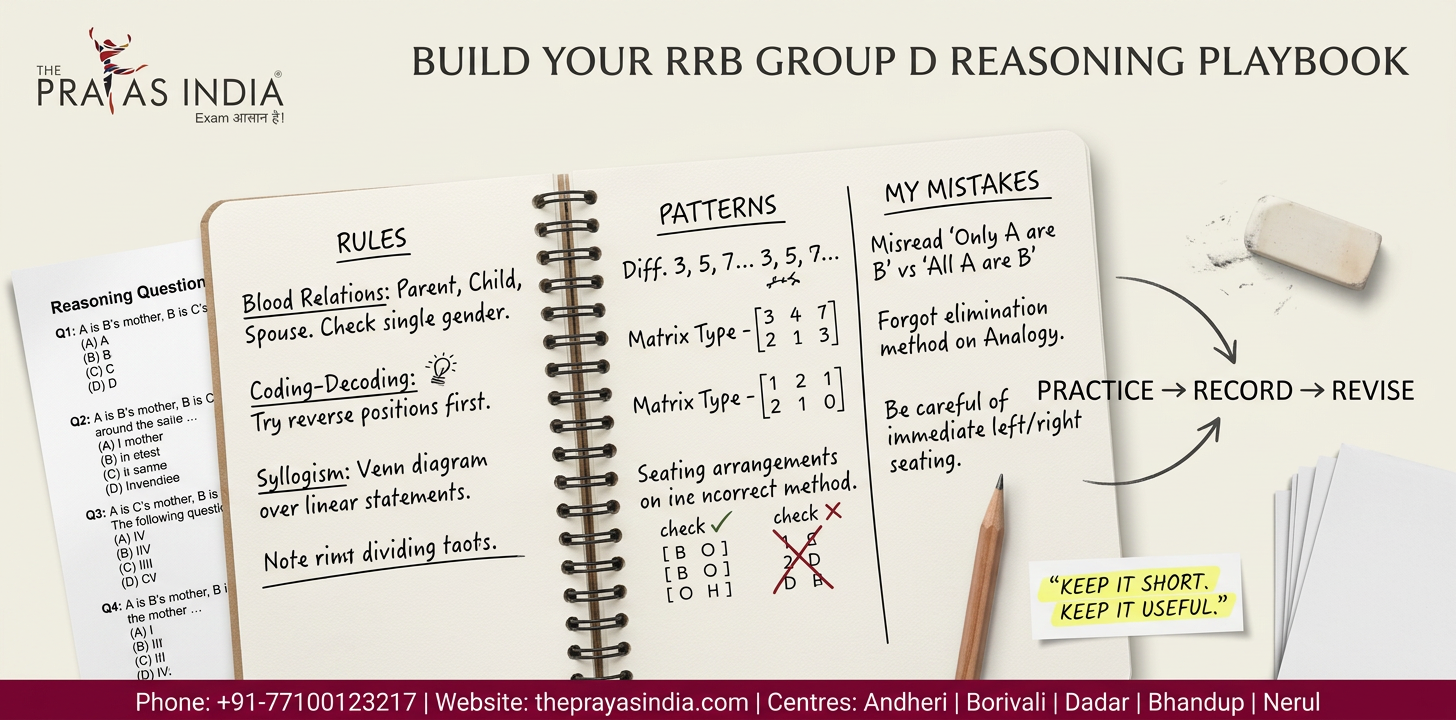
Create a Topic-Wise Reasoning Notebook
Beginners often collect multiple books, PDFs, screenshots and online questions but have no central place to record recurring mistakes. This makes revision unnecessarily difficult.
Maintain a compact reasoning notebook that contains only information you are likely to need again. Instead of copying entire chapters, record:
- Important rules
- Short methods you personally find useful
- Question patterns you repeatedly forget
- Mistakes that occur more than once
- Questions that initially confused you
- Any shortcut that saves meaningful time
The notebook should become smaller and more useful over time. If it turns into another textbook, you are probably writing too much.
A good revision notebook should allow you to refresh an entire topic quickly before a sectional test or mock examination.
A Better Way to Learn Coding-Decoding
Coding-Decoding is an important area for reasoning preparation, but beginners often approach it by memorising individual patterns. That strategy can become confusing because the coding mechanism can vary from one question to another.
Instead, learn to inspect the relationship between the original word, number or symbol and its coded form. Look for changes in alphabetical positions, reverse order, shifting patterns, substitution, arrangement, or combinations of these methods.
During the first few practice sessions, write down the transformation instead of trying to solve everything mentally. This may feel slower, but it helps you understand the structure. Once the pattern becomes familiar, you can gradually reduce your working steps.
The goal is to develop pattern recognition, because that is what eventually makes coding-decoding questions faster.
Make Series Questions a Pattern-Recognition Exercise
Number and alphabet series questions are another area where beginners can improve through systematic practice. The key is to avoid randomly testing every possible operation.
Start by checking simple relationships:
- Addition or subtraction
- Multiplication or division
- Increasing or decreasing differences
- Alternate patterns
- Squares or cubes
- Prime numbers
- Alphabet positions
- Combination of two patterns
If the first obvious pattern does not work, move to the next logical possibility instead of spending too much time on one question.
With practice, you will begin recognising familiar structures almost automatically. This is one of the reasons topic-wise practice is so valuable during the early stages of RRB Group D reasoning preparation.
Learn Direction Sense Through Diagrams First
Direction questions are usually easier when beginners stop trying to visualise everything mentally.
Draw a small direction diagram. Mark the starting point, movement and final position. Use consistent symbols for north, south, east and west. Once the diagram becomes clear, calculate the final direction or distance.
The same principle applies to blood relations. Instead of keeping a long chain of relationships in your head, draw a simple family structure.
These small habits reduce avoidable mistakes and make reasoning more manageable.
The objective is not to solve every question mentally. The objective is to use the simplest reliable method.
Don’t Ignore Accuracy While Building Speed
A beginner may initially celebrate an increase in the number of attempted questions, but attempts alone do not indicate improvement.
Suppose you attempt 25 reasoning questions and get 17 correct. Increasing attempts to 30 while getting only 18 correct does not necessarily represent meaningful progress. A stronger preparation strategy aims to improve the quality of attempts alongside speed.
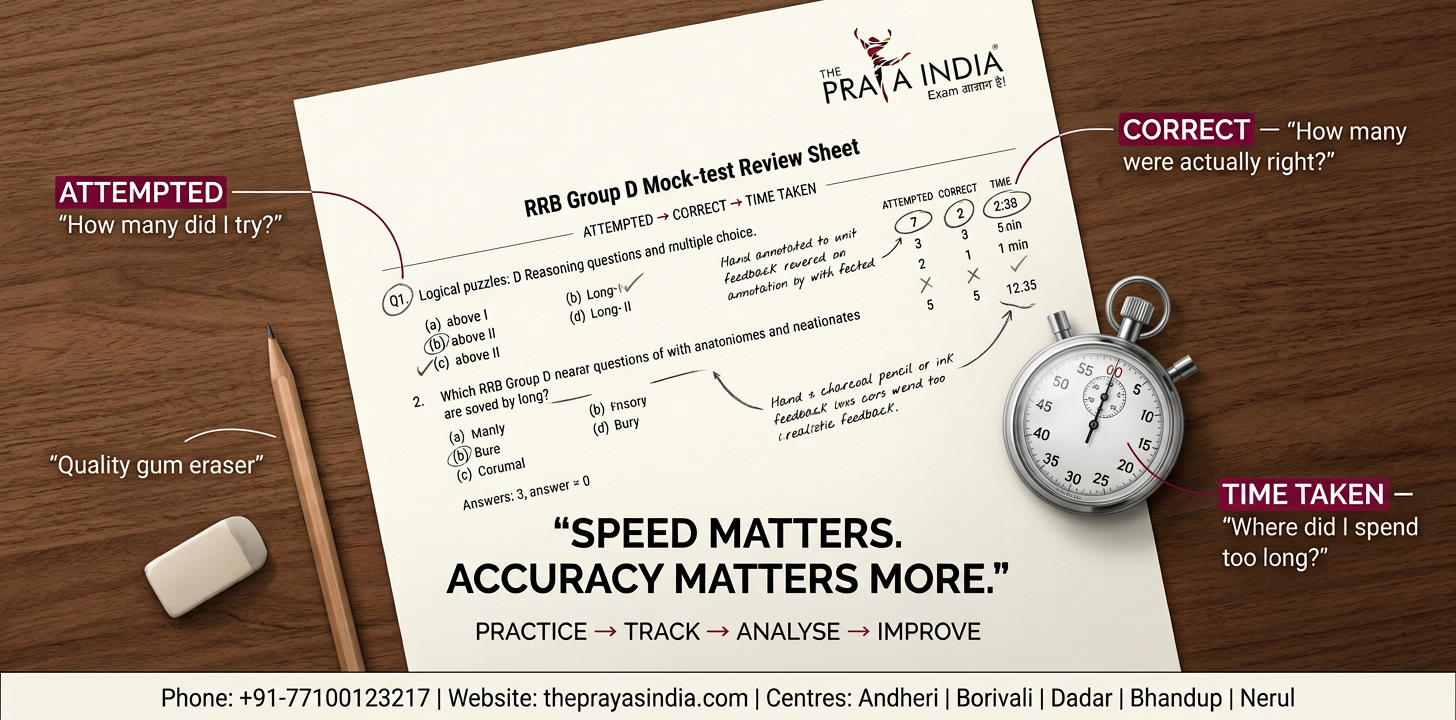
Track three things regularly:
- Questions attempted
- Questions answered correctly
- Time taken
This allows you to identify whether your improvement is coming from better understanding, faster calculation, better question selection, or simply taking more risks.
For RRB Group D, the ultimate objective is not maximum attempts at any cost. It is maximum useful attempts with controlled accuracy.
Use Previous-Year Questions as a Learning Tool
Previous-year questions should not be reserved for the final phase of preparation. They are useful from the beginning because they help candidates understand the nature of questions they are likely to encounter.
After completing a topic, solve relevant previous-year questions and compare them with your basic practice set.
Ask yourself:
- Does the actual question follow the pattern I studied?
- Which concepts appear repeatedly?
- Which question types take me longer?
- Am I making conceptual or calculation-related mistakes?
- Can I recognise the topic quickly?
This process helps beginners move from textbook-oriented preparation towards exam-oriented preparation.
Build a Weekly Reasoning Routine
Consistency matters more than occasional long study sessions.
A beginner can start with a manageable daily routine rather than attempting several hours of reasoning in one sitting. Even a focused session becomes productive when it includes concept learning, question practice and error review.
A sample weekly structure can look like this:
Monday–Tuesday: Learn and practise new concepts.
Wednesday: Revise earlier topics and solve mixed questions.
Thursday–Friday: Practice new question types with moderate time limits.
Saturday: Topic-wise or sectional test.
Sunday: Analyse mistakes, revise the error notebook and revisit weak concepts.
The schedule can be adjusted according to the candidate’s overall RRB Group D preparation plan. The important principle is to maintain a repeated cycle of learning, practice and correction.
How Coaching Can Help Beginners Build the Right Foundation
Self-study can certainly help candidates prepare for RRB Group D, but beginners sometimes spend considerable time figuring out what to study, which topics to prioritise and how to evaluate their mistakes.
Structured coaching can reduce this uncertainty by providing a planned syllabus, faculty guidance, practice material, regular tests and an environment where doubts can be addressed quickly.
For candidates looking for RRB coaching in Mumbai, the admission decision should be based on more than the availability of classes. Look at the quality of teaching, practice support, doubt resolution, test analysis, faculty accessibility and the overall structure of the preparation programme.
At The Prayas India, the focus for competitive-exam aspirants can be positioned around building a structured preparation journey rather than simply completing a syllabus. For a beginner, that structure can make the difference between studying more and preparing more effectively.
The First Milestone Is Not a High Mock Score
Beginners often believe they are ready only when they start scoring highly in full-length tests. That can create unnecessary pressure.
Your first milestone should be much simpler: understanding the common question types and solving basic questions accurately.
Once the foundation is stable, speed can be improved through timed practice. After that, mixed-topic tests can be introduced. Full-length mocks should eventually become part of the routine.
This progression prevents beginners from using difficult mock scores as an early judgment of their potential.
The strongest RRB Group D reasoning preparation is built gradually:
Understand → Practise → Correct → Repeat → Time → Test
Move From Topic Practice to Mixed Practice
Once you have developed basic familiarity with individual reasoning topics, the next challenge is learning to switch between question types. In a real examination, questions do not arrive chapter by chapter. A series question may be followed by coding-decoding, then a blood-relation question and then a logical reasoning problem.
This is why topic-wise practice alone cannot be your final preparation method. It should gradually be replaced by mixed practice.
Begin with small mixed sets containing questions from three or four topics. As your confidence improves, increase the variety. The purpose is to train your mind to identify the type of question before deciding how to solve it.
During this stage, ask yourself two questions before starting the solution: “What kind of question is this?” and “What is the quickest reliable method?” Developing this habit can significantly improve question selection and reduce the time wasted on unfamiliar-looking problems.
Develop a Question-Selection Habit
Good reasoning preparation is not only about solving questions. It is also about knowing which questions deserve your time.
A beginner may see a lengthy question and immediately start working on it because they feel every question must be attempted. In an examination environment, that approach can become costly. Some questions are straightforward once recognised, while others require more calculation or multiple logical steps.
During timed practice, classify questions mentally into three broad categories:
- Quick: Questions you can solve confidently with a familiar method.
- Manageable: Questions that require some working but are still within your comfort zone.
- Time-Consuming: Questions that may require lengthy calculations or repeated checking.
Start with the questions where your accuracy and confidence are highest. This does not mean permanently avoiding difficult questions. It means protecting your time and using it strategically.
With repeated mock practice, question selection should become almost automatic.
Build Speed Through Controlled Timed Practice
Once your accuracy becomes stable, introduce time limits gradually. Avoid immediately placing yourself under extreme pressure.
For example, you can initially solve a small set without a strict deadline. Once you are comfortable, introduce a moderate time limit and compare your performance. The objective is to reduce unnecessary thinking time without damaging accuracy.
Keep a simple record after each timed session:
Questions Attempted | Correct Answers | Incorrect Answers | Time Taken
This information is more useful than simply writing down your score. If your accuracy remains strong while your completion time decreases, you are making genuine progress.
If your speed improves but errors increase sharply, slow down and identify the reason. Speed should be developed through better recognition and efficient methods, not through guessing.
Turn Mock Tests Into a Diagnostic Tool
Mock tests become useful only when you learn something from them. For a beginner, the first few mock scores may not accurately represent future performance because the candidate is still developing familiarity with the exam environment.
Instead of looking only at the final score, examine the questions you got wrong and the questions you left behind.
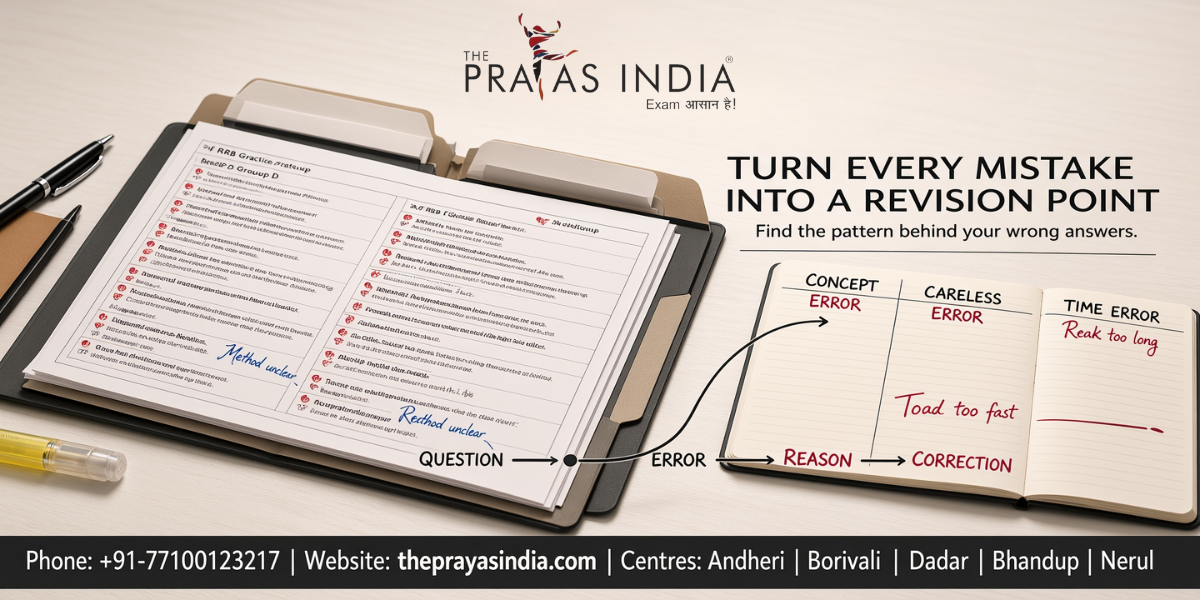
Create four categories during analysis:
Concept Mistakes
You did not understand the underlying concept or method.
Application Mistakes
You knew the concept but could not apply it correctly to the question.
Careless Mistakes
You understood the question but made an avoidable error while calculating, reading or marking the answer.
Time-Management Mistakes
You spent too much time on one question or failed to move away from a difficult problem.
This classification makes mock analysis actionable. If most errors are conceptual, you need more learning. If most are careless mistakes, you need a better checking habit. If time is the major issue, timed sets and question selection should become a priority.
Create an Error Log That Shows Patterns
Recording every wrong answer is not enough. The real value comes from identifying repeated patterns.
Suppose you make mistakes in coding-decoding questions three times in one week. That is no longer an isolated error. It is evidence that the topic needs attention.
Your error log can contain:
| Area | Mistake | Reason | Correct Approach | Revisited |
|---|---|---|---|---|
| Series | Wrong pattern identified | Rushed | Check differences first | Yes/No |
| Coding-Decoding | Transformation missed | Concept gap | Rework alphabet positions | Yes/No |
| Direction Sense | Final direction wrong | Diagram not drawn | Use a quick directional sketch | Yes/No |
The purpose of this record is not to create another lengthy notebook. It is to identify the mistakes that repeatedly reduce your score.
A short error log that you actually revise is much more valuable than pages of questions that you never revisit.
Revise Reasoning in Cycles, Not Just Before the Exam
Reasoning concepts can appear simple when first studied but become less familiar if they are not revisited. Beginners should therefore avoid postponing revision until the final weeks.
A useful revision cycle can be:
First Revision: Within a few days of learning the topic.
Second Revision: After completing a larger set of related topics.
Third Revision: During mixed-question practice.
Final Revision: Through error logs, short notes and selected previous-year questions.
The final revision should not involve relearning everything from the beginning. If your preparation has been structured properly, the final stage should focus mainly on recurring mistakes, important methods and questions that require additional attention.
Use Sectional Tests Before Full-Length Mocks
Full-length mocks are important, but beginners should not depend on them alone.
Sectional reasoning tests provide a controlled environment where you can examine your performance specifically in this subject. They can help answer questions such as whether your accuracy is improving, whether you are becoming faster and which topics continue to consume time.
Start with topic-wise tests, then move to mixed sectional tests and eventually incorporate reasoning sections into full-length RRB Group D mocks.
This creates a natural progression:
Topic Test → Mixed Reasoning Test → Sectional Test → Full Mock
Each stage serves a different purpose. The objective is to reach the full mock stage with enough familiarity that the test measures your strategy rather than simply your lack of preparation.
Common Beginner Mistakes in RRB Group D Reasoning Preparation
Many reasoning problems are created not by the difficulty of the subject but by inefficient preparation habits.
Studying Too Many Sources
Using multiple books, websites, PDFs and video lectures simultaneously can create unnecessary confusion. Choose reliable study material and complete it properly before constantly searching for new resources.
Memorising Without Understanding
Shortcuts are useful only when you understand the logic behind them. Memorising a method without knowing when to use it can lead to errors when the question format changes.
Ignoring Easy Topics
Some beginners focus heavily on difficult logical questions because they believe those questions demonstrate advanced preparation. In reality, strong performance requires securing marks from manageable questions as well.
Practising Without Analysis
Solving hundreds of questions without checking mistakes can reinforce incorrect methods. Every practice session should produce some form of learning.
Taking Mocks Too Early and Judging Yourself Too Quickly
Early mock scores can be low while your concepts are still developing. Treat them as diagnostic tests rather than final judgments of your preparation level.
Chasing Attempts Instead of Useful Attempts
Attempting more questions is not automatically better. Accuracy, time management and question selection must improve together.
A 30-Day Reasoning Improvement Plan for Beginners
Candidates who have completed the basic concepts can use the next month to convert knowledge into exam readiness.
Days 1–7: Strengthen the Foundation
Revise core topics and solve topic-wise questions. Focus heavily on understanding methods and identifying recurring mistakes.
Days 8–14: Increase Practice Volume
Introduce mixed sets involving multiple reasoning topics. Start using moderate time limits and maintain your error log.
Days 15–21: Improve Speed and Selection
Use sectional tests and timed practice. Pay particular attention to questions that consume too much time and identify which question types should be attempted first.
Days 22–26: Mock-Test Integration
Begin combining reasoning preparation with full-length RRB Group D mock tests. Analyse every test instead of moving immediately to the next one.
Days 27–30: Revision and Correction
Revisit your error notebook, difficult question types, important shortcuts and previous-year questions. Avoid starting large new topics unless they are genuinely necessary.
The exact schedule can be adjusted according to your overall preparation timeline, but the principle remains the same: build knowledge first, then convert it into speed, accuracy and exam decision-making.
How The Prayas India Can Support Your RRB Group D Preparation
For beginners, preparation becomes easier when there is a clear structure connecting classes, practice, revision and testing. Instead of trying to independently decide every day what to study, candidates can follow a planned preparation framework and use faculty guidance to address areas where progress is slower.
For aspirants searching for RRB coaching in Mumbai, an effective programme should provide more than classroom instruction. The overall preparation system should support conceptual learning, regular practice, doubt resolution, test-taking and performance analysis.
The Prayas India can be positioned as a structured preparation option for candidates who want guidance throughout this process. The objective is to help students move from basic concepts to consistent practice and eventually towards exam-oriented performance.
For a beginner, the right coaching environment can also provide accountability. Regular classes, practice schedules and tests create a preparation rhythm that can be difficult to maintain when studying without a structured plan.
The Final Preparation Framework
By the time you enter the serious test-practice phase, your reasoning preparation should follow a clear cycle.
Learn the Concept
Understand the logic instead of memorising isolated shortcuts.
Practise the Pattern
Solve enough questions to recognise the common structures.
Record the Mistake
Identify exactly why an answer went wrong.
Revisit the Weak Area
Return to the concept or method responsible for the error.
Practise Under Time Pressure
Introduce controlled timing only after accuracy becomes stable.
Test Yourself
Use sectional and full-length tests to measure readiness.
Analyse and Repeat
Use every test to improve the next attempt.
This approach makes preparation more systematic and prevents beginners from repeatedly making the same mistakes.
Final Checklist for RRB Group D Reasoning Beginners
Before moving into the final stage of preparation, check whether you can confidently say:
- I understand the basic concepts of major reasoning topics.
- I can identify common question patterns.
- I maintain a short and useful revision notebook.
- I track repeated mistakes.
- I practise previous-year questions.
- I regularly solve mixed-topic sets.
- I have started controlled timed practice.
- I analyse sectional and mock-test performance.
- I know which questions I should attempt first.
- I can maintain accuracy while increasing speed.
- I revise weak topics instead of simply solving more questions.
- I have a structured preparation plan for the remaining syllabus.
If several of these points are still missing, do not treat that as failure. It simply shows where your preparation system needs improvement.
Final Takeaway
RRB Group D reasoning preparation does not require a beginner to become exceptionally fast from the first day. What it requires is a structured process that gradually develops conceptual clarity, pattern recognition, accuracy, speed and question-selection ability.
Start with basic concepts. Practise topic-wise. Record mistakes. Use previous-year questions. Introduce mixed sets. Move into timed practice. Analyse sectional tests and mocks. Then revise according to the patterns revealed by your performance.
For candidates preparing in Mumbai, choosing a structured coaching environment can make this journey more organised by bringing together teaching, practice, testing and guidance under one preparation framework.
The real goal is not to solve every reasoning question in the shortest possible time. It is to reach the examination with the ability to recognise the right questions, apply the right method and protect your accuracy under pressure.
That is the foundation on which a stronger RRB Group D preparation strategy can be built.
Frequently Asked Questions
1. Is reasoning difficult for RRB Group D beginners?
Reasoning can initially feel difficult because the question patterns are unfamiliar. However, most beginners can make significant progress by learning the basic concepts first and practising common question types systematically.
2. Which reasoning topics should beginners study first?
Beginners can start with approachable areas such as analogy, classification, series, coding-decoding, direction sense and basic blood relations before gradually moving towards more complex logical reasoning topics.
3. Should I focus on speed from the beginning?
No. Build accuracy and conceptual clarity first. Once you become familiar with the question patterns, introduce timed practice gradually. Speed should develop without causing a major decline in accuracy.
4. How many reasoning questions should I practise every day?
There is no fixed number suitable for every candidate. The quality of practice matters more than simply counting questions. A focused set followed by proper mistake analysis can be more valuable than a large number of questions solved mechanically.
5. Are previous-year questions important for RRB Group D reasoning preparation?
Yes. Previous-year questions help candidates understand the style, recurring concepts and practical difficulty of the examination. They should be incorporated during preparation rather than saved only for the final revision stage.
6. How should I analyse an RRB Group D reasoning mock test?
Do not focus only on the final score. Check attempted questions, correct answers, incorrect answers, time taken and questions that were skipped. Categorise mistakes into concept, application, careless and time-management errors.
7. Can I prepare for RRB Group D reasoning through self-study?
Yes, self-study can be effective when supported by reliable study material, regular practice, revision and test analysis. However, beginners who struggle with planning, doubt resolution or maintaining consistency may benefit from a structured coaching programme.
8. How can RRB coaching in Mumbai help a beginner?
A structured RRB coaching programme can provide a planned syllabus, faculty guidance, practice material, regular testing and support with doubts and performance analysis. The right programme can help beginners avoid wasting time on unstructured preparation.
9. When should I start taking mock tests?
You can begin with topic-wise and sectional tests after building basic conceptual familiarity. Full-length mocks can be introduced progressively as more of the syllabus becomes comfortable.
10. What is the biggest mistake beginners make in reasoning preparation?
One of the biggest mistakes is solving questions continuously without analysing errors. If the same mistake keeps appearing, simply increasing the number of questions will not necessarily solve the problem. Correct analysis and targeted revision are essential.