RRB NTPC General Awareness: Most Important Topics for CBT 1 | The Prayas India
General Awareness is one of the most important sections of the RRB NTPC CBT 1 examination because it covers a broad range of subjects and contributes 40 questions out of the total 100 questions. Unlike Mathematics and Reasoning, where regular practice can gradually improve solving speed, General Awareness requires consistent reading, revision, factual recall and awareness of current events. Candidates who prepare this section only a few weeks before the examination often struggle because the syllabus is wide and several topics need repeated revision.
For RRB NTPC 2026 aspirants, the right approach is not to treat every General Awareness topic equally. The official RRB syllabus includes Current Affairs, General Science and Life Science, History, Geography, Indian Polity, Economy, Science and Technology, Computers, Sports, Art and Culture, Government Programmes, Environment and several other areas. Therefore, candidates need a structured priority-based strategy that helps them cover the syllabus without spending excessive time on low-return areas.
This article explains the most important RRB NTPC General Awareness topics for CBT 1, how to prioritise them, what to study under each topic, how to prepare Current Affairs, and how to use PYQs and mock tests to improve your performance.
RRB NTPC CBT 1 General Awareness: Exam Pattern
According to the official RRB NTPC notification for the Undergraduate category, CBT 1 consists of 100 objective-type questions, with 40 questions from General Awareness, 30 from Mathematics and 30 from General Intelligence and Reasoning. The examination duration is 90 minutes, and one-third of a mark is deducted for every incorrect answer. The section-wise distribution is indicative, so candidates should prepare for possible variation in the actual paper.
| Section | Questions | Marks |
|---|---|---|
| General Awareness | 40 | 40 |
| Mathematics | 30 | 30 |
| General Intelligence & Reasoning | 30 | 30 |
| Total | 100 | 100 |
The official syllabus describes General Awareness as a broad section covering current national and international events, sports, Indian art and culture, literature, monuments and places, General Science and Life Science up to the 10th CBSE level, History and the Freedom Struggle, Geography, Indian Polity and Governance, Science and Technology, international organisations, environment, computers, economy, government programmes, flora and fauna, famous personalities and important government and public sector organisations.
This means that RRB NTPC General Awareness is not simply a Current Affairs section. Current Affairs is important, but candidates also need a strong foundation in static subjects.
What Makes General Awareness Important in RRB NTPC CBT 1?
The biggest advantage of General Awareness is that questions generally do not require lengthy calculations or multi-step problem solving. If you know the answer, you can usually answer it quickly. This makes GA particularly useful for managing the overall time available in CBT 1.
At the same time, the section can be unpredictable because its syllabus is much broader than a single subject. A candidate may encounter questions from Science, History, Geography, Polity, Economy, Sports, Computers and Current Affairs within the same paper. Consequently, preparation should focus on coverage + revision + question practice, rather than simply memorising random facts.
Another important point is that there is no officially published RRB classification called “most scoring topics.” The priority given in this article is a practical preparation framework based on the breadth of the official syllabus and the type of preparation required. Candidates should still use the latest official notification and their own PYQ analysis to adjust their priorities.
RRB NTPC General Awareness: Most Important Topics
The official syllabus is extensive, so it is useful to divide General Awareness into major preparation groups. This makes the subject easier to organise and helps candidates create a realistic study schedule.
1. General Science and Life Science
General Science is one of the core areas of RRB NTPC General Awareness. The official syllabus specifically mentions General Science and Life Science up to the 10th CBSE level.
Candidates should therefore focus on school-level fundamentals rather than unnecessarily advanced scientific concepts. The aim should be to understand important definitions, principles, everyday applications and commonly tested facts.
Physics
Important areas include:
- Units and measurements
- Motion and force
- Work, power and energy
- Heat and temperature
- Light and reflection
- Refraction
- Electricity
- Magnetism
- Sound
- Pressure
- Gravitation
- Basic machines
- Everyday applications of physics
The best way to prepare Physics is to understand the basic concept first and then practise objective questions. Many questions can be answered quickly if the underlying concept is clear.
Chemistry
Focus on:
- Elements and compounds
- Atoms and molecules
- Acids, bases and salts
- Metals and non-metals
- Chemical reactions
- Periodic table basics
- Carbon and its compounds
- Fuels
- Common chemicals and their uses
- Everyday chemistry
Candidates should maintain short revision notes for commonly confused facts, chemical names and applications.
Biology
Biology is especially important for candidates preparing General Science at the school level. Major areas include:
- Human body systems
- Nutrition
- Digestive system
- Respiratory system
- Circulatory system
- Excretory system
- Nervous system
- Diseases
- Vitamins and deficiency diseases
- Blood and blood groups
- Cell structure
- Plant biology
- Reproduction
- Genetics basics
- Environment and ecology
Instead of trying to memorise entire chapters, focus on facts and concepts that can be converted into direct objective questions.
2. History of India and Freedom Struggle
History is another major component explicitly included in the official General Awareness syllabus.
RRB NTPC preparation should cover Ancient, Medieval and Modern Indian History, with particular attention to the Freedom Struggle.
For Ancient History, revise major civilisations, important sites, Vedic culture, Buddhism and Jainism, major dynasties, literature, architecture and important historical developments.
For Medieval History, focus on major dynasties, administrative systems, important rulers, architecture, literature, religious movements and significant battles or developments.
Modern Indian History deserves particularly systematic preparation. Candidates should cover the arrival of European powers, British expansion, major administrative developments, social and religious reform movements, Revolt of 1857, formation of the Indian National Congress, major movements under Mahatma Gandhi, revolutionary activities, constitutional developments and important events leading to Independence.
For the Freedom Struggle, create a chronological timeline. Connecting events with years, leaders, organisations and locations is much more effective than memorising isolated facts.
3. Indian Polity and Constitution
Indian Polity is a high-value static subject because it has a defined conceptual framework. The official syllabus specifically includes Indian Polity and Governance, Constitution and political system.
Important areas include:
- Constitution and its features
- Preamble
- Fundamental Rights
- Fundamental Duties
- Directive Principles of State Policy
- Union and State Executive
- President and Vice-President
- Prime Minister and Council of Ministers
- Parliament
- Supreme Court and High Courts
- Election Commission
- Comptroller and Auditor General
- Finance Commission
- Constitutional and statutory bodies
- Panchayati Raj
- Municipalities
- Centre-State relations
- Constitutional amendments
- Important schedules and articles
Rather than trying to memorise every constitutional provision, begin with the structure of the Constitution and gradually add important factual details.
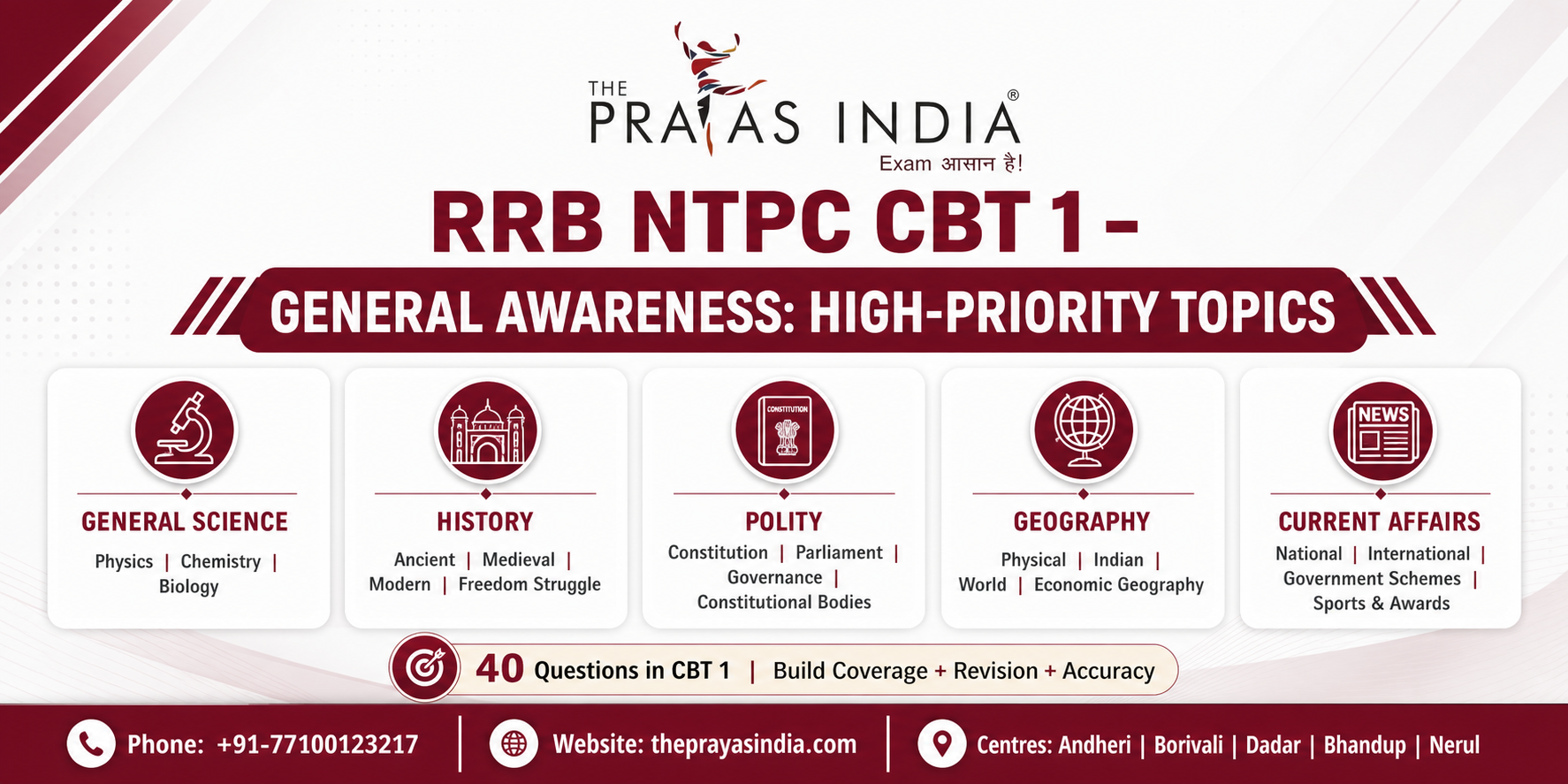
4. Geography: India and the World
Geography is another broad static component of the RRB NTPC General Awareness syllabus. The official syllabus covers physical, social and economic geography of India and the world.
Preparation should begin with Indian Geography because it allows candidates to connect multiple topics. Important areas include:
- Physical features of India
- Himalayas
- Northern Plains
- Peninsular Plateau
- Coastal Plains
- Islands
- Rivers and river systems
- Lakes
- Climate and monsoon
- Soils
- Natural vegetation
- Agriculture
- Minerals
- Industries
- Transport
- Population
- Important geographical locations
World Geography should cover continents, oceans, major mountain ranges, important rivers, deserts, climate zones, countries and major geographical features.
Map-based revision can be particularly useful. Keep a map of India available while studying rivers, states, neighbouring countries, mineral-producing regions, important ports and major geographical locations.
5. Indian Economy
Economy can appear difficult initially because candidates often approach it like a specialised subject. For RRB NTPC, however, preparation should focus primarily on basic concepts and important developments.
Important topics include:
- Basic economic terms
- GDP and national income
- Inflation
- Deflation
- Monetary policy
- Fiscal policy
- Banking basics
- RBI
- Budget
- Taxation
- Financial institutions
- Banking and financial inclusion
- Poverty and unemployment
- Economic sectors
- Government economic programmes
- Important economic indicators
- Current economic developments
Candidates should first build conceptual clarity. For example, understand the difference between inflation and deflation before trying to memorise related factual information.
Current economic developments should then be connected to the static concepts. This integrated approach makes revision more meaningful.
6. Current Affairs
Current Affairs is an essential component of RRB NTPC General Awareness because the official syllabus explicitly includes current events of national and international importance.
However, many aspirants make the mistake of collecting enormous amounts of current-affairs information without revising it. The goal should not be to read everything happening in the world. The goal should be to identify examination-relevant developments and revise them multiple times.
Important Current Affairs categories include:
- National events
- International events
- Government schemes
- Appointments
- Awards and honours
- Sports
- Important reports and indices
- Science and technology
- Defence
- Space missions
- Important summits
- International organisations
- Books and authors
- Important personalities
- Important days
- Economic developments
- Environment-related developments
- Major national and international achievements
Create monthly Current Affairs notes instead of allowing information to accumulate without structure.
A useful revision cycle is:
Daily reading → Weekly revision → Monthly consolidation → Full revision before the exam
This approach reduces the burden of trying to remember hundreds of disconnected facts at the last moment.
7. Science and Technology
The official syllabus specifically includes general scientific and technological developments, including India’s space and nuclear programmes.
This area should be prepared through a combination of static concepts and Current Affairs.
Focus on:
- Space missions
- ISRO-related developments
- Satellites
- Nuclear programmes
- Defence technology
- Biotechnology
- Artificial intelligence
- Digital technology
- Communication technology
- Important inventions
- Emerging technologies
- Major scientific institutions
- Technology-related government initiatives
For Current Affairs-based Science and Technology, focus particularly on developments that receive national importance or are associated with major institutions, missions, discoveries or government programmes.
8. Indian Art and Culture
Art and Culture is explicitly mentioned in the RRB NTPC General Awareness syllabus.
Important areas include:
- Classical dances
- Folk dances
- Music traditions
- Paintings
- Theatre
- Festivals
- Handicrafts
- Architecture
- UNESCO-related heritage
- Important monuments
- Cultural traditions
- Important cultural personalities
- Literature
A useful strategy is to connect each cultural form with its state or region. For example, when studying a dance, learn its state, characteristics and any associated festival or cultural tradition together.
9. Sports and Games
Sports questions are specifically included in the official syllabus.
Candidates should cover both static and current sports awareness.
Static preparation can include:
- Major sports and tournaments
- Important trophies
- Sports terminology
- Famous stadiums
- Major sporting bodies
- Important championships
- National sports-related institutions
Current preparation should focus on major tournaments, winners, important records, Indian achievements, major appointments and significant sporting events.
Do not spend disproportionate time memorising every sports statistic. Prioritise major national and international developments.
10. Computers and Computer Applications
The official syllabus includes basics of computers and computer applications.
Important areas include:
- Computer fundamentals
- Hardware and software
- Input and output devices
- Memory
- Operating systems
- Internet
- Networking basics
- Computer security
- Common applications
- Keyboard shortcuts
- File extensions
- Basic terminology
- Digital technologies
This section can be prepared through short notes and objective practice. Since many concepts are factual, repeated revision is more useful than spending excessive time on theory.
How to Prioritise RRB NTPC General Awareness Topics
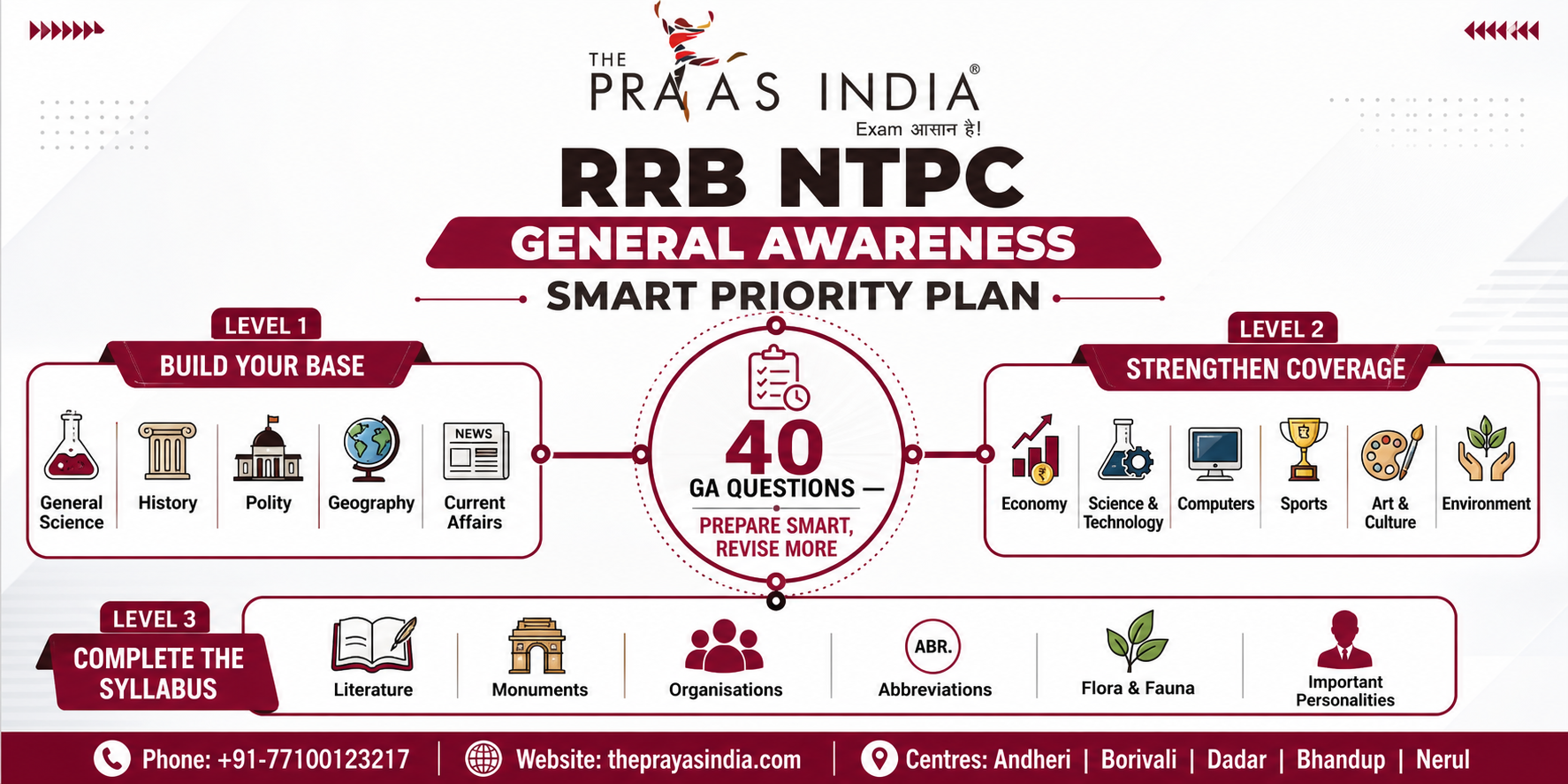
Because the syllabus is extensive, candidates should avoid studying every topic with the same intensity. A practical priority structure can be divided into three levels.
Priority Level 1: Core Preparation
Start with:
- General Science
- History and Freedom Struggle
- Indian Polity
- Geography
- Current Affairs
These areas form the foundation of a comprehensive General Awareness preparation plan.
Priority Level 2: Regular Revision Areas
Next, cover:
- Indian Economy
- Science and Technology
- Computers
- Sports
- Art and Culture
- Environment
These areas should be revised regularly after completing the basic syllabus.
Priority Level 3: Additional Coverage
Finally, include:
- Literature
- Monuments and places
- Famous personalities
- International organisations
- Common abbreviations
- Transport systems
- Flora and fauna
- Government and public-sector organisations
- Other factual areas mentioned in the official syllabus
These should not be ignored, but candidates should first establish a strong foundation in the major subject groups.
How to Prepare RRB NTPC General Awareness for CBT 1
Knowing the syllabus is only the first step. The bigger challenge is converting a large General Awareness syllabus into a preparation routine that can be revised repeatedly. Since CBT 1 has 40 General Awareness questions within a 90-minute paper and carries one-third negative marking for an incorrect answer, candidates should aim for strong factual recall and controlled question selection, rather than simply trying to read more material. The current RRB NTPC CBT 1 notification confirms the 40-question General Awareness component, while also noting that the section-wise distribution is indicative and may vary in the actual paper.
Step 1: Build Your Static GK Foundation
Begin your preparation with the relatively stable areas of General Awareness: General Science, History, Geography, Polity and Economy. These subjects do not change every month, which makes them suitable for systematic study.
Do not attempt to complete everything in one reading. Take one topic at a time, understand the basic concepts, prepare concise notes and immediately solve objective questions. For example, after studying Fundamental Rights in Polity, solve relevant MCQs rather than moving directly to another chapter. Similarly, after studying the Indian river system, practise questions related to rivers, tributaries, dams, states and geographical features.
The objective is to create a foundation that can later be connected with Current Affairs.
Step 2: Follow a Separate Current Affairs Routine
Current Affairs should not be mixed randomly with static GK. Maintain a separate notebook or digital file for monthly current affairs.
Divide the information into categories such as:
- National Affairs
- International Affairs
- Government Schemes
- Appointments
- Awards and Honours
- Sports
- Science and Technology
- Defence
- Space
- Economy
- Important Reports and Indices
- Books and Authors
- Important Days
- Environment
- Important Personalities
The RRB syllabus specifically includes current events of national and international importance along with several of these related categories.
A useful method is to revise current affairs at three levels. First, revise the day’s information briefly. Second, consolidate the week’s important events. Third, revise the complete month’s notes at the end of the month. This prevents the common problem of reading current affairs every day but forgetting most of it by the time the examination approaches.
RRB NTPC General Awareness: Daily Study Plan
A candidate’s available study time will vary depending on whether they are preparing full-time, attending college, working or preparing for multiple competitive examinations. Therefore, the exact number of hours should be adjusted according to the individual’s schedule.
For a candidate who can dedicate around 2 hours daily to General Awareness, a practical routine can look like this:
| Activity | Suggested Time |
|---|---|
| Static GK / General Science | 45 minutes |
| Current Affairs | 30 minutes |
| Topic-wise MCQs | 25 minutes |
| Revision of old topics | 20 minutes |
| Total | 120 minutes |
The important point is that all 120 minutes should not be spent reading. Question practice and revision must be part of the daily routine.
For example, if you study Polity for 45 minutes but do not revisit it for several days, much of the information may be forgotten. On the other hand, a shorter study session followed by repeated revision can create stronger recall.
The 60-30-10 Approach for General Awareness
Candidates can also divide their General Awareness preparation into three broad activities:
60% – Concept and Topic Coverage
Use this time to study Science, History, Geography, Polity, Economy and other syllabus areas.
30% – Practice and PYQs
Solve previous-year questions and topic-wise MCQs to understand how information is tested.
10% – Revision and Error Tracking
Revise previously studied information and record questions that you repeatedly get wrong.
This ratio does not need to remain fixed throughout preparation. During the initial phase, topic coverage may require more time. As the examination approaches, revision and mock-test analysis should naturally take a larger share of the schedule.
RRB NTPC General Awareness PYQ Strategy
Previous-year questions are particularly useful for General Awareness because they show how broad topics are converted into objective questions. However, PYQs should not be treated as a list of questions to memorise.
When you solve a History question about a particular event, for example, use it as a starting point to revise the associated year, personalities, organisations and related events. If a Geography question asks about a river, revise its source, tributaries, states and important projects where relevant.
This creates what can be called a PYQ learning chain:
Question → Topic → Related Facts → Notes → Revision
Maintain a separate list of questions that you repeatedly answer incorrectly. Revisiting this list can be more productive than repeatedly solving questions that you already answer correctly.
How to Use Mock Tests for General Awareness
Mock tests should not be used only to measure marks. They should also be used as diagnostic tools.
After each mock test, divide your incorrect or doubtful questions into three categories:
Category 1: I did not know the fact
Add it to your revision notes.
Category 2: I knew the topic but forgot the fact
Mark it for additional revision.
Category 3: I misunderstood the question
Review the wording and identify why you selected the wrong option.
This analysis helps you understand whether your problem is lack of coverage, weak retention or careless question reading.
Because one-third marks are deducted for an incorrect answer, random guessing should also be avoided.
RRB NTPC General Awareness Revision Strategy
General Awareness is highly dependent on revision. Reading a chapter once does not guarantee that the information will remain available during the examination.
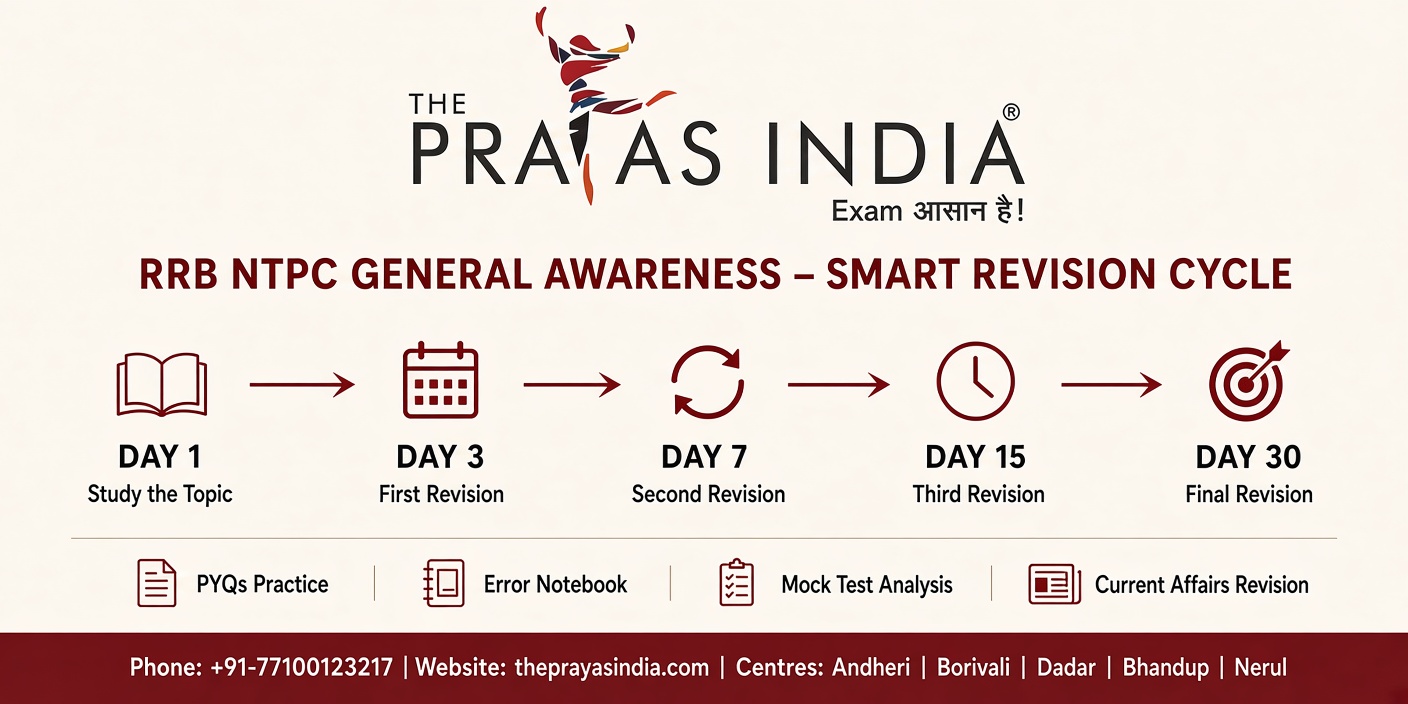
A simple revision cycle can be:
Day 1: Learn the topic
Day 3: First revision
Day 7: Second revision
Day 15: Third revision
Day 30: Full revision
This does not mean every topic needs exactly the same revision schedule. Difficult areas can be revised more frequently, while information that is already firmly remembered can be reviewed at longer intervals.
Create short revision sheets for topics such as:
- Important Articles and Constitutional Bodies
- Important historical events and movements
- Rivers, dams and geographical locations
- Scientific facts and discoveries
- Government schemes
- Awards and appointments
- Sports events
- Important organisations
- Important abbreviations
- Current Affairs
These short sheets become particularly useful during the final stage of preparation.
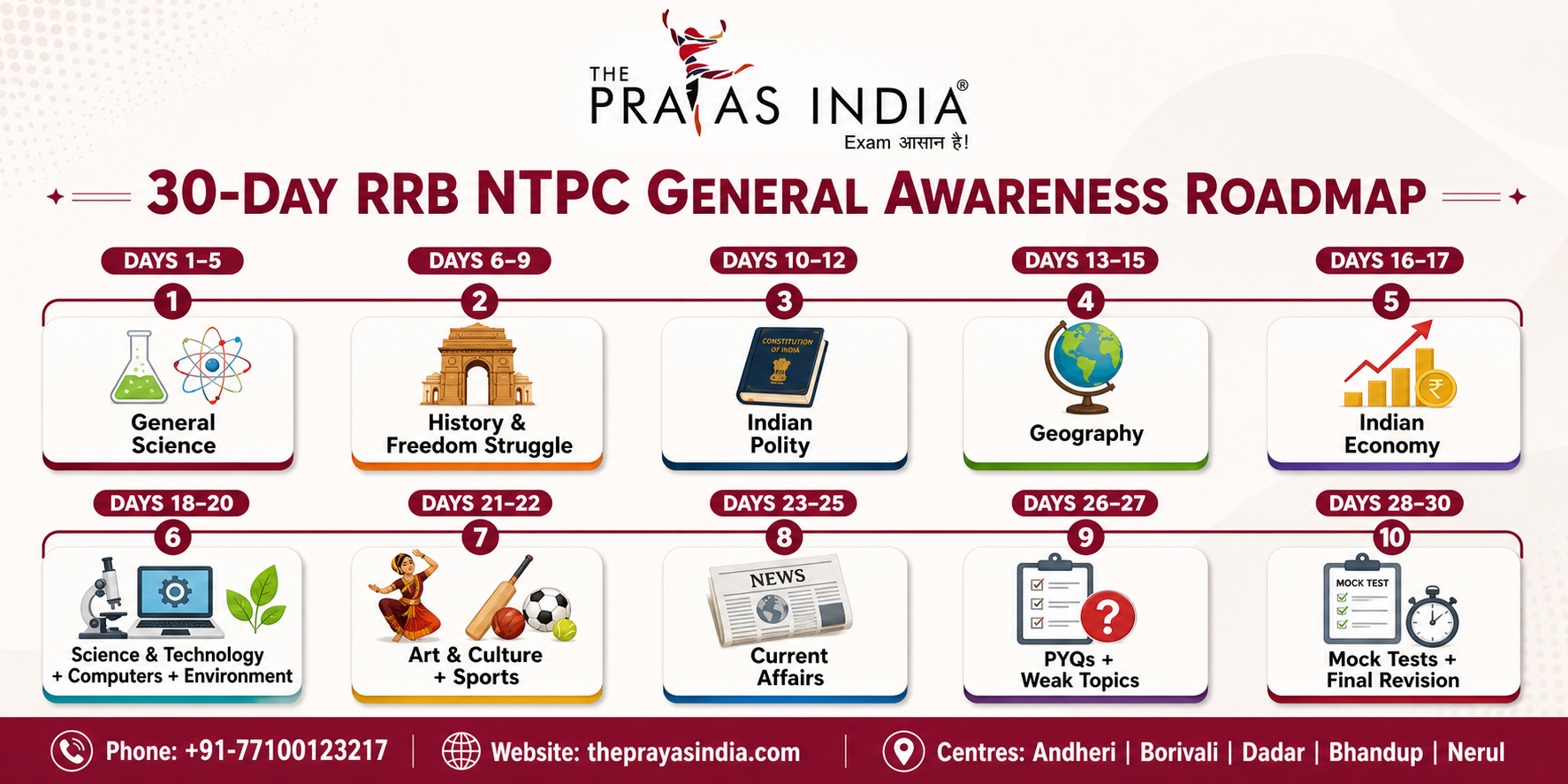
RRB NTPC General Awareness: 30-Day Preparation Plan
A focused 30-day plan can help candidates organise the syllabus without attempting to complete everything randomly.
Days 1–5: General Science
Cover Physics, Chemistry and Biology fundamentals at the required level. Give special attention to frequently confused facts, everyday science and basic concepts.
Days 6–9: History
Cover Ancient, Medieval and Modern History, with dedicated attention to the Freedom Struggle. Prepare a chronological timeline for major events.
Days 10–12: Indian Polity
Study the Constitution, Preamble, Fundamental Rights, Fundamental Duties, Parliament, President, Prime Minister, Supreme Court, constitutional bodies, governance and major constitutional provisions.
Days 13–15: Geography
Focus on Indian physical geography, rivers, climate, soils, agriculture, minerals, industries, states, neighbouring countries and important world geographical features.
Days 16–17: Economy
Revise basic economic concepts, banking, RBI, inflation, GDP, taxation, budget, monetary and fiscal policy and important economic developments.
Days 18–20: Science & Technology, Computers and Environment
Cover important technological developments, space and nuclear programmes, computer fundamentals, environmental issues and major scientific developments.
Days 21–22: Art, Culture and Sports
Revise classical and folk dances, music, festivals, monuments, literature, cultural traditions, major sports tournaments, trophies and important sporting personalities.
Days 23–25: Current Affairs Consolidation
Revise your monthly Current Affairs notes. Focus on national and international events, government schemes, appointments, awards, sports, science and technology, defence, economy and important reports.
Days 26–27: PYQs
Solve mixed General Awareness PYQs under timed conditions. Analyse every incorrect and doubtful question.
Days 28–29: Mock Tests and Revision
Attempt full-length or sectional tests and analyse your performance. Revisit weak areas rather than starting completely new topics.
Day 30: Final Revision
Revise short notes, Current Affairs, important facts, government schemes, appointments, awards, Science, Polity and frequently repeated PYQ concepts.
The purpose of this 30-day plan is not to suggest that the complete RRB NTPC syllabus can be mastered in one month. Rather, it provides a structured cycle for candidates who already have some preparation and want to consolidate their General Awareness.
Common Mistakes to Avoid in RRB NTPC General Awareness
Studying Only Current Affairs
Current Affairs is important, but it is only one component of the official syllabus. General Science, History, Geography, Polity, Economy and other areas also need systematic preparation.
Reading Without Revision
A large amount of reading does not automatically translate into marks. If you never revise what you studied, factual recall will deteriorate.
Collecting Too Many Sources
Using multiple books, PDFs, Telegram channels, videos and Current Affairs compilations can create unnecessary duplication. Select reliable resources and revise them properly.
Ignoring PYQs
Without PYQ practice, it is difficult to understand which facts and concepts you can actually recall under examination conditions.
Memorising Without Understanding
This is especially problematic in Science, Polity, Geography and Economy. Understanding relationships between concepts improves retention.
Spending Too Much Time on Rare Facts
Candidates sometimes spend hours memorising obscure information while leaving important syllabus areas insufficiently revised. Build broad coverage first and then expand into additional factual areas.
Not Maintaining an Error Notebook
Repeated mistakes are valuable because they identify exactly where your preparation needs improvement. Record them and revise them regularly.
How to Improve General Awareness Score in CBT 1
Improving General Awareness is not about finding a single shortcut. It comes from combining consistent coverage with repeated revision.
A practical preparation cycle is:
Study → Practise → Analyse → Revise → Test → Repeat
For example, after completing Indian Polity, solve topic-wise questions. Identify weak chapters, revise them and then test yourself again after a few days. Follow the same process for Science, History, Geography and Current Affairs.
As the examination approaches, gradually reduce the time spent on learning completely new material and increase the time spent on revision, PYQs and mock-test analysis.
The official RRB notification also states that CBT 1 is of a screening nature and that candidates are shortlisted for CBT 2 based on normalized CBT 1 marks. This makes disciplined CBT 1 preparation important for candidates aiming to progress through the recruitment process.
A Practical Question-Attempt Strategy for General Awareness
General Awareness is different from Mathematics and Reasoning because a known answer can generally be marked immediately. Therefore, during a mock test or examination, candidates should quickly identify questions for which they have clear recall.
A practical approach is:
Round 1: Answer questions where you are confident.
Round 2: Revisit questions where you can narrow down the options using knowledge.
Round 3: Avoid spending excessive time on questions where you have no meaningful basis for selecting an answer.
Remember that the official pattern carries a one-third negative marking for incorrect answers. Question selection should therefore be based on confidence and knowledge rather than random guessing.
Final Strategy for RRB NTPC General Awareness CBT 1
The most important principle for RRB NTPC General Awareness preparation is consistency. The syllabus is too broad to be completed effectively through last-minute study. Candidates should start with General Science, History, Polity, Geography and Current Affairs, then progressively add Economy, Science and Technology, Computers, Environment, Sports, Art and Culture and other factual areas.
At the same time, preparation should remain question-oriented. Reading should be followed by MCQs, MCQs should be followed by analysis, and analysis should lead to targeted revision.
For the current RRB NTPC CBT 1 pattern, General Awareness carries 40 questions out of 100, with the official notification also listing a broad range of subjects under the section. Candidates who develop a systematic routine around coverage, PYQs, Current Affairs, revision and mock tests can make their preparation considerably more organised.
Important Takeaway
Do not try to remember everything at once.
Build your preparation in layers:
Static GK → General Science → Current Affairs → PYQs → Revision → Mock Tests → Error Analysis
This approach helps turn a large General Awareness syllabus into manageable preparation targets and keeps revision at the centre of the strategy.
Build Your RRB NTPC Preparation with Structured Guidance
Preparing three CBT 1 sections simultaneously can become difficult when there is no fixed study plan or regular assessment. A structured preparation programme can help candidates organise the syllabus, practise questions regularly, analyse performance and maintain consistent revision.
At The Prayas India, aspirants preparing for RRB NTPC 2026 can access exam-oriented guidance, structured study support, practice, PYQs and mock-test preparation.
Admissions are open for RRB NTPC 2026 batches.
FAQs: RRB NTPC General Awareness Most Important Topics for CBT 1
1. How many General Awareness questions are asked in RRB NTPC CBT 1?
The current RRB NTPC CBT 1 pattern lists 40 General Awareness questions out of 100 total questions, with the section-wise distribution being indicative.
2. Which are the most important General Awareness topics for RRB NTPC?
Candidates should build strong coverage of General Science, History and Freedom Struggle, Indian Polity, Geography, Current Affairs, Economy, Science and Technology, Computers, Environment, Sports, Art and Culture and other areas listed in the official syllabus.
3. Is Current Affairs enough for RRB NTPC General Awareness?
No. Current Affairs is an important component, but the official syllabus also includes static subjects such as Science, History, Geography, Polity, Economy, Computers, Art and Culture and several other areas.
4. What level of General Science should I study for RRB NTPC?
The official syllabus specifies General Science and Life Science up to the 10th CBSE level.
5. Are previous-year questions important for General Awareness?
Yes. PYQs help candidates understand the way topics are converted into objective questions and identify areas that need additional revision.
6. How should I prepare Current Affairs for RRB NTPC?
Follow a monthly system. Read relevant daily developments, consolidate them weekly, prepare monthly notes and revise those notes repeatedly. Give particular attention to national and international events, government schemes, appointments, awards, sports, Science and Technology, economy and important reports.
7. How much time should I spend on General Awareness every day?
There is no single ideal duration for every candidate. Around 1.5–2 hours can be a practical target for many aspirants, but the schedule should be adjusted according to the candidate’s overall preparation time and other subjects.
8. Should I make notes for General Awareness?
Yes. Short, revision-friendly notes can be particularly useful for Polity, History, Science, Geography, government schemes, Current Affairs and factual information that you frequently forget.
9. Does RRB NTPC CBT 1 have negative marking?
Yes. The current notification specifies a deduction of 1/3 mark for each incorrect answer.
10. How can I improve my General Awareness accuracy?
Study fewer but reliable sources, revise repeatedly, practise PYQs, analyse mock-test mistakes and maintain an error notebook. Accuracy improves when information is revised enough times to become readily recallable.
Master RRB NTPC 2026 General Awareness with the Right Strategy
RRB NTPC General Awareness requires consistent coverage of Static GK, General Science, History, Polity, Geography, Current Affairs and other important areas. Get structured guidance, regular practice, revision support and exam-oriented preparation with The Prayas India.
Admissions Open for RRB NTPC 2026 Preparation