SBI Clerk 2026 Mock Test Strategy: How Many Mocks Should You Take Before Prelims? | The Prayas India
For SBI Junior Associate (Clerk) aspirants, mock tests become increasingly important as the Preliminary Examination approaches. They are not simply a way to check your score. A good mock-test strategy can help you understand your current preparation level, improve speed and accuracy, identify weak areas and develop a practical approach to managing the exam within the available time.
With the SBI Clerk 2026 Prelims scheduled for 27 September and 3 October 2026, aspirants entering the final preparation phase should use mocks differently from candidates who are still building their fundamentals. At this stage, the objective is not to take as many tests as possible. The objective is to take enough quality mocks, analyse them properly and use the findings to improve your next performance.
This is particularly important because SBI Clerk Prelims is a speed-oriented examination. Candidates have to manage English Language, Numerical Ability and Reasoning Ability within a limited time. Simply knowing the concepts is not enough. You must also know which questions to attempt, which ones to leave and how much time to spend on different question types.
For students preparing through structured SBI Clerk coaching, mock tests can become an important bridge between classroom learning and actual examination performance. At The Prayas India, aspirants can combine conceptual preparation with practice, testing and performance analysis through online and offline learning options.
Why Mock Tests Matter for SBI Clerk Prelims 2026
A mock test creates a controlled version of the examination environment.
When you solve individual questions during regular practice, you generally know what topic you are working on. You can take your time, check a solution and move to another question.
A mock test is different.
You have to make decisions without knowing exactly what questions will appear. You have to manage the clock, decide which questions deserve your attention and maintain accuracy while moving between different question types.
This makes mocks particularly useful for SBI Clerk preparation.
A mock can reveal problems that regular practice may not show.
For example, you may know how to solve a particular Numerical Ability question but spend too much time on it. You may perform well in Reasoning practice but choose a lengthy puzzle during a mock. You may understand English concepts but lose marks because you rush through the section.
These are exam-execution problems, and mock tests help identify them.
How Many SBI Clerk Mocks Should You Take Before Prelims?
There is no universally correct number of mocks for every aspirant.
A candidate who is still struggling with basic concepts may not benefit from taking a full mock every day. Another candidate who has completed the syllabus and is already comfortable with the exam pattern may benefit from frequent full-length testing.
Therefore, instead of following a fixed number blindly, use your preparation stage to determine mock frequency.
A practical approach can be:
| Preparation Stage | Suggested Mock Frequency | Main Objective |
|---|---|---|
| Foundation Stage | 1 mock occasionally | Diagnose preparation |
| Syllabus Building | 1–2 mocks per week | Identify gaps |
| 4–6 Weeks Before Exam | 2–4 mocks per week | Improve execution |
| Final 2 Weeks | 4–6 mocks per week, depending on stamina | Exam simulation |
| Final Few Days | Selective mocks + revision | Maintain rhythm, avoid burnout |
These are guidelines rather than compulsory targets.
Ten well-analysed mocks can be more useful than twenty-five mocks that you simply take and forget.
Your mock strategy should therefore prioritise quality of analysis over quantity of tests.
The 3-Part Mock Test Strategy
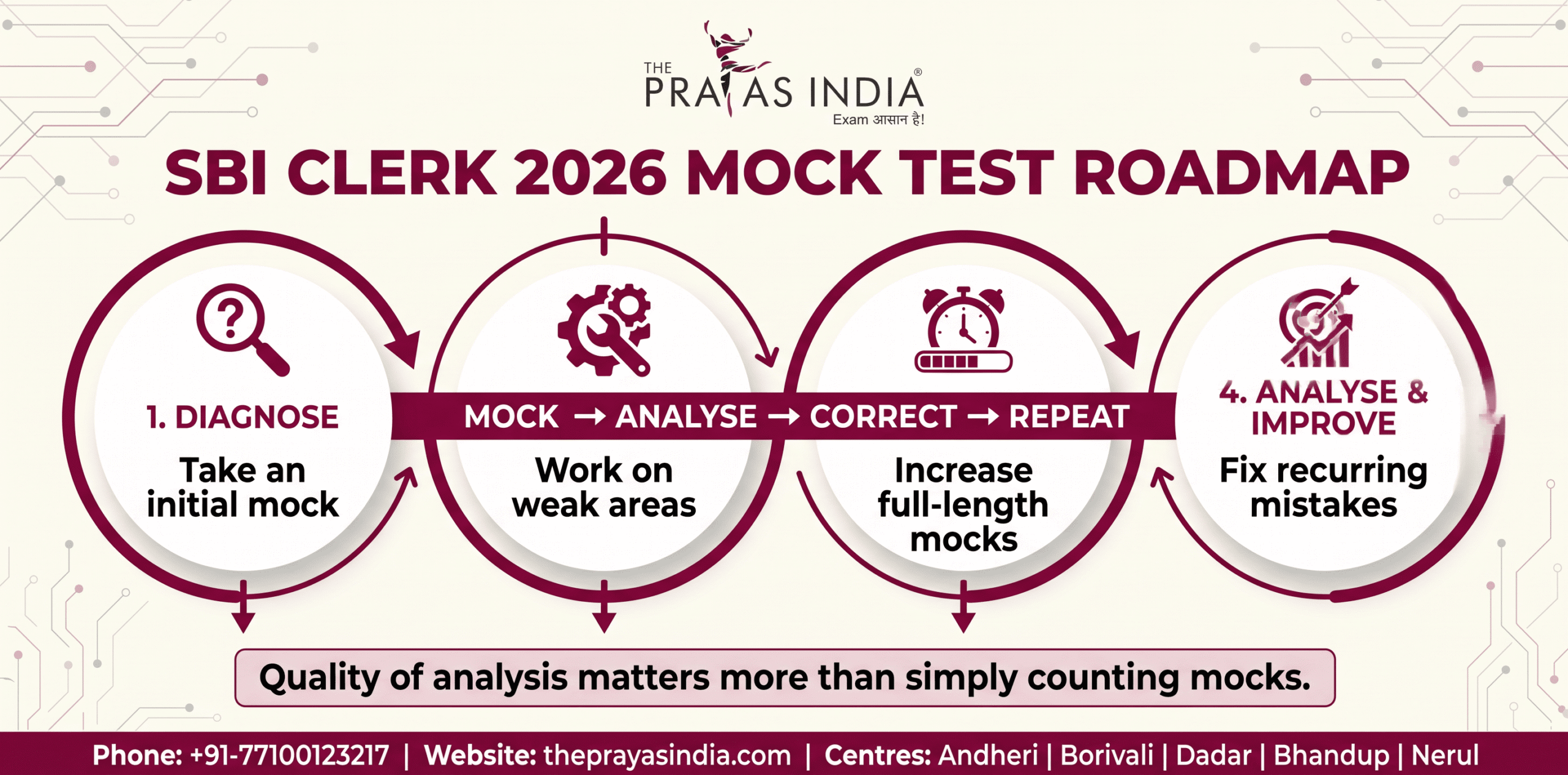
Every SBI Clerk mock should be treated as a three-stage activity:
1. Take the Mock
Attempt the test under realistic examination conditions.
2. Analyse the Mock
Understand what went right, what went wrong and where time was lost.
3. Correct the Problem
Practise the specific area that caused the problem and apply the improvement in the next test.
The third step is often ignored.
A student may take a mock, discover that Numerical Ability accuracy is poor and then immediately take another mock.
That is not enough.
If you do not address the reason behind the poor performance, the same mistake can appear again.
The real value of a mock lies in the improvement cycle:
Mock → Analysis → Correction → Practice → Next Mock
When Should You Start Taking SBI Clerk Mock Tests?
You do not have to wait until the entire syllabus is completed before taking your first mock.
An early diagnostic mock can be useful even when preparation is incomplete.
However, there is a difference between taking a mock to diagnose your level and taking mocks to simulate the actual examination.
Early Stage
Use mocks occasionally to understand your current position.
Middle Stage
Increase the frequency as more concepts are covered.
Final Stage
Use full-length mocks regularly to improve speed, accuracy and decision-making.
This gradual increase prevents mock tests from becoming a source of unnecessary pressure.
SBI Clerk Mock Strategy for the Final Weeks Before Prelims
As the 27 September and 3 October Prelims dates approach, your preparation should become increasingly test-oriented.
If your fundamentals are already reasonably strong, the final weeks should focus heavily on:
- Full-length mock tests
- Sectional tests
- Speed improvement
- Accuracy improvement
- Question selection
- Time management
- Previous mistakes
- Short revision
- Mock analysis
Do not use the final weeks to randomly start dozens of new resources.
Your goal should be to improve the performance of the preparation you have already built.
How to Analyse an SBI Clerk Mock Test
Taking a mock is only the first half of the process.
After completing the test, spend sufficient time analysing it.
Start with your overall performance, but do not stop at the score.
Look at each section separately.
English Language
Check:
- How many questions did you attempt?
- How many were correct?
- Which question types caused mistakes?
- Did you spend too long on reading-based questions?
- Were errors caused by comprehension or rushed selection?
Numerical Ability
Check:
- Which topics consumed the most time?
- Were calculation errors responsible for incorrect answers?
- Did you spend too long on a difficult question?
- Which questions could have been solved more efficiently?
Reasoning Ability
Check:
- Which puzzles or arrangements consumed time?
- Did you select the right sets?
- Were individual reasoning questions easier opportunities?
- Did you continue with a difficult puzzle for too long?
This analysis will help you build a more personalised strategy.
Create an SBI Clerk Mock Analysis Sheet
Maintaining a simple record can make mock analysis significantly more useful.
| Parameter | What to Record |
|---|---|
| Total Attempts | Number of questions attempted |
| Accuracy | Correct vs incorrect |
| Sectional Attempts | Attempts in each section |
| Time Management | Where time was lost |
| Easy Questions Missed | Questions you should have attempted |
| Unnecessary Attempts | Questions that consumed time without enough return |
| Conceptual Errors | Topics requiring revision |
| Calculation Errors | Avoidable mistakes |
| Selection Errors | Poor question/set selection |
| Next Action | What you will improve before the next mock |
After five or ten mocks, compare your records.
You may notice that your biggest issue is not lack of knowledge but a repeated behavioural pattern.
For example, you may repeatedly spend too much time on one difficult reasoning puzzle.
Once you identify the pattern, you can actively work on it.
Don’t Look Only at Your Mock Score
Mock scores can fluctuate.
One test may be easier, another may be more difficult. The distribution of questions can also affect your performance.
Therefore, do not judge your entire preparation based on one score.
Instead, track:
Accuracy
Attempts
Time spent
Questions left unattempted
Easy questions missed
Repeated mistakes
Section-wise performance
Improvement from previous tests
The goal is to see whether your execution is becoming more consistent.
The Most Important Question After Every Mock
After every mock, ask yourself:
“Why did I lose these marks?”
Not:
“How many marks did I get?”
but:
“Why did I not get the marks that were available to me?”
There can be several reasons.
You may have:
- Not known the concept
- Misread the question
- Made a calculation error
- Selected the wrong question
- Spent too much time
- Changed a correct answer
- Panicked after a difficult question
- Failed to identify an easy question
Each reason requires a different solution.
This is why mock analysis should be personalised.
How Many Mocks Should You Take in the Last 30 Days?
The final month should generally have a higher testing frequency than the earlier stages.
However, your exact number should depend on your preparation and ability to analyse each test.
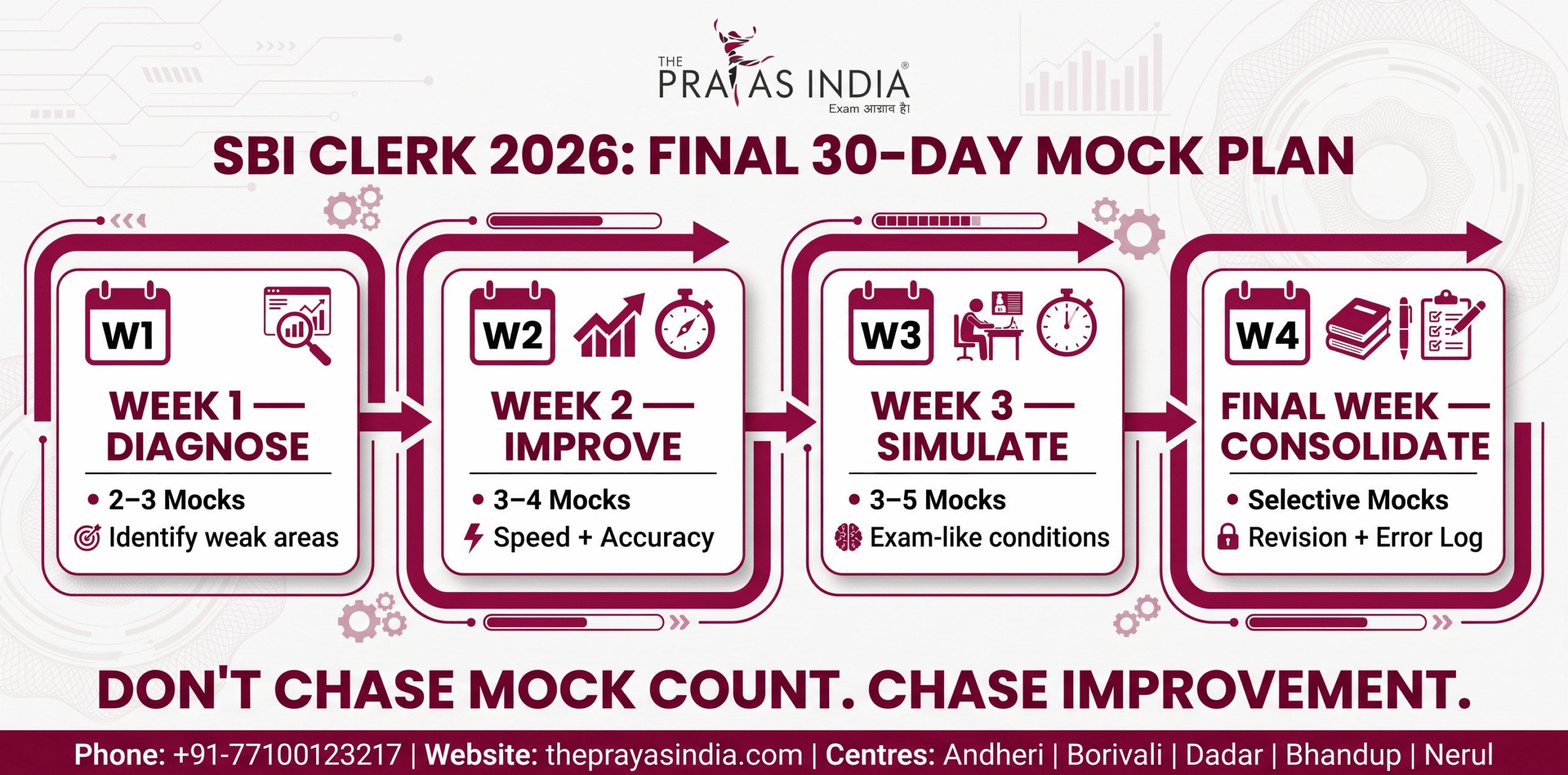
A possible structure is:
Week 1
2–3 full-length mocks
Focus on identifying major weaknesses.
Week 2
3–4 full-length mocks
Increase focus on speed and question selection.
Week 3
3–5 mocks
Practise examination strategy under realistic conditions.
Final Week
Take only as many full mocks as you can analyse properly without exhausting yourself.
Use the remaining time for:
- Revision
- Error-log review
- Short sectional practice
- Important formulas
- Vocabulary and grammar revision
- Calculation practice
- Reasoning patterns
The objective is not to finish a particular number.
The objective is to reach the examination with a stable strategy.
Mock Tests vs Sectional Tests: What Should You Take?
Both have an important role in SBI Clerk preparation.
A full-length mock helps you practise overall time management and switching between sections.
A sectional test allows you to focus on one area and identify specific problems.
For example, if your overall mock score is being affected by Numerical Ability, taking several Numerical Ability sectional tests can help isolate the problem.
Similarly, if Reasoning is taking too long, sectional practice can help you work specifically on question selection and puzzle-solving efficiency.
Therefore, do not treat full-length mocks and sectional tests as alternatives.
Use them for different purposes.
Full Mock = Complete Exam Simulation
Sectional Test = Targeted Improvement
How to Improve Your SBI Clerk Speed Through Mock Tests
Speed is not simply about solving every question faster.
It is also about avoiding unnecessary time expenditure.
Suppose one candidate spends three minutes on a difficult question while another candidate identifies it as time-consuming and moves on.
The second candidate may solve fewer questions individually but still achieve better overall performance because of better time allocation.
During mock analysis, identify questions that consumed disproportionate amounts of time.
Then ask:
Could I have solved this faster?
If yes, learn the shorter approach.
If no, ask:
Should I have skipped it?
This distinction is crucial.
How to Improve Accuracy Through Mock Tests
Accuracy improves when you understand the reason behind your mistakes.
Maintain separate categories for:
Conceptual Errors: You did not know the method.
Calculation Errors: You knew the method but made an avoidable mistake.
Interpretation Errors: You misunderstood the question.
Selection Errors: You chose a poor question.
Time-Pressure Errors: You rushed because you were running out of time.
Once you know which category dominates, your preparation becomes much more targeted.
For example, if calculation errors are frequent, simply taking more mocks may not solve the problem. You may need focused calculation practice.
If selection errors are frequent, you need to work on identifying question difficulty more effectively.
What If Your SBI Clerk Mock Scores Are Not Improving?
Do not immediately increase the number of mocks.
First investigate the reason.
If your scores remain stagnant after several tests, ask:
- Are you making the same mistakes repeatedly?
- Are you analysing your mocks properly?
- Are you revising weak concepts?
- Are you attempting too many questions?
- Is your accuracy suffering because of speed?
- Are you selecting difficult questions unnecessarily?
- Are you neglecting one section?
Sometimes the problem is not insufficient testing.
It is insufficient correction after testing.
If you take ten mocks and repeat the same mistakes in all ten, the number of mocks has not solved the problem.
The SBI Clerk Mock-Test Mistake Log
A mistake log can become one of your most valuable preparation tools.
Instead of writing only the correct answer, record:
Question Type
Your Approach
Where You Went Wrong
Correct Approach
Lesson Learned
Action Required
For example:
“Spent too long on a puzzle because I started creating cases without identifying the fixed condition.”
The next time you encounter a similar puzzle, you have a specific warning to remember.
Over time, your mistake log becomes a personalised preparation guide.
Should You Take a Mock Every Day Before SBI Clerk Prelims?
Not necessarily.
Daily mocks can work for some candidates during a short final phase, but they are not automatically better.
A full-length mock also requires analysis.
If you take a mock in the morning, spend sufficient time analysing it and then revise the relevant weaknesses, the process can become quite intensive.
Taking another mock immediately without correcting the identified problems may have limited value.
A better principle is:
Take the next mock when you are ready to learn from it.
During the final phase, some candidates may take frequent mocks, while others may benefit from alternating between full mocks, sectionals and targeted revision.
A 7-Day SBI Clerk Mock Cycle
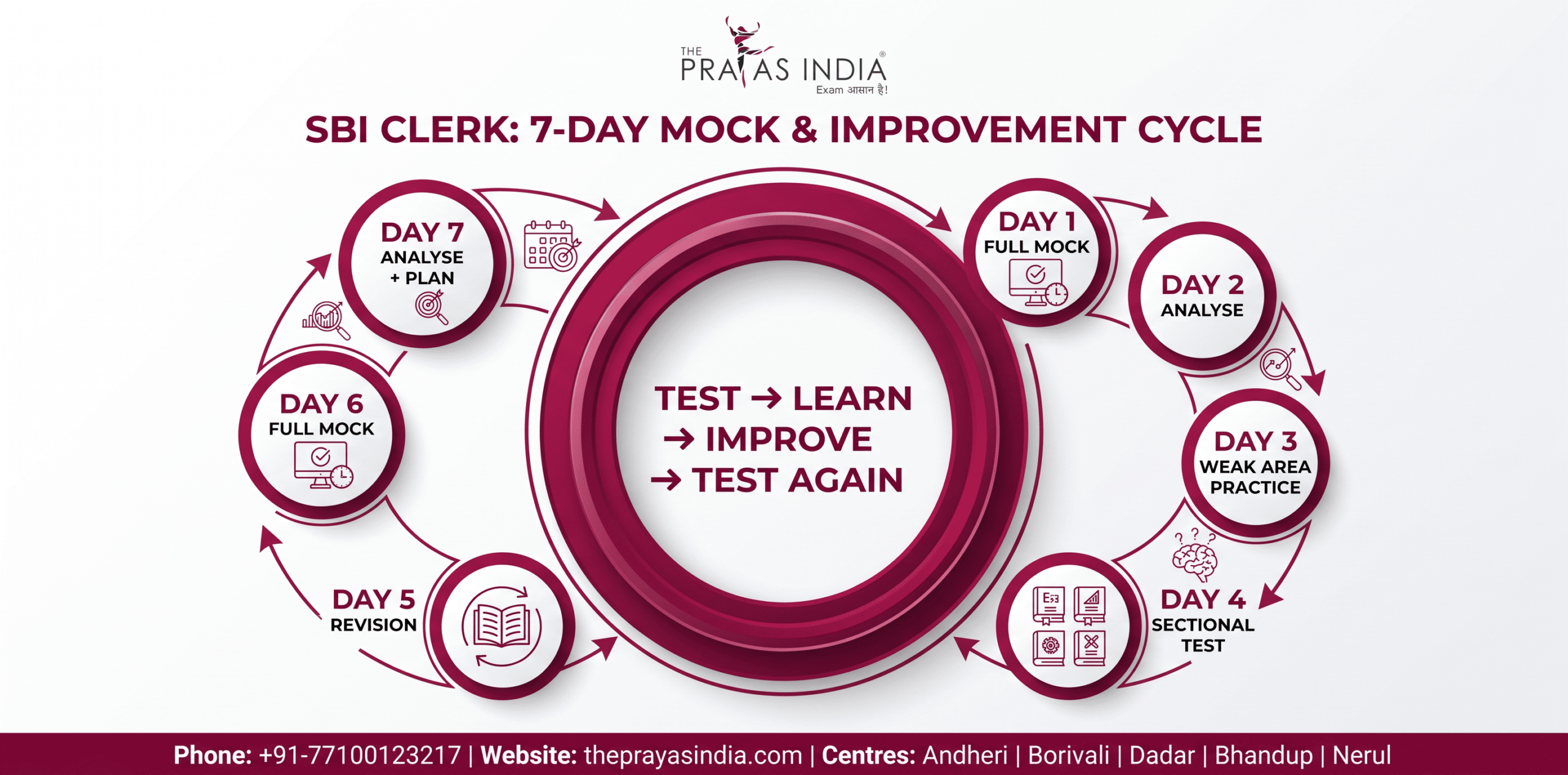
If you want a simple weekly system, you can use a cycle like this:
Day 1 — Full Mock
Take the mock under realistic conditions.
Day 2 — Analysis
Analyse every section and classify mistakes.
Day 3 — Weak Area Practice
Work on the biggest weakness identified.
Day 4 — Sectional Test
Take a focused sectional test.
Day 5 — Revision
Revise concepts, formulas, shortcuts and mistakes.
Day 6 — Full Mock
Attempt another complete test.
Day 7 — Analysis + Revision
Review the second mock and prepare your next week’s strategy.
This cycle can be modified depending on your preparation level and available time.
How to Balance Mock Tests With Revision
A common mistake during the final preparation phase is allowing mock tests to consume all available study time.
Mocks are important, but revision remains essential.
If a mock identifies a weak topic, you should spend time revisiting that topic.
A balanced preparation day can therefore include:
Mock Test: Exam simulation
Mock Analysis: Identify mistakes
Revision: Correct weak concepts
Practice: Solve targeted questions
Short Test: Check whether the correction worked
This creates a complete learning cycle rather than treating mocks as isolated events.
How Coaching Can Support SBI Clerk Mock Preparation
Mock tests become more useful when aspirants know how to interpret their performance.
For many students, simply seeing a score does not explain why the score is low.
Structured SBI Clerk preparation can help students work on the different components of exam performance, including concepts, question selection, speed, accuracy and test analysis.
A coaching programme can also provide a systematic testing schedule rather than leaving students to decide when and how to practise.
For aspirants preparing for SBI Clerk 2026, The Prayas India offers structured preparation through online and offline learning options. Students can use classes, study material, practice, mock tests and guidance to build their preparation systematically.
For students looking for bank exam coaching in Mumbai, The Prayas India has centres at:
Andheri | Borivali | Dadar | Bhandup | Nerul
The advantage of beginning structured preparation before the final stage is that you have more time to identify weaknesses and correct them before the examination.
What Should You Do After SBI Clerk Prelims?
Your preparation should not necessarily stop after the Preliminary Examination.
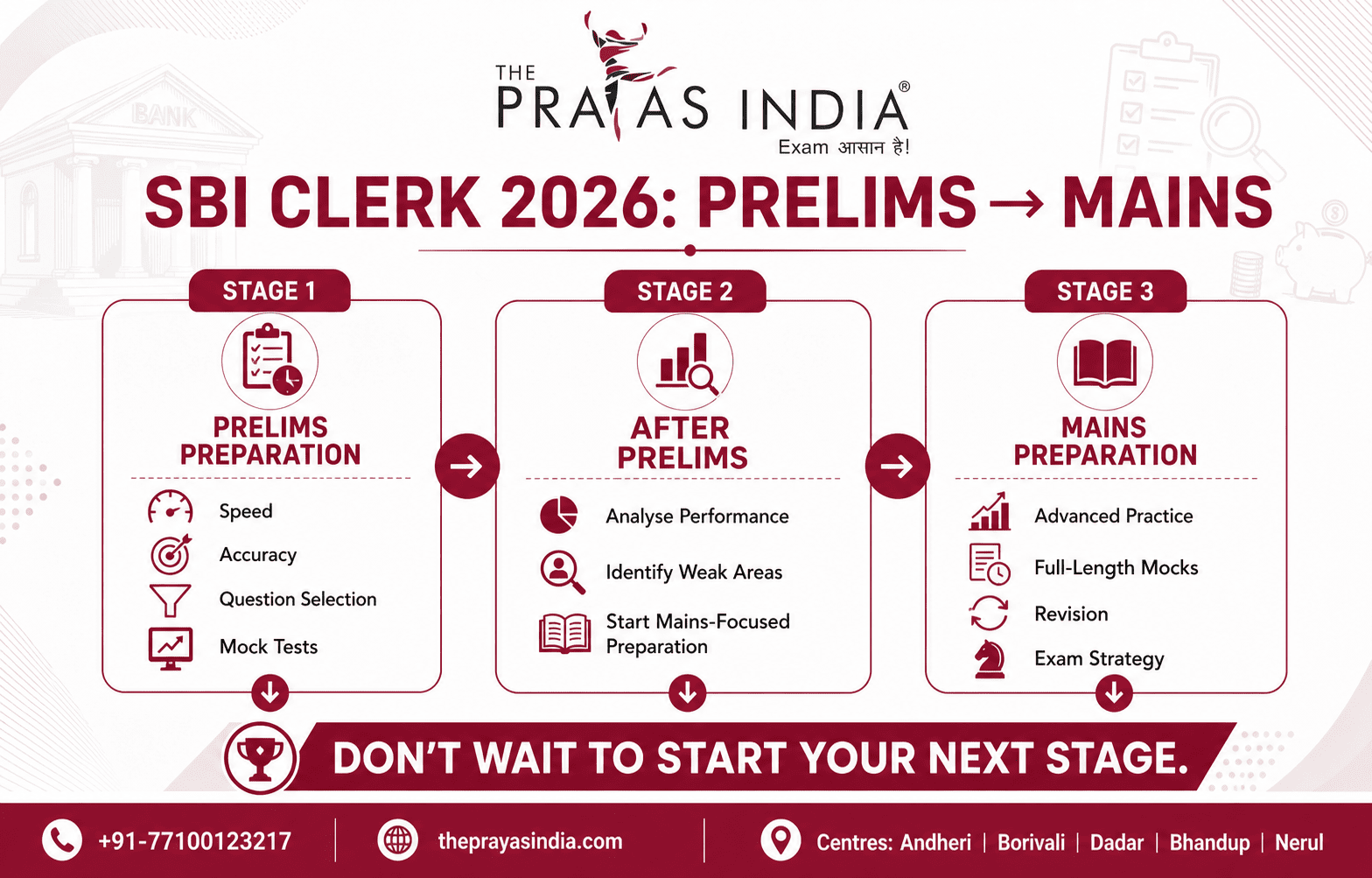
The SBI recruitment process separates Preliminary and Main Examination stages, and the official recruitment notification states that Preliminary Examination marks are not added to the final selection merit; the Main Examination marks are considered for final merit.
Therefore, aspirants targeting the SBI Clerk 2026 cycle should think beyond Prelims.
Once your Prelims preparation becomes stable, start becoming familiar with the requirements of the Mains stage.
Do not wait unnecessarily for the result before beginning every aspect of Mains preparation.
The time between the two stages can be valuable, and a candidate who already has a foundation can use it more effectively.
Final SBI Clerk 2026 Mock-Test Checklist
Before the Prelims, make sure you can answer “yes” to most of these questions:
- Have I taken enough full-length mocks to understand my performance pattern?
- Am I analysing every mock?
- Do I know my strongest section?
- Do I know my weakest section?
- Do I know where I lose time?
- Am I making repeated calculation errors?
- Do I know which questions I should skip?
- Can I maintain accuracy under time pressure?
- Am I revising mistakes between mocks?
- Am I balancing full mocks with sectional tests?
- Have I developed a realistic section-wise strategy?
- Am I preparing for the next stage rather than focusing only on Prelims?
If several answers are “no”, simply taking more mocks may not be the solution. First correct the underlying issue.
Final Thoughts
For SBI Clerk 2026, mock tests should become a learning tool, not just a scorecard.
There is no magic number of mocks that guarantees success. The right number depends on your preparation level, available time, ability to analyse tests and the weaknesses you need to correct.
As the 27 September and 3 October 2026 Prelims approach, your focus should gradually move towards realistic testing, speed, accuracy, question selection and detailed analysis.
Remember the complete process:
Take the Mock → Analyse It → Identify the Problem → Practise the Weak Area → Take the Next Mock
That cycle is far more valuable than simply trying to complete the largest possible number of tests.
And once your Prelims preparation becomes stable, keep the next stage in sight. SBI’s recruitment process places final merit emphasis on the Main Examination, so your preparation should be designed as a complete journey rather than stopping at Prelims.
If you are looking for structured SBI Clerk coaching, The Prayas India provides online and offline preparation support with centres across Andheri, Borivali, Dadar, Bhandup and Nerul.
The right mock-test strategy is ultimately about one thing: making every test teach you something that improves your next performance.
FAQs
How many mocks should I take for SBI Clerk Prelims 2026?
There is no fixed number suitable for every aspirant. During the final preparation phase, many candidates can gradually increase to several full-length mocks per week, provided they analyse each test properly. Quality of analysis should be prioritised over simply increasing mock count.
Should I take an SBI Clerk mock every day?
Not necessarily. Daily mocks are not compulsory. If taking a mock leaves you with no time to analyse and correct your mistakes, taking fewer but better-analysed mocks may be more useful.
When should I start SBI Clerk mock tests?
You can take an early diagnostic mock even before completing the syllabus. As your preparation progresses, gradually increase the frequency of full-length and sectional tests.
How should I analyse my SBI Clerk mock?
Analyse attempts, accuracy, time spent, easy questions missed, unnecessary attempts, conceptual errors, calculation mistakes and question-selection decisions. Then identify one or two specific areas to improve before your next test.
Are sectional tests important for SBI Clerk?
Yes. Full-length mocks provide complete exam simulation, while sectional tests help you work on specific areas such as English, Numerical Ability or Reasoning. Using both can make your preparation more targeted.
What should I do if my SBI Clerk mock scores are not improving?
Do not immediately increase the number of mocks. First identify whether the problem is conceptual knowledge, accuracy, calculation, time management or question selection. Correct the underlying issue and then test again.
Should I prepare for SBI Clerk Mains before Prelims?
You should keep the Mains stage in your overall preparation plan. Since SBI's recruitment process considers Main Examination performance for final merit, candidates should avoid treating Prelims as the end of their preparation.
Does The Prayas India provide SBI Clerk coaching?
Yes. The Prayas India provides structured bank-exam preparation through online and offline learning options. Its Mumbai centres include Andheri, Borivali, Dadar, Bhandup and Nerul.
Want to Crack SBI Clerk 2026 Prelims on Your First Attempt?
Just giving mock tests is not enough; tracking speed and mock analysis is the real key. Get a personalized mock evaluation strategy from our expert banking faculty.
Official Website: theprayasindia.com
Visit Our Centres:
Andheri | Borivali | Dadar | Nerul | Bhandup