SBI Clerk 2026 Notification Out: 9,766 Vacancies, Eligibility, Exam Dates & Complete Recruitment Details
The State Bank of India has opened another major opportunity for banking aspirants with the release of the SBI Clerk 2026 Notification for the recruitment of Junior Associates (Customer Support & Sales).
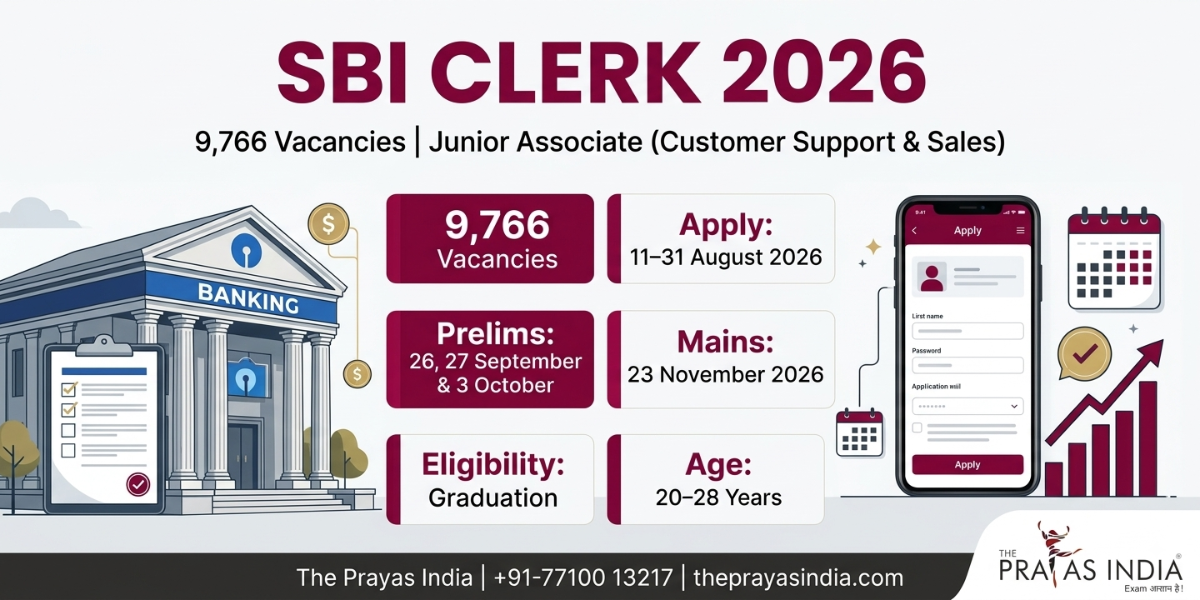
SBI has announced 9,766 vacancies for the 2026–27 recruitment cycle. The online application process has started on 11 August 2026, giving graduates an opportunity to compete for one of the most sought-after clerical positions in the banking sector.
The SBI Clerk recruitment process includes the Preliminary Examination, Main Examination and Local Language Proficiency Test (LPT). Unlike SBI PO recruitment, there is no interview stage for Junior Associate recruitment.
The competition for SBI Clerk is consistently high because of the combination of job security, attractive salary, career growth and the opportunity to work with India’s largest public sector bank. Therefore, candidates should understand the notification carefully and begin preparation according to the latest exam pattern.
In this complete guide, we cover the SBI Clerk 2026 notification, vacancies, important dates, eligibility criteria, application process, selection procedure, exam pattern, salary and preparation requirements.
SBI Clerk 2026 Notification Out
The State Bank of India (SBI) has released the official notification for Junior Associates (Customer Support & Sales) under Advertisement No. CRPD/CR/2026-27/17.
The notification has been released on 11 August 2026, and the online application window is also open from the same date.
Candidates interested in SBI Clerk recruitment should carefully read the official notification before submitting their application. The notification contains important information regarding vacancies, eligibility, state-wise recruitment, examination structure, application requirements and other conditions.
SBI Clerk 2026 Quick Highlights
| Particulars | Details |
|---|---|
| Organisation | State Bank of India (SBI) |
| Post | Junior Associate – Customer Support & Sales |
| Total Vacancies | 9,766 |
| Advertisement No. | CRPD/CR/2026-27/17 |
| Application Mode | Online |
| Registration Dates | 11 August to 31 August 2026 |
| Selection Process | Prelims + Mains + LPT |
| Educational Qualification | Graduation |
| Age Limit | 20 to 28 Years |
| Approx. Starting In-Hand Salary | ₹46,000 |
| Exam Mode | Online |
| Official Website | sbi.bank.in |
📄 Official SBI Clerk 2026 Notification PDF
Candidates should refer to the official notification for complete eligibility conditions, state-wise vacancies, reservation rules and other instructions.
SBI Clerk 2026 Important Dates
Candidates should keep track of the complete recruitment schedule because missing the application deadline can result in losing the opportunity altogether.
The online registration process begins on 11 August 2026 and closes on 31 August 2026.
The Preliminary Examination is scheduled to be conducted on 26 September, 27 September and 3 October 2026, while the Main Examination is scheduled for 23 November 2026.
| Event | Date |
|---|---|
| SBI Clerk Notification 2026 | 11 August 2026 |
| Online Application Starts | 11 August 2026 |
| Last Date to Apply | 31 August 2026 |
| Pre-Examination Training | September 2026 |
| Prelims Admit Card | September 2026 |
| Prelims Examination | 26, 27 September & 3 October 2026 |
| Prelims Result | October/November 2026 |
| Mains Admit Card | November 2026 |
| Mains Examination | 23 November 2026 |
| Final Result | December 2026 / January 2027 |
A Note for Aspirants
The Preliminary Examination is expected to be conducted across multiple shifts. Candidates should therefore start preparing immediately rather than waiting for the admit card or final examination schedule.
With less time between the application window and the Preliminary Examination, consistent preparation from the beginning can make a major difference.
SBI Clerk 2026 Exam Dates
The SBI Clerk recruitment will be conducted in multiple stages.
Preliminary Examination
The Preliminary Examination is scheduled for:
26 September 2026
27 September 2026
3 October 2026
Main Examination
The Main Examination is scheduled for:
23 November 2026
Candidates who qualify in the Preliminary Examination will be shortlisted for the Main Examination.
The final selection process also includes the Local Language Proficiency Test (LPT) for candidates as prescribed by SBI.
SBI Clerk Vacancy 2026 – 9,766 Posts
SBI has announced a total of 9,766 Junior Associate vacancies for the 2026 recruitment cycle.
These include:
- 7,680 Regular Vacancies
- 2,086 Backlog Vacancies
The recruitment is conducted on a state/UT-wise basis. Therefore, candidates should pay particular attention to the vacancy available in the State/UT for which they are applying.
How to Prepare for SBI Clerk 2026 | Prelims & Mains Strategy
SBI Clerk 2026 Regular Vacancy
The regular vacancies announced across different States and Union Territories are given below:
| State/UT | Total Vacancies |
|---|---|
| Gujarat | 330 |
| Karnataka | 760 |
| Madhya Pradesh | 113 |
| Chhattisgarh | 287 |
| Odisha | 1,100 |
| Jammu & Kashmir UT | 84 |
| Himachal Pradesh | 9 |
| Ladakh UT | 7 |
| Tamil Nadu | 1,410 |
| Telangana | 260 |
| Rajasthan | 350 |
| West Bengal | 555 |
| A&N Islands | 15 |
| Sikkim | 60 |
| Uttar Pradesh | 250 |
| Maharashtra | 1,718 |
| Goa | 62 |
| Arunachal Pradesh | 55 |
| Assam | 110 |
| Manipur | 14 |
| Meghalaya | 24 |
| Mizoram | 32 |
| Nagaland | 27 |
| Tripura | 48 |
| Total | 7,680 |
Among the regular vacancies, Maharashtra, Tamil Nadu and Odisha account for a particularly large share of the announced positions.
Candidates should always check the vacancy applicable to their chosen State/UT before applying.
SBI Clerk 2026 Backlog Vacancies
Apart from the regular vacancies, SBI has also reported 2,086 backlog vacancies across different categories, including vacancies related to reserved categories, Persons with Disabilities and eligible ex-servicemen categories.
The detailed backlog distribution should be checked directly from the official notification because it varies considerably from one State/UT to another.
States/UTs With No Reported Vacancies
As stated in the supplied notification details, no vacancies have been reported for:
- Andhra Pradesh
- Bihar
- Haryana
- Jharkhand
- Kerala
- Punjab
- Uttarakhand
- Chandigarh
- Delhi
- Dadra & Nagar Haveli and Daman & Diu
- Lakshadweep
- Puducherry
Candidates should therefore carefully verify the applicable State/UT before completing their application.
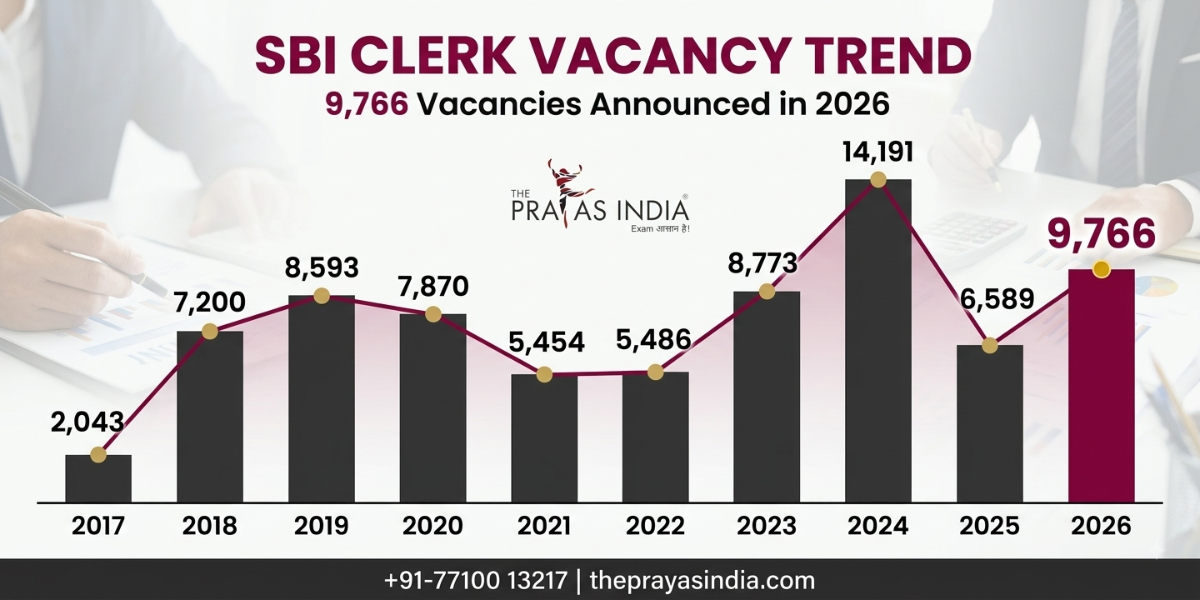
SBI Clerk Vacancy Trend
The number of SBI Clerk vacancies has varied considerably over the years. The 2026 recruitment cycle brings 9,766 vacancies, which is substantially higher than the previous year’s figure.
| Recruitment Year | Vacancies |
|---|---|
| SBI Clerk 2026 | 9,766 |
| SBI Clerk 2025 | 6,589 |
| SBI Clerk 2024 | 14,191 |
| SBI Clerk 2023 | 8,773 |
| SBI Clerk 2022 | 5,486 |
| SBI Clerk 2021 | 5,454 |
| SBI Clerk 2020 | 7,870 |
| SBI Clerk 2019 | 8,593 |
| SBI Clerk 2018 | 7,200 |
| SBI Clerk 2017 | 2,043 |
The vacancy trend shows why candidates should not depend only on the number of available posts. The competition remains high, and preparation quality ultimately determines performance.
SBI Clerk 2026 Eligibility Criteria
Before applying for SBI Clerk 2026, candidates must ensure that they satisfy the educational qualification and age requirements prescribed by SBI.
The two primary eligibility conditions are:
- Educational Qualification
- Age Limit
Candidates must also satisfy other conditions mentioned in the official notification.
SBI Clerk Educational Qualification
Candidates must hold a valid graduation degree in any discipline from a recognised university or an equivalent qualification recognised by the Central Government.
Candidates with an Integrated Dual Degree (IDD) should ensure that they have completed the qualification by the date prescribed in the notification.
Can Final-Year Students Apply for SBI Clerk 2026?
Yes.
Candidates who are in the final year/semester of graduation can apply, subject to the conditions specified by SBI.
However, if provisionally selected, they must produce proof of having successfully completed their graduation within the prescribed timeline.
This makes SBI Clerk an attractive opportunity even for students who are approaching the end of their undergraduate degree.
SBI Clerk Age Limit 2026
The prescribed age limit is:
Minimum Age: 20 years
Maximum Age: 28 years
The age is calculated as on 1 April 2026.
Therefore, candidates should have been born:
Not earlier than 02 April 1998 and not later than 01 April 2006, both dates inclusive.
SBI Clerk Age Relaxation
Upper-age relaxation is available to eligible categories according to SBI and Government of India rules.
| Category | Upper Age Relaxation |
|---|---|
| OBC | 3 Years |
| SC/ST | 5 Years |
| PwBD – General/EWS | 10 Years |
| PwBD – OBC | 13 Years |
| PwBD – SC/ST | 15 Years |
| Ex-Servicemen/Disabled Ex-Servicemen | As per prescribed rules |
| Widows/Divorced Women | As per prescribed conditions |
Additional provisions may apply to eligible trained apprentices of SBI. Candidates claiming any relaxation should carefully verify the relevant conditions in the official notification.
SBI Clerk 2026 Application Form
The online application process for 9,766 SBI Clerk vacancies has started on 11 August 2026.
Eligible candidates should complete the registration process before the deadline of 31 August 2026.
Before submitting the form, applicants should keep their photograph, signature, educational details, identity documents and other required information ready.
Important Application Advice
Do not wait until the last day to submit the application. Technical issues, payment failures or incorrect information can create unnecessary problems close to the deadline.
Candidates should carefully review the application before final submission.
🔗 Direct Application Link
SBI Clerk 2026 Application Fee
The application fee varies according to the candidate’s category.
| Category | Application Fee |
|---|---|
| SC/ST/PwBD | Nil |
| General/OBC/EWS | ₹750 |
The application fee/intimation charges, once paid, are non-refundable and cannot be adjusted against another examination or recruitment.
SBI Clerk 2026 Selection Process
The SBI Clerk recruitment process consists of three stages:
Stage 1 – Preliminary Examination
Candidates first appear for the online Preliminary Examination.
Stage 2 – Main Examination
Candidates qualifying in the Preliminary Examination are shortlisted for the Mains.
Stage 3 – Local Language Proficiency Test
Candidates must demonstrate proficiency in the specified local language applicable to the State/UT for which they have applied, as per SBI’s rules.
No Interview
One major advantage of SBI Clerk recruitment is that there is no interview stage.
Therefore, candidates should concentrate primarily on clearing the written examinations and fulfilling the language proficiency requirement.
A Special Note for SBI Trained Apprentices
Eligible trained apprentices of SBI may receive bonus marks in the Main Examination, subject to the conditions mentioned in the official notification.
As per the supplied notification details, such candidates may receive 2.5% of the maximum Mains marks, equivalent to 5 marks out of 200.
Candidates belonging to this category should carefully read the applicable conditions before applying.
What Makes SBI Clerk 2026 Different?
The SBI Clerk recruitment offers a combination of:
Large Number of Vacancies + No Interview + Attractive Salary + Public Sector Bank Career
However, the competition remains intense.
Candidates who start preparing only after clearing the Preliminary Examination often struggle to build sufficient Mains-level preparation in time.
The smarter approach is to prepare for Prelims and Mains simultaneously, while gradually improving speed, accuracy, General/Financial Awareness and Computer Aptitude.
SBI Clerk 2026 Exam Pattern, Syllabus, Languages, Salary & Exam Analysis
Understanding the SBI Clerk examination pattern is one of the first steps toward building an effective preparation strategy. The recruitment process includes Prelims, Mains and the Local Language Proficiency Test (LPT).
Since the Preliminary and Main examinations test different skill sets, candidates should not treat them as separate preparation phases. A strong preparation plan should gradually cover the complete syllabus while improving speed, accuracy and question-selection ability.
SBI Clerk 2026 Exam Pattern & Syllabus
The SBI Clerk examination is conducted online. Candidates first appear for the Preliminary Examination, followed by the Main Examination for those who qualify.
One important point mentioned in the SBI Clerk 2026 notification is that no minimum qualifying marks are prescribed for individual subjects. Candidates should nevertheless aim for a balanced performance across sections because the overall selection depends on competitive merit.
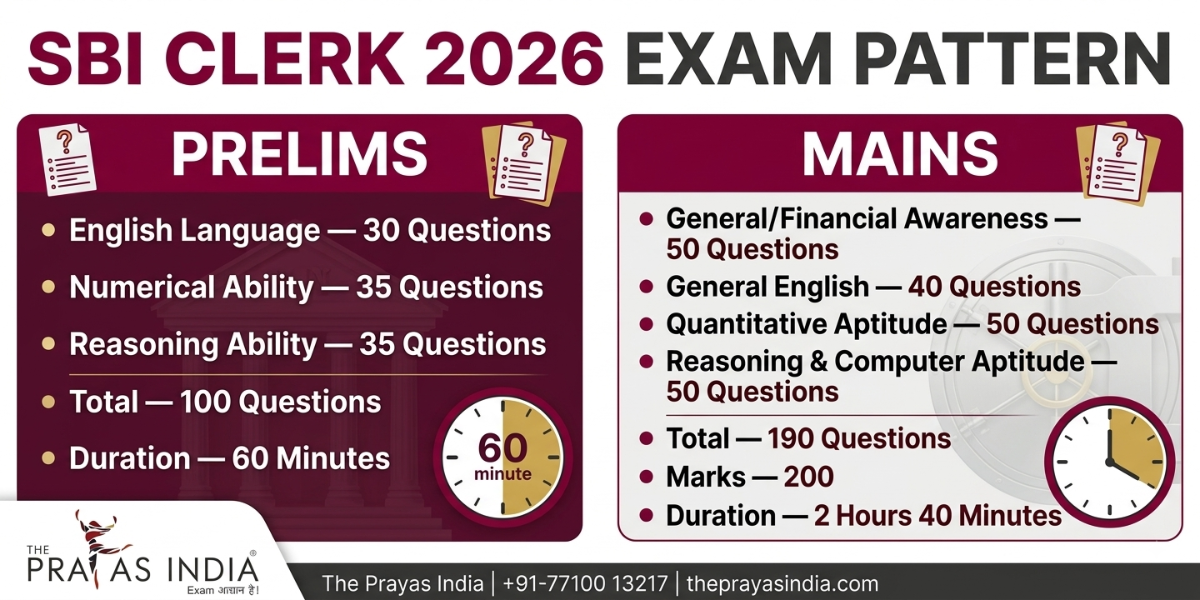
SBI Clerk Preliminary Exam Pattern 2026
The Preliminary Examination consists of three sections:
| Section | Questions | Marks | Duration |
|---|---|---|---|
| English Language | 30 | 30 | 20 Minutes |
| Numerical Ability | 35 | 30 | 20 Minutes |
| Reasoning Ability | 35 | 35 | 20 Minutes |
| Total | 100 | 100 | 60 Minutes |
The exam is divided into separate time slots for each section. Candidates therefore cannot freely transfer time from one section to another.
What This Means for Aspirants
The sectional time limit makes speed and question selection extremely important.
A candidate may know how to solve a question but still lose marks if too much time is spent on it.
The ideal strategy is to:
- Identify easy questions quickly
- Avoid lengthy questions during the first pass
- Maintain high accuracy
- Leave sufficient time for manageable questions
- Practise with sectional timers
SBI Clerk Mains Exam Pattern 2026
The Main Examination is more comprehensive and carries greater importance in the recruitment process.
| Section | Questions | Marks | Duration |
|---|---|---|---|
| General/Financial Awareness | 50 | 50 | 35 Minutes |
| General English | 40 | 40 | 35 Minutes |
| Quantitative Aptitude | 50 | 50 | 45 Minutes |
| Reasoning Ability & Computer Aptitude | 50 | 60 | 45 Minutes |
| Total | 190 | 200 | 2 Hours 40 Minutes |
The Mains examination tests not only aptitude but also a candidate’s awareness of banking, finance, current events and computer fundamentals.
This is why candidates should not postpone Mains preparation until after the Prelims result.
SBI Clerk Prelims vs Mains
| Feature | Prelims | Mains |
|---|---|---|
| Sections | 3 | 4 |
| Questions | 100 | 190 |
| Marks | 100 | 200 |
| Duration | 60 Minutes | 160 Minutes |
| Main Focus | Speed & Accuracy | Accuracy + Conceptual Depth + Awareness |
| General/Financial Awareness | No | Yes |
| Computer Aptitude | No | Yes |
| English | Yes | Yes |
The Preliminary Examination acts as the first screening stage, while the Mains examination plays a crucial role in determining merit.
SBI Clerk Syllabus 2026
Aspirants should divide the syllabus into smaller preparation modules rather than attempting to cover everything simultaneously.
English Language
Important areas include:
- Reading Comprehension
- Error Detection
- Cloze Test
- Fillers
- Sentence Improvement
- Phrase Replacement
- Para Jumbles
- Sentence Rearrangement
- Word Usage
- Vocabulary
- Grammar
- Word Swapping
How to Prepare English
Focus on building reading speed and understanding sentence structure. Regular reading, vocabulary revision and solving previous-year questions can help improve performance.
Instead of memorising hundreds of words randomly, candidates should learn vocabulary through context and repeated usage.
Numerical Ability / Quantitative Aptitude
Important topics include:
- Simplification
- Approximation
- Number Series
- Quadratic Equations
- Data Interpretation
- Arithmetic
- Percentage
- Profit & Loss
- Ratio & Proportion
- Average
- Time & Work
- Time, Speed & Distance
- Simple & Compound Interest
- Mensuration
- Data Sufficiency
How to Prepare Quantitative Aptitude
The biggest challenge in this section is often not understanding the concept but solving questions within the available time.
Candidates should first develop calculation accuracy and then work on speed.
Daily practice should include a combination of:
Concept → Practice → Timed Questions → Analysis
Reasoning Ability
The Reasoning section generally includes topics such as:
- Puzzles
- Seating Arrangement
- Syllogism
- Inequality
- Coding-Decoding
- Blood Relations
- Direction Sense
- Ranking
- Alphanumeric Series
- Logical Reasoning
- Meaningful Words
- Input-Output
- Miscellaneous Reasoning Questions
The Puzzle Factor
Puzzles and seating arrangements can consume significant time if approached incorrectly.
Candidates should practise different formats instead of repeatedly solving the same type of puzzle.
The objective should be to learn how to identify the structure of a puzzle quickly and decide whether it is worth attempting.
Computer Aptitude
Computer Aptitude is included with Reasoning Ability in the SBI Clerk Mains examination.
Important areas include:
- Computer Fundamentals
- Hardware
- Software
- Operating Systems
- Internet
- Networking
- Databases
- MS Office
- Cybersecurity
- Digital Banking
- Basic Computer Terminology
Candidates do not necessarily need advanced technical knowledge. A clear understanding of basic computer concepts and banking technology is important.
General & Financial Awareness
This section can significantly influence the Mains score.
Important areas include:
- Current Affairs
- Banking Awareness
- RBI
- Monetary Policy
- Financial Institutions
- Government Schemes
- Banking Terms
- Reports & Indexes
- Appointments
- Important Economic Developments
- Financial Awareness
- Static Awareness
The Right Way to Prepare Current Affairs
Current affairs should not be treated as a last-week subject.
A better approach is:
Daily Current Affairs → Weekly Revision → Monthly Compilation → Mock Quiz → Final Revision
Candidates should give special attention to banking and financial developments, RBI-related updates and major government initiatives.
SBI Clerk Exam Languages
SBI allows candidates to appear for the examination in the languages specified for their respective State/UT, along with English and Hindi where applicable.
The local language requirement is particularly important because candidates applying for a State/UT must satisfy the prescribed language proficiency condition.
SBI Clerk 2026 Language List
| State/UT | Local Language(s) |
|---|---|
| Gujarat | Gujarati |
| Karnataka | Kannada |
| Madhya Pradesh | Hindi |
| Chhattisgarh | Hindi |
| Odisha | Odia |
| Jammu & Kashmir | Urdu/Hindi |
| Himachal Pradesh | Hindi |
| Ladakh | Urdu/Ladakhi/Bhoti |
| Tamil Nadu | Tamil |
| Telangana | Telugu/Urdu |
| Rajasthan | Hindi |
| West Bengal | Bengali/Nepali |
| Andaman & Nicobar Islands | Hindi/English |
| Sikkim | Nepali/English |
| Uttar Pradesh | Hindi/Urdu |
| Maharashtra | Marathi |
| Goa | Konkani |
| Arunachal Pradesh | English |
| Assam | Assamese/Bengali/Bodo |
| Manipur | Manipuri/English |
| Meghalaya | English/Garo/Khasi |
| Mizoram | Mizo |
| Nagaland | English |
| Tripura | Bengali/Kokborok |
Candidates should verify the language requirement applicable to their selected State/UT in the official notification before submitting the application.
Local Language Proficiency Test (LPT)
The Local Language Proficiency Test is an important stage of the SBI Clerk selection process.
Candidates must demonstrate proficiency in the specified local language applicable to the State/UT for which they have applied.
The purpose of the test is to ensure that selected Junior Associates can effectively communicate with customers in the local region.
Candidates who studied the specified local language as part of their educational qualification may be able to satisfy the language requirement through the prescribed documentation, subject to SBI’s rules.
Those who need to appear for the LPT should prepare for reading, writing, speaking and understanding the relevant language according to the requirements.
SBI Clerk Salary 2026
One of the major reasons candidates prefer SBI Clerk recruitment is the attractive compensation package and long-term career growth.
The starting in-hand salary is approximately ₹46,000, depending on the place of posting and applicable allowances.
The basic pay starts at approximately ₹26,730, including the applicable advance increments for graduates.
The pay scale is:
₹24,050 – 1,340/3 – 28,070 – 1,650/3 – 33,020 – 2,000/4 – 41,020 – 2,340/7 – 57,400 – 4,400/1 – 61,800 – 2,680/1 – 64,480
The overall salary package also includes applicable allowances and benefits.
SBI Clerk Job Profile
A Junior Associate is often one of the first points of contact between the bank and its customers.
The job may involve:
- Customer service
- Account-related services
- Cash-related operations
- Deposits and withdrawals
- Cheque-related work
- Banking documentation
- Digital banking assistance
- Customer queries
- Cross-selling relevant banking products
- Day-to-day branch operations
The role offers exposure to different aspects of banking operations and can provide a strong foundation for a long-term banking career.
SBI Clerk Career Growth
Joining SBI as a Junior Associate is not necessarily the end goal.
Employees can progress through internal promotional opportunities based on the applicable rules, experience, performance and qualifying examinations.
A clerical position can therefore become the starting point for a longer banking career.
For candidates who want to build their future in the banking sector, SBI offers opportunities to develop professional knowledge while gaining practical experience in one of India’s largest banks.
SBI Clerk Previous-Year Exam Analysis
Previous-year examination trends can help candidates understand the types of questions generally asked and the approximate difficulty level.
The supplied previous-year analysis indicates that the SBI Clerk Prelims 2025 was broadly in the easy to moderate range.
However, aspirants should not assume that the same difficulty level will be repeated in 2026.
Competitive exams are relative. Even when the paper is easy, the required score can remain high because a large number of candidates attempt the examination.
SBI Clerk English Language – Previous Exam Trend
The previous examination included topics such as:
| Topic | Questions |
|---|---|
| Reading Comprehension | 8 |
| Error Detection | 5 |
| Word Usage | 3 |
| Sentence Rearrangement | 5 |
| Word Swapping | 4 |
| Cloze Test | 5 |
| Total | 30 |
The section was broadly reported as Easy to Moderate.
The distribution demonstrates why candidates should prepare both grammar and reading-based topics.
SBI Clerk Reasoning – Previous Exam Trend
The previous paper included:
| Topic | Questions |
|---|---|
| Row-Based Puzzle | 5 |
| Circular Puzzle | 5 |
| Floor/Flat-Based Puzzle | 5 |
| Syllogism | 3 |
| Inequality | 3 |
| Blood Relations | 4 |
| Order & Ranking | 4 |
| Meaningful Word | 1 |
| Pairing | 1 |
| Alphanumeric Series | 4 |
| Total | 35 |
The overall section was reported as Easy in the supplied analysis.
This highlights the importance of mastering frequently asked basic reasoning concepts before moving toward more complex puzzle types.
SBI Clerk Numerical Ability – Previous Exam Trend
The previous paper included:
| Topic | Questions |
|---|---|
| Data Interpretation | 5 |
| Caselet DI | 6 |
| Wrong Number Series | 6 |
| Simplification | 10 |
| Arithmetic | 8 |
| Total | 35 |
The section was broadly Easy to Moderate.
Simplification and arithmetic can provide scoring opportunities, but only when candidates have strong calculation speed and accuracy.
SBI Clerk Previous-Year Cut-Off
Cut-off marks are an important part of competitive exam analysis.
SBI releases cut-off information for the relevant recruitment stages. Since cut-offs can vary according to factors such as:
- Number of vacancies
- Number of candidates
- Difficulty level
- State/UT
- Candidate performance
aspirants should avoid relying on a single year’s cut-off as a guaranteed benchmark.
For reference, the supplied SBI Clerk 2024 Preliminary cut-off data includes:
| State/UT | General Cut-Off |
|---|---|
| Andhra Pradesh | 68.75 |
| Arunachal Pradesh | 68.75 |
| Assam | 60.75 |
| Bihar | 47.25 |
| Chhattisgarh | 29.50 |
| Chandigarh | 65.25 |
| Delhi | 67.00 |
| Gujarat | 47.00 |
| Haryana | 64.00 |
| Himachal Pradesh | 68.50 |
| Jammu | 66.50 |
| Jharkhand | 42.25 |
| Karnataka | 72.50 |
| Kerala | 64.00 |
| Madhya Pradesh | 49.25 |
| Maharashtra | 44.75 |
| Meghalaya | 54.75 |
| Manipur | 37.00 |
| Odisha | 64.25 |
| Punjab | 60.25 |
| Rajasthan | 59.50 |
| Sikkim | 39.75 |
| Tamil Nadu | 55.50 |
| Telangana | 60.00 |
| Tripura | 64.00 |
| Uttar Pradesh | 61.75 |
| Uttarakhand | 64.75 |
| West Bengal | 61.25 |
Important: Previous-year cut-offs should be used only as a reference. Candidates should target a comfortable score above the expected competitive range rather than preparing merely to cross the previous cut-off.
How to Read SBI Clerk Cut-Off Trends
A cut-off is not a preparation target.
For example, if a particular State recorded a cut-off of 60 in a previous year, targeting exactly 60 in the next examination is risky.
A better strategy is to aim for a margin of safety.
The focus should be:
High Accuracy + Strong Attempt Selection + Consistent Mock Performance
Instead of asking, “How many marks are enough?”, aspirants should ask:
“How can I consistently score higher than the expected competitive range?”
That change in approach can significantly improve preparation quality.
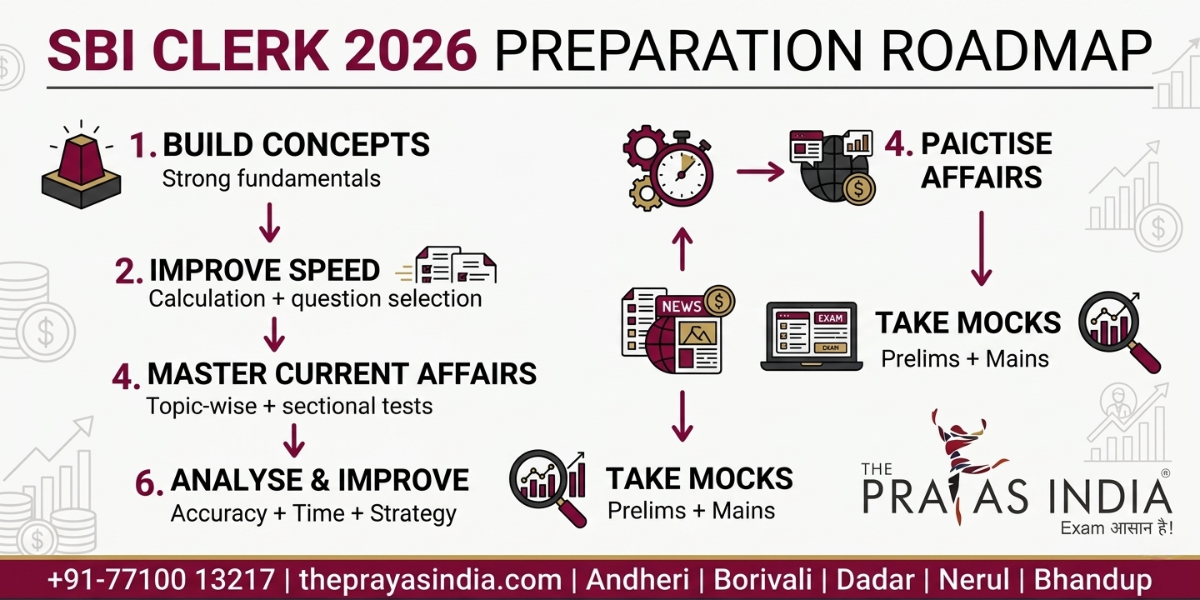
How to Prepare for SBI Clerk 2026
The SBI Clerk syllabus is manageable, but the competition makes preparation demanding.
The biggest mistake candidates make is preparing only for the Preliminary Examination.
A better strategy is to prepare for Prelims and Mains together, with different priorities at different stages.
Step 1: Build Strong Fundamentals
Start with the basic concepts of:
- Quantitative Aptitude
- Reasoning
- English
- Computer Aptitude
- Banking Awareness
- Current Affairs
Do not rush into full-length mocks before understanding the basic concepts.
Step 2: Develop Calculation Speed
Quantitative Aptitude is heavily dependent on calculation speed.
Practise:
- Tables
- Squares
- Cubes
- Fractions
- Percentage conversions
- Approximation
- Simplification
Even a small improvement in calculation speed can save valuable seconds across multiple questions.
Step 3: Practise Reasoning Strategically
Do not solve every puzzle you see.
Learn to identify:
Easy Puzzle → Moderate Puzzle → Time-Consuming Puzzle
During the actual examination, question selection is as important as solving ability.
Step 4: Make English a Daily Subject
Instead of studying English only twice a week, spend some time on it every day.
A daily routine can include:
- Reading comprehension
- Vocabulary
- Grammar
- Error detection
- Cloze tests
- Sentence rearrangement
Consistency is more useful than occasional long study sessions.
Step 5: Start Current Affairs Early
General and Financial Awareness can become one of the most important differentiators in the Mains examination.
Maintain monthly current affairs notes and revise them repeatedly.
Focus particularly on:
- Banking
- RBI
- Financial markets
- Government schemes
- Important appointments
- Reports
- Economic developments
- National and international events
Step 6: Take Sectional Tests
Before jumping directly into full-length mocks, take sectional tests.
For example:
Monday: Quantitative Aptitude
Tuesday: Reasoning
Wednesday: English
Thursday: Quantitative Aptitude
Friday: Reasoning
Saturday: English + GA
Sunday: Full-Length Mock
The exact schedule can be modified according to the student’s strengths and weaknesses.
Step 7: Analyse Every Mock
Taking a mock test without analysing it is one of the biggest mistakes in competitive exam preparation.
After every mock, classify questions into:
1. Correct & Fast
Keep practising to maintain consistency.
2. Correct but Slow
Work on shortcuts and question selection.
3. Incorrect Due to Concept
Return to the topic and revise fundamentals.
4. Incorrect Due to Calculation/Reading Error
Improve attention and checking habits.
5. Not Attempted
Determine whether the question was genuinely difficult or whether more practice is needed.
This approach converts every mock test into a learning exercise.
Don’t Wait for the Prelims Result to Start Mains Preparation
This deserves special attention.
The time between the Preliminary result and Mains examination may not be enough to build General/Financial Awareness and advanced-level preparation from scratch.
Therefore, candidates should maintain at least a basic Mains preparation routine from the beginning.
A smart approach is:
Prelims Focus + Mains Foundation
As the Preliminary Examination approaches, shift more time toward speed and sectional practice while continuing Mains-oriented General Awareness and advanced topics.
SBI Clerk Preparation Strategy at a Glance
| Preparation Area | What to Focus On |
|---|---|
| Quantitative Aptitude | Concepts + Calculation Speed |
| Reasoning | Puzzles + Question Selection |
| English | Grammar + Reading + Vocabulary |
| Current Affairs | Daily Study + Monthly Revision |
| Banking Awareness | RBI + Banking + Financial Awareness |
| Computer | Fundamentals + Digital Banking |
| Mock Tests | Regular Full-Length & Sectional Tests |
| Analysis | Identify Accuracy & Time Issues |
| Revision | Weekly + Monthly Revision |
The Smart Way to Approach SBI Clerk 2026
SBI Clerk is not an examination where simply completing the syllabus guarantees success.
Two candidates can study the same topics for the same number of hours and still achieve very different results.
The difference usually comes from:
How they practise.
How they analyse mistakes.
How they manage time.
How they select questions.
A candidate who regularly analyses mock performance can identify problems much earlier than someone who only keeps taking tests.
For this reason, preparation should follow a simple cycle:
Learn → Practise → Test → Analyse → Revise → Repeat
This cycle should continue throughout the preparation period.
What Should SBI Clerk Aspirants Do Now?
With the application window open from 11 August to 31 August 2026 and the Preliminary Examination scheduled from 26 September, candidates have limited preparation time before the first stage.
The immediate priorities should be:
✓ Complete the application correctly
✓ Understand the complete syllabus
✓ Take a diagnostic mock
✓ Identify weak areas
✓ Build a daily study schedule
✓ Start sectional practice
✓ Begin current affairs preparation
✓ Take regular mocks
✓ Analyse performance after every test
Most importantly, do not wait for the final weeks to begin serious preparation.
The candidates who use the available time systematically will have a much stronger chance of entering the examination with confidence.
How to Prepare for SBI Clerk 2026
A strong preparation strategy should follow four stages:
Learn → Practise → Test → Analyse
Start with the basics and gradually move towards timed practice and full-length mocks.
1. Build Strong Fundamentals
Before focusing heavily on mock tests, make sure your basic concepts are clear.
Give priority to frequently tested areas such as:
- Simplification and Arithmetic
- Data Interpretation
- Puzzles and Seating Arrangement
- Syllogism and Inequality
- Reading Comprehension
- Error Detection
- Cloze Test
Strong fundamentals will make it easier to improve speed later.
2. Improve Speed and Accuracy
SBI Clerk Prelims consists of 100 questions to be attempted in 60 minutes, with separate time limits for each section.
Therefore, knowing the solution is not enough. Candidates must learn to identify which questions should be attempted first and which ones should be skipped.
Practise questions with a timer and gradually reduce the time taken for familiar topics.
The target should not simply be more attempts. The target should be more correct attempts.
Prepare for Prelims and Mains Together
One of the most common mistakes is waiting for the Preliminary result before starting Mains preparation.
The Mains examination includes:
- General/Financial Awareness
- General English
- Quantitative Aptitude
- Reasoning & Computer Aptitude
Current affairs and banking awareness require continuous revision, so they should be part of your preparation from the beginning.
A practical approach is to focus more heavily on Prelims as the exam approaches while continuing daily Mains preparation.
SBI Clerk Mock Test Strategy
Mock tests should become an important part of your preparation once your basic concepts are reasonably strong.
Begin with sectional tests and gradually move to full-length mocks.
After every mock, analyse:
- Incorrect answers
- Questions that consumed excessive time
- Questions left unnecessarily
- Topics with low accuracy
- Sections requiring better time management
A mock test is useful only when you learn something from it.
The objective is not to take more mocks. It is to become better after every mock.
A Simple SBI Clerk Study Routine
Candidates can modify the schedule according to their individual availability.
| Activity | Suggested Time |
|---|---|
| Quantitative Aptitude | 1.5 Hours |
| Reasoning | 1.5 Hours |
| English | 1 Hour |
| Current & Financial Affairs | 45 Minutes |
| Sectional Practice | 45 Minutes |
| Revision & Error Analysis | 30 Minutes |
Working professionals and college students can divide these sessions into smaller study blocks according to their daily schedule.
Previous-Year Questions Are Essential
Previous-year SBI Clerk questions help candidates understand:
- Frequently tested topics
- Question formats
- Difficulty level
- Section-wise trends
- Time requirements
Solve previous-year questions after completing the relevant concepts. This will help you understand how theoretical concepts are converted into actual examination questions.
Common SBI Clerk Preparation Mistakes
Avoid these mistakes during preparation:
- Preparing only for Prelims
- Ignoring Current Affairs until the last month
- Taking mock tests without analysing them
- Spending too much time on difficult questions
- Using too many books and study resources
- Ignoring previous-year papers
- Focusing only on attempts instead of accuracy
- Starting serious preparation at the last moment
A limited set of reliable resources, used consistently, is usually more effective than constantly changing study material.
How The Prayas India Supports SBI Clerk Preparation
Preparing for a competitive banking examination becomes more structured when students have access to experienced faculty, updated study material and regular performance evaluation.
At The Prayas India, SBI Clerk preparation is designed around the requirements of the latest examination pattern.
Expert Faculty
Experienced educators focus on concept clarity, shortcuts, problem-solving approaches and examination strategies.
Updated Study Material
Study resources are aligned with the latest syllabus and changing trends in banking examinations.
Regular Mock Tests
Students can practise through sectional and full-length tests to develop speed, accuracy and examination temperament.
Performance Analysis
Mock performance is analysed to identify weak topics, accuracy issues and time-management problems.
Current Affairs Preparation
Regular coverage of current affairs, banking awareness and financial developments helps students prepare for the Mains examination.
Doubt-Solving Support
Students receive guidance when they face difficulty understanding concepts or solving questions.
Start SBI Clerk Preparation Without Delay
The SBI Clerk 2026 application window is open from 11 August to 31 August 2026, while the Preliminary Examination is scheduled for 26 September, 27 September and 3 October 2026.
The available preparation time should therefore be used carefully.
Instead of waiting for the examination date to approach, begin with a clear plan:
Build concepts → Practise questions → Take mocks → Analyse mistakes → Revise → Repeat
With consistent preparation and the right guidance, the SBI Clerk 2026 recruitment can become a valuable opportunity to begin a career with the State Bank of India.