SBI Clerk Prelims Time Management: How to Attempt 100 Questions in 60 Minutes | Best Bank Coaching in Mumbai | The Prayas India
The SBI Clerk Prelims examination is often described as a test of speed, but that description is only partially correct. With 100 questions to be attempted in 60 minutes, the real challenge is not simply solving questions quickly. It is deciding which questions deserve your time, which questions should be skipped, and how to prevent one difficult question from disturbing the rhythm of the entire paper.
For many SBI Clerk aspirants, the problem becomes visible during mock tests. They may know the concepts, have practised hundreds of questions, and still struggle to complete the paper within the allotted time. A candidate may spend three or four minutes on a difficult reasoning puzzle, get stuck on a lengthy numerical question, or spend too much time trying to achieve 100% accuracy. By the time they move ahead, several easier questions remain unanswered.
This is why SBI Clerk Prelims time management needs to be treated as a separate preparation skill. Knowing the syllabus is one thing; converting that knowledge into maximum attempts within 60 minutes is another.
For candidates preparing for SBI Clerk 2026, the objective should not be to blindly attempt all 100 questions. The smarter objective is to build a strategy that allows you to identify high-confidence questions, maintain accuracy, manage sectional time effectively and maximise your overall score.
For aspirants looking for structured preparation, regular mock-test practice and expert guidance, choosing the right bank exam coaching in Mumbai can make this process considerably more systematic. The Prayas India focuses on helping banking aspirants develop not just conceptual knowledge but also the speed, accuracy and exam temperament required for competitive examinations.
The SBI Clerk Prelims Paper Is a Race Against the Clock
The first thing an aspirant needs to understand is that the SBI Clerk Prelims is not a conventional examination where you can comfortably solve every question in sequence. You have 60 minutes for 100 questions, with separate sections for English Language, Numerical Ability and Reasoning Ability.
That creates an average of only 36 seconds per question. However, this does not mean that every question should be solved in 36 seconds. Some questions can take less than 15 seconds, while others may require considerably more time. The entire strategy depends on creating enough time through quick questions so that you can afford to spend additional seconds on questions that genuinely require calculation or logical processing.
This is where many beginners make their first mistake. They calculate the average time per question and try to maintain the same speed throughout the paper. Competitive exams do not work that way. Your time should be distributed according to the difficulty and potential value of the questions.
A straightforward inequality, a familiar grammar question, a direct simplification or an easy reasoning question can give you a mark in a relatively short time. A complicated puzzle or lengthy arithmetic calculation may consume several times that amount of time. Treating both questions equally from a time-management perspective is therefore inefficient.
The better approach is to think of the paper as a collection of opportunities. Your job is to collect the easier marks first and then use the remaining time intelligently.
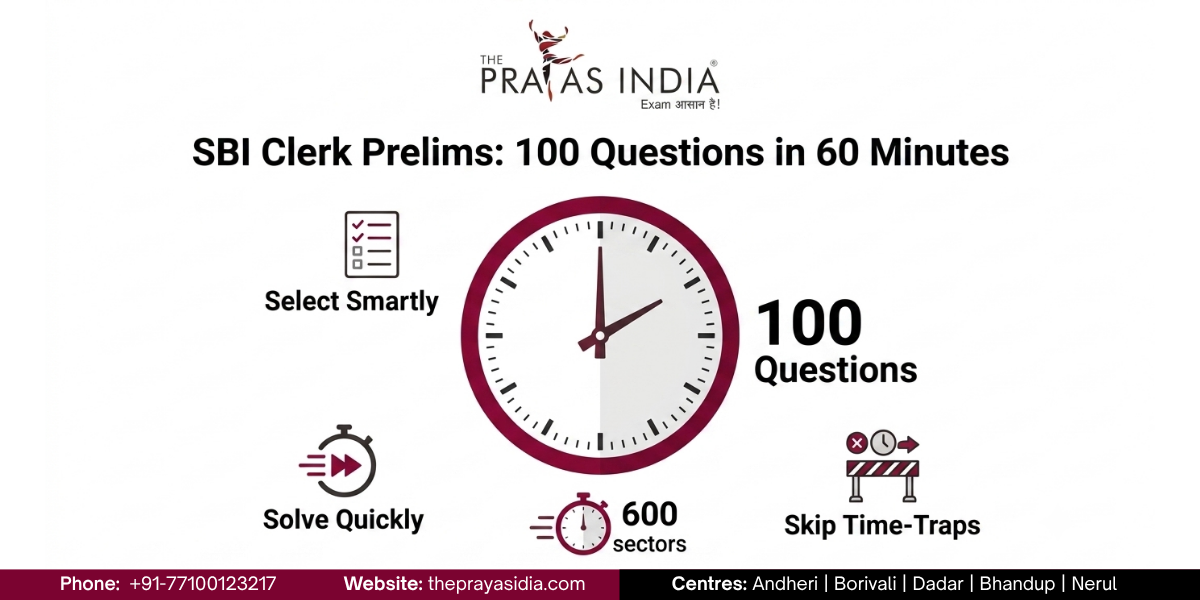
Do Not Begin Your Preparation With the Target of 100 Attempts
The phrase “100 questions in 60 minutes” can create unnecessary pressure, especially among first-time banking aspirants. It is important to understand that attempting 100 questions is not the same as performing well in the SBI Clerk Prelims.
A candidate who attempts a large number of questions with avoidable mistakes can perform worse than another candidate who attempts fewer questions with substantially better accuracy. The actual target should therefore be based on your preparation level, mock-test performance, question difficulty and accuracy.
During the early stages of preparation, your priority should be to understand which questions you can solve confidently and quickly. As your practice improves, you should gradually increase your attempts without allowing accuracy to collapse.
For example, if your mock-test attempts increase from 70 to 80 and your accuracy remains strong, that is meaningful progress. If your attempts rise from 80 to 90 but your mistakes increase sharply, the increase may not represent genuine improvement.
This is one of the reasons structured mock-test analysis becomes important. A good coaching environment should not simply provide a mock-test score. It should help you understand where your time went, which questions consumed excessive time, which topics caused mistakes and which easy questions you left behind.
That distinction can be particularly valuable for students preparing through a banking coaching institute in Mumbai because the right guidance can shorten the trial-and-error phase of preparation.
The Three-Phase Approach to SBI Clerk Prelims Time Management
Instead of trying to solve the paper in one continuous flow, aspirants can think of the examination in three broad phases.
The first phase is selection. During this stage, your priority is to identify questions that look familiar, manageable and high-confidence. You should avoid getting emotionally attached to a difficult question. If a question appears likely to consume significant time, leave it and move forward.
The second phase is execution. Once you have collected the easier questions, you can return to questions that require moderate calculation or reasoning. Because you have already secured several attempts, you can approach these questions with less pressure.
The third phase is review and opportunity hunting. The final portion of your available time should not automatically become a race to attempt every remaining question. Instead, look for questions that you may have initially skipped but can now solve quickly. If there are questions requiring lengthy calculations or uncertain guessing, they may still not deserve your time.
This three-phase mindset is more useful than constantly looking at the clock after every question. Your objective is to maintain a steady rhythm while making sensible decisions.
Section-Wise Time Management Matters
The three sections of SBI Clerk Prelims demand different approaches. English Language generally rewards reading ability, vocabulary, grammar awareness and familiarity with common question patterns. Numerical Ability requires calculation speed along with topic selection. Reasoning Ability can offer several quick-scoring questions, but puzzles and seating arrangements can also consume substantial time.
Because of these differences, a single fixed strategy cannot work equally well for every candidate.
A student who is naturally strong in English may be able to complete the section comfortably and use the saved time more strategically elsewhere, depending on the examination interface and sectional rules. Another student may need additional practice to improve reading speed and avoid spending too long on individual questions.
Similarly, in Numerical Ability, calculation speed can have a major impact on the number of questions you can attempt. Knowing formulas is not enough if basic calculations repeatedly consume too much time. In Reasoning, the ability to distinguish between a quick question and a time-intensive puzzle can make a major difference.
The ideal time allocation should therefore emerge from mock-test data, rather than from someone else’s strategy copied blindly.
English Language: Build Your Speed Around Familiar Questions
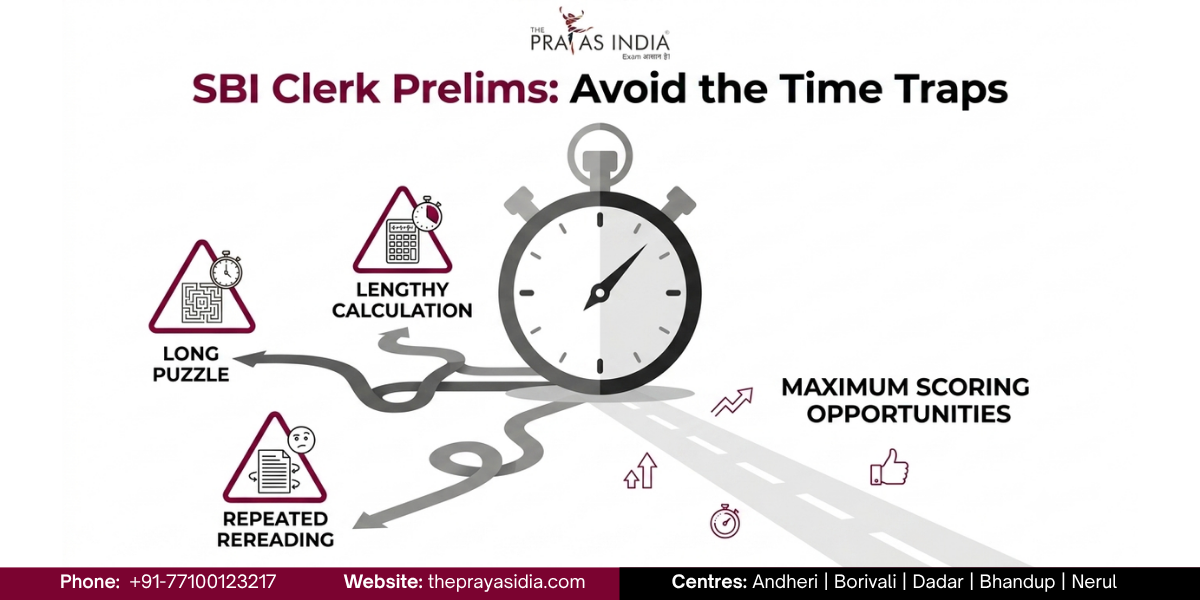
English can become one of the most time-efficient sections when the candidate has developed familiarity with common question types. However, it can also become a time trap when a candidate spends too long reading, rereading or debating between two options.
The key is to identify your strongest areas within the section. Questions based on grammar, vocabulary, fillers, sentence-based concepts or other familiar formats can often be handled quickly when the underlying concepts are strong. Reading Comprehension and other passage-based questions require a slightly different approach because reading itself consumes time.
The objective is not to rush through the English section. It is to prevent unnecessary rereading and hesitation.
Aspirants should also learn to recognise when they are spending too much time on a single question. If two options appear confusing and the candidate has already spent considerably longer than usual, moving ahead may be a better decision than trying to force certainty.
This ability to move on is not a sign of weak preparation. It is an important competitive-exam skill.
Numerical Ability: Calculation Speed Can Decide Your Attempts
Numerical Ability is one of the sections where preparation directly influences time management. Two candidates may understand the same mathematical concept, but the candidate with faster calculations can potentially attempt more questions within the same time.
This is why SBI Clerk preparation should include regular calculation practice rather than only chapter-wise question solving. Simplification, approximation, number-based calculations and other relatively direct questions can become valuable opportunities when solved efficiently.
At the same time, candidates should not automatically start with lengthy arithmetic questions. A question involving multiple calculations may appear easy conceptually but still consume valuable examination time.
The better approach is to identify the questions where your preparation gives you an advantage. Build your calculation speed during practice, but also build your question-selection ability.
If you regularly spend two minutes solving a question that could have been skipped and later discover that three easier questions remained unanswered, the problem is not mathematics alone. It is time management.
Reasoning Ability: Don’t Let One Puzzle Control Your Paper
Reasoning is perhaps the clearest example of why question selection matters in SBI Clerk Prelims. A puzzle or seating arrangement can look interesting and familiar, yet still consume several minutes before producing any answer.
This is where candidates need discipline.
If you are comfortable with a particular puzzle format, you may choose to attempt it. But if the initial information is confusing, the conditions are lengthy or the arrangement is taking longer than expected to establish, it can be more efficient to move to standalone reasoning questions.
The important skill is recognising the difference between productive time and unproductive time.
Productive time is time spent moving toward an answer. Unproductive time is time spent staring at the same condition, recalculating an arrangement repeatedly or trying to rescue a question that has already consumed too much time.
During mock tests, students should specifically record such instances. This creates a much more accurate picture of their real problem than simply looking at the final score.
The 60-Minute Strategy Should Be Practised Before the Exam
Time management cannot be developed effectively by reading strategies on the day before the examination. It has to become a habit during preparation.
When you start attempting SBI Clerk sectional tests, initially focus on accuracy and understanding. Once your concepts become stable, introduce timed practice. Gradually move from sectional tests to full-length mock tests where you have to make real-time decisions about question selection.
The important point is to avoid changing your entire strategy after every mock. One difficult paper can make a candidate believe that their entire approach is wrong, while one unusually easy mock can create overconfidence.
Instead, analyse patterns across several tests.
Ask yourself whether your speed is improving. Are you leaving easy questions because of time pressure? Which section consistently consumes more time? Are you losing marks because of calculation errors, conceptual mistakes or rushed decisions? How much time are you spending on puzzles? Are you spending too long on questions where you are uncertain?
These answers are much more valuable than simply asking, “What was my score?”
Coaching Can Help Turn Time Management Into a Measurable Skill
Many aspirants initially believe that coaching is required only for learning concepts. In reality, a structured banking preparation programme can also help with the less obvious parts of competitive-exam preparation, including mock-test analysis, question selection, speed building and exam strategy.
This becomes especially relevant for students who are preparing for SBI Clerk alongside college, work or other competitive examinations. Without a structured plan, it is easy to spend weeks practising questions without identifying the specific reason behind stagnant mock scores.
A professional coaching environment can provide a more systematic framework: learn the concept, practise the question type, attempt it under time pressure, analyse the result and then work specifically on the weakness.
For students searching for the best bank coaching in Mumbai, this distinction is worth considering before choosing an institute. Faculty quality and study material matter, but so do regular testing, individual performance analysis, doubt support and a preparation system that helps students transition from learning concepts to performing under examination conditions.
The Prayas India provides a structured preparation environment for banking aspirants who want to work on both conceptual clarity and competitive-exam performance. For a student who understands the syllabus but struggles to complete mock tests on time, this kind of guided preparation can be particularly useful.
Your SBI Clerk Strategy Should Be Built Around Your Own Performance
There is no universally perfect 60-minute strategy. One candidate may perform best by completing English quickly and allocating more attention to Reasoning and Numerical Ability. Another may have a stronger numerical background and require additional time for English. Someone comfortable with puzzles may approach Reasoning differently from a beginner.
Therefore, do not copy another aspirant’s exact timing simply because it worked for them.
Use recommended strategies as starting points, then modify them according to your mock-test performance. Your final strategy should answer three questions clearly: Which questions will I attempt first? Which questions will I leave temporarily? And at what point will I stop spending time on a difficult question?
Once these decisions become automatic, the pressure of the 60-minute clock becomes much easier to manage.
In the next part, we will move from the broad strategy to a practical SBI Clerk 60-minute attempt plan, including a realistic section-wise approach, question selection rules, last-minute time management, mock-test benchmarks and the mistakes that prevent aspirants from converting their preparation into a strong Prelims score.
A Practical 60-Minute Attempt Strategy for SBI Clerk Prelims
Once you understand the importance of question selection, the next step is to convert that understanding into an actual examination strategy. The biggest advantage of having a time-management plan is that you do not have to make every decision from scratch inside the examination hall. Your preparation should already have taught you which questions deserve immediate attention, which ones can wait and which ones are better left untouched.
A practical strategy should begin with flexibility rather than a rigid rule. You may decide to divide your 60 minutes broadly across English Language, Numerical Ability and Reasoning Ability, but your exact timing should ultimately depend on your strengths. A candidate who is exceptionally comfortable with English may finish that section efficiently, while another may need more time. The objective is not to spend exactly the same amount of time in every section; it is to make the best use of the time available under the examination’s sectional structure and rules.
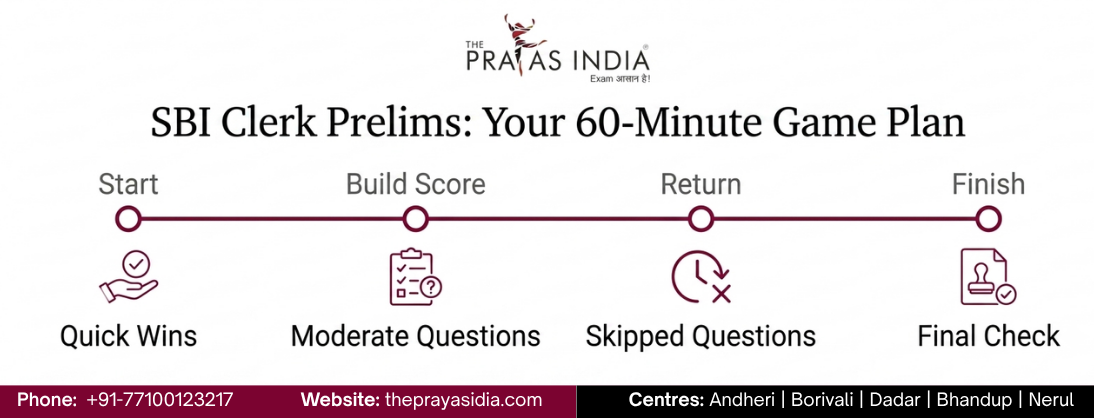
During the initial part of each section, focus on familiar and relatively direct questions. These are the questions that should help you build momentum. Once you have collected the easier marks, you can move toward questions requiring moderate effort. The final stage should be reserved for reviewing skipped opportunities and attempting questions that you can realistically solve within the remaining time.
This approach creates a psychological advantage as well. When candidates begin with difficult questions, they often feel that the paper is harder than expected. When they begin by collecting manageable questions, they gain confidence and establish a rhythm. That rhythm can be extremely valuable in a speed-based examination.
A Simple Rule for Deciding Whether to Attempt a Question
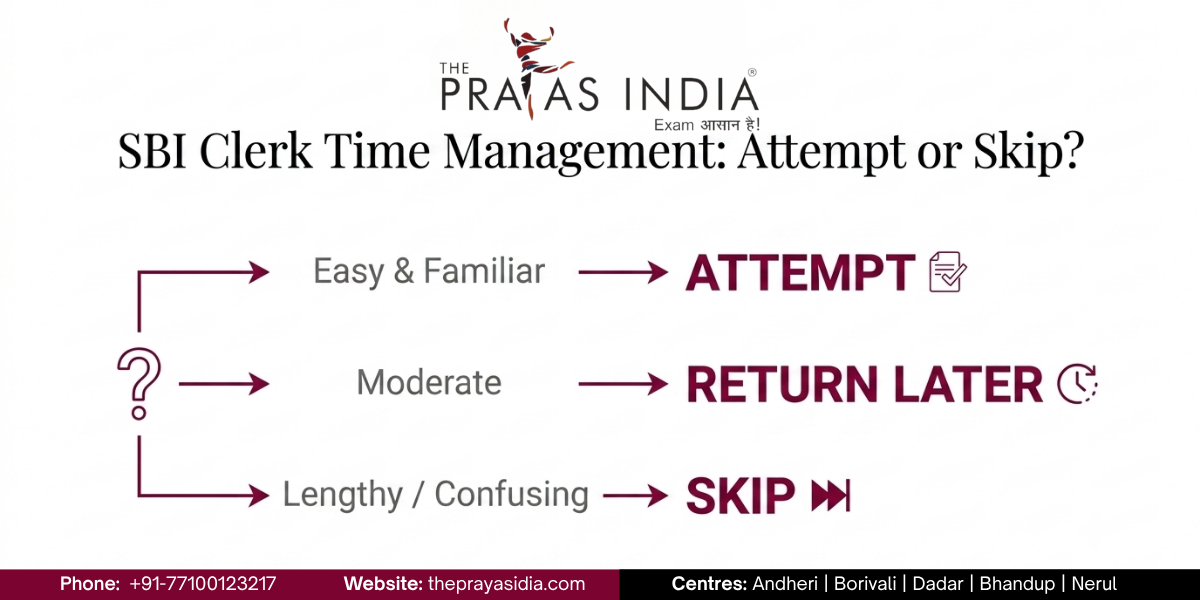
One of the most useful habits an SBI Clerk aspirant can develop is learning to make a quick decision about every question. Before investing significant time, ask yourself whether the question falls into one of three categories: quick to solve, requires moderate effort, or likely to become a time trap.
Quick questions should generally receive priority because they allow you to convert preparation into marks efficiently. Moderate questions can be attempted once the easier opportunities have been addressed. Time-consuming questions should be postponed or skipped unless you have a specific reason to believe that you can solve them efficiently.
This does not mean that difficult questions should never be attempted. It means that difficulty must be considered alongside the amount of time required. A difficult-looking question that you can solve confidently because you have practised that exact concept may actually be a better choice than a seemingly easy question that causes repeated confusion.
Over time, this decision-making ability becomes instinctive. That is why timed practice is so important. You are not merely practising questions; you are practising decisions under pressure.
The Last 15 Minutes Should Not Become a Panic Zone
Many candidates perform reasonably well for the first part of a mock test but lose control during the final 10–15 minutes. They start attempting questions simply because they are still unanswered, rush calculations and make mistakes that could have been avoided.
The final portion of the test should instead be treated as a controlled opportunity to recover additional marks. Look back at questions that you intentionally skipped earlier. Some may now appear more manageable because you have already completed the easier questions and reduced the pressure on yourself.
However, avoid turning the final minutes into a guessing contest. If a question requires extensive calculation and you have very little time remaining, forcing yourself to solve it may not be the best decision. The same applies to questions where you are completely uncertain about the answer.
The final minutes should be used with discipline. A strong time-management strategy is not about squeezing an answer out of every remaining question. It is about making sure that the remaining time produces the maximum possible value.
How Many Questions Should You Target?
The answer to this question should not be identical for every student. Your target attempts should evolve as your preparation improves.
A beginner may initially focus on completing fewer questions accurately. Once accuracy becomes stable, the next objective should be increasing speed. After that, the aspirant should work on maintaining accuracy while increasing attempts under realistic time pressure.
For example, if you are consistently attempting 70–75 questions with strong accuracy, your next goal could be improving the number of questions you can confidently attempt rather than immediately chasing an arbitrary number such as 90 or 100. If you are already attempting a high number but making frequent errors, your priority should move in the opposite direction.
This is where mock-test analysis becomes more important than mock-test scores. Your score tells you the outcome; your analysis tells you the reason.
Track the Questions You Leave Unattempted
One of the most overlooked aspects of SBI Clerk preparation is analysing unanswered questions. Candidates usually review the questions they got wrong but rarely investigate the questions they never attempted.
That can hide a significant weakness.
Suppose you discover after a mock test that you left ten questions unanswered because you ran out of time. On reviewing them, you find that six were questions you could have solved within a reasonable amount of time. That tells you that your problem may not be a lack of knowledge. Your problem could be poor time distribution or spending too much time earlier in the paper.
On the other hand, if most of the unanswered questions were lengthy puzzles or calculation-heavy problems, your strategy may already be reasonable.
This simple analysis can help you distinguish between knowledge gaps and time-management gaps, allowing your preparation to become much more targeted.
Use Mock Tests to Build Your Personal SBI Clerk Strategy
Mock tests should not be treated as occasional examinations that you take merely to see your score. They should function as a laboratory for your preparation strategy.
After each test, spend enough time analysing your performance. Identify the questions where you lost time, the questions where you made avoidable mistakes and the questions that you skipped despite having the ability to solve them. Compare these observations across several tests rather than making decisions based on one paper.
You should also record your average time for common question types. If simplification questions are consistently taking too long, calculation practice may be required. If reasoning puzzles are consuming excessive time, you may need to work on selection rather than simply solving more puzzles. If English questions are taking longer because of repeated reading, your focus may need to shift toward reading efficiency.
This is one area where guided preparation can make a significant difference. Students preparing entirely on their own often know that their score is not improving but struggle to identify the precise reason. Regular evaluation under the guidance of experienced faculty can make that feedback loop faster and more actionable.
Common Time-Management Mistakes SBI Clerk Aspirants Should Avoid
The first major mistake is trying to solve the paper in numerical order. Competitive examinations reward efficiency, not loyalty to question sequence. If Question 1 is taking too long, there is no advantage in remaining stuck simply because it appeared first.
Another common mistake is spending excessive time on puzzles and lengthy arithmetic questions. These questions can be valuable, but only when their expected return justifies the time investment. A single puzzle should not consume the time required to attempt several straightforward questions elsewhere.
Candidates also frequently make the mistake of changing their strategy completely after one bad mock test. One difficult mock does not necessarily indicate poor preparation, just as one excellent mock does not guarantee examination-day performance. Strategy should be refined using patterns from multiple tests.
Finally, many students practise without a stopwatch. Untimed practice is useful while learning concepts, but it cannot replace timed practice when preparing for an examination where every minute matters. Speed must eventually become part of your preparation environment.
The Role of Structured Bank Exam Coaching in Time Management
Time management is often presented as an individual skill, but the preparation environment can influence how quickly that skill develops. A structured coaching programme gives aspirants regular opportunities to learn concepts, practise questions, take tests and analyse performance within a planned schedule.
For students searching for the best bank coaching in Mumbai, it is therefore important to look beyond the basic question of whether an institute provides study material. Aspirants should consider whether the institute offers a structured preparation plan, experienced faculty, regular mock tests, doubt-solving support and meaningful performance analysis.
The right coaching environment can also help students avoid a common preparation problem: spending too much time studying what they already know while neglecting their actual weaknesses. A systematic evaluation process makes it easier to identify where additional effort is required.
The Prayas India provides a structured preparation ecosystem for banking aspirants, with an emphasis on conceptual clarity, practice and examination-oriented preparation. For students who know the syllabus but struggle with speed, question selection or mock-test performance, guided preparation can help bridge the gap between knowing how to solve a question and solving it effectively under exam pressure.
SBI Clerk Preparation Should Move From Learning to Performance
Clearing SBI Clerk Prelims requires more than completing the syllabus. At some point, preparation has to shift from learning concepts to performing under realistic conditions.
In the beginning, it is perfectly reasonable to spend considerable time understanding a new topic. But as the examination approaches, your preparation should increasingly include timed sectional tests, full-length mocks, calculation drills, revision and performance analysis.
This transition is particularly important for students who have been preparing for a long time but still find themselves unable to complete mocks comfortably. The solution is not necessarily to study more chapters. Sometimes the solution is to practise making faster and better decisions with the knowledge you already possess.
That is precisely why aspirants should consider coaching as a complete preparation system rather than simply a source of lectures. When faculty guidance, practice, testing and analysis work together, students can identify weaknesses much earlier and build a preparation strategy that is aligned with the actual demands of the examination.
A Final Approach for SBI Clerk Aspirants
The SBI Clerk Prelims clock will not slow down because a question is difficult. Every candidate receives the same 60 minutes. The difference comes from how effectively those minutes are converted into marks.
The most successful approach is therefore not to chase speed blindly. Build accuracy first, develop calculation and solving speed through practice, learn to identify high-value questions and become comfortable leaving questions that demand disproportionate time. Your goal should be to make the examination feel like a familiar process rather than a series of last-minute decisions.
If your mock tests show that you know the concepts but struggle to complete the paper, start treating time management as a dedicated part of your preparation. If you are unable to identify the reason behind your low attempts or inconsistent scores, consider getting structured guidance rather than continuing with the same preparation cycle.
For aspirants looking for bank exam coaching in Mumbai, The Prayas India offers a structured environment designed to help candidates prepare systematically for competitive banking examinations. With the right combination of preparation, testing, analysis and guidance, the 60-minute SBI Clerk Prelims challenge becomes something you can train for rather than something you simply hope to handle on examination day.
The objective is not to become the fastest student in the room. The objective is to become the candidate who knows where to spend time, where not to spend time and how to turn preparation into maximum scoring opportunities.
Contact Us
- Call Now: +91-77100 13217
- Website: theprayasindia.com
- Centres: Andheri | Borivali | Dadar | Nerul | Bhandup
Frequently Asked Questions
1. How much time is given for SBI Clerk Prelims?
SBI Clerk Prelims is conducted for a total duration of 60 minutes, with 100 questions across English Language, Numerical Ability and Reasoning Ability. Candidates should therefore practise under timed conditions well before the examination.
2. How can I attempt 100 questions in 60 minutes?
Attempting all 100 questions should not be treated as the only measure of success. Focus on identifying easy and familiar questions quickly, avoiding time-consuming questions initially, improving calculation speed and maintaining accuracy. Your ideal attempt level should be determined through repeated mock-test analysis.
3. What is the best time-management strategy for SBI Clerk Prelims?
A practical strategy is to prioritise quick and familiar questions first, move to moderate-difficulty questions next and leave lengthy or uncertain questions for later. Your exact section-wise timing should be adjusted according to your strengths and mock-test performance.
4. How can I improve my speed for SBI Clerk?
Regular timed practice is essential. Work on calculation speed, practise common question types, take sectional tests and analyse questions that consumed excessive time. Speed should be developed without sacrificing accuracy.
5. Should I attempt difficult puzzles in SBI Clerk Prelims?
Not immediately. If a puzzle appears lengthy or confusing, it may be better to move to easier reasoning questions first. You can return to the puzzle later if sufficient time remains and you are confident about solving it efficiently.
6. Is coaching necessary for SBI Clerk preparation?
Coaching is not compulsory, but structured guidance can be useful for candidates who struggle with planning, consistency, mock-test analysis, speed or question selection. The right banking coaching institute can provide a systematic preparation framework and help identify weaknesses faster.
7. How should I analyse SBI Clerk mock tests?
Do more than check your score. Analyse incorrect answers, unanswered questions, questions that consumed excessive time and easy questions that you missed. This helps you determine whether your primary problem is knowledge, accuracy, speed or question selection.
8. Which is the best bank coaching in Mumbai for SBI Clerk preparation?
Aspirants should compare institutes on faculty experience, study structure, mock-test quality, performance analysis, doubt support and overall preparation guidance rather than relying only on brand name or fees. The Prayas India offers structured preparation for banking aspirants seeking a focused approach to competitive examinations.