SBI PO Preparation Strategy: How to Build a High-Score Attempt | Best SBI PO Coaching in Mumbai | The Prayas India
Preparing for SBI PO is not simply about completing the syllabus or attempting as many questions as possible. The real challenge is learning how to convert your preparation into a high-scoring attempt under pressure.
SBI PO attracts candidates who are often academically strong and well-prepared. As a result, the difference between an average attempt and a strong attempt is frequently determined by factors such as question selection, time allocation, accuracy, calculation speed, sectional balance and the ability to avoid low-value questions.
For an aspirant, this changes the way preparation should be approached.
Instead of preparing with the mindset of “I need to solve everything,” the more useful mindset is “I need to identify the questions that give me the best return on my time.”
This is the foundation of a high-score attempt.
For candidates looking for SBI PO coaching in Mumbai, structured preparation can be particularly useful because developing an effective attempt strategy requires more than classroom learning. It requires regular testing, performance analysis, targeted practice and continuous refinement.
A High Score Starts Before the Examination
Your final attempt is the result of months of preparation.
If your concepts are weak, you will spend more time solving questions. If your calculation speed is poor, easy questions can consume valuable seconds. If your mock-test analysis is weak, you may continue repeating the same mistakes.
Therefore, an SBI PO strategy should be built around three connected objectives:
- Know the concepts
- Recognise the right questions
- Execute under time pressure
The first objective creates knowledge.
The second creates selection ability.
The third converts preparation into marks.
A candidate who develops all three is in a much stronger position than someone who focuses only on syllabus completion.
Understand the Difference Between Preparation and Attempt Strategy
Preparation strategy answers:
“What should I study?”
Attempt strategy answers:
“What should I do when the paper is in front of me?”
These are related but different skills.
You may know how to solve a difficult Data Interpretation set, a lengthy Reasoning puzzle or a tricky English question. That does not automatically mean you should attempt it during the examination.
A high-score attempt depends on recognising whether a question is worth your time.
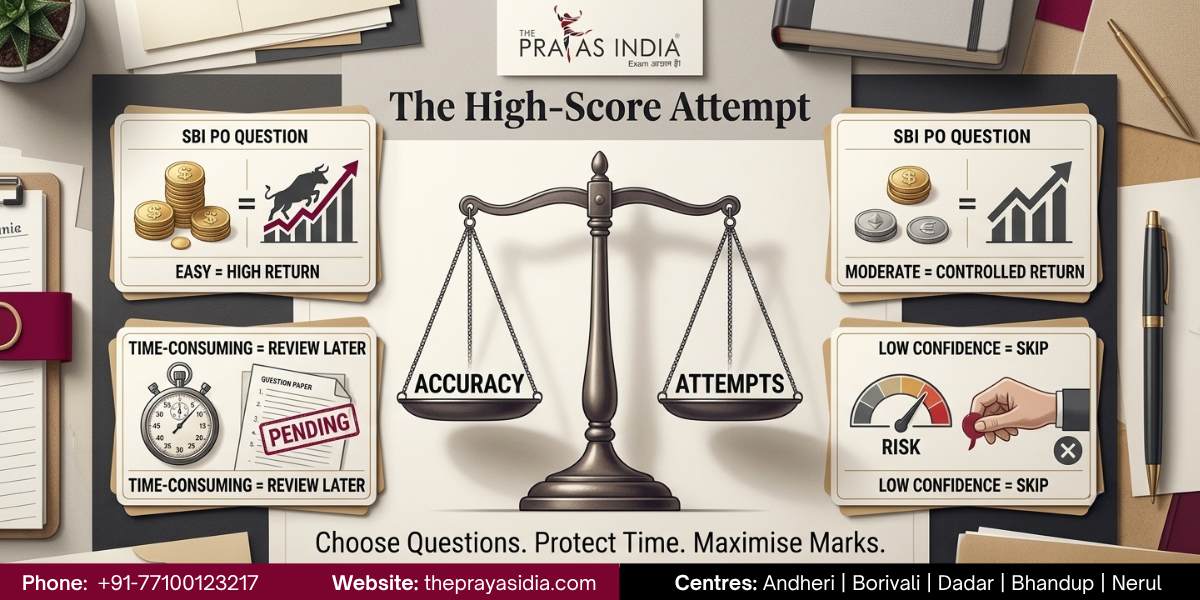
A question can be:
Easy and high-value
Moderate and manageable
Time-consuming but solvable
Difficult and low-value
Your preparation should teach you to distinguish between these categories quickly.
Build Your Strategy Around Marks, Not Attempts
Many aspirants ask, “How many questions should I attempt?”
That question is incomplete.
The more important question is:
“How many questions can I attempt accurately within the available time?”
A high number of attempts with poor accuracy can damage your score.
Similarly, extremely conservative attempts may leave marks on the table.
Your objective should therefore be to identify your personal optimal attempt zone through repeated mock tests.
For example, if your mock analysis shows that increasing attempts by a small number consistently causes several additional errors, increasing attempts may not actually improve your performance.
This is why attempt strategy cannot be copied blindly from another candidate.
The High-Score Attempt Formula
A useful way to think about SBI PO performance is:
Score = Question Selection + Accuracy + Speed + Time Management
If one component is weak, the overall result can suffer.
Imagine two candidates with similar conceptual knowledge.
Candidate A spends too much time on difficult questions and leaves easy questions for later.
Candidate B identifies the easier opportunities first, protects accuracy and returns to moderate questions only after securing the available marks.
Even with similar knowledge, Candidate B may produce a stronger score.
This is why decision-making is an examination skill.
Start With a Section-Wise Diagnostic
Before creating a detailed preparation schedule, understand your current level.
Take a sectional test or diagnostic mock under realistic conditions.
Don’t worry if the score is lower than expected.
The purpose is to identify your starting point.
Analyse each section using four questions:
- How many questions did I attempt?
- How many did I get correct?
- Where did I lose time?
- Which question types caused repeated mistakes?
This creates a baseline.
Without a baseline, it is difficult to know whether your preparation is actually improving.
Quantitative Aptitude: Build Speed Without Sacrificing Accuracy
Quantitative Aptitude can become a major differentiator in SBI PO because several questions require not only conceptual understanding but also efficient calculation and interpretation.
A strong Quant strategy should therefore be built in layers.
First, strengthen the underlying concepts.
Next, improve calculation efficiency.
Then, practise different question formats.
Finally, introduce timed mixed sets.
Important preparation areas can include:
- Arithmetic
- Data Interpretation
- Number-based concepts
- Simplification and approximation
- Percentage
- Ratio and proportion
- Average
- Profit and loss
- Time, speed and distance
- Time and work
- Probability and permutation-combination where relevant
- Algebra and other syllabus areas
The exact topic priority should always be aligned with the latest official SBI PO pattern and syllabus.
Don’t Treat Every Quant Question Equally
One of the biggest differences between an average attempt and a high-score attempt is question selection.
Suppose a Quant section contains:
- A straightforward calculation-based question
- A moderate arithmetic question
- A lengthy Data Interpretation set
- A difficult multi-step problem
A candidate who automatically starts with the first question and proceeds sequentially may spend too much time on the wrong opportunities.
Instead, develop the habit of scanning.
Ask:
Which questions can I solve confidently?
Which questions require too much calculation?
Which questions should I postpone?
This does not mean avoiding difficult questions permanently.
It means protecting your time.
Reasoning: Selection Is as Important as Solving
SBI PO-level Reasoning can include questions that appear manageable but consume considerable time.
Puzzles and seating arrangements are classic examples.
A candidate may spend several minutes setting up a difficult puzzle and eventually discover that the questions cannot be completed efficiently.
Therefore, reasoning preparation should include set selection.
When practising puzzles, don’t only ask whether you solved them.
Record:
- Time taken
- Number of questions generated from the set
- Accuracy
- Difficulty level
- Whether the set was worth attempting
This develops the ability to evaluate the return on time.
Build Puzzle Selection Ability
When looking at a Reasoning set, quickly examine its structure.
Look for:
Number of variables
Number of conditions
Possibility of fixed placements
Amount of information provided
Whether multiple questions can be answered from the same arrangement
With experience, these observations become faster.
The objective is not to avoid challenging puzzles.
It is to recognise when a puzzle is likely to provide sufficient marks for the time required.
English: Make Accuracy Your Advantage
English can become a strong scoring opportunity when preparation is consistent.
Unlike Quant or complex Reasoning, many English questions can be solved efficiently once the underlying concepts and language familiarity are developed.
Focus on:
- Reading comprehension
- Error detection
- Sentence improvement
- Fillers
- Cloze tests
- Para-based questions
- Vocabulary
- Grammar
- Sentence arrangement
Daily reading can improve comprehension speed and help candidates become more comfortable with formal language.
Grammar revision should be combined with question practice so that rules become usable rather than merely memorised.
Reading Comprehension Requires Decision-Making Too
Reading comprehension is not simply about reading quickly.
You also need to understand the passage sufficiently to answer questions accurately.
During preparation, experiment with different approaches.
For some passages, reading the questions first may help.
For others, understanding the passage structure first may be more effective.
Use sectional tests to determine which approach works best for you.
Your goal should be to develop a repeatable method rather than changing your strategy randomly in every mock.
General Awareness: Build Retention, Not Information Overload
For SBI PO preparation, General Awareness can become difficult because the volume of available information is enormous.
Aspirants can easily spend hours consuming current-affairs material without building an effective revision cycle.
The better approach is selective learning followed by repeated revision.
Depending on the current examination requirements, preparation may include:
- Banking awareness
- Financial awareness
- Current affairs
- National and international events
- Government schemes
- Important appointments
- Reports and indices
- Economic developments
- Banking and financial terminology
The exact scope should be checked against the latest official notification and relevant examination requirements.
The biggest advantage in this section comes from retention.
Reading something once is not preparation.
Remembering it when the question appears is preparation.
Current Affairs Should Be Converted Into Revision Material
Instead of maintaining extremely long current-affairs notes, create compact revision resources.
For example, organise information under categories such as:
Banking
Economy
Government Schemes
Appointments
Awards
Reports & Indices
Important Events
Financial Awareness
This makes revision faster.
Near the examination, you should be able to revise important information without reopening dozens of sources.
Develop a “Skip” Habit
One of the most underrated SBI PO skills is knowing when not to attempt a question.
Skipping a question is not failure.
A strategic skip can protect your score.
During preparation, identify questions that typically consume too much time for you.
For example:
- Questions requiring excessive calculation
- Puzzles with complicated conditions
- Questions where you repeatedly make errors
- Questions where you are uncertain between multiple options
This does not mean these questions should never be attempted.
It means you should learn to recognise their opportunity cost.
Your Time Is a Limited Resource
Think of examination time as a budget.
Every question spends part of that budget.
If you spend too much of it on one question, another question may become unavailable to you.
This is why time management should not simply mean “solve faster.”
It means:
Spend more time where the potential return is high and less time where the return is uncertain.
This principle should become part of your mock-test analysis.
Create a Personal Time-Management Profile
Don’t blindly copy someone else’s section order.
Your ideal sequence depends on your strengths.
For example, one candidate may perform best by starting with English because it allows quick confidence-building attempts.
Another may prefer Reasoning.
A Quant-strong candidate may prefer to begin with Quant.
There is no universally perfect order.
Use mocks to test different combinations and identify the sequence that gives you the best combination of:
- Attempts
- Accuracy
- Time control
- Mental stability
Once you find a reliable sequence, practise it repeatedly.
Mock Tests Are Your Strategy Laboratory
Mock tests should not simply tell you your score.
They should help you discover your examination strategy.
Use mocks to experiment with:
- Section order
- Time allocation
- Question selection
- Skip decisions
- Attempt targets
- Calculation approaches
- Reading strategies
For every mock, record what happened.
If changing your section order saves several minutes, that is useful information.
If attempting a certain type of puzzle consistently reduces accuracy, that is also useful information.
Your mock history should gradually become a personal performance database.
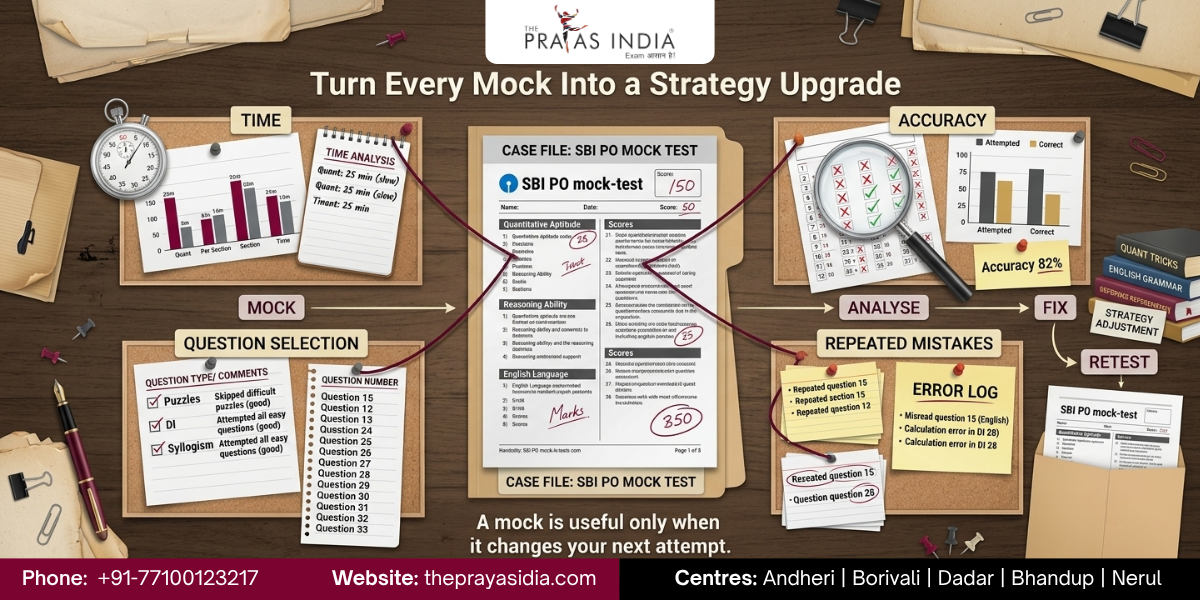
Analyse Every Mock With Three Questions
After every mock, ask:
What worked?
Identify strategies that produced good results.
What failed?
Find decisions that cost time or accuracy.
What will change next time?
Convert the analysis into one or two concrete actions.
This prevents mock analysis from becoming a passive exercise.
Writing “I made mistakes in Reasoning” is not enough.
Write something actionable such as:
“I spent too long on the first puzzle. In the next mock, I will scan all sets before selecting one.”
That is a strategy improvement.
Track the Quality of Your Attempts
Your attempt count should always be viewed alongside accuracy.
A simple performance sheet can track:
| Metric | Purpose |
|---|---|
| Attempts | Measures question volume |
| Accuracy | Measures reliability |
| Time | Identifies efficiency |
| Sectional Score | Shows subject-level performance |
| Wrong Questions | Identifies gaps |
| Skipped Questions | Reveals selection opportunities |
| Time-Consuming Questions | Identifies poor decisions |
Over several mocks, patterns will emerge.
Those patterns should determine your preparation priorities.
Build Your Strategy Around Your Weakest Link
You do not need to become equally strong in every area overnight.
Instead, identify the factor currently limiting your score.
It may be:
Low Quant speed
Poor Reasoning selection
English accuracy
Weak General Awareness retention
Poor mock analysis
Uncontrolled time usage
Fixing your biggest limitation can sometimes produce a larger improvement than spending additional hours on an already strong area.
Avoid the “More Questions Means Better Preparation” Trap
Question volume matters, but quality matters too.
Solving hundreds of questions without reviewing mistakes can reinforce poor habits.
A better practice cycle is:
Solve → Check → Analyse → Correct → Reattempt
If you repeatedly make the same error, solving another hundred questions may not solve the problem.
You need to understand why the mistake is happening.
This is especially important for candidates aiming for high scores rather than simply clearing a sectional benchmark.
Structured Coaching Can Shorten the Learning Curve
For an aspirant preparing independently, a significant amount of time can be spent deciding what to study, which resources to use, how to sequence topics and how to interpret mock performance.
Structured coaching can reduce some of this uncertainty.
A well-organised SBI PO programme can provide a planned curriculum, faculty guidance, practice material, doubt-solving support, mock tests and performance analysis.
For beginners and candidates who struggle with consistency, this structure can provide an organised preparation framework.
However, coaching should complement—not replace—self-study.
The final improvement comes from how consistently you practise, revise and analyse your performance.
Choosing SBI PO Coaching in Mumbai
Candidates searching for the best SBI PO coaching in Mumbai should look beyond advertisements and isolated success claims.
The more important question is whether the institute provides a preparation ecosystem capable of supporting your complete journey.
Before taking admission, evaluate:
- Faculty and teaching methodology
- Foundation support
- SBI PO-focused study material
- Previous-year question practice
- Regular sectional tests
- Full-length mock tests
- Detailed performance analysis
- Doubt-solving mechanism
- Current-affairs and banking-awareness support
- Mentorship
- Batch timings
- Accessibility and location
A good coaching programme should help you understand not only how to solve questions, but also how to approach the examination strategically.
The Prayas India and SBI PO Preparation
The Prayas India provides structured preparation support for banking and competitive examinations.
For SBI PO aspirants, the objective of a structured learning environment is to connect classroom learning with regular practice, testing and performance improvement.
Students can use guided preparation to strengthen concepts, practise examination-level questions and gradually develop the speed, accuracy and decision-making required for competitive banking examinations.
If you are considering SBI PO coaching in Mumbai, admission should be viewed as the beginning of a structured preparation journey rather than simply joining a classroom.
The right programme should help you build a system around:
Concepts → Practice → Previous-Year Questions → Tests → Analysis → Revision → Performance Improvement
The Real Goal: Build a Repeatable High-Score Attempt
A high-score attempt should not depend on luck or an unusually easy paper.
It should come from a repeatable process.
You want to reach a stage where, when the examination begins, you know:
Which section to start with.
How much time to spend.
Which questions to pick first.
Which questions to postpone.
When to move on.
How to protect accuracy.
How to use the remaining time.
That level of clarity comes from repeated testing and analysis.
Building a High-Score SBI PO Attempt: The Practical Roadmap
A high-score SBI PO attempt is not created during the final week of preparation. It is built gradually through the way you study, practise, test yourself and respond to mistakes.
Once the basic concepts are reasonably strong, your preparation should move from learning-oriented to performance-oriented. This means that instead of measuring progress only through chapters completed, you begin measuring it through accuracy, solving time, question selection and mock-test performance.
The strongest candidates are not necessarily those who attempt every difficult question. They are the ones who can recognise opportunities, manage risk and protect their time when the examination becomes demanding.
Create a Preparation Roadmap Around Three Stages
A practical SBI PO preparation journey can be divided into three broad stages.
Stage 1: Foundation
Build conceptual clarity across the major sections. Strengthen calculation ability, grammar, vocabulary, reasoning fundamentals and awareness of banking and current-affairs topics.
At this stage, accuracy should receive greater attention than speed.
Stage 2: Application
Once the concepts become comfortable, move towards previous-year questions, mixed sets and sectional tests.
The focus now shifts towards applying concepts under moderate time pressure.
Stage 3: Performance
The final stage should be dominated by full-length mocks, detailed analysis, revision and attempt optimisation.
The objective is to make your examination strategy predictable.
You should know what works for you before you enter the actual examination hall.
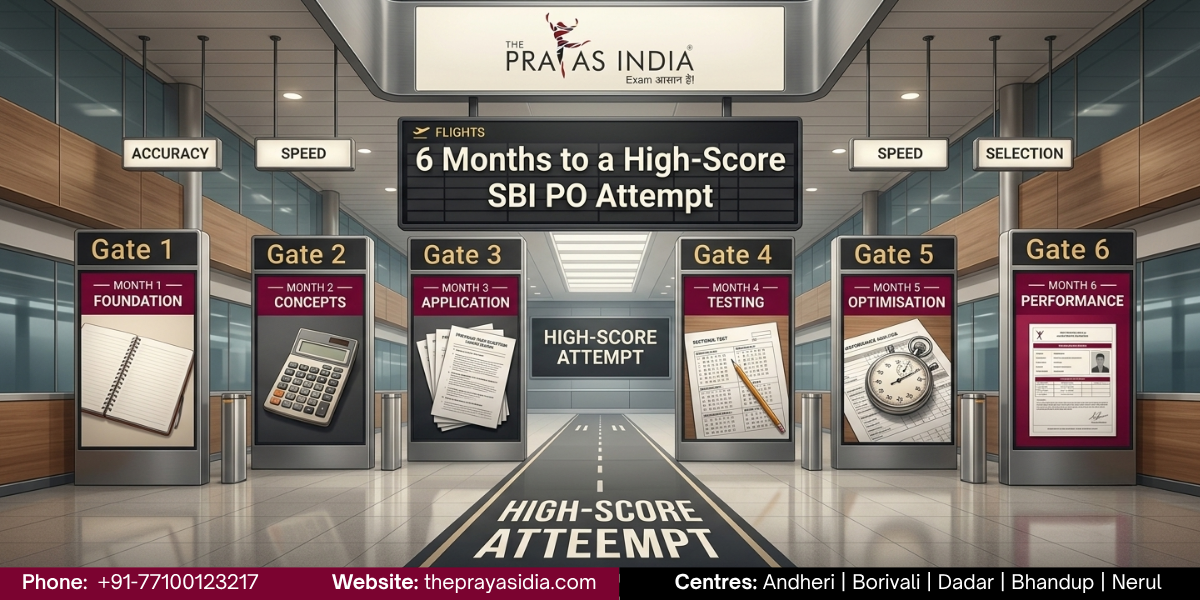
A Six-Month SBI PO Preparation Roadmap
Candidates with approximately six months can use the following broad structure.
Months 1–2: Build the Core
Use the first two months to establish conceptual foundations.
Quant should focus on arithmetic fundamentals and calculation efficiency. Reasoning should introduce different puzzle and logical-question formats. English should become a daily subject, while General Awareness and banking awareness should be studied consistently.
At this stage, don’t judge your preparation only through mock scores.
Instead, concentrate on building the knowledge and habits that will later support a high score.
Your priorities should include:
- Conceptual clarity
- Topic-wise practice
- Calculation improvement
- Grammar and vocabulary
- Basic reasoning sets
- Current-affairs notes
- Banking-awareness fundamentals
- Regular revision
Months 3–4: Increase the Level of Application
The third and fourth months should introduce more exam-oriented practice.
Begin solving larger sets, previous-year questions and sectional tests. Mix topics instead of practising only one chapter at a time.
This is also the right stage to start identifying your preferred attempt order.
Try different approaches in sectional and full-length tests.
Record the results.
If starting with English gives you better time control, note it.
If beginning with Reasoning causes you to spend too much time on puzzles, reconsider it.
Your strategy should be based on evidence from your performance.
Months 5–6: Optimise Performance
The final two months should focus heavily on testing and refinement.
Full-length mocks should become a regular part of the schedule. But taking mocks alone is not enough.
The real improvement comes from analysing them.
For every mock, identify:
- Where did I gain marks?
- Where did I lose marks?
- Which questions consumed excessive time?
- Which mistakes were avoidable?
- Which section affected my overall performance?
- Which questions should I have skipped?
- What will I change in the next mock?
This transforms mock tests from score-generating exercises into strategy-building exercises.
A Three-Month Strategy for Faster Preparation
Candidates with only three months need to combine learning and testing more aggressively.
The first month should focus on high-priority concepts and topic-wise practice. The second month should increase previous-year questions, sectional tests and mixed practice. The final month should focus strongly on mocks, revision, current affairs and performance optimisation.
Do not wait until the final few weeks to discover that you are slow at Quant or spend too much time on Reasoning puzzles.
Test yourself early enough to identify these problems.
Your Daily Study Plan Should Have a Purpose
A good daily timetable is not simply a list of subjects.
Every session should answer a question:
What am I trying to improve today?
For example:
Quant: Improve arithmetic accuracy.
Reasoning: Practise puzzle selection.
English: Strengthen comprehension and grammar application.
General Awareness: Revise banking and current-affairs material.
Mock/Sectional Test: Measure performance.
Analysis: Identify one major weakness.
This approach creates purpose behind each study block.
A Practical Daily Structure
The exact number of hours should depend on your circumstances, but a full-time aspirant could divide a study day broadly into:
- Quantitative Aptitude: concept + practice
- Reasoning: topic/set practice
- English: reading + question practice
- General/Banking Awareness: learning + revision
- Timed practice: sectional or mixed questions
- Analysis: mistake review and revision
Working professionals can compress these blocks into shorter sessions without eliminating any major component.
The objective is not to copy someone else’s eight- or ten-hour schedule.
The objective is to build a schedule that you can execute consistently.
Develop an SBI PO Attempt Order Before the Exam
Your section order should be decided through mock testing rather than guesswork.
There is no single sequence that works equally well for every candidate.
A candidate strong in English may prefer to begin there.
Another candidate may be more comfortable starting with Reasoning.
Someone with strong Quant fundamentals may want to begin with Quant.
Test different sequences during your mocks.
Compare:
Total attempts
Accuracy
Time consumed
Mental fatigue
Sectional performance
Once you identify the sequence that consistently works, practise it enough that it becomes automatic.
Don’t Enter the Exam With a Fixed Number of Attempts
Setting an exact attempt target before seeing the paper can be counterproductive.
Suppose you decide that you must attempt a certain number of questions.
If the paper is unusually difficult, you may start taking unnecessary risks simply to reach your target.
Instead, use a flexible framework.
Your attempt target should depend on:
- Paper difficulty
- Your confidence level
- Time remaining
- Accuracy
- Question quality
The objective is not to satisfy a number.
The objective is to maximise your score.
Use the First Few Minutes Intelligently
The opening portion of the examination can influence your entire attempt.
Avoid rushing simply because the clock has started.
Use the initial period to establish rhythm and identify the nature of the paper.
If the paper appears easy, you can capitalise on straightforward opportunities.
If it appears difficult, remain selective rather than becoming anxious about the number of questions you are attempting.
A difficult paper requires better decision-making, not panic.
The 3-Category Question Selection System
During practice, train yourself to classify questions quickly.
Category A — Immediate Attempt
Questions that are familiar, clear and likely to be solved accurately without excessive time.
Category B — Second Look
Questions that appear manageable but require some calculation or thought.
Category C — Avoid or Revisit
Questions that appear unusually lengthy, confusing or uncertain.
This classification should become almost instinctive with practice.
The purpose is to prevent a difficult question from controlling your entire section.

Quant Strategy: Prioritise Efficient Marks
In Quant, don’t allow one difficult question to consume the time required for several easier questions.
During practice, record the approximate time required for different question types.
You may discover that certain arithmetic questions are highly efficient for you, while particular DI formats consume too much time.
That information should influence your attempt strategy.
The objective is not to become equally fast at every question.
It is to become selectively fast where marks are most accessible.
Reasoning Strategy: Learn to Reject Bad Sets
A high-level Reasoning strategy requires more than solving puzzles.
You need to recognise when a set is worth investing time in.
Before committing to a puzzle, quickly evaluate its structure.
If the conditions are complicated and the number of questions generated is small, it may have a poor return on time.
If a set provides several interconnected questions with a relatively manageable structure, it may be more valuable.
This skill develops through repeated practice and mock analysis.
English Strategy: Protect Your Accuracy
English can provide relatively efficient scoring opportunities when preparation is strong.
However, don’t convert speed into guesswork.
For vocabulary-based questions, don’t force an answer when confidence is low.
For comprehension, don’t rush through the passage so quickly that accuracy falls.
For grammar, rely on understanding rather than instinct alone.
The goal is to develop a balance between quick recognition and reliable decision-making.
General Awareness: Revise More Than You Collect
One of the biggest traps in General Awareness preparation is continuously consuming new information.
Aspirants often keep adding monthly current-affairs PDFs, videos, quizzes and notes without revisiting older material.
This creates volume without retention.
A better cycle is:
Learn → Condense → Revise → Quiz → Revisit Weak Areas
As the examination approaches, the revision component should become increasingly important.
Banking Awareness Needs Conceptual Understanding
Banking awareness should not be treated as a list of definitions to memorise.
Understanding the basic functioning of banking and financial systems can make information easier to retain.
Build familiarity with important banking and financial concepts, terminology, institutions, monetary-policy-related developments and relevant current events according to the latest examination requirements.
Then reinforce them through quizzes and revision.
Build a Revision Calendar
Your revision should be planned rather than accidental.
A simple system can divide material into:
Fresh: Recently studied.
Active: Under regular revision.
Weak: Frequently forgotten or incorrectly answered.
Exam Ready: Strong and repeatedly tested.
Spend more revision time on the weak category.
This is more efficient than giving equal time to every topic.
The Error Notebook Can Become Your Personal Strategy Guide
Your mistake log should evolve throughout preparation.
Don’t simply write the correct answer.
Record the reason for the mistake.
For example:
“Spent too much time on DI because I didn’t identify the calculation-heavy structure.”
Or:
“Changed the correct answer due to uncertainty.”
Or:
“Attempted puzzle without scanning alternative sets.”
These observations reveal behavioural patterns.
And behavioural patterns are exactly what you need to correct before the actual examination.
Don’t Take Too Many Mocks Without Analysis
More mocks do not automatically mean better preparation.
If you take one mock every day but spend almost no time analysing it, you may simply repeat the same mistakes.
A better approach is to give every mock a learning purpose.
After each test, identify the most important issue.
Then spend the next preparation sessions correcting it.
The next mock should tell you whether the correction worked.
This creates a continuous improvement cycle:
Mock → Diagnosis → Targeted Practice → Retest
Track Progress Over Multiple Mocks
One mock score can be misleading.
Your goal should be to observe the trend.
Track:
- Overall score
- Sectional scores
- Attempts
- Accuracy
- Average time
- Unforced errors
- Questions left due to time
- Questions attempted unnecessarily
If your score fluctuates but your accuracy is improving and careless mistakes are decreasing, your preparation may still be moving in the right direction.
Look for patterns rather than reacting emotionally to individual scores.
SBI PO Preparation for Working Professionals
Working professionals often have fewer hours available but can still build strong preparation with disciplined scheduling.
Use your highest-energy period for difficult subjects.
For example, if you concentrate better in the morning, use that time for Quant or Reasoning.
Use shorter breaks for vocabulary, current affairs or revision.
Reserve longer weekend sessions for mocks and detailed analysis.
A practical working-professional routine could include:
- Weekdays: Concepts + targeted practice
- Short breaks: Current affairs/vocabulary revision
- Weekend: Full-length mock + analysis
- Weekly review: Identify priorities for the coming week
Consistency matters more than creating an unrealistic schedule.
SBI PO Preparation for Beginners
Beginners should not compare their preparation with candidates who have already attempted several banking examinations.
Your first objective is to understand the exam language.
Then build your foundation.
Then develop speed.
Then optimise attempts.
A beginner’s progression should look like:
Concepts → Basic Questions → Exam-Level Questions → Sectional Tests → Full Mocks → Attempt Optimisation
Trying to jump directly from concepts to high-speed full mocks can create unnecessary frustration.
When Should You Join SBI PO Coaching?
There is no universal “perfect” month to join coaching.
However, joining early can be useful for candidates who need structured guidance from the beginning.
A structured programme can help establish:
- A predefined syllabus sequence
- Regular classroom learning
- Guided practice
- Doubt-solving support
- Mock-test discipline
- Performance monitoring
- Revision planning
Candidates who already have strong fundamentals may use coaching differently, focusing more on advanced practice, testing and strategy.
The right approach depends on your starting level.
Choosing the Best SBI PO Coaching in Mumbai
If you are searching for the best SBI PO coaching in Mumbai, evaluate the complete preparation ecosystem rather than selecting an institute only because of its popularity.
Ask whether the programme can help you improve from your current level.
Important factors include:
- Faculty expertise
- Teaching methodology
- Foundation support
- SBI PO-oriented study material
- Quality of practice questions
- Previous-year question coverage
- Regular sectional tests
- Full-length mock tests
- Mock analysis
- Doubt-solving support
- Current-affairs and banking-awareness preparation
- Mentorship
- Batch schedules
- Location and accessibility
The most important question is:
Will this environment help me become a better test-taker, not just a better note-taker?
The Prayas India for SBI PO Preparation
The Prayas India offers structured coaching support for banking and competitive examinations.
For SBI PO aspirants, structured preparation can provide a systematic pathway from conceptual learning to exam-level practice and performance improvement.
A coaching environment can help students maintain regularity, access guided academic support, practise through tests and identify areas that need improvement.
However, your personal effort remains essential.
Use classes to understand concepts.
Use self-study to reinforce them.
Use previous-year questions to understand application.
Use mocks to test your readiness.
Use analysis to improve your strategy.
This combination creates a much stronger preparation cycle than relying on any single component.
Admission Should Be a Strategic Decision
Choosing an SBI PO coaching programme is ultimately a preparation decision.
Before taking admission, consider where you currently stand.
If you lack conceptual clarity, foundation support may be your priority.
If concepts are strong but scores are inconsistent, mock analysis and strategy may be more important.
If you struggle with discipline, a structured batch and regular testing environment can provide useful accountability.
Your coaching choice should therefore match your actual preparation problem.
For aspirants seeking SBI PO coaching in Mumbai, The Prayas India can be considered as part of a structured preparation approach focused on learning, practice and examination readiness.
The Final 30 Days: Shift From Learning to Execution
As the examination approaches, avoid continuously expanding your syllabus.
The focus should increasingly move towards:
Revision
Mock Tests
Current Affairs
Weak Areas
Accuracy
Question Selection
Time Management
At this stage, your objective is to make your existing preparation usable under examination conditions.
Don’t introduce unnecessary resources simply because someone else is using them.
Consolidate what you already know.
The Final Week Should Protect Your Performance
The final week is not the time for panic.
Avoid attempting to learn enormous amounts of new material.
Instead, revise your compact notes, important current affairs, banking awareness, formulas, vocabulary and recurring mistakes.
Take practice tests according to your preparation level, but avoid exhausting yourself.
Sleep, concentration and mental stability are also part of examination preparation.
A high-score attempt requires a clear mind as much as strong preparation.
What a High-Score SBI PO Attempt Really Looks Like
A high-score attempt does not necessarily mean attempting the maximum number of questions.
It means making the maximum number of good decisions.
You identify the questions that suit you.
You protect your time.
You maintain accuracy.
You avoid unnecessary risks.
You adapt to the difficulty of the paper.
You know when to move on.
And you use the final minutes intelligently.
These behaviours are not developed on examination day.
They are developed through months of deliberate practice.
Final Takeaway
SBI PO preparation should ultimately lead towards one goal: controlled performance under pressure.
Conceptual knowledge gives you the ability to solve questions.
Practice gives you familiarity.
Previous-year questions give you examination perspective.
Mock tests reveal your weaknesses.
Analysis helps you correct them.
And repeated execution builds the high-score attempt.
If you are preparing for SBI PO from Mumbai and looking for structured guidance, choosing the right coaching environment can help you organise this entire process.
The Prayas India provides a structured learning environment for banking aspirants, helping students connect classroom preparation with practice, testing, revision and performance improvement.
Whether you are a beginner, a repeat aspirant or a working professional, the strategy remains fundamentally the same:
Prepare intelligently. Practise deliberately. Analyse honestly. Attempt strategically.
That is how preparation gets converted into a high-score SBI PO attempt.
Contact Us
- Call Now: +91-77100 13217
- Website: theprayasindia.com
- Centres: Andheri | Borivali | Dadar | Nerul | Bhandup
FAQs
1. How should I start my SBI PO preparation?
Begin by understanding the current examination pattern and assessing your strengths and weaknesses. Build your fundamentals, practise topic-wise questions and gradually introduce previous-year questions, sectional tests and full-length mocks.
2. How can I build a high-score attempt in SBI PO?
Focus on four areas: accuracy, speed, question selection and time management. Regular mock tests and detailed analysis can help you identify the attempt strategy that works best for you.
3. How many questions should I attempt in SBI PO?
There is no universally correct attempt number. Your ideal attempt depends on paper difficulty, accuracy, section-wise performance and time management. Use mock tests to identify your personal optimal range rather than blindly following someone else's target.
4. Should I attempt difficult questions in SBI PO?
Not necessarily. A difficult question may consume disproportionate time. First prioritise questions that you can solve confidently and efficiently, then return to more challenging questions if time permits.
5. How important are mock tests for SBI PO preparation?
Mock tests are extremely useful for developing exam temperament and identifying weaknesses. Their value increases significantly when you analyse mistakes, time usage, question selection and accuracy after every test.
6. When should I start SBI PO mock tests?
You can begin with sectional and topic-wise tests once you have covered sufficient basics. Full-length mocks should gradually become a regular part of preparation as your syllabus coverage and exam readiness improve.
7. How should I prepare Quantitative Aptitude for SBI PO?
Build your concepts first, then practise different question types and previous-year questions. Gradually introduce timed sets and focus on improving calculation speed without compromising accuracy.
8. How can I improve Reasoning for SBI PO?
Practise a variety of reasoning questions and develop the ability to identify manageable puzzles and sets quickly. Track the time and accuracy for different question types to improve selection ability.
9. How should I prepare General Awareness for SBI PO?
Follow a consistent current-affairs and banking-awareness routine, organise important information into compact notes and revise it repeatedly. Focus on retention rather than continuously collecting new material.
10. Is SBI PO coaching necessary?
Coaching is not compulsory, and candidates can succeed through disciplined self-study. However, structured coaching can provide a planned curriculum, faculty guidance, practice, tests, doubt-solving and mentorship, which may be useful for candidates who need direction or accountability.
11. How do I choose the best SBI PO coaching in Mumbai?
Compare faculty, teaching methodology, study material, practice systems, mock tests, analysis, doubt-solving, current-affairs support, batch timings and accessibility. Most importantly, evaluate whether the institute's system matches your current preparation level and goals.
12. Can working professionals prepare for SBI PO?
Yes. Working professionals can prepare by using fixed study blocks, short revision sessions during available breaks and weekends for mocks and detailed analysis. Consistency and realistic planning are particularly important.
13. How can The Prayas India help with SBI PO preparation?
The Prayas India offers structured preparation support for banking and competitive examinations, combining guided learning with practice, testing and performance-oriented preparation.