SSC CHSL Preparation Strategy for Beginners | Best SSC Coaching in Mumbai | The Prayas India
Starting preparation for SSC CHSL can feel confusing, especially when you are appearing for a competitive government examination for the first time. The syllabus may appear manageable when viewed topic by topic, but the real challenge begins when you have to decide what to study first, how much time to give each subject, which resources to use and how to measure your progress. Many beginners spend their initial weeks collecting books, watching random lectures and solving questions without following a structured plan. As a result, they study for long hours but struggle to identify whether their preparation is actually moving in the right direction.
A successful SSC CHSL preparation strategy does not require you to know everything before you begin. It requires a clear starting point, consistent practice and regular performance analysis. Beginners should focus on understanding the examination structure, building their fundamentals, gradually improving speed and accuracy, and developing the habit of solving questions under time pressure. Instead of trying to complete the entire syllabus immediately, the preparation should progress in a way that allows concepts, practice and revision to work together.
For aspirants preparing for SSC CHSL in Mumbai, choosing the right preparation environment can also make a difference. Structured guidance can help beginners avoid common preparation mistakes, understand which topics deserve greater attention and maintain consistency through tests and performance feedback. However, whether you prepare independently or through coaching, your preparation must ultimately be built around a disciplined and measurable routine.
Start With a Clear Understanding of SSC CHSL
Before opening your first preparation book, understand what you are preparing for. SSC CHSL is a competitive examination, and its different stages test candidates through objective questions as well as skill or typing-related requirements for applicable posts. The exact pattern, dates, eligibility conditions and post-specific requirements should always be checked against the latest official SSC notification because these details can change.
For a beginner, understanding the examination structure is important because it changes the way you prepare. You should not approach the syllabus as a collection of independent chapters. Instead, think of it as a combination of English Language, General Intelligence, Quantitative Aptitude and General Awareness, along with the requirements of subsequent stages wherever applicable.
This broader understanding prevents a common mistake: preparing only for the subjects you enjoy. A beginner may naturally spend more time on English because it feels comfortable or focus heavily on Quant because they find calculations interesting. But competitive exams reward balanced preparation. Your stronger subjects should become dependable scoring areas while your weaker subjects need enough attention to prevent them from pulling down your overall performance.
Don’t Try to Finish the Entire Syllabus in the First Week
One of the biggest mistakes beginners make is confusing syllabus completion with preparation. Seeing a long list of topics can create anxiety, and the natural response is often to rush through as many chapters as possible. You may watch several lectures, read multiple chapters and solve a few questions from each topic, believing that you have made significant progress.
The problem is that superficial exposure does not create examination readiness. A topic is not truly prepared simply because you have read its theory once. You need to understand the concept, practise different question types, identify your mistakes and revisit the topic after some time. This process takes longer, but it produces much stronger retention.
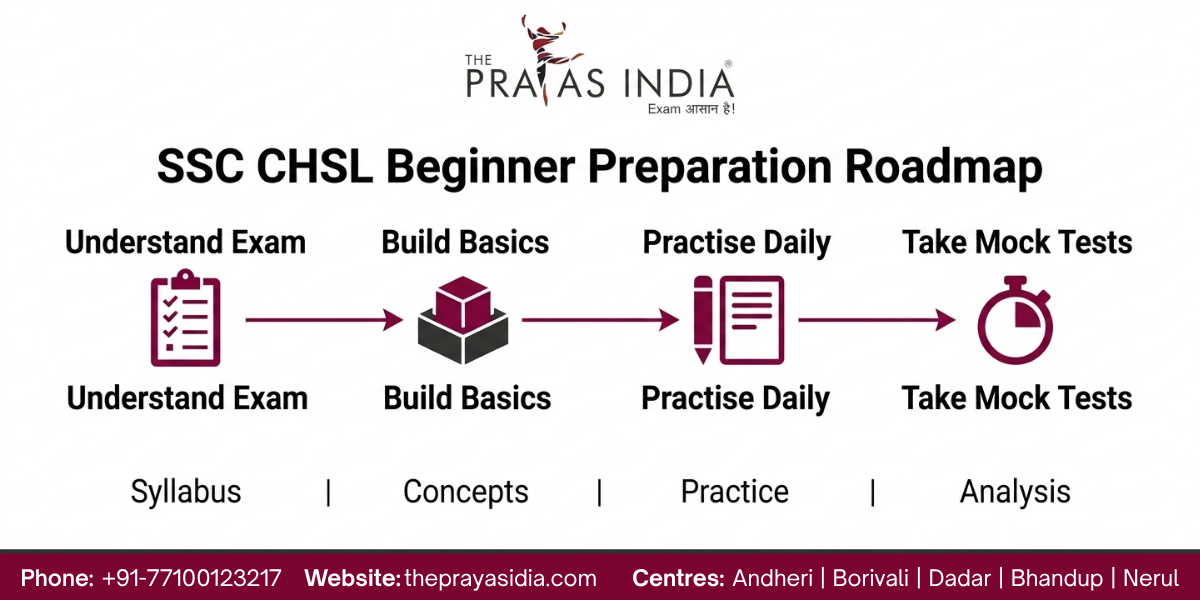
A beginner should therefore divide the syllabus into manageable blocks. Start with fundamental topics, establish a daily routine and gradually introduce more difficult question types. As your confidence increases, combine previously studied topics through mixed practice. This approach may feel slower during the first few weeks, but it creates a much more reliable foundation for the later stages of preparation.
Build Your Preparation Around Four Core Areas
English Language: Build Accuracy Before Chasing Speed
English can become a strong scoring section in SSC CHSL when preparation is systematic. Beginners should first understand the basic grammar concepts that repeatedly appear in competitive examinations. Topics such as parts of speech, subject-verb agreement, tenses, articles, prepositions, conjunctions and common grammatical errors deserve consistent attention.
Vocabulary should not be treated as a task that can be completed in a few days. Instead, develop a daily reading and revision habit. Learn words in context, understand their usage and periodically revise previously learned vocabulary. Reading editorials, quality articles or other suitable English material can also gradually improve comprehension and familiarity with sentence structures.
Once your foundation becomes stronger, shift towards exam-oriented practice. Solve error detection, sentence improvement, fill-in-the-blanks, cloze tests, reading comprehension and other relevant question types under time limits. This allows you to move from knowing English rules to applying them efficiently in an examination.
Quantitative Aptitude: Strengthen the Basics First
For many beginners, Quantitative Aptitude appears intimidating because it involves calculations and multiple mathematical concepts. However, trying to avoid Quant because it looks difficult usually makes the problem worse. A better approach is to build the subject gradually, beginning with fundamental arithmetic concepts.
Start by developing comfort with percentages, ratio and proportion, averages, profit and loss, simple and compound interest, time and work, time-speed-distance and other important arithmetic areas. Once the basics are clear, move towards more advanced topics according to the latest syllabus and your preparation level.
The important point is to separate conceptual learning from speed-building. In the initial stage, concentrate on understanding why a method works. Do not become obsessed with solving every question in the shortest possible time. Once the method becomes familiar, introduce timed practice. This gradual transition helps you develop speed without creating careless calculation habits.
General Intelligence: Learn the Pattern, Then Practise
Reasoning and General Intelligence can become highly manageable when beginners understand that many questions follow recognisable patterns. The objective is not to memorise answers but to develop the ability to identify relationships, sequences, conditions and logical structures.
Start with fundamental topics and practise them individually before moving towards mixed sets. Questions involving analogy, classification, series, coding-decoding, blood relations, direction sense and other relevant areas can be approached more confidently once you understand the basic logic behind them.
With regular practice, the time required to recognise familiar patterns gradually decreases. This is particularly useful in a time-bound examination. However, speed should come naturally from repeated exposure. Beginners should avoid rushing through questions simply to increase their attempt count because incorrect answers can undermine otherwise good preparation.
General Awareness Requires Consistency, Not Last-Minute Preparation
General Awareness is often treated differently from the other sections because it cannot be prepared effectively through problem-solving practice alone. Beginners sometimes postpone it for several months and then attempt to cover everything through intensive revision near the examination. This can create unnecessary pressure.
A better approach is to make General Awareness a regular part of your daily schedule. You do not necessarily need to spend several hours every day on it. Consistent, focused study followed by repeated revision can be much more effective than occasional long sessions.
Static General Knowledge, important facts, basic science, history, geography, polity, economics and relevant current affairs should be studied according to the latest examination requirements. The current SSC notification, recent paper trends and your mock-test performance should guide the exact balance.
The biggest advantage of early GA preparation is that it allows multiple revision cycles. Rather than trying to remember information after reading it once, you can revisit important facts several times, which improves retention.
Your Daily Routine Should Be Practical
Beginners often create extremely ambitious timetables. They may decide to study for ten or twelve hours every day, divide the day into tiny blocks and assign a huge number of targets to each session. Such schedules look impressive on paper but often become difficult to maintain.
A practical SSC CHSL routine should reflect your actual circumstances. If you are a college student or working aspirant, your schedule will naturally differ from someone preparing full-time. The objective is not to copy another candidate’s timetable but to create a routine that you can follow consistently.
A productive day should include a combination of concept learning, question practice, revision and analysis. For example, you might devote one session to learning a new Quant or English concept, another to solving questions, a shorter session to General Awareness and a final session to revision or error analysis. The exact hours can vary, but every study day should contribute something measurable to your preparation.
Consistency is more valuable than occasional bursts of intense study. Studying six focused hours consistently can produce better results than studying twelve hours for two days and then losing momentum for the next three.
Make Revision Part of Your Preparation From Day One
Revision should not begin after you finish the entire syllabus. If you study a topic once and leave it untouched for several weeks, much of what you learned will gradually become less accessible. This is particularly problematic for General Awareness, vocabulary, formulas and frequently used concepts.
A better approach is to revise continuously. After completing a topic, revisit it after a short interval and then again after a longer gap. This spaced revision process allows you to strengthen memory without repeatedly relearning the entire chapter from the beginning.
Revision should also include your mistakes. Maintain an error notebook or digital error log where you record questions that you got wrong, concepts you misunderstood and calculation approaches that caused confusion. Over time, this becomes a highly personalised revision resource because it reflects your actual weaknesses rather than a generic list of topics.
Practise Questions After Understanding the Concept
Reading theory can create a feeling of familiarity, but familiarity should not be mistaken for mastery. You may understand a grammar rule while reading an explanation and still make mistakes when that rule appears inside a complicated sentence. Similarly, you may understand a mathematical formula but struggle to recognise which formula should be applied to a particular question.
This is why practice should immediately follow conceptual learning. Once you finish a topic, solve a meaningful set of questions covering different levels of difficulty. Start without excessive time pressure so that you can focus on the method. Once you become comfortable, introduce a time limit.
During practice, do not simply count correct answers. Study your mistakes. If you make the same type of mistake repeatedly, identify the reason behind it. Sometimes the problem is conceptual, while at other times it may be careless reading or calculation. This distinction helps you improve more efficiently.
Begin Mock Tests Before You Feel “Fully Prepared”
Many beginners postpone mock tests because they believe they should first complete the entire syllabus. This can be counterproductive. Mock tests are not only for measuring final preparation; they are also tools for understanding how you perform under examination conditions.
Early sectional or topic-based tests can reveal which areas are taking too long and which concepts need additional attention. As your preparation progresses, gradually introduce more comprehensive tests. You do not need to worry if your initial scores are low. At the beginning, the purpose is to identify weaknesses and learn how to work under time pressure.
The important thing is to analyse every test properly. A mock test followed by no analysis is simply another set of questions. The real learning happens when you understand why you made mistakes, why certain questions took too long and which areas need targeted practice before the next test.
Build the Right Foundation Before Chasing High Scores
The early stage of SSC CHSL preparation is less about achieving an impressive mock-test score and more about building a dependable foundation. Beginners often compare themselves with candidates who have already been preparing for months and become discouraged when their initial performance is lower. Such comparisons are rarely useful because preparation levels, study backgrounds and strengths can be very different.
Instead, focus on measurable improvement. If your Quant accuracy improves from one week to the next, that is progress. If you can solve a Reasoning set faster than before, that is progress. If your English mistakes are becoming more predictable and easier to correct, that is progress. If you are retaining more General Awareness after repeated revision, that is also progress.
The objective during the beginning phase should be to create a system that you can sustain throughout your preparation. Once the foundation is strong, speed and advanced question practice can be developed much more effectively.
A Beginner’s Preparation Checklist
Before moving deeper into your SSC CHSL preparation, make sure you have established the following habits:
- Understand the latest SSC CHSL notification and examination requirements.
- Divide the syllabus into manageable topic groups.
- Strengthen fundamentals before focusing heavily on speed.
- Practise English regularly instead of relying only on revision near the exam.
- Build Quantitative Aptitude from basic concepts towards advanced application.
- Practise Reasoning consistently and learn to recognise common patterns.
- Give General Awareness regular daily attention.
- Maintain an error log for repeated mistakes.
- Introduce timed practice gradually.
- Start sectional tests before moving heavily into full-length mocks.
- Analyse every test rather than focusing only on the final score.
- Revise previously completed topics at regular intervals.
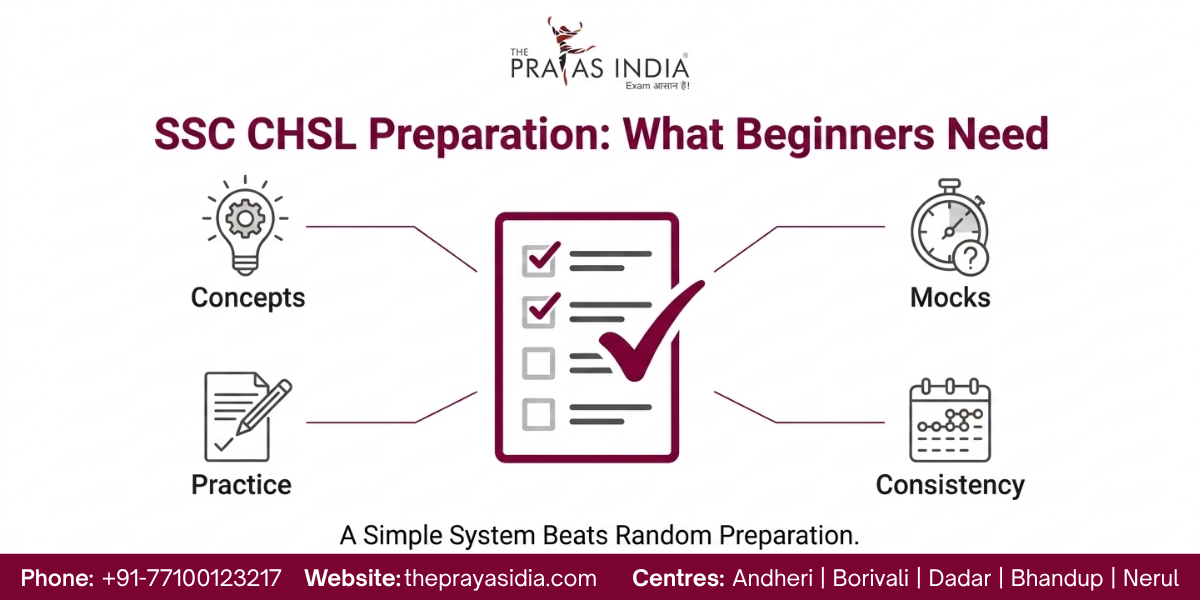
Following these principles can make SSC CHSL preparation far more organised for a beginner. The goal is not to make your study plan complicated. In fact, the most effective preparation systems are often simple enough to follow every day.
Moving From Preparation to Exam Readiness
Once your fundamentals are reasonably strong, the focus of preparation should gradually shift from learning new concepts towards application, speed and accuracy. This transition should happen naturally rather than suddenly. A candidate who spends the entire preparation period learning theory may find it difficult to adapt to the pressure of a timed paper, while someone who starts taking full mocks without understanding the basics may repeatedly reinforce incorrect methods.
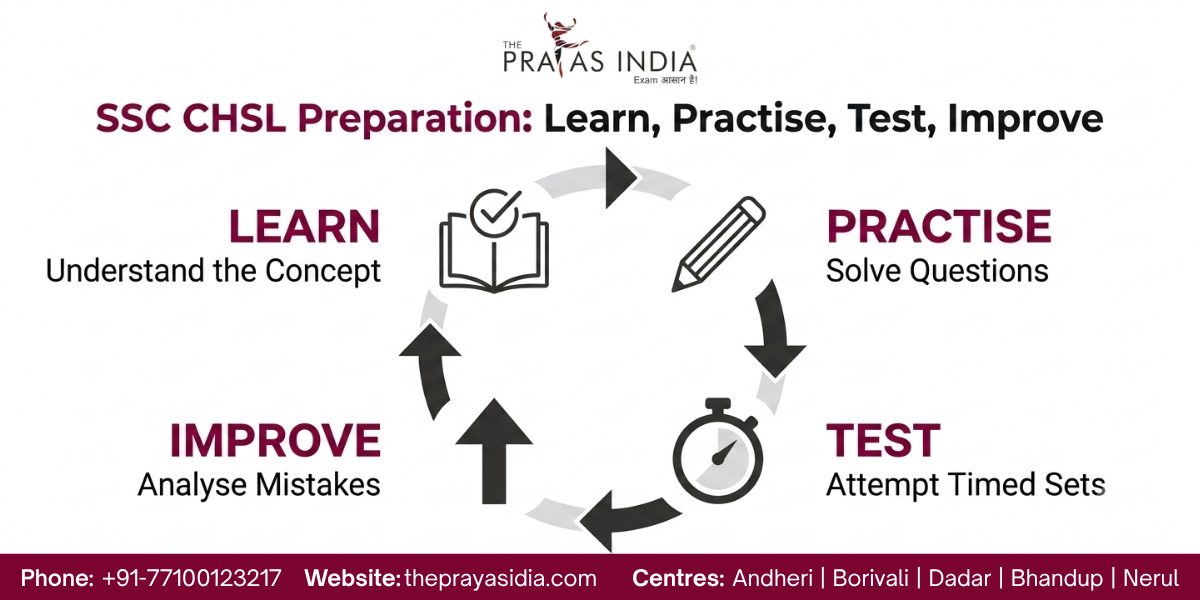
The ideal progression is therefore gradual: understand, practise, revise, test and improve. As these stages become part of your routine, you begin developing not only subject knowledge but also the examination temperament required for SSC CHSL.
For beginners, this structured progression can make the preparation journey much less overwhelming. Instead of asking yourself every day, “What should I study today?”, you can work through a clear system and measure your progress through practice and testing.
That is the foundation on which a serious SSC CHSL preparation strategy should be built.
Develop Speed Without Losing Accuracy
Speed becomes increasingly important as your SSC CHSL preparation progresses, but it should never be treated as an independent target. If you simply try to increase the number of questions you solve, you may start making avoidable mistakes. A better approach is to identify the question types that you already understand and gradually reduce the time required to solve them.
For Quantitative Aptitude, this could mean improving basic calculation efficiency and becoming familiar with standard approaches. In English, it may involve faster identification of grammatical errors or more efficient reading. In Reasoning, repeated exposure to familiar patterns can reduce the time required to understand the logic behind a question. General Awareness is slightly different because speed mainly comes from quick recall rather than lengthy solving.
Your mock-test analysis should help you determine whether your speed is genuinely improving. If your attempts increase but accuracy falls sharply, you are probably rushing. If your accuracy remains stable while your solving time gradually decreases, you are developing controlled speed—the kind that is actually useful in a competitive examination.
Learn to Prioritise Questions
A beginner may initially believe that every question deserves equal attention. With experience, however, you learn that good examination strategy depends heavily on prioritisation. Some questions are straightforward and can be solved quickly, while others may require multiple steps or involve unfamiliar patterns.
During practice, pay attention to the amount of time different question types consume. If a particular question repeatedly takes you much longer than expected, learn to recognise it early. This does not mean permanently avoiding the topic. It means understanding when it is better to attempt it and when it is better to move forward.
Question selection becomes particularly important during mock tests. Instead of measuring success only by how many questions you attempted, evaluate whether you selected questions intelligently. A candidate who attempts fewer questions with high accuracy and efficient time utilisation may be in a much stronger position than someone who attempts more questions but loses time and marks through careless decisions.
Strengthen Your Weak Subjects Strategically
Every beginner has a different preparation profile. You may be comfortable with English but struggle with Quant, or you may find Reasoning easy while General Awareness requires much more revision. The objective should not be to spend equal time on every subject simply because the timetable looks balanced.
Your preparation time should reflect your actual needs. Strong subjects need regular practice so that they remain reliable scoring areas, while weaker subjects require more deliberate work to eliminate major gaps. However, avoid spending your entire day on one difficult subject. If a topic is consistently causing problems, break it into smaller components and improve it step by step.
A useful way to identify priorities is through test performance. If the same topic repeatedly appears among your incorrect or unattempted questions, it deserves additional attention. This data-driven approach is more effective than deciding your priorities purely on the basis of which subject feels difficult.
Make Revision a Continuous Process
Revision should run parallel to syllabus completion rather than being postponed until the final weeks. When beginners keep moving from one new chapter to another without revisiting earlier material, they may feel that they are progressing because the syllabus percentage is increasing. However, previously studied concepts can gradually become less accessible if they are not revised.
A simple revision cycle can solve this problem. After learning a topic, revise it after a short gap, practise it again after a longer interval and then revisit it during mixed question practice. This approach is particularly useful for formulas, grammar rules, vocabulary, General Awareness facts and frequently repeated concepts.
Your error notebook should also become part of this process. Instead of revising only what you got right, spend meaningful time reviewing what you got wrong. A mistake that you repeatedly make in mocks is more important to your preparation than a question you already solve confidently.
Create an Error Log That Actually Helps
Maintaining an error notebook is a common recommendation, but it becomes useful only when it is specific. Simply writing down every wrong answer can create a large collection of notes without helping you understand the underlying problem.
Whenever you make a mistake, identify its category. Was the concept unclear? Did you forget a formula? Did you misread the question? Was the calculation incorrect? Did you select the wrong method? Or did you know the answer but make a careless marking error?
Once mistakes are categorised, patterns become visible. If most of your Quant mistakes come from calculation errors, you need calculation practice. If English mistakes are mainly grammar-related, targeted revision is required. If Reasoning mistakes occur because you rush through conditions, reading and execution discipline need attention.
The purpose of an error log is therefore not to create more study material. It is to create a personal map of your weaknesses.
Use Mock Tests as a Preparation Tool
Mock tests should gradually become an integral part of SSC CHSL preparation. They provide an environment in which you must combine knowledge, speed, accuracy, question selection and time management simultaneously.
However, beginners should not become obsessed with mock scores. Your first few mocks may reveal significant weaknesses, and that is completely normal. At this stage, the purpose of testing is diagnosis. You need to understand what happens when you are under time pressure.
After each mock, review questions that were incorrect, questions that took too long and questions that you left despite knowing the underlying concept. Also look for easy questions that you missed because you were occupied with lengthy ones. This type of analysis often reveals more about your preparation than the score itself.
As you take more mocks, compare performance over time. Look for trends rather than isolated results. Gradual improvement in accuracy, attempts and time utilisation is a stronger indicator of readiness than one unusually high score.
Build a Realistic Weekly Study Plan
A weekly plan is often more useful for beginners than a rigid hour-by-hour timetable. Daily schedules can change because of college, work, family responsibilities or other commitments. A weekly framework gives you enough flexibility to adjust your study hours while ensuring that every important area receives attention.
A balanced week should include concept learning, topic-wise practice, revision, General Awareness, timed sets and mock tests. The proportion can change depending on your preparation stage. During the early phase, concept building may take more time. Later, practice and testing should gradually occupy a larger share of your schedule.
It is also useful to keep one regular review session every week. During this session, look at what you planned to study, what you actually completed and which topics remain weak. This prevents small gaps from becoming major problems later in the preparation.
Don’t Ignore Previous-Year Questions
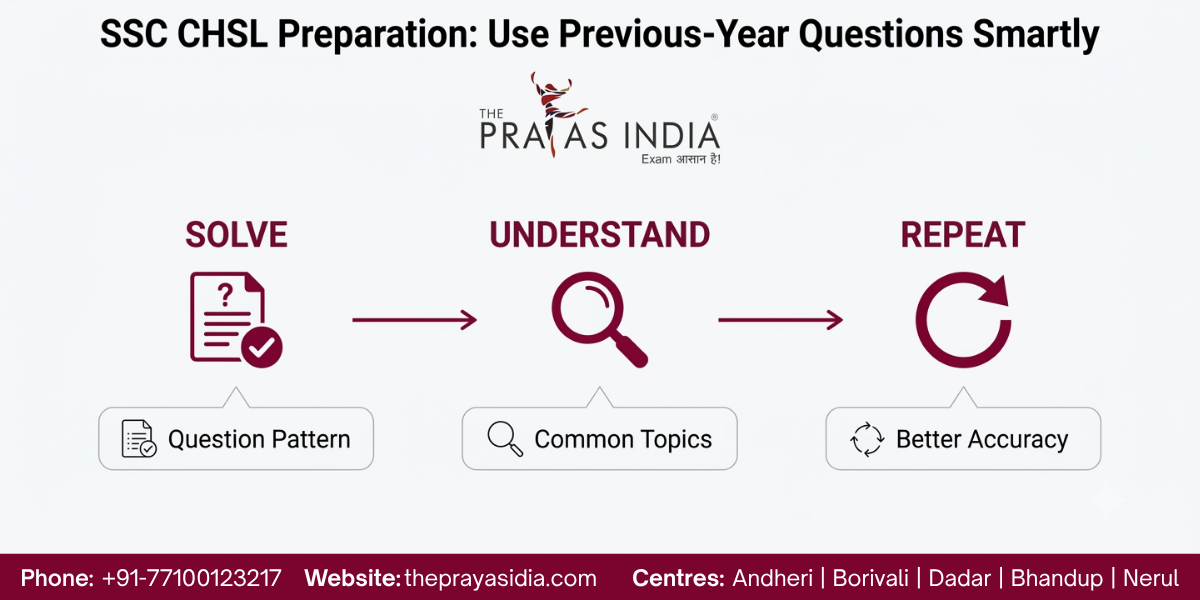
Previous-year questions are among the most useful resources for understanding the practical nature of SSC CHSL preparation. They help you see how concepts are actually converted into examination questions and allow you to identify recurring patterns.
For beginners, previous-year questions should not be treated merely as another practice set. Study them to understand the level of questions, frequently tested concepts and common approaches. When you encounter a familiar topic in a previous-year paper, ask yourself whether you can identify the method quickly and solve it within a reasonable time.
Over time, this exposure helps reduce uncertainty. You become more familiar with the style of questions and can make better decisions about what to prioritise during preparation.
Manage General Awareness Through Smart Revision
General Awareness can become difficult for beginners because the amount of information appears unlimited. The solution is not to try to memorise everything. Instead, build a focused study and revision system based on the examination requirements and reliable preparation resources.
Divide static subjects into manageable areas and revise them repeatedly. Current affairs should also be studied consistently according to the latest examination cycle. Rather than reading large amounts of information without revision, focus on retaining important facts through repeated exposure.
Short revision sessions can be particularly effective here. Even when you have limited time on a particular day, spending some time reviewing previously studied General Awareness material can help maintain continuity.
Avoid the Trap of Constantly Changing Study Material
Beginners often assume that better preparation requires more resources. They switch between books, teachers, websites, videos and test platforms whenever they encounter difficulty. This can create a cycle in which they consume a lot of content but practise comparatively few questions.
A better approach is to choose a limited set of reliable resources and use them consistently. Once a concept is understood, move towards application instead of searching for another explanation of the same concept. Additional resources should be used when you genuinely need clarification, not simply because a new source appears more attractive.
The same principle applies to mock tests. Taking tests from different platforms can sometimes be useful, but constantly switching between test sources without analysing your performance can make your preparation fragmented.
Stay Consistent When Motivation Drops
Long-term preparation inevitably includes days when motivation is low. Beginners sometimes interpret these days as evidence that they are not capable of preparing for a competitive examination. In reality, consistency is built precisely by learning how to continue when motivation is not at its highest.
Instead of expecting every study session to be highly productive, create a minimum daily routine that you can maintain even on difficult days. It could involve revision, a short question set or a General Awareness session. The purpose is to protect continuity.
At the same time, consistency does not mean ignoring genuine fatigue. Planned breaks and adequate rest are important because sustained preparation requires concentration. A realistic schedule that you can maintain for months is far more valuable than an extreme routine that becomes impossible after a few days.
When Should a Beginner Join SSC CHSL Coaching?
The decision to join coaching depends on your preparation style, academic foundation and ability to maintain a structured routine independently. Some candidates are comfortable studying on their own, while others benefit significantly from a guided environment where concepts, practice and testing follow a defined sequence.
For beginners, coaching can be particularly useful when they are unsure about where to start, struggle to identify important topics, need regular doubt resolution or find it difficult to maintain consistency. A structured SSC coaching programme can provide a study framework, practice material, mock tests and performance feedback, reducing the need to constantly decide what to study next.
If you are considering SSC coaching in Mumbai, evaluate an institute on the basis of faculty quality, teaching methodology, practice resources, mock-test support, doubt-solving systems and how effectively the programme supports your preparation throughout the examination cycle. The objective should be to find an environment that helps you build independent problem-solving ability rather than simply completing lectures.
A Practical SSC CHSL Beginner Strategy
Putting everything together, a beginner’s preparation can follow a simple progression. Start by understanding the latest examination requirements and dividing the syllabus into manageable sections. Spend the initial phase strengthening your fundamentals rather than rushing towards full-length mocks. Once the concepts become comfortable, increase question practice and introduce short timed sets.
As your preparation develops, begin sectional tests and gradually move towards full-length mocks. Use every test to identify weaknesses rather than judging yourself only through the score. Revise regularly, maintain an error log and adjust your study priorities according to actual performance.
In the later stage, the emphasis should increasingly shift towards speed, accuracy, question selection and examination strategy. By then, your preparation should no longer depend entirely on learning new concepts. Instead, you should be refining the skills required to convert your knowledge into marks within the available time.
The biggest advantage beginners have is time to build these habits correctly. You do not need to rush through the preparation process. What matters is creating a system that you can follow consistently and improving it through regular feedback.
Frequently Asked Questions
1. How should a beginner start SSC CHSL preparation?
Begin by understanding the latest SSC CHSL notification, examination structure and syllabus. Then assess your current level and divide the syllabus into manageable sections. Focus first on fundamentals, followed by topic-wise practice, revision and gradually increasing timed tests.
2. How many hours should I study for SSC CHSL every day?
There is no universal number of hours that guarantees success. Your study duration should depend on your preparation level and daily responsibilities. Consistent, focused study with measurable targets is more useful than following an unrealistic timetable.
3. Which subjects should I study first for SSC CHSL?
Start with the subjects or topics where your fundamentals are weakest while maintaining regular practice in your stronger areas. English, General Intelligence, Quantitative Aptitude and General Awareness should all receive consistent attention according to the latest examination requirements.
4. Should beginners take SSC CHSL mock tests?
Yes. Beginners can start with topic-wise and sectional tests before moving towards full-length mocks. Early tests are useful for identifying weaknesses and learning how to perform under time pressure.
5. How can I improve SSC CHSL Quantitative Aptitude?
Build your arithmetic fundamentals first and then practise different question types. Once your methods become reliable, introduce timed practice and focus on calculation efficiency without compromising accuracy.
6. How can I improve English for SSC CHSL?
Build your grammar fundamentals, develop vocabulary through regular exposure and practise examination-oriented question types. Reading regularly can also improve comprehension and familiarity with English sentence structures.
7. How should I prepare General Awareness for SSC CHSL?
Study General Awareness consistently rather than postponing it until the final stage. Divide static topics into manageable areas, follow relevant current affairs and revise frequently to improve retention.
8. Is SSC CHSL coaching necessary for beginners?
Coaching is not mandatory for every candidate, but structured guidance can be valuable for beginners who need a systematic study plan, regular testing, expert feedback and doubt resolution. The decision should depend on your individual preparation needs.
9. How important are previous-year SSC CHSL questions?
Previous-year questions are highly useful for understanding the style, difficulty and recurring concepts of the examination. They should be included regularly in topic-wise and mixed practice.
10. What is the biggest mistake beginners make during SSC CHSL preparation?
A common mistake is studying randomly without a structured plan. Constantly changing resources, postponing revision, avoiding mock tests and focusing only on syllabus completion can also weaken preparation. A consistent cycle of learn → practise → revise → test → analyse is much more effective.
Final Takeaway
SSC CHSL preparation becomes much easier to manage when you stop treating it as an enormous syllabus and start treating it as a structured process. Beginners do not need to master everything immediately. They need to build their fundamentals, practise consistently, revise what they learn and gradually become comfortable solving questions under time pressure.
Your preparation should evolve with time. In the beginning, understanding concepts is the priority. In the middle stage, practice and revision become more important. As the examination approaches, mock tests, speed, accuracy, question selection and performance analysis should occupy a larger part of your routine.
Most importantly, do not measure your preparation only by the number of chapters you have completed. Measure it by how confidently and accurately you can apply those concepts in a timed test.
With a realistic study plan, consistent practice, regular revision and the right guidance, a beginner can gradually transform SSC CHSL preparation from an overwhelming task into a manageable and measurable journey.
Contact Us
- 📞 Call Now: +91-77100 13217
- 🌐 Website: theprayasindia.com
- 📍 Centres: Andheri | Borivali | Dadar | Nerul | Bhandup