SSC CHSL Revision Strategy: How to Revise Effectively Before the Exam | Best SSC Coaching in Mumbai | The Prayas India
Revision is often treated as the final stage of SSC CHSL preparation, but in reality, it is the process that determines how much of your preparation remains available when you actually sit for the examination. An aspirant may spend months completing the syllabus, attending classes and solving questions, yet still struggle in the exam if important concepts, formulas, vocabulary and factual information are not revised at the right intervals.
The challenge becomes even greater as the examination approaches. Students usually have multiple subjects to revise, hundreds of questions to revisit and several areas where their confidence may still be inconsistent. Trying to revise everything in exactly the same way can quickly become overwhelming. A better approach is to identify what deserves repeated revision, what requires practice and what only needs occasional recall.
For SSC CHSL aspirants, an effective revision strategy should therefore be based on retention, repetition, practice and performance analysis. Revision should not mean reading the same chapter again and again. It should help you recall information faster, recognise familiar question patterns and reduce the number of mistakes you make under time pressure.
If you are preparing through SSC coaching in Mumbai, revision should also be an important part of the preparation system you evaluate before taking admission. Good classroom teaching can build your foundation, but regular revision, mock tests, doubt-solving and performance tracking are what help convert that knowledge into examination performance.
Revision Is Not the Same as Re-Reading
One of the most common mistakes in SSC CHSL preparation is confusing revision with reading. A candidate may open a familiar chapter, read every line again and feel that the topic has been revised. However, recognition while reading is not the same as being able to recall the information independently.
Effective revision requires active engagement with the material. Instead of simply looking at a formula, try recalling it before checking your notes. Instead of reading a list of vocabulary words repeatedly, test yourself on their meanings. Instead of going through a solved question passively, cover the solution and attempt the problem yourself.
This makes revision more demanding, but it also makes it significantly more useful.
Your revision sessions should increasingly answer one question: “Can I recall and apply this information without looking at the material?”
If the answer is no, the topic needs more active revision.
Start With a Revision Audit
Before creating a revision timetable, take a realistic look at your current preparation. Do not begin by writing down every chapter in the SSC CHSL syllabus and assigning equal hours to each one. Your objective should be to identify where your existing preparation stands.
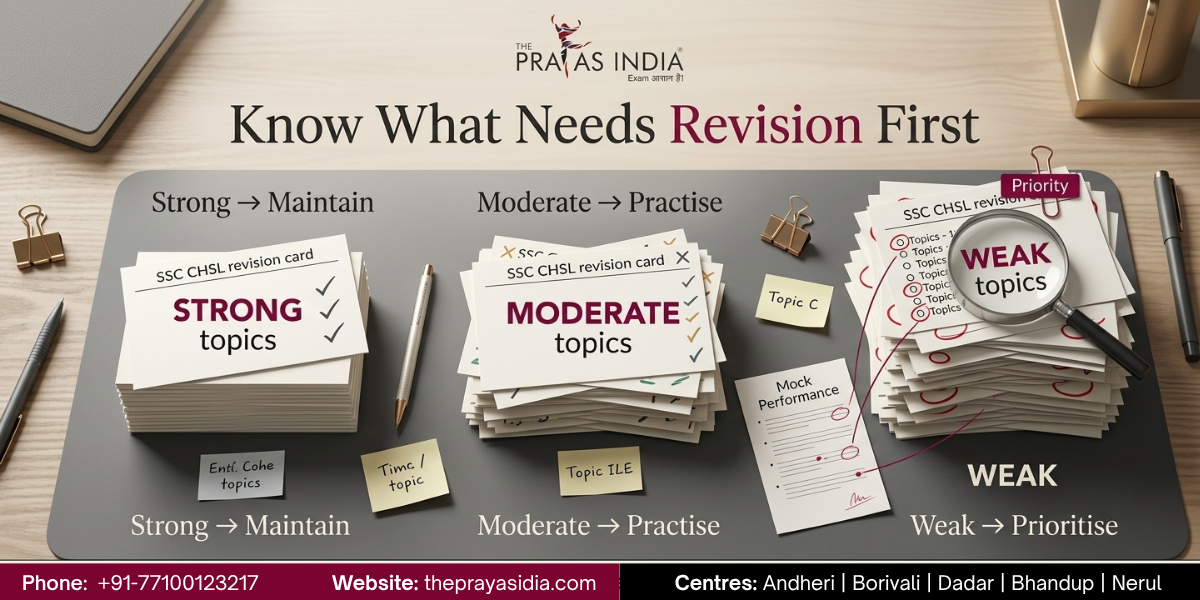
A simple revision audit can divide topics into three broad categories:
- Strong: Concepts are clear, accuracy is high and only periodic revision is required.
- Moderate: You understand the topic but make occasional mistakes or need more practice.
- Weak: Concepts are unclear, recall is poor or accuracy remains consistently low.
This classification gives your revision schedule a purpose. Strong topics should not consume the majority of your available time simply because they feel comfortable. Moderate and weak areas require more attention, particularly when they are important from an examination perspective.
The audit should also include your mock-test performance. If a topic appears strong in your notebook but repeatedly produces mistakes in mocks, your actual preparation level may be lower than you think.
Build Revision Around Your Mistakes
Your previous mistakes are one of the most useful sources of revision material. Every incorrect answer contains information about a weakness in your preparation, whether that weakness is conceptual understanding, memory, calculation, reading or question selection.
Instead of maintaining a generic revision list, maintain a personal error list based on your practice and mock tests.
For example, if you repeatedly make mistakes in percentage calculations, that topic deserves targeted revision. If you repeatedly forget important historical facts, those facts should become part of your recall sessions. If your English mistakes mostly involve specific grammar rules, your revision should focus on those rules rather than revisiting the entire grammar syllabus.
A mistake becomes particularly important when it appears repeatedly. One isolated error may be accidental; repeated errors indicate a pattern that needs correction.
Use Short Revision Cycles
Long revision sessions can create the illusion of productivity while reducing actual retention. Sitting with one subject for several hours and repeatedly reading the same material can become mentally exhausting.
Shorter, focused revision cycles are often easier to maintain. You can divide your study time between concept recall, question practice and error revision rather than spending the entire session on passive reading.
For example, a session could involve:
- Revising a small set of formulas or concepts
- Solving a timed question set
- Reviewing incorrect questions
- Recalling important facts without looking at notes
The exact duration can vary according to your schedule and preparation level. What matters is that every session has a clear purpose.
Mathematics Revision Should Be Practice-Driven
Mathematics cannot be revised effectively through formula reading alone. A formula may look familiar in your notebook but still take too long to apply when you encounter an unfamiliar question.
Your Mathematics revision should therefore combine formula recall with problem-solving practice. Begin by reviewing the essential concepts and shortcuts, but quickly move towards questions that test whether you can actually apply them.
Pay particular attention to topics where your mock-test performance shows inconsistency. If you are accurate but slow, your revision should include timed practice. If you are fast but make frequent mistakes, focus on controlled solving and calculation accuracy.
A useful Mathematics revision session should leave you with greater confidence in both method and execution.
Create a Formula Revision System
Instead of maintaining a huge formula notebook that you rarely open, create a compact collection of formulas and methods that genuinely require repeated recall.
Keep the material organised by topic and make it easy to review quickly. Include only information that is relevant to your preparation and frequently useful in problem-solving.
Your formula revision can include:
- Important arithmetic formulas
- Percentage and ratio relationships
- Profit, loss and discount concepts
- Time, speed and distance relationships
- Time and work concepts
- Algebraic identities
- Geometry and mensuration formulas
- Frequently used calculation shortcuts
The purpose of this material is quick recall, not comprehensive textbook replacement.
Reasoning Revision Should Focus on Patterns
Reasoning revision is different from revising a factual subject. You cannot simply memorise solutions to every possible question. Instead, revision should strengthen your familiarity with recurring question types and the logical approaches used to solve them.
When reviewing Reasoning, pay attention to the process rather than only the final answer. If you made a mistake in a particular question type, identify where your reasoning went wrong.
For example, ask yourself whether you misunderstood the conditions, created an incorrect arrangement, missed a relationship or spent too much time exploring an inefficient possibility.
Regular exposure to different question patterns gradually improves recognition speed. The goal is to reach a point where you can quickly understand what type of reasoning a question demands.
English Revision Needs Regular Exposure
English can deteriorate when it is left untouched for long periods. Vocabulary, grammar rules, sentence structures and comprehension skills benefit from regular exposure.
Instead of reserving English for occasional long sessions, incorporate smaller English revision activities throughout your preparation.
Your revision can include:
- Vocabulary recall
- Synonyms and antonyms
- Idioms and phrases
- Grammar rules
- Error detection practice
- Fill-in-the-blank questions
- Sentence improvement
- Reading comprehension practice
The most important principle is consistency. Regular interaction with English keeps recognition and recall active.
Don’t Memorise Vocabulary Without Revision
Vocabulary lists can become extremely long, and trying to memorise hundreds of words in one sitting is rarely an efficient strategy.
Use repeated exposure instead. When you encounter an unfamiliar word, understand its meaning and revisit it later. Try recalling the meaning before checking your notes. Connecting the word with a sentence or context can also make recall easier.
Create smaller vocabulary groups and revise them repeatedly rather than constantly adding new words without revisiting older ones.
Your objective should be retention, not the size of your vocabulary notebook.
General Awareness Requires a Different Revision Approach
General Awareness can be particularly challenging because the subject contains a wide range of factual information. Candidates may study large quantities of material but forget much of it because they do not revise systematically.
The solution is not necessarily to collect more information. It is to improve recall of the information you have already studied.
Divide your revision into manageable categories and repeatedly test yourself. If certain facts repeatedly appear as mistakes in your mocks, move them into a high-priority revision list.
Avoid spending excessive time reading the same information passively. Instead, close the material and ask yourself what you remember.
This simple change can make your General Awareness revision more active.
General Science Should Be Revised Through Concepts and Questions
General Science revision should combine understanding with question practice. If you memorise isolated facts without understanding the underlying concept, unfamiliar questions can become difficult.
When revising Physics, Chemistry and Biology-related topics, focus on the core concepts that help you interpret questions. Then reinforce those concepts through practice.
If a particular chapter repeatedly produces mistakes, return to the concept first and then solve questions based on it. This prevents revision from becoming a cycle of repeatedly memorising incorrect answers.
Use Active Recall During Revision
Active recall is one of the most useful techniques for examination revision because it forces your brain to retrieve information rather than simply recognise it.
You can use active recall in simple ways without needing complicated tools.
Close your notebook and try to write down the formulas you remember. Explain a concept to yourself without looking at the notes. Attempt a question before checking the solution. Recall vocabulary meanings before looking at the answers.
These activities reveal what you actually remember.
If you cannot recall something, that is not a failure. It is useful feedback telling you exactly what needs another revision cycle.

Combine Revision With Timed Practice
Knowing a concept is different from applying it within examination time. As the exam approaches, your revision should increasingly include timed question practice.
After revising a topic, solve a small set of questions under a realistic time constraint. Then evaluate both accuracy and speed.
This helps answer important questions:
- Can I identify the correct approach quickly?
- Can I solve the question without unnecessary steps?
- Am I making careless errors under pressure?
- Do I spend too much time on particular question types?
- Can I maintain accuracy while increasing speed?
This combination of revision and timed practice makes your preparation more closely aligned with the actual examination environment.
Use Mock Tests as Revision Tools
Mock tests should not be treated only as score-generating exercises. They can also identify exactly what needs to be revised.
Suppose you perform well in most Mathematics topics but repeatedly lose marks in one particular area. That information should influence your next revision session. Similarly, if your English accuracy falls because of specific grammar concepts, those concepts should return to your revision schedule.
After every mock, identify the most important revision actions rather than simply recording the score.
Your cycle should look like:
Mock → Analyse → Identify Weakness → Revise → Practise → Retest
This makes revision dynamic rather than fixed.
Keep a “Last Revision” Notebook
As the examination gets closer, you should not need to revise every page of every notebook. Create a compact final-revision resource containing only the information that needs quick recall.
This can include formulas, difficult vocabulary, important facts, repeated mistakes and concepts that you tend to forget.
The notebook should become progressively smaller as your preparation improves.
A good final-revision notebook is not a second textbook. It is a personalised collection of the information most likely to require last-minute attention.
Avoid the Trap of Revising Only Comfortable Topics
Students often revise topics they already know because those sessions feel productive. Correct answers come easily, confidence increases and the study session feels successful.
However, examination improvement often comes from addressing the areas where performance is weaker.
If a topic is already strong, maintain it through periodic revision. Use the majority of your additional effort on areas where improvement is realistically possible.
This requires honesty. Your revision schedule should be based on performance, not preference.
Revision Should Become More Selective as the Exam Approaches
Early revision can be relatively broad because you still have time to strengthen your overall preparation. As the examination approaches, your revision should become increasingly selective.
Instead of revisiting everything, focus on:
- High-frequency concepts
- Frequently repeated mistakes
- Important formulas
- Difficult-to-remember facts
- Weak question types
- Previous-year question patterns
- Mock-test errors
This helps you get more from your available time.
The Role of Structured Coaching in SSC CHSL Revision
A structured coaching programme can make revision easier by providing a defined academic schedule, organised study material, regular tests and guidance when students are unsure about their weak areas.
For candidates considering the best SSC coaching in Mumbai, this should be an important part of the admission evaluation. A coaching institute should not only promise syllabus completion. Aspirants should also understand how the institute supports revision, practice and performance improvement.
A good preparation system should help students know what to study, when to revise it, how to practise it and how to identify whether the preparation is producing measurable improvement.
This is particularly valuable for students who find it difficult to maintain a revision routine independently.
Choosing SSC Coaching With Revision in Mind
Before taking admission, ask practical questions about the preparation structure rather than focusing only on classroom duration.
Understand whether the programme includes:
- A structured syllabus and revision plan
- Topic-wise practice
- Previous-year question discussions
- Sectional and full-length mock tests
- Performance analysis
- Doubt-solving support
- Regular revision sessions
- Guidance for weak areas
- Exam-oriented preparation
The right coaching environment should reduce unnecessary confusion and allow you to spend more time actually preparing.
For aspirants searching for SSC coaching in Mumbai, this broader preparation ecosystem can be more valuable than choosing an institute based only on its location or promotional claims.
The Prayas India for SSC CHSL Preparation
The Prayas India offers structured preparation support for aspirants targeting competitive examinations. For SSC CHSL candidates, a guided preparation environment can help bring greater discipline to the learning, practice, testing and revision cycle.
The objective should not be to make students dependent on coaching for every step. Instead, structured guidance should help students understand their preparation requirements and gradually develop the ability to monitor their own performance.
For candidates exploring SSC coaching in Mumbai, The Prayas India can be considered as part of a preparation approach that combines classroom learning with practice, revision and examination-focused performance development.
Build Revision Into Your Preparation Before the Final Stage
One of the biggest mistakes is waiting until the final weeks to begin serious revision. Revision should start while preparation is still underway.
Once a topic has been learned, it should enter a revision cycle. This reduces the amount of material that accumulates at the end and prevents the final stage from becoming overwhelming.
A sustainable preparation cycle looks like:
Learn → Practise → Revise → Test → Analyse → Revise Again
The process repeats throughout your preparation.
When revision is built into the routine from the beginning, the final phase becomes about consolidation rather than attempting to relearn the entire syllabus.
What Effective SSC CHSL Revision Ultimately Looks Like
Effective revision is not measured by how many pages you have read again. It is measured by how confidently and accurately you can recall and apply information when faced with a question.
A successful revision strategy should gradually produce four changes:
- You recall important information faster.
- You make fewer repeated mistakes.
- You solve familiar question types more efficiently.
- You feel more prepared to handle the examination under time pressure.
That is the real purpose of revision.
For SSC CHSL aspirants, the final goal is not to know that you have “revised the syllabus.” The goal is to reach the examination with the important concepts, facts, formulas and question-solving methods readily available when you need them.
And that requires planned revision, active recall, targeted practice and consistent testing.
From Revision to Exam Readiness
Revision becomes more important as the SSC CHSL examination approaches because the focus of preparation gradually shifts from learning new concepts to strengthening what you already know. At this stage, your objective should not be to keep expanding your study material endlessly. Instead, you should improve recall, eliminate repeated mistakes and become more comfortable solving questions within the available time.
A candidate who has studied the entire syllabus but cannot recall important concepts during the examination may perform below expectations. Similarly, a student with reasonably strong preparation can lose marks because of poor question selection, careless errors or lack of revision. The final stage should therefore bring together knowledge, practice and examination strategy.
Create a Three-Level Revision Cycle
A useful way to organise SSC CHSL revision is to divide it into three levels. The first level is broad revision, where you revisit the major concepts and identify weak areas. The second level is targeted revision, where you spend more time on topics responsible for repeated mistakes. The third level is rapid revision, where you focus on formulas, facts, vocabulary, error notes and other high-value information that needs quick recall.
This structure prevents the common problem of treating every topic equally until the last day. Your revision should become increasingly selective as the examination gets closer.
A practical sequence can be:
- First Revision: Cover the syllabus and identify weak areas.
- Second Revision: Strengthen weak topics and practise important question types.
- Final Revision: Focus on mistakes, formulas, facts, vocabulary and frequently tested concepts.
The exact duration of each cycle depends on your preparation level, but the principle remains the same: revision should become more focused with time.
Give More Time to High-Return Topics
When time is limited, prioritisation becomes essential. You cannot afford to spend several hours revising a topic simply because it is difficult if another topic is producing far more questions and mistakes in your mocks.
Review your previous tests and identify areas where additional preparation can realistically improve your score. Topics that combine high importance with repeated errors should receive greater attention.
This does not mean completely ignoring difficult or less familiar areas. It means distributing your time intelligently.
Your revision priorities should generally be influenced by:
- Your accuracy in the topic
- Frequency of mistakes
- Importance of the topic
- Time required to improve
- Performance in previous-year questions and mocks
This approach makes revision more strategic rather than purely exhaustive.
Revise Mathematics Through Mixed Practice
As the examination approaches, Mathematics revision should gradually move away from isolated chapter practice towards mixed question sets. During initial preparation, topic-wise practice helps build concepts. Later, mixed practice tests whether you can identify the appropriate method without being told which chapter the question belongs to.
This distinction is important because the actual examination does not announce the topic before every question.
A mixed practice session can contain questions from arithmetic, algebra, geometry, mensuration and other relevant areas. Your task is not only to solve them but to recognise the correct approach quickly.
If you repeatedly select the wrong method, revisit the underlying concept. If your method is correct but your execution is slow, increase timed practice.
Keep Calculation Practice in the Routine
Calculation speed can have a direct impact on your performance in quantitative sections. However, speed should not be developed by rushing through questions. It should come from familiarity with common calculations and efficient methods.
Include short calculation exercises in your regular revision routine rather than attempting to improve speed only during full-length mocks.
Practise calculations involving percentages, fractions, ratios, averages and other commonly used operations. Over time, these small improvements can reduce the amount of mental effort required for routine steps.
The objective is to make basic calculations sufficiently comfortable that they do not unnecessarily consume examination time.
Revise Reasoning Through Timed Sets
Reasoning revision should increasingly involve timed sets because the examination requires you to make decisions quickly. You need to recognise the question type, understand its structure and determine whether it deserves immediate attention.
Timed practice can help identify whether your difficulty is conceptual or strategic.
If you understand the question but cannot solve it within a reasonable time, practise the method.
If you frequently begin questions that turn out to be lengthy, improve your selection process.
If you make mistakes because you rush, work on maintaining controlled accuracy.
This makes Reasoning revision more closely connected to actual examination performance.
English Revision Should Combine Rules With Application
Grammar rules become useful only when you can apply them to questions. Therefore, English revision should not consist entirely of reading grammar notes.
After revising a rule, solve questions that require you to apply it. Review the incorrect answers and identify whether the mistake came from misunderstanding the rule or overlooking something in the sentence.
Vocabulary should similarly be revised through repeated recall rather than passive reading. Reading a word and recognising it may create familiarity, but attempting to recall its meaning without looking at the answer provides a stronger test of retention.
Regular exposure combined with active application can make English revision more productive.
General Awareness Needs Frequent Short Revision
General Awareness is difficult to revise effectively through a single long session because the volume of information can become overwhelming. Short, repeated revision sessions are often more manageable.
Instead of attempting to memorise a large amount of information in one sitting, divide your material into smaller groups and revisit them periodically.
Your revision should also distinguish between information you remember easily and information that repeatedly disappears from memory. The latter should be placed into your personal high-priority revision list.
This is where your mock-test mistakes become particularly useful. If the same type of General Awareness question repeatedly causes errors, that information should receive additional revision.
Previous-Year Questions Should Be Part of Final Revision
Previous-year questions should not be reserved only for the initial practice stage. They can also play an important role during revision.
They help you connect your knowledge with actual examination-style questions and allow you to identify recurring concepts and question patterns.
During the later stages of preparation, use previous-year questions to test whether your revision has improved your ability to apply concepts.
If you can remember a formula but struggle to identify when to use it, more application practice is required.
If you know the concept but repeatedly make careless mistakes, your revision should include timed accuracy practice.
Make Your Error Log Smaller Over Time
Your error notebook may initially contain a large number of entries. That is normal. However, as your preparation progresses, the list should gradually become more selective.
Once a mistake has been corrected consistently across several tests, it no longer needs the same level of attention. New or recurring mistakes should move higher on your priority list.
This creates a dynamic error log rather than a static notebook.
By the final revision stage, ideally, the notebook should contain only the mistakes and concepts that still require your attention.
That makes last-minute revision considerably easier.
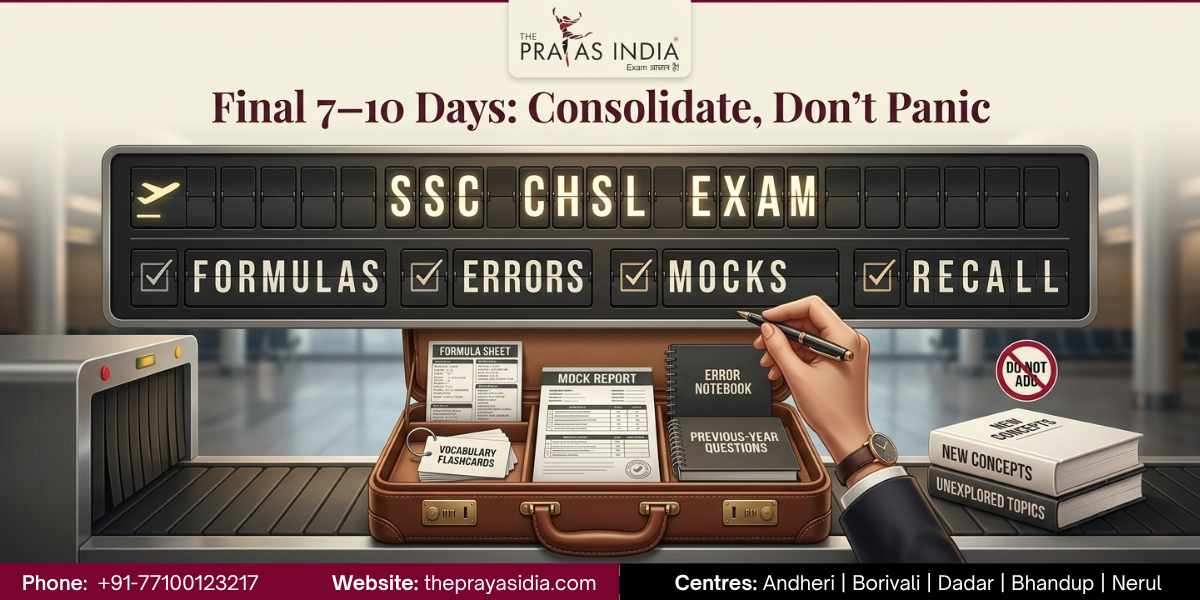
The Final 7–10 Days Should Be About Consolidation
The final week should not become a period of panic-driven syllabus expansion. Attempting to learn large amounts of completely new material at the last moment can create confusion and reduce confidence in topics you already know.
Instead, concentrate on consolidating your preparation.
Your final days can include:
- Short revision of important formulas
- Vocabulary and grammar revision
- General Awareness and Science recall
- Previous-year question practice
- Review of your error notebook
- Selected mock tests
- Analysis of recent mistakes
- Revision of frequently forgotten concepts
The precise schedule can be adjusted according to your strengths and weaknesses, but the underlying goal should remain the same: strengthen existing preparation rather than constantly starting over.
Don’t Ignore Rest During the Final Phase
Long study hours do not automatically produce better revision. Mental fatigue can reduce concentration and recall, particularly when you are already under pressure.
A sustainable final-phase routine should include sufficient sleep, regular breaks and manageable study blocks. The objective is to reach the examination with your mind alert and your preparation accessible.
If you repeatedly study late into the night and then struggle to concentrate during practice tests, your routine may be working against you.
Your final preparation should train not only your knowledge but also your ability to remain mentally effective.
Use Full-Length Mocks as Dress Rehearsals
Near the examination, full-length mocks should increasingly resemble the actual testing environment. Sit for the complete test without interruptions and follow your intended attempt strategy.
Afterwards, do not focus exclusively on the score.
Review whether your strategy worked.
Did you spend too much time on one section? Did your accuracy fall toward the end? Did you attempt questions simply because you felt pressured? Did you leave easy questions because you were focused on difficult ones?
These observations are valuable because they allow you to make final adjustments before the actual examination.
Build a Final-Day Revision Sheet
The last day should not involve reading multiple books or opening every notebook you have created during preparation.
Prepare a compact revision sheet well in advance. It can contain the formulas, rules, facts and reminders that you personally tend to forget.
The exact contents will differ from student to student.
One candidate may need formulas.
Another may need vocabulary.
Someone else may need a small collection of recurring General Awareness facts.
Your final revision material should therefore be personalised rather than copied from a generic checklist.
Don’t Change Your Entire Strategy at the Last Moment
Your final days are not the ideal time to completely redesign your preparation strategy.
If you have already developed a comfortable question order and it has worked consistently in your mocks, there may be little reason to replace it suddenly because another aspirant follows a different approach.
The same applies to study resources. Constantly switching books, teachers, notes or test series can create unnecessary confusion.
Use the final stage to refine what works rather than constantly searching for something new.
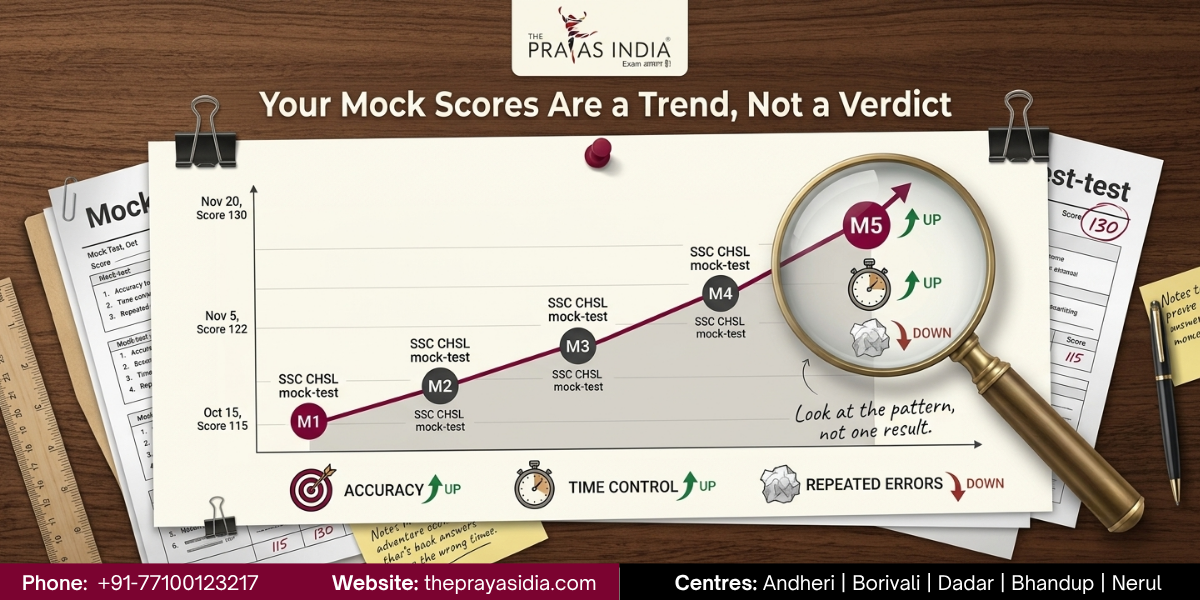
Analyse Trends Across Multiple Mocks
Your performance should be evaluated across several tests rather than one isolated result.
Suppose your scores fluctuate between two ranges. Instead of becoming concerned about every individual test, examine whether your average accuracy is improving, whether repeated errors are declining and whether your time management is becoming more stable.
A trend can reveal progress that one score cannot.
Track indicators such as:
- Overall accuracy
- Average attempts
- Time spent per section
- Repeated mistakes
- Weak topics
- Unattempted easy questions
- Performance under time pressure
These indicators provide a more realistic picture of examination readiness.
Revision Should Support Your Admission Decision Too
For students still deciding whether to join coaching, the revision system offered by an institute deserves attention.
A coaching programme can be useful when it provides structure at the stages where aspirants commonly struggle: completing the syllabus, revising systematically, practising examination-level questions and analysing performance.
If you are searching for the best SSC coaching in Mumbai, don’t evaluate an institute only on the basis of classroom lectures. Ask how the institute supports students after concepts have been taught.
A strong programme should ideally have a clear system for practice, revision, testing, doubt resolution and performance improvement.
What to Check Before Joining SSC Coaching
Before taking admission, consider whether the institute’s academic structure matches your preparation needs. A beginner may require stronger foundation support, while an experienced candidate may need more emphasis on mock analysis, speed and advanced practice.
You can evaluate factors such as:
- Faculty experience and teaching approach
- Course structure and syllabus coverage
- Quality of study material
- Previous-year question practice
- Frequency of tests and mocks
- Performance analysis
- Doubt-solving support
- Revision planning
- Mentorship or academic guidance
- Support during the final examination phase
These factors can help you make an informed admission decision instead of choosing solely on advertisements or assumptions.
The Prayas India for SSC CHSL Preparation
The Prayas India offers structured preparation support for aspirants preparing for competitive examinations. For SSC CHSL candidates, a guided learning environment can help bring consistency to classroom preparation, practice, revision and testing.
A structured approach is particularly useful when students find it difficult to decide what to revise, how frequently to revise it or which weaknesses deserve priority. Regular practice and performance review can help candidates understand whether their preparation is translating into better examination performance.
For aspirants exploring SSC coaching in Mumbai, The Prayas India can be considered as part of a preparation approach focused on systematic learning, practice and exam-oriented improvement.
Admission Should Be About the Complete Preparation Journey
Choosing coaching is an important decision, but admission should not be viewed as the finish line. It should mark the beginning of a structured preparation journey.
The value of coaching depends significantly on how effectively you use the academic resources available to you. Attend classes consistently, revise what is taught, practise questions, analyse your tests and communicate your doubts instead of allowing them to accumulate.
The strongest results generally come when classroom learning and individual effort work together.
A Practical Revision Formula for SSC CHSL
You do not need an excessively complicated system to revise effectively. A simple but disciplined cycle can work well:
LEARN → REVISE → PRACTISE → TEST → ANALYSE → REVISE AGAIN
Each stage has a different purpose.
Learning builds understanding.
Revision strengthens retention.
Practice develops application.
Testing measures performance.
Analysis identifies weaknesses.
The next revision cycle corrects those weaknesses.
When this process is repeated consistently, your preparation becomes increasingly evidence-based.
Final Takeaway
Effective SSC CHSL revision is not about studying for the longest possible number of hours or repeatedly reading every chapter from the beginning. It is about knowing what you need to remember, what you need to practise and what is still costing you marks.
Your revision strategy should evolve as the examination approaches. Early revision can be broad, middle-stage revision should become targeted and final revision should focus heavily on recall, mistakes, previous-year questions and mock-test performance.
Most importantly, do not wait until the last few days to discover how much you have forgotten. Start building your revision cycle early and let your mock tests guide your priorities.
For aspirants preparing through SSC coaching in Mumbai, the right academic environment can add structure to this process by combining teaching, practice, revision and performance analysis.
The objective is not simply to complete the syllabus.
The objective is to remember what you studied, apply it accurately, manage your time effectively and enter the SSC CHSL examination with a preparation strategy you have already tested.
Contact Us
- Call Now: +91-77100 13217
- Website: theprayasindia.com
- Centres: Andheri | Borivali | Dadar | Nerul | Bhandup
FAQs
1. How should I revise for SSC CHSL effectively?
Start by identifying strong, moderate and weak areas. Revise important concepts actively, practise questions, review your mistakes and use mock-test performance to decide what requires additional attention. Revision should gradually become more targeted as the examination approaches.
2. How many times should I revise the SSC CHSL syllabus?
There is no universal number of revisions that works for every candidate. Instead of focusing on the number of times you read a chapter, focus on whether you can recall and apply the information without looking at your notes. Multiple short revision cycles are generally more useful than one prolonged revision session.
3. Should I revise the complete SSC CHSL syllabus again before the exam?
You should maintain familiarity with the complete syllabus, but your final revision should become selective. Give greater attention to weak topics, repeated mistakes, important formulas, difficult-to-remember facts and question types where your mock performance is inconsistent.
4. How can I revise SSC CHSL Mathematics?
Combine formula recall with question practice. As the exam approaches, include mixed question sets so that you practise identifying the correct method independently. Timed practice can also help improve calculation speed and accuracy.
5. What is the best way to revise English for SSC CHSL?
Use a combination of grammar rules, vocabulary recall and question practice. Active recall is particularly useful for vocabulary, while grammar rules should be reinforced through application-based questions.
6. How should I revise General Awareness for SSC CHSL?
Use short, repeated revision sessions instead of trying to memorise large amounts of information at once. Give additional attention to facts and topics that repeatedly appear as mistakes in your practice tests and mocks.
7. Should I take mock tests during the revision phase?
Yes. Mock tests can show whether your revision is actually improving performance. However, the analysis after the test is equally important because it tells you which areas require further revision and practice.
8. What should I do if my SSC CHSL mock score is not improving?
Look beyond the score. Check your accuracy, repeated mistakes, time usage, question selection and section-wise performance. If the same problems continue across multiple mocks, modify your study and revision strategy accordingly.
9. Is it better to revise old topics or study new topics before SSC CHSL?
This depends on how close you are to the examination. Earlier in preparation, new learning may still be necessary. As the exam approaches, consolidation of already studied material should generally become a greater priority.
10. What should I revise in the final week before SSC CHSL?
Focus on formulas, important concepts, vocabulary, General Awareness and Science facts, previous-year questions, mock-test mistakes and your personal error notes. Avoid unnecessarily expanding your study material at the last moment.
11. How can SSC coaching in Mumbai help with revision?
A structured coaching programme can provide a planned syllabus, study material, practice questions, mock tests, performance analysis and revision support. This can make it easier for aspirants to maintain consistency and identify areas requiring additional attention.
12. What should I check before joining the best SSC coaching in Mumbai?
Look beyond classroom teaching. Consider faculty, study material, test series, previous-year question practice, revision support, doubt-solving, performance analysis and academic guidance. The ideal institute should support your preparation throughout the learning and revision cycle.
13. Can beginners prepare for SSC CHSL with coaching?
Yes. Beginners can benefit from a structured programme that builds concepts systematically before moving towards advanced practice and full-length testing. Consistent self-study alongside classroom learning remains essential.
14. Why is revision important even after completing the SSC CHSL syllabus?
Completing the syllabus does not guarantee retention. Revision strengthens recall and helps ensure that concepts, formulas, vocabulary and factual information remain accessible during the examination. It also provides an opportunity to correct mistakes discovered through practice and mocks.