The Right Way to Analyse CAT Mock Tests | Best CAT Coaching in Mumbai | The Prayas India
Your CAT Percentile Is Determined Not Just by the Mock Tests You Attempt, but by What You Learn from Them.
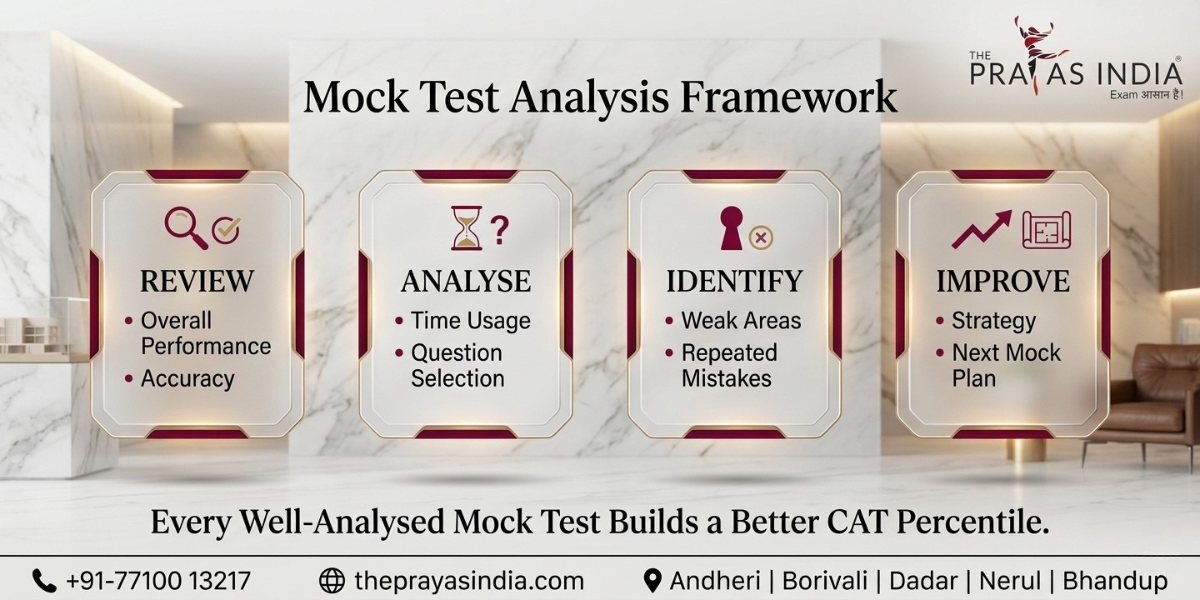
Every CAT aspirant understands the importance of mock tests. They simulate the actual examination, expose weaknesses, improve time management, and prepare students for the pressure of exam day. As the examination approaches, mock tests gradually become one of the most important components of preparation.
However, there is one mistake that prevents many aspirants from converting their hard work into a higher percentile.
They focus on taking more mock tests instead of learning from every mock test.
It is common to see students discussing their scores immediately after completing a mock. They compare percentiles, calculate expected rankings, and move directly to the next practice test. While these discussions may be interesting, they rarely contribute to meaningful improvement.
A mock test is not simply an assessment.
It is a detailed performance report.
Every incorrect answer, every skipped question, every extra minute spent on a difficult problem, and every successful decision provides valuable information about your preparation. Aspirants who analyse this information carefully improve consistently because every mock teaches them how to perform better in the next one.
Those who only record their scores often continue repeating the same mistakes throughout their preparation.
This is why mock test analysis deserves as much attention as the mock test itself.
Why Taking More Mock Tests Alone Doesn’t Improve Your Percentile
Many students believe that attempting a large number of CAT mock tests automatically guarantees improvement.
Unfortunately, this assumption is not always correct.
Imagine two aspirants.
The first student attempts thirty mock tests but spends very little time analysing them. After checking the final score, the student immediately begins preparing for the next paper.
The second student attempts only fifteen mock tests but carefully studies every question after each attempt. They identify conceptual mistakes, review time management, analyse question selection, and adjust their strategy before taking another mock.
In most cases, the second student shows greater improvement over time because every mock contributes directly to better decision-making.
The objective of a CAT mock test is not to increase the number of completed papers.
The objective is to improve your performance in the actual examination.
Every mock should therefore answer three important questions:
- What did I do well?
- What reduced my score?
- What should I change before my next mock?
If these questions remain unanswered, even the highest number of mock tests may produce only limited improvement.
Stop Chasing Scores. Start Understanding Decisions.
One of the biggest psychological traps during CAT preparation is becoming overly attached to mock test scores.
A high percentile creates confidence.
A low percentile creates anxiety.
While both reactions are natural, neither should become the focus of your preparation.
The CAT examination is highly competitive, and mock tests differ in difficulty level, question quality, and sectional balance. As a result, score fluctuations are completely normal. Judging your preparation based on one mock often leads to unnecessary stress and impulsive changes in strategy.
Instead of asking,
“How much did I score?”
begin asking,
“Why did I score this way?”
This shift changes the entire purpose of mock analysis.
You begin examining:
- Which questions consumed excessive time.
- Which easy questions were skipped unnecessarily.
- Which mistakes were conceptual.
- Which errors resulted from poor decision-making.
- Which section required a different approach.
Once your focus moves from marks to decisions, every mock becomes a learning opportunity rather than an emotional experience.
Percentile Is Built Through Better Decisions
CAT is not an examination where attempting every question guarantees success.
In fact, one of the defining characteristics of high-percentile performers is their ability to make intelligent decisions under pressure.
Successful aspirants know:
- Which questions deserve immediate attention.
- Which sets should be skipped.
- When to stop spending time on one problem.
- How to balance speed with accuracy.
- When to take calculated risks.
These decisions cannot be mastered by theory alone.
They develop through repeated mock tests followed by thoughtful analysis.
Every mock helps you recognise patterns in your own behaviour.
You begin discovering:
- Which section you naturally perform best in.
- Where your concentration drops.
- Which question types reduce your efficiency.
- How your accuracy changes under time pressure.
These observations gradually improve your examination strategy, and strategy often contributes just as much to percentile improvement as conceptual knowledge.
Develop a Performance Review Habit
Treat every mock test as a professional performance review instead of an academic examination.
Rather than closing the paper after checking your percentile, spend dedicated time reviewing the entire test.
Focus on areas such as:
- Overall accuracy.
- Section-wise performance.
- Time spent on individual questions.
- Successful question selection.
- Missed scoring opportunities.
- Repeated mistakes.
Maintaining this habit consistently transforms every mock test into a structured improvement session.
Over several weeks, these small improvements accumulate into noticeable percentile gains.
Expert Guidance Makes Mock Analysis More Effective
Independent mock analysis certainly helps aspirants identify obvious mistakes, but interpreting performance correctly often requires experienced academic guidance. Many students recognise where they lost marks but struggle to understand why similar mistakes continue appearing across multiple mock tests. Structured mentorship helps identify recurring behavioural patterns, improve section-wise strategy, and optimise decision-making before the actual CAT examination.
At The Prayas India, CAT preparation goes beyond conducting regular mock tests. Students receive detailed performance reviews, personalised mentoring, section-wise analysis, strategy discussions, and continuous academic support from experienced faculty. This structured approach ensures that every mock test becomes an opportunity to improve accuracy, refine strategy, and steadily increase overall percentile.
Analyse VARC, DILR, and QA Separately Instead of Looking Only at Your Overall Score
A Single CAT Score Can Hide Three Very Different Stories. Section-Wise Analysis Reveals Where Your Percentile Is Actually Being Won or Lost.
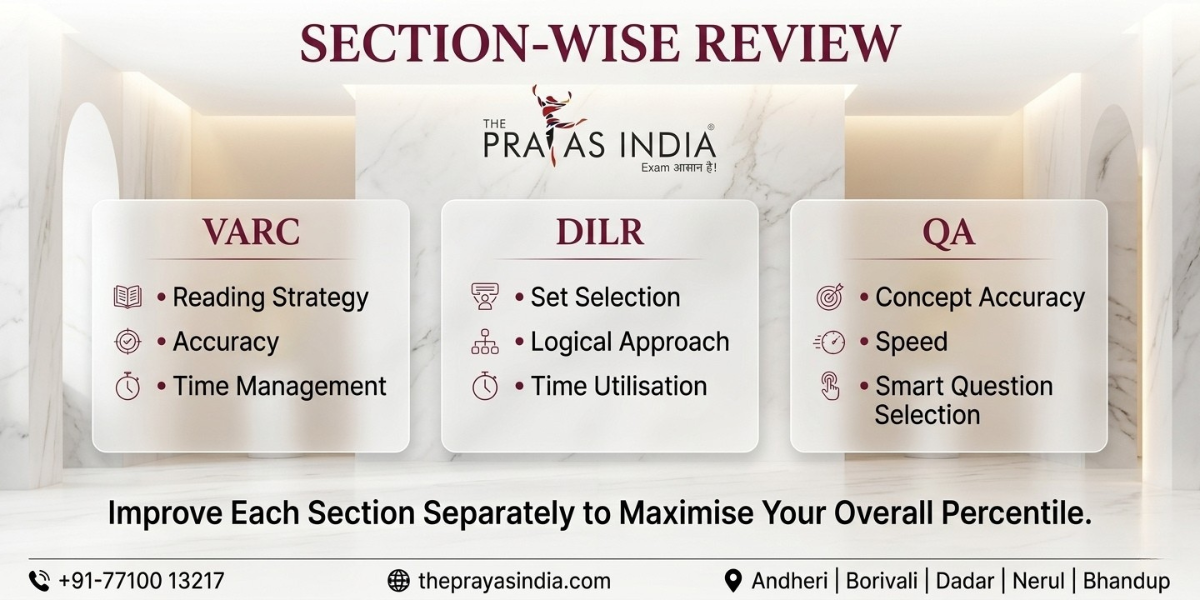
Many CAT aspirants complete a mock test, note their overall percentile, and immediately compare it with their previous attempts. While tracking overall performance is useful, it provides only a broad picture of your preparation. The CAT examination evaluates your performance across three distinct sections—VARC, DILR, and QA—and each section demands a different skill set, decision-making approach, and time management strategy.
A candidate may have excellent reading ability but struggle with logical reasoning. Another may perform exceptionally well in Quantitative Aptitude while consistently losing marks in Reading Comprehension. These differences remain hidden if analysis stops at the overall score.
Meaningful improvement begins when every section is reviewed independently.
Instead of asking whether the mock test was good or bad, ask how each section contributed to the final percentile and what specific changes can improve future performance.
Review VARC Beyond Accuracy
Verbal Ability and Reading Comprehension is often considered one of the most unpredictable sections because performance depends not only on language skills but also on comprehension, concentration, and question selection.
Many aspirants immediately look at the number of correct answers after completing VARC. While accuracy is important, it should not be the only area of analysis.
A more effective review includes questions such as:
- Did I spend too much time on one difficult passage?
- Which Reading Comprehension passages were easiest for me?
- Were my incorrect answers caused by poor comprehension or careless interpretation?
- Did I rush through Verbal Ability questions?
- Which question types consistently reduce my accuracy?
Patterns usually begin appearing after analysing multiple mocks.
For example, you may discover that your accuracy remains consistently high in factual Reading Comprehension passages but declines significantly in abstract philosophy-based passages. Such observations help you prioritise practice more intelligently instead of treating every topic equally.
The objective is not simply to answer more questions.
It is to answer the right questions with confidence and efficiency.
Evaluate DILR Through Decision-Making, Not Just Solved Sets
Data Interpretation and Logical Reasoning is often the most decisive section in CAT because it rewards smart question selection more than aggressive attempts.
Many aspirants lose valuable time trying to solve the first set they encounter without evaluating its complexity. By the time they realise the set is difficult, several minutes have already been lost.
During mock analysis, focus on your decisions rather than only your answers.
Ask yourself:
- Did I identify the easiest set early?
- How much time was spent before abandoning a difficult set?
- Were there easier scoring opportunities left untouched?
- Did I panic after getting stuck?
- Could I have maximised my score by changing the order of attempts?
Reviewing these decisions gradually improves your ability to recognise high-scoring opportunities during future mocks.
This is one of the biggest differences between average and high-percentile aspirants.
High performers rarely solve every difficult set.
They simply identify the right ones faster.
Analyse Quantitative Aptitude Like a Strategy Exercise
Quantitative Aptitude is often viewed purely as a test of mathematical knowledge.
In reality, it is equally a test of strategic thinking.
Many aspirants lose marks not because they lack conceptual understanding but because they spend excessive time on questions that should have been skipped.
When reviewing QA, analyse more than the final score.
Look at:
- Which topics produced the highest accuracy?
- Which questions consumed excessive time?
- Were difficult questions attempted too early?
- Which mistakes resulted from conceptual gaps?
- Which errors were calculation mistakes despite knowing the method?
Categorising your mistakes helps create targeted improvement plans.
For example:
Conceptual Errors
These indicate the need for stronger theory and additional practice.
Calculation Errors
These usually require slower execution and greater attention to detail.
Judgement Errors
These occur when difficult questions are attempted unnecessarily while easier opportunities are ignored.
Each category demands a different solution.
Without identifying the type of mistake, improvement becomes random rather than systematic.
Balance Accuracy and Attempts Instead of Maximising Only One
A common misconception among CAT aspirants is that attempting more questions automatically increases percentile.
This approach can become risky because CAT includes negative marking for incorrect answers.
Similarly, attempting very few questions with perfect accuracy may also limit your overall score.
The goal is to achieve an effective balance.
During mock analysis, review:
- Overall attempt rate.
- Accuracy percentage.
- Time spent per question.
- Questions skipped correctly.
- Incorrect attempts that could have been avoided.
Over multiple mocks, these indicators reveal whether your current strategy is aggressive, conservative, or appropriately balanced.
A slight improvement in question selection often increases percentile more effectively than simply attempting additional questions.
Track Section-Wise Improvement Across Multiple Mocks
One mock test provides useful feedback.
Ten well-analysed mock tests reveal trends.
Maintain a separate performance tracker for each section.
Your tracker may include:
VARC
- Accuracy
- Reading Comprehension performance
- Verbal Ability performance
- Time distribution
DILR
- Sets attempted
- Correct sets
- Time per set
- Question selection quality
QA
- Topic-wise accuracy
- Calculation mistakes
- Conceptual mistakes
- Time management
Reviewing these trends every week helps identify gradual improvement that may not be visible through percentile alone.
It also ensures that preparation remains balanced instead of focusing excessively on one favourite subject.
Expert Feedback Makes Section-Wise Analysis More Productive
Many aspirants can identify which section went poorly after a mock test, but they often struggle to determine the exact reason behind inconsistent performance. Understanding whether the issue lies in concepts, time management, question selection, or examination temperament requires structured academic feedback and experience.
At The Prayas India, every CAT mock test is followed by detailed section-wise performance analysis, personalised mentoring, faculty discussions, and strategy refinement sessions. Students receive guidance on improving VARC, DILR, and QA individually, helping them strengthen weak areas while building on existing strengths. This systematic review process ensures that every mock contributes to measurable percentile improvement.
Turn Every Mistake into a Higher Percentile
The Real Value of a CAT Mock Test Lies in the Improvements You Make Before the Next One.
Many CAT aspirants complete a mock test, review a few incorrect answers, and then immediately begin preparing for the next mock. Although this approach creates the feeling of continuous practice, it often leads to repeated mistakes because very little changes between one test and the next.
A CAT mock test should never be treated as an isolated event.
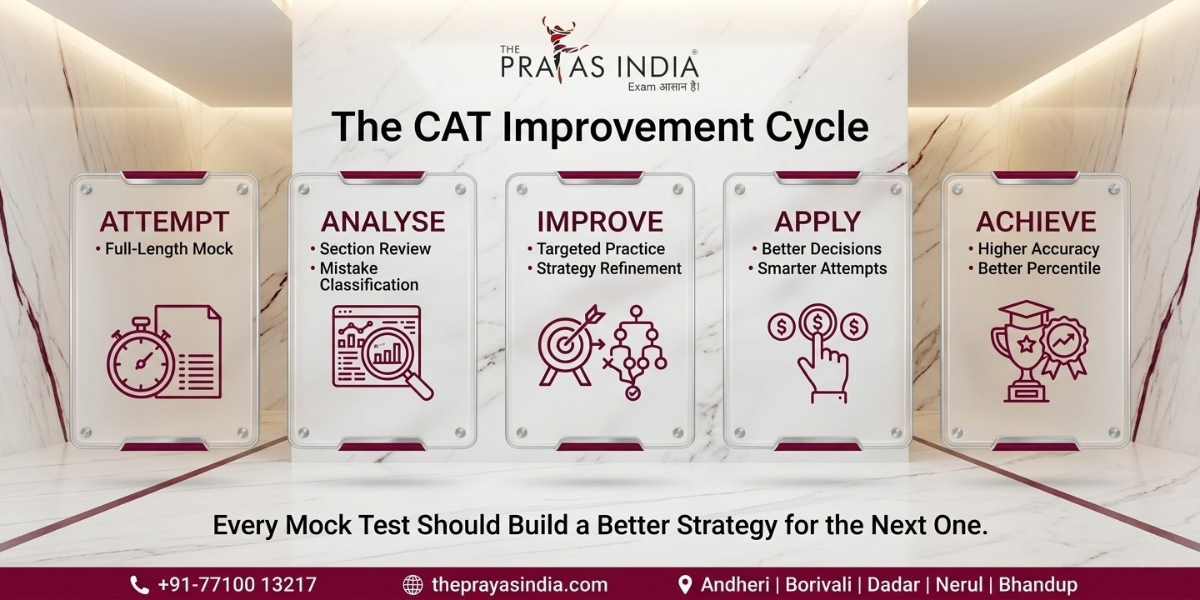
Instead, every mock should become part of a continuous improvement cycle where each analysis influences your preparation strategy, practice sessions, and decision-making for future tests.
The objective is not simply to understand what went wrong.
The objective is to ensure that the same mistake never affects your percentile again.
Developing this mindset transforms mock analysis from a routine review exercise into one of the most powerful tools for CAT preparation.
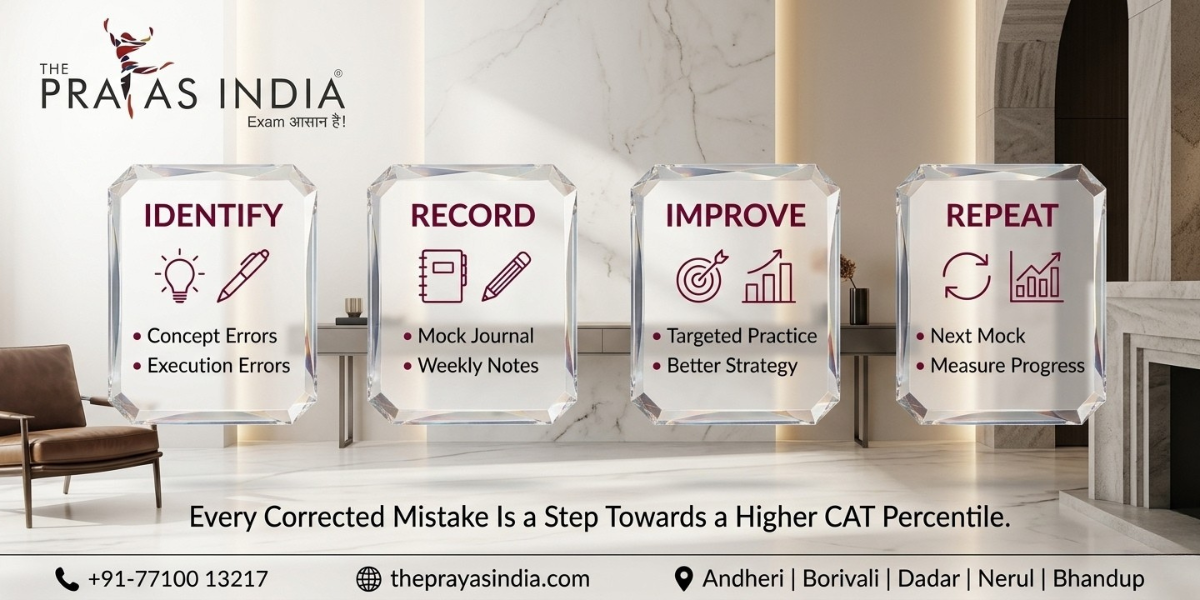
Classify Every Mistake Before Trying to Correct It
Not every incorrect answer deserves the same solution.
Many aspirants simply mark questions as “wrong” and move forward without identifying the actual reason behind the mistake. As a result, the same pattern continues across multiple mock tests.
A more effective approach is to categorise every error.
Conceptual Mistakes
These occur when the underlying concept is not fully understood.
Examples include:
- Incorrect application of mathematical formulas.
- Weak grammar concepts in VARC.
- Incomplete understanding of Logical Reasoning techniques.
- Difficulty interpreting Data Interpretation sets.
These mistakes require concept revision followed by additional practice from the same topic.
Execution Mistakes
Sometimes the concept is correct, but the execution is poor.
Common examples include:
- Calculation errors.
- Misreading the question.
- Selecting the wrong option despite solving correctly.
- Missing important conditions mentioned in the problem.
These mistakes usually improve through slower, more attentive practice rather than learning new concepts.
Time Management Mistakes
Many aspirants spend excessive time attempting one difficult question while several easier questions remain unanswered.
During mock analysis, identify:
- Questions that should have been skipped earlier.
- Sets that consumed too much time.
- Easy opportunities missed because of poor sequencing.
Improving time allocation often increases percentile without requiring additional subject knowledge.
Decision-Making Mistakes
CAT is fundamentally an examination of smart choices.
Sometimes students attempt low-probability questions simply because they have already invested time in them.
This behaviour, known as the sunk cost effect, reduces overall efficiency.
Ask yourself:
- Should I have skipped this question?
- Was there a better scoring opportunity elsewhere?
- Did I continue solving because I believed I was “almost there”?
Learning when not to attempt a question is just as valuable as learning how to solve one.
Maintain a CAT Mock Journal
One of the most effective habits followed by high-percentile aspirants is maintaining a structured mock journal.
Instead of depending on memory, they record important observations after every mock test.
A well-maintained mock journal may include:
Overall Summary
- Overall score
- Percentile
- Overall accuracy
- Attempt strategy
VARC Observations
- Best-performing RC passages
- Difficult question types
- Reading speed observations
- Accuracy trends
DILR Observations
- Sets solved correctly
- Sets skipped
- Incorrect set selection
- Time spent per set
QA Observations
- Strong topics
- Weak topics
- Calculation mistakes
- Time-consuming questions
Improvement Plan
Conclude every mock analysis with clear action points such as:
- Practise Geometry for two hours.
- Solve five additional DILR sets.
- Improve Reading Comprehension accuracy.
- Revise Arithmetic concepts.
- Reduce time spent on lengthy QA questions.
A mock journal transforms vague intentions into measurable improvements.
Build a Weekly Improvement System
Analysing one mock test in isolation provides useful feedback.
However, analysing several mock tests together reveals long-term performance patterns.
At the end of every week, review:
- Which section improved the most?
- Which mistakes appeared repeatedly?
- Which topics continue reducing accuracy?
- Is time management improving?
- Is question selection becoming smarter?
- Has confidence increased in difficult sections?
This weekly review helps you shift your focus from individual scores to continuous growth.
CAT preparation becomes far more effective when improvement is measured over several weeks instead of reacting emotionally to one difficult mock.
Don’t Change Your Entire Strategy After One Bad Mock
One of the most common mistakes among CAT aspirants is overreacting to a single disappointing performance.
A difficult mock test often creates panic.
Students suddenly change study material, alter section order, switch preparation strategies, or begin doubting concepts they had previously mastered.
Such drastic changes usually create more confusion than improvement.
Instead, remember that every mock test has a different difficulty level and question pattern.
Before changing your preparation strategy, evaluate performance across multiple mocks.
Ask:
- Is this mistake recurring?
- Is this weakness consistent?
- Does the data from several mocks support changing my strategy?
Well-informed decisions always outperform emotional reactions.
Expert Performance Reviews Accelerate Improvement
Self-analysis is an essential part of CAT preparation, but experienced mentors often identify improvement opportunities that students overlook. Many aspirants focus only on incorrect answers, while experienced faculty evaluate broader aspects such as question selection, examination temperament, sectional balance, time allocation, and overall strategy. These deeper insights often lead to substantial percentile improvements over time.
At The Prayas India, every CAT mock test becomes part of a structured learning process. Students receive detailed performance reviews, one-to-one mentoring, section-wise strategy discussions, and personalised improvement plans based on their individual strengths and weaknesses. This systematic approach ensures that every mock contributes directly to better decision-making and stronger performance in future tests.
The Best CAT Aspirants Don’t Just Attempt Mock Tests—They Build Better Strategies After Every One
A Mock Test Ends When the Timer Stops. Real Improvement Begins When the Analysis Starts.
By the time you have attempted several CAT mock tests, one thing becomes very clear—your percentile is not determined solely by your subject knowledge. Two aspirants with similar conceptual understanding can finish with completely different percentiles because one of them consistently makes better decisions throughout the paper.
That difference is rarely created overnight.
It is built through disciplined mock analysis, honest self-evaluation, and continuous refinement of strategy.
Every CAT mock test gives you an opportunity to understand your preparation from a different perspective. It highlights conceptual gaps, exposes time management issues, reveals behavioural patterns under pressure, and identifies the types of questions that should be attempted—or avoided—in the actual examination.
Students who treat mock analysis as an essential part of preparation gradually become more confident, accurate, and strategically aware. Instead of repeating the same mistakes, they enter every new mock with a clearer plan and measurable objectives for improvement.
Ultimately, CAT preparation is not about proving how much you already know. It is about continuously improving until the day of the examination.
Frequently Asked Questions About CAT Mock Test Analysis
When should I start analysing CAT mock tests seriously?
The first mock test itself should be analysed thoroughly.
Many aspirants postpone detailed analysis until they have attempted several mocks. This often results in repeating the same mistakes for weeks. Developing the habit of systematic review from the beginning allows every mock to contribute towards better preparation.
How much time should I spend analysing one CAT mock test?
There is no fixed duration, but analysis should generally take at least as much time as attempting the mock itself.
A two-hour mock followed by only fifteen minutes of review provides very limited learning. Careful section-wise analysis, mistake classification, and strategy review require dedicated attention.
Should I analyse correct answers as well?
Absolutely.
Correct answers often reveal useful information about your strengths, efficient solving methods, and successful question selection strategies. Understanding why a question was solved efficiently is just as valuable as understanding why another question was answered incorrectly.
How many CAT mock tests should I attempt before the examination?
The number varies depending on your preparation stage, but quality is always more important than quantity.
Attempting twenty well-analysed mock tests usually provides greater value than attempting forty mocks without structured review. Every mock should lead to measurable improvement before the next one.
Can mock analysis improve percentile even if my concepts are already strong?
Yes.
Many percentile improvements come from better decision-making rather than additional subject knowledge. Improving question selection, reducing avoidable mistakes, managing time effectively, and balancing accuracy with attempts often produce significant gains during the final stages of preparation.
CAT Mock Analysis Checklist
After every mock test, review your preparation using this structured checklist.
Overall Performance
✓ Reviewed overall score and percentile.
✓ Compared performance with previous mocks.
✓ Identified strongest and weakest section.
VARC Review
✓ Analysed Reading Comprehension accuracy.
✓ Reviewed Verbal Ability mistakes.
✓ Evaluated reading speed and question selection.
DILR Review
✓ Analysed set selection.
✓ Reviewed time spent on each set.
✓ Identified easier scoring opportunities.
QA Review
✓ Categorised conceptual and calculation errors.
✓ Identified time-consuming questions.
✓ Reviewed topic-wise accuracy.
Improvement Plan
✓ Recorded key observations.
✓ Updated mock journal.
✓ Planned focused practice before the next mock.
✓ Avoided unnecessary strategy changes.
Following this checklist after every mock transforms random practice into systematic percentile improvement.
Why Structured Mentorship Makes Mock Analysis More Effective
While self-analysis helps students recognise obvious mistakes, interpreting mock performance accurately often requires expert guidance. Many aspirants know where they lost marks but remain uncertain about how to improve efficiently. Without structured feedback, they may spend weeks practising the wrong topics or changing strategies unnecessarily.
At The Prayas India, mock tests are integrated into a comprehensive learning system rather than treated as standalone assessments. Students receive detailed section-wise analysis, personalised mentoring, expert strategy discussions, performance tracking, and regular feedback from experienced CAT faculty. This structured approach helps aspirants understand not only what went wrong but also how to correct it before the next mock, leading to consistent percentile improvement.
Conclusion
Mock tests are among the most powerful learning tools available during CAT preparation, but their true value depends on how effectively they are analysed. Every test provides detailed insights into your conceptual understanding, time management, question selection, and examination temperament. Aspirants who consistently review these insights develop stronger strategies, improve accuracy, and steadily increase their percentile over time.
Instead of treating mock tests as a scoreboard, treat them as opportunities to refine your preparation. Analyse each section carefully, classify your mistakes, maintain a structured mock journal, and implement specific improvements before attempting the next test. This disciplined approach ensures that every mock contributes meaningfully to your overall progress.
Remember, the CAT examination is not won by the student who attempts the highest number of mock tests. It is won by the student who learns the most from every single mock.
Admission Scorecard
Choosing the right CAT coaching institute can make the difference between simply attempting mock tests and using them to achieve continuous percentile improvement. At The Prayas India, mock analysis is not limited to score discussions. Students receive comprehensive section-wise reviews, personalised mentoring, performance tracking, strategic guidance, and regular faculty feedback designed to improve every aspect of their preparation.
Whether you are beginning your CAT journey or aiming to push your percentile higher, a structured learning environment can help you avoid common mistakes, strengthen your preparation strategy, and stay focused throughout the entire process.
Why choose The Prayas India for CAT Preparation?
- Experienced CAT faculty and mentors
- Comprehensive classroom and online programmes
- Regular full-length CAT mock tests
- Detailed performance analysis after every mock
- Personalised mentorship and doubt-solving
- Section-wise strategy improvement for VARC, DILR, and QA
- Study plans designed for consistent percentile growth
- Supportive learning environment with continuous academic guidance
If your goal is to convert every mock test into measurable improvement, learning under expert guidance can significantly accelerate your journey towards your dream B-school.
Contact Us
📞 Call: +91-77100 13217
🌐 Website: https://theprayasindia.com