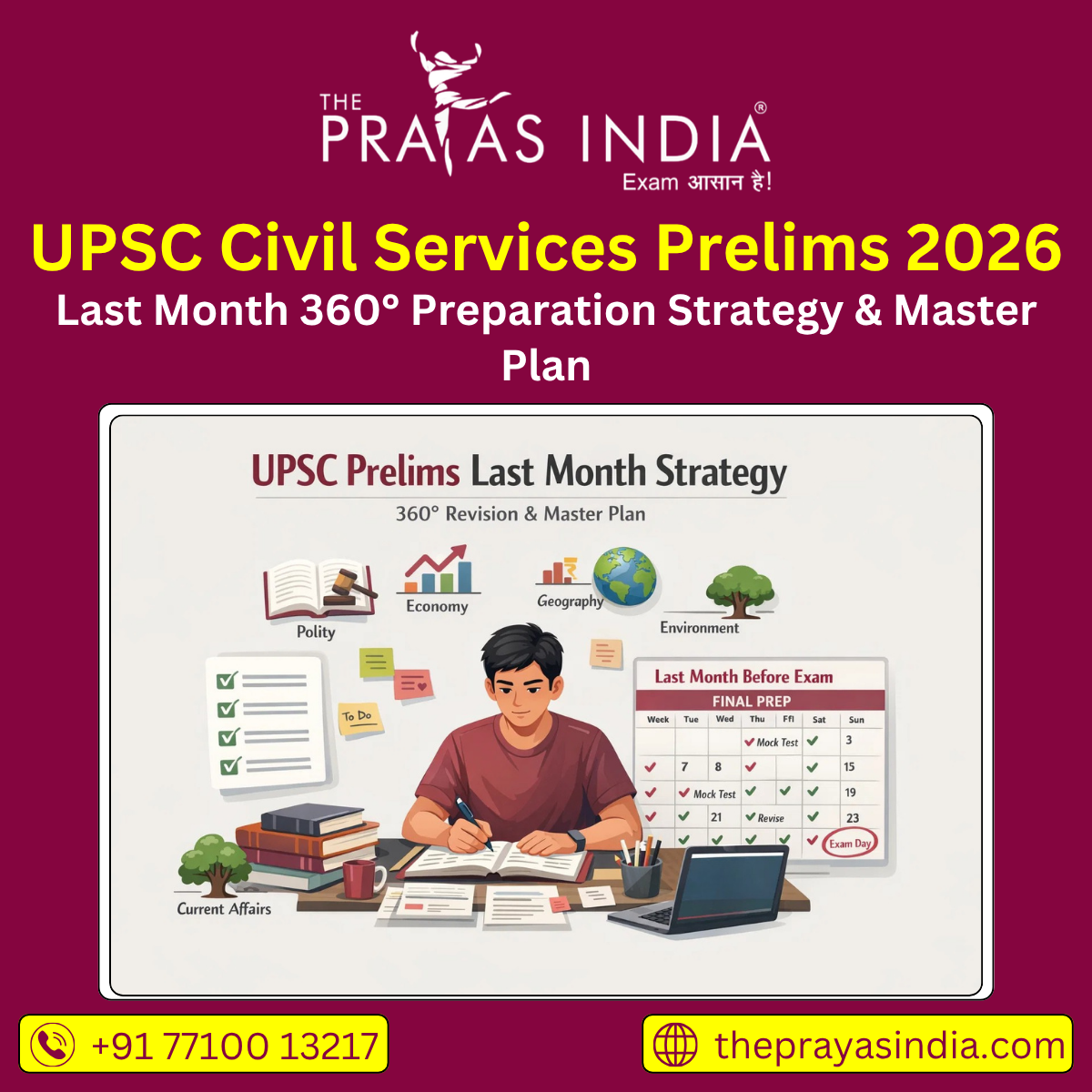
UPSC Civil Services Prelims 2026: Last Month 360° Preparation Strategy & Master Plan
The final 30 days before the UPSC Civil Services Examination Prelims are often described as the “make or break phase” of preparation. By this stage, most aspirants have already covered a significant portion of the syllabus—but the real challenge lies in revision, retention, and exam temperament.
This period is a mix of excitement, pressure, and uncertainty. Many aspirants feel overwhelmed by the vast syllabus, while others struggle with confidence due to fluctuating mock scores. However, with a well-structured 360° preparation strategy, this last month can become your strongest advantage.
In this detailed guide by The Prayas India, we provide a complete last-month master plan, including day-wise strategy, subject prioritization, mock test planning, and high-impact revision techniques to help you maximize your Prelims score.
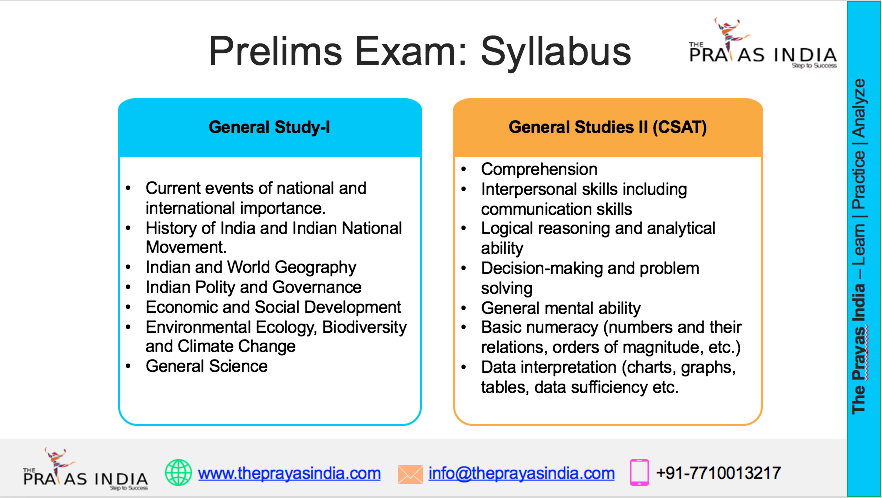
UPSC CSE Prelims CSAT (GS Paper-II) Analysis 2011–2025
Introduction: The Last Mile in UPSC Preparation
The last 30 days are not meant for learning new topics—they are meant for consolidating what you already know.
At this stage:
- Your focus should shift from coverage → revision
- From reading → recall
- From learning → performance
A structured plan for revising the UPSC syllabus ensures:
- Better retention of key concepts
- Reduced exam anxiety
- Improved accuracy in MCQs
- Stronger confidence on exam day
UPSC New Rules 2026
Key Takeaways for Last Month’s Preparation
- Focus on high-weightage topics and repeated PYQ areas
- Follow a daily revision + mock test plan
- Differentiate between Prelims (facts + elimination) and Mains (analysis)
- Avoid common mistakes like ignoring CSAT or starting new topics
- Use mock tests and PYQs as the core of preparation
Why is Revision in the Last 30 Days is Crucial?
1. UPSC Tests Conceptual Clarity, Not Just Facts
The exam is designed to check your analytical understanding. Revision helps strengthen conceptual linkages across subjects.
2. Retention is More Important Than New Learning
The human brain retains information better when revised multiple times. Last-minute new topics often lead to confusion rather than clarity.
3. Smart Revision Builds Confidence
Well-organized notes, short summaries, and repeated revision reduce stress and improve confidence.
4. PYQs and Mock Tests Reveal Real Exam Patterns
Previous Year Questions help you understand:
- Frequently asked topics
- Question framing techniques
- Elimination strategies
5. Integration of Current Affairs with Static Topics
UPSC increasingly asks dynamic questions, combining static knowledge with current affairs. Revision helps in connecting both effectively.
UPSC CSE Cut off 2025
30-Day UPSC Prelims 360° Strategy: Day-Wise Master Plan
First 10 Days: Strong Foundation Revision (Static Subjects)
This phase focuses on core subjects and concept strengthening.
- Day 1–3: Polity & Governance
- Revise key topics like Fundamental Rights, DPSP, Parliament, and Judiciary
- Focus on constitutional amendments and landmark judgments
- Day 4–5: Economy
- Revise basics + current concepts
- Focus on the Budget, Economic Survey, inflation, and banking
- Day 6–7: History & Art & Culture
- Modern history (Freedom Struggle) is crucial
- Important cultural themes, architecture, and personalities
- Day 8–9: Geography & Environment
- Maps, physical geography, and climate
- Biodiversity, conservation, environmental conventions
- Day 10: Science & Tech + IR + Internal Security
- Focus on current developments
- Revise basic science concepts linked with current affairs
Next 10 Days: Mock Tests + Application Phase
This phase is about testing and improving performance.
- Day 11–15: Full-Length Prelims Mock Tests
- Attempt at least 3–4 full-length mocks
- Simulate real exam conditions
- Day 16–18: Concept Strengthening + Weak Areas
- Analyze mock mistakes
- Revise weak topics
- Day 19–20: Current Affairs + IR Revision
- Revise last 1 year current affairs
- Focus on international organizations, reports, schemes
UPSC CSE 2026-27 Syllabus
Last 10 Days: 360° Final Revision & Accuracy Building
This is the most critical phase.
- Day 21–23: PYQs + CSAT Practice
- Solve previous year questions
- Practice CSAT daily (comprehension + reasoning)
- Day 24–25: Static + Current Affairs Integration
- Link static concepts with current events
- Day 26–28: Weak Area Correction
- Focus only on mistakes
- Revise error-prone topics
- Day 29–30: Quick Revision & Mental Conditioning
- Revise short notes, flashcards
- Avoid stress and overloading
Prelims vs Mains: Strategy Difference in Last Month
UPSC Prelims Strategy
- Focus on facts + conceptual clarity
- Revise schemes, reports, indices
- Practice elimination techniques
- Attempt mock tests regularly
- Do not ignore CSAT
UPSC Mains Strategy (Side Preparation)
- Practice answer writing (limited but consistent)
- Use frameworks like:
- SWOT
- PESTLE
- Flowcharts
- Focus on Ethics and Essay themes
UPSC CSE Exam Updates
How to Use Mock Tests Effectively?
Mock tests are the most powerful tool in the last month.
Best Practices:
- Attempt 8–10 full-length mocks before exam
- Maintain a mistake notebook
- Identify:
- Silly mistakes
- Conceptual gaps
- Time management issues
- Practice 2-hour simulations regularly
Smart Strategy:
- Don’t just attempt mocks → Analyze deeply
- Learn elimination techniques
- Improve accuracy rather than attempts
Common Mistakes to Avoid in the Last 30 Days
- Starting new topics at the last moment
- Ignoring revision and focusing only on reading
- Skipping CSAT practice
- Not analyzing mock tests
- Over-attempting questions without accuracy
- Panicking due to low mock scores
Avoiding these mistakes can significantly improve your performance.
UPSC CSE New Batches
Why Choose The Prayas India for UPSC Prelims Preparation?
At The Prayas India, we understand that the last month requires precision, strategy, and expert guidance.
Our approach focuses on:
1. Structured Revision Plan
- Day-wise and subject-wise strategy
- Focus on high-yield topics
2. High-Quality Mock Tests
- Real exam-level difficulty
- Detailed performance analysis
3. PYQ-Based Preparation
- Trend analysis of previous years
- Focus on important areas
4. Current Affairs Integration
- Linking static syllabus with dynamic topics
5. Expert Mentorship
- Personalized guidance
- Doubt-solving sessions
6. Focus on Accuracy & Time Management
- Elimination techniques
- Smart attempt strategies
This ensures aspirants are fully prepared to clear the UPSC Prelims with confidence.
UPSC Civil Services Exam FREE Mock Tests
Final Thoughts: The Key to Cracking UPSC Prelims
The last 30 days before the Union Public Service Commission Prelims are not about studying more—they are about studying smart.
Success in this phase depends on:
- Smart revision
- Effective mock test analysis
- Strong time management
- Emotional stability and confidence
Avoid overburdening yourself. Trust your preparation, focus on your strengths, and refine your strategy.
With the right approach and consistent effort, clearing UPSC Prelims is absolutely achievable—even in the final month.
FAQs on UPSC Prelims Last Month Preparation Strategy
Q1. Is 30 days enough to prepare for UPSC Prelims?
Yes, 30 days are sufficient for revision if you have already covered the syllabus. Focus on revision, mock tests, and Previous Year Questions to maximize your score in the UPSC Civil Services Examination.
Q2. What should I study in the last month before UPSC Prelims?
You should focus on:
- Revising static subjects (Polity, Economy, History, Geography)
- Current affairs (last 1 year)
- Practicing mock tests and PYQs
- CSAT preparation
Q3. How many mock tests should I attempt in the last month?
Ideally, you should attempt 8–10 full-length mock tests along with sectional tests and analyze them thoroughly.
Q4. Should I start new topics in the last month of UPSC preparation?
No, avoid starting new topics. Focus on revising what you have already studied to improve retention and accuracy.
Q5. How important is CSAT in UPSC Prelims?
CSAT is qualifying but very important. Many aspirants fail despite scoring well in GS because they neglect CSAT. Regular practice is essential.
Q6. How to improve accuracy in UPSC Prelims?
Accuracy can be improved by:
- Practicing elimination techniques
- Analyzing mock tests
- Avoiding guesswork
- Strengthening weak areas
Q7. What is the best revision strategy for UPSC Prelims?
The best strategy is:
- Subject-wise revision in the first 10 days
- Mock test practice in the next 10 days
- Final revision + PYQs in the last 10 days
Q8. How to manage stress in the last month before the UPSC exam?
Maintain a balanced routine, take short breaks, avoid overloading new information, and trust your preparation.
Q9. How important are Previous Year Questions (PYQs)?
PYQs are extremely important as they help understand exam patterns, frequently asked topics, and improve answer elimination skills.
Q10. Why choose The Prayas India for UPSC Prelims preparation?
The Prayas India provides structured revision plans, high-quality mock tests, expert mentorship, and focused preparation strategies to help aspirants clear Prelims efficiently.



![Prayas-तेजस [UPSC CSE Sociology Optional] – Online & Offline](https://theprayasindia.com/wp-content/uploads/2025/09/Prayas-तेजस-UPSC-CSE-Optional-Subject-The-Prayas-India-300x300.png)
![Prayas-सूत्र [UPSC CSE Materials (Hardcopy)]](https://theprayasindia.com/wp-content/uploads/2025/09/Prayas-सूत्र-UPSC-CSE-Study-Materials-Hardcopy-The-Prayas-India-300x300.png)
![Prayas-मंत्रा [UPSC CSE CSAT]](https://theprayasindia.com/wp-content/uploads/2025/09/Prayas-मंत्रा-UPSC-CSE-CSAT-The-Prayas-India-300x300.png)
![Prayas सारथी [UPSC CSE One on One Mentorship]](https://theprayasindia.com/wp-content/uploads/2025/09/Prayas-सारथी-UPSC-CSE-One-on-One-Mentorship-The-Prayas-India-300x300.png)