UPSC CSE 2026 Notification Out: Apply Online, Dates, Eligibility, Attempts, New Rules & Form Filling Guide
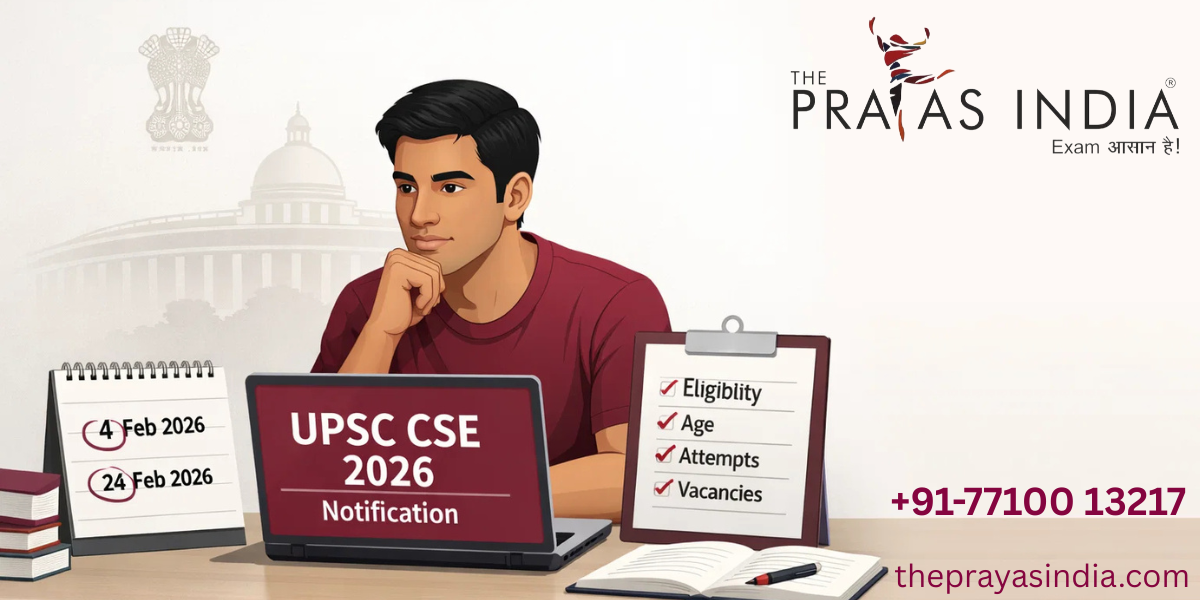
The Union Public Service Commission (UPSC) has officially released the Civil Services Examination (CSE) 2026 Notification on 4th February 2026, marking the formal beginning of the UPSC 2026 examination cycle.
For lakhs of aspirants, this is not just an announcement—it is the moment when preparation must shift from planning to disciplined execution. At this stage, understanding the UPSC eligibility, UPSC age limit, attempts, application process, and the new restrictions introduced in UPSC 2026 notification becomes as important as studying GS and the optional.
This article by The Prayas India provides a complete, structured, and aspirant-friendly explanation of the UPSC CSE 2026 notification—covering dates, vacancies, eligibility, new rules, and step-by-step form filling.
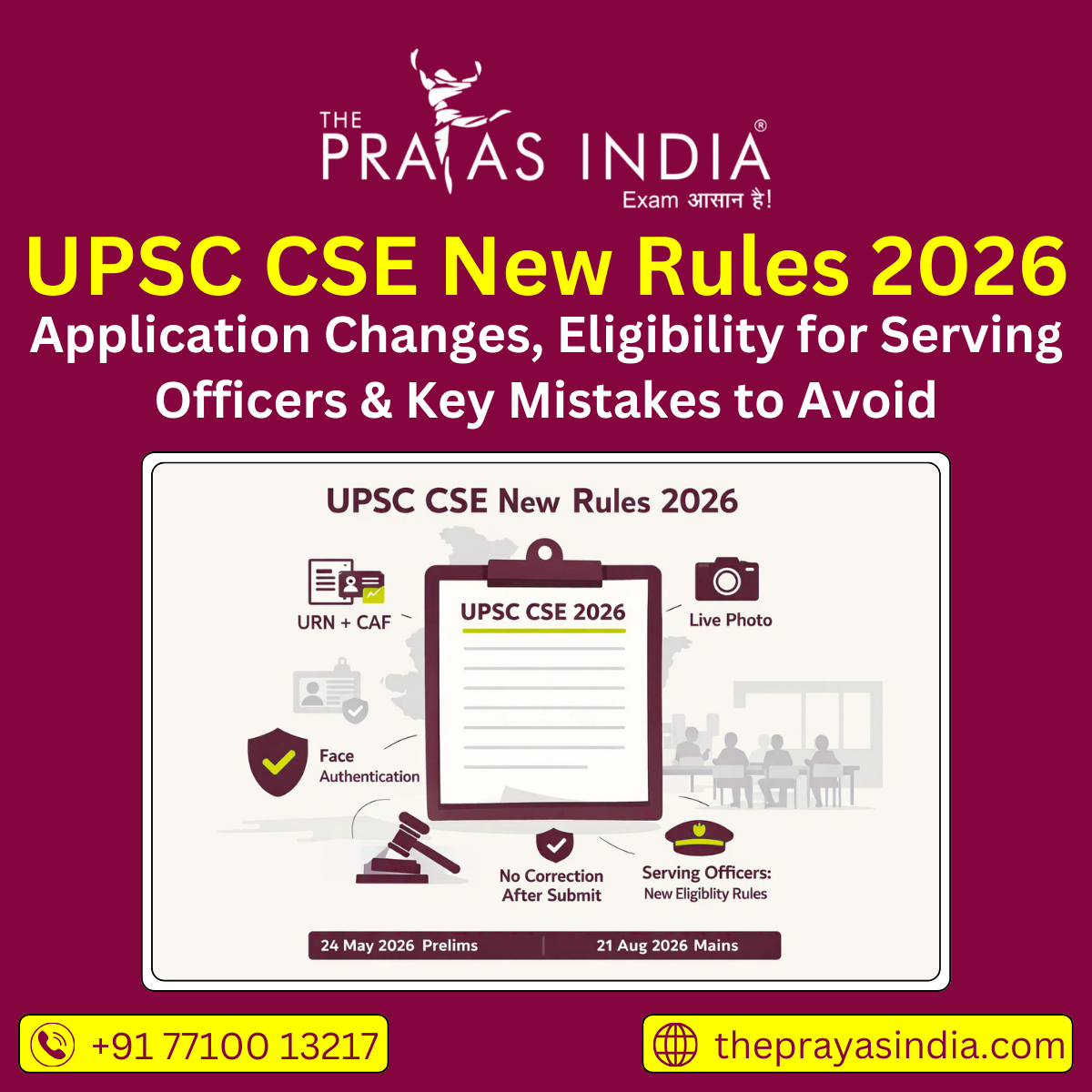
UPSC CSE New Rules 2026
UPSC CSE 2026 Notification PDF English
UPSC CSE 2026 Notification PDF Hindi
UPSC CSE 2026 Notification: Key Highlights
The UPSC CSE 2026 notification defines the complete framework of the examination year. It includes:
- Application schedule
- Prelims and Mains exam dates
- Vacancy details
- Eligibility rules (nationality, age, qualification)
- Attempt limits and relaxations
- New restrictions for already selected/serving candidates
- UPSC online application structure
For serious aspirants, this notification acts as the official boundary within which the entire UPSC journey will operate.
UPSC 2026 Important Dates (Official Schedule)
Candidates must treat UPSC dates as “anchors” for planning revision cycles, test series, and answer writing.
UPSC CSE 2026 Timeline
| Stage | Date |
|---|---|
| UPSC CSE 2026 Notification Released | 4th February 2026 |
| Application Window Ends | 24th February 2026 |
| UPSC Prelims 2026 Exam Date | 24 May 2026 (Sunday) |
| UPSC Mains 2026 Start Date | 21 August 2026 |
| Personality Test / Interview | To be announced |
Note: Missing application deadlines is one of the most avoidable reasons for losing an attempt. Apply early.
UPSC Vacancy 2026: Total Posts Announced
As mentioned in the UPSC notification, the expected number of vacancies for CSE 2026 is approximately:
- Total vacancies: 933
- PwBD reserved vacancies: 33
These vacancies cover multiple services such as:
- IAS
- IPS
- IFS
- IRS
- IA&AS
- and other Group A services
UPSC CSE Exam Updates
UPSC Vacancy Trend (Year-wise)
UPSC vacancies vary every year depending on service requirements.
| Year | Vacancies |
|---|---|
| **2026** | **933** |
| 2025 | 979 |
| 2024 | 1056 |
| 2023 | 1105 |
| 2022 | 1022 |
| 2021 | 712 |
| 2020 | 796 |
| 2019 | 829 |
Key Highlights for UPSC 2026 Aspirants:
- 2026 Vacancies ↓: 933 (from 979 in 2025)
- Trend: Peaked at 1105 (2023), now stabilizing ~900-1000
- Competition: Higher cut-offs expected with fewer seats
- Apply by: 24th Feb 2026
Important: Final vacancy numbers may change after cadre confirmation and reservation application.
UPSC Eligibility Criteria 2026 (As per Official Notification)
Every year, many candidates lose their candidature not due to poor preparation, but due to misunderstanding eligibility rules.
UPSC eligibility for CSE 2026 is mainly based on:
- Nationality
- Educational qualification
- Age limit
- Attempts
Let us understand each one in detail.
1) UPSC Nationality Criteria 2026
For IAS, IPS and IFS
A candidate must be a Citizen of India.
For Other Services
A candidate must be either:
- Citizen of India
- Citizen of Nepal
- Subject of Bhutan
- Tibetan refugee (came before 1 Jan 1962 with intention to settle permanently)
- Person of Indian origin migrated from Pakistan, Burma, Sri Lanka, Kenya, Uganda, Tanzania, Zambia, Malawi, Zaire, Ethiopia and Vietnam
Important condition:
Candidates from Nepal, Bhutan, Tibetan refugee category, and persons of Indian origin must possess a certificate of eligibility issued by Government of India.
2) UPSC Educational Qualification 2026
The minimum qualification required for UPSC CSE 2026 is:
-
A Bachelor’s degree from a recognised university/institution.
Can final-year candidates apply?
Yes. Final-year graduation students may apply provisionally, but they must produce proof of passing before the interview stage.
Key point:
UPSC does not require any specific subject. The degree can be from any stream.
3) UPSC Age Limit 2026 (As on 1st August 2026)
UPSC age eligibility is calculated strictly.
- Minimum age: 21 years
- Maximum age: 32 years
A candidate must be born:
- Not earlier than 2nd August 1994
- Not later than 1st August 2005
UPSC Age Relaxation and Attempts 2026 (Category-wise)
| Category | Age Limit | Maximum Attempts |
|---|---|---|
| General / EWS | 21–32 years | 6 |
| OBC | Up to 35 years | 9 |
| SC / ST | Up to 37 years | Unlimited |
| PwBD | Up to 42 years | PwBD Gen/OBC: 9 PwBD SC/ST: Unlimited |
Note:
Additional relaxations apply for Ex-servicemen and J&K domicile candidates as per notification rules.
UPSC CSE 2026-27 Detailed Syllabus
Major New Change in UPSC Notification 2026: Restrictions on Applying
This is one of the most important updates in UPSC CSE 2026.
The notification clarifies rules for:
- Candidates already allocated a service in earlier years
- Candidates currently in training
- Candidates planning “improvement attempts”
This section is extremely relevant for repeaters and already selected candidates.
1. Absolute Restriction (IAS & IFS)
If a candidate is already appointed to:
- IAS or
- IFS
from an earlier Civil Services Exam, they cannot apply for UPSC CSE 2026.
Even if the appointment happens after Prelims, the candidate will not be allowed to continue.
2. Special Rule for IPS Officers
A candidate appointed to IPS earlier:
- Can appear for UPSC CSE 2026
- But cannot choose IPS again in service preferences
3. One-Time Improvement Attempt Rule
If a candidate is allocated IPS or a Group A Central Service through CSE-2026:
- UPSC allows one improvement attempt in CSE-2027
- This is allowed through a one-time training exemption
- This facility is allowed only once
4. If Candidate Does Not Join Training and Does Not Take Exemption
Then the CSE-2026 allocation gets cancelled.
5. If Candidate Appears in CSE-2027 After Taking Exemption
If they get a better service in 2027:
- The candidate must choose either 2026 or 2027 service
- The other allocation automatically cancels
6. If Candidate Appears in CSE-2027 But Does Not Get Any Service
They can return and join their CSE-2026 allocated service.
7. If the Candidate Does Not Join the Training of the Finally Chosen Service
Then both allocations get cancelled.
8. Restriction After Using One Improvement Attempt
After using the one improvement attempt (CSE-2027):
- The candidate cannot appear for CSE-2028 onwards
- Unless they resign from service
9. Candidates Already in Service from CSE-2025 or Earlier
Such candidates are allowed:
- One chance to appear in either CSE-2026 or CSE-2027 without resigning
- For appearing beyond that, resignation becomes mandatory
Why This Change Matters
This clarification ensures:
- No repeated service allocations
- No misuse of training exemptions
- Better administrative discipline
It also forces candidates to take serious decisions about whether to reappear.
UPSC CSE 2026-27 New Batches
UPSC CSE 2026 Application Form: Step-by-Step Guide
UPSC has clearly stated that applications must be submitted only through the official online portal.
Official portal: upsconline.nic.in
The application process is now structured into four modules/cards, making it more systematic.
Step 1: Account Creation
Candidates must create an account using:
- Active email ID
- Active mobile number
All future UPSC communication will be sent to these credentials.
Step 2: Universal Registration Number (URN)
After account creation, candidates complete the Universal Registration module.
What is URN?
- A unique permanent registration number
- Valid for all UPSC exams
- Created only once in lifetime
The URN stores:
- Name, DOB
- Photo ID details (Aadhaar recommended)
- Address and contact details
Step 3: Common Application Form (CAF)
CAF is common across UPSC examinations.
CAF includes:
- Live photo capture
- Uploading recent photograph
- Uploading signature (signed three times on plain white paper with black ink)
- Education details
- Category details
Warning:
UPSC has clearly stated that unclear photo/signature uploads can lead to cancellation.
Step 4: Examination Specific Module (UPSC CSE 2026)
In this module, candidates must:
- Select Civil Services Examination 2026
- Choose exam centre preferences
- Select an optional subject
- Select the medium of the exam
- Select a compulsory Indian language
- Pay fee (if applicable)
- Submit the final form
After final submission:
- UPSC generates an Application Number
- No correction/withdrawal allowed after submission
UPSC CSE Exam 2026-27 Test Series
UPSC CSE 2026 Exam Structure: Prelims, Mains and Interview
UPSC continues the 3-stage format.
1) Preliminary Examination (Objective)
Includes:
- GS Paper I
- CSAT Paper II
Prelims is qualifying for Mains.
2) Main Examination (Descriptive)
Includes:
- Essay
- GS Paper I–IV
- Optional Paper I–II
- Qualifying language papers
Mains is the biggest scoring stage.
3) Personality Test (Interview)
Candidates who qualify Mains appear for the interview.
Final merit is based on:
- Mains marks
- Interview marks
What Aspirants Should Do Next After UPSC 2026 Notification
Once the notification is out, preparation must shift into a more serious and stable phase.
1. Lock Your Attempt Strategy
Ask yourself clearly:
- Is this your first serious attempt?
- Are you a repeater?
- Do you have strong optional preparation?
This decision impacts:
- Depth of study
- Revision intensity
- Test frequency
2. Build Timeline Backwards from Prelims
Prelims is the anchor date.
A mature strategy works backward:
- Finish syllabus early
- Reserve time for 3–4 revision cycles
- Keep 45–60 days for full-length mocks
3. Integrate Prelims + Mains from the Start
The biggest mistake is treating them as separate.
Instead:
- Read static topics with Mains understanding
- Practice MCQs with concept clarity
- Build notes for both stages together
4. Make Testing + Analysis the Core
Reading creates comfort. Testing creates readiness.
A serious aspirant must do:
- Weekly tests
- Mock analysis
- Error tracking
- Weak area revision
5. Treat CSAT as a Parallel Track
CSAT is no longer “easy qualifying.”
To stay safe:
- Practice regularly
- Focus on comprehension + reasoning
- Do mock CSAT papers
6. Shift from Coverage Mode to Performance Mode
At this stage, progress should be measured by:
- How well you recall under pressure
- How many mistakes can you reduce
- How consistent are your mock scores are
Not by how many books you finished.
Conclusion
The UPSC CSE 2026 notification, released on 4th February 2026 officially begins one of the most competitive examination cycles in India.
To stay in the race, aspirants must first ensure full clarity about:
- UPSC eligibility
- Age limit and attempts
- Form-filling process
- New restrictions for already selected candidates
Once these basics are clear, the real challenge is disciplined preparation—built on revision, testing, and an integrated Prelims-Mains strategy.
For serious aspirants, this is not the time for scattered experimentation. It is time for consistent execution.
UPSC CSE 2026 Notification – FAQs (English)
1. When was the UPSC CSE 2026 notification released?
The UPSC Civil Services Examination (CSE) 2026 notification was officially released on 4th February 2026 by the Union Public Service Commission.
2. What is the last date to apply for UPSC CSE 2026?
The last date to submit the UPSC CSE 2026 online application form is 24th February 2026.
3. What is the UPSC Prelims 2026 exam date?
As per the official calendar, the UPSC Prelims 2026 will be conducted on 24 May 2026 (Sunday).
4. When will UPSC Mains 2026 start?
The UPSC Mains 2026 examination is scheduled to begin from 21 August 2026.
5. How many vacancies are announced for UPSC CSE 2026?
UPSC has mentioned approximately 933 vacancies for the Civil Services Examination 2026, including 33 vacancies reserved for PwBD candidates.
6. What is the age limit for UPSC CSE 2026?
For the General category, the age limit is:
- Minimum Age: 21 years
- Maximum Age: 32 years (as on 1st August 2026)
The candidate must be born between 2nd August 1994 and 1st August 2005.
7. What is the number of attempts allowed for UPSC 2026?
The maximum number of attempts allowed are:
- General/EWS: 6 attempts
- OBC: 9 attempts
- SC/ST: Unlimited (within age limit)
- PwBD: As per category relaxation rules
8. What is the minimum qualification for UPSC CSE 2026?
The minimum educational qualification required is a Bachelor’s degree from a recognised university.
Final-year graduation students can also apply provisionally.
9. Can final-year students apply for UPSC CSE 2026?
Yes. Candidates in the final year of graduation can apply, but they must provide proof of passing the degree before the interview stage.
10. Is the UPSC CSE 2026 application process fully online?
Yes. UPSC applications are accepted only through the official online portal:
upsconline.nic.in
11. What is the UPSC URN and why is it important?
URN stands for Universal Registration Number. It is generated during the registration process and remains valid for all future UPSC examinations. Candidates need to create it only once.
12. What is the new restriction introduced in UPSC CSE 2026 notification?
A major clarification has been added regarding candidates already selected in previous CSE:
- Candidates appointed to IAS or IFS from an earlier CSE cannot appear in CSE-2026.
- Candidates appointed to IPS can appear but cannot choose IPS again in preferences.
13. Can a serving government officer appear for UPSC again?
Yes, but only under specific conditions mentioned in the notification. The rules are stricter now regarding repeated attempts after service allocation.
14. What is the “One-Time Improvement Attempt” rule in UPSC?
UPSC has provided a one-time improvement attempt (CSE-2027) for candidates allocated IPS or Group A services through CSE-2026, using a training exemption.
This facility is allowed only once.
15. What happens if a candidate does not join training after selection?
If a candidate neither joins training nor takes exemption, the service allocation may be cancelled, as per UPSC rules.
16. Can a candidate make corrections after final submission of the form?
No. UPSC clearly states that no correction or withdrawal is permitted after final submission.
17. Is CSAT qualifying in UPSC Prelims 2026?
Yes. CSAT (GS Paper II) is qualifying, and candidates must score at least 33% marks to clear it.
18. Does UPSC Prelims marks count in the final merit?
No. Prelims is only a screening stage. The final merit is based on:
- UPSC Mains marks
- Interview marks
19. What is the structure of UPSC CSE 2026?
UPSC CSE 2026 has three stages:
- Prelims (Objective)
- Mains (Descriptive)
- Interview (Personality Test)
20. What should aspirants do immediately after the UPSC 2026 notification?
Aspirants should:
- Fill the form early (avoid last-day rush)
- Start a revision + mock test schedule
- Integrate Prelims and Mains preparation
- Keep CSAT as a parallel practice track


![Prayas-तेजस [UPSC CSE Sociology Optional] – Online & Offline](https://theprayasindia.com/wp-content/uploads/2025/09/Prayas-तेजस-UPSC-CSE-Optional-Subject-The-Prayas-India-300x300.png)
![Prayas-सूत्र [UPSC CSE Materials (Hardcopy)]](https://theprayasindia.com/wp-content/uploads/2025/09/Prayas-सूत्र-UPSC-CSE-Study-Materials-Hardcopy-The-Prayas-India-300x300.png)
![Prayas-मंत्रा [UPSC CSE CSAT]](https://theprayasindia.com/wp-content/uploads/2025/09/Prayas-मंत्रा-UPSC-CSE-CSAT-The-Prayas-India-300x300.png)
![Prayas सारथी [UPSC CSE One on One Mentorship]](https://theprayasindia.com/wp-content/uploads/2025/09/Prayas-सारथी-UPSC-CSE-One-on-One-Mentorship-The-Prayas-India-300x300.png)