What to Do If You Score Low in CAT Mock Tests | Best CAT Coaching in Mumbai | The Prayas India
Turn a Low Score Into Your Next Breakthrough
A low score in a CAT mock test can be frustrating.
You spend hours preparing, expect your score to improve, and then the result appears on the screen—lower than what you anticipated.
The first reaction is often:
“Maybe I’m not prepared enough for CAT.”
But one low mock score does not tell you that.
A mock test is not a final judgement of your CAT potential. It is a performance diagnostic. It shows you what is working, where you are losing marks, and which parts of your strategy need correction.
The real mistake isn’t scoring low in one mock.
The real mistake is taking another mock without understanding why you scored low in the first one.
A Low Score Is Not the Verdict
CAT preparation doesn’t always follow a straight upward line.
You may score well in one mock and struggle in the next. A difficult DILR set, unfamiliar VARC questions, calculation-heavy Quant questions, or poor time allocation can significantly affect your performance.
This is why you should avoid judging your entire preparation based on a single number.
Instead, look at your mock as a snapshot of your current preparation.
A low score can reveal:
- A conceptual gap
- Poor question selection
- Low accuracy
- Weak time management
- Lack of familiarity with a particular question type
- Panic under time pressure
- Difficulty choosing the right DILR set
- Over-attempting questions
Once you identify the actual reason, you can work on it.
Read the Scorecard, Not Just the Number
The overall score or percentile is only the starting point.
After every mock, look beyond it.
Check Your Attempts
How many questions did you attempt?
A low attempt count may indicate:
- Slow solving speed
- Excessive hesitation
- Poor question selection
- Difficulty understanding the paper
But a high number of attempts isn’t automatically good either.
Check Your Accuracy
Suppose you attempted 50 questions but got only 30 correct.
Increasing your attempts further may not solve the problem.
Your first priority may need to be accuracy.
On the other hand, if your accuracy is high but your attempts are very low, speed and selection may require attention.
Check Sectional Performance
Your overall score can hide important information.
For example:
VARC — Strong
DILR — Moderate
QA — Weak
In such a situation, simply saying “My CAT score is low” doesn’t tell you what needs to be fixed.
Your preparation strategy should respond to the sectional pattern.
Where Did the Marks Disappear?
After every mock, try to reconstruct your performance.
Imagine that you attempted 45 questions.
Now divide the questions into four categories:
🟢 Correct & Confident
These questions indicate areas where your preparation and decision-making are working.
🟡 Correct but Time-Consuming
These questions may indicate that your approach is correct but not yet efficient.
🔴 Incorrect but Attempted
These require deeper analysis.
Was the mistake conceptual?
Was it a calculation error?
Did you misread the question?
Did you make a rushed decision?
⚪ Unattempted but Solvable
This category is extremely important.
If you discover that you left several manageable questions because you spent too much time elsewhere, your problem may not be knowledge.
It may be question selection and time management.
The Difference Between a Low Score and a Bad Strategy
A low score doesn’t necessarily mean your entire CAT preparation strategy is wrong.
You need to determine whether the problem is:
Knowledge → Application → Selection → Speed → Accuracy
For example, if you understand percentages but make repeated mistakes in percentage-based questions, you may not need to relearn the entire chapter.
You may simply need more targeted practice.
Similarly, if you are capable of solving DILR sets but spend 15 minutes on a set that isn’t progressing, the issue may be set selection rather than DILR ability.
This distinction is critical.
Don’t Immediately Change Your Books or Resources
One of the most common reactions after a poor mock score is to change the entire preparation strategy.
Aspirants start searching for:
- New books
- New teachers
- New YouTube channels
- New question banks
- New mock series
This often creates more confusion.
Before changing your resources, ask:
“What exactly did this mock reveal about my preparation?”
If your concepts are weak, strengthen them.
If your accuracy is poor, practise carefully.
If your selection is weak, analyse question patterns.
If your speed is low, introduce timed practice.
Fix the problem before replacing the system.
Your First Goal Shouldn’t Be a Huge Score Jump
Suppose you scored 45 in a mock.
Don’t immediately set your next target at 90.
Instead, identify what improvement is realistically achievable.
For example:
45 → 55 → 65 → 75
Small improvements compound over time.
Your objective after every mock should be:
Find one or two important weaknesses and eliminate them before the next test.
This creates measurable progress without unnecessary pressure.
CAT Mock Tests Should Be Treated Like Diagnostic Reports
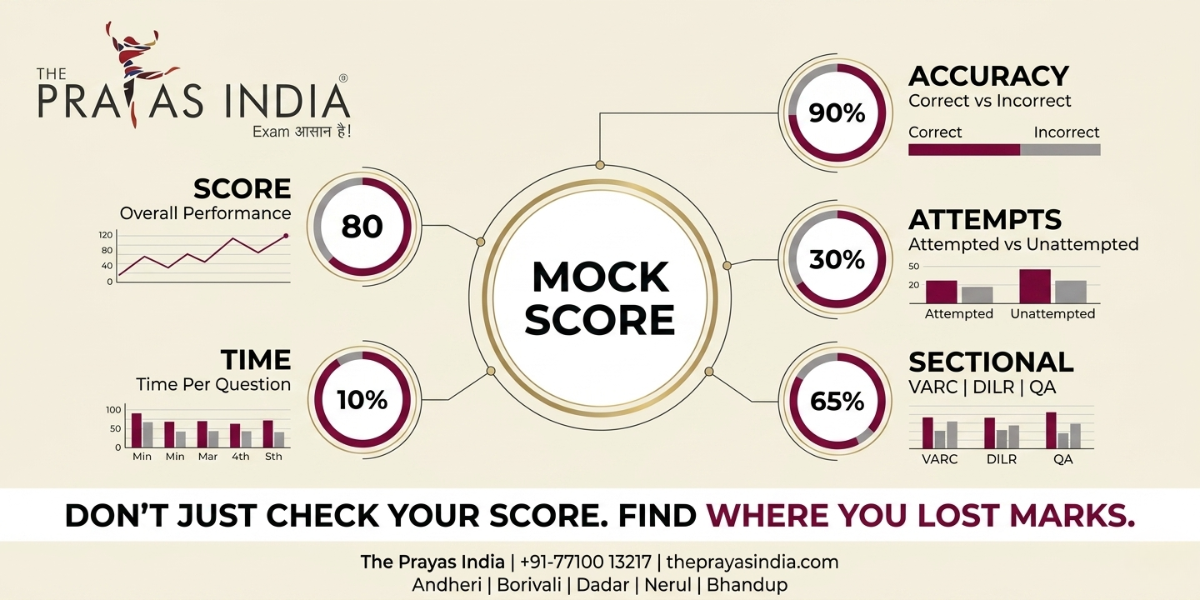
Think of every mock as a performance report.
It tells you:
What You Know
Your conceptual strengths.
What You Can Solve
Your application ability.
What You Can Solve Quickly
Your efficiency.
What You Should Have Attempted
Your question-selection ability.
What You Need to Fix
Your preparation gaps.
This mindset changes the role of mock tests completely.
You stop fearing the score and start learning from the data.
A Low Mock Can Become Your Most Useful Mock
The best outcome of a mock test isn’t always a high score.
Sometimes, the most valuable mock is the one that exposes a weakness you hadn’t noticed before.
If a low score tells you that your accuracy is falling, your DILR selection needs work, your Quant fundamentals are incomplete, or your VARC attempts are consuming too much time, then the mock has already done its job.
Now your responsibility is to analyse the signal, fix the weakness, and test yourself again.
That is how a low score becomes the starting point for improvement.
Where Did the Marks Disappear?
A low CAT mock score becomes useful only when you know exactly why it happened.
Looking at a low percentile and immediately deciding that you need to “study harder” is one of the least effective ways to respond to a poor mock.
The better question is:
What caused the score to fall?
Two students can get the same score for completely different reasons.
One may have strong concepts but poor time management. Another may attempt too many questions with low accuracy. A third may understand the topics but select the wrong DILR sets.
Their solutions cannot be identical.
This is why mock analysis should begin with diagnosis, not reaction.
The Four Types of Mock Mistakes
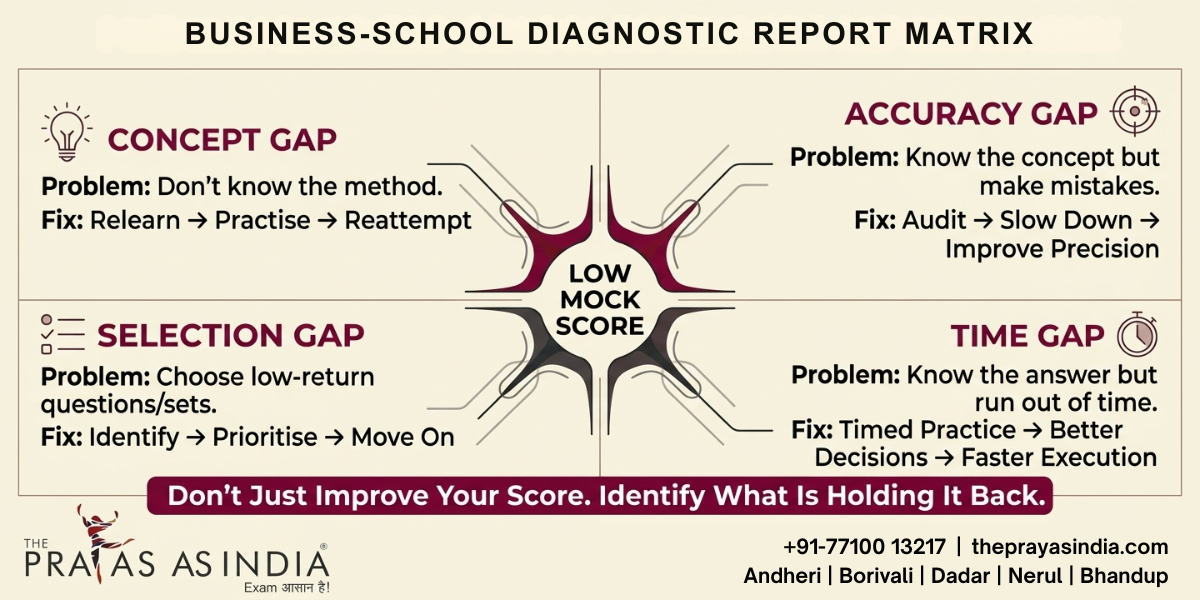
Most problems visible in a CAT mock can be traced to four broad categories:
1. Conceptual Gap
You don’t know how to solve the question.
2. Accuracy Gap
You know the concept but make avoidable mistakes.
3. Selection Gap
You spend time on questions or sets that aren’t worth attempting.
4. Time Gap
You know what to do but cannot complete it within the available time.
Identifying the category is important because each requires a different solution.
1. Conceptual Gaps — When You Don’t Know the Method
Suppose you encounter a Quant question based on a concept you’ve studied but cannot remember the correct approach.
Or perhaps you understand the basic formula but don’t know how to apply it when the question is presented differently.
This is a genuine preparation gap.
What to Do
Don’t simply solve that one question and move on.
Instead:
- Identify the underlying topic.
- Revisit the concept.
- Solve basic questions first.
- Move towards CAT-level applications.
- Practise different variations.
- Reattempt the original question later.
The objective isn’t to memorise one solution.
It’s to make the concept reusable across different questions.
2. Accuracy Gaps — When You Know but Still Get It Wrong
This is one of the most frustrating situations.
You understand the topic.
You know the method.
But your answer is still wrong.
Common reasons include:
- Misreading the question
- Calculation mistakes
- Incorrect assumptions
- Sign errors
- Rushing through options
- Marking the wrong option
- Making an avoidable logical jump
If this happens frequently, don’t immediately try to increase your attempts.
First, improve your accuracy.
Accuracy Audit
After a mock, take every incorrect attempt and ask:
Did I not know the concept?
Did I misunderstand the question?
Did I make a calculation error?
Did I rush because of time pressure?
This simple classification can reveal patterns that your overall score cannot.
If most errors are careless, your preparation problem is different from someone who doesn’t understand the concepts.
3. Selection Gaps — The Hidden CAT Problem
CAT doesn’t reward you simply for attempting more questions.
It rewards effective decision-making under pressure.
This becomes especially important in DILR.
You may be capable of solving a particular set, but that doesn’t necessarily mean it is the right set to attempt in the examination.
The same applies to individual questions in QA and VARC.
You need to recognise:
Easy Opportunity
High probability of solving correctly within reasonable time.
Possible Opportunity
Solvable, but may require more time or careful thinking.
Low-Return Opportunity
Likely to consume substantial time relative to its potential benefit.
A strong CAT strategy is not about solving everything.
It’s about recognising where your time can generate the highest return.
DILR: Selection Can Change the Entire Section
Imagine you begin with a DILR set that looks familiar.
You spend several minutes setting it up.
But the calculations aren’t progressing.
Instead of moving on, you continue because you’ve already invested time.
This is the sunk-cost trap.
The time you’ve already spent does not make the set more valuable.
If another set offers a better opportunity, you need the discipline to move.
During mock analysis, identify:
- Which set did you choose first?
- How much time did you spend on it?
- When did you realise it was difficult?
- Was another set more approachable?
- Did you return to the easier set too late?
These answers can dramatically improve your DILR decision-making.
4. Time Gaps — When You Know the Answer but Run Out of Time
Time management isn’t simply about solving faster.
It includes:
- Reading efficiently
- Choosing questions wisely
- Knowing when to move on
- Avoiding unnecessary calculations
- Maintaining section-level awareness
- Saving enough time for easier opportunities
A student who spends four minutes solving a difficult question may miss two questions that could have been solved in two minutes each.
That is not necessarily a knowledge problem.
It is a time-allocation problem.
Accuracy Before Attempts
One of the most common reactions to a low mock score is:
“I need to attempt more questions.”
Not always.
Consider two situations.
Student A
Attempts 40 questions
Gets 32 correct
Student B
Attempts 55 questions
Gets 32 correct
Student B attempted substantially more questions, but the additional attempts didn’t translate into better performance.
The solution may not be increasing attempts.
It may be improving the quality of attempts.
This is why you should monitor:
Attempts + Accuracy + Time
together.
Never evaluate one number in isolation.
Section-Wise Diagnosis
A low overall score needs to be broken down section by section.
VARC: Check Your Reading Decisions
If VARC is weak, analyse:
- Which RCs did you select?
- How much time did you spend reading?
- Were your incorrect answers concentrated in one question type?
- Did you eliminate options logically?
- Were you rushing towards the end?
A student may not have a reading-comprehension problem at all.
The issue may be passage selection or excessive time spent on one RC.
DILR: Check Set Selection
For DILR, analyse:
- Which sets did you attempt?
- Which sets were actually easier?
- How long did you spend deciding?
- Did you abandon a difficult set early enough?
- Did you make progress before committing more time?
DILR performance can improve significantly when set selection becomes more disciplined.
QA: Check Concept + Application + Speed
For Quant, analyse:
- Which chapters caused errors?
- Were mistakes conceptual or calculation-based?
- Which questions took too long?
- Did you identify easier questions quickly?
- Are you comfortable with common CAT question types?
This tells you whether you need concept revision, targeted practice, or speed improvement.
The 24-Hour Mock Analysis Rule
Don’t let a mock become an event that ends when you see the percentile.
Within the next day, analyse it while you still remember your decision-making process.
Create four lists:
A — Correct & Efficient
Keep your approach.
B — Correct but Slow
Find a faster method.
C — Incorrect
Identify the reason.
D — Unattempted but Solvable
Understand why you missed the opportunity.
This turns one mock into several hours of targeted learning.
Don’t Analyse Only the Questions You Got Wrong
This is a major mistake.
A question you answered correctly may still teach you something.
Suppose you solved a question correctly but took five minutes.
That’s not necessarily a success.
Likewise, you may have guessed a question correctly.
That shouldn’t automatically be considered evidence of mastery.
Your analysis should therefore include:
Correct + Fast
Correct + Slow
Incorrect
Unattempted + Solvable
The second category—correct but slow—can be particularly valuable for improving CAT performance.
Create a Mock Error Log
Maintain a simple record after every test.
| Question/Set | Section | Problem | Time | Correct Approach | Action |
|---|---|---|---|---|---|
| Q1 | QA | Concept gap | 3 min | Revise concept | Practise |
| Q2 | VARC | Misread | 2 min | Better elimination | Reattempt |
| Set 1 | DILR | Poor selection | 12 min | Exit earlier | Set practice |
Over several mocks, patterns will emerge.
You may discover that:
- The same Quant topic keeps causing errors.
- You repeatedly over-attempt a particular VARC question type.
- You spend too long on DILR sets.
- Your accuracy drops sharply in the final part of a section.
That information is far more valuable than simply knowing your percentile.
Your Mock Score Is a Data Point
Don’t label yourself based on one test.
Instead of:
✗ “I’m bad at CAT.”
Ask:
✓ “What does this mock tell me about my current preparation?”
That change in mindset is important.
A low score can reveal exactly what you need to work on next.
And once you know that, the next step becomes much clearer:
Diagnose → Practise → Correct → Retest.
The Next Mock Should Test Your Correction
Don’t take the next mock simply because your schedule says it’s time.
Take it after you’ve addressed the major issue revealed by the previous one.
If your last mock showed:
Low QA accuracy → revise and practise QA.
Poor DILR selection → practise set selection.
VARC time pressure → work on reading and decision-making.
Too many careless errors → introduce accuracy-focused practice.
This creates a meaningful connection between your mocks.
Every test should build on the previous one.
Turn a Bad Mock Into a Better Next Mock
Analysis only matters when it changes what you do next.
Scoring low in a CAT mock is only the first part of the process.
The real improvement begins after the result.
Once you’ve identified whether your problem is conceptual knowledge, accuracy, question selection, or time management, the next step is to build a targeted correction plan.
This is where many aspirants go wrong.
They analyse the mock, make a mental note of their mistakes, and then immediately start preparing for the next test.
A better approach is:
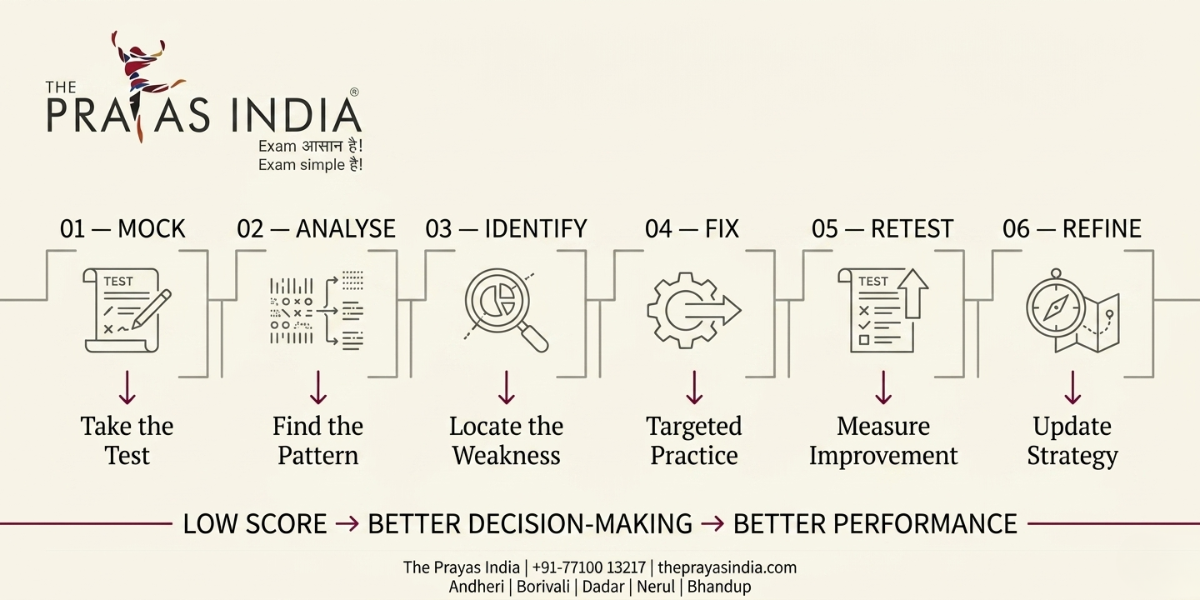
Mock → Analyse → Identify → Fix → Practise → Retest
The objective isn’t to forget the previous score.
It is to make sure the same problem doesn’t appear again.
Don’t Take Another Mock Until You Understand the Last One
More mocks do not automatically mean better preparation.
If you take three mocks every week but barely analyse them, you’re collecting scores rather than improving performance.
A mock should create an action plan.
For example:
Problem: QA accuracy dropped.
Don’t write:
“Study QA more.”
Write:
“Arithmetic accuracy was low because of calculation errors. Practise 30 timed questions and analyse every incorrect attempt before the next mock.”
The second version gives you something measurable.
Build Your Personal CAT Error Log
An error log can become one of the most useful tools in your CAT preparation.
Keep it simple.
For every important mistake, record:
Question
Which question or set caused the problem?
Topic
Which CAT concept was involved?
Error Type
Was it:
- Conceptual?
- Calculation?
- Interpretation?
- Selection?
- Time-related?
Your Approach
What did you actually do?
Correct Approach
What should you have done?
Time Taken
How much time did you spend?
Future Action
What will you do differently next time?
This turns mistakes into specific learning tasks.
Don’t Build an Error Log Just to Build One
The purpose isn’t to maintain a beautiful spreadsheet.
The purpose is to identify patterns.
After three or four mocks, look for repetition.
Perhaps you discover:
QA:
You repeatedly lose marks in arithmetic.
VARC:
You spend too long on difficult RCs.
DILR:
You choose sets based on familiarity rather than solvability.
Now your preparation becomes much more focused.
Instead of saying:
“I need to improve CAT.”
You can say:
“I need to improve arithmetic accuracy and DILR set selection.”
That is a much more manageable problem.
The Retest Rule
Once you’ve identified a weakness, don’t immediately assume that practising it once has solved the problem.
Use a simple cycle:
1. IDENTIFY
Find the exact weakness.
↓
2. LEARN
Revisit the relevant concept or strategy.
↓
3. PRACTISE
Solve targeted questions or sets.
↓
4. TIME IT
Introduce controlled time pressure.
↓
5. RETEST
Check whether the weakness has actually improved.
This final step is essential.
If you don’t retest, you don’t know whether your correction worked.
Targeted Practice Beats Random Practice
Suppose your last mock revealed that you struggled with:
Time & Work
Instead of solving 100 random Quant questions, create a focused practice session.
Round 1
Basic conceptual questions.
Round 2
CAT-level applications.
Round 3
Mixed questions under time pressure.
Round 4
Reattempt the questions you previously got wrong.
This creates progressive difficulty.
The same approach can be used for:
- Arithmetic
- Algebra
- Geometry
- Number System
- RC question types
- DILR set selection
The goal is to attack the specific weakness, not simply increase the number of questions solved.
Accuracy Improvement Requires a Different Approach
If your main problem is accuracy, don’t immediately start solving faster.
Do the opposite.
For a short period, prioritise:
Understanding → Precision → Consistency → Speed
During practice, ask yourself:
- Did I read every condition?
- Did I make an assumption?
- Did I calculate correctly?
- Did I verify the answer?
- Did I eliminate options logically?
Once your accuracy becomes stable, gradually introduce time pressure.
Speed built on weak accuracy can simply create faster mistakes.
When the Problem Is Question Selection
Question selection needs deliberate practice.
During your next sectional test, don’t just solve questions.
Before attempting one, quickly assess:
Can I understand this question quickly?
Do I know the approach?
Is the expected effort reasonable?
Is there a better opportunity elsewhere?
This doesn’t mean spending a long time analysing every question.
You need to develop a rapid decision-making instinct.
That instinct improves through repeated mock analysis.
DILR Needs Its Own Selection Strategy
For DILR, don’t judge yourself only by the number of sets solved.
Analyse your decisions.
After a mock, create a simple comparison:
| Set | Your Decision | Actual Difficulty | Time Spent | Outcome |
|---|---|---|---|---|
| Set A | Attempted | Difficult | 14 min | Incomplete |
| Set B | Skipped | Easy | — | Missed Opportunity |
| Set C | Attempted | Moderate | 9 min | Successful |
This can reveal whether your biggest DILR problem is actually set selection.
If it is, solving more random sets may not be enough.
You need to practise identifying the right sets.
For VARC, Analyse the Decision Behind the Answer
VARC mistakes can be particularly tricky because you may feel that two options are both reasonable.
Instead of simply checking the correct answer, ask:
Why was my option wrong?
Was it:
- Too extreme?
- Beyond the passage?
- Partially correct?
- Based on an assumption?
- Not answering the exact question?
- Less supported than the correct option?
This analysis helps you understand CAT’s logic rather than simply memorising answers.
For QA, Separate Knowledge From Execution
If you get a QA question wrong, determine whether you:
Didn’t Know
Conceptual gap.
Knew but Couldn’t Apply
Application gap.
Applied but Calculated Incorrectly
Accuracy gap.
Solved Correctly but Too Slowly
Efficiency gap.
These are four different problems.
Each requires a different intervention.
When Should You Change Your CAT Strategy?
Not every bad mock requires a strategy change.
Sometimes a difficult paper produces a lower score.
Sometimes you’re tired.
Sometimes a particular section simply doesn’t suit your strengths.
So don’t redesign your entire preparation after one poor performance.
Look for patterns across multiple mocks.
One Bad Mock
Analyse and continue.
Repeated Similar Problem
Make a targeted correction.
Persistent Weakness Despite Practice
Reconsider your approach and seek guidance.
Multiple Sections Consistently Underperforming
Review your broader preparation strategy.
This prevents emotional decision-making.
Don’t Chase Percentile Every Week
Mock percentiles can fluctuate.
If you obsess over every number, your preparation can become psychologically exhausting.
Instead, track performance indicators such as:
- Accuracy
- Attempts
- Questions solved within target time
- DILR set-selection quality
- VARC elimination accuracy
- QA question selection
- Repeated mistakes
These indicators can reveal improvement before it becomes visible in your overall percentile.
Create a Mock-to-Mock Improvement Sheet
After every test, record five things:
Mock Score
What was the result?
Biggest Strength
What worked?
Biggest Weakness
What cost you marks?
Correction
What are you going to fix?
Next-Mock Target
What specific improvement are you testing?
For example:
Previous Mock: 58
Major Weakness: QA accuracy
Correction: Arithmetic practice + calculation drills
Next Target: Improve QA accuracy without increasing careless attempts
Now the next mock has a purpose.
Your Next Mock Should Answer a Question
This is one of the most useful ways to approach mock tests.
Don’t take the next mock simply to ask:
“What score will I get?”
Ask:
“Did my correction work?”
If you worked on DILR selection, the next mock should tell you whether your set choices improved.
If you worked on QA accuracy, check whether your incorrect attempts reduced.
If you worked on VARC time management, check whether you finished the section with better control.
The mock becomes an experiment.
And you are testing your preparation strategy.
Know When You Need Expert Guidance
Self-analysis is powerful, but it has limits.
Sometimes an aspirant keeps repeating the same mistake without recognising the underlying reason.
For example:
- You keep changing your DILR strategy.
- Your QA accuracy remains stagnant.
- Your VARC attempts fluctuate significantly.
- You are taking many mocks but not improving.
- You don’t know which topics deserve priority.
At this stage, external evaluation can save significant preparation time.
A mentor can help identify patterns that are difficult to notice when you’re analysing your own performance.
Structured CAT Preparation at The Prayas India
For CAT aspirants, preparation is not just about completing Quant, VARC and DILR topics.
It is also about understanding how you perform under actual test conditions.
At The Prayas India, structured CAT preparation can help students combine conceptual learning with regular practice, mock testing, performance analysis and strategic guidance.
The focus can extend beyond:
“How many questions did you solve?”
to:
“How effectively are you preparing to solve the right questions in the actual CAT?”
With faculty guidance, structured preparation, mock tests, doubt resolution, performance evaluation and personalised mentoring, students can work systematically on the areas holding back their performance.
Improvement Is a Process, Not a Single Mock
Your CAT score can change because your preparation changes.
A low score today does not define the score you can achieve later.
What matters is whether you’re able to identify the reason behind the low score and systematically work on it.
The strongest preparation cycle is not:
Mock → Score → Stress → Next Mock
It is:
Mock → Analyse → Diagnose → Practise → Retest → Improve
Once you start following that cycle, every mock becomes useful—even the ones where the score isn’t what you wanted.
From Mock Performance to CAT Readiness
The goal of mock tests isn’t to collect scores. It’s to build the decision-making ability you need on CAT day.
A CAT mock becomes truly valuable when it changes the way you prepare.
By now, you have diagnosed your mistakes, created an error log, worked on specific weaknesses, and retested yourself.
The next step is to build a repeatable mock-test system that can continue working throughout your CAT preparation.
Because CAT isn’t simply a test of knowledge.
It is a test of knowledge + speed + accuracy + selection + composure.
Your mock strategy should therefore develop all five.
Build a Mock-Test Improvement Cycle
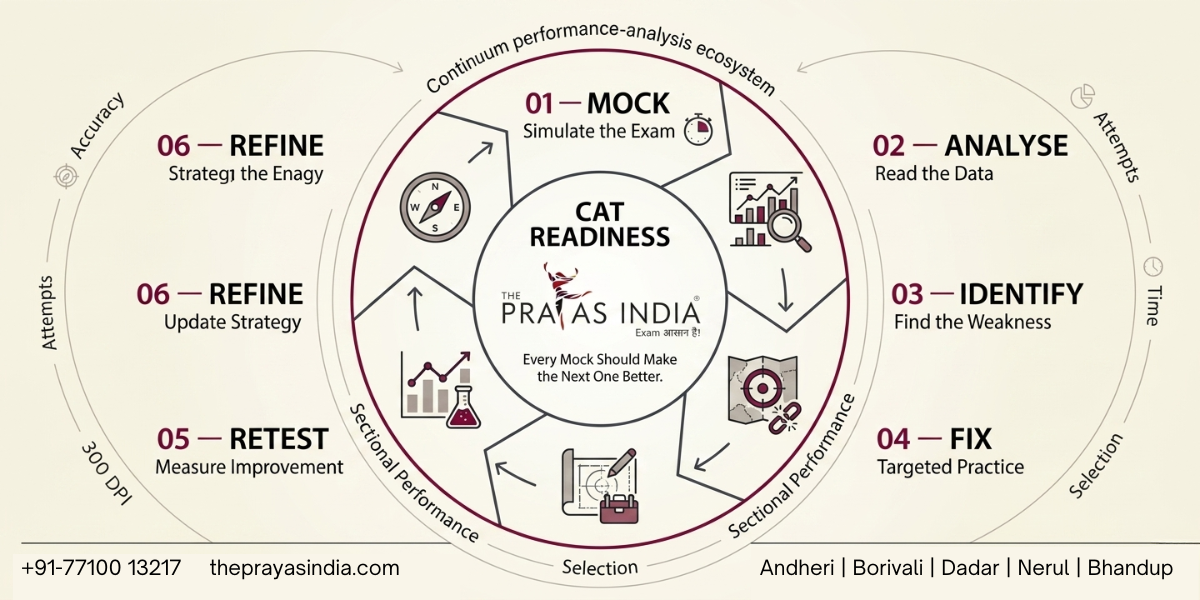
A strong CAT preparation cycle can look like this:
Concept Preparation
Learn and strengthen the fundamentals.
↓
Targeted Practice
Solve questions based on specific topics.
↓
Sectional Tests
Develop speed and section-specific decision-making.
↓
Full-Length Mock
Simulate the CAT environment.
↓
Detailed Analysis
Identify strengths, weaknesses and recurring mistakes.
↓
Correction
Work specifically on the problems revealed.
↓
Retest
Measure whether the correction worked.
Then repeat the cycle.
This approach ensures that mocks become part of your learning system, rather than something separate from preparation.
How Frequently Should You Take CAT Mocks?
There is no single mock frequency that works for every aspirant.
Your mock schedule should depend on your preparation stage.
Early Preparation
Focus more on concepts and sectional practice.
Full-length mocks can be introduced gradually.
Middle Stage
Increase mock frequency as more of the syllabus becomes familiar.
The emphasis should shift towards:
- Time management
- Question selection
- Sectional strategy
- Accuracy
- Exam temperament
Final Preparation Stage
Full-length mocks become increasingly important.
But even here, taking a mock every day isn’t automatically productive.
The crucial question is:
Are you analysing and learning from each test?
A well-analysed mock can be more valuable than several poorly analysed ones.
Don’t Let Mocks Replace Concept Preparation
Another common mistake is becoming obsessed with mock tests.
Aspirants sometimes think:
“If I take enough mocks, my CAT score will automatically improve.”
Not necessarily.
Mocks can expose weaknesses, but they don’t automatically fix them.
If you consistently make mistakes because your Algebra fundamentals are weak, another mock won’t teach you Algebra.
If your VARC accuracy is poor because you struggle with inference-based questions, repeated testing without analysis may simply repeat the same problem.
The right balance is:
Learn → Practise → Test → Analyse → Correct
What Does Healthy Improvement Look Like?
CAT mock scores don’t always increase in a perfectly straight line.
You may experience:
Mock 1 → 58
Mock 2 → 64
Mock 3 → 57
Mock 4 → 69
A temporary drop doesn’t automatically mean that your preparation is getting worse.
Instead, look at the underlying indicators.
Are you:
- Making fewer careless errors?
- Selecting better DILR sets?
- Solving QA questions faster?
- Improving VARC accuracy?
- Attempting more questions without sacrificing precision?
- Managing section time better?
If these indicators are improving, your preparation may be progressing even when the overall score fluctuates.
Track the Right Numbers
Create a simple performance dashboard for every mock.
Overall Score
Track your broad progress.
Sectional Scores
Identify where your strengths and weaknesses lie.
Attempts
Understand your approach to the paper.
Accuracy
Measure the quality of your attempts.
Average Time
Identify slow question types.
Easy Questions Missed
Find opportunities lost through poor selection.
Repeated Errors
Identify weaknesses that haven’t been corrected.
This gives you a much clearer picture of your preparation than percentile alone.
The Most Dangerous CAT Mock Mistakes
1. Taking the Score Personally
A low mock score doesn’t mean you’re incapable of cracking CAT.
It simply means your current performance has weaknesses that need attention.
2. Taking Another Mock Immediately
If you haven’t analysed the previous one, the next mock may simply reproduce the same mistakes.
3. Changing Your Entire Strategy
One difficult mock isn’t enough evidence to redesign your preparation.
Look for patterns.
4. Chasing Attempts
More attempts with poor accuracy can hurt rather than help.
5. Ignoring Sectional Performance
A decent overall score can hide a serious weakness in one section.
6. Comparing Every Mock With Someone Else
Your friend’s score, a topper’s score, or an online discussion shouldn’t determine your strategy.
Track your own performance.
7. Ignoring Correct-but-Slow Questions
A correct answer that consumes excessive time can still indicate a problem.
What If Your Score Remains Low Despite Taking Many Mocks?
If you’ve taken several mocks but your performance remains stagnant, don’t simply increase the number of tests.
Stop and diagnose.
Ask:
Is the syllabus incomplete?
If yes, strengthen your concepts.
Is accuracy the problem?
Introduce precision-focused practice.
Are you selecting questions poorly?
Work on decision-making.
Are you slow?
Use timed drills and sectional practice.
Are you repeating the same mistakes?
Review your error log.
Are you unable to identify the problem?
Seek expert guidance.
Sometimes the solution isn’t more preparation.
It’s better-directed preparation.
When You Should Take Expert Guidance
CAT preparation can become confusing when your performance stops improving.
You may know that something isn’t working without knowing exactly what to change.
A structured coaching environment can help by providing:
- Experienced faculty guidance
- Planned topic coverage
- Quality practice material
- Regular mock tests
- Detailed performance analysis
- Doubt resolution
- Personalised strategy support
- Mentoring and progress tracking
The purpose of guidance isn’t to make students dependent on coaching.
It is to help them avoid unnecessary trial and error.
Why Choose The Prayas India for CAT Preparation?
CAT preparation requires more than simply completing the syllabus.
Students need a system that connects learning, practice, testing and improvement.
At The Prayas India, CAT aspirants can prepare through a structured, examination-focused ecosystem designed around the actual demands of the test.
Concept-Focused Learning
Build strong fundamentals across:
- VARC
- DILR
- Quantitative Aptitude
CAT-Oriented Practice
Move from basic concepts to CAT-level application through focused practice.
Mock Tests & Analysis
Regular testing helps students understand their actual performance under exam-like conditions.
Performance-Based Improvement
Instead of treating every student with the same strategy, performance indicators can be used to identify areas requiring attention.
Doubt Resolution
Get clarity on difficult concepts and questions instead of allowing small gaps to accumulate.
Mentoring & Strategy Guidance
Receive guidance on question selection, time management, preparation priorities and exam strategy.
Admissions-Focused CAT Preparation
If you are serious about converting your CAT preparation into a strong MBA admission opportunity, structured guidance can help you stay focused throughout the preparation journey.
The objective is not merely to take more mocks.
It is to become better at taking the CAT.
Frequently Asked Questions
Is a low CAT mock score a sign that I cannot crack CAT?
No.
A mock score represents your performance under a particular set of questions and conditions. It should be used to identify weaknesses and improve your strategy rather than as a final prediction of your CAT potential.
Should I take another mock immediately after scoring low?
Not necessarily.
First analyse the previous mock, identify the major issues and work on them. Your next mock should ideally measure whether your corrections have worked.
How many CAT mocks should I take?
There is no fixed number suitable for everyone.
Mock frequency should increase as you become more prepared, but analysis and correction should remain an essential part of the process.
Should I focus on attempts or accuracy?
Both matter, but accuracy should not be sacrificed simply to increase attempts.
The objective is to maximise effective attempts—questions you can solve correctly within a reasonable amount of time.
What should I do if my CAT mock percentile is not improving?
Analyse your performance across multiple mocks.
Look for recurring issues in:
- Concepts
- Accuracy
- Question selection
- Time management
- Sectional performance
Then create a targeted correction plan instead of simply taking more tests.
Can coaching help improve CAT mock performance?
Yes, structured coaching can provide expert guidance, quality practice, mock testing, performance analysis and mentoring. However, improvement ultimately depends on consistent practice and the student’s ability to implement feedback.
From Low Mock Scores to CAT Confidence
A low CAT mock score can either become a source of frustration or a source of information.
The difference lies in what you do next.
If you simply look at the percentile and move on, the mock has limited value.
If you analyse the questions, identify the patterns, correct your weaknesses, practise deliberately and retest yourself, the same mock becomes a powerful learning tool.
Remember the cycle:
TAKE THE MOCK
↓
ANALYSE THE PERFORMANCE
↓
IDENTIFY THE PROBLEM
↓
FIX THE WEAKNESS
↓
RETEST
↓
REFINE YOUR STRATEGY
That is how improvement happens.
You don’t need every mock to be your best score.
You need every mock to make you better prepared for the actual CAT.
If you are looking for structured CAT coaching in Mumbai with expert guidance, mock-test practice, performance analysis and admission-focused preparation, The Prayas India can help you build a more systematic preparation strategy.
📞 Call: +91-77100 13217
🌐 Website: https://theprayasindia.com
📍 Centres: Andheri | Borivali | Dadar | Nerul | Bhandup
Your next mock doesn’t have to be perfect.
It just needs to be better analysed than the last one.