Why Are You Unable to Complete SSC CGL Paper on Time? | Best SSC Coaching in Mumbai | The Prayas India
For many SSC CGL aspirants, completing the paper within the available time becomes a bigger challenge than understanding the syllabus itself. A candidate may have studied the important concepts, solved hundreds of practice questions and even performed well when solving questions without a strict time limit. However, the moment a full-length mock or actual examination begins, the situation can change completely. Questions that looked manageable during practice start taking longer, calculations become slower, difficult questions consume disproportionate amounts of time, and eventually several questions are left unanswered simply because the clock runs out.
This often leads to a common question among aspirants: “If I know how to solve the questions, why am I still unable to complete the SSC CGL paper?” The answer is usually not a single weakness. In most cases, incomplete attempts are the result of several small problems working together—slow calculations, inefficient question selection, overthinking, lengthy reading, poor time allocation, lack of timed practice and an inability to recognise when a question should be skipped.
The important thing to understand is that completing SSC CGL on time is a skill that can be developed. It does not happen simply because you study for more hours. You need to train yourself to recognise questions quickly, choose them intelligently, execute familiar methods efficiently and move on when a question is consuming more time than it deserves. Your preparation should therefore focus not only on increasing knowledge but also on improving the way you use that knowledge inside a timed examination.
The Real Reason You Are Not Finishing the Paper
When an aspirant repeatedly fails to complete SSC CGL mocks, the natural reaction is to assume that more syllabus preparation is required. Sometimes that is true, especially when conceptual gaps are responsible for slow solving. However, adding more study material is not always the solution. If you already understand a topic but take twice as long as necessary to solve a question from it, reading another chapter on the same topic will not automatically improve your speed.
For example, imagine that you understand percentages very well but take nearly two minutes to complete a straightforward percentage calculation. Your problem is not conceptual knowledge; it is calculation efficiency. Similarly, if you understand a Reasoning question but spend considerable time deciding whether to attempt it, the problem is not necessarily your Reasoning ability. It is your question-selection process. Recognising this distinction is extremely important because it allows you to work on the actual source of your problem instead of endlessly increasing your study hours.
A useful way to diagnose the issue is to analyse your recent mock tests and ask yourself where the time actually disappeared. Did you spend too long on a particular section? Did calculations consume most of your Quant time? Did you get stuck on one puzzle? Did you repeatedly return to questions because you were unsure of your interpretation? Did you leave easy questions because difficult ones consumed your available time? The answers to these questions can reveal much more about your preparation than your overall mock score.
1. You Are Trying to Solve Questions in Sequence
One of the most common habits that affects SSC CGL time management is solving questions strictly in the order in which they appear. The approach feels organised because you begin with the first question and continue systematically. However, competitive examinations do not guarantee that the questions appearing first will be the easiest or most suitable for you. A question that appears early in a section may require considerably more time than another question appearing later.
When you insist on solving every question sequentially, you can unknowingly allow one difficult question to control the pace of the entire section. You may spend several minutes trying to understand a complicated arrangement or performing a lengthy calculation, while easier questions remain untouched. By the time you realise that you have spent too much time, the opportunity to attempt those easier questions may already have disappeared.
A better approach is to develop question scanning and selection as an examination skill. You should be able to look at a question and make a quick judgement about whether the method is familiar, whether the calculation appears manageable and whether the question is worth attempting at that moment. This does not mean blindly skipping difficult questions. It means prioritising questions according to the combination of confidence, expected time and potential scoring value.
2. You Spend Too Much Time on Questions That Are “Almost Solved”
Another major time trap occurs when a candidate has already invested considerable time in a question and feels compelled to finish it. You may understand the concept, begin the calculation and reach halfway through the solution, only to discover that the remaining steps are becoming complicated. Instead of moving forward, you continue because you feel that leaving the question would waste the time already invested.
This is a common psychological trap in competitive exams. The time you have already spent cannot be recovered, but you can still protect the remaining time. If a question has consumed far more time than expected and the solution is not progressing, continuing with it may create an even larger loss. The minutes spent on that question could have been used to solve several comparatively easier questions.
During practice, therefore, develop the habit of recognising an exit point. If you have tried a question using the method you know and the solution is not moving efficiently, mark it mentally and continue. You can always return to it if time is available. This habit is particularly valuable in Quantitative Aptitude and Reasoning, where certain questions can become unexpectedly lengthy.
3. Slow Calculations Are Eating Into Your Quant Time
For many SSC CGL aspirants, the problem with Quantitative Aptitude is not that they do not understand the concepts. The bigger issue is that their basic calculations are not sufficiently fast or automatic. When every multiplication, division, percentage conversion or ratio calculation requires conscious effort, even straightforward questions begin consuming too much time.
This becomes especially noticeable in a full-length paper. Losing only 20 or 30 seconds on one question may not seem significant. However, if the same delay occurs across ten questions, several minutes can disappear. Those minutes are valuable because they could have been used for questions that require more reasoning or for revisiting questions that were temporarily skipped.
This is why calculation practice should be treated as an independent part of SSC CGL preparation. Regular practice with fractions, percentages, squares, multiplication patterns, ratios, averages and approximation can gradually make calculations more automatic. The objective is not to perform every calculation recklessly fast. It is to reach a point where familiar calculations no longer interrupt your solving flow.
4. You Are Reading Questions More Slowly Than You Realise
Time management problems do not always come from solving questions. Sometimes a significant amount of time is lost simply because the candidate takes too long to understand what a question is asking. Reading the same sentence multiple times, struggling to identify the relevant information or getting confused by lengthy wording can quietly reduce the number of questions you can attempt.
This is particularly important in English and Reasoning, but reading efficiency also matters in Quantitative Aptitude and General Intelligence. Before beginning a calculation or applying a method, you need to identify exactly what information has been provided and what the question is asking you to find. If this initial interpretation takes too long, the actual solving time becomes even longer.
The solution is not to read everything as quickly as possible. Efficient reading is different from rushed reading. With regular practice, you can train yourself to identify keywords, conditions, numerical information and the actual requirement of the question more quickly. As this becomes habitual, the time spent simply understanding questions starts decreasing without compromising accuracy.
5. You Are Chasing Speed Instead of Developing Controlled Speed
Many aspirants know that SSC CGL is a time-bound examination, so they deliberately try to increase their speed. The problem begins when speed becomes the only objective. Candidates start reading faster, calculating faster and marking answers faster, but without first establishing accuracy and control.
This often produces a misleading improvement. Your number of attempts may increase, but so does your error rate. You may finish more questions while losing marks through miscalculations, incorrect interpretations or careless marking. In such a situation, your actual score may remain stagnant even though your speed appears to be improving.
A more effective progression is accuracy first, consistency second, timed practice third and speed improvement last. Once your solving method becomes reliable, introduce time pressure and gradually reduce the amount of time required for familiar question types. This approach develops controlled speed rather than rushed speed. The goal is not simply to work faster; it is to work faster without sacrificing the accuracy that converts attempts into marks.
6. You Do Not Have a Clear Section-Wise Time Framework
Another reason candidates fail to finish SSC CGL papers is that they begin the examination without a clear understanding of how they intend to use their time. They start solving and make decisions question by question, without any broader framework. This can work for a while, but once one section becomes unexpectedly time-consuming, the entire plan begins to fall apart.
Your time-management strategy should be based on your actual performance rather than a generic formula copied from another aspirant. Some candidates may work faster in English, while others may be more comfortable with Reasoning or Quant. The important thing is to understand your own strengths and weaknesses through repeated mock testing.
Your mocks should help you identify which sections consume the most time, where your accuracy falls under pressure and which question types repeatedly become time traps. Once you have this information, you can create a practical framework for your attempts. This framework should still remain flexible because the difficulty level and question mix can vary from one paper to another.
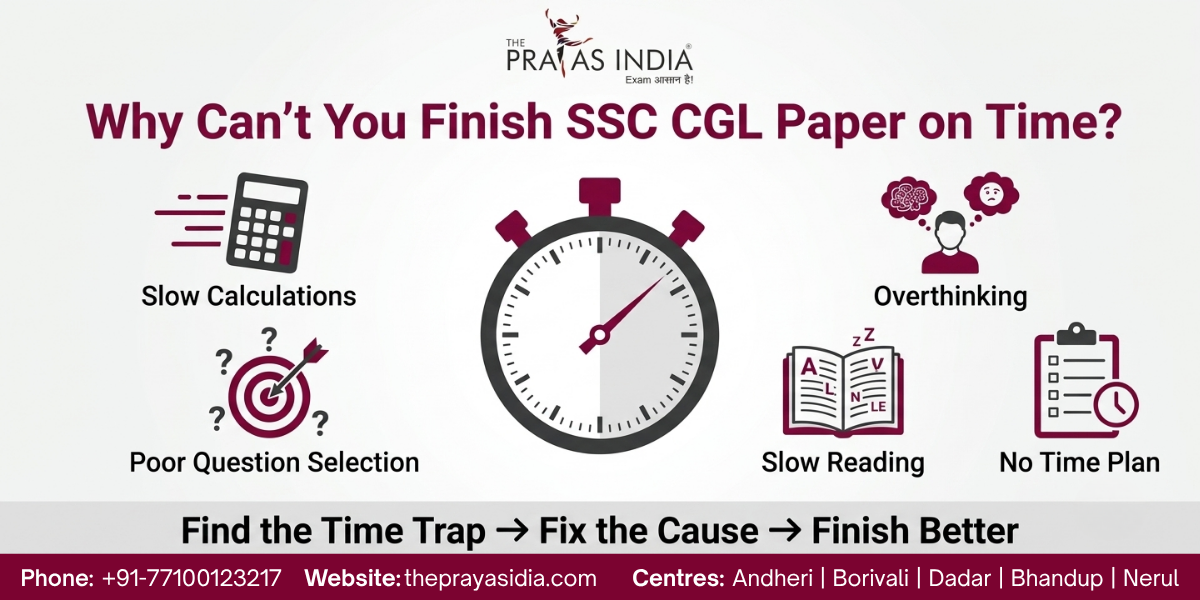
7. Your Reasoning Strategy Is Not Selective Enough
Reasoning can become one of the biggest sources of time loss when candidates treat every question as equally attractive. A question may look familiar because you have practised that topic many times, but familiarity does not necessarily mean that the question will be quick to solve. Certain arrangements, series or logical questions can become unexpectedly lengthy once you start working through their conditions.
The better approach is to develop selection before speed. During practice, expose yourself to different question types and pay attention to how much time each one actually requires. Over time, you will begin recognising patterns that are likely to be quick and patterns that need more time. This judgement becomes especially valuable in the examination because it allows you to protect your time for questions that offer a better return.
The same principle applies to puzzles and arrangements. Instead of automatically committing to the first puzzle you see, spend a few moments assessing its structure. If the conditions appear manageable and the questions attached to the set make it worthwhile, proceed. If the setup looks unusually complicated, leave it temporarily and look for other scoring opportunities. This is not about avoiding difficult questions permanently; it is about attempting them at the right time.
8. You Are Not Practising Under Real Time Pressure
Untimed practice is extremely useful when you are learning a new concept. It gives you enough space to understand the method, identify your mistakes and develop confidence. However, if most of your preparation remains untimed, you may struggle to convert that knowledge into examination performance.
The SSC CGL paper demands a different kind of skill because you are making decisions while the clock is running. You need to know not only how to solve a question but also whether you should solve it now, later or not at all. This decision-making ability develops through timed practice.
Your preparation should gradually move from concept practice to topic-wise timed practice, then sectional tests and finally full-length mocks. Each stage serves a different purpose. Topic practice builds understanding, sectional tests develop section-level control and full-length mocks train you to manage the entire examination under pressure.
9. You Take Mock Tests but Do Not Analyse Your Time Loss
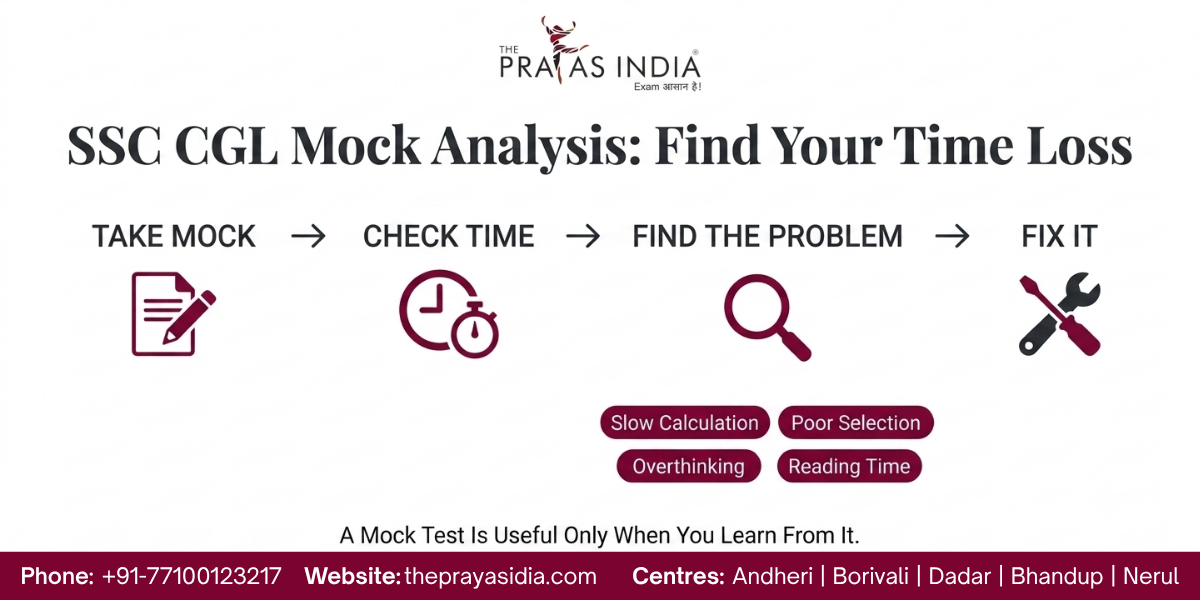
A mock-test score tells you what happened, but it does not automatically tell you why it happened. If you scored below your target, simply taking another mock without analysing the previous one may not solve the problem. You could easily repeat the same timing mistakes in the next test.
After every mock, look beyond your final score. Identify which questions took longer than expected, which questions you should have skipped, which easy questions remained unattempted and where your accuracy dropped. Also compare your actual time spent with the time you had originally intended to spend.
This analysis helps you distinguish between a knowledge problem and a performance problem. If you know the method but take too long, you need speed practice. If you make repeated conceptual mistakes, you need revision. If you know the answer but mark it incorrectly, you need greater execution discipline. If you repeatedly choose lengthy questions, your selection strategy needs attention.
The Bigger Lesson: Finishing the Paper Is a Strategy, Not Just a Speed Problem
If you consistently fail to complete SSC CG L mocks, do not immediately assume that you need to become “faster.” First determine where your time is actually going. A candidate who spends too much time on difficult questions needs better selection. A candidate who takes too long with calculations needs calculation drills. Someone who repeatedly rereads questions needs reading practice, while someone whose attempts collapse under pressure needs more timed sectional and full-length tests.
Once the actual problem is identified, improvement becomes much more manageable. You do not need to transform your entire preparation overnight. Instead, work on the specific habit that is costing you the most time and measure whether the change is improving your mock performance.
That is the foundation of effective SSC CGL time management: do not merely try to solve faster; learn to spend your time better.
Build Speed Through Repeated, Controlled Practice
Speed should be developed gradually rather than forced from the beginning. If you immediately try to solve every question against an extremely tight timer, you may end up sacrificing accuracy and developing rushed habits. A better approach is to first become comfortable with the standard methods used in SSC CGL and then introduce controlled time limits.
For example, if a particular type of Quant question currently takes you two minutes, do not suddenly expect yourself to solve it in 40 seconds. First understand where the extra time is being spent. Perhaps your calculation is slow, perhaps you are writing unnecessary steps or perhaps you are repeatedly reconsidering the method. Once the reason is identified, practise the same question type in small timed sets. Over several sessions, the target should be to reduce solving time without allowing accuracy to fall.
The same principle applies to Reasoning and English. Repeated exposure to familiar question structures gradually reduces the mental effort required to recognise the appropriate approach. The aim is to make common patterns feel familiar enough that you do not have to reinvent the method every time you encounter them.
Use Short Timed Sets Before Full-Length Mocks
A common mistake in SSC CGL preparation is moving directly from normal practice to full-length mock tests. Full mocks are essential, but they should not be the only form of timed practice. Short timed sets can help you isolate specific weaknesses much more effectively.
Suppose your Quant section is consistently taking too long. Instead of simply taking another complete mock, create a short set containing questions from the topics that are causing the delay. Give yourself a realistic but slightly challenging time limit and solve the set. Then analyse the questions immediately. This allows you to understand whether your difficulty comes from calculation, concept selection, question interpretation or hesitation.
Over time, these short exercises build the ability to work under pressure without overwhelming you with the demands of an entire paper. Once your sectional performance becomes more stable, full-length mocks become much more useful because you are testing an already-developed skill rather than discovering basic timing problems for the first time.
Learn to Identify High-Value Questions
Completing an SSC CGL paper is not about giving equal attention to every question. Some questions can be solved quickly and confidently, while others may require significantly more time. The ability to distinguish between the two is one of the most valuable examination skills you can develop.
During practice, start categorising questions according to their solving behaviour. Some are quick-win questions because the concept is familiar and the calculation is manageable. Some are moderate-time questions where you need a few steps but can still reach the answer efficiently. Others are time-consuming questions where the solution requires lengthy calculation, multiple conditions or extensive reasoning.
This classification should eventually become instinctive. When you see a paper, you should be able to recognise which questions deserve immediate attention and which can wait. That does not mean avoiding challenging questions altogether. It means protecting your available time so that difficult questions do not prevent you from collecting easier marks.
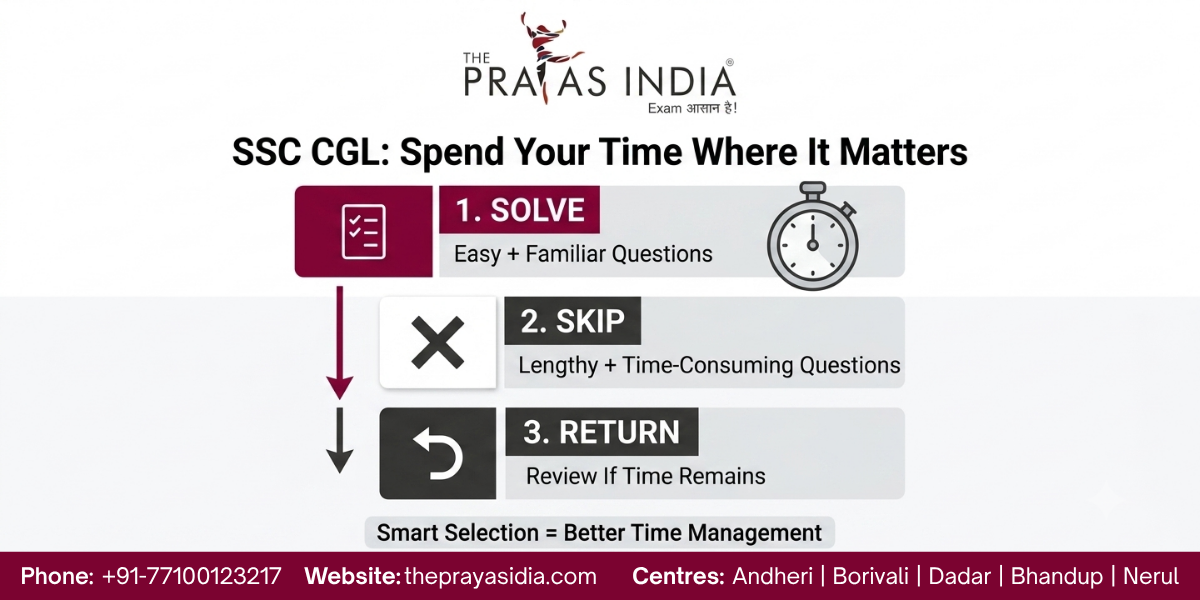
Build a Skip-and-Return Habit
Skipping a question temporarily is not the same as giving up on it. In fact, the ability to leave a question at the right moment can be one of the strongest indicators of mature exam strategy.
Many aspirants hesitate to skip because they fear that they may not get another opportunity to solve the question. However, spending several minutes on a question with no clear progress creates a much greater risk. You may lose the chance to attempt multiple questions that were actually within your ability.
Develop a simple rule during mocks: if you cannot see a clear solving route after a reasonable initial attempt, move ahead. Mark the question mentally or through the test interface and return to it later if sufficient time remains. With practice, this becomes much easier because you stop viewing skipping as failure and start viewing it as time management.
Improve Calculation Efficiency Without Compromising Accuracy
Quantitative Aptitude often determines whether a candidate can maintain a comfortable pace throughout the paper. Even strong conceptual understanding can become ineffective when basic calculations repeatedly consume excessive time.
Regularly practise calculations that appear across multiple SSC CGL topics. Fractions, percentages, ratios, averages, squares, cubes, multiplication and division should gradually become more familiar. You should also learn to recognise when an exact calculation is necessary and when an efficient approximation or alternative method can solve the problem.
However, calculation speed should never be developed at the cost of accuracy. A fast incorrect answer provides no advantage. The real target is efficient and reliable calculation. Your mock analysis should therefore track both the time taken and the accuracy achieved.
Use Your Strongest Section to Build Confidence, Not Complacency
Every aspirant has certain areas in which they perform better. Some candidates are naturally comfortable with English, while others feel more confident in Reasoning or Quant. Your stronger section can be useful for building momentum during preparation, but it should not become an excuse to ignore weaker areas.
A strong section should ideally become your dependable scoring area. This means maintaining its accuracy while gradually improving its speed. At the same time, weaker sections should receive targeted practice so that they stop consuming disproportionate amounts of time.
The objective is not to become equally strong in every topic overnight. It is to create a balanced performance profile in which no individual weakness is capable of destroying your overall attempt strategy.
Track Three Numbers After Every Mock
Instead of looking only at your final score, track three basic indicators after every full-length mock: attempts, accuracy and time utilisation.
Attempts tell you how much of the paper you are reaching. Accuracy tells you whether those attempts are converting into marks. Time utilisation tells you where your available time is being spent. Looking at all three together provides a much clearer picture.
For instance, if your attempts are low but accuracy is high, you may need to improve speed and question selection. If your attempts are high but accuracy is low, rushing may be the problem. If both attempts and accuracy are reasonable but one section consumes excessive time, that section requires targeted practice.
This simple analysis can prevent you from making random changes to your preparation every time your mock score fluctuates.
Don’t Let One Difficult Mock Change Your Entire Strategy
Mock-test scores naturally fluctuate. One paper may contain a question mix that strongly favours your strengths, while another may expose a weakness you have not yet addressed. A single low score should therefore not convince you that your entire preparation strategy is wrong.
Instead, look for patterns across several mocks. If the same issue appears repeatedly, it deserves attention. If Quant timing is consistently poor across five tests, that is meaningful. If one mock suddenly shows a lower score because of an unusually difficult section, it may not require a complete strategy change.
Consistency in analysis is more valuable than emotional reactions to individual scores.
Create a Personal SSC CGL Time-Management System
There is no universal time-management strategy that works identically for every aspirant. A strategy that works for one candidate may be inefficient for another because of differences in speed, accuracy, strengths and preparation level.
Your personal strategy should emerge from your mock-test data. Identify the sections in which you are fastest, the question types that consistently consume time and the areas where your accuracy remains reliable under pressure. Then build an approach around those observations.
For some aspirants, this may mean prioritising their strongest questions first. For others, it may mean spending additional preparation time on calculation speed before attempting more mocks. Some candidates may need to improve their reading efficiency, while others may need to become more comfortable with skipping questions.
The important point is that time management should be personalised rather than copied.
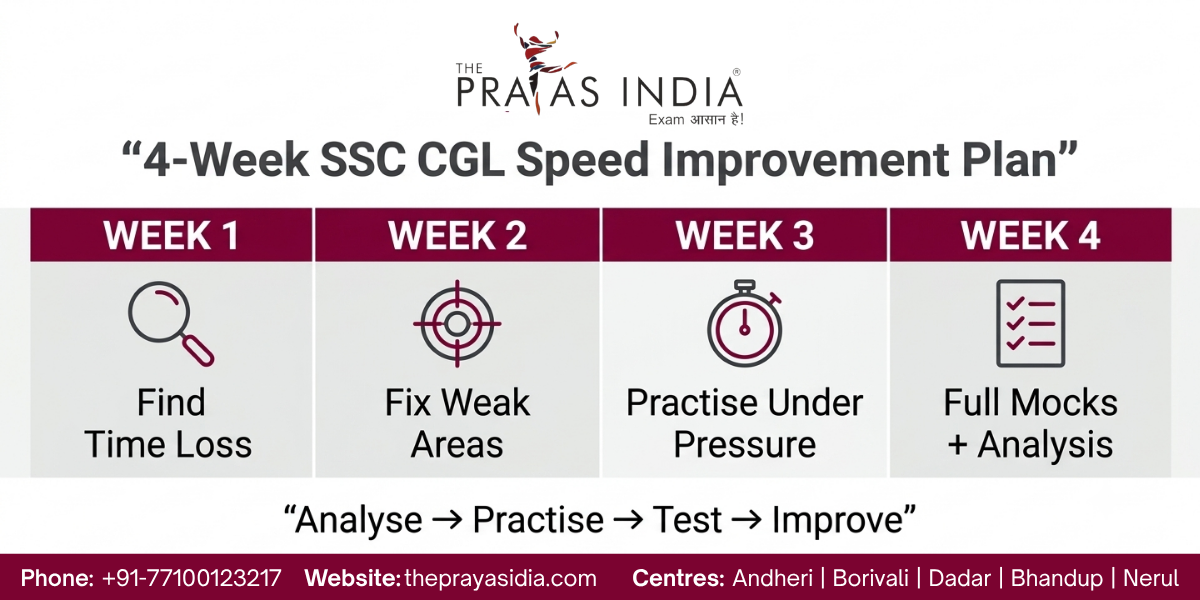
A Practical 4-Week Approach to Improve SSC CGL Speed
If you have a few weeks before an important SSC CGL preparation milestone, you can divide your improvement process into four stages.
Week 1: Identify the Problem
Take full-length or sectional tests and analyse where your time is disappearing. Do not focus only on your score. Record slow question types, calculation delays, unnecessary attempts and questions that should have been skipped.
Week 2: Target the Biggest Time Traps
Practise the specific areas identified during the first week. Use short timed sets for Quant calculations, Reasoning question selection and English reading-based questions. The objective should be controlled improvement rather than maximum attempts.
Week 3: Combine Sections Under Pressure
Introduce more sectional tests and mixed timed sets. Begin practising transitions between different question types and learn to maintain concentration when the clock is moving quickly.
Week 4: Full-Length Mock and Analysis
Take regular full-length mocks under realistic conditions. After every test, identify one or two specific changes for the next mock. Avoid changing your entire strategy after every paper. Improvement comes from repeated testing, analysis and correction.
How Coaching Can Help With SSC CGL Time Management
Time management is one of the areas where structured preparation can make a meaningful difference. When aspirants prepare entirely on their own, they may know that they are slow but struggle to identify the exact reason. They may continue taking more mocks without understanding why their scores remain unchanged.
A structured SSC preparation programme can provide a more systematic process through regular practice, sectional testing, full-length mocks and performance analysis. Guidance can also help candidates identify inefficient approaches and replace them with methods that are more suitable for timed examination conditions.
However, coaching should not be viewed as a substitute for personal practice. The best results come when professional guidance is combined with consistent self-practice, mock analysis and disciplined revision. The role of coaching is to provide direction, structure and feedback, while the aspirant must convert that guidance into performance through regular execution.
For students looking for SSC coaching in Mumbai, evaluating an institute should therefore involve more than checking whether the syllabus is covered. Aspirants should also consider the quality of practice material, mock-test support, faculty guidance, doubt resolution, performance tracking and the overall learning structure.
Final Takeaway
If you are unable to complete the SSC CGL paper on time, the solution is not necessarily to study for more hours. Start by identifying exactly where your time is going. A slow calculation, an unnecessary difficult-question attempt, repeated reading, poor question selection or weak mock analysis can each consume valuable minutes without you noticing.
Once you identify the problem, work on it systematically. Build calculation efficiency, practise timed sets, learn to recognise high-value questions, develop a skip-and-return habit and analyse your mocks beyond the final score. Most importantly, do not confuse rushing with genuine speed.
A successful SSC CGL candidate does not necessarily solve every question faster than everyone else. A successful candidate understands where to spend time, where to save it and when to move on.
That is the real foundation of completing the SSC CGL paper on time—and it is a skill that can be developed through the right combination of strategy, practice, testing and consistent guidance.
Contact Us
📞 Call Now: +91-77100 13217
🌐 Website: theprayasindia.com
📍 Centres: Andheri | Borivali | Dadar | Nerul | Bhandup
Frequently Asked Questions
1. Why am I unable to complete my SSC CGL paper on time?
The problem can result from slow calculations, poor question selection, excessive time spent on difficult questions, slow reading, weak time allocation or insufficient timed practice. Mock-test analysis can help identify the exact reason behind your incomplete attempts.
2. How can I improve my speed for SSC CGL?
Start with accurate solving, then introduce timed topic-wise practice, sectional tests and full-length mocks. Focus particularly on the question types and calculations that repeatedly consume more time than expected.
3. Should I attempt SSC CGL questions in order?
Not necessarily. A better approach is to prioritise questions according to your familiarity, expected solving time and confidence. If a question appears likely to consume excessive time, it can be skipped temporarily and revisited later.
4. How important are mock tests for SSC CGL time management?
Mock tests are extremely useful because they recreate time pressure and reveal how you actually perform under examination conditions. However, the real benefit comes from analysing the mock and correcting specific timing and accuracy problems.
5. How can I reduce time spent on SSC CGL Quant questions?
Regularly practise basic calculations, percentages, fractions, ratios, averages and other frequently used operations. Also learn to recognise efficient methods and avoid unnecessary calculation steps.
6. Is speed more important than accuracy in SSC CGL?
Speed without accuracy is not useful. The objective is to develop controlled speed, where you can increase attempts while maintaining a reliable level of accuracy.
7. Can SSC coaching help improve time management?
Structured coaching can help through planned practice, mock tests, performance analysis and expert feedback. However, consistent personal practice is essential to convert those strategies into actual exam performance.
8. How should I analyse my SSC CGL mock test?
Look beyond the total score. Track attempts, accuracy, time spent by section, questions that took unusually long and questions that should have been skipped. Repeated patterns across multiple mocks are especially useful for identifying weaknesses.