Why Mock Tests Are Essential for Railway Exam Success | Best RRB NTPC Coaching in Mumbai | The Prayas India
Imagine two Railway aspirants preparing for the same RRB NTPC examination.
Both study from the same books.
Both attend classes regularly.
Both spend six to eight hours studying every day.
Yet, when the final Computer-Based Test (CBT) is conducted, one student confidently completes almost every question with excellent accuracy, while the other struggles with time management, panics under pressure, and leaves many questions unanswered.
What creates this difference?
In most cases, it isn’t intelligence.
It isn’t luck.
It’s exam readiness.
And one of the biggest contributors to exam readiness is regular mock test practice.
A mock test is much more than a practice paper.
It recreates the pressure, speed, and decision-making required during the actual Railway examination.
It teaches you how to think under time constraints, prioritize questions, manage stress, and improve your overall exam performance.
Whether you’re preparing for RRB NTPC, RRB Group D, ALP, Technician, Junior Engineer, or other Railway recruitment examinations, mock tests should become a core part of your preparation—not an optional activity.
If you’re aiming to maximize your score and searching for the Best RRB NTPC Coaching in Mumbai, understanding the role of mock tests is one of the smartest steps you can take.
Studying Hard Is Important—But Performing Well in the Exam Is a Different Skill
Many Railway aspirants believe that completing the syllabus automatically guarantees a high score.
Unfortunately, that isn’t always true.
Knowing the answer and answering it correctly within a limited time are two completely different abilities.
For example:
A student may know how to solve a reasoning question in three minutes while studying at home.
However, during the actual CBT examination, spending three minutes on a single question may not be practical.
The student who has regularly practiced mock tests learns to:
- Make quicker decisions.
- Skip difficult questions when necessary.
- Return to manageable questions later.
- Maintain speed without sacrificing accuracy.
- Stay calm under pressure.
This practical exam behavior is difficult to develop through theory alone.
It improves only through repeated exam-like practice.
Think of mock tests the way athletes think about practice matches.
A cricketer doesn’t prepare only by reading cricket books.
A runner doesn’t prepare only by learning running techniques.
Similarly, Railway aspirants shouldn’t prepare only by studying concepts.
They must repeatedly simulate the examination environment.
The Science Behind Mock Tests: Why They Improve Performance
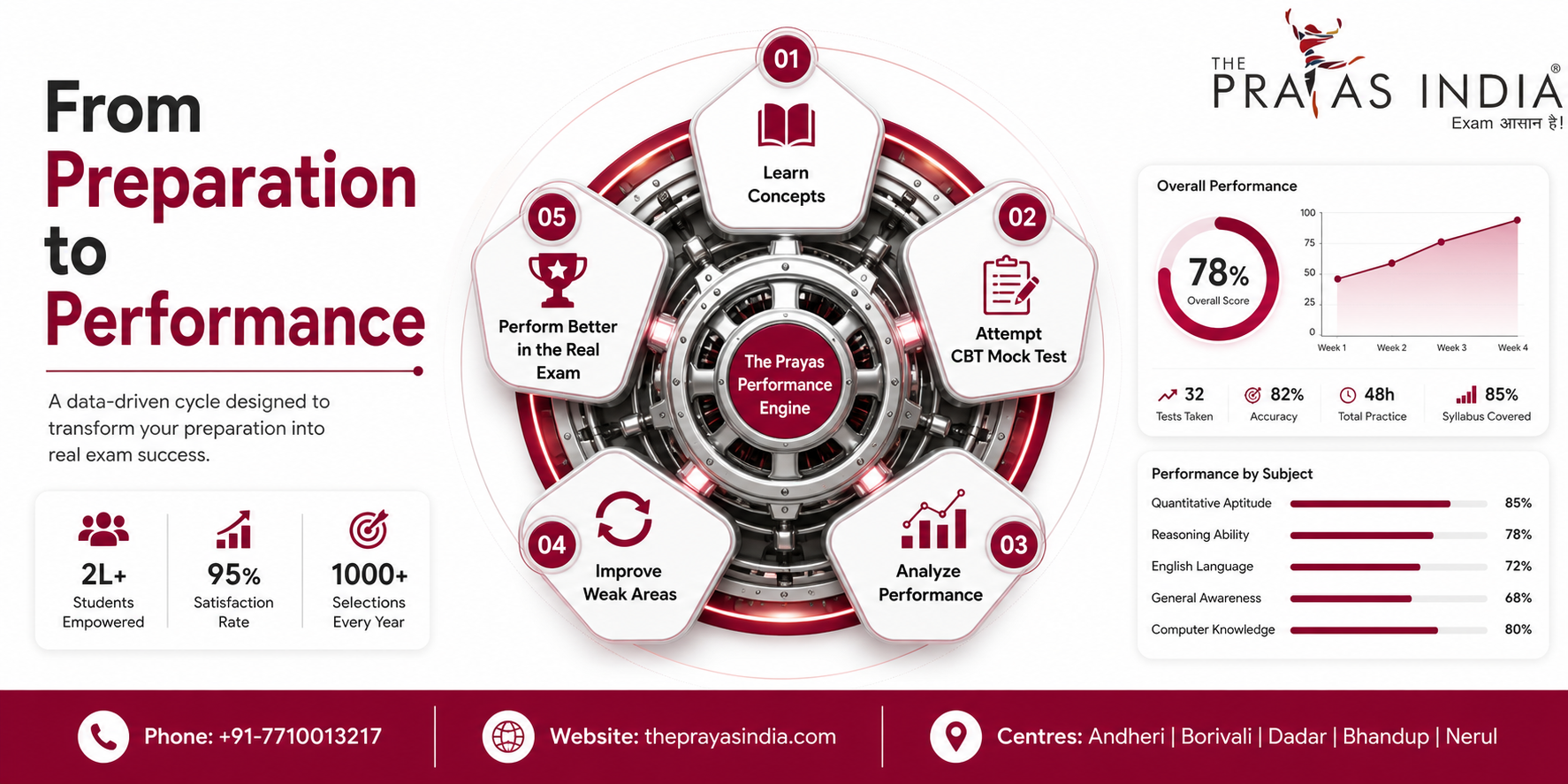
Mock tests don’t just evaluate your preparation—they train your brain.
Every time you attempt a well-designed Railway mock test, your mind becomes more familiar with solving questions under pressure.
This repeated exposure creates several psychological advantages.
1. Better Decision-Making
During a Railway CBT, you don’t have unlimited time.
Your brain must constantly decide:
- Which question should I solve first?
- Which question should I skip?
- Which question deserves another attempt?
Students who regularly attempt mock tests naturally become better decision-makers.
2. Reduced Exam Anxiety
Fear often comes from uncertainty.
Students attempting their first full-length CBT on the actual exam day usually experience:
- Nervousness
- Panic
- Confusion
- Poor concentration
Mock tests reduce this fear because the examination environment becomes familiar.
By exam day, students already know what to expect.
3. Faster Information Recall
Mock tests repeatedly activate concepts stored in long-term memory.
As a result, students retrieve formulas, reasoning techniques, and shortcuts much faster during the examination.
4. Better Time Awareness
Many aspirants never realize where their time is being wasted.
Mock tests provide that awareness.
Students begin noticing patterns like:
- Spending too much time on Quantitative Aptitude.
- Rushing through General Awareness.
- Overthinking easy Reasoning questions.
Once identified, these habits become easier to improve.
5. Improved Confidence
Confidence isn’t built through motivation alone.
It grows from repeated successful practice.
Every well-analyzed mock test makes students more comfortable with the examination pattern.
Instead of worrying about the unknown, they enter the exam hall with confidence earned through preparation.
Why Railway CBT Mock Tests Are Different from Ordinary Practice
Solving individual questions and attempting a full Computer-Based Test are completely different experiences.
When practicing topic-wise questions, students know exactly which subject they’re solving.
The brain stays focused on a single type of problem.
However, during an actual Railway CBT, questions appear in mixed order.
You continuously switch between:
- Quantitative Aptitude
- General Intelligence & Reasoning
- General Awareness
- English or General Science (depending on the examination)
This constant transition demands mental flexibility.
Railway CBT mock tests prepare students for exactly this situation.
They teach aspirants to shift focus quickly without losing concentration or speed.
This is one of the biggest reasons why students preparing at a Top RRB NTPC Coaching in Mumbai spend significant time on full-length CBT simulations instead of solving only chapter-wise questions.
It’s Not About Taking More Mock Tests—It’s About Learning from Them
Some students proudly say they’ve attempted 100 mock tests.
Others attempt only 25 or 30, yet achieve much better scores.
Why?
Because improvement doesn’t come from the number of mock tests.
It comes from how seriously you analyze each one.
Every mock test should answer questions like:
- Which section consumed the most time?
- Which questions were answered incorrectly due to concept errors?
- Which mistakes happened because of carelessness?
- Which topics require additional revision?
- Which shortcut techniques saved valuable time?
Students who treat every mock test as a learning opportunity improve continuously throughout their preparation.
Instead of repeating mistakes, they gradually eliminate them—bringing them closer to success in the final Railway examination.
5 Ways Mock Tests Transform Your Railway Preparation
Many aspirants think mock tests are meant only to evaluate preparation. In reality, they transform the way you prepare.
They don’t just tell you where you stand—they help you become a better test-taker.
Let’s understand how.
1. They Help You Build Exam Temperament
Success in Railway examinations isn’t determined only by knowledge.
It also depends on how you perform when the clock is ticking.
Imagine sitting in front of the computer screen on exam day.
The timer starts.
Questions begin appearing.
Every second counts.
Students who have attempted dozens of CBT mock tests remain calm because the environment feels familiar.
Those attempting a CBT for the first time often spend the first 10–15 minutes simply adjusting to the pressure.
Mock tests eliminate that adjustment period.
Instead of reacting emotionally, your brain begins functioning systematically.
You become comfortable making quick decisions under pressure—one of the most important qualities required to crack Railway examinations.
2. They Reveal the Difference Between “Knowing” and “Scoring”
Many aspirants believe they are well prepared because they can solve questions while studying.
But mock tests expose a different reality.
For example:
You may know all the formulas of Percentage and Profit & Loss.
Yet during a timed CBT, you might:
- Read questions too quickly.
- Miss important data.
- Make calculation errors.
- Spend excessive time on one problem.
Without mock tests, these weaknesses often remain hidden until the actual examination.
Regular testing bridges the gap between theoretical knowledge and practical performance.
This is why experienced mentors at the Best RRB NTPC Coaching in Mumbai encourage students to start mock tests long before completing the entire syllabus.
3. Mock Tests Teach You Time Allocation
Every Railway examination has limited time.
One of the biggest mistakes students make is giving equal attention to every question.
Top performers don’t do that.
Instead, they divide the paper intelligently.
For example:
- Easy questions → Solve immediately.
- Moderate questions → Solve after finishing easier ones.
- Time-consuming questions → Attempt only if time permits.
This strategic thinking develops naturally through repeated mock test practice.
Eventually, students stop asking,
“Can I solve this question?”
and begin asking,
“Should I solve this question right now?”
That small shift often improves overall scores significantly.
4. They Improve Accuracy Along With Speed
Many students focus only on attempting more questions.
However, attempting more questions isn’t useful if accuracy is poor.
Suppose:
Student A attempts 100 questions with 72% accuracy.
Student B attempts 88 questions with 95% accuracy.
Depending on the marking scheme, Student B may achieve a much better score.
Mock tests help students find the right balance between:
- Speed
- Accuracy
- Risk-taking
- Question selection
Over time, students become smarter—not just faster.
5. Every Mock Test Becomes a Personalized Teacher
One of the greatest advantages of mock tests is that they provide feedback specific to your preparation.
No two students receive the same learning experience.
For one aspirant, the mock test may reveal weak reasoning skills.
For another, the biggest challenge may be General Awareness.
Someone else may struggle with time management.
Each test creates a customized improvement roadmap.
This is why students who consistently analyze their performance improve much faster than those who simply keep solving new questions.
How to Analyze a Mock Test Like a Top Ranker
Attempting a mock test is only half the process.
The real improvement begins after you click the “Submit” button.
Many aspirants immediately check their score and move on to the next test.
Top rankers do the opposite.
They spend more time analyzing the test than attempting it.
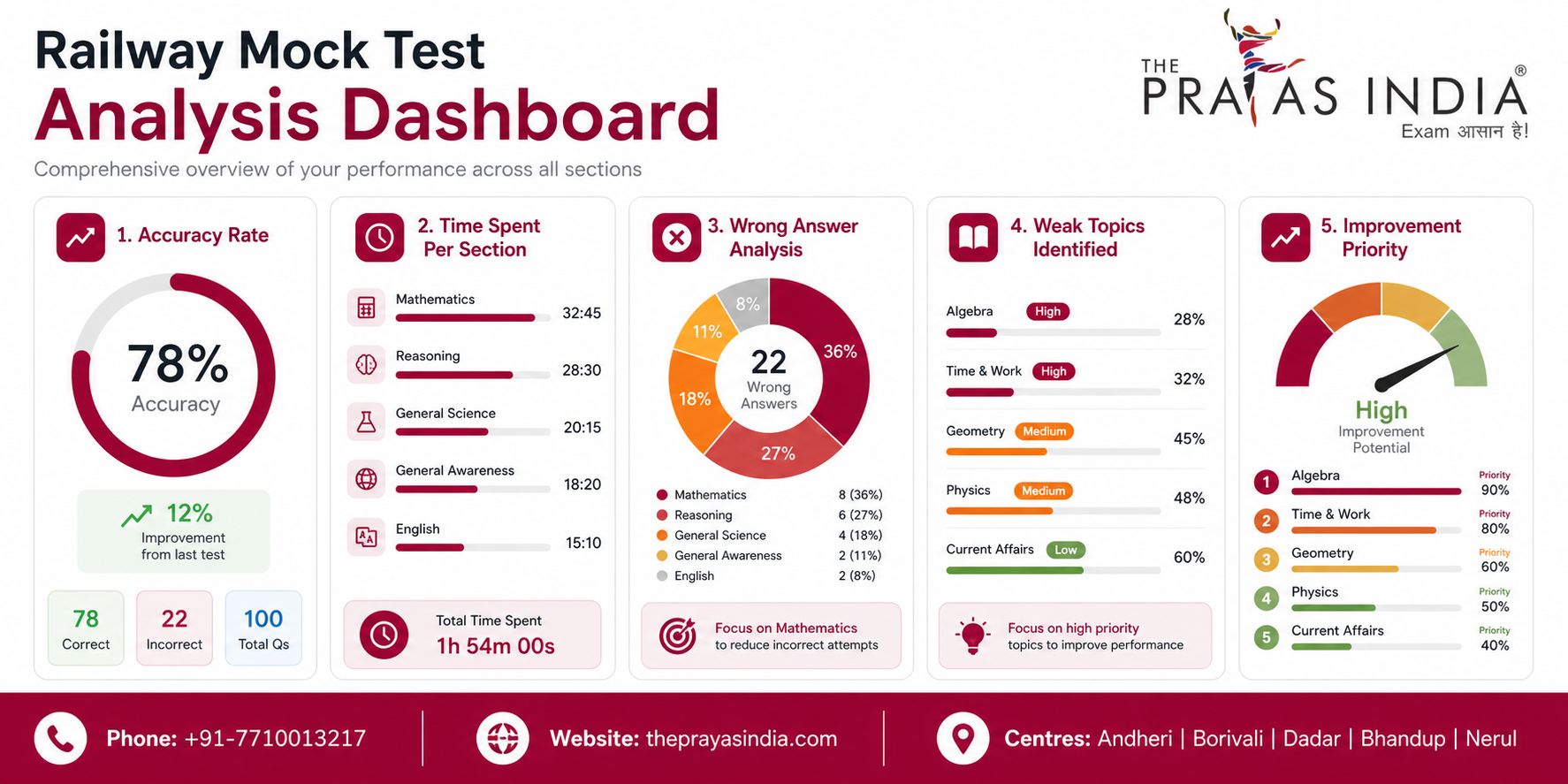
Here’s a practical post-mock analysis framework you can follow.
Step 1: Divide Mistakes into Categories
Don’t treat every incorrect answer the same.
Classify them as:
- Conceptual mistakes
- Calculation mistakes
- Careless errors
- Guesswork
- Time-pressure mistakes
Once you identify the pattern, solving the problem becomes much easier.
Step 2: Identify Weak Topics
If multiple questions from the same chapter are answered incorrectly, that’s a clear signal that the topic requires revision.
Maintain a separate notebook titled:
“Topics I Need to Improve.”
Review it every week.
Step 3: Review Questions You Skipped
Sometimes, the biggest learning doesn’t come from wrong answers.
It comes from unanswered questions.
Ask yourself:
- Why didn’t I attempt this?
- Didn’t I know the concept?
- Was I afraid of negative marking?
- Did I run out of time?
These answers reveal important insights.
Step 4: Measure Section-Wise Performance
Instead of looking only at the overall score, compare each section individually.
For example:
| Section | Questions Attempted | Accuracy |
|---|---|---|
| Quantitative Aptitude | 24 | 83% |
| Reasoning | 31 | 94% |
| General Awareness | 18 | 72% |
| English | 26 | 92% |
This helps you identify exactly where improvement is needed.
Step 5: Create an Action Plan
Every mock test should end with a simple action plan.
Example:
- Revise Number System tomorrow.
- Practice Seating Arrangement for one hour.
- Solve two General Awareness quizzes.
- Attempt another mini mock after revision.
Without an action plan, mistakes tend to repeat.
Common Mock Test Mistakes Railway Aspirants Make
Even sincere students unknowingly reduce the effectiveness of mock tests.
Avoid these common mistakes.
❌ Giving Mock Tests Without Revision
Mock tests should evaluate preparation—not replace it.
Always revise important topics before attempting a full-length test.
❌ Ignoring Performance Reports
Your score alone doesn’t tell the complete story.
Performance reports reveal patterns that can significantly improve your preparation.
❌ Attempting Random Mock Tests
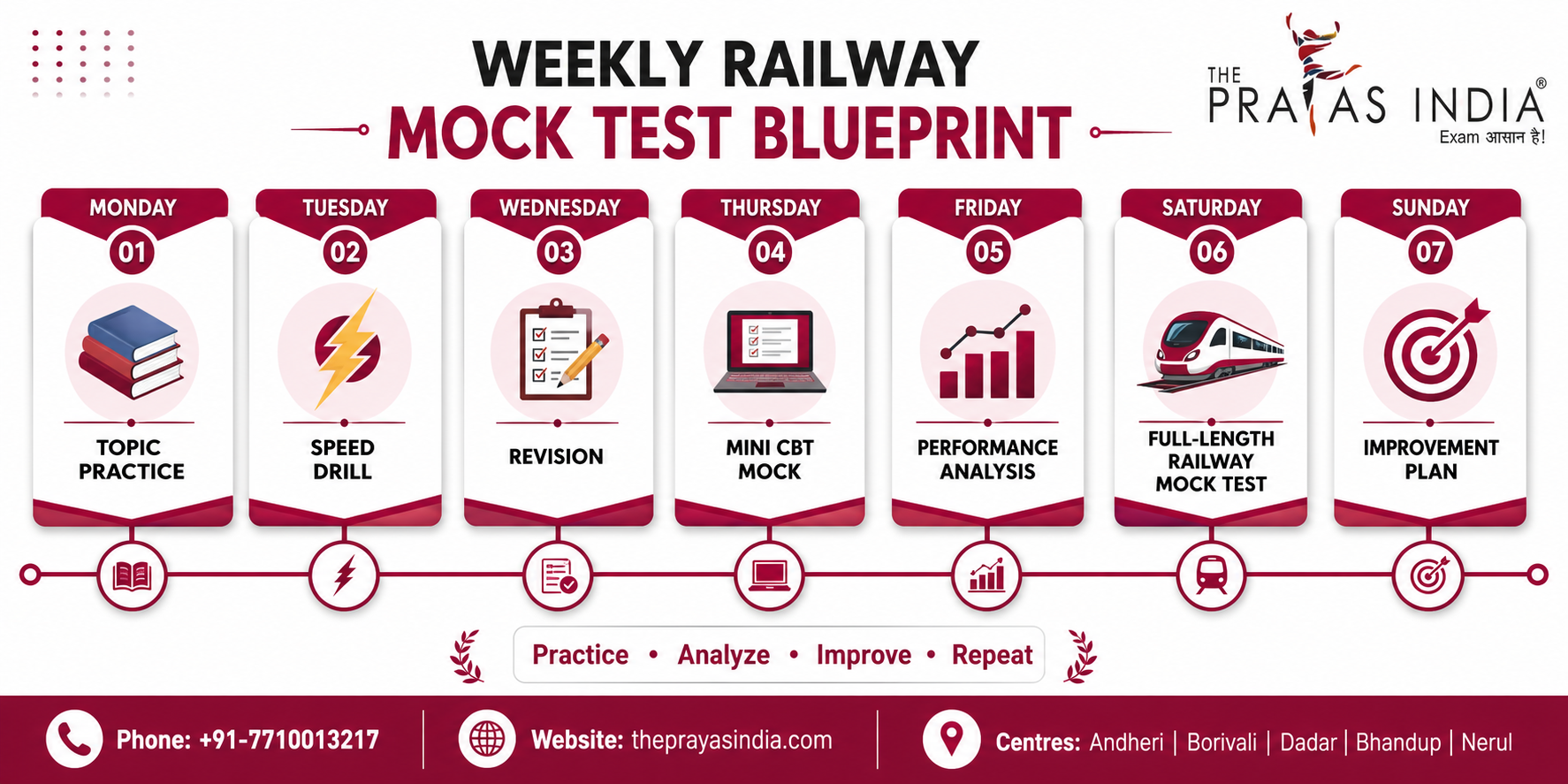
Follow a structured sequence.
Start with sectional tests.
Then move to mini mocks.
Finally, attempt full-length CBT simulations.
❌ Comparing Scores With Others
Every student’s preparation journey is different.
Instead of comparing yourself with others, compare today’s performance with your previous mock.
That’s the comparison that truly matters.
❌ Focusing Only on Marks
A score is just a number.
The real value lies in understanding why you achieved that score.
Learning from mistakes is far more important than celebrating a high mark.
How The Prayas India Makes Mock Tests More Effective
At The Prayas India, mock tests are not treated as standalone assessments.
They are integrated into the entire preparation process.
Every test is designed to help students improve continuously—not just measure performance.
Our approach includes:
CBT-Based Practice
Students experience an exam environment that closely resembles the actual Railway Computer-Based Test.
Detailed Performance Analytics
Every mock test is followed by comprehensive reports highlighting strengths, weak areas, speed, and accuracy.
Faculty Feedback
Students receive guidance from experienced faculty on how to improve their performance instead of simply viewing their scores.
Personalized Improvement Plans
Based on mock test performance, mentors recommend targeted revision strategies and practice schedules.
Continuous Progress Tracking
Regular testing allows students to monitor improvement over time and stay motivated throughout their preparation journey.
This structured approach has helped many Railway aspirants prepare with greater confidence and consistency while pursuing their dream of a government career.
Mock Tests Don’t Predict Success—They Build It
A common misconception among Railway aspirants is that mock tests are only meant to check scores.
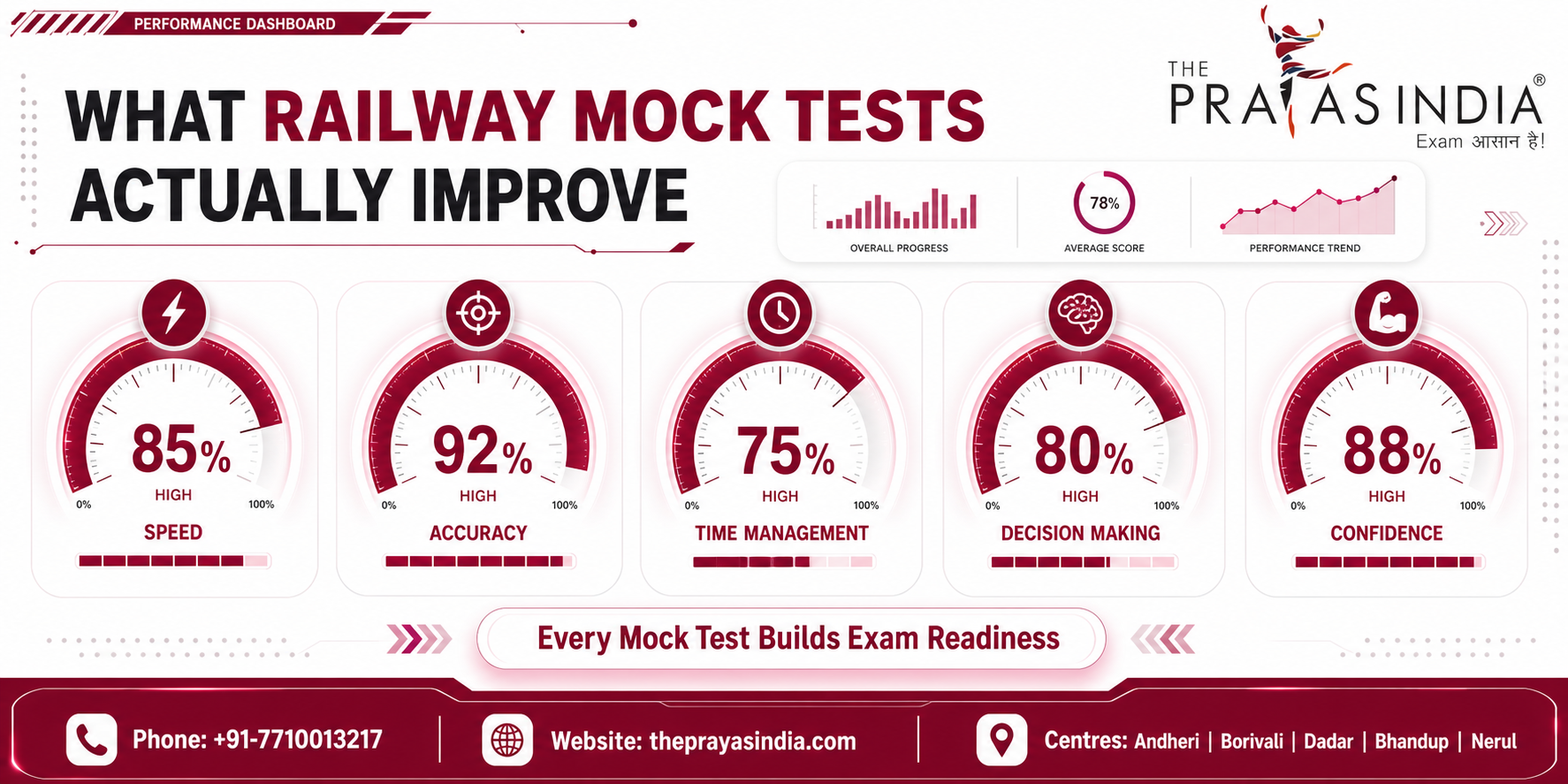
In reality, mock tests shape your decision-making, improve your confidence, sharpen your time management, and gradually prepare you for the pressure of the actual Computer-Based Test.
When approached with the right mindset, every mock test becomes another step toward exam success—not just another practice paper.
Conclusion
Every year, thousands of Railway aspirants complete the syllabus, solve hundreds of practice questions, and dedicate months to preparation. Yet, only a small percentage are able to convert their hard work into success on the actual exam day.
The difference often lies in how they prepare, not just how much they study.
Mock tests bridge the gap between learning concepts and applying them under real exam conditions. They help you manage time effectively, improve accuracy, build confidence, identify weak areas, and develop the decision-making skills required in a Computer-Based Test (CBT).
Remember, mock tests are not designed to discourage you with low scores—they are designed to reveal what needs improvement while there is still time to fix it. Every mistake made during a mock test is an opportunity to avoid the same mistake in the actual Railway examination.
If you’re serious about cracking RRB NTPC, RRB Group D, ALP, Technician, or other Railway recruitment exams, make mock tests an essential part of your weekly preparation strategy instead of treating them as an occasional activity.
For students searching for the Best RRB NTPC Coaching in Mumbai, choosing an institute that emphasizes regular CBT mock tests, detailed performance analysis, personalized mentorship, and structured guidance can make a significant difference in overall preparation.
At The Prayas India, we believe that success is built through continuous practice, smart analysis, and consistent improvement. Our Railway preparation programs combine expert faculty, updated study material, CBT-based mock tests, performance tracking, and personalized mentorship to help students prepare with confidence and maximize their potential.
Your Railway dream deserves more than hard work—it deserves smart preparation.
Frequently Asked Questions (FAQs)
1. Why are mock tests important for Railway exam preparation?
Mock tests simulate the actual Railway CBT environment, helping aspirants improve speed, accuracy, time management, confidence, and exam strategy before the real examination.
2. When should I start attempting Railway mock tests?
You don't have to wait until the syllabus is complete. Start with sectional mock tests after finishing individual topics, then gradually move to full-length CBT mock tests.
3. How many mock tests should I attempt before the Railway exam?
There is no fixed number. Instead of focusing only on quantity, aim to attempt quality mock tests regularly and analyze each one thoroughly. Consistent improvement matters more than the total number of tests.
4. Should I analyze every mock test after attempting it?
Yes. Analysis is the most valuable part of a mock test. Reviewing mistakes, weak topics, time spent, and question selection helps you improve far more than simply checking your score.
5. Can mock tests improve my speed and accuracy?
Absolutely. Regular mock tests train you to solve questions faster while maintaining accuracy, helping you perform better under exam pressure.
6. Are CBT mock tests better than topic-wise practice?
Both are important. Topic-wise practice builds concepts, while CBT mock tests teach you how to apply those concepts effectively in a real exam environment.
7. How does The Prayas India help Railway aspirants through mock tests?
The Prayas India provides CBT-based mock tests, detailed performance analysis, expert faculty guidance, personalized mentorship, and structured improvement plans to help students prepare more effectively.
8. Which Railway exams can I prepare for at The Prayas India?
Students can prepare for RRB NTPC, RRB Group D, ALP, Technician, Junior Engineer (JE), and other major Railway recruitment examinations.
9. What should I do if I score low in my Railway mock tests?
Don't get discouraged. Identify your weak areas, revise those topics, analyze your mistakes, and continue practicing consistently. Mock tests are meant to improve your preparation—not judge your potential.
10. How can I improve my Railway mock test performance?
Follow a structured study plan, revise regularly, attempt mock tests consistently, analyze every test in detail, and focus on improving one weakness at a time.
Final Thoughts
Every Railway examination is a race against both time and competition. While books teach you concepts, mock tests teach you how to use those concepts efficiently under pressure.
Treat every mock test as a rehearsal for the real exam. Analyze your mistakes honestly, refine your strategy, and focus on continuous improvement. Over time, these small improvements compound into higher scores and greater confidence.
At The Prayas India, we encourage every Railway aspirant to prepare beyond the syllabus. With expert guidance, structured CBT mock tests, regular performance analysis, and personalized mentorship, you can develop the skills needed to perform at your best when it matters the most.
Success in Railway exams isn’t built on a single day of preparation—it’s built through consistent practice, smart analysis, and the confidence that comes from being truly exam-ready.
Admissions Open
📞 Call Now: +91-77100 13217