Why Structured CAT Preparation Can Improve Your Percentile | Best CAT Coaching in Mumbai | The Prayas India
The Common Admission Test is often described as a test of aptitude, but that description can make the preparation process sound simpler than it actually is. CAT tests concepts, but it also tests decision-making, time management, question selection, adaptability and the ability to perform consistently under pressure. Two candidates may have similar academic ability and still end up with very different percentiles because their preparation systems are different.
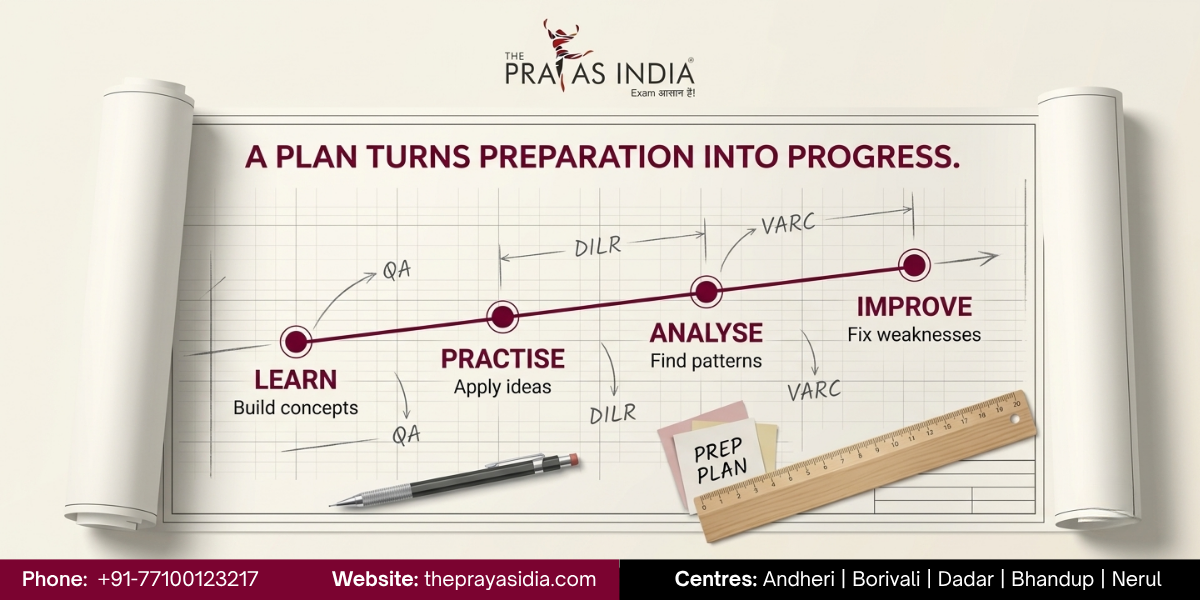
This is where structured CAT preparation can make a meaningful difference. A structured approach does not mean studying for a fixed number of hours every day or following a rigid timetable without considering individual strengths. It means having a clear sequence for learning concepts, practising questions, analysing performance, revising weak areas and gradually adapting to the demands of the actual examination.
For an aspirant targeting competitive MBA programmes, this distinction matters. CAT is not simply about completing the syllabus. It is about converting preparation into a score that can compete effectively for interview calls from leading business schools. That requires an approach in which every stage of preparation has a specific purpose.
CAT Preparation Is More Than Completing the Syllabus
One of the earliest mistakes CAT aspirants make is measuring progress by the number of chapters completed. Finishing Arithmetic, Algebra, Geometry, Reading Comprehension or Logical Reasoning may create a sense of progress, but syllabus completion by itself does not indicate examination readiness.
CAT questions can test familiar concepts in unfamiliar combinations. A candidate may know how to solve a particular type of question during practice but struggle to recognise the same underlying concept when it appears in a different form. Similarly, someone may perform well in untimed practice but lose accuracy when several questions compete for attention within a limited sectional time.
A structured preparation system therefore treats syllabus completion as only one milestone. Progress should also be measured through:
- Conceptual clarity across important topics.
- Accuracy in untimed and timed practice.
- Ability to recognise question types quickly.
- Improvement in sectional performance.
- Quality of mock-test analysis.
- Reduction in recurring mistakes.
- Ability to make better attempt-versus-skip decisions.
This creates a much more realistic picture of CAT readiness. Instead of asking, “How much of the syllabus have I finished?”, an aspirant begins asking, “How effectively can I apply what I have studied?”
The First Advantage: Knowing What to Study and When
CAT preparation becomes inefficient when aspirants move randomly between topics based on mood, difficulty or whatever material they happen to find online that day. One evening may be spent on percentages, the next on a difficult Algebra problem, followed by a few Reading Comprehension passages and then an unrelated Logical Reasoning set.
Variety is useful, but randomness is not a strategy.
A structured programme provides a logical progression. Foundational concepts are introduced before advanced applications, connected topics can be studied together, and sufficient practice is built into the learning process before the candidate moves towards more complex mixed sets.
For example, in Quantitative Aptitude, Arithmetic can provide an important base for topics such as Percentage, Ratio, Average, Profit and Loss, Time and Work and Time-Speed-Distance. Algebra may then require a different style of thinking involving equations, inequalities and functions. Treating these areas as isolated chapters can make preparation feel fragmented, whereas a planned sequence helps candidates understand how different concepts relate to one another.
The same principle applies to DILR and VARC. Reading practice should gradually develop into timed passage selection and comprehension strategy. DILR preparation should move from understanding individual set structures towards identifying which sets are worth attempting under sectional pressure.
The objective is to make preparation cumulative rather than repetitive.
CAT Rewards Decision-Making, Not Just Knowledge
A candidate who knows more mathematics is not automatically guaranteed a higher CAT percentile. Similarly, reading more articles does not automatically translate into a strong VARC score. The examination rewards candidates who can make good decisions with limited time.
Consider a Quantitative Aptitude section containing several questions. You may know how to solve eight of them, but if you spend too much time on the first two difficult questions, you may not reach the easier questions later. In another situation, you may identify the right method but make an avoidable calculation error because you rushed.
The same issue appears in DILR. The ability to solve a set is useful, but the ability to decide which set to solve first can be equally important. In VARC, reading every passage with equal intensity may not be the best use of sectional time if some passages are significantly more difficult or time-consuming.
This is why structured CAT preparation should include decision-making practice, not just question-solving practice.
Over time, candidates should develop the ability to ask:
- Is this question worth attempting now?
- Can I identify the method quickly?
- How much time is reasonable for this question?
- Am I continuing because the question is solvable or because I have already invested time in it?
- Should I move on and return later?
These decisions can have a direct impact on how effectively a candidate converts knowledge into marks.
Build Quantitative Aptitude Around Concepts, Not Shortcuts
Quantitative Aptitude is often approached through shortcuts, especially when candidates become anxious about CAT’s time pressure. Short methods can certainly be useful, but they should come after conceptual understanding rather than replacing it.
A candidate who memorises a shortcut without understanding its underlying logic may be able to solve familiar questions quickly but become uncomfortable when the question is modified. CAT can reward flexibility, so the ability to understand relationships is more valuable than memorising a large collection of tricks.
A strong Quant preparation cycle should move through three stages:
Understand → Apply → Optimise
First, understand the concept and the relationships behind it. Next, apply it to different question types. Finally, identify whether a shorter or cleaner method can improve efficiency without reducing accuracy.
This approach also helps candidates become less dependent on one particular solving method. If a conventional approach is lengthy, conceptual understanding makes it easier to discover an alternative route.
DILR Requires a Different Kind of Structured Practice
Data Interpretation and Logical Reasoning can be particularly unpredictable because the challenge is not always the individual calculation. Often, the real difficulty lies in understanding the structure of the set and identifying the information that matters.
This makes random DILR practice less effective than progressive exposure to different set structures. Candidates should encounter arrangements, tables, charts, games, selections, distributions, scheduling problems and other logical frameworks while gradually learning to identify the entry point into each set.
A structured DILR programme should therefore focus on both set-solving ability and set-selection ability.
During practice, candidates should analyse not only whether they solved a set but also why they chose it. A set that took 25 minutes may have been technically solvable, but it may still have been a poor examination choice. Similarly, abandoning a set after two minutes may be a mistake if the candidate was actually close to finding the key relationship.
This kind of analysis cannot be developed simply by counting the number of DILR sets solved. It requires reflection on the process.
VARC Preparation Needs Consistency More Than Occasional Intensity
VARC often creates a different problem. Candidates may prepare intensely for a few days, read extensively, solve several passages and then stop practising for a week. This makes it difficult to develop the consistency required for reading-heavy sections.
Reading comprehension is not simply about reading faster. It involves understanding the author’s argument, identifying the central idea, distinguishing between strong and weak inferences, recognising tone and eliminating options that are attractive but unsupported by the passage.
A structured VARC routine should therefore include regular exposure to different writing styles and question types. The candidate should gradually develop the ability to read with purpose rather than simply reading more.
A practical routine can include:
- Regular Reading Comprehension practice.
- Editorial and analytical reading.
- Para-based questions.
- Summary and inference practice.
- Option-elimination analysis.
- Review of incorrect questions.
- Timed sectional practice as preparation progresses.
The most important element is consistency. Reading for three hours once a week is unlikely to be as useful as maintaining a focused reading and practice habit throughout the preparation period.
Structured Preparation Helps Identify Weaknesses Earlier
Self-study can work extremely well for disciplined candidates, but one of its biggest challenges is delayed feedback. An aspirant may spend weeks solving questions without realising that a particular weakness is affecting performance repeatedly.
A structured system introduces checkpoints. After completing a topic, the candidate can test it. After a group of topics, performance can be compared. After a mock, mistakes can be categorised. This creates a continuous feedback mechanism.
The earlier a weakness is identified, the easier it is to correct. If an aspirant discovers only near the end of preparation that Algebra is significantly weaker than expected, there may not be enough time to rebuild the foundation comfortably. If the same weakness is identified months earlier, it can be addressed gradually.
This is one reason performance tracking should be treated as part of CAT preparation rather than as something that begins only after the syllabus is completed.
Mock Tests Should Be Used as Diagnostic Tools
Mock tests are often reduced to one number: percentile. That number is useful, but it does not tell the entire story. A mock is much more valuable when it explains why the score was what it was.
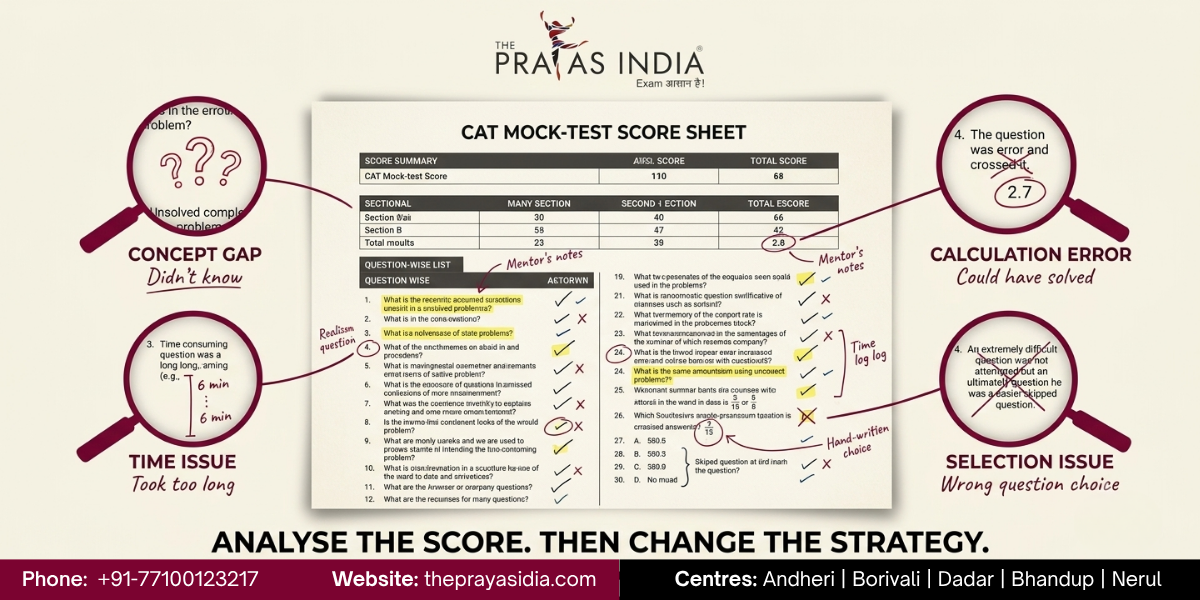
Suppose your Quant score falls. The next question should not simply be, “How do I increase my score?” Instead, determine whether the problem came from weak concepts, poor selection, calculation errors, excessive time on difficult questions or incorrect attempts caused by rushing.
Similarly, a low DILR score may not mean that you cannot solve DILR sets. It may indicate that you selected an inefficient set combination. A weak VARC score could result from poor passage selection or repeated errors in inference questions rather than a general reading problem.
A useful mock-analysis framework can divide questions into:
- Correct and efficient: Maintain the approach.
- Correct but slow: Find a more efficient method.
- Incorrect but solvable: Identify the exact mistake.
- Incorrect due to guessing: Improve selection discipline.
- Unattempted but manageable: Work on confidence and recognition.
- Unattempted and difficult: Understand whether it was worth attempting.
This turns mock tests into learning instruments rather than score-report events.
Structured CAT Preparation Is About Building the Right Habits
A preparation plan becomes effective when it changes how the candidate approaches questions. Over time, structured practice should make certain behaviours automatic: reading the question carefully, identifying the underlying concept, estimating the likely effort, selecting the appropriate method and moving on when the return on time is poor.
These habits are particularly important because CAT does not reward effort directly. Spending more time on a question does not guarantee more marks. Reading more material does not guarantee better comprehension. Solving more questions does not guarantee a higher percentile unless the quality of preparation improves alongside the quantity.
A structured programme therefore needs to balance coverage, depth and performance.
Candidates should aim to:
- Cover the important concepts systematically.
- Practise different levels of questions.
- Maintain an error log.
- Revisit weak areas at planned intervals.
- Take sectional tests regularly.
- Introduce full-length mocks progressively.
- Analyse performance instead of chasing mock scores.
- Adapt the strategy based on evidence.
This creates a preparation cycle that becomes increasingly personalised as the examination approaches.
Why the Final Months Should Look Different From the First Months
CAT preparation should evolve. The strategy that works when you are learning concepts for the first time cannot remain unchanged during the final phase.
In the initial months, learning should receive greater emphasis. Candidates need time to understand concepts, explore question types and build basic confidence. As the syllabus develops, practice should become more mixed and increasingly timed. Later, mock tests and detailed analysis should take a larger share of preparation time.
This progression prevents a common problem: taking full-length mocks too early and becoming discouraged by low scores without having developed the conceptual base required to perform well.
The preparation journey can broadly move through:
Foundation → Application → Timed Practice → Mock Analysis → Exam Strategy
Each stage has a different purpose, and moving through them in the right sequence can make preparation more productive.
A Structured Approach Can Also Make Self-Study More Efficient
Structured preparation does not necessarily mean that every candidate must follow the exact same timetable. Even self-study can be structured effectively when the candidate establishes clear weekly objectives and performance checkpoints.
For example, instead of setting a vague target such as “study Quant this week”, define a measurable objective: complete selected Arithmetic concepts, solve a specific number of quality questions, take a timed sectional test and analyse every error. This makes the preparation process observable.
The same principle applies to VARC and DILR. Rather than simply deciding to “read more” or “solve more sets”, track the quality of the practice and whether performance is improving.
The advantage of coaching is that much of this structure can be provided through a planned curriculum, classroom sequencing, study material, tests and mentoring. For candidates who struggle with consistency or are unsure how to organise the enormous amount of CAT preparation material available online, a guided environment can reduce the time spent deciding what to study next.
Choosing the Right CAT Preparation Environment
For an aspirant targeting a competitive CAT percentile, choosing a coaching institute should be based on more than location or promotional claims. The preparation environment should support the complete journey—from concept building to mock-test analysis and final examination strategy.
For students looking for CAT coaching in Mumbai, The Prayas India provides a structured preparation environment designed to help aspirants approach the examination systematically. The purpose of coaching is not to replace individual effort. It is to make that effort more focused by providing a framework for learning, practice, testing and improvement.
A strong preparation environment can be particularly valuable when an aspirant reaches the stage where the question is no longer “What should I study?” but “Why is my performance not improving despite studying?”
That is where analysis, mentoring and a disciplined preparation system become increasingly important.
The Goal Is Not Just to Prepare for CAT—It Is to Prepare for Your Target Percentile
Every CAT aspirant has a different academic background, preparation timeline and target. A candidate aiming for a very competitive percentile may need a different level of consistency and mock-test discipline from someone approaching CAT primarily as an experience-building attempt.
This makes personalised performance analysis important. The goal should not be to copy another aspirant’s study schedule. Instead, use a structured framework and adapt it according to your performance.
If Arithmetic is already strong, your preparation time may be better invested in another weak area. If VARC accuracy is good but time management is poor, additional untimed reading may not be the best solution. If DILR scores fluctuate dramatically between mocks, set selection and consistency may need more attention than simply solving more sets.
A structured approach provides the framework. Your performance data determines how that framework should be adjusted.
Key Takeaway
CAT preparation becomes more effective when it is treated as a process rather than a collection of study sessions. The examination demands much more than conceptual knowledge. It requires the ability to apply concepts under pressure, select questions intelligently, manage sectional time, learn from mistakes and adapt your strategy based on performance.
Structured preparation can bring these elements together. It gives candidates a sequence to follow, checkpoints to measure progress and a system through which weaknesses can be identified before they become major problems.
The most productive CAT preparation cycle is therefore:
Learn the concept → Practise different applications → Test yourself → Analyse the result → Fix the weakness → Test again.
For aspirants preparing for CAT in Mumbai, choosing a structured coaching environment can make this process more organised and accountable. If your goal is not simply to appear for CAT but to compete for a strong percentile and move towards leading MBA opportunities, the quality of your preparation system deserves as much attention as the number of hours you study.
A Structured Approach Helps You Identify Weaknesses Earlier
One of the biggest advantages of structured CAT preparation is that it makes weaknesses visible before they become serious problems. In an unplanned preparation cycle, a student may spend several weeks solving questions without knowing whether the actual issue is conceptual understanding, calculation accuracy, reading speed, question selection, or time management. The number of questions solved may increase, but the underlying problem can remain untouched.
A structured preparation plan creates regular checkpoints. After completing a topic, the student should know whether the concepts are clear, whether standard question types can be solved independently, and whether the topic can be handled within a reasonable amount of time. Once sectional tests and mock tests are introduced, this evaluation becomes more realistic because performance is measured under exam-like conditions.
This is particularly important for CAT because percentile is determined by relative performance. Improving one weak area can sometimes have a greater impact than spending additional hours strengthening a section that is already performing well. A structured plan therefore allows aspirants to allocate preparation time according to actual performance rather than personal comfort.
The process can be kept relatively simple:
- Identify the topic or skill causing difficulty.
- Determine whether the problem is conceptual, procedural or time-related.
- Practise targeted questions rather than random questions.
- Re-test the same skill after a short revision cycle.
- Track whether accuracy and solving efficiency improve.
This creates a preparation loop in which every test or practice session contributes to the next stage of preparation.
Mock Tests Should Be Used as Diagnostic Tools
A CAT mock test should not be treated simply as a score-producing exercise. The score tells you where you currently stand, but the analysis tells you what needs to change. Two students can obtain the same percentile in a mock test while having completely different reasons for that performance. One may have strong concepts but poor question selection, while another may know how to select questions but lose marks because of calculation or comprehension errors.
This is why structured CAT preparation gives considerable importance to post-mock analysis. Instead of looking only at the total score, an aspirant should examine the questions attempted, questions left, incorrect answers, time spent, and questions that could have been solved with a better approach.
A useful mock-analysis framework can divide mistakes into four broad categories:
| Problem Area | Typical Sign | Corrective Action |
|---|---|---|
| Concept Gap | Unable to start or understand the method | Revise concept + targeted practice |
| Calculation/Execution Error | Correct approach but wrong final answer | Improve calculation discipline |
| Time Issue | Too much time spent on individual questions | Practise timed sets |
| Selection Issue | Difficult questions attempted while easier ones were missed | Improve question selection |
The objective is not to chase a higher mock score every single week. The more important objective is to make each mock test produce a better decision-making process than the previous one.

Preparation Habits Matter More as the Exam Gets Closer
Structured preparation is not only about creating a timetable. It is about developing habits that remain consistent even when the pressure of the examination increases. CAT preparation involves solving unfamiliar questions, making quick decisions, moving away from questions that consume excessive time, and maintaining concentration across three different sections. These behaviours become easier when they are repeatedly practised during preparation.
An aspirant who studies without a system may experience large variations in performance. One day the mock score may be strong, while the next test may expose weaknesses that were never addressed. Structured preparation reduces this unpredictability by creating a regular cycle of learning, practice, testing and correction.
The closer the examination gets, the more important this becomes. Preparation should gradually move from learning individual concepts to combining those concepts under time pressure. This transition should not be left until the final few weeks.
Your Preparation Strategy Should Change With Your Progress
A common mistake among CAT aspirants is to follow the same preparation pattern from the beginning until the examination. The requirements of the first month and the final month are not identical.
During the initial phase, the emphasis should be on understanding concepts, identifying strengths and weaknesses, and becoming familiar with CAT-style questions. Once the fundamentals become comfortable, preparation can shift toward mixed practice, sectional tests and timed problem-solving.
The later stage should be increasingly focused on mock tests, detailed analysis, revision and decision-making. At this point, repeatedly learning basic concepts without testing them under pressure may not provide the same benefit.
A practical progression looks like this:
Foundation Phase → Topic Practice → Mixed Practice → Sectional Testing → Full Mocks → Final Refinement
This does not mean every aspirant must follow identical timelines. The important principle is that preparation should evolve according to performance.
Structured Preparation Can Make Self-Study More Efficient
Structured preparation does not necessarily mean that every aspirant must follow a rigid classroom schedule. Even students preparing independently can benefit significantly from a planned system. The difference lies in whether preparation is being driven by measurable objectives or simply by the number of hours spent studying.
A self-study aspirant can create weekly targets around specific outcomes rather than vague goals. Instead of deciding to “study Quant for three hours”, a more useful target could be completing a particular concept, solving a defined set of questions, analysing errors and taking a timed test.
However, self-study can become difficult when an aspirant struggles to evaluate performance objectively. This is one area where professional CAT coaching can provide additional value. A structured coaching environment can bring together a planned curriculum, sectional practice, mock tests, performance analysis, faculty guidance and peer-level competition.
For students looking for CAT coaching in Mumbai, the decision should therefore go beyond asking whether an institute provides study material. The more relevant question is whether the preparation environment helps convert effort into measurable improvement.
Choosing the Right CAT Preparation Environment
The quality of a preparation system can influence how efficiently an aspirant uses the months available before CAT. A good preparation environment should provide a balance between structured learning and individual analysis. Students need enough guidance to understand difficult concepts, but they also need sufficient practice to develop independent decision-making.
The Prayas India can be considered by aspirants looking for a structured CAT preparation environment in Mumbai, particularly those who want preparation to extend beyond classroom learning. A useful coaching ecosystem should help students work through the entire preparation cycle: understanding concepts, practising CAT-level questions, taking tests, analysing performance and correcting weaknesses.
For an aspirant, the value of coaching should ultimately be judged by whether it makes preparation more organised and measurable. The objective is not to remain dependent on coaching throughout the preparation journey. The objective is to develop the ability to make better decisions independently on the actual CAT paper.
The Real Target Is Not Just a High Mock Score
A high mock score can certainly be encouraging, but it should not become the sole measure of preparation. CAT is a single examination in which performance depends on what happens on the actual test day. Therefore, the more useful goal is to build a preparation process that produces reliable performance across different papers and difficulty levels.
This is another reason structured preparation can make a difference to percentile. It encourages consistency rather than isolated performance. If an aspirant can repeatedly identify manageable questions, avoid unnecessary risks, maintain section-wise control and learn from mistakes, the preparation becomes more robust.
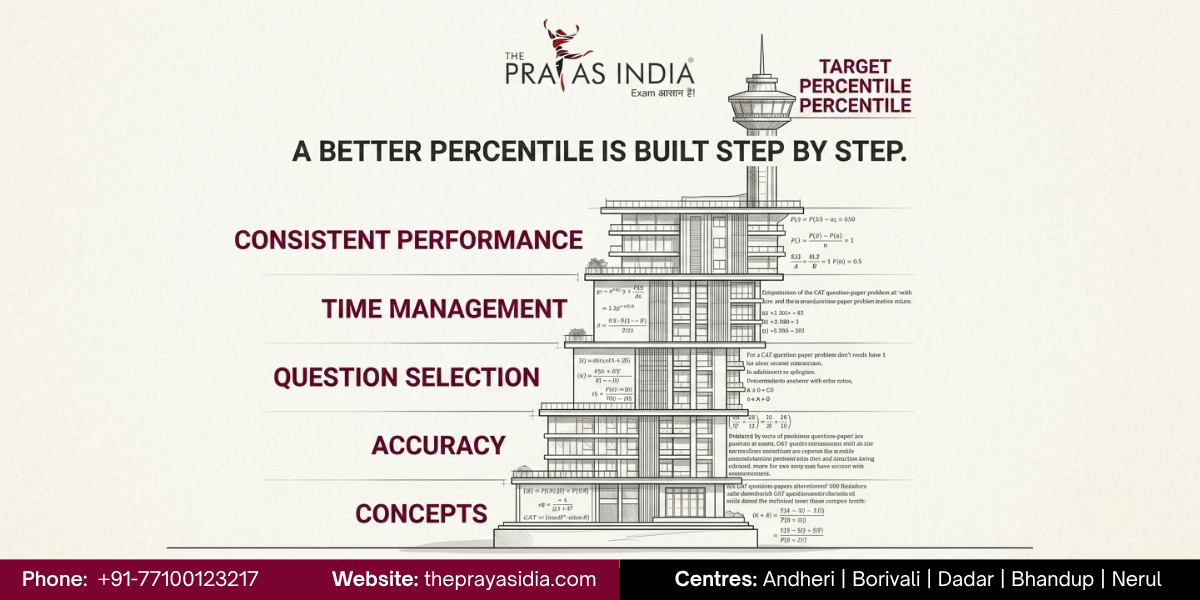
Percentile improvement is therefore often the result of many smaller improvements working together: stronger concepts, better accuracy, smarter selection, improved time management and more effective revision.
A Better Preparation System Creates Better Decisions
CAT preparation is ultimately a decision-making exercise. Knowing a concept is important, but knowing when to apply it, when to move on, and how much time to invest in a question can determine whether that knowledge translates into marks.
Structured preparation brings these elements together. It creates a clear sequence in which concepts are learned, questions are practised, mistakes are analysed and strategies are tested. Over time, the aspirant develops a stronger understanding not only of the syllabus but also of personal performance patterns.
That is the real advantage of having a system. It allows preparation to become less reactive. Instead of repeatedly asking, “What should I study today?”, an aspirant can work from evidence: “What is currently limiting my performance, and what should I do about it?”
For CAT aspirants targeting competitive management institutes, that shift can be significant.
Final Takeaway
CAT does not reward preparation simply because an aspirant has spent a large number of hours studying. It rewards the ability to perform accurately, efficiently and strategically when the examination presents a mixture of familiar and unfamiliar problems.
A structured preparation strategy helps bring order to that process. It ensures that learning is followed by practice, practice is followed by testing, and testing is followed by analysis. It also allows aspirants to adjust their preparation according to actual performance rather than continuing with methods that may no longer be effective.
For students preparing for CAT in Mumbai, joining a structured coaching programme can provide an organised framework, expert guidance and regular performance evaluation. The final responsibility, however, remains with the aspirant: to practise consistently, analyse honestly and make smarter decisions with every stage of preparation.
The objective is not simply to complete the CAT syllabus. It is to build a preparation system capable of converting knowledge and practice into a stronger percentile on the actual examination.
Contact Us
- Call Now: +91-77100 13217
- Website: theprayasindia.com
- Centres: Andheri | Borivali | Dadar | Nerul | Bhandup
Frequently Asked Questions
1. Can structured CAT preparation really improve percentile?
Structured preparation can improve the quality and consistency of preparation by helping aspirants identify weaknesses, practise systematically, analyse mock tests and improve question selection. The exact percentile improvement depends on the student's starting level, consistency, test performance and execution on the actual CAT day.
2. Is structured preparation useful for students who are already good at academics?
Yes. Strong academic fundamentals can make concept learning easier, but CAT also tests time management, question selection and performance under pressure. A structured approach helps academically strong students convert their knowledge into exam-oriented performance.
3. Should I focus on completing the CAT syllabus first?
Concept completion is important, but preparation should not be divided into a strict “syllabus first, testing later” model. Topic-wise practice and testing should begin progressively so that weaknesses are identified while there is still enough time to correct them.
4. How often should CAT aspirants take mock tests?
Mock-test frequency should depend on the preparation stage. Early in preparation, sectional tests and topic-level tests may be more useful. As the examination approaches, full-length mocks can become more frequent, provided each test is followed by detailed analysis.
5. What should I analyse after a CAT mock test?
Analyse more than the final score. Look at incorrect answers, unanswered questions, time spent on individual questions, questions that were attempted unnecessarily, questions that could have been solved with a better method, and recurring conceptual or calculation errors.
6. Is self-study enough for CAT preparation?
Self-study can be effective when the aspirant has strong discipline, reliable study material and the ability to evaluate performance objectively. Coaching can add value through structured learning, faculty guidance, test series, performance analysis and a competitive preparation environment.
7. When should I start taking CAT mock tests?
There is no universal date for starting mocks. Aspirants should gradually move from topic tests to sectional tests and then full-length mocks as their fundamentals become stronger. Waiting until the final weeks to experience the complete CAT format is generally not an efficient strategy.
8. Does speed matter more than accuracy in CAT?
Speed and accuracy need to work together. Solving many questions quickly has limited value if a large proportion of those attempts are incorrect. The better objective is to improve solving speed while maintaining sufficient accuracy and making intelligent question-selection decisions.
9. How can CAT coaching help with structured preparation?
A well-designed CAT coaching programme can provide a planned learning sequence, concept guidance, practice material, sectional tests, mock tests and performance feedback. The most useful coaching environment is one that helps students understand not only what to study but also how to evaluate and improve their performance.
10. How should I choose the best CAT coaching in Mumbai?
Look beyond advertising claims and compare factors such as faculty quality, teaching methodology, study material, test quality, doubt support, performance analysis, batch structure and the overall preparation system. The right institute should fit your learning requirements and help you maintain a measurable preparation process.