Why Your CAT Mock Scores Are Not Improving: Common Reasons and Solutions | The Prayas India
CAT preparation often reaches a frustrating stage where an aspirant is studying consistently, solving questions every day and taking regular mock tests, yet the score refuses to move. One mock may produce a decent percentile, the next may drop sharply, and after several weeks the overall performance may still look almost unchanged. This can make preparation feel directionless, particularly when the CAT exam is approaching and every mock seems to reinforce the same weaknesses.
However, stagnant mock scores do not necessarily mean that your preparation is failing. In many cases, the problem is not the amount of effort being invested but the way that effort is being converted into improvement. Taking more mocks without analysing them properly, repeatedly practising familiar topics, spending too much time on difficult questions, ignoring accuracy, or following the same strategy despite consistently poor results can create the illusion of preparation without producing measurable progress.
For CAT aspirants, mock tests should function as diagnostic tools rather than simply score-generating exercises. Every mock should tell you something about your concepts, question selection, time management, accuracy, exam temperament and preparation priorities. Once these patterns become visible, improvement becomes much more systematic.
For students preparing for CAT with structured guidance, this is also where the role of coaching becomes relevant. A well-designed preparation programme can help aspirants identify recurring mistakes, interpret mock performance and create a more targeted improvement cycle instead of relying entirely on trial and error.
A Stagnant Mock Score Is Usually a Signal, Not a Verdict
The first thing an aspirant should understand is that a stable or fluctuating mock score is information. It tells you that something in your current preparation or test-taking approach needs to change. Treating every low score as a reflection of your actual CAT potential can lead to unnecessary anxiety and poor decision-making.
CAT is a relative and highly competitive examination. Your performance depends not only on whether you know the concepts but also on which questions you attempt, how quickly you recognise familiar patterns, how accurately you calculate, how efficiently you manage time and whether you know when to leave a question. Two students with similar conceptual knowledge can therefore achieve very different mock scores because their test-taking decisions are different.
This is why simply increasing study hours may not solve a stagnant score. If an aspirant spends three additional hours every day practising questions but continues making the same selection and time-management mistakes during mocks, the extra effort may have limited impact on the final score.
The better approach is to identify the specific reason behind the stagnation and then modify the preparation process accordingly.
Reason 1: You Are Taking Mocks but Not Analysing Them Properly
One of the most common reasons CAT mock scores fail to improve is incomplete mock analysis. Many aspirants finish a mock, check the percentile, look at the correct answers and immediately move on to the next test. The score becomes the main outcome, while the information hidden inside the test is ignored.
A mock contains much more information than your final score. It can reveal which questions you should have attempted but missed, which questions consumed excessive time, where accuracy dropped, which topics repeatedly caused mistakes and whether you are losing marks because of conceptual gaps or poor decisions.
For example, suppose you attempted 18 questions in a section and got 12 correct. The immediate reaction may be that six questions went wrong. But deeper analysis could reveal that three of those six were questions you actually knew how to solve but made calculation errors on, two were questions where you misunderstood the requirement and one was genuinely outside your current conceptual comfort zone. These are six different problems and therefore require six different solutions.
A serious mock-analysis process should therefore go beyond checking the answer key. After every mock, categorise your questions into broad groups such as correct and efficient, correct but time-consuming, incorrect due to concept, incorrect due to careless error, incorrect due to question selection, and unattempted but potentially solvable.
This classification gradually shows where your score is actually being lost.
Reason 2: You Are Measuring Progress Only Through Overall Percentile
Percentile is important, but it should not be the only metric you use to judge improvement. CAT mock difficulty can vary significantly from one test to another, so comparing only the final percentile may hide meaningful progress.
An aspirant may, for instance, improve accuracy from 70% to 82%, reduce average time per question and make fewer calculation mistakes, while the overall percentile remains similar because the particular mock was more difficult. If the aspirant looks only at the percentile, this improvement may go unnoticed.
Instead, track multiple performance indicators across your mocks. Section-wise attempts, accuracy, time spent, number of avoidable errors, questions left despite being solvable and questions attempted despite being poor choices can provide a much clearer picture of preparation quality.
Over several mocks, these metrics help identify trends. If accuracy is consistently improving but attempts remain low, the next priority may be question selection and speed. If attempts are high but accuracy is falling, the problem may be over-attempting. If one section consistently consumes disproportionate time, section-specific strategy may need attention.
The objective is not to make every metric perfect simultaneously. It is to identify the highest-impact weakness and work on it systematically.
Reason 3: Your Conceptual Preparation Is Still Incomplete
Mock tests can expose conceptual gaps that regular practice sometimes hides. During topic-wise preparation, students often solve questions immediately after studying a chapter. Because the topic is already known, the connection between the concept and the question is obvious.
A CAT mock is different. You are not told which concept a question is testing, and you must recognise the underlying structure yourself. A question that appears unfamiliar may actually be based on a concept you have studied but have not yet learned to identify independently.
If the same topic repeatedly causes errors across different mocks, it is worth returning to the fundamentals rather than simply solving more mock questions. Revisiting concepts, studying standard approaches and then practising questions of gradually increasing difficulty can rebuild the foundation.
This is particularly important in Quantitative Aptitude and DILR, where conceptual familiarity must eventually translate into pattern recognition and application. In VARC, improvement may involve developing better comprehension, inference and option-elimination habits rather than simply increasing the number of passages attempted.
A mock should therefore help you decide whether you need more testing or more learning. Not every weakness can be solved by taking another mock.
Reason 4: You Are Practising Questions, But Not the Right Questions
A large question bank can create the impression of extensive preparation. However, volume alone does not guarantee improvement. If you repeatedly practise questions that are either too easy or already familiar, your comfort level may increase without sufficiently developing your CAT-solving ability.
CAT preparation requires exposure to a meaningful range of question types and difficulty levels. More importantly, you need to practise recognising which questions deserve your time.
This distinction becomes crucial during mocks. A student may be capable of solving a difficult question but still lose marks because the question consumes four or five minutes that could have been used to solve two easier questions. In a competitive examination, solving ability and decision-making ability have to work together.
Your practice should therefore include not only “Can I solve this?” but also “Should I solve this now?”
That change in thinking can significantly improve mock performance.
Reason 5: You Are Spending Too Much Time on Individual Questions
Time management problems are often mistaken for speed problems. An aspirant may believe that they simply need to “solve faster”, when the real issue is spending too much time on questions that should have been left earlier.
This usually happens when students become emotionally attached to a question. They start with a reasonable approach, encounter a calculation difficulty or an unexpected twist and continue because they have already invested time in it. After several minutes, the question may still remain unresolved.
The problem is not necessarily a lack of ability. It is the inability to recognise when the expected return from continuing has become too low.
CAT rewards efficient decision-making. A question that takes 90 seconds and produces a correct answer may be much more valuable than a question that takes four minutes, even if both are technically solvable.
During mock analysis, identify the questions where you spent significantly more time than necessary. Then ask whether the problem was a difficult concept, a poor approach, slow calculation or simply a failure to leave the question at the right moment.
This analysis can help you develop personal time thresholds rather than relying on vague instructions such as “solve quickly”.
Reason 6: Your Question Selection Strategy Is Weak
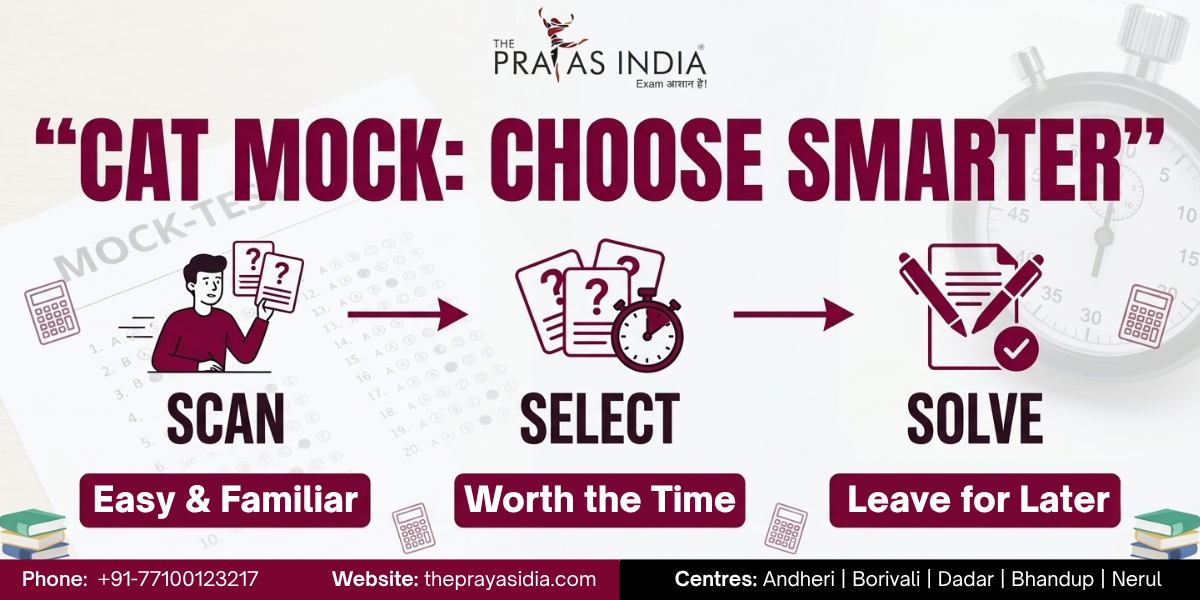
A CAT mock is not an exercise where every question has to be attempted. One of the most important skills is identifying the questions that offer a reasonable chance of a correct answer within the available time.
Some questions will immediately appear familiar. Others may require moderate effort but have a clear path once understood. A third category may look complicated, involve lengthy calculations or require an approach you are not comfortable with. Treating all three categories equally can damage your score.
Strong aspirants gradually develop the ability to scan questions and make quick decisions. They do not necessarily know how to solve every question before choosing it; they recognise whether a question appears worth their time.
This skill cannot be developed by merely reading strategy tips. It develops through repeated mock exposure and detailed post-mock analysis.
After each mock, look at questions you attempted and ask whether they were genuinely good choices. Then examine questions you skipped and determine whether some of them were actually manageable. This comparison can reveal whether your current strategy is too aggressive, too conservative or reasonably balanced.
Reason 7: Your Mock Strategy Is the Same Every Time
Another reason for stagnant scores is repeating the same test-taking strategy despite evidence that it is not working.
An aspirant may always begin with the same section, attempt questions in the same sequence and divide time according to a fixed formula. Consistency can be useful, but blindly repeating a strategy that produces poor outcomes is not.
Your mock strategy should evolve from your performance data. If you consistently perform strongly in one section, you may use that strength strategically. If another section takes too much time, you may need to change your approach. Similarly, if a particular type of question repeatedly causes losses, you should reconsider how quickly you commit to it.
The objective is not to find one magical strategy that works for every mock. It is to build a flexible framework that allows you to adapt to the paper in front of you.
A good CAT preparation plan should therefore include strategic experimentation during mocks, followed by evidence-based refinement.
Reason 8: You Are Ignoring Accuracy While Chasing Attempts
A rising attempt count can look encouraging, but attempts without adequate accuracy do not necessarily represent progress. Aspirants sometimes respond to a low score by deciding to attempt significantly more questions in the next mock. If those additional attempts are based on guesses, rushed calculations or weak question selection, the score may remain stagnant or even fall.
The better goal is to improve productive attempts—questions where your probability of getting the answer right is reasonably strong relative to the time required.
Suppose your attempts increase substantially but your number of correct answers remains almost unchanged. That tells you that simply attempting more questions is not solving the underlying problem. You may need to improve selection, accuracy or conceptual confidence before increasing attempts further.
Track your attempts and accuracy together. The relationship between the two is often more informative than either number independently.
Reason 9: You Are Not Revisiting Repeated Mistakes
One of the biggest missed opportunities in CAT preparation is allowing the same mistake to occur repeatedly.
If you make a particular error in one mock, analyse it and move on, the lesson may not become permanent. But if the same mistake appears again two or three mocks later, it becomes evidence of a process problem.
Create a mistake log that records recurring issues rather than simply collecting difficult questions. For every important error, note the reason: concept gap, calculation error, interpretation error, time pressure, wrong question selection, incomplete reading or overconfidence.
The purpose is not to create an enormous notebook. It is to identify patterns.
If you repeatedly make calculation errors in arithmetic questions, your preparation needs a calculation-accuracy intervention. If you repeatedly select lengthy DILR sets that do not convert into answers, your set-selection strategy needs attention. If you make avoidable errors in VARC because you rush through the passage, the problem is reading discipline rather than vocabulary.
The mistake log becomes useful when it changes your future behaviour.
Reason 10: You Are Taking Too Many Mocks Too Early
More mocks do not automatically mean better preparation. Taking full-length tests before building adequate conceptual coverage can sometimes create unnecessary pressure without providing enough actionable information.
Mocks are most useful when the aspirant has sufficient preparation to interpret the results. Early in preparation, topic tests, sectional practice and focused problem-solving can be more productive for certain weaknesses. As the syllabus and foundational preparation develop, full-length mocks become increasingly valuable for integrating skills under realistic time pressure.
This does not mean postponing mocks indefinitely. It means using the right testing tool at the right stage.
A balanced CAT preparation journey generally moves from learning concepts to topic practice, sectional testing, full-length mocks and repeated mock analysis. The exact timeline can vary by aspirant, but the principle remains the same: testing should support learning rather than replace it.
The Real Purpose of a CAT Mock Test
A mock test should answer three questions.
First: What can you currently solve?
Second: What are you losing marks on?
Third: What should you change before the next mock?
If your mock routine answers only the first question, it is incomplete.
The most valuable mock is not necessarily the one in which you score the highest. It can also be the one that clearly exposes a weakness you can fix. Once mocks become part of a continuous test → analyse → improve → retest cycle, score improvement becomes more measurable.
This is also where structured CAT coaching can provide value. Instead of treating every mock score as an isolated event, a guided preparation system can help students interpret performance trends, prioritise weaknesses and build targeted practice around them.
How The Prayas India Can Support Your CAT Preparation
CAT preparation becomes more manageable when students have a structured system connecting concepts, practice, testing and improvement. At The Prayas India, the emphasis is on helping aspirants approach preparation with a clear academic and test-taking framework rather than depending solely on random practice.
For an aspirant whose mock scores are not improving, the first step should be diagnosis. Identifying whether the issue lies in concepts, accuracy, speed, question selection, time management or mock analysis can help determine what should be worked on next.
With structured classroom guidance, regular practice, mock-test exposure and performance-oriented preparation, students can build a more disciplined approach to CAT. The objective is not simply to take more tests but to learn from every test and progressively improve the quality of decisions made under pressure.
For aspirants looking for CAT coaching in Mumbai, choosing a preparation environment that combines conceptual learning with regular testing and analysis can make the preparation process more organised and accountable.
Key Takeaway
If your CAT mock scores are not improving, do not immediately conclude that you need to study longer or take more tests. First identify where the score is being lost.
Your improvement may come from better mock analysis, stronger concepts, improved question selection, greater accuracy, better time management or simply learning when to move on from a question. The key is to replace repetitive testing with purposeful testing.
Turning Mock Analysis into Score Improvement
Identifying the reasons behind stagnant CAT mock scores is only the first step. The real improvement begins when the findings from your mocks are converted into specific changes in your preparation routine. A mock test should not end when the timer stops. In many ways, the most valuable part of the test begins after submission, when you examine your decisions, mistakes, time usage and missed opportunities.
For CAT aspirants, this process becomes particularly important as the exam approaches. At this stage, studying everything again is neither practical nor necessary. The focus should gradually shift towards improving the quality of attempts, reducing avoidable mistakes and developing a reliable strategy for different types of questions. A structured approach can help you identify where each additional hour of preparation is likely to have the greatest impact.
Diagnose Your CAT Mock Performance Section by Section
Your overall mock score can hide important differences between sections. An aspirant may have a reasonable overall percentile but a major weakness in one section, while another student may have strong conceptual knowledge but lose marks because of poor question selection.
Section-wise analysis allows you to identify these differences.
VARC: Separate Reading Problems from Option-Selection Problems
If your VARC performance is inconsistent, first determine whether the problem begins with comprehension or with answer selection. Some students understand the passage but choose incorrect options because they interpret them too broadly, bring outside assumptions into the question or fail to distinguish between the most appropriate option and an option that merely appears plausible.
Others lose time because they read passages without a clear strategy and then struggle to complete the section comfortably.
During mock analysis, revisit incorrect questions without immediately checking the explanation. Ask yourself what the passage actually established and why your selected option seemed attractive. Then compare it with the correct option and identify the precise difference.
For RC-based questions, maintaining an error classification can be particularly useful. Mark mistakes as comprehension, inference, tone, elimination or overthinking. After several mocks, recurring patterns will become visible.
For VA questions, analyse whether errors arise from difficulty understanding the sentence structure, paragraph logic or from choosing an option that sounds grammatically acceptable but does not fit the intended sequence or meaning.
This makes VARC improvement more targeted than simply solving a larger number of passages.
DILR: Focus on Set Selection and Information Processing
DILR can be one of the biggest differentiators in CAT because performance depends not only on solving ability but also on recognising which sets are worth investing time in.
A student may spend several minutes building an arrangement, only to discover that the set is more complicated than initially expected. Meanwhile, another set that looked less attractive may have offered multiple achievable questions.
After every mock, review the DILR sets you selected and the sets you ignored. Ask whether your initial assessment of their difficulty was accurate. If you repeatedly choose sets that consume significant time without producing enough answers, set selection needs to become a preparation priority.
Also examine whether your difficulty is related to interpreting data, establishing relationships, creating the initial framework or performing calculations. These are different skills and should be practised separately.
Improvement in DILR often comes from becoming faster at understanding the structure of a set rather than merely becoming faster at calculations.
Quantitative Aptitude: Identify the Difference Between Knowledge and Execution
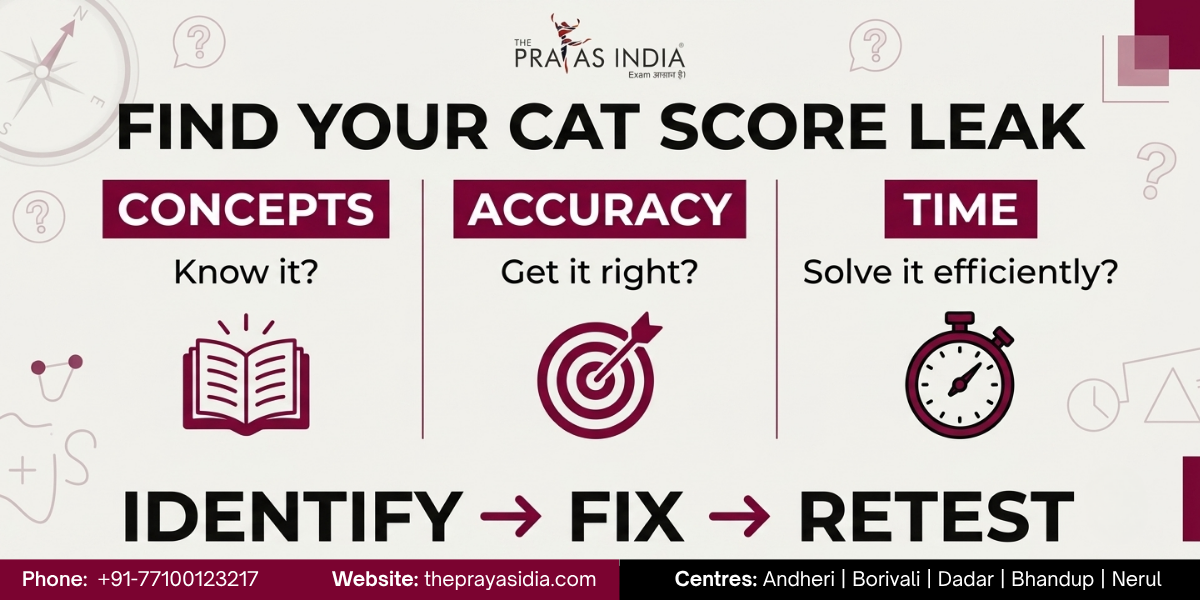
In QA, stagnant scores can originate from several different problems. You may know the underlying concept but take too long to reach the answer. You may understand the method but make calculation errors. Or you may select questions that are technically solvable but inefficient under CAT time constraints.
Your mock analysis should therefore record the reason behind every important mistake.
If a question is marked incorrect because you did not know the concept, revisit the topic. If you knew the concept but used an inefficient method, work on alternate approaches. If the answer was lost because of calculation or interpretation, develop an accuracy habit.
You should also identify topics where your success rate is consistently strong. These areas can become part of your high-confidence question pool during mocks.
The goal is to develop a balanced approach where conceptual preparation and exam execution reinforce each other.
Build a Mock Analysis Sheet That Actually Helps
A mock analysis sheet should be simple enough to maintain consistently. If it becomes a complicated spreadsheet requiring excessive time, students often stop updating it after a few tests.
Record the important information that can influence your next preparation decision. For each section, track your attempts, correct answers, incorrect answers, approximate time usage and major reasons for mistakes.
You can also maintain a small list of questions that you should have attempted but missed. These questions are particularly valuable because they represent lost opportunities rather than pure knowledge gaps.
Over time, the sheet should answer questions such as:
- Which section is improving?
- Which section is stagnant?
- Where are avoidable errors occurring?
- Which topics repeatedly cause difficulty?
- Which question types consume excessive time?
- Are attempts increasing without a corresponding improvement in accuracy?
- Am I becoming better at identifying questions worth attempting?
The purpose of tracking is not to create additional academic work. It is to make your preparation decisions more objective.
Distinguish Between Knowledge Gaps and Test-Taking Gaps
This distinction can completely change your preparation strategy.
A knowledge gap means you genuinely do not understand the concept required to solve the question. The solution is learning and practising that concept.
A test-taking gap occurs when you know the concept but fail to convert that knowledge into marks because of poor selection, excessive time, misreading, calculation mistakes or pressure.
These two problems require different interventions.
If your mock analysis shows a large number of knowledge gaps, your study schedule should allocate more time to conceptual revision and topic-wise practice. If the concepts are largely under control but your scores remain low, repeatedly revising theory may not be the best use of time. Your attention should move towards mocks, sectionals, question selection, timing and accuracy.
This is one of the major benefits of structured CAT preparation: instead of responding emotionally to a low score, you can identify the specific skill that needs attention.
Create a Three-Level Improvement Plan
Once your mock performance has been analysed, divide your weaknesses into three categories.
Priority 1: High-impact weaknesses
These are problems that repeatedly cost you marks and can realistically be improved. Examples include calculation errors, poor RC option selection, inefficient DILR set selection or spending too long on QA questions.
Priority 2: Conceptual weaknesses
These are topics where your understanding is incomplete. Schedule focused revision and targeted practice rather than trying to cover everything simultaneously.
Priority 3: Low-impact weaknesses
These may include rare question types or areas that consume a disproportionate amount of preparation time for limited expected improvement. They should not automatically become your top priority.
This approach prevents a common CAT preparation mistake: trying to fix every weakness at once.
Do Not Let One Bad Mock Change Your Entire Preparation Plan
CAT mock scores naturally fluctuate. A difficult mock, an unfamiliar paper structure or an unusually poor section can affect performance. One bad score should therefore not lead to drastic changes in your entire preparation strategy.
Look for patterns across multiple mocks.
If one mock shows a weakness that does not appear elsewhere, investigate it but avoid overreacting. If the same weakness appears repeatedly, it deserves immediate attention.
Similarly, one unusually high score does not automatically mean that a weakness has disappeared. Sustainable improvement should be visible across multiple tests.
Think in terms of performance trends rather than individual scores.
This mindset is especially important during the final phase of preparation, when emotional reactions to mock scores can easily disrupt an otherwise effective study routine.
Use Sectional Tests Between Full-Length Mocks
Full-length mocks are essential, but they should not be the only testing tool in your preparation.
Suppose your last three mocks show that QA accuracy is acceptable but speed is weak. Taking another full-length mock may confirm the same problem, but a set of focused QA sectionals can give you more opportunities to work specifically on that issue.
Similarly, if DILR set selection is weak, targeted sectional practice can help you repeatedly practise scanning and prioritising sets without the distractions of the entire examination.
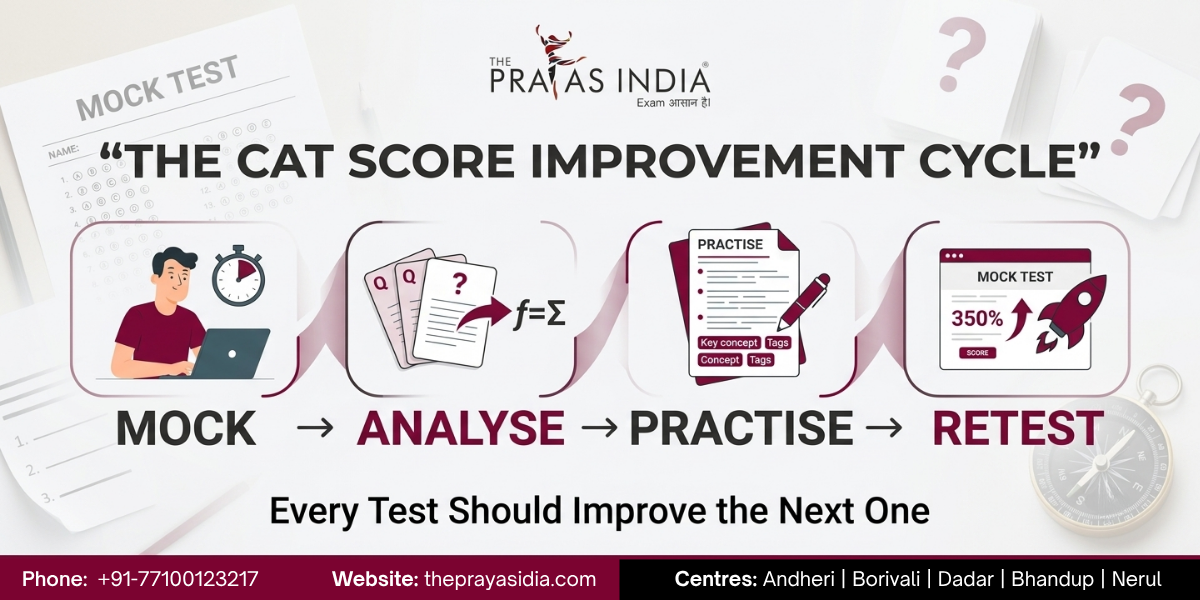
A useful cycle can therefore look like:
Full Mock → Analyse → Identify Weakness → Sectional Practice → Targeted Revision → Full Mock
This turns testing into a continuous improvement system rather than a sequence of unrelated examinations.
Build a Personal CAT Attempt Strategy
As your mock experience increases, you should gradually develop a personal attempt strategy instead of copying someone else’s approach.
Some students perform better when they begin with questions they immediately recognise. Others prefer scanning the entire section first and then creating an attempt order. Some may be comfortable taking calculated risks, while others perform better with a more accuracy-focused strategy.
There is no universal formula that guarantees the same result for every aspirant.
Your strategy should emerge from your own data. Look at the questions you consistently solve correctly, the questions where you lose time and the types of questions you tend to misjudge. Then create a framework that helps you identify high-value opportunities quickly.
This is where regular mock exposure becomes important. The more intelligently you analyse your tests, the more accurately you understand your own strengths and limitations.
Improve Speed Without Sacrificing Accuracy
Speed should not be treated as simply reducing the time spent on every question. The real objective is to increase the number of useful questions you can solve correctly within the available time.
This requires three things: faster recognition, efficient methods and disciplined decision-making.
For example, a student who spends 20 seconds less on every question but starts making frequent errors may not actually improve. Another student who learns to leave three time-consuming questions early can create enough time to solve several manageable questions accurately.
Therefore, speed improvement should be measured alongside accuracy.
Ask yourself not only “How quickly did I solve this?” but also “Was this question worth the time I spent?”
That question can gradually transform your mock-taking approach.
Use Your Strong Areas Strategically
Improvement does not always mean spending all your time on weaknesses. Your existing strengths are important because they can become reliable scoring opportunities.
If you are consistently strong in a particular QA topic, comfortable with certain VARC question types or effective at specific DILR structures, maintain those strengths through regular practice.
At the same time, avoid becoming so dependent on familiar areas that you stop developing flexibility. CAT papers can vary considerably, so your strategy should have enough depth to handle changes in question distribution and difficulty.
A balanced preparation plan protects strong areas while progressively reducing the impact of weaker ones.
What Structured CAT Coaching Can Add to Mock Preparation
Self-study can be effective, but one of its challenges is knowing exactly what to change when performance stagnates. Students may correctly identify that their scores are low but struggle to determine whether the problem is conceptual knowledge, practice quality, question selection, timing or exam temperament.
A structured CAT coaching programme can provide an external framework for this process. Faculty guidance, regular testing, performance discussions, doubt-solving support and a planned preparation schedule can help students reduce the amount of trial and error involved in preparation.
At The Prayas India, CAT preparation is designed around the combination of conceptual learning, practice, mock testing and performance improvement. For aspirants preparing in Mumbai, a structured coaching environment can provide greater accountability and a consistent preparation routine while allowing students to work on individual weaknesses.
The goal is not simply to increase the number of tests taken. It is to make every test more useful.
When Should You Consider Joining CAT Coaching?
There is no single point in the year at which every aspirant must join coaching. The right time depends on your starting level, target percentile, academic schedule and familiarity with the CAT syllabus.
However, if you repeatedly face difficulty creating a study plan, identifying important weaknesses, maintaining consistency or interpreting mock performance, structured guidance can become particularly valuable.
Students who are beginning their CAT preparation can use coaching to establish a strong foundation and avoid inefficient study habits. Students who have already started preparation can also benefit from structured testing, faculty feedback and targeted practice if their scores have plateaued.
For aspirants looking for CAT coaching in Mumbai, the important consideration should be whether the programme provides a complete preparation ecosystem rather than only classroom lectures.
Admission-Focused Preparation at The Prayas India
Choosing a CAT coaching institute is ultimately a preparation decision. The right environment should help you move from learning concepts to applying them under realistic examination conditions.
At The Prayas India, aspirants can approach CAT preparation through structured learning, regular practice, mock tests, analysis and targeted improvement. The emphasis is on developing the skills required not only to understand questions but also to make better decisions under CAT’s time constraints.
For students targeting IIMs and other leading management institutes, preparation should ideally begin with a clear understanding of the examination and gradually evolve into a personalised strategy based on performance.
If your mock scores are currently not improving, the answer may not be another random test or another round of revision. It may be a better preparation system.
Final Takeaway: Make Every Mock Count
A stagnant CAT mock score should be treated as a problem to diagnose, not a label to accept.
The most important question is not “Why am I scoring low?” but “Where exactly am I losing marks, and what can I change before my next mock?”
Analyse your mistakes. Separate conceptual gaps from execution problems. Review your question selection. Track accuracy and time together. Use sectionals to target specific weaknesses. Protect your strong areas and gradually build a personalised attempt strategy.
Most importantly, give every mock a purpose.
When the cycle becomes learn → practise → test → analyse → improve → retest, mock tests stop being sources of anxiety and become powerful tools for CAT preparation.
For aspirants who want structured CAT preparation and are considering coaching in Mumbai, The Prayas India can provide a guided environment where preparation, testing and performance improvement work together.
Contact Us
- Call Now: +91-77100 13217
- Website: theprayasindia.com
- Centres: Andheri | Borivali | Dadar | Nerul | Bhandup
Frequently Asked Questions
1. Why are my CAT mock scores not improving despite regular preparation?
Stagnant scores can result from several factors, including incomplete conceptual preparation, poor question selection, low accuracy, inefficient time management or inadequate mock analysis. The first step is to identify the specific weakness rather than simply increasing study hours.
2. How many CAT mocks should I take?
The ideal number varies depending on your preparation stage and available time. Quality matters more than quantity. Every full-length mock should be followed by detailed analysis and targeted practice so that the next test reflects what you have learned.
3. Should I take another mock if my previous score was very low?
Not immediately in every case. First analyse the previous mock, identify the major causes of lost marks and work on them through targeted practice or sectional tests. Then take another full-length mock to check whether the intervention worked.
4. How can I improve my CAT mock percentile?
Focus on improving productive attempts, accuracy, question selection and time management. At the same time, strengthen recurring conceptual weaknesses. Consistent improvement in these areas is more sustainable than simply trying to increase the number of attempted questions.
5. Why is my CAT mock score high in one test and low in another?
Mock difficulty, question selection, section-wise comfort, concentration and test-taking strategy can all influence performance. Instead of focusing on one score, analyse trends across multiple mocks to identify consistent strengths and weaknesses.
6. Should I focus more on CAT concepts or mock tests?
Both are important at different stages. Conceptual preparation builds the foundation, while mocks help you apply that knowledge under time pressure. A strong preparation plan gradually integrates both rather than relying exclusively on either one.
7. Can CAT coaching help if my mock scores have plateaued?
Yes, structured coaching can help identify recurring weaknesses, provide faculty guidance, organise practice and introduce a systematic mock-analysis process. The value depends on the quality of the programme and how actively the student uses the available guidance.
8. When should I join CAT coaching in Mumbai?
The earlier you establish a structured preparation approach, the more time you have to build concepts and refine your strategy. However, even students who have already started preparation can consider coaching if they need structured guidance, mock analysis, regular practice or accountability.