Scoring Low in CAT Mocks? Here’s How to Improve Your Percentile | The Prayas India
Scoring low in CAT mocks can be frustrating, especially when you have been studying consistently and still do not see the percentile you expected. A mock score can make you question your preparation, your strategy and sometimes even your chances of getting into a good MBA programme. But a low mock percentile should not automatically be treated as a prediction of your CAT result. It should be treated as feedback about your current preparation.
For CAT aspirants, mock tests become increasingly important as preparation progresses because they reveal something that books, lectures and topic-wise practice cannot fully show: how effectively you can apply your knowledge under actual exam conditions. A student may understand concepts well but lose marks because of poor question selection, slow calculations, weak reading discipline, excessive time spent on difficult LRDI sets or repeated careless mistakes. The mock exposes these gaps.
The important question, therefore, is not simply, “What was my percentile?” It is, “Why did I score this percentile, and what can I change before the next mock?”
If you are preparing for CAT 2026 or beginning your CAT preparation journey with the aim of securing admission to a leading management institute, learning how to analyse mocks can become one of the most valuable parts of your preparation. With structured guidance, regular testing and systematic performance analysis, mock scores can gradually become a tool for improving your actual exam performance.
A Low Mock Percentile Is a Signal, Not a Final Verdict
One of the biggest mistakes CAT aspirants make is judging their entire preparation based on a single mock score. A difficult mock, an unfamiliar DILR arrangement, a lengthy VARC section or a poor decision during the first few minutes can significantly affect the final percentile. Your performance can also fluctuate because of fatigue, concentration, time management and test-day decision-making.
Instead of treating a low score emotionally, look at the mock as a diagnostic report. The score tells you where you currently stand, but the analysis tells you how to move forward.
Suppose two students score the same percentile. One loses marks because of weak Quant concepts, while the other understands the concepts but spends too much time on difficult questions. Their improvement strategies cannot be identical. The first student needs targeted concept-building and practice. The second needs better question selection, timed practice and exam strategy.
This is why simply taking more mocks is not enough. Mock analysis has to become part of the preparation process.
A useful cycle is:
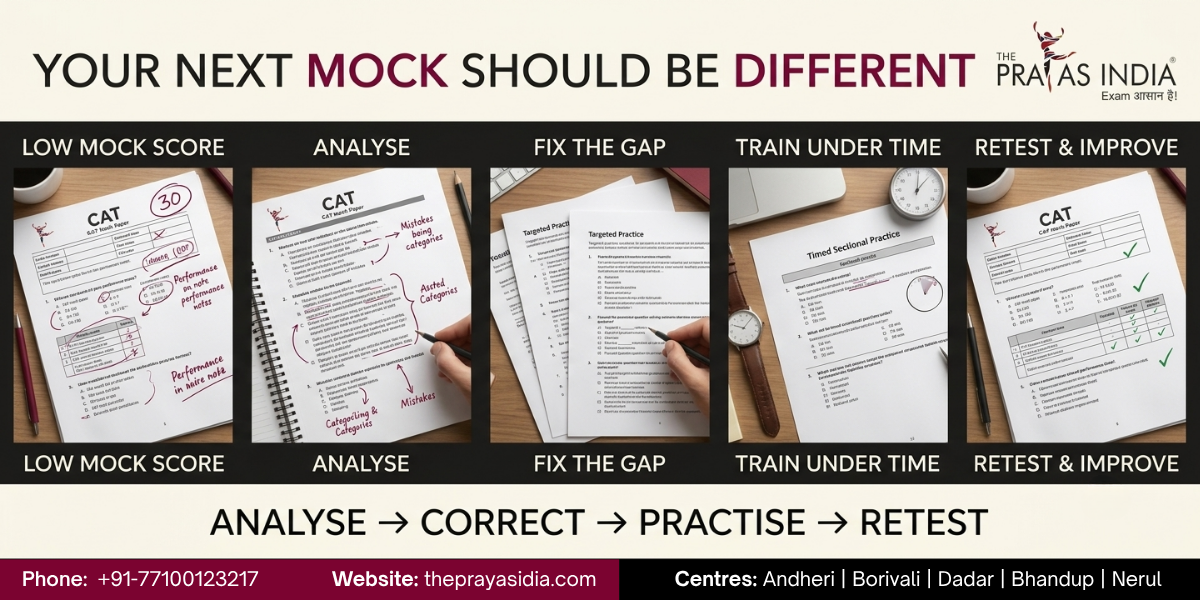
MOCK → ANALYSE → IDENTIFY GAPS → FIX → PRACTISE → RETEST
The objective is not to chase a higher score in every single test. The objective is to ensure that the same mistakes do not keep appearing in every test.

Start by Breaking Down Your Mock Score
When a mock goes badly, avoid immediately opening another test. First, break the result down section by section and then question by question. Your overall percentile can hide the actual reasons behind your performance.
Start by examining:
- Overall score and percentile
- Section-wise scores
- Number of questions attempted
- Accuracy percentage
- Correct and incorrect attempts
- Unattempted questions
- Time spent in each section
- Questions that consumed excessive time
- Easy questions that were missed
- Questions where the concept was known but execution failed
This analysis helps you move from a vague conclusion such as “My mock went badly” to a specific diagnosis such as “I spent too much time on two difficult DILR sets,” or “I attempted several Quant questions without identifying the easier alternatives.”
That distinction matters because different problems require different solutions.
If your accuracy is low, attempting more questions may make the situation worse. If your accuracy is high but your attempts are too low, the focus should shift towards speed and question selection. If your section-wise performance is uneven, you may need to rebalance preparation instead of simply increasing total study hours.
The Four Numbers You Should Track After Every Mock
CAT aspirants often focus almost entirely on percentile. However, percentile is an outcome. To improve it consistently, track the performance indicators behind it.
1. Attempts
Your attempts indicate how many questions you were able to engage with during the available time. A very low attempt count may indicate slow solving, excessive time spent on individual questions or difficulty identifying questions worth attempting.
However, increasing attempts blindly is not the answer. The goal is to increase productive attempts, not simply the number of questions touched.
2. Accuracy
Accuracy tells you whether your attempts are translating into marks. If you are attempting a large number of questions but making frequent errors, your strategy needs correction.
High attempts with poor accuracy can be less useful than moderate attempts with strong accuracy. Therefore, before chasing speed, make sure your fundamentals and decision-making are reliable.
3. Time per Question or Set
Time management is one of the most important factors in CAT performance. A question that takes significantly longer than expected can affect several subsequent questions.
For VARC, excessive time on one RC passage can reduce the opportunity to attempt other manageable questions. In DILR, getting stuck on one set can consume valuable minutes that could have been used to identify and solve a more suitable set. In Quant, repeatedly fighting with one difficult question can reduce the number of easier questions you reach.
Your mock analysis should therefore identify where your time is actually going.
4. Net Score Contribution
Look beyond the total score and identify which questions or sets contributed positively and which ones consumed time without producing marks.
This helps build a practical distinction between high-value attempts and low-value attempts.

Find Your Biggest Score Leak First
Not every weakness deserves equal attention. One of the most effective ways to improve your percentile is to identify the area causing the largest loss of marks and address that problem first.
Consider a student whose Quant accuracy is reasonably strong but who spends 15 minutes on a difficult DILR set without solving it. Spending another week revising basic Quant concepts may not produce a meaningful improvement in the next mock. The immediate opportunity lies in improving DILR set selection and time allocation.
Similarly, a student may know the concepts required for several Quant questions but lose marks because of calculation errors. In that case, completing another round of theoretical lessons may not solve the actual problem. The preparation needs more timed practice and error tracking.
Your mock analysis should therefore answer three questions:
Where am I losing marks?
Why am I losing those marks?
What specific action will prevent the same loss in my next mock?
This approach makes preparation much more efficient.
A Practical Error Log Can Change Your Mock Performance
One of the simplest tools for improving mock scores is an error log. Instead of merely checking the solutions after a mock, record the questions that taught you something important.
Your error log can include categories such as:
| Error Type | Typical Problem | Corrective Action |
|---|---|---|
| Concept Gap | Formula or concept not understood | Revise concept + targeted practice |
| Application Gap | Concept known but incorrectly applied | Solve similar questions |
| Calculation Error | Arithmetic or estimation mistake | Timed calculation practice |
| Misreading | Question interpreted incorrectly | Slow down initial reading |
| Time Loss | Too long spent on one question | Set time limits |
| Selection Error | Difficult question chosen too early | Practise question selection |
| Guessing Error | Attempt made without sufficient confidence | Improve elimination and decision-making |
| Careless Error | Avoidable mistake despite knowing solution | Build checking discipline |
The purpose of the error log is not to create another notebook that you never revisit. It should become a revision tool.
Before taking your next mock, spend a few minutes reviewing the mistakes from previous tests. If the same error appears repeatedly, it deserves priority.
Learn to Separate Knowledge Gaps from Strategy Gaps
This distinction can significantly improve your CAT preparation.
A knowledge gap means you do not sufficiently understand the concept required to solve a question. For example, you may struggle with a particular arithmetic concept or lack familiarity with a specific type of LR arrangement.
A strategy gap is different. You may know how to solve the question but make a poor decision about whether to attempt it, when to attempt it or how much time to invest in it.
These two problems often look similar in a mock score.
Imagine you spend four minutes on a Quant question and eventually get it wrong. If you did not know the underlying concept, you have a knowledge gap. If you knew the concept but failed to recognise that the question was unnecessarily time-consuming, you have a strategy gap.
The solution changes accordingly.
Knowledge Gap → Learn, practise and revise.
Strategy Gap → Analyse, simulate and improve decision-making.
Students preparing through a structured CAT coaching programme can benefit from external performance feedback at this stage because another person can sometimes identify patterns that the student overlooks while reviewing the test alone.
VARC: Low Scores Often Begin with Reading Decisions
In VARC, many students assume that a low score automatically means they need to solve more questions. But the actual issue may lie in passage selection, reading approach or interpretation.
If you are consistently spending too much time on difficult RC passages, start analysing your passage choices. After every mock, revisit the passages you attempted and ask whether they were actually suitable for you.
Look at:
- Passage difficulty
- Subject familiarity
- Question types
- Time spent reading
- Time spent answering
- Accuracy by passage
- Questions where two options seemed confusing
You may discover that your biggest issue is not reading speed but selection discipline.
For example, if one passage consumed eight minutes and produced only one correct answer while another manageable passage was left untouched, the problem is partly strategic.
This does not mean avoiding difficult passages permanently. It means learning to identify where your effort has the best probability of converting into marks.
DILR: Stop Measuring Progress Only by Questions
DILR is often different from the other CAT sections because performance depends heavily on set selection and the ability to develop a workable structure.
A student can spend a significant amount of time on a difficult set and still fail to reach the correct answer. Another student may identify a more approachable set and complete it accurately.
Therefore, DILR analysis should focus heavily on set selection and time investment.
After every mock, revisit all the sets and classify them:
- Sets you could solve comfortably
- Sets you could solve with additional practice
- Sets that were too time-consuming
- Sets where you understood the approach only after seeing the solution
- Sets that were unsuitable for your current level
The objective is to develop the ability to recognise the right opportunity under pressure.
As your preparation improves, you should become better at answering a crucial question early in the section: “Which set deserves my time?”
Quant: Identify the Difference Between Concept and Execution
Quantitative Aptitude can produce a different pattern of errors. You may know the formulas and still lose marks because of slow calculations, incomplete understanding, incorrect interpretation or inefficient solving methods.
During mock analysis, classify your Quant mistakes topic-wise. For example, you may find that Arithmetic questions are generally accurate while Algebra questions produce repeated errors. Or perhaps your conceptual understanding is fine, but calculations take too long.
This information is much more useful than simply saying, “My Quant is weak.”
Once you know the exact problem, your practice becomes targeted. Instead of solving random questions for hours, you can work on the specific topics and question types responsible for your score loss.
The Prayas India Approach: Turn Mock Data into a Preparation Plan
For serious CAT aspirants, mock tests become significantly more valuable when they are connected to a structured preparation system. At The Prayas India, the objective is not merely to encourage students to take more tests but to help them understand the performance patterns emerging from those tests.
A structured CAT preparation environment can support aspirants through concept-building, guided practice, sectional testing, full-length mocks, performance analysis and targeted improvement. This becomes particularly useful for students who are preparing in Mumbai and want consistent academic guidance instead of relying entirely on self-evaluation.
For an aspirant scoring below the desired percentile, the immediate goal should not be to compare their score with someone else’s. The focus should be on building a clear improvement plan based on their own performance.
Low percentile → Diagnose the reason → Fix the weakness → Practise → Retest → Measure improvement.
This is the mindset that can turn mock tests from a source of anxiety into one of the strongest tools in CAT preparation.
Your Next Mock Should Be Better Because of the Previous One
The most important principle to remember is simple: never take a mock just to complete a mock.
Every test should leave you with actionable information. You should know which concepts need revision, which mistakes are recurring, where you are losing time, which questions you should have avoided and which opportunities you missed.
If your next mock contains exactly the same mistakes as the previous one, the problem is not the mock. The problem is that the analysis was not converted into action.
Your target should therefore be progressive improvement, not perfection in every test.
In the next stage of your preparation, your mock strategy should gradually move from basic diagnosis to advanced exam simulation. This means improving section-wise strategy, refining question selection, controlling time allocation, analysing percentile movement and developing the confidence to make decisions under CAT-like pressure.
A low mock score is useful if it tells you exactly what to fix.
For aspirants targeting top MBA institutes, that ability to identify weaknesses early and correct them systematically can make the difference between passive preparation and genuinely performance-oriented CAT preparation.
Build a Section-Wise Improvement Strategy Instead of Repeating the Same Preparation Routine
Once you have analysed several CAT mocks, you should start seeing patterns. A single mock can fluctuate, but repeated performance across multiple tests usually reveals where the real problems lie.
For example, your VARC score may remain reasonably stable while DILR fluctuates significantly. Quant may show decent accuracy but low attempts. Or you may notice that all three sections are affected by the same problem: spending too much time on questions that are not worth attempting.
At this stage, continuing with the same study routine every week is unlikely to produce a major change. Your preparation needs to become more personalised.
The purpose of mock analysis is to answer a practical question:
What should I do differently before my next mock?
A useful section-wise approach can look like this:
VARC
Focus on reading efficiency, passage selection, question interpretation and accuracy. Analyse whether low performance is caused by poor comprehension, incorrect option selection or excessive time spent on one passage.
DILR
Focus on identifying workable sets early, developing a structured approach and avoiding excessive investment in an unsuitable set. Practise different set types, but also train yourself to make faster selection decisions.
Quant
Identify whether your problem is conceptual weakness, slow calculation, inefficient methods or question selection. Topic-wise analysis is particularly important because a general conclusion such as “Quant is weak” does not provide a useful action plan.
The objective is not to make every section equally strong overnight. It is to gradually reduce the weaknesses that are creating the biggest score losses.
Stop Chasing Percentile and Start Improving Controllable Metrics
Percentile is influenced by your performance relative to other test-takers, so it can fluctuate from one mock to another. A more productive approach is to focus on the numbers you can directly improve.
Track:
- Number of productive attempts
- Accuracy percentage
- Time wasted on unsuccessful questions
- Easy questions missed
- Questions skipped correctly
- Repeated error types
- Section-wise score movement
- Improvement in familiar question types
Suppose your percentile does not increase significantly after one mock, but your accuracy improves and your time loss decreases. That can still indicate genuine progress.
The goal is to build a preparation process that produces better performance over time rather than becoming emotionally dependent on every individual percentile.

The 30-Day CAT Mock Improvement Cycle
If your CAT mock scores have remained low or stagnant, random practice may not be enough. A structured improvement cycle can help you connect mock performance with your daily preparation.
The following framework can be repeated and adjusted according to your current level.
Days 1–3: Analyse the Previous Mock
Do not rush into the next full-length mock immediately.
Review every important mistake and classify it. Identify the concepts you did not know, the questions where you lost time, the attempts that should have been avoided and the easy opportunities you missed.
Create a short priority list. Avoid creating a list of twenty weaknesses at once. Select the two or three areas most responsible for your recent score loss.
Days 4–10: Target the Biggest Weakness
Use this period for focused practice.
If DILR set selection is your biggest issue, spend time solving sets and, equally importantly, practise identifying which sets are worth attempting. If Quant calculation speed is the issue, include targeted calculation drills along with timed problem solving.
The goal is not to study more. It is to correct the specific reason your previous mock score suffered.
Days 11–17: Add Timed Practice
Once you have revised and practised the weak area, introduce time pressure.
Attempt sectional tests and mixed practice sets. Measure whether your accuracy remains stable when the time limit is introduced.
This stage is important because improvement during untimed practice does not always translate directly into exam performance.
Days 18–24: Simulate Decision-Making
Start focusing on question selection.
During CAT, you are not required to prove that you can solve every difficult question. You need to make better decisions about where your time and effort can produce the best result.
Practise recognising:
- Questions you can solve quickly
- Questions requiring moderate effort
- Questions that are consuming too much time
- Questions better left for later
Days 25–30: Retest and Compare
Take another mock under proper exam conditions.
Then compare it with the previous test. Do not look only at percentile.
Ask:
- Did my accuracy improve?
- Did I waste less time?
- Did I select better questions?
- Did my weak section become more stable?
- Did I repeat the same mistakes?
This comparison gives you evidence of whether your corrective strategy worked.
Improve Your CAT Question Selection Strategy
Many aspirants believe their low mock score is caused entirely by a lack of knowledge. In reality, a significant amount of score loss can occur because of poor question selection.
A CAT paper is not solved in an ideal environment. You have limited time, varying levels of difficulty and incomplete information about which questions will consume more effort. This makes decision-making an important part of performance.
A better approach is to develop a three-level question-selection system.
Level 1: Immediate Opportunity
These are questions or sets where you recognise the approach relatively quickly. They may not always be easy, but you understand what the question requires.
These should receive priority.
Level 2: Possible but Time-Dependent
You may be able to solve these questions, but they require additional effort. Attempt them after securing the stronger opportunities.
Level 3: High-Risk Investment
These are questions where the approach remains unclear even after an initial review. Continuing to invest time without progress can damage the rest of your section.
The purpose of this framework is not to create rigid rules. With practice, it helps you become more aware of how your decisions affect the score.
Common Reasons CAT Mock Scores Remain Stagnant
Sometimes students take ten or fifteen mocks and still see very little improvement. In such cases, the problem may not be effort.
Taking Mocks Without Enough Analysis
A mock test followed by a quick look at the solutions does not create a complete improvement cycle.
You need to understand the reason behind every significant loss.
Practising Randomly After Every Mock
If your weak area is DILR set selection but you spend the next week revising vocabulary, your preparation and mock analysis are disconnected.
Practice should respond to performance.
Repeating the Same Test Strategy
If you consistently start every section the same way and repeatedly lose time, experiment during mocks and sectional tests.
A strategy should be tested and refined, not followed blindly.
Trying to Fix Everything Simultaneously
You may have weaknesses in multiple areas, but attempting to solve every problem in one week can lead to unfocused preparation.
Prioritise the weaknesses creating the largest score loss.
Ignoring Strong Sections
Improvement is not always about repairing your weakest area. Sometimes strengthening an already reliable section can produce more predictable score gains.
Your strategy should consider both score recovery and score maximisation.
Comparing Every Mock With Another Aspirant
Different students have different strengths, preparation histories and starting points.
Your most useful comparison is your current performance against your previous performance.
Build a Personal CAT Score Improvement Plan
After analysing at least a few mocks, create a short written plan for the next preparation cycle.
For example:
VARC Goal: Improve RC selection and maintain accuracy.
Action: Timed reading practice, two RC sets daily and detailed option analysis.
DILR Goal: Reduce time lost on unsuitable sets.
Action: Practise set scanning, solve selected sets under time limits and analyse abandoned sets.
Quant Goal: Improve productive attempts without reducing accuracy.
Action: Topic-wise revision, timed question sets and calculation practice.
The plan should remain flexible. If the next mock reveals a different issue, update it.
The purpose is to ensure that your daily preparation has a clear connection with your performance data.
When Should You Take More Mocks?
More mocks are useful when you have enough time to analyse and learn from them.
Taking several full-length mocks every week without reviewing them properly can create fatigue and repetition without meaningful improvement. On the other hand, taking too few mocks may limit your exposure to exam-like conditions.
The right frequency depends on your stage of preparation, available time and current performance.
A balanced strategy generally includes:
- Topic-wise practice for weak concepts
- Sectional tests for targeted improvement
- Regular full-length mocks
- Detailed post-mock analysis
- Revision based on recurring mistakes
The key principle remains simple:
A mock is not complete when you submit it. It is complete when you understand what it taught you.
The Prayas India Approach to CAT Mock Improvement
For students who are scoring below their target percentile, the biggest challenge is often understanding what should change next.
At The Prayas India, CAT preparation can be approached as a structured progression rather than a collection of classes and mock tests. Aspirants need support across concept building, practice, testing and performance analysis.
A structured CAT coaching environment can help students:
- Understand recurring performance patterns
- Strengthen weak concepts
- Improve section-wise strategy
- Practise under time pressure
- Develop better question-selection skills
- Analyse mock-test mistakes
- Build a more effective revision process
- Monitor improvement across multiple tests
For students searching for Best CAT Coaching in Mumbai, the value of a coaching programme should not be measured only by the quantity of study material or the number of tests available. The quality of academic guidance and performance feedback can play an important role in helping aspirants convert effort into measurable improvement.
The Prayas India focuses on helping students approach CAT preparation with greater structure and clarity. Instead of allowing a low mock score to create panic, aspirants can use performance feedback to build the next stage of their preparation.
From Low Mock Scores to Better Percentile: The Right Mindset
A low CAT mock score can create two very different responses.
The first response is emotional: changing resources, changing strategies every few days, comparing scores and attempting more tests without analysis.
The second response is analytical: identifying the score leak, correcting it and measuring whether the correction worked.
The second approach is more sustainable.
Your preparation should gradually become a process of reducing uncertainty. Every mock should tell you more about:
- Which questions suit your strengths
- Which mistakes are repeating
- How your time is being used
- Where accuracy drops
- Which topics need more work
- Which strategies are producing better outcomes
As this understanding improves, your test-taking decisions can become more deliberate.
A Final Framework for Improving Your CAT Percentile
If you are consistently scoring low in CAT mocks, avoid searching for a completely new strategy after every test.
Instead, follow a structured cycle:
1. Take the mock under proper conditions.
2. Analyse the score section by section.
3. Identify the biggest source of mark loss.
4. Separate concept problems from strategy problems.
5. Create a focused corrective plan.
6. Practise the required skill under increasing time pressure.
7. Take sectional tests to measure improvement.
8. Retake a full-length mock.
9. Compare performance indicators, not just percentile.
10. Repeat the cycle.
The objective is not to produce an immediate perfect mock score. It is to ensure that your preparation becomes progressively smarter.
Conclusion
Scoring low in CAT mocks does not mean that your CAT preparation has failed. It means your current performance has revealed something that needs attention.
The most important step is to move beyond the overall percentile and identify the actual reason behind the score. It may be a conceptual weakness, poor question selection, low accuracy, slow execution, ineffective time management or a combination of these factors.
Once the reason is clear, improvement becomes more practical.
For aspirants looking for CAT Coaching in Mumbai, The Prayas India provides a structured preparation environment where learning can be connected with regular practice, mock tests and performance analysis. This approach can help students move from simply taking CAT mocks to using them as a systematic tool for improvement.
A low mock score should therefore not become the end of your preparation strategy.
It should become the starting point of a better one.
Contact Us
- Call Now: +91-77100 13217
- Website: theprayasindia.com
- Centres: Andheri | Borivali | Dadar | Nerul | Bhandup
FAQs
1. Is scoring low in CAT mocks normal?
Yes. Mock scores can fluctuate, particularly when you are still developing concepts, speed, question selection and exam strategy. The important factor is identifying the reason behind repeated low performance.
2. How can I improve my CAT percentile after scoring low in mocks?
Analyse your section-wise performance, identify the biggest score leak, separate concept gaps from strategy gaps and create a targeted practice plan before your next mock.
3. Should I take more CAT mocks if my score is low?
More mocks can help, but only when combined with detailed analysis and corrective practice. Taking multiple mocks without understanding your mistakes may lead to repeated errors.
4. How important is CAT mock analysis?
Mock analysis is extremely important because it helps identify weaknesses in concepts, accuracy, time management and question selection.
5. How can I improve DILR scores in CAT mocks?
Focus on identifying workable sets early, practising different set types, improving structured solving and analysing how much time you spend on unsuccessful sets.
6. Why is my CAT Quant score low despite studying regularly?
The problem may be related to concept gaps, calculation speed, question interpretation, inefficient methods or poor question selection. Topic-wise mock analysis can help identify the exact issue.
7. Should I focus on my weakest CAT section?
You should address major weaknesses, but do not ignore your stronger sections. A balanced strategy should combine score recovery in weaker areas with score maximisation in stronger areas.
8. Can CAT coaching help improve mock scores?
A structured coaching programme can provide concept support, regular testing, faculty guidance and performance feedback, helping students identify weaknesses and build a more organised improvement strategy.
9. How can The Prayas India help CAT aspirants?
The Prayas India can support CAT aspirants through structured preparation, concept building, guided practice, mock tests, performance analysis, doubt-solving and strategy development.
10. What is the best approach after a poor CAT mock?
Avoid immediately taking another mock. First analyse the test, identify the most important reason for the score loss, practise that specific area and then retest to measure improvement.