Most Important Topics for MBA CET Preparation: Section-Wise Topics to Focus On
Preparing for the MBA CET requires more than simply completing the syllabus. The exam tests how quickly and accurately you can solve a large number of questions within a limited time. Therefore, students need to identify the topics that deserve the most practice, build strong fundamentals, and gradually improve their question-selection and calculation speed.
For the MAH-MBA/MMS CET, the official 2026 structure consists of 200 objective questions to be attempted in 150 minutes. The paper includes Logical Reasoning, Abstract Reasoning, Quantitative Aptitude, and Verbal Ability/Reading Comprehension. Logical Reasoning has 75 questions, Abstract Reasoning 25, Quantitative Aptitude 50, and Verbal Ability/Reading Comprehension 50. The official brochure also states that there is no negative marking.
This structure makes MBA CET preparation different from exams where students can spend several minutes on a difficult question. In MBA CET, speed, familiarity with question types, accuracy and the ability to move quickly between questions are extremely important.
This guide covers the most important MBA CET topics section-wise, how to prioritise them, how to practise them, and how to turn topic preparation into a practical strategy for the exam.
Understanding the MBA CET Syllabus Before Prioritising Topics
Before creating a preparation plan, it is important to understand what the examination actually tests. The official syllabus broadly covers logical and abstract reasoning, quantitative aptitude, and verbal ability and reading comprehension. The official description specifically mentions areas such as figures and diagrams, verbal reasoning, numerical calculations, arithmetic concepts, ratios and percentages, tables and graphs, comprehension, grammar, vocabulary, sentence completion, synonyms and antonyms.
However, students preparing for MBA CET should not treat every topic identically.
A better approach is to divide preparation into three levels:
High-priority topics: Topics that should receive regular practice because they form an important part of your preparation and help build speed.
Medium-priority topics: Topics that should be covered after the fundamentals and high-priority areas are reasonably strong.
Practice-dependent topics: Topics where familiarity with different question patterns can significantly improve solving speed.
This does not mean that questions from a particular topic are guaranteed to appear in a specific number. The actual distribution can vary. Topic priority should therefore be used as a preparation framework, not as a prediction of the exact question paper.
1. Logical Reasoning: One of the Biggest Areas to Master
Logical Reasoning is a major component of the MBA CET. The official 2026 pattern assigns 75 questions to Logical Reasoning, making it the largest individual section by question count.
Because of its size, students should not postpone LR preparation until the final stage. The objective should be to become comfortable with common question structures so that you can identify the approach quickly rather than spending excessive time understanding the question.
Important Logical Reasoning Topics
1. Arrangements
Arrangement-based questions can involve people, objects, positions, floors, days, rankings or other conditions.
Focus on:
- Linear arrangements
- Circular arrangements
- Ordering and ranking
- Floor-based arrangements
- Scheduling-based arrangements
- Position-based questions
The most important skill here is not memorising a formula. It is learning how to convert the conditions into a structured representation.
2. Blood Relations
Blood relation questions are generally based on family relationships and require careful interpretation.
Practise:
- Direct relationships
- Multi-generation relationships
- Family trees
- Coded relationships
- Mixed relationship statements
Drawing a small family tree can often reduce confusion and save time.
3. Direction Sense
Direction questions test your ability to track movement and position.
Important areas include:
- Basic directions
- Turns
- Distance travelled
- Final position
- Shortest distance
- Multiple movements
Regular practice can make these questions considerably faster.
4. Coding-Decoding
Coding questions can appear in different formats, so students should practise multiple patterns instead of depending on one familiar method.
Focus on:
- Letter coding
- Number coding
- Word coding
- Position-based coding
- Mixed coding patterns
The objective is to recognise the underlying rule quickly.
5. Syllogisms
Syllogism questions require students to understand relationships between statements and conclusions.
Practise:
- Basic statements
- Conclusions
- Possibility-based questions
- Venn diagram approaches
- Statement-conclusion relationships
6. Statement-Based Reasoning
Students should also practise questions involving:
- Statements and conclusions
- Statements and assumptions
- Cause and effect
- Course of action
- Arguments
- Inference-based reasoning
These questions test logical interpretation rather than calculation.
7. Series and Analogies
These are useful areas for building quick-solving ability.
Practise:
- Number series
- Alphabet series
- Alphanumeric series
- Analogies
- Odd-one-out patterns
The key is to identify the pattern without overthinking.
MBA CET Preparation Tip
In Logical Reasoning: Do not measure progress only by the number of questions you solve. Track how quickly you recognise the question type and how often you make avoidable errors.
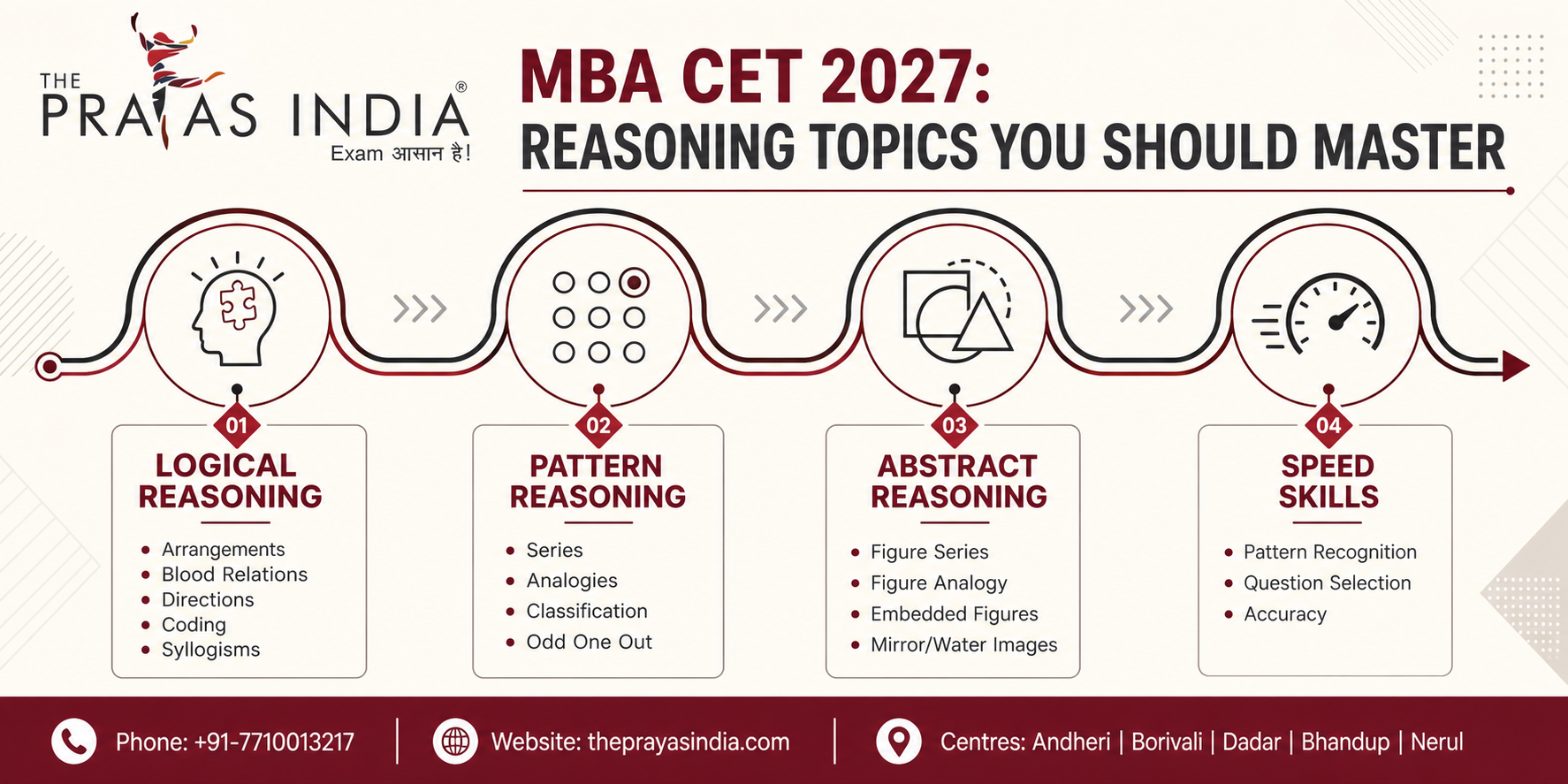
2. Abstract Reasoning: Build Pattern Recognition Speed
The official MBA CET 2026 pattern includes 25 questions from Abstract Reasoning. The official syllabus describes Logical/Abstract Reasoning as including questions based on figures and diagrams as well as verbal reasoning.
Abstract Reasoning can become a scoring area for students who develop strong visual pattern recognition. However, it requires consistent exposure to different types of figures.
Important Abstract Reasoning Topics
1. Figure Series
Learn to identify changes involving:
- Rotation
- Movement
- Addition
- Removal
- Direction
- Number of elements
- Position changes
2. Figure Analogy
Understand how one figure changes into another and apply the same relationship to a new pair.
3. Odd Figure Out
These questions require you to identify the figure that does not follow the common pattern.
4. Figure Classification
Practise grouping figures according to their structural or transformational relationships.
5. Mirror and Water Images
Develop familiarity with:
- Mirror-image changes
- Water-image changes
- Direction reversal
- Position reversal
6. Embedded Figures
These questions test your ability to locate a smaller figure inside a complex image.
7. Paper Folding and Figure Formation
Where applicable, practise questions involving:
- Folding
- Cutting
- Unfolding
- Shape formation
- Figure completion
How to Improve Abstract Reasoning
Abstract Reasoning should not be studied only by reading explanations. It requires visual practice.
Spend a short amount of time regularly solving different figure-based questions. Over time, your brain becomes faster at recognising transformations.
3. Quantitative Aptitude: Focus on Arithmetic and Calculation Speed
The official MBA CET 2026 pattern includes 50 questions in Quantitative Aptitude. The official syllabus specifically refers to numerical calculations, arithmetic problems involving concepts such as ratio and proportion and percentage, along with interpretation of tables, graphs and charts.
For MBA CET, Quant preparation should not become an exercise in learning unnecessarily complicated mathematics. The focus should be on building strong fundamentals and solving standard question types quickly.
Important Quantitative Aptitude Topics
1. Percentages
Percentage is one of the most useful concepts because it connects with several other areas.
Practise:
- Percentage increase/decrease
- Successive percentage changes
- Comparison
- Percentage-based word problems
2. Ratio and Proportion
Important subtopics include:
- Basic ratios
- Proportions
- Direct proportion
- Inverse proportion
- Mixtures
- Partnership-based applications
A strong understanding of ratios can also help with faster calculations in other topics.
3. Profit, Loss and Discount
Focus on:
- Cost price
- Selling price
- Marked price
- Discount
- Profit percentage
- Loss percentage
- Successive discounts
4. Averages
Practise:
- Basic averages
- Weighted averages
- Changes in average
- Replacement-based problems
5. Time, Speed and Distance
Important concepts include:
- Relative speed
- Average speed
- Trains
- Boats and streams
- Basic movement problems
6. Time and Work
Focus on:
- Work efficiency
- Individual work
- Combined work
- Work and wages
- Pipes and cisterns
7. Simple and Compound Interest
Understand:
- Simple Interest
- Compound Interest
- Difference between SI and CI
- Growth-based applications
8. Number System
Important areas include:
- Divisibility
- Factors and multiples
- HCF and LCM
- Remainders
- Units digit
- Basic number properties
9. Algebra
Students should develop comfort with:
- Linear equations
- Basic quadratic equations
- Algebraic identities
- Simplification
- Inequalities
10. Data Interpretation
The official syllabus specifically mentions interpretation of tables, common graphs and charts.
Practise:
- Tables
- Bar graphs
- Line graphs
- Pie charts
- Percentage-based DI
- Comparison-based DI
The important skill is not only calculation. You should learn to quickly identify which information is actually required.
4. Verbal Ability and Reading Comprehension: Build Accuracy Without Losing Time
The official MBA CET syllabus includes Verbal Ability and Reading Comprehension, with 50 questions in the 2026 pattern. The official description mentions comprehension passages, grammar, vocabulary, sentence completion, synonyms, antonyms and appropriate word/phrase selection.
This section should be prepared consistently rather than through last-minute vocabulary memorisation.
Important VARC Topics
1. Reading Comprehension
Practise passages covering different subjects and writing styles.
Focus on:
- Main idea
- Supporting details
- Inference
- Tone
- Vocabulary in context
- Passage-based conclusions
The objective is to understand the passage efficiently rather than reading every sentence repeatedly.
2. Vocabulary
Build vocabulary through context and regular reading.
Focus on:
- Synonyms
- Antonyms
- Word usage
- Contextual meaning
- Commonly confused words
3. Grammar
Important areas include:
- Subject-verb agreement
- Tenses
- Articles
- Prepositions
- Pronouns
- Conjunctions
- Modifiers
- Sentence structure
4. Sentence Completion
Practise understanding the context before selecting an option.
Look for:
- Logical flow
- Tone
- Grammar
- Word relationships
- Contextual meaning
5. Para-Based Questions
Depending on the question pattern, practise:
- Sentence arrangement
- Paragraph completion
- Logical sequence
- Connecting sentences
How Should You Prioritise These MBA CET Topics?
One of the biggest mistakes students make is trying to complete every topic with exactly the same amount of time.
Instead, create three preparation layers.
| Priority | What to Focus On | Preparation Approach |
|---|---|---|
| High | Core LR, Arithmetic, RC, Vocabulary, Abstract Reasoning | Regular practice |
| Medium | Advanced LR, Algebra, DI, Grammar | Concept + practice |
| Support | Less familiar or difficult question types | Targeted practice |
The exact importance of individual subtopics can vary from one paper to another. Therefore, students should use previous-year questions and mock tests to identify which areas are consistently causing difficulty.
The Right Way to Prepare These Topics
Knowing the important topics is only the first step. The real improvement comes from the way you practise them.
Start with concept clarity. Make sure you understand the basic method before trying to solve questions at high speed.
Move next to untimed practice. At this stage, focus on understanding different question patterns and avoiding conceptual mistakes.
Once accuracy becomes stable, introduce timed sets. Solve a fixed number of questions under a time limit and record both your accuracy and average solving time.
Finally, integrate these topics into full-length MBA CET mock tests. This is where you learn how to make decisions under the pressure of a 150-minute, 200-question examination.
Topic-Wise Preparation Is Not Enough: Build Speed Alongside Accuracy
A student may know the formulas, understand reasoning concepts and have a reasonable vocabulary, but still struggle in MBA CET because the exam requires rapid decision-making.
The official 2026 examination structure gives candidates 150 minutes for 200 questions, which means preparation must eventually move beyond individual topic practice toward speed-oriented solving. There is also no negative marking under the official 2026 marking scheme.
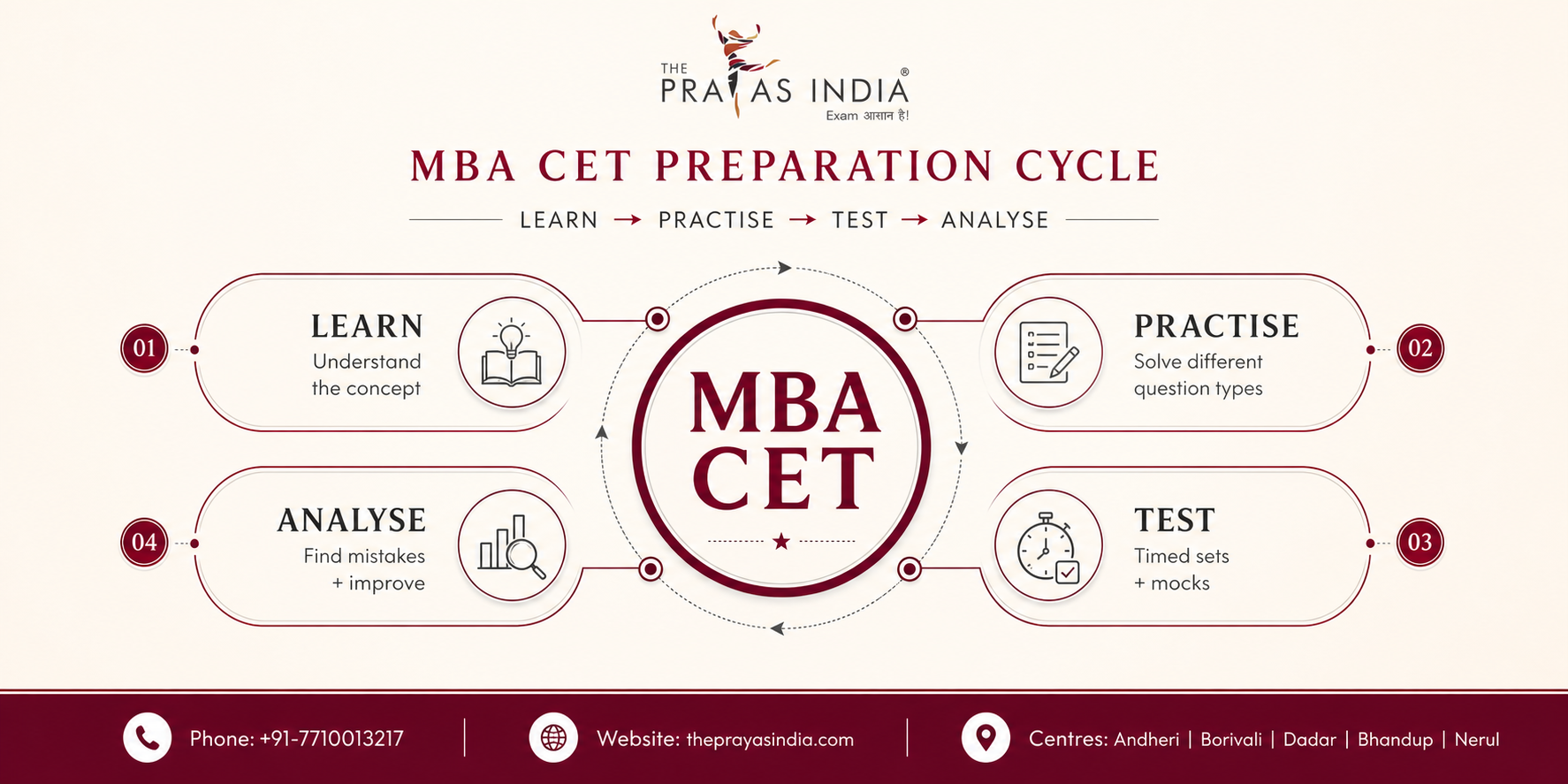
This means your preparation should gradually move through four stages:
Learn → Practise → Time Yourself → Simulate the Exam
Do not jump directly to full-length mocks if your basic concepts are weak. Similarly, do not remain stuck in untimed practice for months.
MBA CET Topic-Wise Preparation Strategy
Phase 1: Build Your Fundamentals
Start by covering the core concepts in all four areas.
For Logical Reasoning, understand the common structures of arrangements, coding, directions, blood relations, syllogisms and statement-based reasoning.
For Quantitative Aptitude, strengthen arithmetic fundamentals such as percentages, ratios, averages, profit and loss, time and work, time-speed-distance and basic number properties.
For VARC, combine grammar, vocabulary and reading comprehension instead of focusing on only one area.
For Abstract Reasoning, develop familiarity with common visual transformations and figure-based patterns.
The objective of this phase is clarity, not maximum speed.
Phase 2: Convert Concepts into Speed
Once you understand the topics, begin solving timed sets.
For example:
- 15–20 LR questions under a fixed time
- 10–15 Quant questions under a fixed time
- 1–2 RC passages under a fixed time
- 15–20 Abstract Reasoning questions under a fixed time
- Short mixed-section practice sets
Maintain an error log.
Record:
Question → Mistake → Correct Approach → Time Taken → Reason for Error
After a few weeks, this log becomes much more useful than simply knowing your total mock score.
Phase 3: Use Previous-Year Questions
Previous-year questions are important because they help students understand the nature of the examination better than random practice questions.
Use them to identify:
- Familiar question structures
- Your weak topics
- Calculation patterns
- Frequently repeated concepts
- Questions that consume too much time
- Areas where you make avoidable errors
Do not simply solve previous-year questions and check the answer.
Ask yourself:
Could I have solved this faster?
Did I use the simplest method?
Did I spend too long understanding the question?
Was the question worth attempting immediately?
These questions help develop exam-oriented thinking.

MBA CET Mock Tests: The Bridge Between Preparation and Performance
Mock tests should not be treated simply as a way of checking your score.
A mock test tells you how effectively you can apply your preparation when several things happen simultaneously: the clock is running, questions vary in difficulty, some questions take longer than expected, and you must decide whether to continue or move ahead.
After every mock, analyse at least four things:
1. Accuracy
How many questions did you get right?
2. Speed
Which questions consumed excessive time?
3. Selection
Which questions should you have attempted earlier, and which should you have left for later?
4. Conceptual Gaps
Which mistakes happened because you did not know the concept?
This analysis is where much of the value of mock testing comes from.
How to Improve Question Selection
MBA CET preparation should include question-selection practice because not every question deserves the same amount of attention.
When practising, classify questions as:
Quick: Can be solved almost immediately.
Standard: Requires some calculation or reasoning but follows a familiar method.
Time-consuming: Requires multiple steps or extensive calculation.
Unclear: You are not immediately sure how to approach it.
During mock analysis, identify how often you spend too much time on the last two categories.
The goal is not to avoid difficult questions forever. The goal is to develop the judgement to decide when a question is worth your time.
Calculation Speed: An Essential Part of MBA CET Preparation
Quantitative Aptitude is not only about knowing formulas.
Students should work on:
- Percentage calculations
- Fraction-to-percentage conversions
- Squares and cubes
- Multiplication
- Division
- Approximation
- Ratio calculations
- Basic mental arithmetic
Faster calculations can reduce the time spent on standard questions and give you more flexibility elsewhere in the paper.
However, speed should not come at the cost of accuracy. A faster calculation that produces the wrong answer does not improve your performance.
How to Prepare for MBA CET If You Are Starting from Zero
If you are beginning preparation from scratch, do not start by attempting full-length mocks every day.
Use a gradual progression.
Month 1: Foundation
Focus on:
- Basic arithmetic
- Core LR concepts
- Basic abstract reasoning
- Grammar fundamentals
- Reading habit
- Basic vocabulary
Month 2: Topic Practice
Move toward:
- Mixed LR sets
- Arithmetic practice
- DI
- RC
- Advanced reasoning patterns
- Regular timed sets
Month 3: Speed Building
Increase:
- Timed practice
- Sectional tests
- Previous-year questions
- Calculation drills
- Abstract reasoning speed
Final Phase: Mock + Analysis
Focus on:
- Full-length mocks
- Mock analysis
- Revision
- Weak-area practice
- Question selection
- Speed and accuracy
The exact timeline should be adjusted according to your starting level and the examination schedule.
A Practical Daily MBA CET Study Routine
Students preparing alongside college or other responsibilities can divide their preparation into focused sessions.
Session 1: Quantitative Aptitude
Spend time on one concept followed by timed questions.
Session 2: Logical/Abstract Reasoning
Practise different question structures instead of solving only one type repeatedly.
Session 3: VARC
Combine reading comprehension, vocabulary and grammar.
Session 4: Speed Practice
Solve a short mixed set under a strict time limit.
Session 5: Analysis
Review mistakes and update your error log.
Even a shorter daily routine can become effective when maintained consistently.
Common Mistakes Students Make While Preparing Important MBA CET Topics
Trying to Complete Everything Before Practising
Students sometimes spend weeks watching lectures and making notes without solving enough questions.
MBA CET preparation requires application. Move from learning to practice as soon as the basic concept becomes clear.
Ignoring Abstract Reasoning
Because Abstract Reasoning has fewer questions than Logical Reasoning in the official pattern, students sometimes postpone it.
That can create a problem later because visual pattern recognition improves through practice.
Focusing Only on Quantitative Aptitude
Students with a mathematics background may spend too much time on Quant while neglecting LR and VARC.
Your preparation should remain balanced across the entire paper.
Taking Mocks Without Analysis
A mock score by itself does not tell you what to improve.
Always analyse your wrong answers, unattempted questions and time-consuming questions.
Practising Without a Timer
Eventually, speed must become part of your preparation.
Once your concepts are reasonably strong, timed practice should become a regular part of your routine.
How The Prayas India Can Support MBA CET Preparation
Preparing for MBA CET becomes more structured when students have a clear study plan, regular practice and a system for tracking improvement.
At The Prayas India, MBA CET aspirants can prepare through structured online and offline coaching, supported by topic-wise learning, practice sessions, mock tests, revision and performance analysis.
A coaching programme can be particularly useful for students who struggle to decide what to study first, how much time to allocate to different sections, or how to analyse their mock-test performance.
The objective should not be to simply complete the syllabus. The preparation should gradually move toward concept clarity, speed, accuracy, question selection and exam readiness.
Admissions are open for MBA CET preparation at The Prayas India.
MBA CET Preparation Checklist
Before considering your preparation complete, make sure you have covered the following:
Logical Reasoning
- Arrangements
- Blood Relations
- Directions
- Coding-Decoding
- Syllogisms
- Series
- Statement-based reasoning
- Ranking and ordering
Abstract Reasoning
- Figure Series
- Figure Analogy
- Classification
- Odd One Out
- Embedded Figures
- Mirror/Water Images
- Figure Formation
Quantitative Aptitude
- Percentages
- Ratio and Proportion
- Averages
- Profit and Loss
- Time and Work
- Time-Speed-Distance
- Simple and Compound Interest
- Number System
- Algebra
- Data Interpretation
Verbal Ability & Reading Comprehension
- Reading Comprehension
- Vocabulary
- Synonyms and Antonyms
- Grammar
- Sentence Completion
- Para-based questions
- Contextual word usage
Exam Skills
- Calculation speed
- Timed practice
- Question selection
- Mock tests
- Mock analysis
- Error tracking
- Revision
Final Takeaway
The most important topics for MBA CET preparation are not simply the topics that appear in a syllabus list. They are the areas where strong fundamentals can be converted into fast, accurate and confident question-solving.
Begin with the core areas of Logical Reasoning, Abstract Reasoning, Quantitative Aptitude and Verbal Ability/Reading Comprehension. Build your concepts first, then introduce timed practice, previous-year questions and mock tests.
Most importantly, do not measure preparation only by how many chapters you have completed. Measure it by whether you are becoming faster, more accurate and better at selecting questions.
The official MAH-MBA/MMS CET structure can change through future notifications, so candidates should always verify the latest syllabus, pattern and examination instructions from the State CET Cell before the exam.
FAQs: Most Important Topics for MBA CET Preparation
1. What are the most important topics for MBA CET?
Important preparation areas include Logical Reasoning, Abstract Reasoning, Quantitative Aptitude and Verbal Ability/Reading Comprehension. Within these, students should focus on core areas such as arrangements, coding, arithmetic, DI, RC, grammar, vocabulary and figure-based reasoning.
2. Which section has the highest number of questions in MBA CET?
In the official MAH-MBA/MMS CET 2026 pattern, Logical Reasoning has 75 questions, while Abstract Reasoning, Quantitative Aptitude and Verbal Ability/Reading Comprehension have 25, 50 and 50 questions respectively.
3. Is Quantitative Aptitude important for MBA CET?
Yes. Quantitative Aptitude accounts for 50 questions in the official 2026 structure, so students should build strong arithmetic and calculation fundamentals.
4. Which Quant topics should I study first?
Start with percentages, ratio and proportion, averages, profit and loss, time and work, time-speed-distance and number-system fundamentals. You can then move toward algebra and data interpretation.
5. Is Abstract Reasoning important for MBA CET?
Yes. Abstract Reasoning forms a separate component of the examination. Regular practice can help students become more comfortable with visual patterns and transformations.
6. How should I prepare for Logical Reasoning?
Begin with common structures such as arrangements, coding-decoding, blood relations, directions, syllogisms, series and statement-based reasoning. After learning the concepts, practise timed sets.
7. How important is Reading Comprehension for MBA CET?
Reading Comprehension is part of the official Verbal Ability/Reading Comprehension section. Students should practise understanding the main idea, details, inference and contextual meaning while improving reading speed.
8. Does MBA CET have negative marking?
The official MAH-MBA/MMS CET 2026 brochure states that there is no negative marking. Candidates should nevertheless verify the applicable rules for their examination year from the latest official notification.
9. How many questions are there in MBA CET?
The official 2026 structure contains 200 questions, with a test duration of 150 minutes.
10. Should I solve previous-year MBA CET questions?
Yes. Previous-year questions can help you understand question structures, identify weak areas and practise exam-oriented problem solving.
11. When should I start taking MBA CET mock tests?
You can begin with sectional or topic-wise tests after developing basic conceptual clarity. Full-length mocks should gradually become a regular part of preparation as your syllabus coverage and speed improve.
12. Can coaching help with MBA CET preparation?
Structured coaching can help students organise the syllabus, follow a study plan, practise regularly and analyse mock-test performance. The Prayas India offers MBA CET preparation through online and offline modes.
Master Your MBA CET Logical Reasoning Strategy!
Recognizing patterns quickly and eliminating avoidable errors is the secret to a 99.9+ percentile. Connect with expert MBA mentors at The Prayas India to build elite speed-building strategies and clear your target cutoff.
Official Website: theprayasindia.com
Visit Our Mumbai Centres:
Andheri | Borivali | Dadar | Nerul | Bhandup