
CAT 2027 DILR Preparation: How to Start with Sets from the Basics | The Prayas India
Data Interpretation and Logical Reasoning, commonly known as DILR, is one of the most distinctive sections of the CAT exam. Unlike Quantitative Aptitude, where students can often identify a topic from the question itself, DILR usually presents information through a set and requires the candidate to understand the structure, identify relationships, organise the information and then answer multiple questions based on the same framework.
For a beginner, this can initially feel confusing. A DILR set may contain a table, chart, arrangement, schedule, game, network, selection condition or a combination of several pieces of information. The difficulty is often not because every individual calculation is complicated. Instead, the real challenge is deciding how to represent the information and which approach will unlock the set.
That is why CAT 2027 DILR preparation should not begin with randomly solving difficult sets. Beginners need to first understand what a DILR set is, how to read its conditions, how to structure information and how to recognise recurring patterns.
The objective of this article is to provide a step-by-step roadmap for students who are starting DILR from the basics. Whether you are a college student, a working professional, a non-maths student or someone preparing for CAT for the first time, the same fundamental principle applies: build the ability to think through sets before trying to maximise speed.
Important for CAT 2027
The official CAT 2027 notification and examination-specific details are not available yet. This article uses the latest available CAT framework as the preparation reference. Candidates should check the official CAT website when the CAT 2027 notification is released for the final exam pattern, section details, timings and other changes.
What Is DILR in CAT?
DILR combines two closely connected skill areas: Data Interpretation and Logical Reasoning.
Data Interpretation involves extracting information from data presented in different formats and using that information to reach conclusions. The data may appear in tables, bar graphs, line graphs, pie charts, caselets or other structured formats. However, modern CAT preparation should not be restricted to traditional graph-based DI because CAT-style sets can require interpretation, comparison and logical deductions in addition to calculations.
Logical Reasoning focuses more heavily on relationships, conditions, arrangements, selections, sequences, distributions and deductions. A set may ask you to arrange people or objects, determine possible combinations, identify valid cases or infer an outcome from multiple conditions.
In practice, the boundary between DI and LR is not always rigid. Many sets combine numerical information with logical conditions. Therefore, the most useful way to approach DILR preparation is not to treat it as a collection of isolated chapters but as a set-solving skill.
The official CAT framework has historically treated DILR as one of the three sections of the examination, alongside VARC and QA. Official CAT material also reports sectional scores and percentiles, which is one reason candidates should not treat DILR as an optional part of their overall preparation.
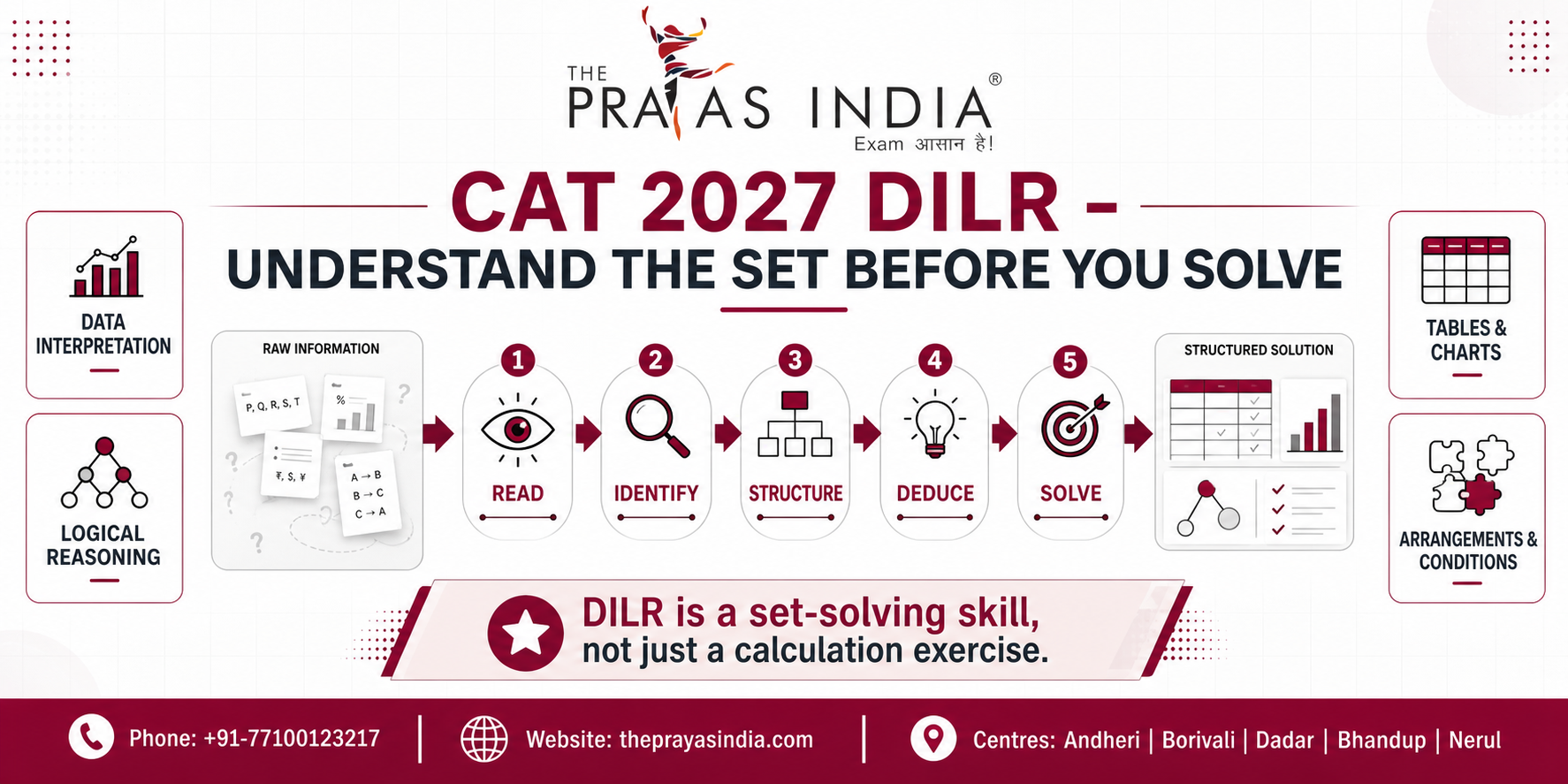
Why Does DILR Feel Difficult for Beginners?
The first problem beginners encounter is usually not mathematics. It is information overload.
Imagine a set that tells you that six people are attending three meetings, each person has a different preference, two people cannot attend the same meeting, one person must attend before another, and exactly two people belong to a particular category. Even before answering the questions, you have to organise all these conditions.
This creates three separate challenges.
First, you have to understand the information correctly. Missing one condition can make an otherwise correct solution impossible.
Second, you need to represent the information efficiently. A paragraph may be difficult to process mentally, while a small table or diagram can make the relationships immediately visible.
Third, you need to identify the correct path. Some sets become manageable after one key observation, while others require systematic casework.
This is why repeatedly solving random advanced sets is not necessarily the best starting strategy. A beginner needs to develop a process for converting information into structure.
The Most Important Mindset Shift: DILR Is About Sets, Not Individual Questions
A common mistake is to look at every DILR question separately.
Instead, think of the set as the primary unit of preparation.
Suppose one set contains four questions. You should not think:
Question 1 → solve → Question 2 → solve → Question 3 → solve.
Think:
Understand the set → build the structure → identify deductions → answer multiple questions.
Once the underlying structure has been correctly established, several questions may become straightforward.
This is one of the biggest differences between DILR and conventional chapter-based preparation. You are not simply learning a formula and applying it. You are learning how to build and manipulate a model of the information provided in the set.
A Beginner-Friendly DILR Cycle
READ → STRUCTURE → DEDUCE → SOLVE → VERIFY
The goal during the initial stage of preparation should be to make this process natural.
Step 1: Learn to Read a DILR Set Properly
Before attempting calculations or making assumptions, read the entire set carefully.
Many beginners start solving as soon as they encounter the first piece of information. This can create an incomplete representation of the problem because later conditions may completely change the way the first condition should be interpreted.
Instead, develop the habit of identifying:
- Who or what is involved?
- What information is fixed?
- What information is variable?
- What relationships are given?
- What restrictions exist?
- What quantities need to be determined?
- Which conditions can be combined?
Do not worry if your first few attempts take a long time. At this stage, comprehension is more important than speed.
Step 2: Identify the Type of Information
Once you have read the set, ask yourself what kind of structure the information naturally suggests.
For example:
People + positions
→ arrangement
People + days + activities
→ scheduling
Items + categories + quantities
→ distribution/table
Cities + routes + connections
→ network/graph
Scores + percentages + quantities
→ data table/calculation
Selection restrictions
→ grouping or casework
This classification does not mean that every set belongs to one fixed category. CAT-style sets can combine multiple concepts. The purpose is simply to give your brain a starting framework.
Step 3: Convert Words into a Visual Structure
This is one of the most important DILR skills.
Suppose a question says:
“Five students A, B, C, D and E are sitting in five different positions. A sits immediately before C. B cannot sit next to D.”
Reading these statements repeatedly is inefficient.
Instead, convert them into a structure:
A C
and
B ≠ adjacent to D
Now the conditions become easier to manipulate.
Similarly, if a set gives information about days, create a calendar-like table. If it gives information about people and categories, create a matrix. If it describes relationships between locations, draw a network.
The representation does not need to be beautiful. It needs to be functional.
Step 4: Learn the Basic DILR Representation Tools
Beginners should become comfortable with a small set of representations.
Tables
Tables are useful when several variables interact.
For example:
| Person | Monday | Tuesday | Wednesday |
|---|---|---|---|
| A | ? | ? | ? |
| B | ? | ? | ? |
| C | ? | ? | ? |
Instead of keeping every possibility in your head, the table externalises the information.
Grids
A grid can be useful when you need to establish whether two elements can or cannot be associated.
For example:
| X | Y | Z | |
|---|---|---|---|
| A | ? | ? | ? |
| B | ? | ? | ? |
| C | ? | ? | ? |
You can mark confirmed relationships and eliminate impossible ones.
Number Lines
Number lines are useful for rankings, positions, age-related conditions, scores and ordered arrangements.
Flowcharts
Flowcharts are useful when information involves movement, processes or sequential decisions.
Networks
Networks can simplify route, connection and relationship-based sets.
The purpose of these tools is simple: move information from your working memory onto paper or screen in an organised form.
Step 5: Start with Easy Sets, Not Difficult Sets
A beginner should not measure progress by the number of extremely difficult sets solved.
Instead, start with sets where the primary objective is learning the structure.
Your initial progression can look like this:
Level 1: Direct tables and basic data interpretation
↓
Level 2: Simple arrangements and distributions
↓
Level 3: Basic selection and grouping
↓
Level 4: Multi-condition logical sets
↓
Level 5: Mixed DI-LR sets
↓
Level 6: CAT-level sets under time pressure
This gradual increase in complexity helps you develop pattern recognition.
If you immediately begin with advanced CAT-level sets, repeated failure can make DILR appear much more difficult than it actually is.
Step 6: Master the Basic Set Types
A strong beginner foundation should include several broad DILR structures.
1. Arrangements
Arrangement sets involve placing people, objects or events in a specific order.
Common formats include:
- Linear arrangements
- Circular arrangements
- Ranking
- Position-based arrangements
- Scheduling
The key skill is learning to convert verbal conditions into positional relationships.
2. Distribution
Distribution sets involve assigning objects, people, resources or quantities to different groups.
Typical questions may involve conditions such as:
- At least one
- Exactly two
- Maximum
- Minimum
- Cannot be together
- Must be together
These words matter because they determine the structure of possible cases.
3. Selection and Grouping
These sets ask you to form teams, committees or groups while satisfying multiple restrictions.
The important skill is not simply calculating combinations. It is understanding which selections are permitted and which are eliminated by the conditions.
4. Tables and Caselets
These sets present information in paragraph form and require you to create a table or extract relationships.
They are particularly useful for beginners because they teach the fundamental skill of converting textual information into structured data.
5. Games and Tournaments
These sets may involve matches, wins, losses, points or rankings.
You need to understand the scoring system first and then establish relationships between outcomes.
6. Networks and Routes
These sets involve connections between locations, people or entities.
Drawing the network is often more effective than repeatedly reading the conditions.
How to Know Which Set to Solve First
In the actual CAT exam, one of the most important DILR skills is set selection.
A candidate may understand how to solve a difficult set but still lose valuable time by choosing it too early.
During practice, therefore, do not only ask:
“Can I solve this set?”
Also ask:
“How quickly can I identify whether this set is worth attempting?”
Look for:
- Clear information
- Familiar structure
- Manageable number of variables
- Strong initial deductions
- Limited or controlled casework
- Questions that appear interconnected
Be cautious when a set contains too many variables, unclear conditions, extensive casework or a structure that you cannot decode after a reasonable initial reading.
Set selection is not about avoiding difficult questions permanently. It is about learning to allocate limited exam time intelligently.
Step 7: Build Your DILR Vocabulary
DILR questions frequently depend on precise wording.
Words such as only, exactly, at least, at most, either, neither, unless, before, after, immediately, consecutive, different, same, minimum and maximum can change the meaning of a condition.
A beginner should consciously highlight or mentally identify these words while reading.
For example:
“A is before B”
does not necessarily mean A is immediately before B.
But:
“A is immediately before B”
creates a much stronger positional restriction.
Similarly:
“At least two” means two or more.
“At most two” means two or fewer.
“Exactly two” means precisely two.
Small language differences can create completely different solution spaces.
Step 8: Learn Controlled Casework
Casework is not something beginners should fear. It is a tool for systematically handling multiple possibilities.
Suppose one condition gives you three possible positions for an element.
Instead of keeping all three possibilities in your head, create:
Case 1 → Position A
Case 2 → Position B
Case 3 → Position C
Then apply the remaining conditions to each case.
The key is controlled casework.
Uncontrolled casework happens when you create possibilities without eliminating them systematically. This quickly becomes confusing.
Good casework should have:
- A clear starting condition.
- A limited number of branches.
- A logical reason for each branch.
- Quick elimination wherever possible.
The objective is not to create every imaginable arrangement. It is to create only the cases that are logically possible.
A Simple Daily Routine for a DILR Beginner
If you are starting CAT 2027 preparation early, you do not need to spend several hours on DILR every day initially.
A focused session can look like this:
10 minutes: Review a previously solved concept or set.
20 minutes: Solve one beginner-level set without worrying about speed.
15 minutes: Analyse the solution and compare your representation with the standard approach.
15 minutes: Solve a second set or revisit the difficult portion of the first set.
10 minutes: Record the key learning in an error/strategy notebook.
The most important part is the analysis after solving.
A set that takes you 25 minutes but teaches you three important deductions can be more valuable than several sets that you solve mechanically.
What Should You Record in Your DILR Notebook?
Do not create a notebook that contains only solutions.
Create a DILR learning notebook with sections such as:
Set Type
Arrangement / Distribution / Selection / DI / Network / Mixed
What Was the Key Idea?
Write the observation that unlocked the set.
Where Did I Get Stuck?
Was the problem:
- Understanding the condition?
- Choosing the representation?
- Creating cases?
- Doing calculations?
- Selecting the set?
- Managing time?
Better Approach
Write how the same set could be approached more efficiently.
Time Taken
Record your actual solving time.
This turns practice into measurable improvement rather than simply increasing the number of sets completed.
The Right Way to Use Solutions
Do not look at the solution immediately after getting stuck.
First ask yourself:
What exactly am I unable to determine?
Maybe the representation is wrong. Maybe one condition has been overlooked. Maybe you have created too many cases.
Spend some additional time trying to identify the blockage.
When you eventually read the solution, do not merely copy the steps. Ask:
What did the solution setter notice that I did not?
That question is much more valuable.
Over time, you will start recognising common structures faster.
How Many DILR Sets Should You Solve?
There is no universal number that guarantees CAT success.
For a beginner, quality should come before quantity.
If you solve five sets without analysing them, the learning may be limited.
If you solve two sets carefully, identify the representation, understand the key deduction, review the alternative approach and record your mistakes, the learning can be considerably deeper.
A useful progression is:
Beginning stage: 1–2 quality sets per day
Foundation stage: 2–3 sets per day
Intermediate stage: 3–4 sets per day
Advanced stage: Timed mixed sets + sectional practice
These numbers are flexible. The appropriate workload depends on your existing aptitude, available preparation time and performance.
CAT 2027 DILR Preparation: What Beginners Should Focus on First
At the beginning, your priority should be:
Understanding > Representation > Accuracy > Pattern Recognition > Speed
Do not reverse this order.
Many aspirants make the mistake of timing themselves from their first day of DILR preparation. While time tracking eventually becomes essential, excessive focus on speed before understanding can create bad habits.
Once you can consistently understand and structure easy and moderate sets, speed improvement becomes much easier.
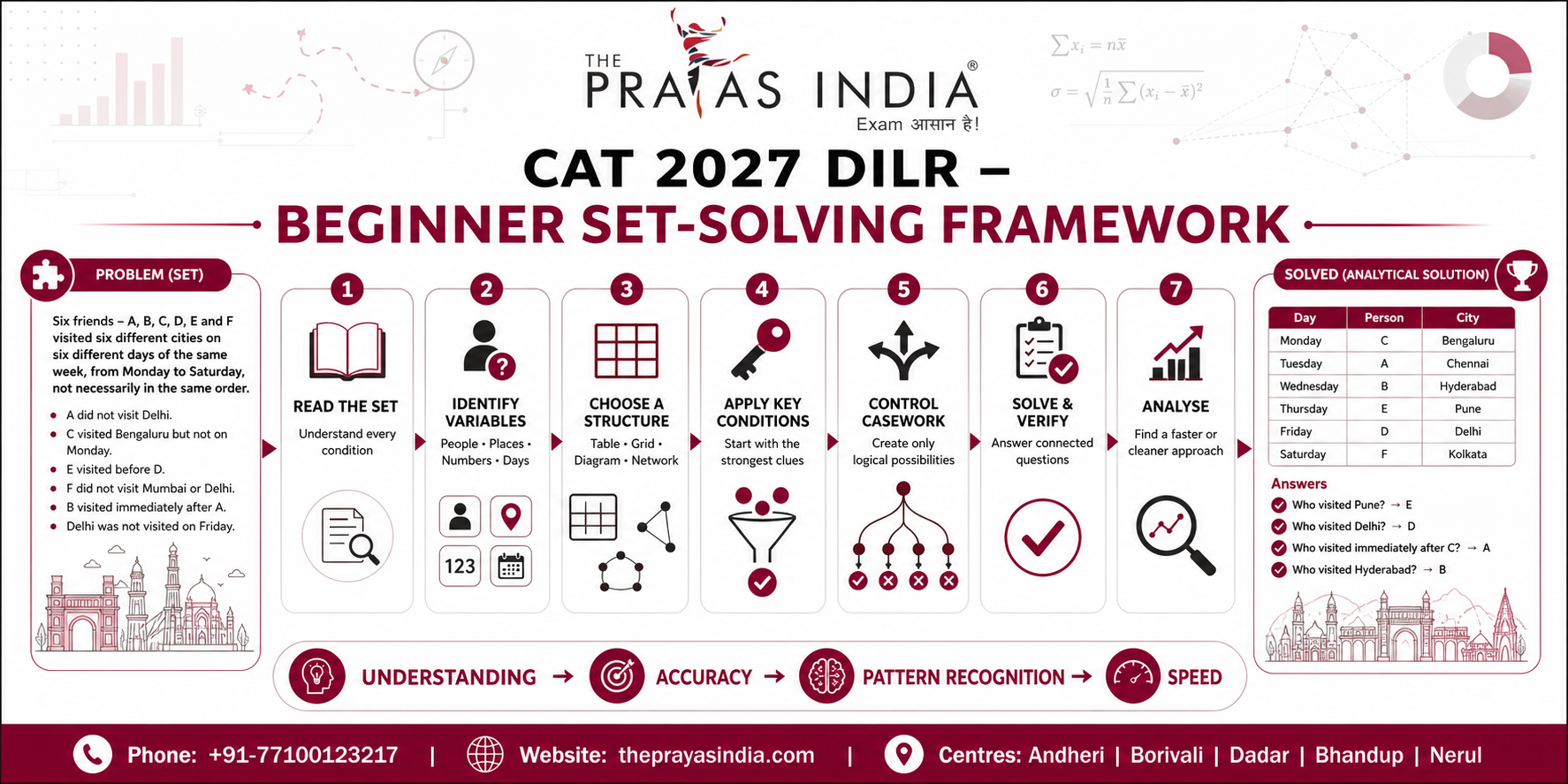
Beginner DILR Priority Framework
1. Understand the language of the set
↓
2. Identify the variables
↓
3. Choose a representation
↓
4. Apply the strongest conditions first
↓
5. Create controlled cases if necessary
↓
6. Solve interconnected questions
↓
7. Analyse the solution
↓
8. Repeat with increasing difficulty
Common Beginner Mistakes in DILR Preparation
Starting with difficult sets
Difficulty does not automatically equal better preparation. Build the foundation first.
Solving without creating a structure
Trying to remember every condition mentally increases cognitive load and leads to avoidable mistakes.
Ignoring wording
A single word such as “only” or “exactly” can change the entire set.
Doing uncontrolled casework
If your cases keep multiplying without a clear structure, stop and reconsider the representation.
Looking at solutions too quickly
Struggling productively is part of DILR learning.
Focusing only on calculations
DILR is not simply a calculation section. Interpretation, reasoning and structure are equally important.
Not analysing failed sets
A failed set can teach you more than an easy set if you understand why you failed.
Building Your Foundation Before Moving to Advanced Sets
The first phase of DILR preparation should make you comfortable with the basic mechanics of set solving. You should gradually reach a stage where reading a set automatically triggers certain questions in your mind:
What are my variables?
What is fixed?
What is flexible?
Which condition is strongest?
Can I create a table?
Can I eliminate possibilities?
Do I need cases?
Which question should I attempt first?
That thought process is the foundation of advanced DILR preparation.
Once this foundation becomes natural, you can move towards more complex mixed sets, CAT-level difficulty and eventually timed sectional practice.
DILR Preparation for Non-Maths Students
Students from non-mathematical backgrounds sometimes assume that DILR will be difficult because it contains data interpretation.
However, the initial focus should not be on advanced mathematical techniques. Many foundational DILR skills are based on reading, organisation, comparison, logical deduction and systematic elimination.
A non-maths student should therefore avoid developing the mindset that DILR is “not for me.” Instead, begin with structured sets and progressively introduce calculations where required.
The same principle applies to students who are mathematically comfortable but struggle with reasoning. Strong calculation ability does not automatically translate into strong DILR performance. Set interpretation and selection still need to be developed.
How Coaching Can Help in DILR Preparation
DILR is one area where guided preparation can be useful because the same set can often be approached through multiple methods.
A structured CAT preparation programme can help students understand different types of sets, learn standard representations, receive feedback on their approach and practise progressively more challenging questions.
More importantly, guided preparation can help prevent a common problem: spending weeks repeatedly practising the same type of set without identifying the underlying weakness.
For aspirants preparing for CAT 2027, the objective should not simply be to collect study material. The focus should be on building a repeatable set-solving process, supported by regular practice, analysis and feedback.
What Should Your Next Stage of DILR Preparation Look Like?
After completing the beginner phase, move towards:
- Moderate-level arrangements
- Advanced distributions
- Multi-condition selection sets
- Mixed DI-LR caselets
- Games and tournaments
- Networks and routes
- Complex tables
- CAT Previous Year Questions
- Timed set selection
- Sectional tests
The transition should be gradual.
Do not jump from basic sets directly into full-length timed DILR sections. First make sure that your solving approach is reliable.
Key Takeaway
CAT 2027 DILR preparation should begin with how to think through a set, not with how many questions you can solve in an hour.
A beginner who learns to read conditions carefully, represent information visually, identify strong deductions, control casework and analyse mistakes is building the exact foundation required for more advanced DILR preparation.
The long-term progression is straightforward:
Understand the set → Structure the information → Find the key deduction → Solve systematically → Analyse your approach → Improve speed.
Start with easy sets. Build consistency. Gradually increase complexity. Once your accuracy and set-selection ability improve, introduce time pressure.
For CAT 2027 aspirants, starting DILR preparation early gives you something extremely valuable: time to develop the thinking process instead of trying to rush through it during the final months.
Step 9: Move from Basic Sets to Mixed DILR Sets
Once you are comfortable with basic arrangements, tables, distributions and straightforward caselets, start introducing mixed sets.
A mixed set may combine several skills. For example, a problem could involve people being assigned to different days while also providing numerical data that has to be interpreted. Another set might combine ranking with selection restrictions.
These sets are important because CAT does not necessarily announce the underlying technique before presenting the problem. You have to discover the structure yourself.
During this stage, do not immediately focus on solving the set within a very short time. Instead, ask:
- What is the central structure?
- Which information is numerical?
- Which information is logical?
- What is fixed?
- What can change?
- Which condition gives the strongest restriction?
- Can one deduction reduce several possibilities?
- Is there a better representation than the one I initially created?
Your ability to answer these questions quickly is a major part of DILR preparation.
Step 10: Develop Strong Set-Selection Skills
Set selection is one of the most important skills to develop before beginning serious mock-test practice.
Suppose you encounter four sets. You may eventually be capable of solving all four, but you may not have enough time to solve them all during the examination. Therefore, the objective is not simply to know how to solve sets. It is also to recognise which set deserves your time first.
During practice, spend a few minutes reviewing a group of sets without solving them completely.
Look at:
- Number of variables
- Amount of information
- Familiarity of the structure
- Number of conditions
- Possibility of direct deductions
- Expected amount of casework
- Complexity of calculations
- Whether the questions appear interconnected
Then classify them mentally as:
Approachable → Requires thought → Potentially time-consuming
This classification does not mean that a difficult-looking set should always be ignored. It simply teaches you to evaluate the potential effort before committing significant time.
The Three-Question Set Selection Test
Before committing to a set, ask:
1. Do I understand what the set is asking?
2. Can I identify a possible starting point?
3. Can I see at least one useful deduction or representation?
If the answer to all three is yes, the set may be worth attempting.
If you cannot even identify the structure after reading it carefully, moving to another set may be more efficient.
Step 11: Learn to Find the First Breakthrough
Every DILR set has some information that can help you begin.
The first breakthrough may be:
- A fixed position
- A unique value
- A maximum/minimum condition
- A mandatory selection
- A direct comparison
- A total that must be maintained
- A restriction that eliminates several cases
- A relationship that connects two variables
Train yourself to search for this information.
For example, if a set says that one person must be first and another must be last, those conditions immediately reduce the possible arrangements.
Similarly, if a table provides a fixed total and several values are already known, the remaining values may become easier to determine.
The important lesson is:
Do not treat every condition equally.
Some conditions have significantly greater solving power than others.
Step 12: Master the Art of Elimination
DILR is often about reducing possibilities.
Suppose you initially have ten possible arrangements. If one condition eliminates four and another eliminates three, you are left with only three cases.
That is much easier than trying to construct the final arrangement directly.
This is why elimination is such an important skill.
Whenever you encounter a condition, ask:
“How many possibilities does this remove?”
If a condition removes almost nothing, it may not be the best starting point.
If another condition immediately eliminates half the possibilities, begin there.
This approach makes your solving process more systematic.
Step 13: Practise Different DILR Set Categories
At the intermediate stage, your preparation should become broad enough to expose you to different structures.
Arrangements and Scheduling
Practise:
- Linear arrangements
- Circular arrangements
- Multiple-day schedules
- Position-based problems
- Ordering and ranking
Focus on translating verbal conditions into positional relationships.
Selection and Distribution
Practise:
- Team formation
- Committee selection
- Grouping
- Resource distribution
- Conditional selection
Pay particular attention to words such as “exactly,” “at least,” “at most,” “either” and “neither.”
Games and Tournaments
Learn to organise:
- Matches
- Wins and losses
- Points
- Rankings
- Possible outcomes
Instead of calculating every possibility immediately, identify the constraints created by the scoring system.
Networks and Routes
Practise:
- Connections
- Paths
- Movement
- Relationships
- Network-based deductions
A visual diagram is usually more useful than keeping the entire structure mentally.
Data-Heavy Sets
Practise:
- Tables
- Percentage-based data
- Ratios
- Averages
- Comparisons
- Missing information
Here, the challenge is often identifying what the data actually allows you to conclude rather than performing complicated calculations.
Step 14: Build Your Calculation Efficiency
Although DILR is not purely a calculation section, inefficient calculations can consume valuable time.
Therefore, gradually improve:
- Percentage conversions
- Fractions
- Ratios
- Averages
- Basic arithmetic
- Approximation
- Comparison techniques
You do not need to turn every DILR session into a Quantitative Aptitude session. Instead, identify the calculations that repeatedly slow you down and practise those separately.
For example, if percentage conversions consistently take too long, spend a few minutes each day revising common fraction-percentage relationships.
The objective is not to perform unnecessarily complicated calculations. It is to recognise when a calculation can be simplified.
Step 15: Start Using CAT Previous Year Questions
Once your basic and intermediate foundation is established, CAT Previous Year Questions should become an important part of preparation.
PYQs help you understand the style of reasoning expected in the actual examination.
Do not use them merely as another collection of practice questions.
For every PYQ set, analyse:
What was the underlying structure?
What was the key observation?
Which information was most useful?
Could the set be represented differently?
Which questions could be solved first?
Where could time have been saved?
This analysis is often more valuable than simply recording whether you got the final answer right.
How to Maintain a DILR PYQ Log
| Set | Type | Time Taken | Accuracy | Key Idea | Mistake |
|---|---|---|---|---|---|
| Set 1 | Arrangement | 18 min | 3/4 | Fixed positions | Casework |
| Set 2 | Distribution | 15 min | 4/4 | Elimination | Calculation |
| Set 3 | Table | 12 min | 2/4 | Ratio relation | Misread condition |
Over time, this log can reveal patterns in your preparation.
If you repeatedly struggle with one type of set, that area deserves targeted practice.
Step 16: Introduce Timed Practice Gradually
Timing should be introduced only after you have developed reasonable comfort with the basic solving process.
Start by timing individual sets.
Then move to:
Two sets under a fixed time
Then:
Three mixed sets
Then:
A complete DILR sectional practice session
The purpose of timed practice is not merely to make you solve faster. It is to train you to make decisions while time is limited.
A good timed session therefore includes three skills:
Selection + Solving + Time Management
Step 17: Learn from Every Wrong Answer
There are several different reasons why a DILR answer can be wrong.
You may have:
- Misread the set
- Missed a condition
- Created an incorrect representation
- Made an arithmetic error
- Made an invalid assumption
- Created incomplete cases
- Spent too much time on one approach
- Selected the wrong set
These are very different problems.
If you simply write “wrong” beside the question, you lose the opportunity to identify the actual weakness.
Instead, classify your mistake.
DILR Error Categories
Conceptual: Did not understand the structure.
Interpretation: Misread the information.
Representation: Used an inefficient table/diagram.
Logic: Made an invalid deduction.
Calculation: Arithmetic or percentage mistake.
Casework: Missed or duplicated possibilities.
Selection: Chose a poor set.
Time Management: Spent too long before switching.
This classification can make your preparation much more targeted.
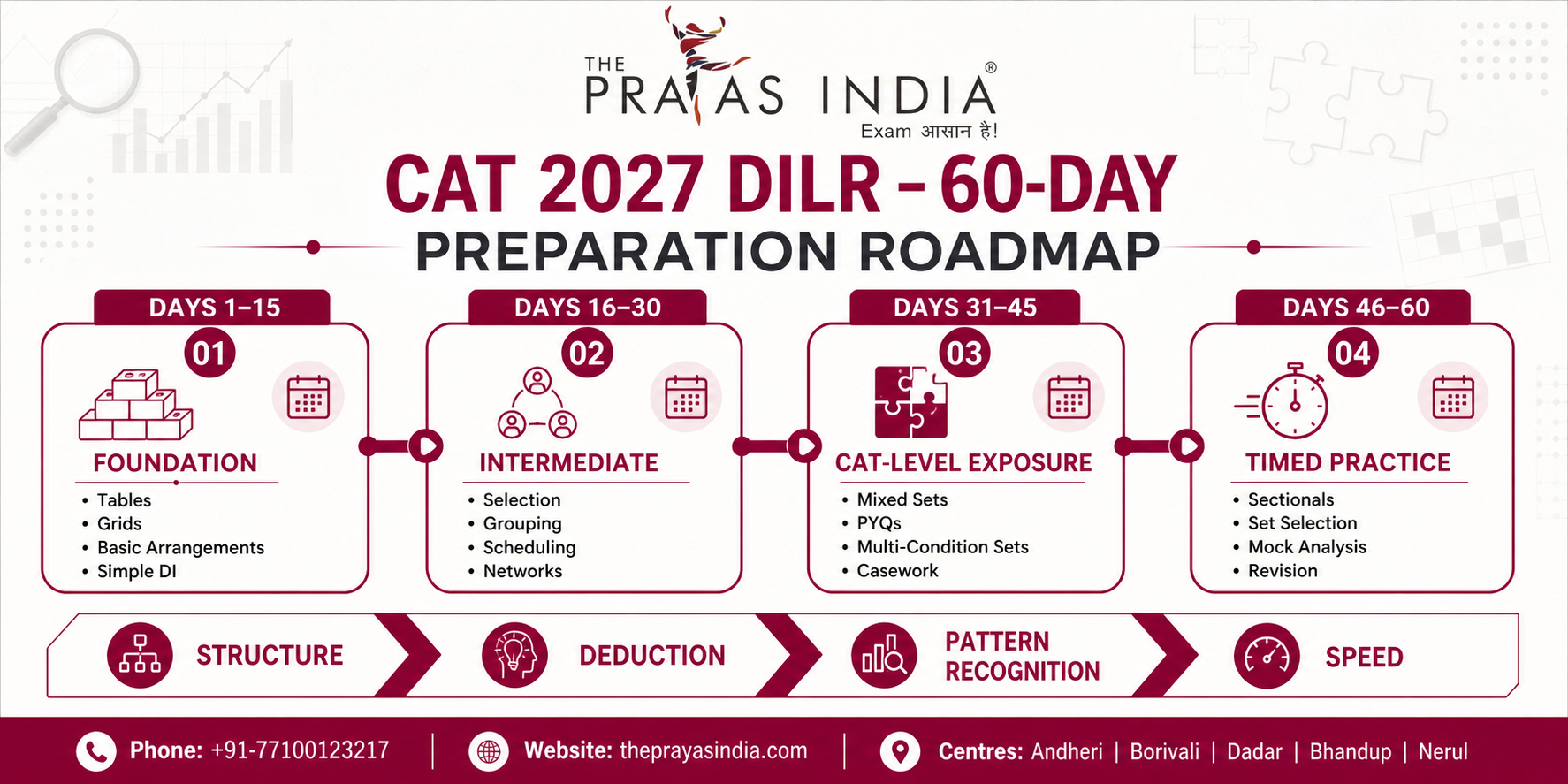
Step 18: Follow a 60-Day DILR Preparation Plan
A structured plan can help prevent random practice.
Days 1–15: Foundation
Focus on:
- Tables
- Grids
- Basic arrangements
- Simple distributions
- Basic data interpretation
- Easy caselets
Primary objective:
Understand how to represent information.
Days 16–30: Intermediate Sets
Focus on:
- Complex arrangements
- Selection
- Grouping
- Scheduling
- Moderate DI
- Basic networks
- Controlled casework
Primary objective:
Improve deductions and accuracy.
Days 31–45: CAT-Level Exposure
Focus on:
- Mixed sets
- PYQs
- Multi-condition problems
- Games and tournaments
- Complex data sets
- Advanced casework
Primary objective:
Improve pattern recognition and set selection.
Days 46–60: Timed Practice
Focus on:
- Timed sets
- Sectional tests
- Set selection
- PYQ revision
- Error-log revision
- Mock analysis
Primary objective:
Build exam-oriented decision-making.
Step 19: How to Analyse a DILR Mock Test
Taking a mock test is only the first part of the process.
The real improvement often happens during analysis.
After completing a sectional test, divide the sets into four categories:
Category A: Solved Correctly and Efficiently
These sets indicate approaches that are working.
Category B: Solved Correctly but Too Slowly
These require efficiency improvement.
Category C: Could Have Been Solved but Was Left
These are especially important. Ask why you skipped them.
Was the set selection incorrect? Did the set look harder than it actually was? Did you fail to identify the starting point?
Category D: Attempted but Incorrect
Analyse the exact source of the mistake.
This four-category analysis provides much more information than simply looking at your score.
Step 20: The Difference Between Practice and Exam Preparation
Practice teaches you how to solve.
Exam preparation teaches you when to solve, what to solve and when to move on.
This distinction becomes increasingly important as you progress.
During normal practice, it is perfectly acceptable to spend a long time understanding a difficult set.
During an examination, however, time is limited. You need to make decisions based on the expected value of your time.
Therefore, advanced preparation should include deliberate practice of:
- Reading sets quickly
- Identifying structure
- Estimating difficulty
- Choosing an attempt order
- Recognising when to abandon a set
- Returning to a set later if appropriate
- Avoiding emotional attachment to one problem
The ability to leave a difficult set is not a sign that you cannot solve it. It can simply be a time-management decision.
Step 21: CAT 2027 DILR Preparation for Working Professionals
Working professionals often face a different preparation challenge because the available study time is limited.
Instead of attempting to follow an unrealistic schedule, divide preparation into focused sessions.
For example:
Weekdays: One focused DILR set + analysis
Weekends: Multiple sets + PYQs + timed practice
A working professional should also maintain continuity. Missing an occasional session is less damaging than repeatedly starting and stopping the preparation cycle.
A structured coaching programme can also help working professionals by providing a defined learning path, practice material, tests and guidance instead of requiring them to independently organise every aspect of preparation.
Step 22: CAT 2027 DILR Preparation for Non-Maths Students
Non-maths students should initially focus heavily on the reasoning side of DILR while gradually strengthening the calculation skills required for DI.
Start with:
- Arrangements
- Selection
- Grouping
- Scheduling
- Tables
- Logical caselets
Then progressively introduce:
- Percentages
- Ratios
- Averages
- Data comparison
- Calculative DI sets
The objective is to remove the psychological barrier that DILR is “too mathematical.”
DILR rewards systematic thinking. A student who carefully structures information can often simplify a problem before performing any significant calculation.
Step 23: How to Improve DILR Speed Without Losing Accuracy
Speed should be treated as the result of familiarity and efficiency, not as something that can be forced immediately.
To improve speed:
Improve reading
Avoid repeatedly rereading the same condition.
Improve representation
A good table can save several minutes.
Improve deduction
Look for conditions that eliminate multiple possibilities.
Improve calculation
Use simpler numerical relationships wherever possible.
Improve selection
Do not spend excessive time on a set that has low solving potential.
Improve analysis
After every timed session, identify where time was actually lost.
Speed becomes sustainable when the process becomes cleaner.
Step 24: Common DILR Mistakes to Avoid
Mistake 1: Practising Only One Type of Set
Being excellent at arrangements does not guarantee comfort with data-heavy or mixed sets.
Mistake 2: Ignoring Set Selection
Solving ability is only one part of DILR performance.
Mistake 3: Memorising Approaches
Do not memorise a solution without understanding why it works.
Mistake 4: Avoiding Difficult Sets Completely
After building your foundation, difficult sets should be introduced gradually. They are important for developing flexibility.
Mistake 5: Timing Every Beginner Set
Initially, understanding should take priority over speed.
Mistake 6: Never Timing Practice
The opposite extreme is also problematic. Once your fundamentals are established, timed practice becomes essential.
Mistake 7: Not Revisiting Failed Sets
A difficult set can become a valuable learning resource when revisited after a few days.
Mistake 8: Measuring Progress Only Through Scores
Track accuracy, time, set selection and mistake categories as well.
Step 25: A Practical Weekly CAT 2027 DILR Schedule
A balanced weekly routine could look like this:
| Day | DILR Focus |
|---|---|
| Monday | 1–2 foundation/intermediate sets |
| Tuesday | Set type practice + analysis |
| Wednesday | 2 mixed sets |
| Thursday | PYQ practice |
| Friday | Weak-area practice |
| Saturday | Timed DILR session |
| Sunday | Mock/sectional analysis + revision |
You can modify this based on your overall CAT preparation schedule.
The important principle is consistency.
Step 26: How DILR Fits into Overall CAT 2027 Preparation
DILR should not be prepared in isolation from VARC and QA.
A student preparing for CAT 2027 needs to balance all three sections while also maintaining sufficient time for mock tests and revision.
One possible approach is:
Daily: DILR + one other CAT section
Weekly: At least one dedicated DILR timed session
Monthly: Review performance trends and weak areas
As the examination approaches, increase the frequency of mixed sectionals and full-length mocks.
The exact allocation should depend on your strengths and weaknesses rather than following an identical schedule throughout the year.

Final CAT 2027 DILR Preparation Strategy
Starting DILR preparation from the basics does not mean spending months solving only easy questions. It means developing the right foundation before introducing complexity and time pressure.
The ideal progression is:
Basic Sets → Representation → Deductions → Intermediate Sets → Mixed Sets → PYQs → Set Selection → Timed Practice → Sectionals → Mocks
At every stage, ask yourself what you are actually improving.
If you are solving more sets but making the same mistakes, your practice needs better analysis.
If you are getting questions correct but taking too long, work on representation, deduction and selection.
If you are fast but inaccurate, slow down temporarily and improve your process.
If you understand individual sets but struggle in mocks, focus on set selection and time management.
This approach makes DILR preparation measurable and adaptable.
For CAT 2027 aspirants, starting early provides enough time to build these skills gradually. Instead of treating DILR as a section that has to be “completed,” treat it as a reasoning ability that develops through repeated exposure, analysis and refinement.
CAT 2027 DILR Preparation: Key Takeaways
- Start with basic sets and gradually increase complexity.
- Learn to convert information into tables, grids and diagrams.
- Treat the entire set as the primary unit of preparation.
- Look for the strongest conditions first.
- Use controlled casework instead of random possibilities.
- Practise different DILR structures.
- Include CAT Previous Year Questions after building fundamentals.
- Develop set-selection skills before relying heavily on mocks.
- Maintain an error log.
- Analyse both successful and unsuccessful attempts.
- Introduce time pressure gradually.
- Do not measure progress only through the number of sets solved.
- Balance DILR preparation with VARC and QA.
- Use regular sectionals and mocks as the exam approaches.
Build Your CAT 2027 Preparation with the Right Structure
CAT preparation becomes easier to manage when students have a clear learning path, appropriate practice material, regular tests and guidance on how to analyse their performance.
For aspirants who want structured preparation for CAT 2027, The Prayas India provides preparation support across key CAT areas, including Quantitative Aptitude, DILR and VARC, with a focus on concept building, practice and test preparation.
Starting early gives you time to identify weaknesses, experiment with different solving approaches and gradually develop the speed and decision-making required for the examination.
Frequently Asked Questions About CAT 2027 DILR Preparation
When should I start DILR preparation for CAT 2027?
You can start DILR preparation early, especially if you are currently uncomfortable with logical reasoning or data interpretation. Starting early gives you enough time to build set-solving skills gradually and improve through repeated practice.
Is DILR difficult for beginners?
DILR can initially feel difficult because each set contains multiple pieces of information and conditions. Beginners should start with simple sets and gradually move towards more complex arrangements, distributions, caselets and mixed sets.
How many DILR sets should I solve every day?
There is no fixed number that works for every aspirant. Beginners can start with one or two quality sets per day and gradually increase the workload. Analysing your mistakes and understanding the solution is more important than simply increasing the number of sets.
Should I solve CAT DILR Previous Year Questions?
Yes. Once your basic foundation is established, CAT Previous Year Questions can help you understand the style, structure and reasoning involved in actual CAT-level DILR sets.
How can I improve my DILR speed?
Improve your speed by developing better representations, identifying strong deductions, simplifying calculations and learning how to select sets efficiently. Speed should be introduced gradually after building accuracy and conceptual clarity.
Is DILR preparation suitable for non-maths students?
Yes. DILR involves logical organisation, interpretation and systematic reasoning along with numerical skills. Non-maths students can begin with logic-oriented sets and gradually strengthen the calculation skills required for Data Interpretation.
How important is set selection in CAT DILR?
Set selection is an important part of DILR preparation because examination time is limited. Aspirants should learn to identify approachable sets, estimate the effort required and decide which sets to attempt first.
Can coaching help with CAT 2027 DILR preparation?
A structured CAT preparation programme can provide guided learning, practice sets, mock tests, performance analysis and feedback on solving approaches. This can help aspirants follow a systematic preparation path instead of relying entirely on random practice.
Preparing for CAT 2027 DILR? Build Your Set-Solving Skills with Expert Guidance!
DILR requires more than just calculation—it demands logical thinking, structured representation, set selection and time management. Start your CAT 2027 preparation with a systematic approach and expert guidance at The Prayas India.
Official Website:
theprayasindia.com
Visit Our Mumbai Centres: