
How to Analyse MBA CET Mock Tests and Learn from Mistakes
Preparing for the MAH MBA CET requires more than solving practice questions and attempting mock tests. To improve your performance, you must understand your mistakes, identify weak areas, and use every mock test as an opportunity to improve.
Many students attempt multiple MBA CET mock tests but continue making the same errors because they focus only on their scores. Effective mock test analysis helps you improve accuracy, manage time, strengthen concepts, and develop a better exam strategy.
If you are preparing for the MAH MBA CET, this guide explains how to analyse mock tests step by step and turn your mistakes into measurable progress.
Understand Why MBA CET Mock Test Analysis Matters
Mock tests help you understand the exam pattern, practise under time limits, and evaluate your preparation. However, your score alone does not show where you need improvement.
A detailed analysis helps you identify:
- Topics where you consistently make mistakes.
- Questions that take too much time to solve.
- Concepts that require additional revision.
- Errors caused by rushing or misreading questions.
- Sections where you need a better time-management strategy.
- Question types you should attempt first during the exam.
For example, if you repeatedly answer seating arrangement questions incorrectly, you may need more practice with the underlying concepts. If you solve them correctly but take too long, your priority should be improving speed and solving techniques.
Remember: The real value of a mock test comes from what you learn after completing it.
Review Your Overall Mock Test Performance
After completing a mock test, review your score and section-wise performance before moving on to the next test.
Check the following details:
- Overall score.
- Number of correct and incorrect answers.
- Questions attempted and left unanswered.
- Time spent on each section.
- Accuracy in different topics.
- Questions that you found difficult or confusing.
Do not judge your preparation based on one mock test alone. Your performance may vary depending on the difficulty level, topic distribution, and your familiarity with the questions.
Instead, compare your performance across several mock tests to identify consistent patterns.
For instance, if your accuracy in Quantitative Aptitude improves over three consecutive tests, your practice may be working. If your Logical Reasoning performance remains inconsistent, review the topics and question types responsible for the variation.
Categorise Your Mistakes
One of the most effective ways to analyse MBA CET mock tests is to classify every incorrect answer and every question that took longer than expected.
A. Conceptual mistakes
These occur when you do not understand the concept or method required to solve a question.
Example: You struggle with probability questions because you are unfamiliar with the basic formulas.
How to improve: Revisit the relevant concept, study solved examples, and practise similar questions before attempting another timed test.
B. Calculation mistakes
These happen when you understand the question but make an error during calculations.
Example: You use the correct formula but make an arithmetic error while calculating the final answer.
How to improve: Practise mental calculations, improve calculation discipline, and check your working when appropriate.
C. Misreading the question
Sometimes, you know how to solve a question but overlook a word, condition, or instruction.
Example: You calculate a percentage increase when the question asks for the final value.
How to improve: Read the question carefully, identify the exact requirement, and underline or mentally note important conditions.
D. Time-management mistakes
These occur when you spend too much time on a difficult question and have insufficient time for easier ones.
How to improve: Practise recognising lengthy questions, set reasonable time limits during practice, and move on when a question is not worth the time investment.
E. Guessing and decision-making mistakes
Random guessing or attempting questions without evaluating the options can reduce your overall performance, particularly when negative marking applies.
How to improve: Understand the exam’s marking scheme, practise elimination techniques, and make informed decisions about which questions to attempt.
F. Silly or avoidable mistakes
These include selecting the wrong option, marking an answer incorrectly, or overlooking a simple detail.
How to improve: Slow down slightly when reading answer choices, maintain concentration, and review avoidable errors after every test.
Analyse Correct Answers Too
Mock test analysis should not be limited to incorrect answers. Some correct answers may also reveal areas that need improvement.
Review questions that you answered correctly by guessing, using an unnecessarily lengthy method, or spending too much time on them.
Ask yourself:
- Did I understand the concept completely?
- Could I solve the question using a shorter method?
- Was my answer based on logic or guesswork?
- Can I recognise a similar question more quickly next time?
If you answered correctly by guessing, treat the question as an area that requires further practice. If your method was unnecessarily long, look for a more efficient approach.
This process helps you develop both accuracy and speed for the MAH MBA CET.
Review Each Section Separately
The MAH MBA CET includes Logical Reasoning, Abstract Reasoning, Quantitative Aptitude, and Verbal Ability/Reading Comprehension. Analyse your performance in each area separately.
Logical Reasoning
Review questions involving arrangements, puzzles, series, coding-decoding, syllogisms, and other reasoning topics included in your practice material.
Identify whether your mistakes result from misunderstanding conditions, choosing an inefficient approach, or spending too much time on complex sets.
Abstract Reasoning
Review visual patterns, figure series, analogies, and other abstract reasoning question types.
Practise identifying changes in shape, position, direction, number, and pattern. If you struggle with a particular type, solve additional questions of that type.
Quantitative Aptitude
Check your understanding of arithmetic, algebra, number systems, data interpretation, and other relevant syllabus topics.
Separate conceptual errors from calculation errors. Revise formulas and practise timed questions to improve accuracy and efficiency.
Verbal Ability and Reading Comprehension
Review grammar, vocabulary, sentence structure, comprehension, and other relevant question types.
For Reading Comprehension, identify whether mistakes occur because you misunderstood the passage, overlooked details, or selected an option that was not supported by the text.
Your analysis should help you decide how to distribute your study time across the different sections.
Maintain an MBA CET Mock Test Error Log
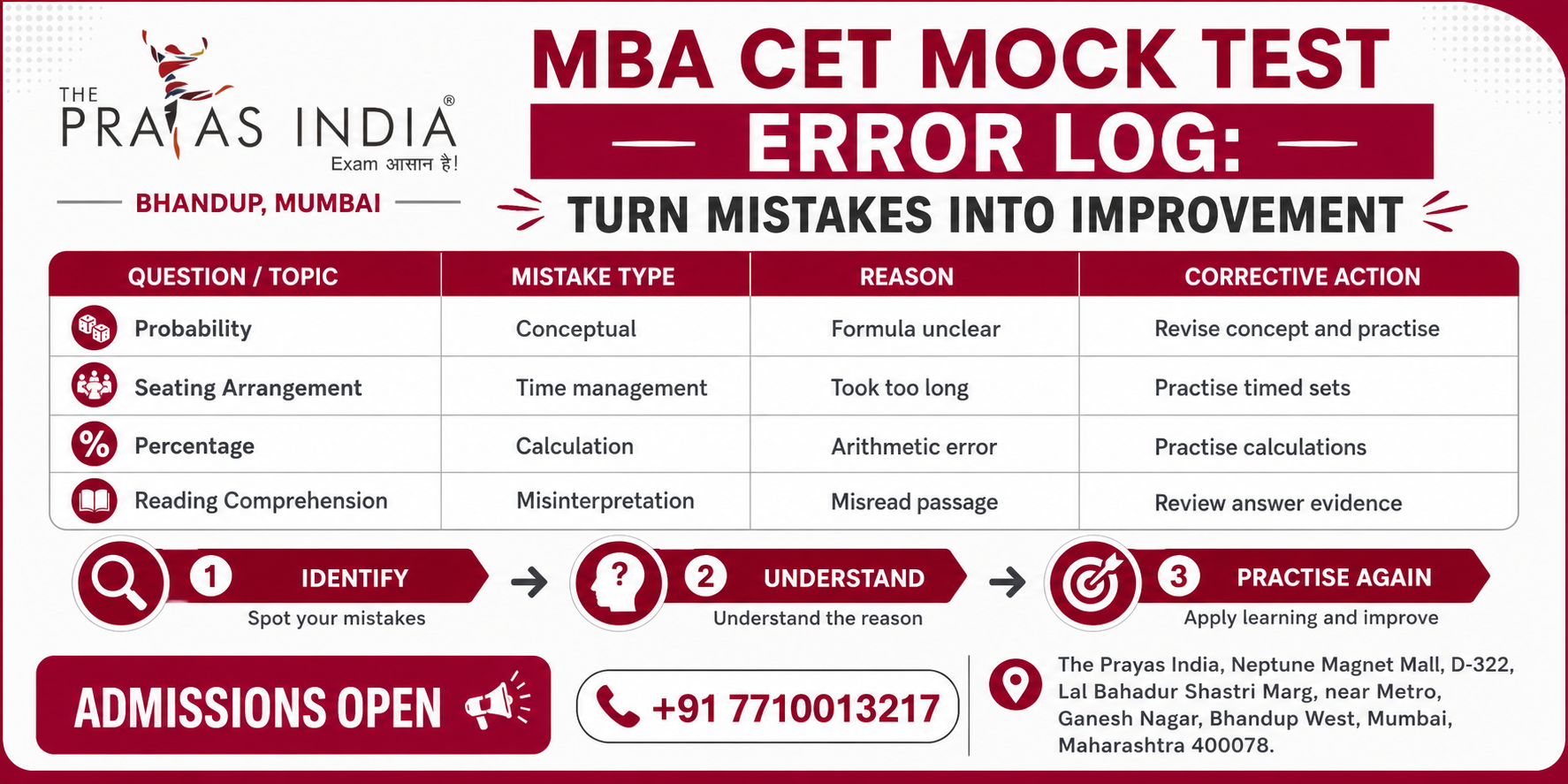
An error log is a simple record of your mistakes, their causes, and the actions you will take to avoid repeating them.
You can maintain it in a notebook, spreadsheet, or digital document.
| Question or topic | Mistake type | Reason | Corrective action |
|---|---|---|---|
| Probability | Conceptual | Formula not clear | Revise concept and solve 15 questions |
| Seating arrangement | Time management | Spent too long on one set | Practise timed sets |
| Percentage | Calculation | Arithmetic error | Practise calculations daily |
| Reading Comprehension | Misinterpretation | Misread the passage | Review evidence supporting each answer |
Update your error log after every mock test and revisit it during weekly revision.
Over time, it will reveal recurring weaknesses and help you prioritise the topics that need the most attention.
Follow a Step-by-Step Mock Test Analysis Routine
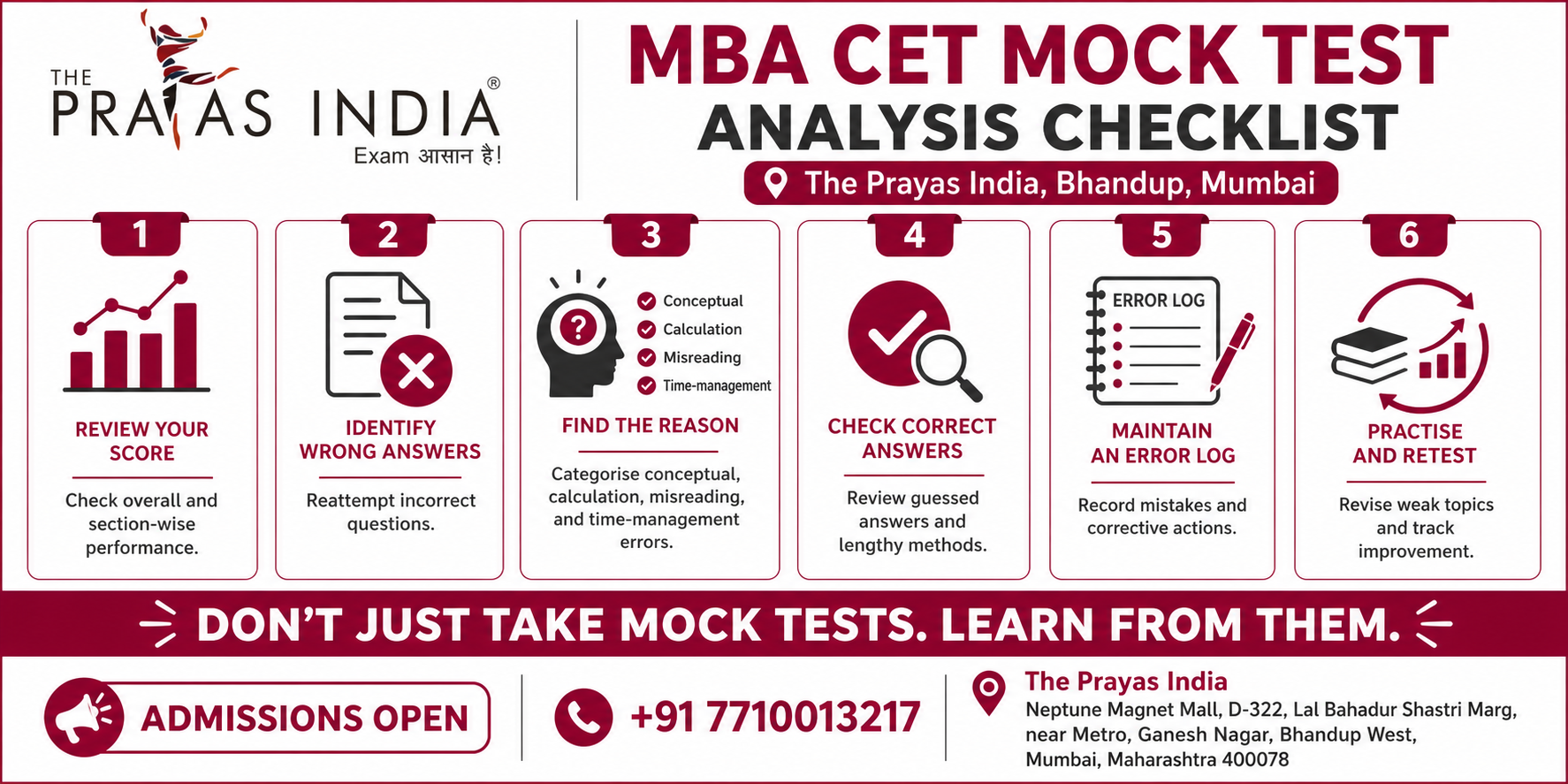
Use the following process after every MBA CET mock test.
Step 1: Review the score and section-wise results. Identify your strongest and weakest areas.
Step 2: Revisit incorrect questions. Attempt them again without immediately looking at the solution.
Step 3: Understand the correct method. Compare your approach with the explanation and identify where your reasoning went wrong.
Step 4: Classify each mistake. Record whether it was conceptual, calculation-related, time-related, or caused by misreading.
Step 5: Practise similar questions. Solve additional questions to confirm that you understand the concept.
Step 6: Update your error log. Record the mistake and the corrective action.
Step 7: Reattempt difficult questions later. Check whether you can solve them correctly without assistance.
The goal is not simply to understand the correct answer once. It is to develop the ability to solve similar questions independently in the future.
Create a Daily and Weekly Improvement Plan
Mock test analysis becomes effective when you turn your findings into a regular study routine.
Suggested daily routine
- 20 minutes: Revise concepts related to recent mistakes.
- 25 minutes: Practise questions from your weakest topic.
- 15 minutes: Review your error log and previously incorrect questions.
- 20 minutes: Solve timed questions from another section.
- 10 minutes: Review formulas, shortcuts, vocabulary, or key concepts.
This 90-minute routine can help you maintain consistent preparation alongside college or work. Adjust the timings according to your schedule and the topics you need to improve.
Suggested weekly routine
- Attempt a full-length mock test under exam-like conditions.
- Spend dedicated time analysing the results.
- Identify the three most important areas for improvement.
- Practise questions from those areas throughout the week.
- Reattempt selected questions from your error log.
- Compare your results with previous mock tests.
Avoid attempting full-length mocks so frequently that you have no time to review them. The right balance between testing, analysis, and targeted practice is essential.
Track Progress Across Multiple Mock Tests
One mock test provides a snapshot of your performance. Several tests help you understand whether your preparation strategy is working.
Track these indicators over time:
- Overall score and section-wise scores.
- Accuracy rate.
- Number of questions attempted.
- Time spent on difficult questions.
- Frequency of repeated mistakes.
- Performance in previously weak topics.
You can calculate accuracy using:
Accuracy (%) = (Correct Answers ÷ Total Questions Attempted) × 100
For example, if you attempt 100 questions and answer 80 correctly, your accuracy is 80%.
However, accuracy should not be considered in isolation. Also review your attempts, time management, and the exam’s marking scheme. A high accuracy rate with too few attempts may indicate that you need to improve speed, while many attempts with low accuracy may indicate that you need to make better question-selection decisions.
Focus on consistent improvement rather than expecting your score to increase after every single mock test.
Avoid Common Mock Test Analysis Mistakes
Students often lose the benefits of mock tests by making these avoidable mistakes:
- Checking only the score: Review the reasons behind your performance instead of focusing only on marks.
- Ignoring correct answers obtained through guessing: Strengthen your understanding of these questions.
- Repeating tests without revision: Address weaknesses before taking another test.
- Copying solutions without understanding them: Learn why a method works and practise it independently.
- Ignoring time-consuming questions: Develop a strategy for deciding when to move on.
- Comparing yourself constantly with others: Use your own previous performance to evaluate progress.
- Failing to revisit old mistakes: Review your error log regularly to prevent repeated errors.
A consistent improvement process is more useful than taking numerous mock tests without meaningful analysis.
How Structured Coaching Can Support Your MBA CET Preparation
Some students find it difficult to identify the reasons behind their mistakes or decide which topics to prioritise. Structured preparation can provide a clearer study plan, regular practice, mock tests, and guidance on improving accuracy and time management.
If you are looking for MAH MBA CET coaching in Bhandup West, Mumbai, The Prayas India can be an option to explore for exam preparation support.
You can learn more about the branch and available preparation options here:
The Prayas India – Bhandup Branch
Address: The Prayas India, Neptune Magnet Mall, D-322, Lal Bahadur Shastri Marg, near Metro, Ganesh Nagar, Bhandup West, Mumbai, Maharashtra 400078.
Website: https://theprayasindia.com/bhandup/
Google Maps: https://maps.app.goo.gl/7RGDwfaV3gzGyfbaA
Choose a preparation approach that helps you understand your mistakes, practise consistently, and monitor your progress.
Final Thoughts
Analysing MBA CET mock tests is an essential part of effective exam preparation. Your score tells you how you performed in a particular test, but your mistakes explain what you need to do next.
Review every incorrect answer, examine questions you solved inefficiently, maintain an error log, and practise your weak areas regularly. Track your progress across multiple tests and adjust your study plan according to the patterns you identify.
With consistent analysis and targeted practice, you can work towards better accuracy, improved speed, and more confident decision-making in the MAH MBA CET.
Make every mock test count: identify the mistake, understand the reason, practise the solution, and avoid repeating it.
Frequently Asked Questions About MBA CET Mock Test Analysis
1. How should I analyse my MAH MBA CET mock test?
Start by reviewing your overall score, accuracy, attempted questions, and section-wise performance. Revisit incorrect answers, identify why you made each mistake, and practise similar questions. Maintain an error log to track recurring weaknesses and monitor improvement across mock tests.
2. How much time should I spend analysing an MBA CET mock test?
Set aside sufficient time to review incorrect, guessed, and time-consuming questions. Depending on the length of the test and your performance, analysis may take as long as or longer than the test itself. Focus on understanding mistakes rather than rushing through the solutions.
3. Why is my MBA CET mock test score not improving?
Your score may remain stagnant if you repeat the same mistakes, neglect weak topics, or focus only on taking tests without analysing them. Review your error patterns, revise concepts, practise targeted questions, and track your performance over multiple tests.
4. Should I analyse correct answers in a mock test?
Yes. Review correct answers that involved guessing, lengthy calculations, or excessive time. Understanding why your method worked and whether a more efficient approach is available can help improve your accuracy and speed.
5. What is an MBA CET mock test error log?
An error log records questions you answered incorrectly or inefficiently, the reason for each mistake, the correct approach, and the action needed to improve. Reviewing it regularly helps you identify recurring problems and plan targeted revision.
6. How many mock tests should I attempt for MAH MBA CET?
The ideal number depends on your preparation level and available time. Focus on a manageable schedule that allows you to analyse each test, revise weak topics, and practise similar questions before moving to the next mock test.
7. How can I improve accuracy in MBA CET mock tests?
Strengthen your fundamentals, read questions carefully, practise timed exercises, and review calculation and interpretation errors. Use your error log to identify recurring mistakes and follow the marking scheme when deciding which questions to attempt.
8. Where can I find MBA CET coaching in Bhandup West, Mumbai?
Students exploring MAH MBA CET preparation support can visit The Prayas India, Neptune Magnet Mall, D-322, Lal Bahadur Shastri Marg, near Metro, Ganesh Nagar, Bhandup West, Mumbai, Maharashtra 400078. Visit the official Bhandup branch website to learn more.
MAH MBA CET PREPARATION
Stop Repeating Mistakes. Start Improving Your MBA CET Performance!
Every mock test is an opportunity to improve your accuracy, speed, and exam strategy. Build a focused preparation routine, identify your weak areas, and work towards your MBA entrance exam goals with the right guidance.
ADMISSIONS OPEN
Explore MAH MBA CET preparation support at The Prayas India, Bhandup West, Mumbai.
Visit us:
The Prayas India, Neptune Magnet Mall, D-322, Lal Bahadur Shastri Marg, near Metro, Ganesh Nagar, Bhandup West, Mumbai, Maharashtra 400078.